|
시장보고서
상품코드
2117256
엔지니어링 소프트웨어 시장 : 시장 점유율 분석, 업계 동향 및 통계, 성장 예측(2026-2031년)Engineering Software - Market Share Analysis, Industry Trends & Statistics, Growth Forecasts (2026 - 2031) |
||||||
 Mordor Intelligence
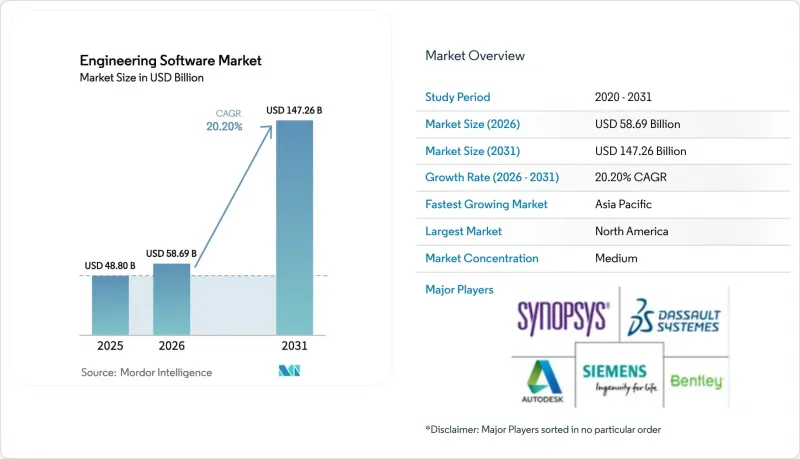
Mordor Intelligence에 의하면, 2026년 엔지니어링 소프트웨어 시장 규모는 587억 달러로 추정되고, 2025년 488억 달러에서 확대해, 2031년에는 1,473억 달러에 이를 것으로 예측됩니다.
2026-2031년 연평균 성장률(CAGR) 20.2%로 성장할 것으로 전망됩니다.
본 보고서는 유형별(컴퓨터 지원 설계(CAD) 소프트웨어, 컴퓨터 지원 엔지니어링(CAE) 소프트웨어, 컴퓨터 지원 제조(CAM) 소프트웨어 등), 배포 방식별(온프레미스, 클라우드, 하이브리드), 용도별(설계 자동화, 플랜트 및 공정 설계 등), 최종 사용자 산업별(자동차 및 운송, 항공우주 및 방위 등) 및 지역별로 분류되어 있습니다. 시장 예측은 금액(달러) 기준으로 제시되어 있습니다.
세계의 엔지니어링 소프트웨어 시장 동향 및 인사이트
클라우드 기반 도입이 표준 라이선싱 모델로 자리 잡고 있습니다.
지멘스의 클라우드 네이티브 제품인 ‘Designcenter’와 오토데스크의 ‘Token Flex’가 지속적인 업데이트와 세계 협업을 통해 설비 투자 예산을 상쇄할 수 있음을 보여주고 있어, 기업들은 서버에 대한 예산 배분에서 구독형 모델로의 예산 배분으로 전환하고 있습니다. 제조업체의 3분의 2는 이미 이러한 플랫폼에 대응할 수 있도록 직원의 역량 강화를 추진하고 있지만, 멀티테넌트 아키텍처는 지적 재산(IP) 보안에 대한 우려를 야기하고 있어, 기밀성이 높은 작업은 온프레미스에서 유지하면서 처리 부하의 급증분을 클라우드로 아웃소싱하는 하이브리드 모델이 촉진되고 있습니다. 제로 트러스트 암호화 및 소버린 클라우드 옵션을 제공하는 벤더는 엔지니어링 소프트웨어 시장에서 아직 주저하고 있는 부문을 확보하게 될 것입니다.
중소기업에서의 CAD 및 3D 모델링 보급 확대
저렴한 가격의 SaaS 요금제 덕분에 수백만 개에 달하는 중소기업이 엔지니어링 소프트웨어 시장에 진입할 수 있게 되었습니다. 케냐의 사례 연구에 따르면, 수작업으로 작성하던 도면을 디지털 파일로 대체함으로써 생산성이 비약적으로 향상된 것으로 나타났습니다. 그러나 OECD 데이터에 따르면, 자금 및 기술 격차가 여전히 도입의 장벽으로 작용하고 있는 것으로 확인되어, 로우코드 설계 마법사 및 내장형 교육의 필요성이 부각되고 있습니다. 벤더가 도입 지원, 템플릿, 파트너 생태계를 라이선스에 포함시킴으로써 가치 실현까지의 시간을 단축하고, 가격에 민감한 경제권에서 엔지니어링 소프트웨어 시장의 확장을 가속화할 수 있습니다.
고급 제품군에 따른 고액의 초기 라이선스 비용 및 교육 비용
ANSYS사의 엔터프라이즈급 시뮬레이션 번들의 연간 매출액은 28억 달러를 초과하며, 이는 ROI를 단계적으로만 얻을 수 있는 한 대부분의 중소기업이 감당하기 어려운 가격대임을 반영하고 있습니다. 제조업체의 65%가 새로운 도구를 다루기 위해 기술을 재습득하고 있기 때문에 교육이 장벽을 더욱 높이며 도입 예산을 부풀리고 있습니다. 구독 방식에서는 비용이 분산되지만, 총 소유 비용이 기존의 영구 라이선스를 초과하는 경우도 있어, 비용에 민감한 지역에서는 엔지니어링 소프트웨어 시장의 성장을 둔화시키고 있습니다.
부문 분석
2025년 엔지니어링 소프트웨어 시장 규모에서 CAD 도구 시장 규모는 181억 1,000만 달러에 달했고, 총 매출의 37.10%를 차지했습니다. 이는 CAD 도구가 업계의 기반이 되는 작업 환경으로서의 역할을 강조하는 것입니다. 지속적인 사용량 기반 업그레이드를 통해 이러한 툴은 건축, 기계, 산업 디자인 분야의 각 설계 팀에 확고히 자리 잡고 있습니다. 생성형 AI를 활용한 스케치 기능은 컨셉 형성을 가속화하지만, 하류 단계의 제조 가능성은 여전히 정밀한 파라메트릭 CAD에 의존하고 있어 워크플로우 내에서의 우위는 유지되고 있습니다.
컴퓨터 지원 엔지니어링(CAE) 솔루션은 물리 기반 시뮬레이션과 대리 모델을 융합하여 계산 시간을 대폭 단축하는 AI 기반 솔버를 바탕으로, 2031년까지 연평균 성장률(CAGR) 13.3%로 확대될 전망입니다. 다양한 분야의 최적화가 보다 광범위한 플랫폼에 통합됨에 따라, 엔지니어링 소프트웨어 시장 매출에서 CAE가 차지하는 비중은 CAD와의 격차를 좁힐 것으로 예측됩니다. CAM, PLM, EDA 제품군은 생산 단계로 이어지는 필수적인 연속성을 제공하지만, 많은 고객이 이미 기본 모듈 라이선스를 보유하고 있으며 프로그램 규모 확대에 맞추어 라이선스 수를 단계적으로 늘리고 있을 뿐이므로, 그 성장률은 주력인 CAD 및 CAE 카테고리에 뒤처지고 있습니다.
2025년 시점에서 온프레미스 도입은 여전히 엔지니어링 소프트웨어 시장 점유율의 54.30%를 차지했습니다. 이는 기밀성이 높은 지적 재산을 보호하는 방위, 중장비, 항공우주 기업의 확고한 인프라에 의해 뒷받침되고 있습니다. 또한, 로컬 컴퓨팅 클러스터는 대역폭이 제한된 환경에서 처리 능력이 따라가지 못하는 고밀도 다중 물리 현상을 다루는 시뮬레이션에서도 확실한 성능을 보장합니다.
클라우드 도입은 구독형 과금, 즉각적인 확장성, 브라우저를 통한 접근이 중소기업 및 전 세계에 분산된 팀들로부터 지지를 받고 있어 연평균 성장률(CAGR) 18.8%로 확대되고 있습니다. 규정 준수가 완료된 소버린 클라우드와 기밀 컴퓨팅이 성숙해짐에 따라, 클라우드 라이선스를 통한 엔지니어링 소프트웨어 시장 규모는 2031년까지 924억 달러를 넘어설 것으로 예측됩니다. 하이브리드 아키텍처가 표준으로 자리 잡고 있습니다. 설계 데이터는 온프레미스에 보관되고, 버스트 용량은 암호화된 클라우드 노드로 라우팅됨으로써 탄력성을 저해하지 않으면서 IT 정책을 충족합니다. 환경 간 투명한 라이선스 로밍을 제공하는 벤더는 고객 이탈 위험을 줄이고, 더 긴 수명 주기 가치를 확보할 수 있을 것입니다.
지역별 분석
북미는 2025년 엔지니어링 소프트웨어 시장 매출의 32.10%를 차지했습니다. 이는 제품 수명 주기 및 전체 공장 운영에 디지털 트윈을 통합하는 항공우주 및 자동차 업계의 선구자들에 의해 뒷받침되고 있습니다. AI 지원 의료기기에 대한 해당 지역의 정책 주도력은 의료기기 OEM 제조업체로부터 파급 수요를 창출하고 있는 반면, 캐나다의 청정 전력 로드맵은 재생에너지용 설계 제품군에 대한 수요를 촉진하고 있습니다. 벤처 투자는 계속해서 AI 네이티브 스타트업에 자금을 지원하며 경쟁을 심화시키고 있습니다.
아시아태평양(APAC)은 연평균 성장률(CAGR) 14.8%로 가장 빠른 성장세를 기록하고 있으며, 2024년 첫 9개월 동안 중국의 소프트웨어 매출액은 98조 2,810억 위안을 돌파했습니다. 현지 유력 기업들은 유럽 및 미국의 대기업들과의 기술 격차를 해소하기 위해 연구개발(R&D)예산을 증액하고 있습니다. 인도에서는 엔지니어 부족이 AI 지원 도구에 대한 수요를 자극하고 있는 반면, 일본과 한국은 첨단 노드 반도체를 위한 EDA 혁신을 주도하고 있습니다. 동남아시아 각국 정적층 제조업 이전을 유치하는 가운데, 이 지역의 중소기업들은 클라우드 구독 서비스를 도입하고 있어 엔지니어링 소프트웨어 시장의 기반이 확대되고 있습니다. 유럽에서는 엄격한 지속가능성 법규가 유지되고 있어, 모든 OEM 제조업체는 제품 출시 전에 내장형 LCA(생명주기평가)를 실시해야 하며, 이에 따른 규정 준수 비용이 소프트웨어 지출로 전환되고 있습니다. 북유럽 국가들에서 건축 수명 주기 데이터의 조화를 통해 BIM 도입이 가속화되고 있으며, 독일의 산업계 수출 기업들은 원격 서비스 최적화를 위해 디지털 트윈을 통합하고 있습니다. 데이터 주권에 관한 규제가 클라우드 도입에 대한 신중한 태도를 형성하고 있으며, 벤더들은 지적 재산을 보호하기 위해 EU 지역 내 멀티테넌트형 인스턴스 도입으로 방향을 전환하고 있습니다.
기타 혜택 :
- 엑셀 형식 시장 예측(ME) 시트
- 3개월간의 애널리스트 지원
자주 묻는 질문
목차
제1장 서론
제2장 조사 방법
제3장 개요
제4장 시장 구도
제5장 시장 규모 및 성장 예측
제6장 경쟁 구도
제7장 시장 기회 및 향후 전망
AJY 26.09.01According to Mordor Intelligence, engineering software market size in 2026 is estimated at USD 58.7 billion, growing from 2025 value of USD 48.8 billion with 2031 projections showing USD 147.3 billion, growing at 20.2% CAGR over 2026-2031.
This report is Segmented by Type (Computer-Aided Design Software, Computer-Aided Engineering Software, Computer-Aided Manufacturing Software, and More), Deployment (On-Premise, Cloud, Hybrid), Application (Design Automation, Plant and Process Design, and More), End-User Industry (Automotive and Transportation, Aerospace and Defence and More), and Geography. The Market Forecasts are Provided in Terms of Value (USD).
Global Engineering Software Market Trends and Insights
Cloud-based deployment becomes default licensing model
Enterprises are shifting budget from servers to subscriptions as Siemens' cloud-native Designcenter and Autodesk's Token Flex show how continuous updates and global collaboration offset capital budgets. Two-thirds of manufacturers are already reskilling staff for these platforms, yet multi-tenant architectures raise IP-security questions, spurring hybrid models that keep sensitive work on-premise while outsourcing compute spikes to the cloud. Vendors that deliver zero-trust encryption and sovereign-cloud options will capture the hesitant segments of the engineering software market.
Growing adoption of CAD and 3-D modelling across SMEs
Affordable SaaS tiers are opening the engineering software market to millions of small firms: Kenyan case studies show productivity jumps once manual drafting is replaced with digital files. Yet OECD data confirm that financial and skills gaps still obstruct uptake, highlighting a need for low-code design wizards and built-in training. Where vendors wrap onboarding, templates, and partner ecosystems into the license, they compress time-to-value and expand the engineering software market faster in price-sensitive economies.
High upfront licence and training costs for advanced suites
Enterprise-class simulation bundles from ANSYS push beyond USD 2.8 billion in annual sales, reflecting price points that few SMEs can absorb without staggered ROI. Training magnifies the hurdle because 65% of manufacturers are reskilling for new tools, inflating onboarding budgets. Although subscriptions spread expense, all-in ownership sometimes outstrips legacy perpetual licences, slowing the engineering software market in cost-sensitive regions.
Other drivers and restraints analyzed in the detailed report include:
- Simulation-driven digital-twin engineering workflows
- Subscription-SaaS price model expands addressable base
- Global shortage of specialised CAE/CAD talent
For complete list of drivers and restraints, kindly check the Table Of Contents.
Segment Analysis
The engineering software market size reached USD 18.11 billion for CAD tools in 2025, equal to 37.10% of total revenue, underscoring their role as the industry's baseline workspace. Continuous usage-based upgrades keep these tools sticky across architecture, mechanical, and industrial design teams. Generative-AI sketching accelerates concept formation, yet downstream manufacturability remains contingent on precise parametric CAD, preserving its primacy in workflows.
Computer-Aided Engineering solutions are scaling at 13.3% CAGR to 2031 on the back of AI-powered solvers that slash compute time by blending physics-based simulation with surrogate models. As multidisciplinary optimisation embeds inside broader platforms, CAE's share of the engineering software market revenue is projected to close the gap with CAD. CAM, PLM, and EDA suites provide essential continuity into production, yet their growth rates trail the flagship CAD and CAE categories because many customers already license basic modules and add incremental seats only as programmes scale.
On-premise installations still hold 54.30% engineering software market share as of 2025, supported by entrenched infrastructure in defence, heavy machinery, and aerospace firms guarding classified IP. Local compute clusters also ensure deterministic performance for dense, multi-physics simulations that can swamp bandwidth-limited locations.
Cloud deployments are expanding at 18.8% CAGR because subscription billing, instant scaling, and browser access appeal to SMEs and globally distributed teams. The engineering software market size for cloud seats is forecast to surpass USD 92.4 billion by 2031 as compliance-ready sovereign clouds and confidential computing mature. Hybrid architecture is becoming the default: design vaults reside on-premise while burst capacity routes to encrypted cloud nodes, satisfying IT policy without forfeiting elasticity. Vendors that provide transparent license roaming between environments will temper churn risk and capture longer lifetime value.
Complete Report Scope:
- By Type
- Computer-Aided Design (CAD) Software
- Computer-Aided Engineering (CAE) Software
- Computer-Aided Manufacturing (CAM) Software
- Architecture, Engineering and Construction (AEC/BIM) Software
- Electronic Design Automation (EDA) Software
- Product Lifecycle Management (PLM) Software
- Geotechnical/Infrastructure Engineering Software
- By Deployment
- On-premise
- Cloud
- Hybrid
- By Application
- Design Automation
- Plant and Process Design
- Product Design, Testing and Digital Twin
- Drafting and 3-D Modelling
- Other Specialised Applications
- By End-user Industry
- Automotive and Transportation
- Aerospace and Defence
- Industrial Machinery and Heavy Equipment
- Construction and Infrastructure
- Electronics and Semiconductor
- Energy and Utilities
- Healthcare and Medical Devices
- Others
- By Geography
- North America
- United States
- Canada
- Mexico
- South America
- Brazil
- Argentina
- Rest of South America
- Europe
- Germany
- United Kingdom
- France
- Italy
- Spain
- Russia
- Rest of Europe
- Asia-Pacific
- China
- Japan
- India
- South Korea
- South-East Asia
- Rest of Asia-Pacific
- Middle East and Africa
- Middle East
- Saudi Arabia
- United Arab Emirates
- Turkey
- Rest of Middle East
- Africa
- South Africa
- Nigeria
- Rest of Africa
- Middle East
- North America
Geography Analysis
North America generated 32.10% of the engineering software market revenue in 2025, buoyed by aerospace and automotive pioneers that embed twins across the product lifecycle and factory operations. The region's policy leadership in AI-enabled medical devices creates spill-over demand from healthcare OEMs, while Canada's clean-electricity roadmap triggers demand for renewable-energy design suites. Venture investment continues to seed AI-native startups, intensifying competition.
APAC records the fastest cadence at 14.8% CAGR, with China's software revenue topping 98,281 billion yuan in the first nine months of 2024 and local champions increasing R&D budgets to close feature gaps with Western majors. India's engineer shortfall stimulates demand for AI-assisted tools, while Japan and South Korea drive EDA innovation for advanced node semiconductors. As Southeast Asian governments court manufacturing shifts, SMEs there adopt cloud subscriptions, widening the engineering software market footprint. Europe maintains stringent sustainability laws that oblige every OEM to run embedded LCA before product release, converting compliance cost into software spend. Nordic harmonisation of building-lifecycle data amps BIM uptake, and German industrial exporters integrate digital twins for remote service optimisation. Data-sovereignty rules shape cautious cloud adoption, nudging vendors toward multi-tenant instances within EU borders to safeguard IP.
- Autodesk Inc.
- Dassault Systemes SE
- Siemens Digital Industries Software
- Bentley Systems Inc.
- PTC Inc.
- ANSYS Inc.
- Synopsys Inc.
- Hexagon AB (Intergraph)
- Trimble Inc.
- AVEVA Group
- IBM Corporation
- SAP SE
- HCLTech
- Altair Engineering Inc.
- Oracle Corporation
- Rockwell Automation Inc.
- Geometric Ltd.
- Tech Soft 3D
- Aspen Tech
Additional Benefits:
- The market estimate (ME) sheet in Excel format
- 3 months of analyst support
TABLE OF CONTENTS
1 INTRODUCTION
- 1.1 Study Assumptions and Market Definition
- 1.2 Scope of the Study
2 RESEARCH METHODOLOGY
3 EXECUTIVE SUMMARY
4 MARKET LANDSCAPE
- 4.1 Market Overview
- 4.2 Market Drivers
- 4.2.1 Cloud-based deployment becomes default licensing model
- 4.2.2 Growing adoption of CAD and 3D modelling across SMEs
- 4.2.3 Simulation-driven digital-twin engineering workflows
- 4.2.4 Subscription-SaaS price model expands addressable base
- 4.2.5 Generative-AI assisted design automation unlocks productivity
- 4.2.6 Mandatory sustainability LCA modules in EU and Asia-Pacific design codes
- 4.3 Market Restraints
- 4.3.1 High upfront licence and training costs for advanced suites
- 4.3.2 Global shortage of specialised CAE/CAD talent
- 4.3.3 IP-security concerns on multi-tenant cloud platforms
- 4.3.4 Format / data-model interoperability gaps across AI-native tools
- 4.4 Regulatory Landscape
- 4.5 Technological Outlook
- 4.6 Porter's Five Forces Analysis
- 4.6.1 Bargaining Power of Suppliers
- 4.6.2 Bargaining Power of Buyers
- 4.6.3 Threat of New Entrants
- 4.6.4 Threat of Substitutes
- 4.6.5 Intensity of Competitive Rivalry
5 MARKET SIZE AND GROWTH FORECASTS (VALUE)
- 5.1 By Type
- 5.1.1 Computer-Aided Design (CAD) Software
- 5.1.2 Computer-Aided Engineering (CAE) Software
- 5.1.3 Computer-Aided Manufacturing (CAM) Software
- 5.1.4 Architecture, Engineering and Construction (AEC/BIM) Software
- 5.1.5 Electronic Design Automation (EDA) Software
- 5.1.6 Product Lifecycle Management (PLM) Software
- 5.1.7 Geotechnical/Infrastructure Engineering Software
- 5.2 By Deployment
- 5.2.1 On-premise
- 5.2.2 Cloud
- 5.2.3 Hybrid
- 5.3 By Application
- 5.3.1 Design Automation
- 5.3.2 Plant and Process Design
- 5.3.3 Product Design, Testing and Digital Twin
- 5.3.4 Drafting and 3-D Modelling
- 5.3.5 Other Specialised Applications
- 5.4 By End-user Industry
- 5.4.1 Automotive and Transportation
- 5.4.2 Aerospace and Defence
- 5.4.3 Industrial Machinery and Heavy Equipment
- 5.4.4 Construction and Infrastructure
- 5.4.5 Electronics and Semiconductor
- 5.4.6 Energy and Utilities
- 5.4.7 Healthcare and Medical Devices
- 5.4.8 Others
- 5.5 By Geography
- 5.5.1 North America
- 5.5.1.1 United States
- 5.5.1.2 Canada
- 5.5.1.3 Mexico
- 5.5.2 South America
- 5.5.2.1 Brazil
- 5.5.2.2 Argentina
- 5.5.2.3 Rest of South America
- 5.5.3 Europe
- 5.5.3.1 Germany
- 5.5.3.2 United Kingdom
- 5.5.3.3 France
- 5.5.3.4 Italy
- 5.5.3.5 Spain
- 5.5.3.6 Russia
- 5.5.3.7 Rest of Europe
- 5.5.4 Asia-Pacific
- 5.5.4.1 China
- 5.5.4.2 Japan
- 5.5.4.3 India
- 5.5.4.4 South Korea
- 5.5.4.5 South-East Asia
- 5.5.4.6 Rest of Asia-Pacific
- 5.5.5 Middle East and Africa
- 5.5.5.1 Middle East
- 5.5.5.1.1 Saudi Arabia
- 5.5.5.1.2 United Arab Emirates
- 5.5.5.1.3 Turkey
- 5.5.5.1.4 Rest of Middle East
- 5.5.5.2 Africa
- 5.5.5.2.1 South Africa
- 5.5.5.2.2 Nigeria
- 5.5.5.2.3 Rest of Africa
- 5.5.5.1 Middle East
- 5.5.1 North America
6 COMPETITIVE LANDSCAPE
- 6.1 Market Concentration Analysis
- 6.2 Strategic Moves (MandA, Funding, Partnerships)
- 6.3 Market Share Analysis
- 6.4 Company Profiles (includes Global level Overview, Market level overview, Core Segments, Financials as available, Strategic Information, Market Rank/Share, Products and Services, Recent Developments)
- 6.4.1 Autodesk Inc.
- 6.4.2 Dassault Systemes SE
- 6.4.3 Siemens Digital Industries Software
- 6.4.4 Bentley Systems Inc.
- 6.4.5 PTC Inc.
- 6.4.6 ANSYS Inc.
- 6.4.7 Synopsys Inc.
- 6.4.8 Hexagon AB (Intergraph)
- 6.4.9 Trimble Inc.
- 6.4.10 AVEVA Group
- 6.4.11 IBM Corporation
- 6.4.12 SAP SE
- 6.4.13 HCLTech
- 6.4.14 Altair Engineering Inc.
- 6.4.15 Oracle Corporation
- 6.4.16 Rockwell Automation Inc.
- 6.4.17 Geometric Ltd.
- 6.4.18 Tech Soft 3D
- 6.4.19 Aspen Tech
7 MARKET OPPORTUNITIES AND FUTURE OUTLOOK
- 7.1 White-space and Unmet-need Assessment