

|
시장보고서
상품코드
2117259
목질 섬유 단열재 시장 : 시장 점유율 분석, 업계 동향 및 통계, 성장 예측(2026-2031년)Wood Fiber Insulation - Market Share Analysis, Industry Trends & Statistics, Growth Forecasts (2026 - 2031) |
||||||
 Mordor Intelligence
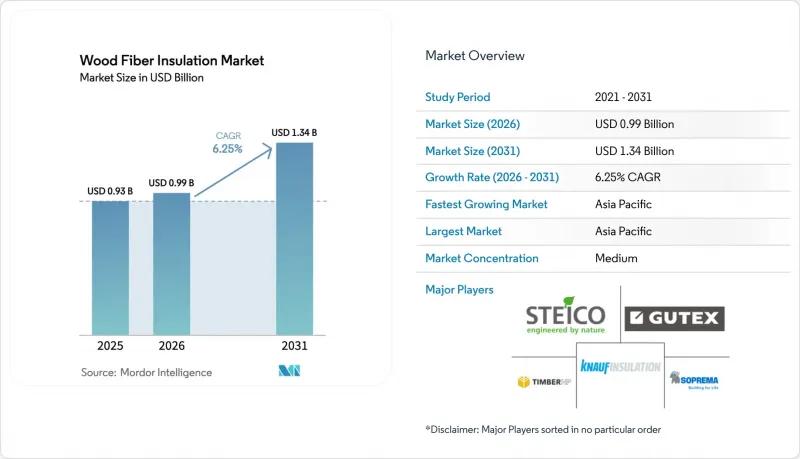
Mordor Intelligence에 의하면, 목질 섬유 단열재 시장 규모는 2025년에 9억 3,000만 달러로 평가되었고, 2026년에 9억 9,000만 달러로 추정되고, 2031년까지 13억 4,000만 달러에 이를 것으로 예측되며, 2026-2031년 CAGR 6.25%로 성장할 전망입니다.
본 보고서는 제품 형태별(경질 보드, 연질 배트 등), 용도별(단열, 방음, 전기·방화), 최종 사용자 산업별(주택, 상업, 공공시설, 산업, 인프라), 지역별(아시아태평양, 북미, 유럽, 남미, 중동 및 아프리카)로 분류되어 있습니다. 시장 전망은 금액(달러) 기준으로 제시되어 있습니다.
세계의 목질 섬유 단열재 시장 동향 및 인사이트
더 엄격해진 순제로 건축 에너지 기준
벽의 R값 및 탄소 예산 상한에 대한 의무적인 상향 조정으로 인해 바이오 단열재의 투자 회수 기간이 단축되고 있습니다. 캘리포니아주의 2025년판 ‘타이틀 24’ 개정으로 인해 벽의 R값이 15% 상향 조정되었으며, 기후 구역 3-16에서는 단층 유리섬유 사용이 금지되어 건축가들은 투습성 요건을 충족하는 연속적인 외장용 목질 섬유 보드를 채택하도록 유도되고 있습니다. 노르웨이의 2025년판 건축 기술 규정에서는 운영 및 제조 시 배출량의 합계를 연간 1제곱미터당 8kg의 CO2 환산량으로 제한하고, 허가 심사에 명확한 탄소 예산이 포함되었습니다. 아일랜드와 독일의 넷제로 기준 역시 마찬가지로, 적합성 평가 소프트웨어에 전체 수명 주기에 걸친 탄소 모듈을 통합하여 설계 초기 단계부터 목질 섬유에 포함된 생물 유래 탄소를 가시화하고 있습니다. 허가 담당자와 에너지 시뮬레이션 컨설턴트가 탄소 배출 상한선에 대해 의견을 조율함에 따라, 목질 섬유는 틈새 친환경 선택지에서 특히 온대 및 한대 기후의 건축 외피 분야에서 주류 규정 준수 수단으로 전환되고 있습니다. 캘리포니아주와 뉴욕주를 제외한 미국 각 주가 ASHRAE가 곧 발표할 CH-36 탄소 부록과 건축 기준을 조화시킨다면, 이러한 움직임의 영향력은 더욱 커질 것으로 예측됩니다.
주택 대상 대규모 개보수 프로그램의 급증
공적 자금은 사상 최고 수준에 도달하여, 단열과 기밀성을 단일 작업 공정으로 겸비한 벽체 충진재에 대한 잠재적 수요가 촉발되고 있습니다. 뉴욕주의 ‘EmPower+’ 에너지 절약 개조 의무 규정에서는 블로우도어 시험의 성능 기준을 1제곱피트당 0.25 cfm50으로 정하고 있지만, 고밀도 충전 목질 섬유는 포름알데히드계 결합제를 사용하지 않고도 이 기준을 충족합니다. 캐나다의 ‘Greener Homes Loan’은 2025년에 상한액을 40,000 캐나다 달러(2만 9,600 달러)로 인상했으나, 주택 소유자들이 히트 펌프와 다락방 단열재 교체를 병행한 결과, 신청 건수가 예측치를 40% 상회했습니다. 독일의 BEG 보조금은 현재 ‘Efficiency House 55’ 개보수 공사의 자재비 45%를 지원하고 있으며, 이 목표 달성에 있어 수증기 투과성이 있는 목질 섬유가 벽체 내부의 결로를 방지함으로써 기여하고 있습니다. 보조금 지급 요건에 따라 시공업체는 블로우도어 시험이나 열화상 촬영에 투자할 수밖에 없으며, 검증된 기밀 성능이 향후 목질 섬유 사양을 확고히 하는 선순환이 만들어지고 있습니다. 따라서 이러한 개보수 공사의 급증은 공사량 증가를 촉진하는 요인이자, 동시에 기술 개발을 가속화하는 원동력이기도 합니다.
미네랄 울 및 유리섬유와의 경쟁
미국 및 아시아태평양의 주택 시장에서는 내장된 탄소로 인한 비용 프리미엄이 아직 의무적인 사양에 반영되지 않았기 때문에 납품 비용은 일반적인 미네랄 울보다 10-20% 높은 상태를 유지하고 있습니다. 2025년 대형 유통 채널에서 유리섬유 및 배트의 소매 가격은 R값 1보드피트당 0.45달러였던 반면, 경질 목질 섬유 보드는 0.55달러였습니다. 미네랄 울은 불연성인 ASTM E136 분류에 따라 추가 코팅이 필요하지 않기 때문에 내화 구조재로서의 점유율을 유지하고 있습니다. 반면, 목질 섬유 보드는 동일한 내화 등급을 충족하기 위해 하이브리드 구조가 필요한 경우가 있습니다. 대규모 개보수 시 인건비의 시너지 효과로 인해 그 차이의 일부는 메워지고 있지만, 많은 관할 구역의 보조금 제도에서는 상환액에 상품 가격 수준 상한선이 설정되어 있어 주택 소유자는 그 차액을 자비로 부담할 수밖에 없습니다. 보조금 제도가 저탄소 자재를 직접 장려하게 될 때까지는 가격 측면의 과제가 예산에 제약이 있는 프로젝트에서의 보급률 상한선이 될 것입니다.
부문 분석
2025년 매출액 중 경질 보드가 57.57%를 차지했으며, 치수 안정성이 요구되는 레인스크린이나 연속 단열 구조와의 적합성이 두드러집니다. 조립식 공장에서는 구조용 하지재를 겸하는 보드가 중시되고 있으며, 이를 통해 SKU 수와 시공 공정이 절감되고 있습니다. 유연한 배트는 스터드 간격이 불규칙한 곳에서는 틈새 시장으로 남아 있지만, 해당 분야에서는 여전히 미네랄 울이 지배적이기 때문에 배트의 채택률은 낮은 수준을 유지하고 있습니다. 한편, 루즈필 및 덴스팩 제품은 연평균 성장률(CAGR) 6.97%로 성장하고 있습니다. 이는 리모델링 시공업체가 침하 위험 없이 불규칙한 공간에 재료를 분사할 수 있으며, 그 내구성의 우수성이 캐나다 현장 조사를 통해 확인되었기 때문입니다. 목질 섬유 표면재와 미네랄 울 또는 PIR 코어를 결합한 복합 패널은 가장 빠르게 진화하고 있는 제품군으로, 팽창성 스프레이를 사용하지 않고도 EN 13501-2의 내화 등급을 충족할 수 있습니다. 킹스팬과 구텍스가 2025년에 설립한 진공 패널 합작 사업이 성숙해짐에 따라, 패시브 하우스 개보수 공사에서 하이브리드 솔루션이 경질 보드 시장 점유율을 잠식해 나갈 것입니다. 다만, 건축 기준의 최소 요건을 충족하는 주택 건설 분야에서는 단일 소재 보드가 계속해서 주류를 이룰 전망입니다.
2세대 습식 생산 라인은 기존 시스템에 비해 제조 에너지를 18% 절감하고 가격 인하를 가능하게 함으로써 경질 보드 시장 입지를 강화하고 있습니다. 한편, 루스필(분사 충전재) 제조업체들은 부피 밀도를 12% 향상시키는 섬유 조정 밀에 투자하고 있으며, 이를 통해 운송 비용을 절감하고 분사 시 피복성을 균일화하고 있습니다. 따라서 제품 형태의 동향은 양극화되고 있습니다. 고성능 복합재 제품은 벽 두께가 중요한 요소가 되는 상업시설의 개보수를 타겟으로 하는 반면, 합리화된 경질 보드는 주택 시장의 핵심 판매량을 유지하고 있습니다. 두 채널 모두에서 디지털 모델링 도구에는 현재 목질 섬유의 완충 성능이라는 장점을 강조하는 습열 모듈이 통합되어 있어, 건축가가 기본 설계 초기 단계에서 투습성 층을 지정하도록 유도하고 있습니다.
지역별 분석
아시아태평양은 2025년 전 세계 목질 섬유 단열재 시장에서 51.19%라는 최대 매출 점유율을 유지했으며, 2026-2031년 연평균 성장률(CAGR) 6.19%를 기록하며 가장 빠르게 성장하는 지역이 될 것으로 추정됩니다. 이 지역에서 목질 섬유 단열재의 채택은 시공자 교육이 불충분하거나 운송 비용 부담과 같은 요인으로 인해 많은 시장에서 아직 발전 단계에 머물러 있습니다. 일본의 2025년 건축기준법에서는 2,000 m2를 초과하는 공공 건축물의 내재 탄소량에 상한선이 설정되어 있으며, 세키스이 하우스는 모듈식 철골 프레임에 유럽산 보드를 채택하는 시험을 진행하고 있습니다. 호주의 ‘2025년 국가건축기준법’에서는 고산 지대의 단열 성능(R값) 기준이 상향 조정되어, 태즈메이니아주나 해발 고도가 높은 뉴사우스웨일스주에서 틈새 수요가 발생하고 있습니다. 보드피트당 0.10-0.12달러의 운송비가 추가되기 때문에 해당 지역에 공장이 설립되기 전까지는 목질 섬유 단열재가 고급 친환경 건축 프로젝트로 한정될 전망입니다.
2025년에는 독일, 프랑스, 영국을 주축으로 유럽이 지역별 점유율에서 큰 비중을 차지했습니다. 2026년에 시행될 영국의 ‘퓨처 홈스 스탠다드(Future Homes Standard)’에서는 운영 시 이산화탄소 배출량을 75% 감축할 것을 요구하고 있으며, 패시브 하우스(Passive House) 설계를 하는 건축가들은 열교를 제거하기 위해 연속적인 목질 섬유 층을 채택하고 있습니다. 유럽에서는 알프스 지역과 북유럽의 신축 주택 보급률이 40%에 육박하고 있으며, 신축 시장의 성장 여지가 축소되는 상황에서도 리모델링 프로그램이 완만한 성장을 뒷받침하고 있습니다.
북미에서는 캘리포니아주, 오리건주, 워싱턴주가 에너지 기준 준수 요건에 ‘매장 탄소’ 산정표를 포함시키고 있는 반면, 뉴욕주는 히트 펌프와 연속 외단열을 결합한 대규모 에너지 절약 개보수에 자금을 지원하고 있습니다. 캐나다의 ‘Greener Homes’ 대출 한도가 40,000캐나다 달러(2만 9,600달러)로 인상됨에 따라 각 주에서 일괄 구매 프로그램이 시작되었고, 목질 섬유 보드 가격이 12-15% 인하되었습니다. 멕시코의 NOM-020-ENER 개정으로 목질 섬유가 충족해야 할 외피 요건이 설정됨에 따라, 몬테레이와 과달라하라의 고급 프로젝트에서 조기 도입 사례가 잇따르고 있습니다.
남미, 중동 및 아프리카에서는 아직 뒤처져 있지만, 두바이의 ‘알 사파트(Al Sa'fat)’ 평가 제도에서는 저탄소 크레딧이 부여되기 때문에 고급 호텔 프로젝트에서 목질 섬유 단열재의 채택이 확대되고 있습니다.
기타 혜택 :
- 엑셀 형식 시장 예측(ME) 시트
- 3개월간의 애널리스트 지원
자주 묻는 질문
목차
제1장 서론
제2장 조사 방법
제3장 개요
제4장 시장 구도
제5장 시장 규모 및 성장 예측
제6장 경쟁 구도
제7장 시장 기회 및 향후 전망
AJY 26.09.01According to Mordor Intelligence, the wood fiber insulation market size is projected to be USD 0.93 billion in 2025, USD 0.99 billion in 2026, and reach USD 1.34 billion by 2031, growing at a CAGR of 6.25% from 2026 to 2031.
This report is Segmented by Product Form (Rigid Boards, Flexible Batts, and More), Application (Thermal, Acoustic, and Electrical/Fire-Protection), End-User Industry (Residential, Commercial, Institutional, Industrial and Infrastructure), and Geography (Asia-Pacific, North America, Europe, South America, Middle East and Africa). Market Forecasts are Provided in Terms of Value (USD).
Global Wood Fiber Insulation Market Trends and Insights
Stricter Net-Zero Building Energy Codes
Mandatory upgrades to wall R-values and carbon-budget ceilings are compressing payback periods for bio-based insulation. California's 2025 Title 24 amendments raised wall R-values by 15%, disqualifying single-layer fiberglass in climate zones 3-16 and steering architects toward continuous exterior wood fiber boards that satisfy vapor-open requirements. Norway's 2025 Technical Building Regulation capped operational plus embodied emissions at 8 kg CO2-equivalent per m2 annually, adding explicit carbon budgets to permit reviews. Irish and German net-zero standards likewise embed whole-life-carbon modules in compliance software, making the biogenic carbon of wood fiber visible at early design stages. As permit officers and energy-modeling consultants align on carbon ceilings, wood fiber moves from niche eco-choice to mainstream compliance route, especially in temperate and cold-climate envelopes. The driver's influence is expected to intensify once U.S. states beyond California and New York harmonize codes with ASHRAE's forthcoming CH-36 carbon appendix.
Surge in Residential Deep-Retrofit Programs
Public funding has reached record levels, unlocking latent demand for cavity-infilling materials that combine insulation and air-sealing in a single work step. New York's EmPower+ weatherization mandate pegs blower-door performance at 0.25 cfm50 per ft2, a threshold dense-pack wood fiber satisfies without formaldehyde-based binders. Canada's Greener Homes Loan lifted its ceiling to CAD 40,000 (USD 29,600) in 2025, and application volume exceeded forecasts by 40% after homeowners paired heat pumps with attic re-insulation. Germany's BEG grant now covers 45% of material costs for Efficiency House 55 retrofits, a target that vapor-open wood fiber helps achieve by preventing interstitial condensation. Funding milestones have forced contractors to invest in blower-door testing and thermal imaging, creating a feedback loop where verified air-sealing performance cements future wood fiber specifications. The retrofit surge is therefore both a volume catalyst and a skills-development accelerator.
Price Competition vs. Mineral Wool and Fiberglass
Delivered cost remains 10-20% higher than commodity mineral wool in U.S. and APAC housing markets where embodied-carbon premiums have yet to translate into mandatory specifications. Fiberglass batts retailed at USD 0.45 per board-foot R-value in 2025 big-box channels, compared with USD 0.55 for rigid wood fiber boards. Mineral wool keeps share in fire-rated assemblies because its non-combustible ASTM E136 classification eliminates extra coatings, whereas wood fiber boards sometimes require hybrid constructs to meet the same rating. Although deep-retrofit labor synergies close part of the gap, rebate structures in many jurisdictions cap reimbursements at commodity pricing, leaving homeowners to self-fund the premium. Until subsidy frameworks reward low-carbon materials directly, price tension will cap penetration in budget-constrained projects.
Other drivers and restraints analyzed in the detailed report include:
- Embodied-Carbon Rules in Public Procurement
- Off-Site Modular Growth Driving Vapor-Open Materials
- Limited Installer Familiarity Outside Europe
For complete list of drivers and restraints, kindly check the Table Of Contents.
Segment Analysis
Rigid boards commanded 57.57% of 2025 revenue, underscoring their fit with rain-screen and continuous-insulation assemblies that require dimensional stability. Prefab plants value boards that double as structural sheathing, trimming SKUs, and installation steps. Flexible batts remain niche where stud cavities vary, but mineral wool still dominates that channel, keeping batt uptake modest. Loose-fill and dense-pack products, however, are growing at a 6.97% CAGR because retrofit contractors blow material into irregular bays without settling risk, a durability edge verified in Canadian field studies. Composite panels pairing wood fiber facings with mineral wool or PIR cores are the fastest-evolving line, allowing EN 13501-2 fire ratings without intumescent sprays. As Kingspan's 2025 vacuum-panel joint venture with Gutex matures, hybrid solutions will erode rigid-board share in passive-house retrofits, though single-material boards will stay dominant in code-minimum residential builds.
Second-generation wet-process lines reduce embodied energy by 18% versus legacy systems, enabling price cuts that buttress rigid-board market position. Meanwhile, loose-fill producers are investing in fiber-conditioning mills that raise bulk density by 12%, paring freight cost and smoothing blown coverage. The product-form landscape is therefore bifurcating: high-performance composite offerings target commercial retrofits where wall thickness is at a premium, while streamlined rigid boards defend core residential volume. Across both channels, digital modeling tools now include hygrothermal modules that highlight wood fiber's buffering advantage, nudging architects to specify vapor-open layers early in schematic design.
Complete Report Scope:
- By Product Form
- Rigid Boards
- Flexible Batts
- Loose-Fill / Dense-Pack
- Composite and Hybrid Panels
- By Application
- Thermal Insulation
- Acoustic Insulation
- Electrical / Fire-Protection Linings
- By End-User Industry
- Residential
- Commercial
- Institutional
- Industrial and Infrastructure
- By Geography
- Asia-Pacific
- China
- Japan
- India
- South Korea
- Australia and New Zealand
- Rest of Asia-Pacific
- North America
- United States
- Canada
- Mexico
- Europe
- Germany
- United Kingdom
- France
- Italy
- Rest of Europe
- South America
- Brazil
- Argentina
- Rest of South America
- Middle East and Africa
- Saudi Arabia
- United Arab Emirates
- South Africa
- Nigeria
- Rest of Middle-East and Africa
- Asia-Pacific
Geography Analysis
Asia-Pacific retained the largest revenue share at 51.19% of the global wood fiber insulation market in 2025, and is also estimated to be the fastest-growing region with a CAGR of 6.19% from 2026-2031. Wood fiber insulation adoption in the region is still developing in many markets due to sparse installer training and freight cost penalties. Japan's 2025 Building Standard Law now caps embodied carbon in public buildings above 2,000 m2, and Sekisui House is testing European-sourced boards in modular steel frames. Australia's National Construction Code 2025 tightened R-values in alpine zones, creating niche demand in Tasmania and high-altitude New South Wales. Freight costs add USD 0.10-0.12 per board-foot, limiting wood fiber to premium green-build projects until regional plants emerge.
Europe accounted for a significant regional share in 2025, underpinned by Germany, France, and the United Kingdom. The United Kingdom's Future Homes Standard, effective 2026, requires 75% operational-carbon reductions; passive-house architects wield continuous wood fiber layers to eliminate thermal bridges. Although Europe's penetration rate nears 40% in Alpine and Nordic new-builds, retrofit programs sustain modest growth even as new-construction upside narrows.
In North America, California, Oregon, and Washington integrate embodied-carbon tables into energy-code compliance, while New York funds deep-energy retrofits that pair heat pumps with continuous exterior insulation. Canada's Greener Homes loan boost to CAD 40,000 (USD 29,600) sparked provincial bulk-purchase programs that shaved 12-15% off wood fiber board pricing. Mexico's NOM-020-ENER update set envelope requirements that wood fiber fulfills, birthing an early-adopter cluster in Monterrey and Guadalajara luxury projects.
South America and the Middle East and Africa trail, though Dubai's Al Sa'fat rating system grants low-carbon credits that tilt high-end hospitality projects toward wood fiber.
- Beltermo
- BISCHOFF SCHAFER Holz GmbH
- DIEFFENBACHER GmbH
- EWI Pro Insulation Systems Ltd
- Gutex Holzfaserplattenwerk H. Henselmann GmbH + Co. KG
- ISOCELL GmbH & Co KG
- Kingspan Group
- Knauf Insulation
- Swiss Krono
- LIGNOTREND GmbH & Co. KG.
- Lime Green Products Ltd
- Schneider GmbH
- Soprema
- STEICO SE
- TimberHP
Additional Benefits:
- The market estimate (ME) sheet in Excel format
- 3 months of analyst support
TABLE OF CONTENTS
1 Introduction
- 1.1 Study Assumptions and Market Definition
- 1.2 Scope of the Study
2 Research Methodology
3 Executive Summary
4 Market Landscape
- 4.1 Market Overview
- 4.2 Market Drivers
- 4.2.1 Stricter net-zero building energy codes
- 4.2.2 Surge in residential deep-retrofit programs
- 4.2.3 Embodied-carbon rules in public procurement
- 4.2.4 Off-site modular growth driving vapor-open materials
- 4.2.5 Supply-chain localization for circular-economy compliance
- 4.3 Market Restraints
- 4.3.1 Price competition vs. mineral wool and fiberglass
- 4.3.2 Limited installer familiarity outside Europe
- 4.3.3 High logistics cost from low bulk density
- 4.4 Value Chain Analysis
- 4.5 Regulatory Landscape
- 4.6 Technological Outlook
- 4.7 Porter's Five Forces
- 4.7.1 Bargaining Power of Suppliers
- 4.7.2 Bargaining Power of Buyers
- 4.7.3 Threat of New Entrants
- 4.7.4 Threat of Substitutes
- 4.7.5 Degree of Competition
5 Market Size and Growth Forecasts (Value)
- 5.1 By Product Form
- 5.1.1 Rigid Boards
- 5.1.2 Flexible Batts
- 5.1.3 Loose-Fill / Dense-Pack
- 5.1.4 Composite and Hybrid Panels
- 5.2 By Application
- 5.2.1 Thermal Insulation
- 5.2.2 Acoustic Insulation
- 5.2.3 Electrical / Fire-Protection Linings
- 5.3 By End-User Industry
- 5.3.1 Residential
- 5.3.2 Commercial
- 5.3.3 Institutional
- 5.3.4 Industrial and Infrastructure
- 5.4 By Geography
- 5.4.1 Asia-Pacific
- 5.4.1.1 China
- 5.4.1.2 Japan
- 5.4.1.3 India
- 5.4.1.4 South Korea
- 5.4.1.5 Australia and New Zealand
- 5.4.1.6 Rest of Asia-Pacific
- 5.4.2 North America
- 5.4.2.1 United States
- 5.4.2.2 Canada
- 5.4.2.3 Mexico
- 5.4.3 Europe
- 5.4.3.1 Germany
- 5.4.3.2 United Kingdom
- 5.4.3.3 France
- 5.4.3.4 Italy
- 5.4.3.5 Rest of Europe
- 5.4.4 South America
- 5.4.4.1 Brazil
- 5.4.4.2 Argentina
- 5.4.4.3 Rest of South America
- 5.4.5 Middle East and Africa
- 5.4.5.1 Saudi Arabia
- 5.4.5.2 United Arab Emirates
- 5.4.5.3 South Africa
- 5.4.5.4 Nigeria
- 5.4.5.5 Rest of Middle-East and Africa
- 5.4.1 Asia-Pacific
6 Competitive Landscape
- 6.1 Market Concentration
- 6.2 Strategic Moves
- 6.3 Market Share(%)/Ranking Analysis
- 6.4 Company Profiles (includes Global level Overview, Market level overview, Core Segments, Financials as available, Strategic Information, Market Rank/Share, Products and Services, Recent Developments)
- 6.4.1 Beltermo
- 6.4.2 BISCHOFF SCHAFER Holz GmbH
- 6.4.3 DIEFFENBACHER GmbH
- 6.4.4 EWI Pro Insulation Systems Ltd
- 6.4.5 Gutex Holzfaserplattenwerk H. Henselmann GmbH + Co. KG
- 6.4.6 ISOCELL GmbH & Co KG
- 6.4.7 Kingspan Group
- 6.4.8 Knauf Insulation
- 6.4.9 Swiss Krono
- 6.4.10 LIGNOTREND GmbH & Co. KG.
- 6.4.11 Lime Green Products Ltd
- 6.4.12 Schneider GmbH
- 6.4.13 Soprema
- 6.4.14 STEICO SE
- 6.4.15 TimberHP
7 Market Opportunities and Future Outlook
- 7.1 White-space and Unmet-Need Assessment
- 7.2 Technological Advancements and Product Innovation


