|
시장보고서
상품코드
2117269
수산화마그네슘 시장 : 시장 점유율 분석, 업계 동향 및 통계, 성장 예측(2026-2031년)Magnesium Hydroxide - Market Share Analysis, Industry Trends & Statistics, Growth Forecasts (2026 - 2031) |
||||||
 Mordor Intelligence
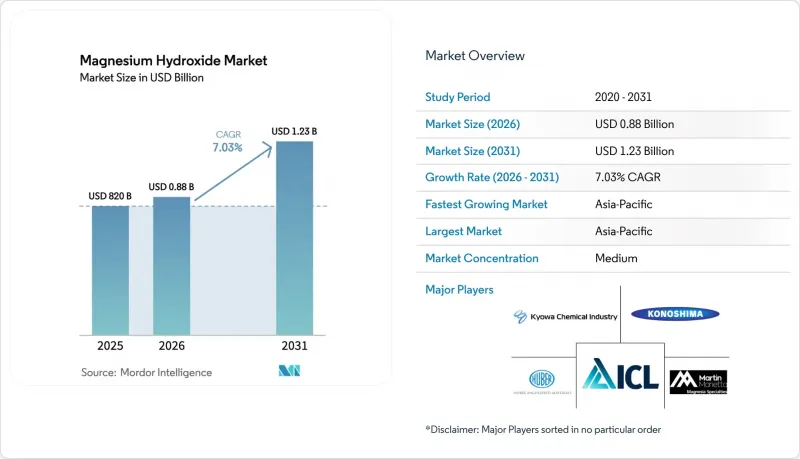
Mordor Intelligence에 의하면, 수산화마그네슘 시장 규모는 2025년 8억 2,000만 달러로 평가되었고, 2026년에는 8억 7,765만 달러로 추정되고, 2026-2031년 CAGR 7.03%로 성장을 지속할 전망이며, 2031년에는 12억 3,000만 달러에 이를 것으로 예측됩니다.
본 보고서는 형태별(슬러리, 분말, 현탁액·페이스트), 등급별(산업용 등급, 의약품 등급, 식품 등급), 제조 방법별(화학적 침전법, 해수·석회법, 기타), 용도별(산업, 의약품, 기타), 지역별(아시아태평양, 북미, 유럽, 기타)로 분류되어 있습니다. 시장 예측은 금액(달러) 기준으로 제시되어 있습니다.
세계의 수산화마그네슘 시장 동향 및 인사이트
할로겐계 난연제에서 전환
EU와 북미 각국 정부는 전자기기, 건축용 패널,전선 절연체에서 브롬계 및 염소계 난연제의 사용을 단계적으로 폐지하고 있으며, 이에 따라 전 세계의 폴리머 컴파운더들은 부식성이 있는 할로겐화 수소 대신 330°C에서 수증기와 MgO만을 방출하는 수산화마그네슘 마스터배치로 전환을 추진하고 있습니다. 또한, 이 컴파운드는 300°C 이상에서 삼수산화알루미늄보다 우수한 성능을 발휘하므로, 폴리카보네이트나 PBT에 적용하기에 적합합니다. 전 세계 OEM 업체들의 표준화가 진행됨에 따라, 특정 지역의 규제 변경이 공급망 전체로 파급되어 아시아태평양의 모든 생산 거점에서 수요가 두 배로 증가하고 있습니다. 화재 검사 데이터에 따르면, 첨가량을 30% 줄여도 ATH와 동등한 성능이 확인되었으며, 기계적 특성을 유지하면서 경량화도 도모할 수 있어 운송 기기나 가전제품의 외장재에 대한 채택이 촉진되고 있습니다.
배수 기준의 엄격화
배수 규제에서는 배수의 pH 값이나 중금속 부하량의 상한이 점점 더 엄격해지고 있지만, 수산화마그네슘 슬러리는 pH 10.5에서 완충 작용을 발휘하기 때문에 pH 14의 가성소다보다 안전하게 취급할 수 있으며, 동시에 생물반응조에 필수적인 마그네슘 영양소를 공급합니다. 미국의 지자체 소화조에서는 NaOH에서 수산화마그네슘으로 전환했을 때, 단가가 높아졌음에도 불구하고 투여량이 감소하고 슬러지의 탈수성이 향상되어 알칼리 사용량을 36% 절감할 수 있었습니다. 아시아에서 산업 공해 억제 움직임이 가속화되는 가운데, 식품, 섬유, 전자 산업의 집적지에서 첫 도입이 진행되고 있으며, 투여 준비가 완료된 슬러리 등급 제품에 대한 대량 주문이 즉각 발생하고 있습니다.
가성 마그네시아 원료의 가격 변동
중국은 전 세계 마그네사이트 공급량의 3분의 2 이상을 장악하고 있으며, 2021년 에너지 정책에 따른 가동 중단으로 수출 가격이 4배로 급등하여 하류 수산화마그네슘 공장의 이익률이 압박을 받았습니다. 품질 변동도 비용 증가 요인이 되고 있습니다. 철분 함량이 높은 MgO는 추가 정제가 필요하여 수율을 저하시키고 폐기물 처리 비용을 증가시킵니다. 서문암 광석이나 폐슬래그 회수를 통한 다각화는 장기적인 해결책이 될 수 있으나, 이러한 방식에는 막대한 설비 투자가 필요한 가마와 제조 허가가 필요하며, 이를 감당할 수 있는 중견 제조업체는 거의 없습니다. 그 결과, 수산화마그네슘 시장은 공급 측면의 주기적인 충격에 계속 노출된 상태입니다.
부문 분석
2025년에는 슬러리 제품이 수산화마그네슘 시장 점유율의 53.62%를 차지했습니다. 이는 산업 사용자들이 분진 발생이 없는 취급 방식과 노동 시간을 단축하며 흡입으로 인한 위험성을 줄여주는 자동 투여 시스템을 선호했기 때문입니다. 현탁액·페이스트 유형은 콘크리트 부식 방지용 라이닝 공사 및 틱소트로피성이 필요한 3D 프린팅 건축자재 수요에 힘입어 연평균 성장률(CAGR) 7.09%라는 견조한 성장세를 보일 것으로 예측됩니다. 의약품 및 영양 보조 식품의 배합에 필수적인 분말 등급은 여전히 그 중요성을 유지하고 있지만, 벌크 화학 플랜트에서 추가 설비 및 폭발 방지 대책이 비용 증가로 이어지기 때문에 성장 속도는 둔화되고 있습니다.
공정 엔지니어들은 슬러리의 완충된 pH와 적당한 이온 강도를 높이 평가하고 있으며, 이는 폭기조에서 이루어지는 하류 생물학적 처리를 보호합니다. 최근 유변학 분야의 획기적인 발전으로 킬레이트 분산제를 사용하여 고형분 함량을 60wt% 이상으로 유지할 수 있게 되어, 유효 단위당 운송비가 대폭 절감되었습니다. 이온 교환막 결정화 장치에 대한 연구에 따르면, 가마 소성 및 분쇄 공정을 생략하고 염수에서 직접 의약품 등급의 슬러리를 생산할 가능성이 시사되고 있습니다. 이러한 기술이 실용화되면 비용 곡선이 재구성되어, 2031년에 걸쳐 고순도 수산화마그네슘 제품 시장 규모가 재정의될 가능성이 있습니다.
2025년에는 난연제 배합, 배가스 탈황, 폐수 중화 분야에서 적정 순도의 제품이 계속해서 대량으로 구매됨에 따라, 산업용 등급이 수산화 마그네슘 시장 점유율의 65.48%를 차지했습니다. 가격에 민감한 플라스틱 산업에서는 비용과 난연 성능의 균형을 고려하여, 96-97%의 Mg(OH)₂ 함량을 가진 제품이 선택되고 있습니다. 의약품 등급은 취급량으로는 극히 일부에 불과하지만, 신장 치료용 결합제, 신규 완하제, EU에서 승인된 고용량 영양 보충제용 분말 덕분에 연평균 성장률(CAGR) 8.32%가 예상됩니다. 식품 등급 수요는 츄잉껌용 베이스 및 설탕 정제 분야에서 증가하고 있으나, 그 성장세는 의약품 등급에 미치지 못하는 상황입니다.
규제 당국은 비소를 2ppm 이하, 납을 0.5ppm 이하로 제한하는 등 중금속 규격 강화 조치를 추진하고 있으며, 이에 따라 새로운 정제 라인의 도입이 시급해지고 있습니다. 일부 중국 정제소에서는 미국 FDA 승인을 목적으로 하는 주사용 현탁액에 사용되는 비소를 ppm 이하로 억제하기 위해 새로운 이온 교환 컬럼을 도입하고 있습니다. 의약품용 수산화마그네슘 시장 규모는 작지만, 1톤당 4,500달러를 넘는 이익률을 자랑하며, 이는 산업용 벌크 가격의 4배에 해당합니다. 이 때문에 전용 물류 경로, 전용 건조기, GMP 인증 창고의 도입이 정당화되고 있습니다.
지역별 분석
아시아태평양은 2025년에 전 세계 매출의 46.72%를 차지한 것으로 평가되었으며, 중국, 인도, 동남아시아의 폴리머 컴파운딩, 전자기기 조립, 도시 하수 처리 능력 확대에 따라 2031년까지 연평균 성장률(CAGR) 8.56%로 성장을 가속화할 전망입니다. 국내산 마그네사이트 광석과 석탄 연소 가마는 비용 면에서 우위를 제공하지만, 베이징의 에너지 집약도 규제로 인해 간헐적인 공급 부족이 발생하고 있으며, 이에 따라 베트남과 호주는 뱀무늬암 및 염수 자원에 주목하고 있습니다. 인도 구자라트주의 제약 산업 클러스터에서는 치약 및 제산제 생산 라인이 확대되면서 의약품 등급 분말을 대량으로 소비하고 있습니다. 한편, 싱가포르의 석유화학 단지에서는 크래커 폐수 처리용 슬러리 계약이 확보되어 있습니다.
북미에서는 산업 부문과 의료 부문 전반에 걸쳐 균형 잡힌 수요 기반이 유지되고 있습니다. 연방 정부의 인프라 자금을 통한 인센티브를 받은 미국 지자체들은 혐기성 소화조에 수산화마그네슘 주입 설비를 추가 설치하고 있으며, 이를 통해 수년에 걸친 공급 계약이 촉진되고 있습니다. 캐나다의 광산 지역에서는 현장에 설치된 이동식 슬러리 플랜트를 이용하여 산성 암석 배수 대책을 시행하고 있으며, 시약 회수와 결합함으로써 트럭 왕래를 줄이고 있습니다. 인수 사례, 특히 Calix의 Inland Environmental Resources 인수는 응용 노하우와 독자적인 플래시 소성 기술(IP)을 융합하는 것을 목적으로 하고 있습니다.
유럽에서는 성숙한 난연제 규제가 현재 지중해 연안의 탄소 제거 및 해양 알칼리화 실증 실험으로 전환되고 있어, 꾸준하기는 하지만 성장 속도는 완만해지고 있습니다. 독일의 Tier 1 자동차 부품 공급업체는 보닛 아래의 PBT용으로 염화물 함량이 1,000ppm 이하인 분말을 지정하고 있어, 고순도 제품에 대한 수요가 지속되고 있습니다. 북유럽의 펄프 공장에서는 기존 석회 루프를 활용하는 바이오가스 탈황 용도로 수산화마그네슘에 대한 평가가 진행되고 있습니다. EU의 택소노미 규정에서는 순환형 원료가 우선시되고 있으며, 염수 유래 마그네슘은 새로운 보조금 대상으로 특히 주목받고 있습니다.
기타 혜택
- 엑셀 형식 시장 예측(ME) 시트
- 3개월간의 애널리스트 지원
자주 묻는 질문
목차
제1장 서론
제2장 조사 방법
제3장 개요
제4장 시장 구도
제5장 시장 규모 및 성장 예측
제6장 경쟁 구도
제7장 시장 기회 및 향후 전망
AJY 26.09.01According to Mordor Intelligence, the magnesium hydroxide market size is expected to grow from USD 820 million in 2025 to USD 877.65 million in 2026 and is forecast to reach USD 1.23 billion by 2031 at 7.03% CAGR over 2026-2031.
This report is Segmented by Form (Slurry, Powder, Suspension/Paste), Grade (Industrial Grade, Pharmaceutical Grade, Food Grade), Manufacturing Method (Chemical Precipitation, Seawater-Lime Process, and More), Application (Industrial, Pharmaceuticals, and More), and Geography (Asia-Pacific, North America, Europe, and More). The Market Forecasts are Provided in Terms of Value (USD).
Global Magnesium Hydroxide Market Trends and Insights
Shift Away from Halogenated Flame-Retardants
Governments in the EU and North America are phasing out brominated and chlorinated retardants in electronics, construction panels, and wire insulation, prompting polymer compounders worldwide to convert to magnesium hydroxide masterbatches that release only water vapor and MgO at 330 °C instead of corrosive hydrogen halides. The compound also outperforms aluminum trihydroxide above 300 °C, making it suitable for polycarbonate and PBT. Standardization by global OEMs means a regulatory change in one region now cascades through supply chains, multiplying demand across Asia-Pacific production hubs. Fire-test data confirm parity with ATH at loading levels 30 % lower, preserving mechanical properties and reducing weight, thus fueling adoption in transport and appliance casings.
Tightening Wastewater Discharge Norms
Wastewater codes increasingly cap effluent pH and heavy-metal loads, and magnesium hydroxide slurries buffer at pH 10.5, providing safer handling than caustic soda at pH 14 while supplying essential Mg nutrients to biological reactors. Municipal digesters in the United States cut alkali usage by 36% when switching from NaOH to magnesium hydroxide, even after higher unit prices, as dosage volumes fell and sludge dewatering improved. Asia's push to curb industrial pollution accelerates first-time deployments in food, textile, and electronics clusters, driving immediate volume orders for ready-to-dose slurry grades.
Price Volatility of Caustic Magnesia Feedstock
China controls more than two-thirds of global magnesite, and energy-policy-driven shutdowns in 2021 spiked export prices fourfold, compressing margins at downstream magnesium hydroxide plants. Quality swings add cost: high-iron MgO demands extra purification, lowering yield and raising waste disposal bills. Diversification into serpentine ores and waste-slag recovery offers long-run relief, yet these routes require CAPEX-heavy kilns and process licenses that few midsized producers can underwrite, leaving the magnesium hydroxide market exposed to periodic supply-side shocks.
Other drivers and restraints analyzed in the detailed report include:
- Growing Demand from Pharmaceutical Industry
- Increasing Demand from Industrial Manufacturing Industry
- Competition from Synthetic Aluminum Trihydroxide
For complete list of drivers and restraints, kindly check the Table Of Contents.
Segment Analysis
Slurry products delivered 53.62% of magnesium hydroxide market share in 2025 as industrial users favored dust-free handling and automated dosing systems that cut labor hours and reduce inhalation hazards. Suspension/paste variants are forecast to expand at a healthy 7.09% CAGR, propelled by concrete-corrosion lining jobs and 3D-printed building parts needing thixotropic rheology. Powder grades, indispensable in pharmaceuticals and nutraceutical blends, retain relevance but post slower growth because additional equipment and explosion-mitigation steps add cost in bulk chemical sites.
Process engineers appreciate slurry's buffered pH and moderate ionic strength, which safeguard downstream biology in aeration basins. Recent rheology breakthroughs use chelating dispersants to keep solids higher than 60 wt%, slicing freight bills per active unit. Research on ionic-exchange membrane crystallizers hints at generating pharmaceutical-grade slurries directly from brine, bypassing kiln calcination and milling. These inventions, if scaled, could reorder cost curves and redefine the magnesium hydroxide market size for higher-grade streams through 2031.
Industrial grades occupied 65.48% of magnesium hydroxide market share in 2025 as flame-retardant compounding, flue-gas desulfurization, and wastewater neutralization continued to buy bulk quantity at moderate purity. Price-sensitive plastics choose 96-97 % Mg(OH)2 assays, balancing cost and fire performance. Pharmaceutical grades, though only a fraction of tonnage, are set for an 8.32% CAGR owing to renal-care binders, novel laxatives, and high-dose nutraceutical powders now EU-approved. Food-grade demand grows in chewing-gum bases and sugar refining but trails pharma in momentum.
Regulators push for tighter heavy-metal specs-arsenic below 2 ppm and Pb below 0.5 ppm-forcing new purification trains. Some Chinese refineries deploy novel ion-exchange columns to hit sub-ppm boron for injectable suspensions bound for U.S. FDA filings. The magnesium hydroxide market size for pharma is small but commands margins topping USD 4,500 per ton, quadruple bulk industrial rates, justifying tailored logistic channels, dedicated dryers, and GMP-validated warehouses.
Complete Report Scope:
- By Form
- Slurry
- Powder
- Suspension/Paste
- By Grade
- Industrial Grade
- Pharmaceutical Grade
- Food Grade
- By Manufacturing Method
- Chemical Precipitation
- Seawater-Lime Process
- Brine Electrolysis By-product
- Other Methods
- By Application
- Industrial
- Pharmaceuticals
- Other Applications (Pulp and Paper, etc.)
- By Geography
- Asia-Pacific
- China
- India
- Japan
- South Korea
- Thailand
- Indonesia
- Vietnam
- Malaysia
- Philippines
- Rest of Asia-Pacific
- North America
- United States
- Canada
- Mexico
- Europe
- Germany
- United Kingdom
- France
- Italy
- Spain
- Russia
- NORDIC Countries
- Turkey
- Rest of Europe
- South America
- Brazil
- Argentina
- Colombia
- Rest of South America
- Middle East and Africa
- Saudi Arabia
- United Arab Emirates
- Qatar
- South Africa
- Nigeria
- Egypt
- Rest of Middle East and Africa
- Middle East and Africa
- Saudi Arabia
- Turkey
- South Africa
- Rest of Middle East and Africa
- Asia-Pacific
Geography Analysis
Asia-Pacific generated 46.72% of global revenue in 2025 and will accelerate at an 8.56% CAGR to 2031 as China, India, and Southeast Asia boost polymer compounding, electronics assembly, and municipal wastewater capacity. Domestic magnesite ore and coal-fired kilns confer cost advantage, yet Beijing's energy-intensity rules create intermittent supply gaps, prompting Vietnam and Australia to eye serpentine and brine assets. India's pharmaceuticals corridor in Gujarat scales tooth-paste and antacid lines, soaking up pharma-grade powders, while Singapore's petrochem complex secures slurry contracts for cracker wastewater.
North America retains a balanced demand base across industrial and healthcare sectors. U.S. municipalities, incentivized by federal infrastructure funds, retrofit anaerobic digesters with magnesium hydroxide dosing, spurring multi-year supply contracts. Canadian mining camps combat acid-rock drainage with onsite mobile slurry plants, pairing them with reagent recovery to shrink truck traffic. Acquisition deals, notably Calix's move for Inland Environmental Resources, aim to merge application know-how with proprietary flash-calcination IP.
Europe contributes steady but slower growth as mature flame-retardant mandates now transition into carbon-removal and ocean-alkalinization pilots along Mediterranean coasts. German Tier-1 auto suppliers specify less than 1,000 ppm chloride powder for under-hood PBT, sustaining high-purity demand. Nordic pulp mills evaluate magnesium hydroxide for biogas desulfurization, an application leveraging their existing lime loops. EU taxonomy rules prioritize circular inputs, making brine-derived magnesium particularly attractive for new subsidies.
- Elementis PLC
- Grecian Magnesite
- Huber Engineered Materials
- ICL
- Konoshima Chemical Co.,Ltd.
- Kyowa Chemical Industry Co., Ltd.
- Lehmann&Voss&Co.
- Magris Performance Materials
- Martin Marietta Magnesia Specialties
- Nedmag B.V.
- NikoMag
- Premier Magnesia, LLC
- RMCC LLC
- Tateho Chemical Industries Co.,Ltd.
- Ube Material Industries,Ltd.
- Yunmeng Zhineng Electronics Co., Ltd.
Additional Benefits:
- The market estimate (ME) sheet in Excel format
- 3 months of analyst support
TABLE OF CONTENTS
1 Introduction
- 1.1 Study Assumptions & Market Definition
- 1.2 Scope of the Study
2 Research Methodology
3 Executive Summary
4 Market Landscape
- 4.1 Market Overview
- 4.2 Market Drivers
- 4.2.1 Shift away from halogenated flame-retardants
- 4.2.2 Tightening wastewater discharge norms
- 4.2.3 Growing Demand from Pharmaceutical Industry
- 4.2.4 Increasing Demand from Industrial Manufacturing Industry
- 4.2.5 Circular sourcing from desalination brine
- 4.3 Market Restraints
- 4.3.1 Price volatility of caustic magnesia feedstock
- 4.3.2 Competition from synthetic aluminum trihydroxide
- 4.3.3 Availability of Other Alkaline Bulk Chemicals
- 4.4 Value Chain Analysis
- 4.5 Porter's Five Forces
- 4.5.1 Bargaining Power of Suppliers
- 4.5.2 Bargaining Power of Buyers
- 4.5.3 Threat of New Entrants
- 4.5.4 Threat of Substitute Products
- 4.5.5 Degree of Competition
5 Market Size & Growth Forecasts (Value)
- 5.1 By Form
- 5.1.1 Slurry
- 5.1.2 Powder
- 5.1.3 Suspension/Paste
- 5.2 By Grade
- 5.2.1 Industrial Grade
- 5.2.2 Pharmaceutical Grade
- 5.2.3 Food Grade
- 5.3 By Manufacturing Method
- 5.3.1 Chemical Precipitation
- 5.3.2 Seawater-Lime Process
- 5.3.3 Brine Electrolysis By-product
- 5.3.4 Other Methods
- 5.4 By Application
- 5.4.1 Industrial
- 5.4.2 Pharmaceuticals
- 5.4.3 Other Applications (Pulp and Paper, etc.)
- 5.5 By Geography
- 5.5.1 Asia-Pacific
- 5.5.1.1 China
- 5.5.1.2 India
- 5.5.1.3 Japan
- 5.5.1.4 South Korea
- 5.5.1.5 Thailand
- 5.5.1.6 Indonesia
- 5.5.1.7 Vietnam
- 5.5.1.8 Malaysia
- 5.5.1.9 Philippines
- 5.5.1.10 Rest of Asia-Pacific
- 5.5.2 North America
- 5.5.2.1 United States
- 5.5.2.2 Canada
- 5.5.2.3 Mexico
- 5.5.3 Europe
- 5.5.3.1 Germany
- 5.5.3.2 United Kingdom
- 5.5.3.3 France
- 5.5.3.4 Italy
- 5.5.3.5 Spain
- 5.5.3.6 Russia
- 5.5.3.7 NORDIC Countries
- 5.5.3.8 Turkey
- 5.5.3.9 Rest of Europe
- 5.5.4 South America
- 5.5.4.1 Brazil
- 5.5.4.2 Argentina
- 5.5.4.3 Colombia
- 5.5.4.4 Rest of South America
- 5.5.5 Middle East and Africa
- 5.5.5.1 Saudi Arabia
- 5.5.5.2 United Arab Emirates
- 5.5.5.3 Qatar
- 5.5.5.4 South Africa
- 5.5.5.5 Nigeria
- 5.5.5.6 Egypt
- 5.5.5.7 Rest of Middle East and Africa
- 5.5.6 Middle East and Africa
- 5.5.6.1 Saudi Arabia
- 5.5.6.2 Turkey
- 5.5.6.3 South Africa
- 5.5.6.4 Rest of Middle East and Africa
- 5.5.1 Asia-Pacific
6 Competitive Landscape
- 6.1 Market Concentration
- 6.2 Strategic Moves
- 6.3 Market Share(%)/Ranking Analysis
- 6.4 Company Profiles (includes Global level Overview, Market level overview, Core Segments, Financials as available, Strategic Information, Market Rank/Share for key companies, Products & Services, and Recent Developments)
- 6.4.1 Elementis PLC
- 6.4.2 Grecian Magnesite
- 6.4.3 Huber Engineered Materials
- 6.4.4 ICL
- 6.4.5 Konoshima Chemical Co.,Ltd.
- 6.4.6 Kyowa Chemical Industry Co., Ltd.
- 6.4.7 Lehmann&Voss&Co.
- 6.4.8 Magris Performance Materials
- 6.4.9 Martin Marietta Magnesia Specialties
- 6.4.10 Nedmag B.V.
- 6.4.11 NikoMag
- 6.4.12 Premier Magnesia, LLC
- 6.4.13 RMCC LLC
- 6.4.14 Tateho Chemical Industries Co.,Ltd.
- 6.4.15 Ube Material Industries,Ltd.
- 6.4.16 Yunmeng Zhineng Electronics Co., Ltd.
7 Market Opportunities & Future Outlook
- 7.1 White-space & Unmet-need Assessment