

|
시장보고서
상품코드
2117346
애드블루 시장 : 시장 점유율 분석, 업계 동향 및 통계, 성장 예측(2026-2031년)AdBlue - Market Share Analysis, Industry Trends & Statistics, Growth Forecasts (2026 - 2031) |
||||||
 Mordor Intelligence
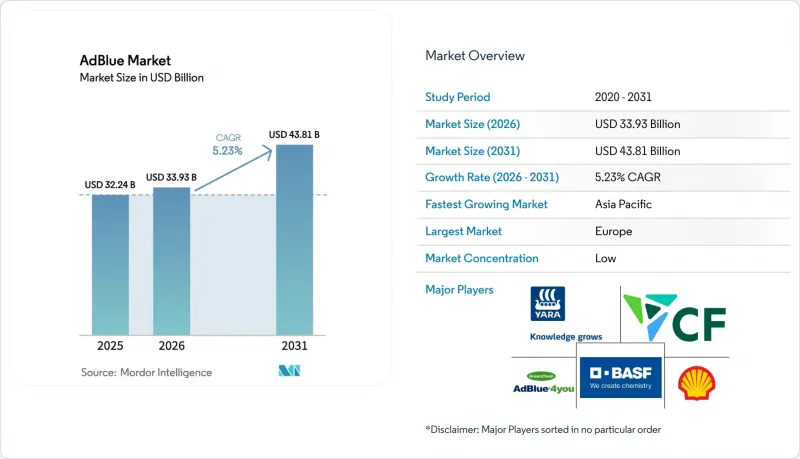
Mordor Intelligence에 의하면, 애드블루 시장 규모는 2025년 322억 4,000만 달러로 평가되었고, 2026년에는 339억 3,000만 달러로 추정되고, 2026-2031년 CAGR 5.23%로 성장을 지속할 전망이며, 2031년에는 438억 1,000만 달러에 이를 것으로 예측됩니다.
본 보고서는 방식별(연소 전 처리, 연소 후 처리), 용도별(상용차, 승용차, 철도 차량, 비도로용 이동 기계, 기타 용도), 지역별(아시아태평양, 북미, 유럽, 남미, 중동 및 아프리카)로 분류되어 있습니다. 시장 예측은 금액(달러) 기준으로 제시되어 있습니다.
세계의 애드블루 시장 동향 및 인사이트
전 세계 NOx 배출 규제의 강화
2026년부터 소형 차량, 2028년부터 대형 트럭에 적용되는 유로 7 규제에 따르면, 실제 주행 시 NOx 배출 상한선이 60 mg/km로 강화되고 암모니아 슬립 상한선이 도입됨에 따라, 제조업체는 NH3 센서와 더 대용량의 요소 탱크를 장착해야 합니다. 중국의 국가 VI 규제는 SCR 데이터를 성(省) 수준의 서버에 업로드하는 차량 내 모니터링을 의무화하고 있어, 액체 절약을 목적으로 한 투여량 부족을 억제하고 있습니다. 인도의 BS-VI 2단계에서는 실제 주행 배기가스 시험이 도입되어, 이에 따라 각 주(州)의 연료 소매업체들이 고속도로용 디스펜서 도입을 가속화하고 있습니다. 미국에서는 EPA의 2027년 요건이 최종 확정되어 2031년까지 NOx를 90% 감축해야 하며, 이에 따라 엔진 제조업체들은 듀얼 도징 방식으로의 전환을 강요받고 있습니다. 아세안은 뒤처져 있지만, 베트남의 유로 5 채택은 지역적 규제 강화의 조짐을 보여주고 있으며, 이로 인해 애드블루의 잠재 시장이 확대될 것입니다.
비도로용 기계에서의 SCR 급속한 보급
EU의 스테이지 V 규정에 따르면, 56kW를 초과하는 엔진(굴삭기, 휠 로더, 트랙터, 기타)에 SCR+DPF 시스템의 탑재가 의무화되어 있으며, 이러한 장비에서는 보충 주기가 여전히 큰 운영상의 과제로 남아 있습니다. 북미의 Tier 4 Final 규제의 대상이 되는 농업용 및 건설용 차량도 비슷한 상황이며, 텔레매틱스를 통한 경보 기능으로 작업 중 출력 저하를 방지하고 있습니다. 캐나다와 칠레의 광산용 운반 트럭에서는 고지대에서의 결정화를 방지하기 위한 저온용 배합이 실증되고 있습니다. 중국의 비도로용 엔진이 ‘국가 IV’로 전환됨에 따라, 중국석유화학(Sinopec)은 도시용 장비 전용 저비우렛 등급 제품을 시장에 출시하고 있습니다. 이러한 동향들이 맞물리면서 차량 1대당 애드블루 사용량이 증가하고 있으며, 수요가 도로용 차량 이외의 분야로도 다양화되고 있습니다.
소형 전기차의 보급 확대
2024년까지 배터리식 전기 트럭은 일부 도시 지역의 운영 주기에서 디젤 차량과 총비용 패리티(동등성)를 달성하여, 배송 및 지역 운송 부문의 전동화를 가속화하고 있습니다. 캘리포니아주의 ‘Advanced Clean Trucks’ 규정은 2035년까지 클래스 7-8 제로 배출 차량의 판매 비율을 최대 75%까지 끌어올릴 것을 의무화하고 있으며, 미국 대형 차량 등록 대수의 12%를 차지하는 이 주에서 디젤 차량의 대상 시장이 축소되고 있습니다. 중국에서는 주요 도시에서 버스 및 택시의 100% 전동화가 의무화되어, 3.5-7.5톤 차량 등급에서의 아드블루 수요가 감소하고 있습니다. 유럽의 CO₂ 배출 기준에 따라, 각 OEM 업체들은 도시 지역 배송 차량용으로 배터리 및 연료전지 옵션을 추진하고 있습니다. 장거리 운송에서는 여전히 디젤 차량이 주류를 이루고 있지만, 이러한 도시 지역의 변화로 인해 애드블루 시장 동향은 소폭 변화하고 있습니다.
부문 분석
2025년, 애드블루 시장 점유율의 80.95%를 배기 후처리 방식이 차지했습니다. 이는 NOx를 환원하기 위해 배기 가스에 요소를 분사하는 방식이 도로용 디젤 엔진에서 거의 보편적으로 채택되고 있음을 반영합니다. 이 방식은 유로 7, EPA 2027, 중국 국가 VI에 포함되어 있으며, 2030년을 훨씬 넘어서도 산업 표준으로 자리매김할 것으로 보입니다. 연소 전 주입 방식의 경우, 선박용 디젤 엔진이나 고정식 발전기 등 전문 분야에서 연비 효율 향상이 추구됨에 따라 연평균 5.58%의 성장이 예상됩니다. 철도용 기관차 및 광산기계에 적용되는 하이브리드 EGR-SCR 시스템은 내구성과 유체 소비량의 균형을 유지하고 있어, 연소 후 처리 기술 중에서도 계속해서 중요한 위치를 차지할 것으로 보입니다. 승용차에는 오일 교환 주기에 맞춘 10-20리터 용량의 탱크가 탑재되어 있는 반면, 상용차에서는 40-80리터 용량의 탱크가 사용되며, 텔레매틱스를 통해 모니터링되어 출력 제한 임계값이 작동하기 전에 운전자에게 경고가 전송됩니다.
연소 전 처리 방식에서는 암모니아를 실린더에 직접 분사하여 연소 최고 온도를 낮추고, 발생원에서 NOx를 저감합니다. 기술적 과제로는 열 응력 증가나 NH3의 누출 위험 등이 꼽히지만, 2-3%의 연비 향상을 기대할 수 있어 선박 및 고정 플랜트 운영자들의 주목을 받고 있습니다. IMO Tier III 규제로 인해 대형 SCR 반응기를 설치할 수 없는 연안 선박에서의 시험이 촉진되고 있습니다. 중국의 산업 지역에서는 배기가스 중의 NOx를 50 mg/Nm³로 제한하고 있기 때문에 발전소에서는 개조 공간의 제약을 피할 수 있는 연소 전 주입 방식의 시험이 진행되고 있습니다. 그럼에도 불구하고 애드블루 시장은 여전히 연소 후 SCR 방식이 주를 이루고 있으며, 이 방식은 다양한 유형의 이동식 엔진에서 입증된 규제 준수성을 제공합니다.
지역별 분석
2025년, 유럽은 애드블루 시장에서 38.12%의 점유율을 차지했습니다. 이는 주로 유로 7 규제의 도입과 방대한 장거리 트럭 차량군 덕분입니다. 독일, 프랑스, 영국에서는 엄격한 암모니아 슬립 제한과 장기 내구성 시험으로 인해 차량당 주입량이 여전히 높은 수준을 유지하고 있습니다. 북유럽 차량의 경우, 20°C 미만의 환경에서도 규제 준수를 보장하기 위해 한랭지용 이중 주입 방식이 시험되고 있어, 지역에 따른 기술적 적응이 나타나고 있습니다. 스페인과 이탈리아에서는 지방 지역의 주유소에서 공급 부족 현상이 나타나고 있으나, 토탈에너지와 쉘은 지중해 연안의 화물 운송 회랑을 따라 이러한 부족 현상을 해소하는 것을 목표로 하고 있습니다. 브렉시트 이후의 규제 차이로 인해 차량군은 EU와 영국의 서로 다른 규정에 대응할 수밖에 없지만, 양 제도 모두 SCR 의무를 유지하고 있어 액체 수요의 최저 수준은 유지되고 있습니다.
아시아태평양은 가장 빠르게 성장하고 있으며, 2031년 연평균 성장률(CAGR)은 6.05%로 전망됩니다. 이는 중국의 OBM(온보드 모니터링) 시행과 인도의 BS-VI 2단계 RDE(실주행 배출 시험)가 원동력이 되고 있습니다. 시노펙의 전국 3만 곳에 달하는 주유소 네트워크는 주유에 대한 불안을 해소하고, 자국 브랜드에 대한 충성도를 높이고 있습니다. 인디언 오일(Indian Oil) 및 동종 업계 경쟁사들은 ‘골든 쿼드릴래터럴(Golden Quadrilateral)’을 따라 인프라를 확충하고 있지만, 농촌 지역공급 격차로 인해 차량을 이용한 연료 비축이 진행되고 있습니다. 일본의 성숙한 시장에서는 승용차 부문의 디젤차 점유율이 축소됨에 따라 시장이 안정화되고 있지만, 한국에서는 트럭 운송 및 건설업에 힘입어 완만한 성장이 나타나고 있습니다. 아세안(ASEAN)에서는 규격이 제각각이라 통일된 보급이 늦어지고 있지만, 베트남과 말레이시아에서는 유로 5 규제가 정착되기 시작하며 초기 성장세를 보이고 있습니다.
북미는 2024년에 10%대 중반의 점유율을 유지했습니다. EPA의 2027년 규제로 인해 엔진 제조업체들은 고효율 SCR로의 전환을 강요받고 있으며, 차량 1대당 액제 사용량은 유지되고 있습니다. 캘리포니아주의 제로 에미션 판매 의무화로 인해 장기적인 디젤 연료 전망은 어두워지고 있지만, 수년에 걸쳐 단계적으로 도입되기 때문에 기존 차량은 계속해서 애드블루에 의존하고 있습니다. 캐나다 수요는 트랜스캐나다 고속도로를 따라 집중되어 있으며, 페트로캐나다와 쉘이 최대 규모의 급유 네트워크를 운영하고 있습니다. 멕시코 국경을 넘어 사업을 전개하는 업체들은 미국 입국 규제를 충족하기 위해 SCR을 채택하고 있으며, 이에 따라 페멕스(Pemex)는 북부 주에서 공급 강화를 추진하고 있습니다. 브라질은 PROCONVE P8의 시행으로 남미를 선도하고 있지만, 광대한 내륙 지역에서는 여전히 공급이 부족합니다. 사우디아라비아와 아랍에미리트는 유로 5 규격 트럭의 조기 도입을 뒷받침하는 고속도로망에 투자하고 있는 반면, 남아프리카공화국의 광업 물류는 하우텡 주와 웨스턴케이프 주 주변에서 수요를 유지하고 있습니다.
기타 혜택
- 엑셀 형식 시장 예측(ME) 시트
- 3개월간의 애널리스트 지원
자주 묻는 질문
목차
제1장 서론
제2장 조사 방법
제3장 개요
제4장 시장 구도
제5장 시장 규모 및 성장 예측
제6장 경쟁 구도
제7장 시장 기회 및 향후 전망
AJY 26.09.01According to Mordor Intelligence, the adBlue market size is expected to grow from USD 32.24 billion in 2025 to USD 33.93 billion in 2026 and is forecast to reach USD 43.81 billion by 2031 at 5.23% CAGR over 2026-2031.
This report is Segmented by Method (Pre-Combustion and Post-Combustion), Application (Commercial Vehicles, Passenger Cars, Railway Trains, Non-Road Mobile Machinery, and Other Applications), and Geography (Asia-Pacific, North America, Europe, South America, and Middle East and Africa). The Market Forecasts are Provided in Terms of Value (USD).
Global AdBlue Market Trends and Insights
Stricter Global NOx-Emission Regulations
Euro 7 limits effective from 2026 for light-duty vehicles and 2028 for heavy-duty trucks tighten real-driving NOx caps to 60 mg/km and introduce ammonia-slip ceilings, obligating manufacturers to integrate NH3 sensors and larger urea tanks. China's National VI rule mandates on-board monitoring that uploads SCR data to provincial servers, discouraging underdosing to save fluid. India's BS-VI Phase 2 introduces real-driving-emissions tests, which accelerate the roll-out of highway dispensers by state fuel retailers. The United States finalizes EPA 2027 requirements, demanding a 90% NOx cut by 2031, which pushes engine makers toward dual-dosing architectures. ASEAN economies trail, but Vietnam's Euro 5 adoption signals regional tightening that widens the addressable AdBlue market.
Rapid SCR Uptake Across Non-Road Machinery
EU Stage V rules require SCR-plus-DPF systems on engines exceeding 56 kW, including excavators, wheel loaders, and tractors, where refill intervals remain a significant operational challenge. North America's Tier 4 Final drives are similar to those in agricultural and construction fleets, with telematics alerts preventing mid-shift derates. Mining haul trucks in Canada and Chile validate low-temperature formulations to prevent crystallization at high altitudes. China's move to National IV in non-road engines spurs Sinopec to market a dedicated low-biuret grade for urban equipment. These developments collectively lift AdBlue intensity per machine and diversify demand beyond on-road vehicles.
Rising Light-Duty EV Penetration
Battery-electric trucks achieved total cost parity with diesel in several urban duty cycles by 2024, accelerating electrification in delivery and regional haul segments. California's Advanced Clean Trucks rule demands up to 75% zero-emission Class 7-8 sales by 2035, shrinking diesel's addressable base in the state that holds 12% of U.S. heavy-duty registrations. China mandates 100% electric buses and taxis in key cities, eroding demand for AdBlue in the 3.5-7.5 t bracket. Europe's CO2 standards push OEMs toward battery and fuel-cell options for urban distribution vehicles. Although long-haul diesel remains prevalent, these urban shifts modestly alter the trajectory of the AdBlue market.
Other drivers and restraints analyzed in the detailed report include:
- Expansion of AdBlue Retail Infrastructure in Emerging Markets
- Surge in E-Commerce Logistics Diesel Mileage
- Volatile Urea Feedstock Prices
For complete list of drivers and restraints, kindly check the Table Of Contents.
Segment Analysis
Post-combustion method captured 80.95% of the AdBlue market share in 2025, reflecting near-universal use in on-road diesel engines where urea is injected into the exhaust stream to convert NOx. This layout is embedded in Euro 7, EPA 2027, and China National VI, making it the industry baseline well past 2030. Pre-combustion dosing is forecast to grow at a rate of 5.58% as specialized sectors, such as marine diesel and stationary generators, pursue fuel efficiency gains. Railway locomotives and hybrid EGR-SCR setups in mining equipment strike a balance between durability and fluid consumption, ensuring ongoing relevance after combustion. Passenger cars carry 10-20 l tanks aligned with oil-change intervals, while commercial vehicles use 40-80 l tanks monitored by telematics that warn operators before derate thresholds activate.
Pre-combustion approaches inject ammonia directly into the cylinder, lowering peak combustion temperature and cutting NOx at the source. Technical hurdles include higher thermal stress and the risk of NH3 slip, yet 2-3% fuel-efficiency gains appeal to marine and fixed-plant operators. IMO Tier III stimulates trials on coastal vessels that cannot accommodate bulky SCR reactors. China's industrial zones cap stack NOx at 50 mg/Nm3, prompting power plants to test pre-combustion dosing that circumvents retrofit space constraints. Even so, the AdBlue market remains anchored by post-combustion SCR, which offers proven compliance across the broadest range of mobile engines.
Complete Report Scope:
- By Method
- Pre-combustion
- Post-combustion
- By Application
- Commercial Vehicles
- Passenger Cars
- Railway Trains
- Non-road Mobile Machinery
- Other Applications
- Geography
- Asia-Pacific
- China
- India
- Japan
- South Korea
- ASEAN Countries
- Rest of Asia-Pacific
- North America
- United States
- Canada
- Mexico
- Europe
- Germany
- United Kingdom
- France
- Italy
- Russia
- Spain
- NORDIC Countries
- Rest of Europe
- South America
- Brazil
- Argentina
- Rest of South America
- Middle-East and Africa
- Saudi Arabia
- South Africa
- Rest of Middle East and Africa
- Asia-Pacific
Geography Analysis
Europe commanded a 38.12% market share of the AdBlue market in 2025, largely due to the implementation of the Euro 7 rules and a vast long-haul truck fleet. Germany, France, and the United Kingdom maintain high per-vehicle dosing due to strict ammonia-slip limits and extended durability testing. Nordic fleets test cold-weather dual-dosing to secure compliance at sub-20 °C, illustrating regional engineering adaptations. Spain and Italy face gaps in rural dispensers that TotalEnergies and Shell aim to close along the Mediterranean freight corridors. Post-Brexit divergence obliges fleets to navigate separate EU and UK rules; however, both regimes maintain SCR obligations, preserving a baseline of fluid demand.
The Asia-Pacific region is the fastest-growing, with a 6.05% CAGR to 2031, driven by China's OBM enforcement and India's BS-VI Phase 2 RDE testing. Sinopec's nationwide network of 30,000 stations alleviates refill anxiety and fosters domestic brand loyalty. Indian Oil and peers expand infrastructure along the Golden Quadrilateral, yet rural gaps encourage fleet stockpiling. Japan's mature market stabilizes as diesel share in passenger cars shrinks, while South Korea posts modest growth tied to trucking and construction. ASEAN's fragmented standards delay uniform uptake, but Vietnam and Malaysia show early momentum as Euro 5 rules take hold.
North America held a mid-teens share in 2024. EPA 2027 pushes engine builders toward higher-efficiency SCR, sustaining fluid use per vehicle. California's zero-emission sales mandates tighten long-term diesel prospects, yet the multi-year phase-in keeps the existing fleet reliant on AdBlue. Canada's demand concentrates along the Trans-Canada Highway, with Petro-Canada and Shell hosting the largest dispenser networks. Mexico's cross-border operators adopt SCR to meet U.S. entry rules, prompting Pemex to bolster supply in northern states. Brazil leads South America after PROCONVE P8 enforcement, yet vast interior regions remain underserved. Saudi Arabia and the UAE invest in highway networks that underpin early Euro 5 truck adoption, while South Africa's mining logistics maintain demand around Gauteng and the Western Cape.
- BASF
- Bosch Limited
- Brenntag SpA
- CF Industries Holdings, Inc.
- China Petrochemical corporation (Sinopec)
- CrossChem
- Cummins Inc.,
- Enilive S.p.A.
- GreenChem
- Komatsu.
- LAT Nitrogen Austria GmbH
- Mitsui Chemicals Inc.
- NANDAN PETROCHEM LTD
- Old World Industries
- S.C. OMV PETROM S.A.
- Shell plc
- STOCKMEIER Group
- TotalEnergies
- Yara
Additional Benefits:
- The market estimate (ME) sheet in Excel format
- 3 months of analyst support
TABLE OF CONTENTS
1 Introduction
- 1.1 Study Assumptions & Market Definition
- 1.2 Scope of the Study
2 Research Methodology
3 Executive Summary
4 Market Landscape
- 4.1 Market Overview
- 4.2 Market Drivers
- 4.2.1 Stricter global NOx-emission regulations
- 4.2.2 Rapid SCR uptake across non-road machinery
- 4.2.3 Expansion of AdBlue retail infrastructure in EMs
- 4.2.4 Surge in e-commerce logistics diesel mileage
- 4.2.5 Telematics-driven dosing and fleet analytics
- 4.3 Market Restraints
- 4.3.1 Rising light-duty EV penetration
- 4.3.2 Volatile urea feed-stock prices
- 4.3.3 Counterfeit / contaminated AdBlue risk
- 4.4 Value Chain Analysis
- 4.5 Porter's Five Forces
- 4.5.1 Bargaining Power of Suppliers
- 4.5.2 Bargaining Power of Buyers
- 4.5.3 Threat of New Entrants
- 4.5.4 Threat of Substitutes
- 4.5.5 Degree of Competition
5 Market Size & Growth Forecasts (Value)
- 5.1 By Method
- 5.1.1 Pre-combustion
- 5.1.2 Post-combustion
- 5.2 By Application
- 5.2.1 Commercial Vehicles
- 5.2.2 Passenger Cars
- 5.2.3 Railway Trains
- 5.2.4 Non-road Mobile Machinery
- 5.2.5 Other Applications
- 5.3 Geography
- 5.3.1 Asia-Pacific
- 5.3.1.1 China
- 5.3.1.2 India
- 5.3.1.3 Japan
- 5.3.1.4 South Korea
- 5.3.1.5 ASEAN Countries
- 5.3.1.6 Rest of Asia-Pacific
- 5.3.2 North America
- 5.3.2.1 United States
- 5.3.2.2 Canada
- 5.3.2.3 Mexico
- 5.3.3 Europe
- 5.3.3.1 Germany
- 5.3.3.2 United Kingdom
- 5.3.3.3 France
- 5.3.3.4 Italy
- 5.3.3.5 Russia
- 5.3.3.6 Spain
- 5.3.3.7 NORDIC Countries
- 5.3.3.8 Rest of Europe
- 5.3.4 South America
- 5.3.4.1 Brazil
- 5.3.4.2 Argentina
- 5.3.4.3 Rest of South America
- 5.3.5 Middle-East and Africa
- 5.3.5.1 Saudi Arabia
- 5.3.5.2 South Africa
- 5.3.5.3 Rest of Middle East and Africa
- 5.3.1 Asia-Pacific
6 Competitive Landscape
- 6.1 Market Concentration
- 6.2 Strategic Moves
- 6.3 Market Share(%)/Ranking Analysis
- 6.4 Company Profiles (includes Global level Overview, Market level overview, Core Segments, Financials as available, Strategic Information, Market Rank/Share, Products & Services, and Recent Developments)
- 6.4.1 BASF
- 6.4.2 Bosch Limited
- 6.4.3 Brenntag SpA
- 6.4.4 CF Industries Holdings, Inc.
- 6.4.5 China Petrochemical corporation (Sinopec)
- 6.4.6 CrossChem
- 6.4.7 Cummins Inc.,
- 6.4.8 Enilive S.p.A.
- 6.4.9 GreenChem
- 6.4.10 Komatsu.
- 6.4.11 LAT Nitrogen Austria GmbH
- 6.4.12 Mitsui Chemicals Inc.
- 6.4.13 NANDAN PETROCHEM LTD
- 6.4.14 Old World Industries
- 6.4.15 S.C. OMV PETROM S.A.
- 6.4.16 Shell plc
- 6.4.17 STOCKMEIER Group
- 6.4.18 TotalEnergies
- 6.4.19 Yara
7 Market Opportunities and Future Outlook
- 7.1 White-space and Unmet-Need Assessment


