|
시장보고서
상품코드
2117356
북미의 자동차 충돌 수리 시장 : 시장 점유율 분석, 산업 동향 및 통계 데이터, 성장 예측(2026-2031년)North America Automotive Collision Repair - Market Share Analysis, Industry Trends & Statistics, Growth Forecasts (2026 - 2031) |
||||||
 Mordor Intelligence
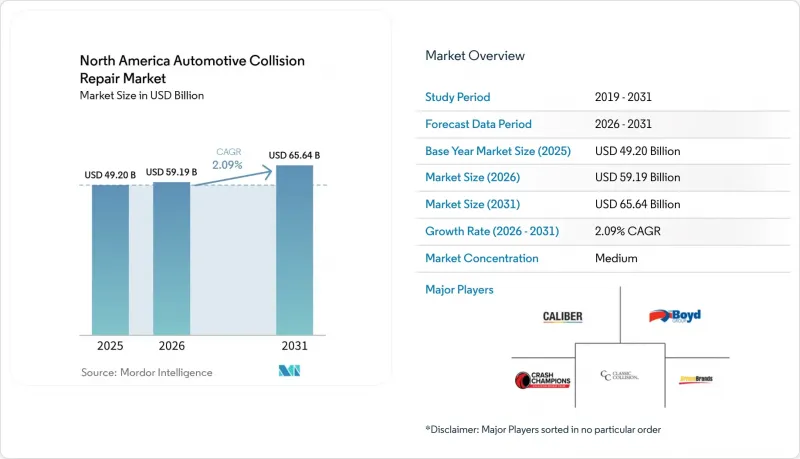
Mordor Intelligence에 의하면, 북미의 자동차 충돌 수리 시장 규모는 2025년에 492억 달러로 평가되었고, 2026년 591억 9,000만 달러에서 2031년까지 656억 4,000만 달러에 이를 것으로 추정되며, 예측 기간(2026-2031년) CAGR은 2.09%를 나타낼 전망입니다.
본 보고서는 차종별(승용차, 상용차), 제품별(페인트 및 코팅, 소모품 등), 서비스 채널별(DIY(Do-It-Yourself), DIFM(Do-It-For-Me) 등), 손상 유형별(구조 보수, 외장·도장 등),및 국가별(미국, 캐나다 등)로 분류되어 있습니다. 시장 예측은 금액(달러) 기준으로 제시되어 있습니다.
북미의 자동차 충돌 수리 시장 동향 및 인사이트
ADAS 보정이 수리 청구서 금액을 끌어올려
2025년에는 ADAS가 탑재된 차량이 수리 가능한 차량 총수의 상당 부분을 차지했습니다. 보정(캘리브레이션)이 이루어질 때마다 평균 수리 주문 단가가 상승하여 전체 수리 비용 증가에 기여했습니다. 이 해에는 수리 견적에서 진단 스캔이 중요한 위치를 차지했으나, OEM 전용 라이선스를 보유하지 않은 많은 독립 정비소가 존재했기 때문에 서비스 시장은 양극화되었습니다. 뉴욕주와 매사추세츠주에서는 앞유리 수리 후 OEM 사양에 따른 재보정이 의무화되어 있으며, 전국의 보험사들도 배상 책임을 경감하기 위해 유사한 절차를 채택하고 있습니다. 업계 보고서에 따르면, ADAS 시스템이 관련된 경미한 충돌 사고의 수리 비용은 ADAS가 탑재되지 않은 차량의 수리에 비해 현저히 높습니다. 진입 장벽은 높지만, 인증 사업자는 높은 인건비와 직접 리페어 프로그램(DRP) 처리량의 큰 점유율이라는 혜택을 누리며, 인증을 받지 않은 경쟁사보다 수익성을 높이고 있습니다.
차량의 노후화로 수리 수요 증가
2025년에는 차량의 평균 사용 연수가 증가함에 따라, 판금 공장을 이용할 가능성이 있는 차량의 경제적 수명이 연장되었습니다. 수리 빈도가 높은 것으로 알려진 사용 연수 6-11년 차 차량은 특히 해당 연도에 신차 가격이 상승한 점과 맞물려 그 대수가 증가하는 추세에 있습니다. 2025년에 연방 정부의 전기차(EV) 세액 공제가 만료되어 전기차 구매가 주춤한 반면, 하이브리드차 판매가 급증함에 따라 충돌 사고가 발생하기 쉬운 차종이 도로에 남아 있게 되었습니다. 2026년까지의 주행 거리 추이를 보면, 사고 발생 빈도는 감소했으나 사고 위험의 기반은 안정적인 것으로 나타났습니다.
ADAS 및 능동형 안전 기술에 의한 충돌 빈도 감소
2025년 8월까지 저속 충돌을 회피하는 데 도움이 된 AEB(자동 긴급 제동) 및 차선 유지 기술의 보급으로 인해 수리 가능한 보험 청구 건수가 감소했습니다. 경미한 수리 청구 건수가 줄어들면서, 과거에는 안정적인 수익원이었던 외장 수리 분야가 축소되고 있습니다. 2029년 이후부터 AEB 탑재가 의무화될 예정인 만큼, 이러한 추세는 앞으로도 지속될 것으로 예측됩니다. 2025년 10월에는 전손 보험 청구 건수가 증가하면서 수리 가능한 차량 수가 감소했습니다. 한편, 운전자가 전기 파워트레인에 적응해 감에 따라 차량 함대의 충돌률도 상승하여, 수리 건수는 감소했으나 건당 수리 비용은 증가했습니다.
부문 분석
상용차는 규모가 작은 부문이지만, 연평균 성장률(CAGR) 2.55%로 더 빠른 성장이 예상됩니다. 이러한 성장에 따라 북미 자동차 충돌 수리 시장에서 첨단 ADAS 및 고전압에 대한 전문 지식이 필요한 차량 대여 업체 대상 서비스에 대한 수요가 높아질 것입니다. 승용차는 계속해서 수리 대수의 대부분을 차지하며, 2025년에는 북미 자동차 충돌 수리 시장 점유율의 74.15%를 차지할 것으로 예상되지만, 멀티포인트 캘리브레이션의 필요성은 점점 더 높아지고 있습니다. 플릿의 전기화가 진행됨에 따라, 정비소는 전기식 클래스 7-8 트럭용 부품을 재고로 확보하고, 충전 관련 안전 프로토콜을 유지해야 합니다. 텔레매틱스에 따른 보험 청구 증가로 수리 빈도가 높아지고 있지만, 가동 중단에 따른 위약금으로 인해 공인 정비 센터에서는 더 높은 인건비가 정당화되고 있습니다. 승용차 운영 사업자들도 당일 내 교정이 가능한 MSO 네트워크를 선호하는 경향이 있지만, 독립 정비소는 구형 차량 및 ADAS가 탑재되지 않은 차량을 전문으로 취급함으로써 틈새 시장 점유율을 유지할 수 있습니다.
상용 차량 플릿의 경우, 전기 트럭에 복합 소재로 제작된 운전실, 열 관리 시스템, 배터리 인클로저가 채택되어 있어 제조업체 인증 절차가 필요하므로 수리 단가가 높아집니다. 보험사는 상용 전기차의 경우 OE 인증 시설에서의 수리를 의무화하는 경우가 많으며, 이로 인해 DRP(보험사 지정 수리 프로그램)를 통한 MSO로의 유도가 촉진되고 있습니다. 교정 기준을 충족하지 못하는 승용차 수리 업체는 면책 금액 미만의 외장 수리 업무로 밀려날 위험이 있습니다. 그 결과, 북미 자동차 충돌 수리 시장은 대량의 승용차 사고 수리와 피해가 심각한 차량 대여용 차량 수리 모두에 대응할 수 있는 업체로 기울고 있으며, 통합 진단 시스템에 대한 투자가 촉진되고 있습니다.
2025년, 북미 자동차 충돌 수리 시장에서 도료 및 코팅이 44.36%의 점유율을 차지하며 시장을 주도했습니다. 그러나 센서, 카메라, 레이더 모듈이 교체용 부품의 주류로 자리 잡음에 따라, 예비 부품은 연평균 성장률(CAGR) 2.86%로 가장 빠르게 성장하는 부문이 될 것이며, 가격이 1,000달러 이상인 초음파 어셈블리 등의 부품 시장 규모를 확대할 것입니다. 캘리포니아주의 VOC 규제로 인해 수리 공장은 더 비싼 수성 도료로 전환해야 하는 상황에 처해 있지만, 개별 레이더 유닛의 상대적 가치가 전체 재도장 키트 세트보다 높기 때문에 지출 비율이 변화하고 있습니다.
관세 및 해외 의존도가 높기 때문에 LKQ와 같은 애그리게이터는 국내 리맨(재제조) 제품 및 배터리 재활용 프로그램 확충에 주력하고 있으며, 노후 차량이나 EV를 불문하고 부품 공급을 확보하고 있습니다. 도료 공급업체들은 BASF Glasurit이나 Axalta Cromax Gen과 같은 저VOC 시스템으로 이에 대응하고 있지만, 그 매출 성장률은 ADAS 모듈 수요 증가세를 따라가지 못하고 있습니다. 첨단 재고 관리 소프트웨어를 도입한 사업자는 가격 변동 위험을 헤지하고, 신속한 부품 공급을 통해 이익을 확보할 수 있습니다.
기타 혜택 :
- Excel 형식 시장 예측(ME) 시트
- 3개월간의 애널리스트 지원
자주 묻는 질문
목차
제1장 서론
제2장 분석 방법
제3장 개요
제4장 시장 구도
제5장 시장 규모 및 성장률 예측
제6장 경쟁 구도
제7장 시장 기회 및 향후 전망
AJY 26.09.01According to Mordor Intelligence, the North America automotive collision repair market size was valued at USD 49.20 billion in 2025 and is estimated to grow from USD 59.19 billion in 2026 to reach USD 65.64 billion by 2031, at a CAGR of 2.09% during the forecast period (2026-2031).
This report is Segmented by Vehicle Type (Passenger Car, Commercial Vehicle), Product (Paints and Coatings, Consumables, and More), Service Channel (DIY (Do-It-Yourself), DIFM (Do-It-For-Me), and More), Damage Type (Structural Repair, Cosmetic and Paint, and More), and Country (United States, Canada, and More). The Market Forecasts are Provided in Terms of Value (USD).
North America Automotive Collision Repair Market Trends and Insights
ADAS Calibration Boosting Repair Ticket Size
In 2025, vehicles equipped with ADAS accounted for a significant share of the repairable fleet. Each calibration increased the average repair order cost, contributing to higher overall repair expenses. Diagnostic scans featured prominently in repair estimates during the year, yet many independent shops, lacking OEM-specific licenses, contributed to a divided service market. New York and Massachusetts require OEM-spec recalibration after windshield work, and national insurers are adopting identical protocols to reduce liability . According to industry reports, minor collisions involving ADAS systems incur significantly higher repair costs compared to non-ADAS repairs. While capital entry barriers are high, certified operators benefit from premium labor rates and a larger share of the Direct Repair Program (DRP) volume, thereby amplifying their profitability relative to uncertified competitors.
Aging Fleet Extending Repair Demand
In 2025, the average vehicle age increased, extending the economic life of units likely to visit body shops. Vehicles aged between 6 and 11 years, known for their high repair frequency, are seeing an expanding cohort, especially as new vehicle prices rose that year. While federal EV credits expired in 2025, dampening EV purchases, hybrid vehicle sales surged, resulting in more collision-prone platforms remaining on the road. By 2026, vehicle miles traveled indicated a stable exposure base, even with a dip in frequency.
ADAS and Active-Safety Lowering Collision Frequency
Through August 2025, repairable claims declined, driven by AEB and lane-keeping technologies that helped avoid low-speed impacts. Claims for minor repairs have reduced in volume, diminishing the once-reliable cosmetic repair segment. With mandatory AEB set to roll out post-2029, this trend is expected to persist. In October 2025, total-loss claims increased, reducing the number of repairable vehicles, while fleet collision rates rose as drivers adapted to electrified powertrains, resulting in fewer but more expensive repairs.
Other drivers and restraints analyzed in the detailed report include:
- PE-Backed MSO Consolidation
- Stringent U.S. and Canada Safety Regulations
- Certified-Technician Shortage
For complete list of drivers and restraints, kindly check the Table Of Contents.
Segment Analysis
Commercial vehicles represent a smaller segment but are projected to grow faster, at a CAGR of 2.55%. This growth will increase demand in the North American automotive collision repair market for fleet-focused services requiring specialized ADAS and high-voltage expertise. Passenger cars will continue to dominate repair volumes, accounting for 74.15% of the North American automotive collision repair market share in 2025, although they increasingly require multi-point calibration. As fleets electrify, repair shops must stock parts for electric Class 7-8 trucks and maintain safety protocols for charging. Telematics-triggered claims increase repair frequency, while downtime penalties support higher labor rates at certified repair centers. Passenger vehicle operators also favor MSO networks that can provide same-day calibration, although independent shops can retain niche share by specializing in older, non-ADAS-equipped vehicles.
Commercial fleets yield higher ticket values because electric trucks incorporate composite cabs, thermal systems, and battery enclosures needing manufacturer-approved procedures. Insurance underwriters often mandate OE-certified facilities for commercial EVs, boosting DRP steerage toward MSOs. Passenger-car repairers who cannot meet calibration standards risk being relegated to sub-deductible cosmetic work. Consequently, the North American automotive collision repair market is tilting toward businesses that service both high-volume passenger claims and high-severity fleet jobs, incentivizing investment in integrated diagnostics.
Paints and coatings led the North American automotive collision repair market in 2025, with a 44.36% share. Yet, spare parts will be the fastest-growing segment, with a 2.86% CAGR, as sensors, cameras, and radar modules become replacement staples, expanding the North American automotive collision repair market size for components such as ultrasonic assemblies priced above USD 1,000. California's VOC restrictions push shops toward pricier waterborne finishes, but the relative value of a single radar unit eclipses a complete refinish kit, shifting wallet share.
Tariffs and overseas dependency motivate aggregators like LKQ to expand domestic reman offerings and battery re-use programs, ensuring parts availability for aging vehicles and EVs alike. Coatings suppliers respond with low-VOC systems, including BASF Glasurit and Axalta Cromax Gen, yet their revenue growth trails the growth in ADAS module demand. Operators running advanced inventory software can hedge volatility and capture margin through rapid parts fulfillment.
Complete Report Scope:
- By Vehicle Type
- Passenger Car
- Commercial Vehicle
- By Product
- Paints and Coatings
- Consumables
- Spare Parts
- Glass
- Other Product
- By Service Channel
- DIY (Do-It-Yourself)
- DIFM (Do-It-For-Me)
- OE (Original Equipment)
- By Damage Type
- Structural Repair
- Cosmetic and Paint
- Glass and ADAS Calibration
- By Country
- United States
- Canada
- Rest of North America
List of Companies Covered in this Report:
- Caliber Holdings LLC
- Boyd Group Services Ltd.
- Crash Champions
- Classic Collision
- Safelite Group
- LKQ Corporation
- Driven Brands Holdings
- Axalta Coating Systems
- PPG Industries
- BASF SE
- Sherwin-Williams Automotive Finishes
- AkzoNobel
- 3M
- Dorman Products
Additional Benefits:
- The market estimate (ME) sheet in Excel format
- 3 months of analyst support
TABLE OF CONTENTS
1 Introduction
- 1.1 Scope of the Study
- 1.2 Study Assumptions & Market Definition
2 Research Methodology
3 Executive Summary
4 Market Landscape
- 4.1 Market Overview
- 4.2 Market Drivers
- 4.2.1 ADAS Calibration Boosting Repair Ticket Size
- 4.2.2 Aging Fleet Extending Repair Demand
- 4.2.3 PE-Backed MSO Consolidation
- 4.2.4 Stringent U.S. and Canada Safety Regulations
- 4.2.5 Digital-First Insurance Workflows
- 4.2.6 Growing Vehicle Parc and VMT in North America
- 4.3 Market Restraints
- 4.3.1 ADAS and Active-Safety Lowering Collision Frequency
- 4.3.2 Certified-Technician Shortage
- 4.3.3 Parts-Supply Volatility
- 4.3.4 VOC Limits on Refinish Coatings
- 4.4 Value / Supply-Chain Analysis
- 4.5 Regulatory Landscape
- 4.6 Technological Outlook
- 4.7 Porter's Five Forces
- 4.7.1 Supplier Power
- 4.7.2 Buyer Power
- 4.7.3 Threat of Substitutes
- 4.7.4 Threat of New Entrants
- 4.7.5 Competitive Rivalry
5 Market Size & Growth Forecasts (Value (USD))
- 5.1 By Vehicle Type
- 5.1.1 Passenger Car
- 5.1.2 Commercial Vehicle
- 5.2 By Product
- 5.2.1 Paints and Coatings
- 5.2.2 Consumables
- 5.2.3 Spare Parts
- 5.2.4 Glass
- 5.2.5 Other Product
- 5.3 By Service Channel
- 5.3.1 DIY (Do-It-Yourself)
- 5.3.2 DIFM (Do-It-For-Me)
- 5.3.3 OE (Original Equipment)
- 5.4 By Damage Type
- 5.4.1 Structural Repair
- 5.4.2 Cosmetic and Paint
- 5.4.3 Glass and ADAS Calibration
- 5.5 By Country
- 5.5.1 United States
- 5.5.2 Canada
- 5.5.3 Rest of North America
6 Competitive Landscape
- 6.1 Market Concentration
- 6.2 Strategic Moves
- 6.3 Market Share Analysis
- 6.4 Company Profiles (Includes Global Level Overview, Market Level Overview, Core Segments, Financials as Available, Strategic Information, Market Rank/Share for Key Companies, Products and Services, SWOT Analysis, and Recent Developments)
- 6.4.1 Caliber Holdings LLC
- 6.4.2 Boyd Group Services Ltd.
- 6.4.3 Crash Champions
- 6.4.4 Classic Collision
- 6.4.5 Safelite Group
- 6.4.6 LKQ Corporation
- 6.4.7 Driven Brands Holdings
- 6.4.8 Axalta Coating Systems
- 6.4.9 PPG Industries
- 6.4.10 BASF SE
- 6.4.11 Sherwin-Williams Automotive Finishes
- 6.4.12 AkzoNobel
- 6.4.13 3M
- 6.4.14 Dorman Products
7 Market Opportunities & Future Outlook
- 7.1 White-space & Unmet-Need Assessment