
|
시장보고서
상품코드
2117401
비행 검사 : 시장 점유율 분석, 산업 동향 및 통계 데이터, 성장 예측(2026-2031년)Flight Inspection - Market Share Analysis, Industry Trends & Statistics, Growth Forecasts (2026 - 2031) |
||||||
 Mordor Intelligence
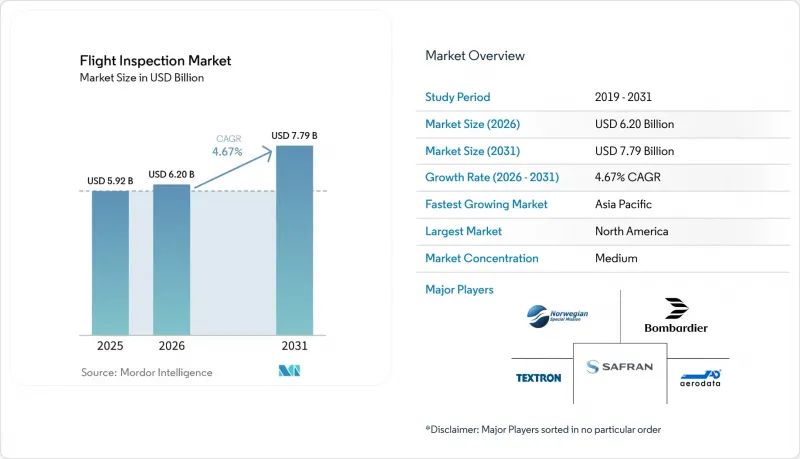
Mordor Intelligence에 의하면, 비행 검사 시장 규모는 2025년에 59억 2,000만 달러로 평가되었습니다. 2026년 62억 달러에서 2031년까지 77억 9,000만 달러에 이를 것으로 예상되며, 예측 기간 중 CAGR은 4.67%를 나타낼 전망입니다.
본 보고서는 서비스 모델(비행 검사 시스템(FIS) 조달 등), 플랫폼 유형(고정익 항공기 등), 시스템 아키텍처(기내 통합 시스템 등), 검사 유형(정기 점검 등), 최종 사용자(항공 관제 서비스 제공업체 등), 지역(북미, 유럽 등)별로 분류되어 있습니다. 시장 전망은 금액(달러) 기준으로 제시되어 있습니다.
세계의 비행 검사 시장 동향 및 인사이트
CNS/ATM 인프라의 디지털화
CNS/ATM에 대한 디지털 투자로 인해 비행 검사 시장의 업무 범위가 확대되고 있습니다. 이는 새로운 항법·감시 자산은 운용 개시 전에 검증이 필요하기 때문입니다. GBAS 설치, 디지털 VOR 장비 및 ADS-B 지상국 도입으로 인해 기존의 정기 점검에 더해 추가적인 시운전 요건이 부과될 것입니다. 일본의 JCAB는 2025년 1월 하네다 공항의 GBAS를 본격적으로 가동하기 시작했습니다. 이는 일본 최초의 CAT-I 지원 GBAS로, 적용되는 절차에 따른 비행 검증이 필요합니다. 이러한 전환에 따라 기존 지상 지원 설비의 상당수는 교체되지 않고 그대로 유지되므로, 이에 대한 검사 요건은 변경되지 않습니다. 이러한 중복으로 인해 인증 사업자나 시스템 공급업체가 대응할 수 있는 업무 범위가 확대됩니다. 따라서 비행 검사 시장은 기존 설비의 유지보수와 새로운 디지털 인프라 양쪽 모두로부터 혜택을 받고 있습니다.
성능 기반 항법(PBN) 도입의 급증
PBN 도입은 비행 검사 시장 수요를 견인하고 있습니다. 이는 새로운 계기 비행 절차가 상업 운항 개시 전에 인수 검사를 필요로 하기 때문입니다. 2025년 12월 베이징에서 개최된 ICAO의 PBNICG/12 회의에서는 해당 지역 내 도입 활동이 재확인되었습니다. 베트남은 같은 시기에 탄손? 공항 및 롱탄 공항에서 새로운 RNP 절차가 도입되었다고 보고했습니다. 이러한 프로젝트는 시운전 단계 및 그 이후의 정기적인 검토 과정에서 업무 기회를 창출합니다. 또한 ICAO는 AFI 지역이 전 세계 ‘안전상 중대한 우려 사항(SSC)’의 50%를 차지한다고 보고하고 있으며, 절차가 확대되고 있는 지역에서는 신뢰할 수 있는 검증이 특히 중요합니다. 그 결과, 비행 검사 시장은 공항 건설뿐만 아니라 절차 도입의 질과 속도에도 밀접하게 연관되어 있습니다.
전용 항공기의 도입 및 운영 비용 부담
전용 검사용 항공기에는 기체, 탑재된 검사 시스템, 인증, 승무원 훈련 및 지속적인 정비가 필요합니다. 이러한 요건으로 인해 조달이 지연될 가능성이 있으며, 소규모 항공교통관리기관(ANSP)의 경우 자사 항공기 편대의 자금 조달이 어려워질 수 있습니다. 이러한 제약이 FIaaS(Flight Inspection as a Service) 수요를 뒷받침하고 있습니다. 당국은 초기 투자 비용 전액을 부담하지 않고도 임무를 구매할 수 있기 때문입니다. ICAO의 감항성 요건 및 각국의 인증 규정에 따라 구매 후에도 지속적인 의무가 발생합니다. 이러한 영향은 항공 예산이 제한적이고 임무량이 불안정한 국가에서 더욱 두드러집니다. 따라서 비행 검사 시장에는 신규 기단 운영 사업자에게는 진입 장벽이 남아 있는 반면, 인증을 받은 서비스 제공업체에게는 진입의 여지가 생기고 있습니다.
부문별 분석
2025년 시점에서 FIS 조달은 서비스 모델별 점유율에서 49.37%를 차지했습니다. 대규모 공공 자금을 바탕으로 하는 ANSP는 안전상 중요한 자산과 일정을 직접 관리해야 하므로, 대부분의 경우 항공기를 계속 보유합니다. 이러한 조직의 내부 팀은 정기 임무, 시운전 임무 및 긴급 임무에 항공기를 배정할 수 있습니다. 또한, 이러한 체제를 통해 당국 내부에 운영 노하우가 유지됩니다. FIaaS는 2031년까지 연평균 성장률(CAGR) 6.55%를 나타낼 것으로 예측됩니다. 소규모 공항 당국이나 신흥 시장의 규제 당국은 항공기 보유가 예산을 초과하는 고정비를 초래할 경우, 외부 운항 능력을 활용할 수 있습니다. FIaaS에 대한 수요는 전용 항공기에 자본을 투자하지 않고도 검사 의무를 이행해야 할 필요성에 의해 뒷받침되고 있습니다. 인가를 받은 승무원과 항공기를 보유한 제공업체는 자사 항공기를 이용할 수 없는 경우에도 일시적인 운용 능력을 제공할 수 있습니다. 이 모델은 임무량이 너무 적어 전용기나 상근 승무원을 유지할 수 없는 경우에 특히 효과적입니다. 또한 고객은 계약 기간을 건설 계획, 절차 도입 또는 일시적인 운항 능력 부족 기간에 맞추어 조정할 수도 있습니다.
하이브리드 소유 형태는 완전 소유 기단과 완전 외부 위탁 서비스 계약의 중간에 위치합니다. 이러한 모델에서는 전문 업체가 항공기를 소유하고, ANSP가 일정 관리, 데이터 관리 또는 운항 감독을 담당합니다. 비행 검사 시장은 대규모 ANSP가 핵심 기단의 운영 능력을 유지하면서, 예외적인 수요에 대해서는 외부 지원을 구매하는 단계적인 서비스 구조로 전환되고 있습니다. FIaaS 제공업체는 일상 업무를 수행하고 긴급 요청에 신속하게 대응할 수 있을 때 이점을 얻을 수 있습니다. 조달 결정은 앞으로도 인증 범위, 기체 가용성, 그리고 기밀 데이터를 다루는 운영자의 역량에 계속 좌우될 것입니다. 따라서 비행 검사 업계에서는 소유 모델과 관리형 서비스 모델이 모두 유지될 전망입니다.
2025년에는 플랫폼 부문의 72.71%를 고정익 항공기가 차지했습니다. 그 항속 거리 덕분에 운영자는 장거리 항로 조사를 완료하고, 한 번의 임무로 여러 시설을 점검할 수 있습니다. 또한, 그 적재 능력은 탑재된 센서 시스템 및 관련 기술 장비도 수용할 수 있습니다. 확립된 인증 경로를 통해 고정익 항공기는 고정밀 작업에서 지속적으로 중요한 역할을 수행하고 있습니다. 회전익 항공기는 활주로 접근성, 지형 또는 현지 공역 제한으로 인해 고정익 항공기의 실용적인 사용이 제한되는 현장에도 대응할 수 있으므로, 2031년까지 연평균 성장률(CAGR) 5.89%를 나타낼 것으로 예측됩니다. 고정익 항공기 플랫폼에 대한 수요는 광범위한 노선망을 필요로 하는 국내 네트워크와 여전히 밀접하게 연결되어 있습니다. 또한 고정익 항공기 시스템은 높은 안정성과 반복적인 측정이 가능한 플랫폼을 필요로 하는 임무에서도 여전히 중요한 역할을 수행하고 있습니다. 게다가, 여러 대의 항공기를 번갈아 가며 운용할 필요 없이, 원격지에 걸친 계획적인 일련의 점검을 지원할 수도 있습니다. 이러한 운용 범위를 통해 운영사는 임무 수행 중 기상 조건이나 공항 접근 상황이 변하더라도 일정의 확실성을 유지할 수 있습니다.
새로운 터보프롭 항공기와 비즈니스 제트기가 점검 사업자가 사용하는 항공기 군을 새롭게 바꾸고 있습니다. 이러한 변화에는 전문 시스템과 통합 가능한 ‘킹에어 360’, ‘CJ4’, ‘프레토르 600’과 같은 기종이 포함됩니다. EASA가 2026년 6월에 시행한 무인 항공기 규정 개정에는 SORA 2.5 패키지가 포함되어, 일부 UAS(무인 항공기 시스템) 운영에 대해 보다 명확한 규정 준수 지침이 제시되었습니다. UAS 도구를 사용하여 선정된 자산에 대한 사전 보정을 수행하는 한편, 유인 항공기가 최종 검증을 완료할 수 있습니다. 이러한 조합을 통해 인증된 비행 검사용 항공기의 필요성을 배제하지 않으면서도 계획의 효율성을 높일 수 있습니다. 따라서 비행 검사 업계에서는 핵심인 고정익 항공기의 임무를 대체하는 대신, 그 주변에 무인 도구를 추가하는 방식을 취하고 있습니다.
지역별 분석
2025년, 북미는 비행 검사 시장의 30.13%를 차지했습니다. 이 지역에는 계기비행방식(IFR)을 지원하는 공항이 다수 있어 FAA 관련 검증 수요가 지속적으로 발생하고 있을 뿐만 아니라, 국방 관련 요구 사항도 병행하여 존재하고 있습니다. NextGen 이니셔티브에 따라 GBAS, ADS-B, 데이터 링크 및 기타 CNS 업그레이드에 관한 시운전 업무가 추가되었습니다. NAV CANADA는 2026년 1월, King Air 360 기체용 AeroFIS 시스템 2대에 대한 공장 인수 검사를 완료했으며, 2027년 말에 항공기 인도를 예정하고 있습니다. 이 투자는 캐나다의 지속적인 현대화 주기를 보여줍니다.
아시아태평양은 2031년까지 연평균 성장률(CAGR) 7.12%를 나타낼 것으로 예측됩니다. 인도는 2026년 3월 ‘Modified UDAN 2.0’을 승인하여, 향후 10년간 100곳의 신규 공항 건설에 2,888억 루피(34억 달러 상당)를 투자하기로 했습니다. 이러한 건설 현장에서는 검사 이력이 제한적이거나 존재하지 않는 경우, 시운전에 대한 수요가 발생할 가능성이 있습니다. 일본은 성숙한 기술력과 UAS(무인 항공기 시스템)를 활용한 새로운 업무, 그리고 GNSS 보정 데이터의 적극적인 조달을 결합하고 있습니다. 중국의 항공 계획은 계속해서 공항 건설 및 항법 보조 시설의 업그레이드를 지원하고 있습니다.
유럽에서는 SESAR 관련 현대화 및 EASA에 의한 계기비행절차 감독을 통해 수요가 유지되고 있습니다. EASA와 EUROCONTROL은 2026년 3월, GNSS 무선 주파수 간섭에 관한 유럽 행동 계획을 발표하고, 항법 백업 수단으로서 ILS, VOR, DME의 중요성을 재확인했습니다. 이를 통해 위성 항법의 확대가 진행되는 가운데에서도 지상 항법 보조 시설의 지속적인 보정이 지원되고 있습니다. 중동에서는 대규모 공항 프로젝트와 GNSS 간섭에 대한 높은 노출 위험이 공존하고 있습니다. 아프리카 국가들은 ICAO의 지역 체계 하에서 항법 현대화를 추진하고 있는 반면, 브라질은 지속적인 CNS 개발을 통해 남미 수요를 뒷받침하고 있습니다. 새로운 인프라, 회복탄력성에 대한 요구, 그리고 조달 역량의 차이가 복합적으로 작용하여 이 지역들의 비행 검사 시장을 형성하고 있습니다.
기타 혜택 :
- 엑셀 형식 시장 예측(ME) 시트
- 3개월간의 애널리스트 지원
자주 묻는 질문
목차
제1장 서론
제2장 분석 방법
제3장 개요
제4장 시장 구도
제5장 시장 규모 및 성장률 예측
제6장 경쟁 구도
제7장 시장 기회 및 향후 전망
KTH 26.09.02According to Mordor Intelligence, the flight inspection market size was valued at USD 5.92 billion in 2025 and estimated to grow from USD 6.20 billion in 2026 to reach USD 7.79 billion by 2031, at a CAGR of 4.67% during the forecast period.
This report is Segmented by Service Model (Flight Inspection Systems Procurement, and More), Platform Type (Fixed-Wing Aircraft, and More), System Architecture (Onboard Integrated Systems, and More), Inspection Type (Periodic Routine, and More), End-User (Air Navigation Service Providers, and More), and Geography (North America, Europe, and More). The Market Forecasts are Provided in Terms of Value (USD).
Global Flight Inspection Market Trends and Insights
Digitalization of CNS/ATM Infrastructure
Digital CNS/ATM investment broadens the scope of missions in the flight inspection market, as each new navigation or surveillance asset must be validated before operational use. GBAS installations, digital VOR equipment, and ADS-B ground stations introduce additional commissioning requirements beyond established periodic checks. Japan's JCAB placed its GBAS at Haneda Airport into full operations in January 2025, representing Japan's first CAT-I capable GBAS and requiring flight validation under the applicable procedure. The same transition leaves many existing ground aids in place rather than replacing the inspection requirements for them. This overlap widens the work available to certified operators and system suppliers. The flight inspection market, therefore, gains from both installed-base maintenance and new digital infrastructure.
Surge in Performance-Based Navigation Implementations
PBN implementation drives demand in the flight inspection market, as new instrument procedures require acceptance checks before commercial activation. ICAO's PBNICG/12 meeting in Beijing in December 2025 reaffirmed regional deployment activity. Vietnam reported new RNP procedures at Tan Son Nhat and Long Thanh airports during the same period. These projects create work at commissioning and later during periodic review. ICAO also reported that the AFI region accounted for 50% of global Safety Significant Concerns, making reliable validation particularly important where procedures are being expanded. The flight inspection market is consequently linked to the quality and pace of procedure implementation as well as airport construction.
High Acquisition and Operating Cost of Specialized Aircraft
A dedicated inspection aircraft requires an airframe, an installed inspection system, certification, crew preparation, and continuing maintenance. These needs can delay procurement and make it difficult for smaller ANSPs to fund owned fleets. The constraint supports FIaaS demand because authorities can purchase missions without carrying the full initial investment. ICAO airworthiness requirements and national certification rules add continuing obligations after purchase. The effect is stronger in countries with limited aviation budgets and irregular mission volumes. The flight inspection market thus retains a barrier to new fleet operators while creating space for certified service providers.
Other drivers and restraints analyzed in the detailed report include:
- Adoption of Cloud-Connected Flight-Inspection Analytics
- Space-Based ADS-B Verification Demand
- Spectrum-Congestion Interference in GNSS Flight Checks
For complete list of drivers and restraints, kindly check the Table Of Contents.
Segment Analysis
FIS procurement accounted for 49.37% of the service model segment in 2025. Large, state-funded ANSPs often retain fleets because they need direct control of safety-critical assets and schedules. Their internal teams can allocate aircraft across routine, commissioning, and contingency missions. That structure also preserves operational knowledge within the authority. FIaaS is forecast to grow at a 6.55% CAGR through 2031. Smaller airport authorities and developing-market regulators can use external capacity when fleet ownership would impose fixed costs beyond their budgets. Demand for FIaaS is supported by the need to meet inspection obligations without committing capital to specialized aircraft. Providers with certified crews and aircraft can also provide temporary capacity when their owned fleets are unavailable. The model is especially relevant when mission volumes are too low to support a dedicated aircraft and full-time crew. It also allows the customer to align the contract period with a construction program, procedure rollout, or temporary capacity gap.
Hybrid ownership arrangements sit between fully owned fleets and fully outsourced service contracts. In these models, a specialist can own the aircraft while an ANSP contributes scheduling, data management, or operational oversight. The flight inspection market is moving toward a tiered service structure in which large ANSPs maintain core fleet capacity and purchase external support for exceptional demand. FIaaS providers benefit when they can perform routine work and respond quickly to emergency requirements. Procurement decisions will continue to depend on certification coverage, fleet availability, and the operator's ability to handle sensitive data. The flight inspection industry is therefore likely to retain both ownership and managed-service models.
Fixed-wing aircraft accounted for 72.71% of the platform segment in 2025. Their endurance allows operators to complete long en route surveys and inspect several facilities during a single mission. Their payload capacity also accommodates installed sensor systems and associated technical equipment. Established certification routes reinforce their continued role in high-precision work. Rotary-wing aircraft are forecast to grow at a CAGR of 5.89% through 2031, as they can serve sites where runway access, terrain, or local airspace constraints limit the practical use of fixed-wing aircraft. Demand for fixed-wing platforms remains tied to national networks that require broad route coverage. Fixed-wing systems also remain relevant for missions that require a stable, repeatable measurement platform. They can also support a planned sequence of checks across distant locations without multiple aircraft handovers. This operating range helps operators protect schedule reliability when weather or airport access changes during a mission.
New turboprop and business-jet platforms are renewing the aircraft base used by inspection operators. The shift includes King Air 360, CJ4, and Praetor 600 platforms, which can be integrated with specialized systems. EASA's June 2026 update to its unmanned aircraft rules incorporated the SORA 2.5 package, providing a clearer compliance route for some UAS tasks. UAS tools can pre-calibrate selected assets while manned aircraft complete final validation. This combination can improve planning without removing the need for certified flight inspection aircraft. The flight inspection industry is therefore adding unmanned tools around, rather than in place of, core fixed-wing missions.
Complete Report Scope:
- By Service Model
- Flight Inspection Systems (FIS) Procurement
- Flight Inspection as-a-Service (FIaaS)
- Hybrid Ownership Models
- By Platform Type
- Fixed-Wing Aircraft
- Rotary-Wing Aircraft
- By System Architecture
- Onboard Integrated Systems
- Portable/Roll-On Roll-Off Systems
- Ground-Based Reference Systems
- By Inspection Type
- Commissioning/Site Acceptance
- Periodic Routine
- Special/Emergency
- By End User
- Air Navigation Service Providers (ANSPs)
- Airport Operators
- Military Aviation Authorities
- Private/Business Aviation
- By Geography
- North America
- United States
- Canada
- Mexico
- Europe
- United Kingdom
- France
- Germany
- Italy
- Spain
- Rest of Europe
- Asia-Pacific
- China
- Japan
- India
- South Korea
- Australia
- Rest of Asia-Pacific
- South America
- Brazil
- Rest of South America
- Middle East and Africa
- Middle East
- United Arab Emirates
- Saudi Arabia
- Rest of Middle East
- Africa
- South Africa
- Rest of Africa
- Middle East
- North America
Geography Analysis
North America held 30.13% of the flight inspection market in 2025. The region has a large base of instrument airports, recurring FAA-related validation needs, and parallel defense requirements. NextGen activity adds commissioning work for GBAS, ADS-B, datalink, and other CNS upgrades. NAV CANADA completed factory acceptance of two AeroFIS systems for King Air 360 aircraft in January 2026, with aircraft delivery scheduled for the end of 2027. This investment shows an ongoing modernization cycle in Canada.
Asia-Pacific is forecast to grow at a 7.12% CAGR through 2031. India approved Modified UDAN 2.0 in March 2026 with an INR 288.80 billion outlay (equivalent to USD 3.40 billion) for 100 new airports over 10 years. These sites can create commissioning demand where inspection history is limited or absent. Japan combines mature technical capability with new UAS-based work and active GNSS correction-data procurement. China's aviation plans continue to support airport construction and navigation-aid upgrades.
Europe retains demand through SESAR-related modernization and EASA oversight of instrument procedures. EASA and EUROCONTROL issued a European action plan on GNSS radio-frequency interference in March 2026, reinforcing the importance of ILS, VOR, and DME as navigation backups. This supports continuing calibration of ground-based aids even as satellite navigation expands. The Middle East combines large airport projects with a high level of exposure to GNSS interference. African countries are progressing with navigation modernization under ICAO regional frameworks, while Brazil supports South American demand through continuing CNS development. The combination of new infrastructure, resilience needs, and differing procurement capacity shapes the flight inspection market across these regions.
- Aerodata AG
- Textron Inc.
- Norwegian Special Mission AS
- Safran S.A.
- Bombardier Inc.
- Thales Group
- Flight Calibration Services Limited
- Embraer S.A.
- Lufthansa Technik AG
- SGI Aviation Services B.V.
- Flight Precision Ltd.
- Samana Special Mission
- ENAV S.p.A.
- International Flight Services Association
Additional Benefits:
- The market estimate (ME) sheet in Excel format
- 3 months of analyst support
TABLE OF CONTENTS
1 INTRODUCTION
- 1.1 Study Assumptions and Market Definition
- 1.2 Scope of the Study
2 RESEARCH METHODOLOGY
3 EXECUTIVE SUMMARY
4 MARKET LANDSCAPE
- 4.1 Market Overview
- 4.2 Market Drivers
- 4.2.1 Digitalization of CNS/ATM infrastructure
- 4.2.2 Surge in Performance-Based Navigation (PBN) implementations
- 4.2.3 Global runway-capacity optimization mandates
- 4.2.4 Fleet renewal toward next-generation turboprop fixed-wing calibration aircraft
- 4.2.5 Adoption of cloud-connected flight-inspection analytics
- 4.2.6 Space-based ADS-B verification demand
- 4.3 Market Restraints
- 4.3.1 High acquisition and operating cost of specialised aircraft
- 4.3.2 Skilled-crew shortage for dual-pilot/dual-engine missions
- 4.3.3 Spectrum-congestion interference in GNSS flight checks
- 4.3.4 Limited operational endurance of rotary-wing aircraft on long-range inspection routes
- 4.4 Value Chain Analysis
- 4.5 Regulatory Landscape
- 4.6 Technological Outlook
- 4.7 Porter's Five Forces Analysis
- 4.7.1 Threat of New Entrants
- 4.7.2 Bargaining Power of Suppliers
- 4.7.3 Bargaining Power of Buyers
- 4.7.4 Threat of Substitutes
- 4.7.5 Intensity of Competitive Rivalry
5 MARKET SIZE AND GROWTH FORECASTS (VALUE)
- 5.1 By Service Model
- 5.1.1 Flight Inspection Systems (FIS) Procurement
- 5.1.2 Flight Inspection as-a-Service (FIaaS)
- 5.1.3 Hybrid Ownership Models
- 5.2 By Platform Type
- 5.2.1 Fixed-Wing Aircraft
- 5.2.2 Rotary-Wing Aircraft
- 5.3 By System Architecture
- 5.3.1 Onboard Integrated Systems
- 5.3.2 Portable/Roll-On Roll-Off Systems
- 5.3.3 Ground-Based Reference Systems
- 5.4 By Inspection Type
- 5.4.1 Commissioning/Site Acceptance
- 5.4.2 Periodic Routine
- 5.4.3 Special/Emergency
- 5.5 By End User
- 5.5.1 Air Navigation Service Providers (ANSPs)
- 5.5.2 Airport Operators
- 5.5.3 Military Aviation Authorities
- 5.5.4 Private/Business Aviation
- 5.6 By Geography
- 5.6.1 North America
- 5.6.1.1 United States
- 5.6.1.2 Canada
- 5.6.1.3 Mexico
- 5.6.2 Europe
- 5.6.2.1 United Kingdom
- 5.6.2.2 France
- 5.6.2.3 Germany
- 5.6.2.4 Italy
- 5.6.2.5 Spain
- 5.6.2.6 Rest of Europe
- 5.6.3 Asia-Pacific
- 5.6.3.1 China
- 5.6.3.2 Japan
- 5.6.3.3 India
- 5.6.3.4 South Korea
- 5.6.3.5 Australia
- 5.6.3.6 Rest of Asia-Pacific
- 5.6.4 South America
- 5.6.4.1 Brazil
- 5.6.4.2 Rest of South America
- 5.6.5 Middle East and Africa
- 5.6.5.1 Middle East
- 5.6.5.1.1 United Arab Emirates
- 5.6.5.1.2 Saudi Arabia
- 5.6.5.1.3 Rest of Middle East
- 5.6.5.2 Africa
- 5.6.5.2.1 South Africa
- 5.6.5.2.2 Rest of Africa
- 5.6.5.1 Middle East
- 5.6.1 North America
6 COMPETITIVE LANDSCAPE
- 6.1 Market Concentration
- 6.2 Strategic Moves
- 6.3 Market Share Analysis
- 6.4 Company Profiles (includes Global level Overview, Market level overview, Core Segments, Financials as available, Strategic Information, Market Rank/Share for key companies, Products and Services, and Recent Developments)
- 6.4.1 Aerodata AG
- 6.4.2 Textron Inc.
- 6.4.3 Norwegian Special Mission AS
- 6.4.4 Safran S.A.
- 6.4.5 Bombardier Inc.
- 6.4.6 Thales Group
- 6.4.7 Flight Calibration Services Limited
- 6.4.8 Embraer S.A.
- 6.4.9 Lufthansa Technik AG
- 6.4.10 SGI Aviation Services B.V.
- 6.4.11 Flight Precision Ltd.
- 6.4.12 Samana Special Mission
- 6.4.13 ENAV S.p.A.
- 6.4.14 International Flight Services Association
7 MARKET OPPORTUNITIES AND FUTURE OUTLOOK
- 7.1 White-space and Unmet-Need Assessment