
|
시장보고서
상품코드
2117408
비행 관리 시스템 시장 : 점유율 분석, 업계 동향과 통계, 성장 예측(2026-2031년)Flight Management Systems - Market Share Analysis, Industry Trends & Statistics, Growth Forecasts (2026 - 2031) |
||||||
 Mordor Intelligence
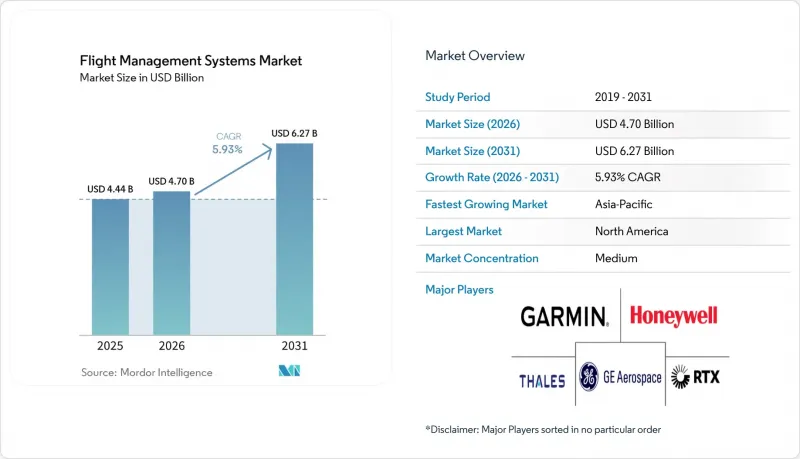
Mordor Intelligence에 의하면, 비행 관리 시스템(FMS) 시장 규모는 2025년에 44억 4,000만 달러로 평가되었고 2026년 47억 달러에서 2031년까지 62억 7,000만 달러에 이를 것으로 추정되고 있어 예측 기간(2026-2031년) CAGR은 5.93%를 나타낼 전망입니다.
본 보고서는 구성 요소(하드웨어 및 소프트웨어), 항공기 유형(민간, 군용, 일반 항공, 무인 항공기 시스템, 도심항공모빌리티(UAM)), 탑재 형태(라인 핏 및 레트로핏), 설치 유형(싱글 FMS 및 듀얼/트리플 중복 FMS),지역(북미, 유럽, 아시아태평양, 기타)별로 세분화되어 있습니다. 시장 예측은 금액(달러) 기준으로 제시되어 있습니다.
세계 비행 관리 시스템 시장 동향 및 인사이트
나로우드바디 항공기 생산이 미결 주문량을 인증된 FMS 수요로 전환
민간 항공기 생산 대수는 비행 관리 시스템 시장 수요에 대한 직접적인 원천으로 계속 작용하고 있습니다. 에어버스는 2025년에 793대의 민간 항공기를 인도하고, 2026년에는 870대 인도를 목표로 하고 있습니다. A320 계열은 에어버스의 2025년 인도 대수의 약 3분의 2를 차지하며, 협폭기 프로그램은 계속해서 항공전자 장비 조달의 핵심을 이루고 있습니다. 인도되는 각 항공기에는 조종실 구성의 일부로서 인증된 비행 관리 시스템이 필요합니다. 항공전자 부품 및 인증 절차에는 긴 리드타임이 소요되므로, 공급업체는 예정된 항공기 인도 시점을 훨씬 앞서 생산 능력을 확보해 두어야 합니다. 따라서 라인 핏(생산 라인에서의 표준 장착)으로 선정되는 것은 인도 시의 하드웨어 출하뿐만 아니라 항공기 운용 기간 전반에 걸친 서비스 수익 확보로도 이어집니다.
항공기 제조업체가 생산을 확대하면, 동일한 인증된 시스템을 대규모 항공기 제품군 전체에 걸쳐 선정할 수 있으므로, 비행 관리 시스템 시장은 그 혜택을 누리게 됩니다. 에어버스는 2027년에 A320 제품군의 월간 생산 대수를 75대로 늘릴 의향을 밝혔습니다. 이러한 계획에 따라 비행 관리 컴퓨터, 디스플레이 및 항법 소프트웨어 공급업체에게는 공급 체계의 구축이 중요해집니다. 인증된 플랫폼은 일단 도입되면 확고한 입지를 구축합니다. 이는 항공전자 시스템 변경 시 설계, 시험 및 승인에 드는 비용이 수반되기 때문입니다. 이러한 추세는 항공기 프로그램 초기 단계에서 입지를 확립한 기업에게 유리하게 작용합니다. 또한, 이로 인해 항공기 생산 일정은 단기적인 비행 관리 시스템 시장 수요를 나타내는 중요한 지표가 됩니다.
연료 효율 최적화가 소프트웨어 업그레이드 수요를 견인
항공사들은 효율적인 항로 계획, 항공기 성능 관리, 변화하는 운항 상황에 대응하기 위해 비행 관리 기능을 활용하고 있습니다. 따라서 비행 관리 시스템 시장은 연료 소비량과 운항 비용 절감을 목표로 하는 항공사들의 노력과 밀접하게 연관되어 있습니다. 에어버스(Airbus)는 GEESE 공동 프로젝트에서 항공기 간 간격 조정을 통해 후류 에너지 회수를 지원할 수 있는 ‘도착 소요 시간(RTO)’ 기능을 시험했다고 보고했습니다. 이러한 기능에는 기내 비행 관리 시스템과 항공 교통 관리 프로세스 간의 긴밀한 연계가 필요합니다. 또한, 이러한 기능들은 실시간 성능 데이터, 항법 데이터베이스 및 소프트웨어 기능의 중요성을 한층 더 높이고 있습니다.
각 항공사가 비행 관리 컴퓨터의 초기 구매에만 그치지 않고 그 너머를 내다보면서 비즈니스 모델도 변화하고 있습니다. 소프트웨어 업데이트를 통해 하드웨어를 교체하지 않고도 항법 절차 추가, 성능 향상, 항공 교통 시스템과의 호환성 확보가 가능해집니다. 에어버스는 2026년 6월, 디지털 방식을 통해 용도, 성능 데이터베이스, 규정 준수 업데이트의 도입을 지원하는 ‘소프트웨어 정의 항공기’ 접근 방식에 대해 설명했습니다. 이 모델은 항공기가 취항한 후의 수익 주기를 연장할 수 있습니다. 또한, 연료, 항로, 운항 요건이 변화하는 가운데, 운항 사업자가 소프트웨어를 최신 상태로 유지해야 하는 이유이기도 합니다. 이러한 상황이 비행 관리 시스템 시장의 소프트웨어 분야를 뒷받침하고 있습니다.
항공기 인도 지연이 라인 핏 수익을 늦추다.
항공기 인도 지연은 라인 핏 시스템의 탑재 및 수익 계상을 지연시킬 가능성이 있습니다. 비행 관리 시스템은 일반적으로 항공기 인도 마일스톤에 맞추어 일정이 잡히기 때문에 생산 지연으로 인해 관련 설치 작업이 후반기로 밀리게 됩니다. 이러한 영향은 대규모 미결 주문으로 인해 협폭기(narrow-body)의 인도 일정이 장기화되는 경우에 가장 두드러집니다. 인증된 항공 전자 장비는 쉽게 교체할 수 없는 특수 부품에 의존하고 있기 때문에 부품의 조달 가능 여부가 문제를 더욱 복잡하게 만들 수 있습니다. 특정 용도용 집적 회로(ASIC)는 안전상 중요한 용도로 사용될 때 인증을 받아야 하므로, 이에 따라 허용되는 대체 공급업체의 수가 제한됩니다.
또한, 공급업체가 부품의 재인증을 받거나 인증된 구성을 변경해야 하는 경우, 비행 관리 시스템 시장에서는 리드타임이 길어지는 경향이 있습니다. 이러한 제약으로 인해 대부분의 항공 전자 장비가 이용 가능하더라도 항공기 전체의 인도 일정에 영향을 미칠 수 있습니다. 그 결과, 항공사는 계획보다 늦게 항공기를 인도받게 되어 관련 서비스 및 소프트웨어의 수익 발생 시기가 연기될 것입니다. 미결 주문은 비행 관리 시스템에 대한 미래의 필요성을 없애지는 않지만, 예측 기간 동안 수요의 이동을 유발할 가능성이 있습니다. 이러한 압박은 이미 운용 중인 항공기에 시스템을 탑재할 수 있는 개조 업체보다, 라인 핏(신규 탑재) 공급업체에게 더 시급한 문제가 될 것입니다.
부문 분석
2025년 부품 매출액 중 하드웨어가 65.78%를 차지했습니다. 비행 관리 컴퓨터, 제어 표시 장치 및 시각 표시 장치는 설치 시 인증된 물리적 핵심을 구성합니다. 그 가치는 안전성, 신뢰성 및 환경 요건을 충족하기 위해 필요한 엔지니어링을 반영합니다. 허니웰(Honeywell)은 2025년 9월, 차세대 FMS를 위해 TTTech Aerospace의 ‘TTEthernet End System’을 채택했습니다. 이 네트워크는 결정론적 데이터 교환을 지원하며, 최고 수준의 설계 보증 등급으로 인증 가능한 시스템을 가정하고 있습니다. 이러한 접근 방식은 소프트웨어 기능이 확대되는 상황에서도 하드웨어가 여전히 중요한 이유를 보여줍니다.
소프트웨어는 가장 빠르게 성장하는 구성 요소이며, 비행 관리 시스템(FMS) 시장에서 소프트웨어 시장 규모는 2031년까지 연평균 성장률(CAGR) 7.41%로 확대될 것으로 예측됩니다. 소프트웨어는 항법 데이터베이스, 비행 계획 로직, 항공기 성능 계산을 지원하며, 다른 항공기 시스템과의 인터페이스 역할을 담당합니다. 에어버스의 ‘소프트웨어 정의 항공기’ 이니셔티브는 핵심 하드웨어를 변경하지 않고도 용도 및 데이터 업데이트를 제공할 수 있음을 보여줍니다. 이러한 기능 덕분에 시스템 도입 후에도 공급업체에게는 지속적인 업무 기회가 발생할 가능성이 있습니다. 또한, 운항 사업자가 변화하는 성능 기반의 항법 요건에 대응하는 데에도 도움이 됩니다. 소프트웨어 서비스를 제공하는 하드웨어 공급업체는 항공기 운항 사업자와의 장기적인 관계를 더욱 공고히 다질 가능성이 있습니다.
2025년에는 민간 항공이 시장 수익의 74.89%를 차지했습니다. 대규모 항공사의 기단에는 공통된 항법 기능, 표준화된 훈련, 그리고 지속적인 데이터베이스 지원이 요구됩니다. 협폭기(narrow-body)는 전 세계 민간 항공기 인도 대수의 상당 부분을 차지하고 있기 때문에 특히 중요합니다. 에어버스(Airbus)는 2044년까지 아시아태평양이 전 세계 신형 민간 항공기 수요 중 19,560대를 차지할 것으로 예측했습니다. 이러한 수요 기반은 새로운 시스템 도입뿐만 아니라 장기적인 지원 활동도 뒷받침하고 있습니다.
군용 항공 분야에서는 미션 컴퓨터 및 조종실 업그레이드 프로그램을 통해 독자적인 현대화 로드맵이 제시되고 있습니다. 커티스 라이트(Curtis Wright)사는 미국 공군의 C-17 현대화 프로그램을 위한 미션 컴퓨터 공급업체로 선정되었으며, 그 추정 수명 주기 가치는 4억 달러 이상에 달할 것으로 예측됩니다. 일반 항공 및 무인 항공기는 개조 및 특수 항법 시스템에 대한 수요를 창출하고 있습니다. UAM(도심항공모빌리티(UAM))은 2031년까지 연평균 성장률(CAGR)이 10.84%에 달하고, 가장 빠르게 성장하는 항공기 부문입니다. 2026년 7월, 사프란(Safran)은 이브 에어 모빌리티(Eve Air Mobility)의 eVTOL 항공기를 위한 듀얼 ‘SkyNaute’ 하이브리드 관성 항법 시스템을 공급할 기업으로 선정되었습니다. 이번 선정은 UAM 시스템이 GNSS 수신 상태가 악화되는 도시 환경에서 고도의 항법 성능을 필요로 하고 있음을 보여줍니다.
지역별 분석
2025년 지역별 매출 중 북미가 33.16%를 차지했습니다. 이 지역에는 대규모 항공기 제조 활동, 주요 항공전자 장비 공급업체, 그리고 FAA의 NextGen 현대화 프로그램이 집중되어 있습니다. FAA의 NextGen 사업은 전미 영공 시스템 전반에 걸친 항법, 통신, 정보 공유의 업그레이드를 지원하고 있습니다. 이러한 환경은 항공기 업그레이드 및 관련 비행 관리 소프트웨어 활동을 촉진하고 있습니다.
유럽은 비행 관리 시스템 시장에서 두 번째로 큰 지역이었습니다. 툴루즈, 함부르크, 세비야에 위치한 에어버스사의 생산 거점은 이 지역의 항공기 제조거점을 뒷받침하고 있습니다. 또한, 유럽의 공역 규정은 대상 운항에 대해 성능 기반 항법 능력을 의무화하고 있습니다. 규정 2025/520에 따라 RNP 4 요건이 특정 해양 및 외딴 대륙 지역에서의 운항에도 적용되게 되었습니다. 이러한 규제는 개조 및 소프트웨어 업데이트에 대한 수요를 촉진할 가능성이 있습니다.
아시아태평양은 2031년까지 연평균 성장률(CAGR) 8.82%를 나타낼 것으로 예측되며, 이는 비행 관리 시스템 시장에서 가장 높은 지역별 성장률입니다. 에어버스는 2044년까지 해당 지역의 여객 수송량이 연평균 4.4% 성장할 것으로 전망하고 있습니다. 인도, 중국, 동남아시아는 상업용 항공기 기단과 항공 운송 네트워크를 확대하고 있어 중요한 지역입니다. 또한 인도는 대규모 A320 계열 기단을 대상으로 한 주요 항공전자 서비스 계약을 수주했습니다. 중국은 국내 민간 항공용 비행 계획 시스템을 개발 중이며, 이는 장기적으로 중국이 다른 기술적 경로를 따를 것임을 시사합니다.
남미에서는 2025년 시점에서 규모는 작지만 명확한 비행 관리 시스템 시장 수요 기반이 확인되었습니다. 브라질은 군용 항공 관련 사업 및 UAM 플랫폼 개발을 통해 지역 내 활동을 뒷받침하고 있습니다. 중동 및 아프리카에서는 와이드바디 항공기 수요, 인프라 개발, 그리고 운용 중인 항공기의 기령 구성이 수요를 좌우하고 있습니다. 이 지역 일부에서는 PBN 도입률이 여전히 세계 평균보다 낮은 수준이며, 공역 및 공항에 대한 투자가 진행됨에 따라 장기적인 규정 준수 대응 기회가 생겨나고 있습니다.
기타 혜택:
- 엑셀 형식 시장 전망(ME) 시트
- 3개월간의 애널리스트 지원
자주 묻는 질문
목차
제1장 서론
제2장 조사 방법
제3장 개요
제4장 시장 구도
제5장 시장 규모와 성장 예측
제6장 경쟁 구도
제7장 시장 기회와 향후 전망
JHS 26.09.01According to Mordor Intelligence, the flight management systems market size was valued at USD 4.44 billion in 2025 and estimated to grow from USD 4.70 billion in 2026 to reach USD 6.27 billion by 2031, at a CAGR of 5.93% during the forecast period (2026-2031).
This report is Segmented by Component (Hardware and Software), Aircraft Type (Commercial, Military, General Aviation, Unmanned Aerial Systems, and Urban Air Mobility), Fit (Linefit and Retrofit), Installation Type (Single-FMS and Dual/Triple-Redundant FMS), and Geography (North America, Europe, Asia-Pacific, and More). The Market Forecasts are Provided in Terms of Value (USD).
Global Flight Management Systems Market Trends and Insights
Narrowbody Production Converts Backlogs Into Certified FMS Demand
Commercial aircraft output remains a direct source of unit demand in the flight management systems market. Airbus delivered 793 commercial aircraft in 2025 and targets 870 deliveries in 2026. The A320 Family accounted for around two-thirds of the company's 2025 delivery volume, keeping narrowbody programs central to avionics procurement. Each delivered aircraft requires a certified flight management system as part of its flight deck configuration. Suppliers need to reserve production capacity well before scheduled aircraft delivery because avionics parts and certification processes have long lead times. A linefit selection can therefore support hardware shipments at delivery and service revenue throughout the aircraft's operating life.
The flight management systems market benefits when aircraft manufacturers raise production because the same certified systems can be selected across a large aircraft family. Airbus has stated that it intends to increase A320 Family output to 75 aircraft per month in 2027. These plans make supply readiness important for suppliers of flight management computer, display, and navigation software. Certified platforms have a strong position once installed because changing an avionics system involves engineering, testing, and approval costs. This pattern favors companies that secure positions early in an aircraft program. It also makes aircraft production schedules a meaningful indicator for near-term flight management systems market demand.
Fuel Optimization Supports Software Upgrade Demand
Airlines use flight management functions to plan efficient routes, manage aircraft performance, and respond to changing operating conditions. The flight management systems market is therefore linked to airline efforts to reduce fuel use and operating costs. Airbus reported that its GEESE collaboration tested Required Time of Arrival functions that can support wake energy retrieval through coordinated aircraft spacing. Such functions require close interaction between onboard flight management systems and air traffic management processes. They also place greater value on current performance data, navigation databases, and software capabilities.
The commercial model is changing as airlines look beyond the initial purchase of a flight management computer. Software updates can add navigation procedures, performance improvements, and compatibility with air traffic systems without replacing the hardware. Airbus described a software-defined aircraft approach in June 2026 that supports the deployment of applications, performance databases, and compliance updates through digital methods. This model can extend the revenue cycle after an aircraft enters service. It also gives operators a reason to keep software current as fuel, route, and operational requirements change. These conditions support the software portion of the flight management systems market.
Aircraft Delivery Backlogs Delay Linefit Revenue
Aircraft delivery backlogs can be delayed when linefit systems are installed and recognized as revenue. Flight management systems are usually scheduled against aircraft delivery milestones, so a production delay shifts the related installation into a later period. The impact is most visible where large order books extend delivery schedules for narrowbody aircraft. Component availability can complicate the issue because certified avionics rely on specialized parts that cannot be easily replaced. Application-specific integrated circuits require qualification for safety-critical use, which limits the number of acceptable substitute suppliers.
The flight management systems market also faces longer lead times when suppliers must requalify a part or alter a certified configuration. These constraints can affect the full aircraft delivery schedule even if most avionics equipment is available. Airlines may then receive aircraft later than planned, which postpones the start of associated service and software revenue. Backlogs do not remove the eventual need for flight management systems, but they can shift demand between forecast periods. The pressure is more immediate for linefit suppliers than for retrofit providers, which can pursue installations on aircraft already in operation.
Other drivers and restraints analyzed in the detailed report include:
- Performance-Based Navigation Creates a Compliance Pipeline
- Connected Aircraft and AI-Assisted Operations Expand System Requirements
- Cybersecurity Certification Adds Development Risk
For complete list of drivers and restraints, kindly check the Table Of Contents.
Segment Analysis
Hardware held 65.78% of 2025 component revenue. Flight management computers, control display units, and visual display units form the certified physical core of an installation. Their value reflects the engineering needed to meet safety, reliability, and environmental requirements. Honeywell selected TTTech Aerospace's TTEthernet End System for its next-generation FMS in September 2025. The network supports deterministic data exchange and is intended for a system that can be certified to the highest design assurance level. This approach shows why hardware remains important even as software functions grow.
Software is the fastest-growing component, with the flight management systems market size for software projected to expand at a 7.41% CAGR through 2031. Software supports navigation databases, flight planning logic, aircraft performance calculations, and interfaces with other aircraft systems. Airbus's software-defined aircraft work indicates that applications and data updates can be delivered without changing core hardware. That capability can create repeat work for suppliers after a system is installed. It can also help operators respond to changing performance-based navigation requirements. Hardware suppliers that offer software services may have a stronger long-term relationship with aircraft operators.
Commercial aviation accounted for 74.89% of market revenue in 2025. Large airline fleets require common navigation capabilities, standardized training, and ongoing database support. Narrowbody aircraft are especially important because they account for a large share of global commercial deliveries. Airbus expects Asia-Pacific to account for 19,560 of global demand for new commercial aircraft through 2044. This demand base supports new system installations as well as long-running support activity.
Military aviation provides a separate modernization path through mission computer and flight-deck upgrade programs. Curtiss-Wright was selected to supply mission computers for the US Air Force C-17 modernization program, with an estimated lifetime value above USD 400 million. General aviation and uncrewed aircraft add retrofit and specialized navigation demand. UAM is the fastest-growing aircraft category at a 10.84% CAGR through 2031. Safran was selected in July 2026 to supply dual SkyNaute hybrid inertial navigation systems for Eve Air Mobility's eVTOL aircraft. The selection shows that UAM systems need specialized navigation performance in GNSS-degraded urban environments.
Complete Report Scope:
- By Component
- Hardware
- Flight Management Computer (FMC)
- Control Display Unit (CDU)
- Visual Display Unit (VDU)
- Software
- Hardware
- By Aircraft Type
- Commercial Aircraft
- Narrowbody
- Widebody
- Regional Jets
- Military Aircraft
- Combat
- Transport
- Special Mission
- Helicopters
- General Aviation
- Business Jets
- Piston and Turboprops
- Commercial Helicopters
- Unmanned Aerial Systems (UAS)
- Civil and Commercial
- Defense and Government
- Urban Air Mobility (UAM)
- Commercial Aircraft
- By Fit
- Linefit
- Retrofit
- By Installation Type
- Single-FMS
- Dual/Triple-Redundant FMS
- By Geography
- North America
- United States
- Canada
- Mexico
- Europe
- United Kingdom
- France
- Germany
- Italy
- Rest of Europe
- Asia-Pacific
- China
- India
- Japan
- South Korea
- Australia
- Rest of Asia-Pacific
- South America
- Brazil
- Rest of South America
- Middle East and Africa
- Middle East
- Saudi Arabia
- United Arab Emirates
- Rest of Middle East
- Africa
- South Africa
- Rest of Africa
- Middle East
- North America
Geography Analysis
North America held 33.16% of the 2025 regional revenue. The region combines large aircraft manufacturing activity, major avionics suppliers, and the FAA NextGen modernization program. The FAA's NextGen work supports navigation, communication, and information-sharing upgrades across the national airspace system. This environment supports aircraft upgrades and related flight management software activity.
Europe was the second-largest regional area in the flight management systems market. Airbus production sites in Toulouse, Hamburg, and Seville support the region's aircraft manufacturing base. European airspace rules also require performance-based navigation capabilities on eligible operations. Regulation 2025/520 extends RNP 4 requirements into specified oceanic and remote continental operations. These rules can support demand for retrofits and software updates.
Asia-Pacific is projected to record an 8.82% CAGR through 2031, the fastest regional growth rate in the flight management systems market. Airbus forecasts 4.4% annual passenger traffic growth for the region through 2044. India, China, and Southeast Asia are important because they are expanding commercial fleets and air transport networks. India has also attracted major avionics service commitments for large A320-family fleets. China has developed a domestic civil aviation flight-planning system, which points to a different longer-term technology path in the country.
South America had a smaller but distinct flight management systems market demand base in 2025. Brazil supports regional activity through military aviation work and the development of UAM platforms. Widebody fleet needs, infrastructure development, and the age profile of operating aircraft shape demand in the Middle East and Africa. PBN implementation remains below the global average in parts of the region, creating a longer-term compliance opportunity as airspace and airport investment progress.
- Honeywell International Inc.
- Thales Group
- RTX Corporation
- Garmin Ltd.
- GE Aerospace (General Electric Company)
- Safran S.A.
- Universal Avionics Systems Corporation (Elbit Systems Ltd.)
- Lufthansa Systems GmbH (Deutsche Lufthansa AG)
- CMC Electronics Inc.
- Leonardo S.p.A.
- Curtiss-Wright Corporation
- BAE Systems plc
Additional Benefits:
- The market estimate (ME) sheet in Excel format
- 3 months of analyst support
TABLE OF CONTENTS
1 INTRODUCTION
- 1.1 Study Assumptions and Market Definition
- 1.2 Scope of the Study
2 RESEARCH METHODOLOGY
3 EXECUTIVE SUMMARY
4 MARKET LANDSCAPE
- 4.1 Market Overview
- 4.2 Market Drivers
- 4.2.1 Rising production rates of single-aisle commercial aircraft
- 4.2.2 Increasing airline focus on fuel efficiency and operating cost reduction
- 4.2.3 Mandatory compliance with advanced navigation performance standards
- 4.2.4 Expanding adoption of connected aircraft and real-time analytics
- 4.2.5 Advancements in AI-enabled cockpit decision-support systems
- 4.2.6 Integration of FMS with next-generation air traffic management platforms
- 4.3 Market Restraints
- 4.3.1 Prolonged aircraft delivery backlogs affecting new system installations
- 4.3.2 Delays in certification of cyber-secure avionics architectures
- 4.3.3 Shortages of application-specific integrated circuits for avionics systems
- 4.3.4 High retrofit costs limiting adoption in older aircraft fleets
- 4.4 Value Chain Analysis
- 4.5 Regulatory Landscape
- 4.6 Technological Outlook
- 4.7 Porter's Five Forces Analysis
- 4.7.1 Bargaining Power of Buyers
- 4.7.2 Bargaining Power of Suppliers
- 4.7.3 Threat of New Entrants
- 4.7.4 Threat of Substitutes
- 4.7.5 Intensity of Competitive Rivalry
5 MARKET SIZE AND GROWTH FORECASTS (VALUE)
- 5.1 By Component
- 5.1.1 Hardware
- 5.1.1.1 Flight Management Computer (FMC)
- 5.1.1.2 Control Display Unit (CDU)
- 5.1.1.3 Visual Display Unit (VDU)
- 5.1.2 Software
- 5.1.1 Hardware
- 5.2 By Aircraft Type
- 5.2.1 Commercial Aircraft
- 5.2.1.1 Narrowbody
- 5.2.1.2 Widebody
- 5.2.1.3 Regional Jets
- 5.2.2 Military Aircraft
- 5.2.2.1 Combat
- 5.2.2.2 Transport
- 5.2.2.3 Special Mission
- 5.2.2.4 Helicopters
- 5.2.3 General Aviation
- 5.2.3.1 Business Jets
- 5.2.3.2 Piston and Turboprops
- 5.2.3.3 Commercial Helicopters
- 5.2.4 Unmanned Aerial Systems (UAS)
- 5.2.4.1 Civil and Commercial
- 5.2.4.2 Defense and Government
- 5.2.5 Urban Air Mobility (UAM)
- 5.2.1 Commercial Aircraft
- 5.3 By Fit
- 5.3.1 Linefit
- 5.3.2 Retrofit
- 5.4 By Installation Type
- 5.4.1 Single-FMS
- 5.4.2 Dual/Triple-Redundant FMS
- 5.5 By Geography
- 5.5.1 North America
- 5.5.1.1 United States
- 5.5.1.2 Canada
- 5.5.1.3 Mexico
- 5.5.2 Europe
- 5.5.2.1 United Kingdom
- 5.5.2.2 France
- 5.5.2.3 Germany
- 5.5.2.4 Italy
- 5.5.2.5 Rest of Europe
- 5.5.3 Asia-Pacific
- 5.5.3.1 China
- 5.5.3.2 India
- 5.5.3.3 Japan
- 5.5.3.4 South Korea
- 5.5.3.5 Australia
- 5.5.3.6 Rest of Asia-Pacific
- 5.5.4 South America
- 5.5.4.1 Brazil
- 5.5.4.2 Rest of South America
- 5.5.5 Middle East and Africa
- 5.5.5.1 Middle East
- 5.5.5.1.1 Saudi Arabia
- 5.5.5.1.2 United Arab Emirates
- 5.5.5.1.3 Rest of Middle East
- 5.5.5.2 Africa
- 5.5.5.2.1 South Africa
- 5.5.5.2.2 Rest of Africa
- 5.5.5.1 Middle East
- 5.5.1 North America
6 COMPETITIVE LANDSCAPE
- 6.1 Market Concentration
- 6.2 Strategic Moves
- 6.3 Market Share Analysis
- 6.4 Company Profiles (includes Global level Overview, Market level overview, Core Segments, Financials as available, Strategic Information, Market Rank/Share for key companies, Products and Services, and Recent Developments)
- 6.4.1 Honeywell International Inc.
- 6.4.2 Thales Group
- 6.4.3 RTX Corporation
- 6.4.4 Garmin Ltd.
- 6.4.5 GE Aerospace (General Electric Company)
- 6.4.6 Safran S.A.
- 6.4.7 Universal Avionics Systems Corporation (Elbit Systems Ltd.)
- 6.4.8 Lufthansa Systems GmbH (Deutsche Lufthansa AG)
- 6.4.9 CMC Electronics Inc.
- 6.4.10 Leonardo S.p.A.
- 6.4.11 Curtiss-Wright Corporation
- 6.4.12 BAE Systems plc
7 MARKET OPPORTUNITIES AND FUTURE OUTLOOK
- 7.1 White-space and unmet-need assessment