

|
시장보고서
상품코드
2117422
전기차용 타이어 시장 : 점유율 분석, 업계 동향과 통계, 성장 예측(2026-2031년)Electric Vehicle Tires - Market Share Analysis, Industry Trends & Statistics, Growth Forecasts (2026 - 2031) |
||||||
 Mordor Intelligence
Mordor Intelligence에 의하면, 전기차용 타이어 시장 규모는 2025년에 109억 5,000만 달러, 2026년에 126억 2,000만 달러가 되고, 2031년까지 257억 달러에 이를 것으로 예상되고 있습니다.
2026년부터 2031년까지 연평균 성장률(CAGR) 15.28%로 성장할 것으로 전망됩니다.
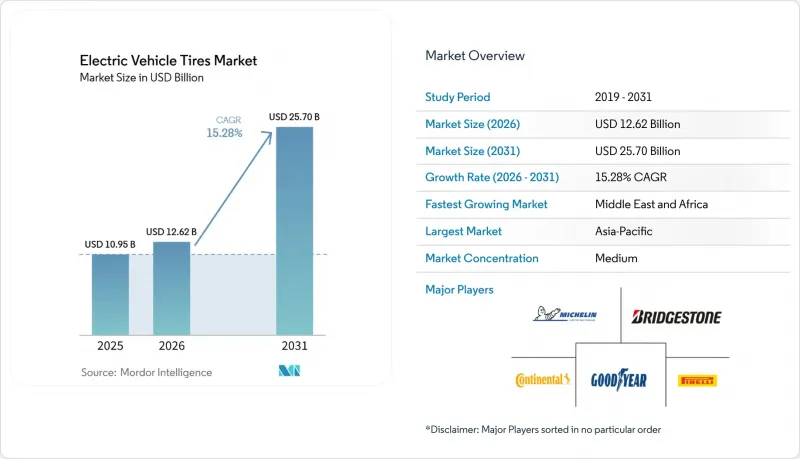
본 보고서는 구동 방식(배터리 전기자동차(BEV), PHEV 등), 차종(승용차, 소형 상용차(LCV) 등), 용도(온로드 및 오프로드), 림 크기(13-15인치, 16-18인치, 기타),판매 채널, 그리고 지역별로 분류되어 있습니다. 시장 전망은 금액(달러) 및 수량(대수)으로 제시되어 있습니다.
전 세계 전기차용 타이어 시장 동향 및 인사이트
전 세계 전기차(EV) 생산 및 판매의 급증
세계 전기차(EV) 생산은 눈부신 성장을 이루고 있으며, 중국이 가장 큰 점유율을 차지하고 있고, 유럽이 그 뒤를 잇고 있습니다. 국제에너지기구(IEA)는 향후 몇년내에 전기차가 신규 승용차 등록의 대부분을 차지하게 될 것으로 예측하고 있으며, 이는 전기차용 타이어 시장의 장기적인 성장을 견인할 것입니다. 조립 공장에서는 스페어 타이어를 포함해 차량 1대당 5개의 타이어가 필요하기 때문에 생산량 증가는 직접적으로 타이어 수요 증가로 이어집니다. 최근 생산 동향을 보면 단기적인 재고 조정이 이루어지고 있음을 알 수 있습니다. 그럼에도 불구하고, OEM(원청 브랜드 제조업체) 각사는 공급업체 목록을 축소하고 있습니다. 특히 콘티넨탈은 현재 대량 생산을 하는 전기차 제조업체 대부분에 공급하며 경제 규모를 확대되고 있습니다. 동남아시아나 멕시코 등지에서 생산 거점이 확대됨에 따라 물류는 점점 더 복잡해지고 있습니다. 이러한 변화는 현지에서 가황 시설을 보유한 세계 공급업체에게 경쟁 우위를 가져다주고 있습니다.
OEM 각사가 주력하는 주행 거리를 연장하는 저회전저항 타이어
구름 저항은 고속도로에서 에너지 소비의 최대 30%를 차지하며, 타이어 선정은 주행 거리 우려를 해소하기 위한 중요한 수단이 되고 있습니다. 콘티넨탈의 ‘EcoContact 7’은 EU 규정 2020/740에 따라 ‘A’ 등급을 획득했으며, 이전 모델에 비해 구름 저항을 15% 줄였습니다. 이에 반해 미쉐린은 2026년 3월에 출시한 ‘Primacy 5 Energy’에서 실리카를 풍부하게 배합한 트레드 화학 조성 덕분에 주행 거리를 최대 10% 향상시켰습니다. EU의 라벨 제도는 에너지 소비를 효과적으로 절감하고 있으며, 앞으로도 지속적인 에너지 절약 효과가 기대됩니다. 한편, 미국에서는 NHTSA(미국 도로교통안전국)가 기업 평균 연비(CAFE) 목표를 달성하기 위한 비용 대비 효과가 높은 해결책으로 ROLL10 및 ROLL20 기술을 인증했습니다. 이러한 정책을 통해 첨단 계산 모델링에 대한 예산이 유지되고, 공급업체가 컴파운드 최적화에 집중하도록 유도함으로써, 트레드 깊이가 접지력이나 내구성을 저해하지 않도록 보장하고 있습니다.
원자재 가격 변동 및 공급망 리스크
동남아시아의 폭풍우로 인해 라텍스 공급이 차질을 빚고, 농장이 팜유 생산으로 전환되면서 이용 가능한 경작 면적이 감소함에 따라 천연고무 가격은 1년여 만에 최고치를 기록했습니다. 지속적인 공급 부족으로 인해 수급 불균형이 발생하여 이익률에 압박을 가하고 있습니다. 한편, 원유 가격 변동과 밀접하게 연관된 합성고무 가격은 큰 폭의 변동을 보이고 있습니다. 원가의 대부분을 원유 연동 원자재가 차지하는 인도 제조업체들은 원유 가격 상승에 따라 이익률 하락을 겪었습니다. 이러한 가격 변동에 대응하여 각사는 헤지 전략 도입 및 원료 다각화를 추진하고 있습니다. 이러한 상품 가격 변동에 대응하기 위해 콘티넨탈사는 시장 변동에 대한 완충 장치로서 재생 가능 소재의 함유율을 높이는 목표를 세웠습니다.
부문별 분석
2025년에는 배터리식 전기차(BEV)가 전기차용 타이어 시장의 72.34%를 차지하며, 승용차 및 소형 상용차에서의 보급 확대를 반영해 시장을 주도했습니다. 연료전지 전기차(FCEV)의 경우, 일본과 한국이 수소 공급 네트워크에 대한 지원을 하고 있기 때문에 2031년까지 연평균 성장률(CAGR) 17.12%를 나타낼 것으로 예측됩니다.
혼다의 ‘CR-V e:FCEV’는 차축 후방에 수소 탱크를 배치하고, 차량 중량을 감당할 수 있도록 타이어를 활용한 세련된 디자인이 특징입니다. 배터리 전기차(BEV)용 타이어 공급은 전 세계적으로 확대될 수 있지만, 수소연료전지차(FCEV)의 생산 대수가 제한적이기 때문에 전용 금형 도입은 타당성이 없습니다. 이러한 제약으로 인해 공급업체들은 BEV용 타이어 케이싱에 약간의 화학적 변경을 가해 대응할 수밖에 없는 상황입니다. 그러나 인프라 발전이 따라잡는다면, FCEV가 주도하는 전기차용 타이어 시장은 프리미엄 브랜드가 수소 대응 컴파운드에 진출할 절호의 기회가 될 가능성이 있습니다. ISO의 조화 지연이 전 세계 형식 인증에 과제를 안겨주는 한편, UNECE의 ‘컨보이 얼라인먼트 규정’은 모든 전동화 구동계에서 구름 저항 및 마모 기준을 표준화하는 데 진전을 보이고 있습니다.
2025년에는 승용차가 매출의 64.18%를 차지했으나, EU가 2030년까지 CO2 배출량을 45% 감축할 것을 요구하는 가운데, 대형 상용차는 연평균 성장률(CAGR) 16.06%로 확대되며 시장 점유율을 높일 것으로 예측됩니다.
콘티넨탈의 ‘Conti Efficient Pro’는 디젤 차량에 비해 30% 더 무거운 트랙터를 지탱하면서도 효율성을 저하시키지 않기 위해 필요한 기술적 도약을 입증하고 있습니다. 또한, 주요 전자상거래 기업들이 탄소 중립 물류를 추구하는 가운데 소형 상용 밴도 급속히 보급되고 있으며, 아마존, DHL, UPS는 유럽 및 북미 전역에서 전기 구동 시스템의 채택을 의무화하고 있습니다. 림 직경의 확대(18-20인치)와 하중 지수의 향상으로 발열량은 증가하지만, 타이어 1개당 400-800달러라는 프리미엄 가격 책정이 판매 대수 감소를 상쇄하고 있습니다. 조기 도입 시장에서는 승용차의 성장세가 둔화되고 있지만, 크로스오버 차량과 SUV가 교체 수요의 주축을 이루고 있어, 전기차용 타이어 시장은 경기 순환을 넘어 견조한 모습을 유지하고 있습니다.
지역별 분석
중국을 핵심으로 하는 아시아태평양은 2025년 전기차용 타이어 시장의 54.63%를 차지했습니다. 타이어의 국내 생산 대수가 대폭 증가하여 시장을 활성화시키고 있습니다. 무역 마찰을 극복하기 위해 중쯔(Zhongce), 지타이(Giti), 사이룬(Sailun) 등의 중국 기업들은 해외 가황 능력을 확대되고 있습니다. 그러나 국내 재고가 증가하고 있어 가격 상승에 따른 압박을 받고 있습니다. 인도에서 전기차 판매 대수가 계속 증가하는 가운데, 브리지스톤은 푸네 공장에 투자하고 있으며, 콘티넨탈은 새로운 생산 라인에 자금을 배정하고 있습니다. MRF는 타타, 마힌드라 및 수많은 신흥 이륜차 프로젝트를 지원하고 있습니다. 한편, JK 타이어는 EKA 모빌리티와 제휴하여 상용 전기차 타이어 케이싱에 첨단 커넥티드 센서를 탑재하고 있습니다.
시장에서 큰 점유율을 차지하는 북미와 유럽은 프리미엄 A등급 부문에서 매우 중요한 역할을 하고 있습니다. 이는 EU의 라벨링 기준과 캘리포니아주의 ‘어드밴스드 클린 트럭(ACT)’ 규제로 인해 성능 기준이 상향 조정되고 있기 때문에 특히 두드러집니다. EU의 미세 플라스틱 규제 및 미국의 6PPD 규정을 준수하기 위해 각 공급업체들은 재활용 고무와 바이오 유래 충진재를 제품 로드맵에 반영하는 움직임을 강화하고 있습니다. 이러한 변화로 인해 인증 주기가 단축되고 리드타임이 장기화되는 경향도 나타나고 있습니다.
중동 및 아프리카는 규모는 작지만, UAE와 사우디아라비아가 충전 네트워크에 정부 펀드를 투입하고 제로 배출 할당량을 의무화하고 있어, 2031년까지 연평균 성장률(CAGR) 15.74%로 가장 높은 성장세를 보일 것으로 예측됩니다. 50°C를 넘는 높은 주변 온도는 산화를 촉진하므로, 오존 내성이 있는 폴리머를 우선적으로 사용한 컴파운드 조정이 요구되고 있습니다. 남미는 출발이 늦었지만, 중국계 OEM의 현지 BEV 조립에 대한 브라질의 세제 혜택 조치로 인해 성장세가 가속화되고 있습니다. 다만, 인프라 및 가격 측면의 문제가 여전히 단기적인 성장을 억제하고 있습니다. 이러한 지역적 요인들이 복합적으로 작용하여, 전기차용 타이어 시장은 경제 사이클이나 규제 체제와 관계없이 다양성을 유지하고 있습니다.
기타 혜택:
- 엑셀 형식 시장 예측(ME) 시트
- 3개월간의 애널리스트 지원
자주 묻는 질문
목차
제1장 서론
제2장 조사 방법
제3장 개요
제4장 시장 구도
제5장 시장 규모와 성장 예측
제6장 경쟁 구도
제7장 시장 기회와 향후 전망
JHS 26.09.01According to Mordor Intelligence, the electric vehicle tires market size is expected to be USD 10.95 billion in 2025, USD 12.62 billion in 2026, and reach USD 25.70 billion by 2031, growing at a CAGR of 15.28% from 2026 to 2031.
This report is Segmented by Propulsion Type (Battery Electric Vehicle (BEV), Plug-In Hybrid Electric Vehicle (PHEV), and More), Vehicle Type (Passenger Cars, Light Commercial Vehicles (LCVs), and More), Application (On-Road and Off-Road), Rim Size (13-15 Inches, 16-18 Inches, and More), Sales Channel, and Geography. The Market Forecasts are Provided in Terms of Value (USD) and Volume (Units).
Global Electric Vehicle Tires Market Trends and Insights
Surge in Global EV Production and Sales
Global electric vehicle (EV) production has seen significant growth, with China contributing the largest share and Europe following. The International Energy Agency forecasts that EVs will dominate new passenger-car registrations in the coming years, driving long-term growth in the electric vehicle tires market. Assembly plants require five tires per vehicle, including spares, which directly translates production increases into higher tire demand. Recent production trends indicate short-term inventory adjustments. Despite this, original equipment manufacturers (OEMs) are narrowing their supplier lists. Notably, Continental now serves most of the high-volume EV producers, improving its economic scale. As production hubs expand in regions like Southeast Asia and Mexico, logistics are becoming increasingly complex. This shift provides a competitive advantage to global suppliers with localized curing facilities.
OEM Focus on Range-Boosting Low-Rolling-Resistance Tires
Rolling resistance accounts for as much as 30% of highway energy draw, making tire selection a prime lever in easing range anxiety. Continental's EcoContact 7 received an A label under EU Regulation 2020/740, achieving a 15% reduction in rolling resistance compared to its predecessor . Michelin responded with the Primacy 5 Energy, launched in March 2026, delivering up to a 10% range uplift through silica-rich tread chemistry . The EU label program has effectively reduced energy consumption and is projected to continue saving energy over time. Meanwhile, in the U.S., the NHTSA has identified ROLL10 and ROLL20 technologies as cost-effective solutions for meeting Corporate Average Fuel Economy targets. These policies sustain high computational modeling budgets and encourage suppliers to focus on compound optimization, ensuring tread depth does not compromise grip or longevity.
Raw Material Price Volatility and Supply-Chain Risk
Natural rubber prices reached their highest level in over a year due to storms in Southeast Asia disrupting latex flows and a shift in plantations towards palm oil, which reduced available acreage. Continuous supply deficits have created a demand-supply imbalance, putting pressure on profit margins. Meanwhile, synthetic rubber prices, closely tied to crude oil volatility, have fluctuated significantly. Indian producers, with crude-linked inputs accounting for a substantial portion of their costs, experienced margin declines as oil prices rose. This volatility has prompted them to adopt hedging strategies and diversify their feedstock. In response to such commodity fluctuations, Continental has set a target to increase its renewable content to buffer against market swings.
Other drivers and restraints analyzed in the detailed report include:
- Accelerated EV Tire-Wear Boosting Replacement Demand
- Stricter Tire Energy-Label and Noise Regulations
- High R&D and Tooling Cost for EV-Specific Compounds
For complete list of drivers and restraints, kindly check the Table Of Contents.
Segment Analysis
Battery Electric Vehicles (BEVs) dominated the electric vehicle tires market with a 72.34% share in 2025, reflecting their prevalence in passenger and light-commercial applications. Fuel-Cell Electric Vehicles (FCEVs) are forecast to grow at a 17.12% CAGR through 2031 as Japan and South Korea subsidize hydrogen dispensing corridors.
Honda's CR-V e:FCEV showcases design nuances, utilizing tires to handle a curb weight, with hydrogen tanks positioned behind the axle. While tire supply for Battery Electric Vehicles (BEVs) is scalable globally, the limited volume of Fuel Cell Electric Vehicles (FCEVs) hasn't justified specialized tooling. This constraint nudges suppliers to adapt BEV casings with minor chemical modifications. Yet, if infrastructure advancements keep pace, the electric vehicle tires market, driven by FCEVs, could present a prime opportunity for premium brands to delve into hydrogen-compatible compounds. While a lag in ISO cohesion poses challenges for global homologation, UNECE's convoy alignment rule marks progress in standardizing rolling-resistance and abrasion benchmarks across all electrified drivetrains.
Passenger cars accounted for 64.18% of revenues in 2025, yet heavy commercial vehicles are expected to expand at a 16.06% CAGR, lifting their market share amid EU demands for a 45% CO2 cut by 2030.
Continental's Conti Efficient Pro demonstrates the engineering leap needed to support tractors weighing 30% more than diesel peers without eroding efficiency. Light commercial vans are also being rapidly adopted as e-commerce leaders pursue carbon-neutral logistics, with Amazon, DHL, and UPS specifying electric drivetrains across Europe and North America. Higher rim diameters (18-20 inches) and load indices intensify heat build-up, but premium pricing-USD 400-800 per tire-offsets lower unit volumes. While passenger-car growth is moderating in early-adopter markets, crossovers and SUVs anchor replacement demand, keeping the electric vehicle tires market resilient across cycles.
Complete Report Scope:
- By Propulsion Type
- Battery Electric Vehicle (BEV)
- Plug-in Hybrid Electric Vehicle (PHEV)
- Hybrid Electric Vehicle (HEV)
- Fuel-Cell Electric Vehicle (FCEV)
- By Vehicle Type
- Passenger Cars
- Light Commercial Vehicles (LCVs)
- Heavy Commercial Vehicles (HCVs)
- Buses and Coaches
- By Application
- On-Road
- Off-Road
- By Rim Size
- 13-15 Inches
- 16-18 Inches
- 19-21 Inches
- Above 21 Inches
- By Sales Channel
- OEM
- Aftermarket
- By Geography
- North America
- United States
- Canada
- Rest of North America
- South America
- Brazil
- Argentina
- Rest of South America
- Europe
- United Kingdom
- Germany
- Spain
- Italy
- France
- Russia
- Rest of Europe
- Asia-Pacific
- India
- China
- Japan
- South Korea
- Rest of Asia-Pacific
- Middle East and Africa
- United Arab Emirates
- Saudi Arabia
- Turkey
- Egypt
- South Africa
- Rest of Middle East and Africa
- North America
Geography Analysis
Asia-Pacific, anchored by China, secured 54.63% of the electric vehicle tires market in 2025. Domestic production of tire units has significantly increased, energizing the market. To navigate trade frictions, Chinese firms like Zhongce, Giti, and Sailun are expanding their overseas curing capacities. However, with domestic inventories on the rise, they're feeling the squeeze of rising prices. As India's EV sales continue to grow, Bridgestone has invested in its Pune facility, while Continental has allocated funds for new production lines. MRF is catering to Tata, Mahindra, and a host of emerging two-wheeler initiatives. Meanwhile, JK Tire has partnered with EKA Mobility, integrating advanced connected sensors into commercial EV casings .
North America and Europe, together accounting for a significant share of the market, play a pivotal role in the premium A-rated segment. This is especially true as EU labeling standards and California's Advanced Clean Trucks regulation elevate performance benchmarks. To align with EU microplastic mandates and U.S. 6PPD restrictions, suppliers are increasingly incorporating recycled rubber and bio-based fillers into their roadmaps. This shift is also leading to tighter qualification cycles and extended lead times.
The Middle East and Africa, though small, are forecast to post the fastest CAGR of 15.74% through 2031, as the UAE and Saudi Arabia allocate sovereign funds to charging networks and mandate zero-emission quotas. Elevated ambient temperatures above 50 °C hasten oxidation, forcing compound tweaks that favor ozone-resistant polymers. South America lags but gains momentum via Brazilian tax waivers for local BEV assembly by Chinese OEMs, although infrastructure and affordability still curb near-term upside. Together, these regional vectors keep the electric vehicle tires market diversified across economic cycles and regulatory regimes.
- Michelin
- Bridgestone Corporation
- Continental Tires
- Goodyear Tire and Rubber Company
- Pirelli & C S.p.A.
- Yokohama Rubber Co., Ltd.
- Hankook Tire and Technology Co., Ltd.
- Sumitomo Rubber Industries, Ltd.
- Nokian Tyres
- Apollo Tyres Limited
- MRF Ltd
- Zhongce Rubber (ZC Rubber)
- Giti Tire
- Sailun Group Co., Ltd.
- Kumho Tire
- Triangle Tire
- Toyo Tires
- Maxxis Tyres (Cheng Shin Rubber Industry Co.)
- CEAT Limited
Additional Benefits:
- The market estimate (ME) sheet in Excel format
- 3 months of analyst support
TABLE OF CONTENTS
1 Introduction
- 1.1 Study Assumptions & Market Definition
- 1.2 Scope of the Study
2 Research Methodology
3 Executive Summary
4 Market Landscape
- 4.1 Market Overview
- 4.2 Market Drivers
- 4.2.1 Surge in Global EV Production and Sales
- 4.2.2 OEM Focus on Range-Boosting Low-Rolling-Resistance Tires
- 4.2.3 Accelerated EV Tire-Wear Boosting Replacement Demand
- 4.2.4 Stricter Tire Energy-Label and Noise Regulations
- 4.2.5 OEM Warranty Need for High-Load EV Tire Designs
- 4.2.6 Smart-Sensor Tire Adoption Unlocking New Revenue Streams
- 4.3 Market Restraints
- 4.3.1 Raw Material Price Volatility and Supply-Chain Risk
- 4.3.2 High R&D and Tooling Cost for EV-Specific Compounds
- 4.3.3 Sustainability Scrutiny on Synthetic-Rubber Lifecycle
- 4.3.4 Absence of Unified EV-Tire Performance Certification
- 4.4 Value / Supply-Chain Analysis
- 4.5 Regulatory Landscape
- 4.6 Technological Outlook
- 4.7 Porter's Five Forces
- 4.7.1 Threat of New Entrants
- 4.7.2 Bargaining Power of Suppliers
- 4.7.3 Bargaining Power of Buyers
- 4.7.4 Threat of Substitutes
- 4.7.5 Competitive Rivalry
5 Market Size & Growth Forecasts (Value (USD) and Volume (Units))
- 5.1 By Propulsion Type
- 5.1.1 Battery Electric Vehicle (BEV)
- 5.1.2 Plug-in Hybrid Electric Vehicle (PHEV)
- 5.1.3 Hybrid Electric Vehicle (HEV)
- 5.1.4 Fuel-Cell Electric Vehicle (FCEV)
- 5.2 By Vehicle Type
- 5.2.1 Passenger Cars
- 5.2.2 Light Commercial Vehicles (LCVs)
- 5.2.3 Heavy Commercial Vehicles (HCVs)
- 5.2.4 Buses and Coaches
- 5.3 By Application
- 5.3.1 On-Road
- 5.3.2 Off-Road
- 5.4 By Rim Size
- 5.4.1 13-15 Inches
- 5.4.2 16-18 Inches
- 5.4.3 19-21 Inches
- 5.4.4 Above 21 Inches
- 5.5 By Sales Channel
- 5.5.1 OEM
- 5.5.2 Aftermarket
- 5.6 By Geography
- 5.6.1 North America
- 5.6.1.1 United States
- 5.6.1.2 Canada
- 5.6.1.3 Rest of North America
- 5.6.2 South America
- 5.6.2.1 Brazil
- 5.6.2.2 Argentina
- 5.6.2.3 Rest of South America
- 5.6.3 Europe
- 5.6.3.1 United Kingdom
- 5.6.3.2 Germany
- 5.6.3.3 Spain
- 5.6.3.4 Italy
- 5.6.3.5 France
- 5.6.3.6 Russia
- 5.6.3.7 Rest of Europe
- 5.6.4 Asia-Pacific
- 5.6.4.1 India
- 5.6.4.2 China
- 5.6.4.3 Japan
- 5.6.4.4 South Korea
- 5.6.4.5 Rest of Asia-Pacific
- 5.6.5 Middle East and Africa
- 5.6.5.1 United Arab Emirates
- 5.6.5.2 Saudi Arabia
- 5.6.5.3 Turkey
- 5.6.5.4 Egypt
- 5.6.5.5 South Africa
- 5.6.5.6 Rest of Middle East and Africa
- 5.6.1 North America
6 Competitive Landscape
- 6.1 Market Concentration
- 6.2 Strategic Moves
- 6.3 Market Share Analysis
- 6.4 Company Profiles (Includes Global Level Overview, Market Level Overview, Core Segments, Financials as Available, Strategic Information, Market Rank/Share for Key Companies, Products and Services, SWOT Analysis, and Recent Developments)
- 6.4.1 Michelin
- 6.4.2 Bridgestone Corporation
- 6.4.3 Continental Tires
- 6.4.4 Goodyear Tire and Rubber Company
- 6.4.5 Pirelli & C S.p.A.
- 6.4.6 Yokohama Rubber Co., Ltd.
- 6.4.7 Hankook Tire and Technology Co., Ltd.
- 6.4.8 Sumitomo Rubber Industries, Ltd.
- 6.4.9 Nokian Tyres
- 6.4.10 Apollo Tyres Limited
- 6.4.11 MRF Ltd
- 6.4.12 Zhongce Rubber (ZC Rubber)
- 6.4.13 Giti Tire
- 6.4.14 Sailun Group Co., Ltd.
- 6.4.15 Kumho Tire
- 6.4.16 Triangle Tire
- 6.4.17 Toyo Tires
- 6.4.18 Maxxis Tyres (Cheng Shin Rubber Industry Co.)
- 6.4.19 CEAT Limited
7 Market Opportunities & Future Outlook
- 7.1 White-Space & Unmet-Need Assessment


