

|
시장보고서
상품코드
2117433
커넥티드 타이어 시장 : 점유율 분석, 업계 동향과 통계, 성장 예측(2026-2031년)Connected Tires - Market Share Analysis, Industry Trends & Statistics, Growth Forecasts (2026 - 2031) |
||||||
 Mordor Intelligence
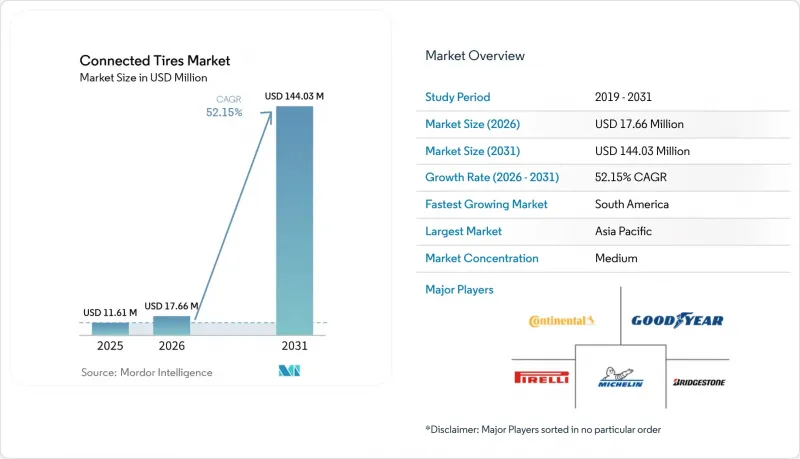
Mordor Intelligence에 의하면, 커넥티드 타이어 시장 규모는 2025년 1,161만 달러에서 2026년에는 1,766만 달러로 확대되어 2026년부터 2031년까지 CAGR 52.15%로 성장을 지속하여, 2031년에는 1억 4,403만 달러에 이를 것으로 예측됩니다.
본 보고서는 구성 요소(TPMS 등), 연결 기술(블루투스 등), 림 크기(12-17인치 등), 구동 방식(ICE 등), 차종(승용차 등), 판매 채널(OEM 및 애프터마켓), 그리고 지역별로 분류되어 있습니다. 시장 전망은 금액(달러) 및 수량(단위)으로 제시되어 있습니다.
세계 커넥티드 타이어 시장 동향 및 인사이트
EV가 주도하는 하중 지지형 스마트 타이어 수요
배터리식 전기차(BEV)는 동등한 내연기관 차량 플랫폼에 비해 무게가 20-30% 증가하기 때문에 타이어에 가해지는 하중이 커지고, 비대칭 마모가 발생하기 쉽습니다. 내장된 스트레인 게이지와 3축 가속도계가 5밀리초마다 변형 데이터를 차량의 ECU로 전송함으로써, 마모가 가속화되기 전에 소프트웨어가 토크와 감쇠력을 조정할 수 있게 되었습니다. 피렐리의 ‘사이버 타이어’는 실제 도로 테스트에서 시속 70마일에서의 긴급 제동 거리를 10피트 단축했으며, 애스턴 마틴의 2027년형 모델에 최초로 탑재될 예정입니다. 프리미엄 전기차(EV)가 전 세계적으로 보급되는 가운데, 타이어 텔레메트리 기술은 주행 거리 연장과 보증 비용 절감을 위한 최전선의 차별화 요인으로 부상하고 있습니다.
플릿의 예측 유지보수 및 가동률에 대한 집중
클래스 7-8 차량을 운영하는 차량 대여 업체는 타이어 관련 위반 1건당 막대한 벌금을 부과받을 뿐만 아니라, 도로에서 단 한 번이라도 고장이 발생하기만 해도 보험료가 급격히 상승하게 됩니다. 2026년 3월에 발표된 미쉐린의 ‘스마트 프레딕티브 타이어’는 미국 주간 고속도로에서 실시된 파일럿 테스트를 통해 도로상 사고를 대폭 줄이고 연비 효율을 향상시킨다는 사실이 입증되었습니다. 콘티넨탈의 ‘ContiConnect’는 현재 다수의 커넥티드 타이어를 모니터링하고 있으며, 비교적 짧은 투자 회수 기간을 실현하고 있습니다. 이를 통해 장거리 운송업체들은 사후 대응형 타이어 교체에서 AI 기반 일정 관리 로테이션으로 전환하게 되어 가동 중단 시간을 대폭 줄이고 있습니다.
고가의 센서 패키지와 가혹한 사용 환경에서의 신뢰성
비용은 중간 수준에 머물러 있지만, 다기능 TPMS 모듈은 중급 타이어의 가격을 소폭 상승시키기 때문에 비용에 민감한 OEM 제조업체에게는 도입 장벽이 되고 있습니다. 기온 변동이 심한 가혹한 기후 조건에서는 배터리 수명이 단축되며, 구형 센서의 경우 현저한 고장률이 나타납니다. TDK와 굿이어는 배터리 의존도를 낮추기 위한 압전식 에너지 수확 프로토타입을 개발했으나, 그 상업적 성공 여부는 극히 경쟁력 있는 가격 책정이 가능하느냐에 달려 있습니다.
부문 분석
EU의 ‘디지털 제품 여권’에 따라 2028년까지 일련번호를 통한 타이어 추적이 의무화됨에 따라, RFID 칩은 예측 기간(2026-2031년) 동안 연평균 성장률(CAGR) 52.17%를 기록할 전망이며, 이는 구성 부품 중 가장 높은 성장률입니다. 미쉐린과 Beontag는 5,000만 개 이상의 4세대 UHF TireTag를 탑재했으며, 2026년 말까지 1억 개를 목표로 하고 있습니다. TPMS는 2025년 매출의 63.37%를 차지하고 있지만, 배터리 교체 주기와 단가 압박으로 인해 향후 성장은 수동형 무정비 RFID로 전환될 전망입니다. RFID를 활용한 커넥티드 타이어 시장 규모는 예측 기간 후반에 TPMS 매출을 넘어설 것으로 예상되며, 이는 OEM이 식별과 원격 측정이라는 이중 용도를 선호하는 경향을 반영합니다. 가속도 센서 및 스트레인 게이지 패키지는 여전히 전기차(EV)의 프리미엄 기능이지만, 시스템 온 칩(SoC) 설계로 인해 평균 판매 가격(ASP)이 하락하면 보급이 확대될 것입니다. 통합 IC가 4mm 실적에 압력, 온도, 움직임 측정 기능을 통합함에 따라 부품 간의 경계가 모호해지고, 식별용 RFID와 실시간 데이터 스트림용 TPMS 모듈이 정착하게 될 것입니다.
센서의 통합으로 SKU 수는 감소하고 있습니다. 인피니언의 SP490-01-11에는 Cortex-M0+, MEMS 압력 다이, Z축 가속도 센서 및 315 MHz 송신기가 내장되어 있어, 암호화 처리 부하 하에서도 10년의 배터리 수명을 실현합니다. NXP의 NTM88Kxx5S는 2축의 허용 범위를 ±550 g까지 확대하여, 높은 G의 급격한 가속도가 발생하는 쓰레기 수거차나 트랙터에 적합합니다. 한편, 800%의 성장률로 테스트된 그래핀 기반 스트레인 게이지(strain gauge)는 초유연한 케이싱의 길을 열어주고 있지만, 상용화는 2030년 이후가 될 전망입니다. 뛰어난 구성 요소는 다기능 실리콘과 수동형 RFID를 융합한 것으로, 이 모델을 통해 단일 타이어로 규제 요건과 차량 자산 추적 요건을 모두 충족할 수 있게 됩니다.
차량 함대의 OTA 펌웨어 업데이트, 지오펜스 기반 알림, 클라우드 분석에 대한 수요가 증가함에 따라 4G/5G 셀룰러 통신은 연평균 성장률(CAGR) 52.21%를 기록할 전망입니다. 이 모든 것은 블루투스의 10미터라는 통신 거리 제한으로는 대응할 수 없습니다. 블루투스는 2025년 매출의 38.71%를 차지하지만, 그 점유율의 대부분은 스마트폰과 페어링된 승용차용 TPMS에서 비롯된 것입니다. 피렐리(Pirelli)사의 바리(Bari) 시범 프로젝트에서는 5G를 통해 1.5마일 떨어진 교통 관제 센터로 마찰 데이터를 스트리밍하여 광역 V2X 알림의 유효성을 입증했습니다. 학술적 비교 시험에 따르면, LoRa는 저대역폭 핑에서 98%의 패킷 전달률을 달성하고 있지만, 가속도계의 동영상 스트림에서는 처리 능력이 부족한 반면, 5G는 이를 원활하게 처리하고 있습니다. Wi-Fi는 여전히 실험실 수준에 머물러 있는 반면, 북미에서는 DSRC가 쇠퇴하고 있으며, 그 대신 C-V2X가 주파수 대역 재할당을 확보하고 있습니다.
현재 하이브리드 칩에는 멀티모드 무선 기능이 탑재되어 있습니다. 인피니언(Infineon)의 SP490은 315 MHz RF와 블루투스 LE를 통합하고 있으며, 퀘크텔(Quectel)의 AG35 4G Cat 4 모듈에는 OEM이 펌웨어를 통해 활성화할 수 있는 TPMS API가 내장되어 있습니다. 공유 SIM의 가입자당월요금이 1달러 미만으로 떨어짐에 따라, 커넥티드 타이어 시장은 차량용으로는 셀룰러 통신으로, 비용 제약이 있는 자가용으로는 블루투스로 수렴되고 있습니다. 기존의 315 MHz 솔루션은 초저전력 대안으로서 당분간 남아 있겠지만, 5G RedCap 모듈의 가격이 4달러 미만으로 떨어지면 사실상 구식화될 것입니다.
지역별 분석
2025년에는 중국의 전국적인 TPMS 의무화와 세계 최고의 EV 생산 대수에 힘입어 아시아태평양이 매출의 38.81%를 차지하며 시장을 주도했습니다. 브리지스톤과 요코하마 고무는 향후 순환형 경제 규제를 준수하기 위해 공장 출하 시 RFID 태그를 내장하고 있습니다. 한편, 넥센은 주행 거리 기반 계약을 시범 도입하여 한국의 플릿용 타이어 예산을 최대 18% 절감하고 있습니다. 인도에서는 규제 지연으로 인해 도입이 고급 SUV와 이용 빈도가 높은 물류 트럭으로 제한되고 있습니다. 그러나 정책 초안에는 센서 장착 의무화가 시사되어 있어, 2028년까지 잠재 수요를 자극할 가능성이 있습니다. 중국의 연결성 단편화와 데이터 현지화 법은 지역 고유의 펌웨어를 만들어내고 있지만, 센서 총 출하량 증가세를 둔화시키지는 않을 것입니다.
남미는 가장 빠르게 성장하는 지역으로, 2031년까지 연평균 성장률(CAGR)이 52.33%를 나타낼 것으로 예측됩니다. 콘티넨탈은 브라질 내 다수의 차량에 수천 개의 커넥티드 타이어를 장착하고, 여러 개의 ‘ContiConnect’ 트럭 허브를 설립함으로써 브라질을 스마트 타이어의 최대 시장 중 하나로 자리매김하고 있습니다. 미쉐린은 가까운 시일 내에 상파울루에서 ‘SmartLoad AI’ 서비스를 시작할 예정입니다. 이를 통해 디지털 트윈을 활용한 수명 예측을 주행 거리(레인 킬로미터) 기반의 과금 시스템에 도입하게 됩니다. 이러한 움직임은 해당 지역의 열대 기후로 어려움을 겪고 있는 운송업체들로부터 큰 호응을 얻고 있습니다. 광업이 주를 이루는 아르헨티나에서는 단 한 번의 외딴 지역에서의 타이어 펑크만으로도 가동이 장기간 중단되기 때문에 해당 국가의 경제 변동에도 불구하고 센서의 급속한 보급이 진행되고 있습니다.
북미와 유럽에서는 TPMS 도입이 거의 보편화되었으나, 초점은 트레드 깊이 모니터링, V2X 통신, OTA(Over-the-Air)를 통한 보안과 같은 고급 기능으로 점차 이동하고 있습니다. 향후 몇년내에 시행될 예정인 EU 데이터법은 운전자에게 원시 센서 데이터를 내보낼 권리를 부여하고 있어, 제3자에 의한 분석 사업의 길을 열어줄 것입니다. 미국에서는 주요 제조업체가 제공하는 ‘타이어 애즈 어 서비스(TaaS)’ 모델을 차량 함대가 점점 더 많이 채택하고 있으며, 단기적인 투자 회수가 입증됨에 따라 재무 담당자들은 대형 차량에 대한 사후 장착 도입을 추진하고 있습니다. 중동 및 아프리카에서는 도입 대수가 뒤처지고 있지만, 극심한 기온으로 인한 과제를 해결하기 위해 센서를 활용하고 있으며, 이러한 지역에서는 타이어 펑크가 심각한 안전 위험을 초래합니다. 지역별 차이는 규제, 차량 관리 업체의 성숙도, 그리고 이동통신 서비스 지역의 경제성 등의 요소가 상호 작용한 결과를 반영합니다.
기타 혜택:
- 엑셀 형식 시장 예측(ME) 시트
- 3개월간의 애널리스트 지원
자주 묻는 질문
목차
제1장 서론
제2장 조사 방법
제3장 개요
제4장 시장 구도
제5장 시장 규모와 성장 예측
제6장 경쟁 구도
제7장 시장 기회와 향후 전망
JHS 26.09.01According to Mordor Intelligence, the connected tires market size is expected to grow from USD 11.61 million in 2025 to USD 17.66 million in 2026, and is forecast to reach USD 144.03 million by 2031, at a 52.15% CAGR over 2026-2031.
This report is Segmented by Component (TPMS and More), Connectivity Technology (Bluetooth and More), Rim Size (12-17 Inches and More), Propulsion Type (ICE and More), Vehicle Type (Passenger Cars and More), Sales Channel (OEM and Aftermarket), and Geography. The Market Forecasts are Provided in Terms of Value (USD) and Volume (Units).
Global Connected Tires Market Trends and Insights
EV-Driven Demand for Load-Bearing Smart Tires
Battery electric vehicles add 20-30% weight compared with comparable ICE platforms, increasing tire stress and asymmetric wear. Embedded strain gauges and tri-axial accelerometers now stream deformation data every 5 milliseconds to vehicle ECUs, letting software adjust torque and damping before wear accelerates. Pirelli's Cyber Tire cut emergency stopping distances by 10 feet at 70 mph in road tests and will debut on Aston Martin's 2027 lineup . As premium EVs scale globally, tire telemetry emerges as a frontline differentiator for extending range and curbing warranty costs.
Fleet Focus on Predictive Maintenance & Uptime
Fleets operating Class 7-8 vehicles face significant fines for each tire violation, and a single roadside failure leads to a noticeable increase in their insurance premiums. Michelin's Smart Predictive Tire, unveiled in March 2026, demonstrated a substantial reduction in on-road incidents and improved fuel efficiency during pilot tests on U.S. interstates . Continental's ContiConnect, now monitoring a large number of connected tires, offers a relatively short payback period. This has encouraged long-haul carriers to shift from reactive tire replacements to AI-scheduled rotations, significantly reducing their downtime.
High Sensor-Package Cost & Harsh-Duty Reliability
Costing within a moderate range, multifunction TPMS modules increase the price of a mid-tier tire by a small percentage, which dissuades cost-sensitive OEMs. In extreme climates with significant temperature fluctuations, battery lives diminish, leading to a notable failure rate in older sensors. TDK and Goodyear have developed a piezoelectric energy-harvesting prototype to reduce reliance on batteries, but its commercial success is contingent on achieving highly competitive price points.
Other drivers and restraints analyzed in the detailed report include:
- Regulatory Mandates for TPMS Adoption
- OEM Shift to Mileage-Based "Tire-as-a-Service"
- Fragmented Connectivity Standards & Interfaces
For complete list of drivers and restraints, kindly check the Table Of Contents.
Segment Analysis
RFID chips are on track for a 52.17% CAGR during the forecast period (2026-2031), the fastest in the component mix, as the EU Digital Product Passport mandates serialized tire tracking by 2028. Michelin and Beontag have embedded more than 50 million Gen4 UHF TireTags, with a target of 100 million by year-end 2026. TPMS still commands 63.37% of 2025 revenue, yet battery replacement cycles and unit-cost pressures tilt future gains toward passive, maintenance-free RFID. The connected tires market size for RFID is expected to outpace TPMS revenues in the latter half of the forecast window, reflecting OEM preference for dual-purpose identification and telemetry. Accelerometer and strain-gauge packages remain premium EV features but will proliferate once system-on-chip designs lower ASPs. As integrated ICs merge pressure, temperature, and motion in 4 mm footprints, the component boundary blurs, anchoring RFID for identity and TPMS modules for live data streams.
Sensor convergence is shrinking SKU counts; Infineon's SP490-01-11 embeds a Cortex-M0+, a MEMS pressure die, a z-axis accelerometer, and a 315-MHz transmitter, promising 10-year battery life under cryptographic load. NXP's NTM88Kxx5S ups dual-axis tolerance to +-550 g, suiting waste-haulers and tractors that generate high-g spikes. At the same time, graphene-based strain gauges tested at 800% stretch open pathways for ultra-flexible casings, though commercialization remains post-2030. Component winners will fuse multifunction silicon with passive RFID, a model that addresses regulatory and fleet asset-tracking requirements in a single tire.
Cellular 4G/5G will post a 52.21% CAGR as fleets demand OTA firmware updates, geofenced alerts, and cloud analytics, all of which are unsupported by Bluetooth's 10-meter ceiling. Although Bluetooth led 38.71% 2025 revenue, its foothold is mostly smartphone-paired passenger TPMS. Pirelli's Bari pilot streams friction data over 5G to traffic-control centers 1.5 miles away, validating wide-area V2X alerts. Academic head-to-heads show LoRa achieves 98% packet delivery on low-bandwidth pressure pings but chokes on accelerometer video streams, which 5G handles elegantly. Wi-Fi remains workshop-bound, while DSRC recedes in North America, where C-V2X garners spectrum re-allocations.
Hybrid chips now ship with multi-mode radios. Infineon's SP490 integrates RF 315-MHz and Bluetooth LE; Quectel's AG35 4G Cat 4 module nests a TPMS API that OEMs can unlock via firmware. As subscriber price curves drop below USD 1 per month for pooled SIMs, the connected tires market converges on cellular for fleets and on Bluetooth for cost-constrained private cars. Legacy 315-MHz solutions will linger as ultra-low-power fallbacks but face de facto obsolescence once 5G RedCap modules hit sub-USD 4 pricing.
Complete Report Scope:
- By Component
- TPMS
- Accelerometer Sensors
- Strain-Gauge Sensors
- RFID Chips
- By Connectivity Technology
- Bluetooth
- Cellular (4G/5G)
- Wi-Fi
- V2X
- By Rim Size
- 12-17 Inches
- 18-22 Inches
- Above 22 Inches
- By Propulsion Type
- Internal Combustion Engine
- Battery Electric Vehicle (BEV)
- Plug-in Hybrid EV (PHEV)
- Hybrid EV (HEV)
- Fuel Cell EV (FCEV)
- By Vehicle Type
- Passenger Cars
- Light Commercial Vehicles (LCVs)
- Heavy Commercial Vehicles (HCVs)
- Buses & Coaches
- By Sales Channel
- OEM
- Aftermarket
- By Geography
- North America
- United States
- Canada
- Rest of North America
- South America
- Brazil
- Argentina
- Rest of South America
- Europe
- United Kingdom
- Germany
- Spain
- Italy
- France
- Russia
- Rest of Europe
- Asia-Pacific
- India
- China
- Japan
- South Korea
- Rest of Asia-Pacific
- Middle East and Africa
- United Arab Emirates
- Saudi Arabia
- Turkey
- Egypt
- South Africa
- Rest of Middle East and Africa
- North America
Geography Analysis
Asia-Pacific led with 38.81% revenue in 2025, propelled by China's nationwide TPMS mandate and the world's highest EV production rates. Bridgestone and Yokohama embed RFID tags at the factory to comply with future circular-economy rules. At the same time, Nexen pilots mileage-based contracts that cut South Korean fleet tire budgets by up to 18%. India's regulatory lag confines adoption to premium SUVs and high-utilization logistics trucks; nonetheless, policy drafts signal a forthcoming direct-sensor requirement that could unlock latent demand by 2028. Connectivity fragmentation and data-localization laws in China spawn region-specific firmware but do not slow net sensor volumes.
South America is the fastest climber, forecast for 52.33% CAGR to 2031. Continental has equipped several thousand connected tires on numerous vehicles in Brazil and established multiple ContiConnect truck hubs, positioning Brazil as one of its largest markets for smart tires. Michelin is set to launch its SmartLoad AI in Sao Paulo in the near future, introducing digital-twin lifespan forecasts to lane-kilometer billing, a move that resonates with haulers contending with the region's tropical heat. In Argentina, with its mining-centric focus, a single remote blowout can halt operations for extended periods, driving the swift adoption of sensors despite the nation's economic fluctuations.
While North America and Europe boast nearly universal adoption of TPMS, the focus is shifting towards advanced features like tread-depth monitoring, V2X communication, and over-the-air security. The EU Data Act, set to take effect in the coming years, grants drivers the right to export raw sensor data, paving the way for third-party analytics ventures. In the United States, fleets are increasingly adopting tire-as-a-service models offered by major manufacturers, with documented short-term paybacks prompting financial decision-makers to retrofit heavy-duty vehicles. The Middle East and Africa, while trailing in volume, utilize sensors to address challenges posed by extreme temperatures, where blowouts pose significant safety risks. Regional differences reflect the interplay among regulation, fleet maturity, and cellular coverage economics.
- Bridgestone
- Michelin
- Continental
- Goodyear
- Pirelli
- Hankook
- Yokohama
- Sumitomo Rubber (SRI)
- Sensata Technologies
- Schrader Electronics
- NXP Semiconductors
- DENSO
- Huf Hulsbeck & Furst
- Aptiv
- Infineon
- NIRA Dynamics
- Revvo Technologies
- The SMART Tire Company
- BANF
- Alligator Ventilfabrik
Additional Benefits:
- The market estimate (ME) sheet in Excel format
- 3 months of analyst support
TABLE OF CONTENTS
1 Introduction
- 1.1 Study Assumptions & Market Definition
- 1.2 Scope of the Study
2 Research Methodology
3 Executive Summary
4 Market Landscape
- 4.1 Market Overview
- 4.2 Market Drivers
- 4.2.1 EV-Driven Demand For Load-Bearing Smart Tires
- 4.2.2 Fleet Focus On Predictive Maintenance & Uptime
- 4.2.3 Regulatory Mandates For Tpms Adoption
- 4.2.4 OEM Shift To Mileage-Based "Tire-As-A-Service"
- 4.2.5 Integration With In-Wheel Motor Torque-Vectoring
- 4.2.6 Airless/Sma Tires Enable Persistent Sensing
- 4.3 Market Restraints
- 4.3.1 High Sensor-Package Cost & Harsh-Duty Reliability
- 4.3.2 Fragmented Connectivity Standards & Interfaces
- 4.3.3 Cyber-Security Liability At The Tire Edge
- 4.3.4 Data-Ownership Disputes Slow Ecosystem Uptake
- 4.4 Value / Supply-Chain Analysis
- 4.5 Regulatory Landscape
- 4.6 Technological Outlook
- 4.7 Porter's Five Forces
- 4.7.1 Threat of New Entrants
- 4.7.2 Bargaining Power of Suppliers
- 4.7.3 Bargaining Power of Buyers
- 4.7.4 Threat of Substitutes
- 4.7.5 Competitive Rivalry
5 Market Size & Growth Forecasts (Value (USD) and Volume (Units))
- 5.1 By Component
- 5.1.1 TPMS
- 5.1.2 Accelerometer Sensors
- 5.1.3 Strain-Gauge Sensors
- 5.1.4 RFID Chips
- 5.2 By Connectivity Technology
- 5.2.1 Bluetooth
- 5.2.2 Cellular (4G/5G)
- 5.2.3 Wi-Fi
- 5.2.4 V2X
- 5.3 By Rim Size
- 5.3.1 12-17 Inches
- 5.3.2 18-22 Inches
- 5.3.3 Above 22 Inches
- 5.4 By Propulsion Type
- 5.4.1 Internal Combustion Engine
- 5.4.2 Battery Electric Vehicle (BEV)
- 5.4.3 Plug-in Hybrid EV (PHEV)
- 5.4.4 Hybrid EV (HEV)
- 5.4.5 Fuel Cell EV (FCEV)
- 5.5 By Vehicle Type
- 5.5.1 Passenger Cars
- 5.5.2 Light Commercial Vehicles (LCVs)
- 5.5.3 Heavy Commercial Vehicles (HCVs)
- 5.5.4 Buses & Coaches
- 5.6 By Sales Channel
- 5.6.1 OEM
- 5.6.2 Aftermarket
- 5.7 By Geography
- 5.7.1 North America
- 5.7.1.1 United States
- 5.7.1.2 Canada
- 5.7.1.3 Rest of North America
- 5.7.2 South America
- 5.7.2.1 Brazil
- 5.7.2.2 Argentina
- 5.7.2.3 Rest of South America
- 5.7.3 Europe
- 5.7.3.1 United Kingdom
- 5.7.3.2 Germany
- 5.7.3.3 Spain
- 5.7.3.4 Italy
- 5.7.3.5 France
- 5.7.3.6 Russia
- 5.7.3.7 Rest of Europe
- 5.7.4 Asia-Pacific
- 5.7.4.1 India
- 5.7.4.2 China
- 5.7.4.3 Japan
- 5.7.4.4 South Korea
- 5.7.4.5 Rest of Asia-Pacific
- 5.7.5 Middle East and Africa
- 5.7.5.1 United Arab Emirates
- 5.7.5.2 Saudi Arabia
- 5.7.5.3 Turkey
- 5.7.5.4 Egypt
- 5.7.5.5 South Africa
- 5.7.5.6 Rest of Middle East and Africa
- 5.7.1 North America
6 Competitive Landscape
- 6.1 Market Concentration
- 6.2 Strategic Moves
- 6.3 Market Share Analysis
- 6.4 Company Profiles (includes Global Level Overview, Market Level Overview, Core Segments, Financials as Available, Strategic Information, Market Rank/Share for Key Companies, Products and Services, SWOT Analysis, and Recent Developments)
- 6.4.1 Bridgestone
- 6.4.2 Michelin
- 6.4.3 Continental
- 6.4.4 Goodyear
- 6.4.5 Pirelli
- 6.4.6 Hankook
- 6.4.7 Yokohama
- 6.4.8 Sumitomo Rubber (SRI)
- 6.4.9 Sensata Technologies
- 6.4.10 Schrader Electronics
- 6.4.11 NXP Semiconductors
- 6.4.12 DENSO
- 6.4.13 Huf Hulsbeck & Furst
- 6.4.14 Aptiv
- 6.4.15 Infineon
- 6.4.16 NIRA Dynamics
- 6.4.17 Revvo Technologies
- 6.4.18 The SMART Tire Company
- 6.4.19 BANF
- 6.4.20 Alligator Ventilfabrik
7 Market Opportunities & Future Outlook
- 7.1 White-space & Unmet-Need Assessment


