|
시장보고서
상품코드
2117442
유럽의 타이어 시장 : 점유율 분석, 업계 동향과 통계, 성장 예측(2026-2031년)Europe Tire - Market Share Analysis, Industry Trends & Statistics, Growth Forecasts (2026 - 2031) |
||||||
 Mordor Intelligence
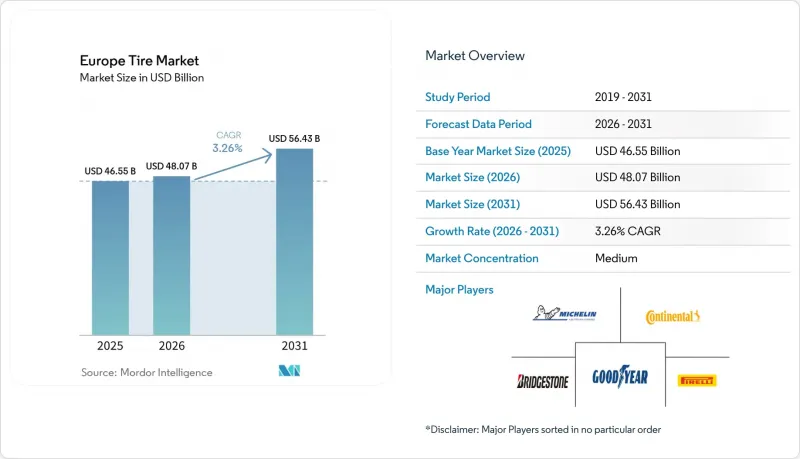
Mordor Intelligence에 의하면, 유럽의 타이어 시장 규모는 2025년에 465억 5,000만 달러로 평가되었고 2026년에는 480억 7,000만 달러로 추정되고 있어 2031년까지 564억 3,000만 달러에 이를 것으로 예측됩니다.
2026년부터 2031년까지 연평균 성장률(CAGR) 3.26%로 성장할 것으로 전망됩니다.
본 보고서는 계절(여름용, 겨울용, 기타), 타이어 구조(레이디얼, 바이애스, 기타), 차종(이륜차, 승용차, 소형 상용차, 기타),용도(온로드 및 오프로드), 최종 사용자(OEM 및 애프터마켓), 림 크기(15인치 미만, 15-20인치, 기타), 구동 방식 및 국가별로 분류되어 있습니다. 시장 전망은 금액(달러) 및 수량(단위)으로 제시되어 있습니다.
유럽 타이어 시장 동향 및 인사이트
전동화에 특화된 타이어 수요(저소음, 고하중 지수)
배터리 팩은 차량 중량을 약 150-200kg 증가시키지만, 토크를 향상시켜 성능을 대폭 높입니다. 그러나 이러한 추가된 토크로 인해 기존 타이어 컴파운드를 사용할 경우 트레드 수명이 최대 20% 단축됩니다. 이러한 과제를 해결하기 위해 한코크의 ‘iON’ 시리즈에는 구름 저항을 저해하지 않으면서 차량 내부 소음 수준을 9.2dB 효과적으로 저감하는 첨단 음향 폼 라이너가 채택되었습니다. 이 혁신적인 기술로 에너지 효율을 유지하면서 전반적인 주행 경험이 향상됩니다. 또한, 이 부문에서 채택된 프리미엄 가격 전략은 연구 개발에 수반되는 높은 비용과 생산에 필요한 특수한 성형 공정의 비용을 상쇄하는 데 기여하고 있습니다. 그 결과, 이 부문은 견조한 성장을 이루며 시장 내 모든 추진 시스템 카테고리 중에서 가장 높은 성장률을 기록하고 있습니다.
저회전저항 타이어를 위한 그린 딜 추진
유럽연합(EU)의 탈탄소화 목표에 따라, 낮은 구름 저항 성능의 실현은 타이어 제조업체에게 필수적인 요건이 되었습니다. 연비 효율을 최적화하도록 설계된 클래스 A 타이어는 상당한 에너지 절감을 가져올 것으로 기대되며, 2030년까지 EU 전체에서 연간 최대 57 TWh의 연료 절감이 예상됩니다. 이러한 추세는 해당 지역의 지속가능성 목표를 뒷받침하는 데 있어 타이어 기술이 수행하는 매우 중요한 역할을 부각시키고 있습니다. 이러한 성능 기준을 충족하기 위해 각 제조업체는 첨단 트레드 디자인과 벼 껍질 재 유래 실리카를 결합하는 등 혁신적인 접근 방식을 채택하고 있습니다. 이러한 조합은 젖은 노면에서의 접지력을 향상시킬 뿐만 아니라 트레드 수명을 연장하여 안전성과 내구성의 균형을 확보합니다. 이러한 혁신의 대표적인 예로 피렐리의 지속가능한 타이어 시리즈를 들 수 있습니다. 이 회사는 환경적 측면과 성능적 측면의 요구를 모두 충족하기 위해 이미 이 기술을 제품화했습니다. 또한, 차량 구매 담당자들은 구매 결정을 내릴 때 총소유비용(TCO)을 점점 더 중요하게 여기고 있습니다. 이러한 중점의 변화에 따라, 특히 투자 회수 기간이 2년 미만인 시나리오에서 클래스 A 타이어의 채택이 촉진되고 있습니다. TCO에 대한 중시는 운영 효율과 지속가능성 목표를 양립시키려는 차량 운영자들 사이에서 확산되는 추세를 반영하며, 에너지 효율이 높은 타이어 솔루션으로의 전환을 더욱 가속화하고 있습니다.
원자재 가격의 급격한 변동(천연고무 및 합성고무)
2024년, 천연고무 가격은 전 분기 대비 대폭 상승하며 뚜렷한 시장 역학을 반영했습니다. 2025년 2월까지 합성고무 지수는 120.2까지 상승하여 가격 동향에 현저한 변화가 발생하고 있음을 보여줍니다. 동남아시아에서 발생한 낙엽병으로 인해 해당 지역의 생산이 차질을 빚었고, 고무 공급은 큰 제약을 받았습니다. 동시에 아시아에서 유럽으로 향하는 해상 운송 요금이 3배로 급등하여 배송 비용을 더욱 악화시켰고, 이는 공급망 전체에 영향을 미쳤습니다. OEM(주문자 상표 제조업체)과의 가격 계약으로 인해 제조업체는 이러한 비용 증가를 최종 소비자에게 전적으로 전가하는 데 제약을 받았습니다. 이러한 제약으로 인해 제조업체의 이익률은 압박을 받았으며, 대체 전략을 모색할 수밖에 없었습니다. 이에 대응하여 많은 생산자들은 위험을 줄이고 변화하는 시장 상황에 적응하기 위해 원자재 다각화에 나섰습니다. 이러한 동향은 고무 업계가 직면한 과제를 부각시키는 동시에, 현재 시장 환경을 효과적으로 극복하기 위한 전략적 조정의 필요성을 강조하고 있습니다.
부문 분석
2025년, 올시즌 타이어는 유럽 타이어 시장의 47.15%를 차지하며, 2031년까지의 연평균 성장률(CAGR)은 3.88%를 나타낼 것으로 전망됩니다. 독일, 프랑스, 폴란드의 대도시권 소비자들 사이에서 올시즌 타이어에 대한 선호도가 높아지는 것은 한 세트의 타이어를 1년 내내 사용할 수 있는 편의성과 그에 따른 보관 비용 절감에 힘입은 것입니다. 각 제조업체는 7°C 이하의 온도에서도 유연성을 유지하면서도 30°C를 넘는 온도에서의 변형을 견딜 수 있는 첨단 적응형 실리카 고함유 컴파운드를 활용하고 있습니다. 사계절용 타이어 시장 점유율이 확대되고 있음에도 불구하고, 고온 조건에서 뛰어난 그립 성능을 중시하는 스페인과 이탈리아의 고성능 지향 소비자층 사이에서는 여름용 타이어가 여전히 큰 인기를 끌고 있습니다. 한편, 북유럽에서는 엄격한 규제와 혹독한 기상 조건으로 인해 겨울용 타이어 장착이 여전히 의무화되어 있습니다. 올시즌 타이어의 보급으로 소매업체의 재고 관리가 간소화되어, 전자상거래가 지속적으로 확대되는 상황에서 특히 유리하게 작용하고 있습니다. 이러한 추세는 수요 안정화에도 기여하고 있어, 제조 시설이 거의 풀가동 상태로 운영될 수 있게 되었으며, 그 결과 시장을 선도하는 기업들의 비용 효율성과 수익성이 향상되고 있습니다.
순정 부품 제조업체(OEM)는 공급 계약을 협상할 때, 사계절용 타이어 라인업이 유럽 타이어 시장 전체 규모에 미치는 영향을 면밀히 분석했습니다. 노키안 타이어는 지속 가능한 소재를 38% 배합한 ‘Seasonproof’ 시리즈에서 견조한 실적을 보고하며 두 자릿수 성장을 달성하고 있습니다. 규제 체계 내에서 눈송이 마크나 젖은 노면 그립 성능 점수 등의 표시 요건이 점점 더 중요시되는 가운데, 각 타이어 공급업체들은 이러한 기준을 충족하고 나아가 이를 뛰어넘을 수 있도록 트레드 디자인을 개선하고 있습니다. 이러한 노력은 규제 준수를 보장할 뿐만 아니라 경쟁사와의 차별화를 촉진하여, 경쟁이 치열해지는 시장 환경에서 공급업체가 시장 내 입지를 강화할 수 있게 해줍니다.
2025년, 레이디얼 구조는 계속해서 유럽 타이어 시장을 독점하며 94.16%라는 큰 점유율을 차지했습니다. 이 스틸 벨트 구조는 트레드의 안정성을 높일 뿐만 아니라 연비 효율도 향상시켜 유럽연합(EU)의 에너지 효율 목표와 밀접하게 부합합니다. 한편, 바이애스 구조는 주로 농업 분야에서 입지를 유지하고 있으며, 저속 주행 시 발열을 억제한다는 성능상의 이점을 활용하고 있습니다. 또한 미쉐린과 GM이 공동 개발한 ‘UPTIS’와 같은 비공기식 타이어 프로토타입이 주목을 받고 있습니다. 현재 도시 지역의 셔틀버스 차량에서 실증 실험이 진행되고 있는 이러한 에어리스 타이어는 2031년까지 연평균 성장률(CAGR) 5.56%를 나타낼 것으로 예측됩니다. 펑크가 나지 않는 특성과 유지보수 부담이 줄어든다는 주요 특징 덕분에 자율주행차 개발자들에게 특히 매력적인 선택지가 되고 있습니다.
그러나 여전히 몇 가지 기술적 과제가 남아 있습니다. 설계자들은 승차감 기준을 충족하기 위해 스포크 구조로 인해 발생하는 진동이나 소음과 같은 문제를 해결해야 합니다. 또한, 기존 레이디얼 타이어와 동등한 비용을 실현하기 위해서는 복잡한 폴리우레탄 복합재 성형 공정의 양산화가 성공하느냐에 달려 있습니다. 이러한 과제에도 불구하고, 2024년 뮌헨 국제 자동차 박람회(IAA)에서 진행된 공개 시연에서는 OEM(주문자 상표 제조업체)들의 관심이 높아지고 있음이 드러났습니다. 이러한 관심 증가는 기술 발전과 소비자 취향의 변화에 힘입어, 에어리스 타이어의 보급이 전기차(EV) 시장의 확대와 유사한 궤적을 따를 가능성이 있음을 시사합니다.
2025년, 유럽 타이어 시장에서 승용차는 58.33%라는 큰 점유율을 차지하고 있으며, 이는 해당 지역의 방대한 자동차 보유 대수에 힘입은 것입니다. 현재 진행 중인 전동화로 인해 프리미엄 타이어 수요가 현저히 증가하고 있습니다. 이는 전기차(EV) 소유자들이 자신의 차량에 적합한 저소음 및 고하중 대응 타이어를 우선적으로 선택하고 있기 때문입니다. 또한, 전자상거래의 성장이 소형 상용차 수요를 견인하고 있으며, 그 결과 대형 트럭을 능가하는 교체 주기가 형성되고 있습니다. 이탈리아나 스페인 등에서는 오토바이가 여전히 중요한 이동 수단으로 기능하고 있어, 이륜차용 타이어에 대한 수요는 안정적으로 유지되고 있습니다.
유럽 승용차용 타이어 시장은 2031년까지 연평균 성장률(CAGR) 4.11%를 나타낼 것으로 예측됩니다. OEM(순정 부품 제조업체)은 더 큰 림 직경을 사양으로 지정하는 경향이 강해지고 있으며, 타이어 제조업체들은 이러한 요건을 충족하기 위해 첨단 보강 직물이나 비드 프로파일을 활용한 기술 혁신을 추진하고 있습니다. 플릿 사업자, 특히 밴을 운영하는 사업자는 가동 중단 시간을 단축하기 위해 내마모성이 뛰어난 타이어 컴파운드와 RFID 대응 추적 시스템에 주목하고 있습니다. 이 분야에는 콘티넨탈이나 브리지스톤과 같은 주요 기업들이 진출해 있으며, 타이어, 센서, 유지보수 서비스를 통합한 구독형 모델을 시범적으로 도입하여 차량 관리 업체 구매자들에게 종합적인 솔루션을 제공합니다.
기타 혜택:
- 엑셀 형식 시장 예측(ME) 시트
- 3개월간 애널리스트 지원
목차
제1장 서론
제2장 조사 방법
제3장 개요
제4장 시장 구도
제5장 시장 규모와 성장 예측
제6장 경쟁 구도
제7장 시장 기회와 향후 전망
JHSAccording to Mordor Intelligence, the european tire market size was valued at USD 46.55 billion in 2025, is estimated at USD 48.07 billion in 2026, and is projected to reach USD 56.43 billion by 2031, growing at a CAGR of 3.26% over 2026-2031.
This report is Segmented by Season (Summer, Winter, and More), Tire Design (Radial, Bias, and More), Vehicle Type (Two-Wheeler, Passenger Cars, Light Commercial Vehicles, and More), Application (On-Road and Off-Road), End User (OEM and Aftermarket), Rim Size (Below 15 Inches, 15 To 20 Inches, and More), Propulsion, and Country. The Market Forecasts are Provided in Terms of Value (USD) and Volume (Units).
Europe Tire Market Trends and Insights
Electrification-Specific Tire Demand (Low Noise, Higher Load Index)
Battery packs, which add approximately 150-200 kg to a vehicle's curb weight, significantly improve performance by increasing torque. This added torque, however, results in a reduction of tread life by up to 20% when using conventional tire compounds. To address such challenges, Hankook's iON series incorporates advanced acoustic foam liners that effectively reduce cabin noise levels by 9.2 dB, without compromising rolling resistance. This innovation enhances the overall driving experience while maintaining energy efficiency. Furthermore, the premium pricing strategy adopted in this segment helps offset the higher costs associated with research and development, as well as the specialized molding processes required for production. As a result, this segment is experiencing robust growth, marking the highest expansion rate among all propulsion categories in the market.
Green-Deal Push for Low-Rolling-Resistance Tires
In alignment with the European Union's decarbonization targets, achieving low-rolling-resistance performance has become a fundamental requirement for tire manufacturers. Class A tires, which are designed to optimize fuel efficiency, are anticipated to deliver significant energy savings, with projections estimating up to 57 TWh of annual fuel savings across the EU by 2030. This development underscores the critical role of tire technology in supporting the region's sustainability goals. To meet these performance standards, manufacturers are employing innovative approaches, such as integrating advanced tread designs with rice-husk-ash silica. This combination not only enhances wet grip but also extends tread life, ensuring a balance between safety and durability. A notable example of this innovation is Pirelli's sustainable tire range, which has already commercialized this technology to address both environmental and performance demands. Additionally, fleet buyers are increasingly prioritizing the total cost of ownership (TCO) when making purchasing decisions. This shift in focus is driving the adoption of Class A tires, particularly in scenarios where the payback period for the investment is less than two years. The emphasis on TCO reflects a broader trend among fleet operators to align operational efficiency with sustainability objectives, further accelerating the transition to energy-efficient tire solutions.
High Raw-Material Price Volatility (Natural and Synthetic Rubber)
In 2024, natural rubber prices experienced a significant quarter-on-quarter increase, reflecting notable market dynamics. By February 2025, synthetic rubber indices had climbed to 120.2, indicating a marked shift in pricing trends. The rubber supply faced substantial constraints due to a leaf-fall disease outbreak in Southeast Asia, which disrupted production in the region. Simultaneously, freight rates on Asia-to-Europe shipping lanes surged threefold, further exacerbating delivery costs and impacting the overall supply chain. Original equipment manufacturer (OEM) pricing contracts restricted producers from fully passing on these increased costs to end-users. This limitation resulted in compressed profit margins for producers, compelling them to explore alternative strategies. In response, many producers began diversifying their feedstocks to mitigate risks and adapt to the evolving market conditions. These developments underscore the challenges faced by the rubber industry and highlight the need for strategic adjustments to navigate the current market environment effectively.
Other drivers and restraints analyzed in the detailed report include:
- Surge in All-Season Tire Fitment Across Central and Western Europe
- E-Commerce and Direct-to-Consumer Tire Retail Growth
- EU Anti-Dumping Duties on Chinese Truck/Bus Tires Pressuring Import Mix
For complete list of drivers and restraints, kindly check the Table Of Contents.
Segment Analysis
In 2025, all-season tires accounted for a 47.15% share of the European tire market, with forecasts indicating a compound annual growth rate (CAGR) of 3.88% through 2031. The increasing preference for all-season tires among consumers in metropolitan areas of Germany, France, and Poland is driven by the convenience of using a single tire set throughout the year and the associated reduction in storage costs. Manufacturers are leveraging advanced adaptive silica-rich compounds that maintain flexibility at temperatures below 7 °C while resisting deformation at temperatures exceeding 30 °C. Despite the growing dominance of all-season tires, summer tires continue to hold significant appeal among performance-oriented consumers in Spain and Italy, who prioritize superior grip in high-temperature conditions. Meanwhile, winter tires remain mandatory in Nordic regions due to stringent regulations and extreme weather conditions. The widespread adoption of all-season tires simplifies inventory management for retailers, which is particularly advantageous as e-commerce continues to expand. This trend also contributes to demand stability, enabling manufacturing facilities to operate closer to their full capacity, thereby improving cost efficiency and profitability for leading market players.
Original equipment manufacturers (OEMs), when negotiating supply contracts, closely analyze the contributions of all-season tire lines to the overall size of the European tire market. Nokian Tyres has reported robust performance in its Seasonproof range, achieving double-digit growth following the incorporation of 38% sustainable material content. As regulatory frameworks increasingly emphasize labeling requirements, such as snowflake markings and wet-grip performance scores, tire suppliers are refining tread designs to meet and exceed these standards. These efforts not only ensure compliance but also enhance competitive differentiation, allowing suppliers to strengthen their market positioning in an increasingly competitive landscape.
In 2025, radial construction continued to dominate the European tire market, accounting for a significant 94.16% share. This steel-belted architecture not only enhances tread stability but also improves fuel efficiency, aligning closely with the European Union's energy efficiency objectives. Bias designs, on the other hand, have maintained their presence primarily in the agricultural sector, where their performance benefits from reduced heat build-up at lower operating speeds. Meanwhile, non-pneumatic prototypes, such as Michelin-GM's UPTIS, are gaining traction. These airless tires, currently undergoing pilot programs with urban shuttle fleets, are projected to grow at a CAGR of 5.56% through 2031. Their key features, including puncture immunity and reduced maintenance requirements, make them particularly appealing to developers of autonomous vehicles.
However, several technological challenges remain. Designers are tasked with addressing issues such as vibration and noise generated by spoke structures to ensure compliance with ride-comfort standards. Additionally, achieving cost parity with traditional radial alternatives depends on the successful scaling of complex polyurethane composite molding processes. Despite these hurdles, public demonstrations at the 2024 Munich IAA showcased increasing interest from original equipment manufacturers (OEMs). This growing attention suggests that the adoption of airless tires may follow a trajectory similar to the expansion of the electric vehicle (EV) market, driven by advancements in technology and evolving consumer preferences.
In 2025, passenger cars accounted for a significant 58.33% share of the European tire market, supported by the region's extensive car parc. The ongoing shift towards electrification has notably increased the demand for premium tires, as electric vehicle (EV) owners prioritize low-noise and high-load tire options to complement their vehicles. Additionally, the growth of e-commerce has driven the demand for light commercial vehicles, resulting in replacement cycles that surpass those of heavy trucks. In countries like Italy and Spain, motorcycles continue to serve as a critical mode of mobility, maintaining a consistent demand for two-wheeler tires.
Europe's passenger car tire market is anticipated to grow at a CAGR of 4.11% through 2031. Original equipment manufacturers (OEMs) are increasingly specifying larger rim diameters, prompting tire manufacturers to innovate with advanced reinforcing fabrics and bead profiles to meet these requirements. Fleet operators, particularly those managing van fleets, are focusing on high-wear tire compounds and RFID-enabled tracking systems to reduce operational downtime. This segment has attracted key players such as Continental and Bridgestone, who are piloting subscription-based models that integrate tires, sensors, and maintenance services, offering a comprehensive solution to fleet buyers.
Complete Report Scope:
- By Season
- Summer
- Winter
- All-Season
- By Tire Design
- Radial
- Bias
- Non-pneumatic/Airless
- By Vehicle Type
- Two-Wheelers
- Passenger Cars
- Light Commercial Vehicles
- Heavy Commercial Trucks and Buses
- Off-the-Road and Specialty (OTR, Agriculture, Mining, Racing)
- By Application
- On-Road
- Off-Road (Construction, Mining, Agriculture)
- By End User
- OEM
- Aftermarket (Replacement and Retread)
- By Rim Size
- Below 15 inches
- 15 - 20 inches
- Above 20 inches
- By Propulsion
- Internal-Combustion Vehicles
- Battery-Electric Vehicles
- Hybrid and Fuel-Cell Vehicles
- By Country
- Germany
- United Kingdom
- France
- Italy
- Spain
- Russia
- Rest of Europe
List of Companies Covered in this Report:
- Michelin
- Continental AG
- Bridgestone Corporation
- The Goodyear Tire & Rubber Company
- Pirelli & C. S.p.A.
- Nokian Tyres plc
- Hankook Tire Europe
- Apollo Vredestein B.V.
- Yokohama Europe GmbH
- Toyo Tire Europe GmbH
- Sumitomo Rubber Europe (Falken)
- Kumho Tire Europe
- Giti Tire Deutschland GmbH
- Sailun Group Co. Ltd.
- Mitas a.s. (Trelleborg)
- Triangle Tyre Co. Ltd.
- Titan International (Titan Europe)
- Nexen Tire Europe
- Prometeon Tyre Group
- Linglong Tire Europe
Additional Benefits:
- The market estimate (ME) sheet in Excel format
- 3 months of analyst support
TABLE OF CONTENTS
1 Introduction
- 1.1 Study Assumptions and Market Definition
- 1.2 Scope of the Study
2 Research Methodology
3 Executive Summary
4 Market Landscape
- 4.1 Market Overview
- 4.2 Market Drivers
- 4.2.1 Electrification-Specific Tire Demand
- 4.2.2 Green-Deal Push for Low-Rolling-Resistance Tires
- 4.2.3 Surge in All-Season Tire Fitment Across Central and Western Europe
- 4.2.4 E-Commerce and Direct-to-Consumer Tire Retail Growth
- 4.2.5 OEM Factory-Fill Mandates for Recycled and Bio-Based Compounds
- 4.2.6 AI-Enabled Predictive Maintenance Boosting Smart-Tire Adoption
- 4.3 Market Restraints
- 4.3.1 High Raw-Material Price Volatility (Natural and Synthetic Rubber)
- 4.3.2 EU Anti-Dumping Duties on Chinese Truck/Bus Tires Pressuring Import Mix
- 4.3.3 EV Curb-Weight Driven Tread-Wear Concerns Shortening Replacement Cycles
- 4.3.4 Slow Permitting for New Pyrolysis and RCB Plants Limiting Circular Feedstock
- 4.4 Value/Supply-Chain Analysis
- 4.5 Regulatory Landscape
- 4.6 Technological Outlook
- 4.7 Porter's Five Forces
- 4.7.1 Threat of New Entrants
- 4.7.2 Bargaining Power of Suppliers
- 4.7.3 Bargaining Power of Buyers
- 4.7.4 Threat of Substitutes
- 4.7.5 Competitive Rivalry
5 Market Size and Growth Forecasts (Value (USD) and Volume (Units))
- 5.1 By Season
- 5.1.1 Summer
- 5.1.2 Winter
- 5.1.3 All-Season
- 5.2 By Tire Design
- 5.2.1 Radial
- 5.2.2 Bias
- 5.2.3 Non-pneumatic/Airless
- 5.3 By Vehicle Type
- 5.3.1 Two-Wheelers
- 5.3.2 Passenger Cars
- 5.3.3 Light Commercial Vehicles
- 5.3.4 Heavy Commercial Trucks and Buses
- 5.3.5 Off-the-Road and Specialty (OTR, Agriculture, Mining, Racing)
- 5.4 By Application
- 5.4.1 On-Road
- 5.4.2 Off-Road (Construction, Mining, Agriculture)
- 5.5 By End User
- 5.5.1 OEM
- 5.5.2 Aftermarket (Replacement and Retread)
- 5.6 By Rim Size
- 5.6.1 Below 15 inches
- 5.6.2 15 - 20 inches
- 5.6.3 Above 20 inches
- 5.7 By Propulsion
- 5.7.1 Internal-Combustion Vehicles
- 5.7.2 Battery-Electric Vehicles
- 5.7.3 Hybrid and Fuel-Cell Vehicles
- 5.8 By Country
- 5.8.1 Germany
- 5.8.2 United Kingdom
- 5.8.3 France
- 5.8.4 Italy
- 5.8.5 Spain
- 5.8.6 Russia
- 5.8.7 Rest of Europe
6 Competitive Landscape
- 6.1 Market Concentration
- 6.2 Strategic Moves
- 6.3 Market Share Analysis
- 6.4 Company Profiles (Includes Global Level Overview, Market Level Overview, Core Segments, Financials as Available, Strategic Information, Market Rank/Share for Key Companies, Products and Services, SWOT Analysis, and Recent Developments)
- 6.4.1 Michelin
- 6.4.2 Continental AG
- 6.4.3 Bridgestone Corporation
- 6.4.4 The Goodyear Tire & Rubber Company
- 6.4.5 Pirelli & C. S.p.A.
- 6.4.6 Nokian Tyres plc
- 6.4.7 Hankook Tire Europe
- 6.4.8 Apollo Vredestein B.V.
- 6.4.9 Yokohama Europe GmbH
- 6.4.10 Toyo Tire Europe GmbH
- 6.4.11 Sumitomo Rubber Europe (Falken)
- 6.4.12 Kumho Tire Europe
- 6.4.13 Giti Tire Deutschland GmbH
- 6.4.14 Sailun Group Co. Ltd.
- 6.4.15 Mitas a.s. (Trelleborg)
- 6.4.16 Triangle Tyre Co. Ltd.
- 6.4.17 Titan International (Titan Europe)
- 6.4.18 Nexen Tire Europe
- 6.4.19 Prometeon Tyre Group
- 6.4.20 Linglong Tire Europe
7 Market Opportunities and Future Outlook
- 7.1 White-space and Unmet-Need Assessment