|
시장보고서
상품코드
2117445
베트남의 타이어 시장 : 점유율 분석, 업계 동향과 통계, 성장 예측(2026-2031년)Vietnam Tire - Market Share Analysis, Industry Trends & Statistics, Growth Forecasts (2026 - 2031) |
||||||
 Mordor Intelligence
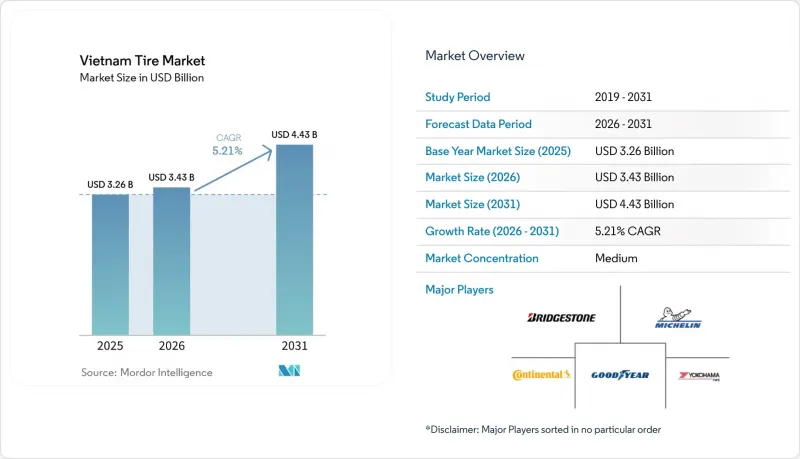
Mordor Intelligence에 의하면, 베트남의 타이어 시장 규모는 2025년에 32억 6,000만 달러로 평가되었고 2026년에는 34억 3,000만 달러로 추정되고 있어 2031년까지 44억 3,000만 달러에 이를 것으로 예측됩니다.
2026년부터 2031년까지의 연평균 성장률(CAGR)은 5.21%가 될 것으로 전망됩니다.
본 보고서는 계절별(여름용 등), 타이어 구조별(레이디얼, 바이애스 등), 차종별(이륜차, 승용차 등), 용도(온로드 및 오프로드), 최종 사용자(OEM 및 애프터마켓),림 크기(15인치 미만, 15-20인치, 20인치 이상), 구동 방식(내연기관 차량 등)별로 분류되어 있습니다. 시장 전망은 금액(달러) 및 수량(단위)으로 제시되어 있습니다.
베트남 타이어 시장 동향 및 인사이트
자동차 보유 대수 증가와 가처분 소득 증가
2024년, 자동차 신규 등록 대수가 크게 증가함에 따라 차량 보유 대수가 늘어나, 애프터마켓 분야에서 안정적인 수요를 지속적으로 견인하고 있습니다. 연간 GDP 성장률이 10%에 육박함에 따라 가계의 구매력이 향상되었으며, 특히 하노이 및 호치민시 등 주요 도시 지역에서 고급 브랜드 타이어를 중심으로 교체 주기가 단축되고 있습니다. 개인용 모빌리티 시장에 진입하는 사람들에게 오토바이가 여전히 주된 선택지인 반면, 승용차의 보급이 가속화되고 있습니다. 이러한 추세는 대출 옵션의 이용 편의성 향상과 도시 지역 도로 인프라의 지속적인 확충에 힘입고 있습니다. 차량 이용 증가에 따라 트레드 마모가 진행되고 있으며, 그 결과 딜러 네트워크와 퀵핏 서비스 매장에서 고품질 교체용 타이어에 대한 꾸준하고 예측 가능한 수요가 발생하고 있습니다.
물류 및 전자상거래의 급속한 성장이 상용차용 타이어 수요를 끌어올리고 있다.
베트남의 전자상거래 부문은 눈부신 성장을 이루며 물류 및 운송 분야에 큰 변화를 가져오고 있습니다. 이러한 확장에 따라 도시 지역의 라스트 마일 배송 차량 밀집도가 높아지고 있으며, 지역 간 간선 노선도 연장되고 있습니다. 하루 주행 거리가 긴 배송용 밴이나 냉장 트럭은 일반 승용차에 비해 타이어 마모가 가속화되고 있습니다. 또한 남북 고속도로나 국경 검문소를 연결하는 진행 중인 고속도로 프로젝트와 같은 인프라 확충으로 도로 접근성이 향상되고 있습니다. 이러한 개선으로 인해 사업자들은 새로 정비된 노선을 활용하여 연비 효율을 최적화하도록 장려받고 있습니다. 수산물 수출 분야에서는 전용 콜드체인 차량에 고부하·저온 대응 트레드 컴파운드의 사용이 증가하고 있습니다. 이러한 컴파운드는 뛰어난 성능 특성으로 인해 고가 대에서 거래되고 있습니다.
천연고무의 가격 변동
2024년, 베트남은 세계 유수의 생산국으로서의 지위를 유지했으나, 농장의 노후화와 예측 불가능한 강우 패턴으로 인한 문제에 직면했고, 그 결과 고무 공급이 부족해졌습니다. 베트남 러버 그룹의 자사 농장만으로는 세계 가격 변동의 영향을 완화하기에 불충분했기 때문에 각 타이어 제조업체들은 헤지나 합성 고무에 대한 의존도를 분산시키는 등의 전략을 강구할 수밖에 없었습니다. 원자재 비용의 급격한 상승은 소비자 행동에 큰 영향을 미쳤습니다. 특히 농촌 지역의 오토바이 시장은 가격 탄력성이 높았기 때문에 구매 결정이 현저히 지연되는 결과를 낳았습니다.
부문 분석
2025년, 올시즌 타이어는 베트남 타이어 시장 점유율의 43.47%를 차지했습니다. 동시에, 서머 타이어는 예측 기간 동안 연평균 성장률(CAGR) 5.23%로 꾸준한 성장을 이룰 것으로 전망됩니다. 베트남의 비교적 안정적인 기온 분포는 단일 패턴 타이어에 대한 수요를 뒷받침하고 있으며, 이를 통해 운전자는 보관 및 계절별 타이어 교체에 따른 비용을 절감할 수 있습니다. 반면, 겨울용 타이어는 여전히 틈새 시장으로 남아 있으며, 주로 기온이 때때로 10°C 이하로 떨어지는 산악 고개를 주행하는 버스나 냉장 창고용 지게차 등 특정 용도로만 제한되어 있습니다. 이러한 기후의 균일성은 제조업체에게 컴파운드 라인업을 합리화하고 유통 재고 관리를 최적화할 수 있는 이점을 가져다줍니다.
프리미엄 타이어 브랜드 각사는 전용으로 설계된 여름용 타이어의 뛰어난 수막 현상 방지 능력과 제동 성능을 강조하기 위해 소비자 대상 홍보 캠페인을 적극적으로 전개하고 있습니다. 이러한 노력으로 인해 소비자들 사이에서 엔트리급 올시즌 타이어(SKU)에서 보다 전문적인 선택지로의 전환이 서서히 촉진되고 있습니다. 다낭이나 칸토 등 주요 지역의 소매업체들은 특히 몬순 시즌 동안 안전성을 강조한 타겟팅 메시지를 전달함으로써 업셀링 기회가 증가하고 있다고 보고하고 있습니다. 또한, 지속적으로 성장하고 있는 렌터카 업계에서는 법인용 차량 보험 요건을 충족하기 위해 더 높은 속도 등급을 가진 서머 타이어가 점점 더 선호되고 있습니다. 이러한 추세는 예측 가능한 발주 패턴과 안정적인 수요 주기를 특징으로 하는 새로운 기업 간 거래(B2B) 채널의 발전을 촉진하고 있습니다.
2025년, 베트남 타이어 시장 점유율의 89.73%를 레이디얼 타이어가 차지하고 있으며, 2031년까지 연평균 성장률(CAGR) 5.32%를 나타낼 것으로 예측됩니다. 이러한 성장은 주로 저배출 가스 기준이 트럭에 적용된 데 기인합니다. 차량 비용 분석에서는 리트레드 주기 연장 및 연료 소비량 감소와 같은 이점이 강조되고 있으며, 이는 바이어스 타이어에 비해 레이디얼 타이어의 가격이 높은 것을 정당화하고 있습니다. 또한, 2023년 이후 OEM 각사는 레이디얼 타이어만을 채택하게 되었으며, 제조업체 보증 기간 만료에 따라 애프터마켓에서의 교체 수요가 크게 증가하고 있습니다.
주요 브랜드들은 펑크로 인한 가동 중단이 막대한 운영 비용으로 이어지는 도시 지역의 라스트 마일 배송용 밴을 대상으로 한 비공기식 타이어 프로토타입을 발표하고 있습니다. 그러나 이러한 프로토타입의 상업적 상용화에는 아직 몇 년이 더 소요될 것으로 예측됩니다. 한편, 중국의 제조업체들은 그래핀과 재생 고무를 접목한 첨단 벨트 구조의 레이디얼 타이어를 출시하고 있습니다. 이러한 혁신은 지속가능성에 대한 노력을 강화할 뿐만 아니라, 확대되고 있는 ‘확대 생산자 책임(EPR)’ 준수 압력에도 대응하고 있습니다. 이러한 기술적 진보는 경쟁의 기준을 높이고 있어, 저가형 오토바이 시장 진출을 목표로 하는 국내 2선 제조업체들에게는 큰 과제가 되고 있습니다.
2025년, 이륜차는 베트남 타이어 시장에서 43.35%라는 큰 점유율을 차지하며 해당 부문에서의 우위를 유지했습니다. 승용차는 딜러들의 적극적인 금융 전략과 VinFast, 현대, 토요타 등 주요 제조업체들의 차종 라인업 확충에 힘입어 5.27%라는 견실한 연평균 성장률(CAGR)을 기록했습니다. 승용차 타이어 시장 점유율은 특히 베트남에서 성장세가 두드러지는 2선 도시의 다대 소유 가구 증가를 배경으로, 2031년까지 5분의 2를 넘어설 것으로 예측됩니다.
전자상거래 산업의 유지에 중요한 역할을 하고 있는 소형 상용차와 픽업 트럭은 2025년에 타이어 판매의 5분의 1 가까이를 차지했습니다. 이러한 차량에서는 다양한 도로 상황에 적합한 올테레인 레이디얼 타이어의 채택이 점점 더 늘어나고 있습니다. 대형 트럭과 버스는 ‘일대일로(BRI)’ 이니셔티브와 관련된 인프라 프로젝트의 혜택을 받고 있습니다. 그러나 초중량급 차량의 성장은 여전히 축중량 제한으로 인해 제약을 받고 있습니다. 광산용 트럭이나 콤바인 수확기 등의 차량을 포함하는 특수 오프로드 타이어 부문은 비교적 작은 기반에서 성장하고 있습니다. 이 부문은 국내 제조업체, 특히 농장 고객들의 급증하는 수요에 대응하기 위해 효율적이고 현지화된 공급망을 활용하는 제조업체들에게 높은 수익 기회를 제공합니다.
기타 혜택:
- 엑셀 형식 시장 예측(ME) 시트
- 3개월간의 애널리스트 지원
목차
제1장 서론
제2장 조사 방법
제3장 개요
제4장 시장 구도
제5장 시장 규모와 성장 예측
제6장 경쟁 구도
제7장 시장 기회와 향후 전망
JHSAccording to Mordor Intelligence, the Vietnam tire market size was valued at USD 3.26 billion in 2025, is estimated at USD 3.43 billion in 2026, and is projected to reach USD 4.43 billion by 2031, registering a CAGR of 5.21% between 2026 and 2031.
This report is Segmented by Season (Summer and More), Tire Design (Radial, Bias, and More), Vehicle Type (Two-Wheelers, Passenger Cars and More), Application (On-Road and Off-Road), End User (OEM and Aftermarket), Rim Size (Below 15 Inches, 15 To 20 Inches, and Above 20 Inches), and Propulsion (Internal-Combustion Vehicles and More). The Market Forecasts are Provided in Terms of Value (USD) and Volume (Units).
Vietnam Tire Market Trends and Insights
Rising Vehicle PARC and Disposable Income Growth
In 2024, vehicle registrations experienced significant growth, contributing to an expanding installed base of vehicles that continues to drive consistent demand in the aftermarket segment. The annual GDP growth rate of nearly 10% has enhanced household purchasing power, resulting in shorter replacement cycles, particularly for premium-branded tires in key urban centers such as Hanoi and Ho Chi Minh City. While motorcycles remain the dominant choice for individuals entering the personal mobility market, the adoption of passenger cars is accelerating. This trend is supported by improved access to financing options and the ongoing expansion of urban road infrastructure. Increased vehicle utilization has led to higher tread wear, which in turn is generating a steady and predictable demand for high-quality replacement tires across dealership networks and quick-fit service outlets..
Logistics and E-Commerce Boom Increasing CV Tire Demand
Vietnam's e-commerce sector has experienced significant growth, driving substantial changes in the logistics and transportation landscape. This expansion has resulted in the proliferation of dense urban last-mile delivery fleets and the extension of intra-regional trunk routes. Delivery vans and refrigerated trucks, which operate with high daily mileage, are experiencing accelerated tire wear compared to private vehicles. Additionally, infrastructure developments, such as the North-South Expressway and ongoing highway projects connecting to border gates, are enhancing road accessibility. These improvements are encouraging operators to optimize fuel efficiency by leveraging the newly developed routes. In the seafood export segment, specialized cold-chain vehicles are increasingly utilizing high-load, low-temperature tread compounds, which are priced at a premium due to their advanced performance characteristics.
Natural Rubber Price Volatility
In 2024, Vietnam, despite maintaining its position as a leading global player, faced challenges stemming from aging plantations and unpredictable rainfall patterns, which resulted in a tightened supply of rubber. The Vietnam Rubber Group's estate proved insufficient in mitigating the impact of global price volatility, prompting tire manufacturers to adopt strategies such as hedging or diversifying their reliance on synthetic rubber inputs. The sharp increase in raw material costs significantly influenced consumer behavior, particularly in the rural motorcycle segment, where high price elasticity led to a noticeable delay in purchase decisions.
Other drivers and restraints analyzed in the detailed report include:
- Government Incentives for Domestic Tire Manufacturing
- Rapid Electrification of Two-Wheelers
- Price Competition from Low-Cost Chinese Imports
For complete list of drivers and restraints, kindly check the Table Of Contents.
Segment Analysis
In 2025, all-season tires accounted for 43.47% of Vietnam's tire market share. Concurrently, summer tires are projected to experience steady growth, with a CAGR of 5.23% during the forecast period. Vietnam's relatively consistent temperature profile supports the preference for single-pattern tires, enabling motorists to reduce costs associated with storage and seasonal tire changes. Winter tire designs, however, remain niche, primarily serving specific applications such as mountain-pass buses and cold-storage forklifts, where temperatures occasionally fall below 10 °C. This climate uniformity provides manufacturers with the advantage of streamlining their compound portfolios and optimizing distribution inventory management.
Premium tire brands are actively conducting consumer education campaigns to highlight the superior hydroplaning resistance and braking performance of purpose-engineered summer tire patterns. These initiatives are gradually encouraging a shift among consumers from entry-level all-season stock-keeping units (SKUs) to more specialized options. Retailers in key regions such as Da Nang and Can Tho report increased opportunities for upselling, particularly through targeted safety messaging during the monsoon season. Furthermore, the expanding car-rental sector is increasingly favoring higher-speed-rated summer tires to meet the requirements of corporate fleet insurers. This trend is fostering the development of new business-to-business (B2B) channels, characterized by predictable ordering patterns and consistent demand cycles.
In 2025, radials accounted for 89.73% of Vietnam's tire market share and are anticipated to grow at a 5.32% CAGR by 2031. This growth is primarily attributed to the enforcement of low-emission truck standards. Fleet cost analyses emphasize the benefits of extended retread cycles and reduced fuel consumption, which justify the premium pricing of radials over bias alternatives. Furthermore, since 2023, OEMs have exclusively adopted radial fitments, driving a significant increase in aftermarket conversions as factory warranties expire.
Leading brands have introduced non-pneumatic prototypes targeting urban last-mile vans, where puncture-related downtimes result in substantial operational costs. However, the commercial viability of these prototypes is expected to take several years to materialize. Concurrently, Chinese manufacturers are launching advanced belt-package radials incorporating graphene and recycled rubber. These innovations not only enhance sustainability credentials but also align with the growing pressures of Extended Producer Responsibility (EPR) compliance. Such technological advancements are raising the competitive benchmark, presenting significant challenges for domestic second-tier producers aiming to penetrate the budget motorcycle segment.
In 2025, two-wheelers accounted for a significant 43.35% share of Vietnam's tire market, maintaining their dominance in the sector. Passenger cars, supported by aggressive dealer financing strategies and an expanding range of models from key players such as VinFast, Hyundai, and Toyota, exhibited a strong 5.27% CAGR. The tire market share for passenger cars is projected to exceed two-fifths by 2031, driven by the increasing prevalence of multi-car households, particularly in Vietnam's growing second-tier cities.
Light commercial vans and pickups, which play a critical role in sustaining the e-commerce sector, contributed to nearly one-fifth of tire sales in 2025. These vehicles are increasingly adopting all-terrain radial designs, which are well-suited for mixed-road conditions. Heavy trucks and buses are benefiting from infrastructure projects associated with the Belt and Road Initiative (BRI). However, the growth of ultra-heavy-spec vehicles remains constrained by axle-load restrictions. The specialty off-road tire segment, encompassing vehicles such as mining trucks and combine harvesters, is expanding from a relatively small base. This segment offers high-margin opportunities for domestic manufacturers, particularly those leveraging efficient and localized supply chains to meet the rapid demands of plantation clients.
Complete Report Scope:
- By Season
- Summer
- Winter
- All-Season
- By Tire Design
- Radial
- Bias
- Non-pneumatic/Airless
- By Vehicle Type
- Two-Wheelers
- Passenger Cars
- Light Commercial Vehicles
- Heavy Commercial Trucks and Buses
- Off-the-Road and Specialty (OTR, Agriculture, Mining, Racing)
- By Application
- On-Road
- Off-Road
- By End User
- OEM
- Aftermarket
- By Rim Size
- Below 15 inches
- 15 to 20 inches
- Above 20 inches
- By Propulsion
- Internal-Combustion Vehicles
- Battery-Electric Vehicles
- Hybrid and Fuel-Cell Vehicles
List of Companies Covered in this Report:
- Bridgestone Corporation
- Michelin SCA
- Yokohama Rubber Co., Ltd.
- Kumho Tire Co., Inc.
- Sailun Group Co., Ltd.
- The Southern Rubber Industry JSC (Casumina)
- Danang Rubber Company (DRC)
- Pirelli & C. S.p.A.
- Goodyear Tire and Rubber Company
- Continental AG
- Apollo Tyres Ltd.
- Cheng Shin Rubber Ind. Co. (Maxxis)
- Hankook Tire and Technology
- Toyo Tire Corporation
- Triangle Tyre Co., Ltd.
- Double Coin Holdings Ltd.
- Linglong Tire Co., Ltd.
- JK Tyre & Industries Ltd.
- Giti Tire Pte. Ltd.
- Cheng Shin Rubber Vietnam (CST)
Additional Benefits:
- The market estimate (ME) sheet in Excel format
- 3 months of analyst support
TABLE OF CONTENTS
1 Introduction
- 1.1 Study Assumptions and Market Definition
- 1.2 Scope of the Study
2 Research Methodology
3 Executive Summary
4 Market Landscape
- 4.1 Market Overview
- 4.2 Market Drivers
- 4.2.1 Rising Vehicle PARC and Disposable Income Growth
- 4.2.2 Logistics and E-Commerce Boom Increasing CV Tire Demand
- 4.2.3 Government Incentives for Domestic Tire Manufacturing
- 4.2.4 Rapid Electrification of Two-Wheelers
- 4.2.5 Green Public-Sector Procurement Targets
- 4.2.6 Truck and Bus Radialization Push by Toll/Fuel-Efficiency Policies
- 4.3 Market Restraints
- 4.3.1 Natural Rubber Price Volatility
- 4.3.2 Price Competition from Low-Cost Chinese Imports
- 4.3.3 Extended Producer Responsibility (EPR) Compliance Costs
- 4.3.4 Rural Infrastructure Gaps Limiting Off-Take
- 4.4 Value/Supply-Chain Analysis
- 4.5 Regulatory Landscape
- 4.6 Technological Outlook
- 4.7 Porter's Five Forces
- 4.7.1 Threat of New Entrants
- 4.7.2 Bargaining Power of Suppliers
- 4.7.3 Bargaining Power of Buyers
- 4.7.4 Threat of Substitutes
- 4.7.5 Competitive Rivalry
5 Market Size and Growth Forecasts (Value (USD) and Volume (Units))
- 5.1 By Season
- 5.1.1 Summer
- 5.1.2 Winter
- 5.1.3 All-Season
- 5.2 By Tire Design
- 5.2.1 Radial
- 5.2.2 Bias
- 5.2.3 Non-pneumatic/Airless
- 5.3 By Vehicle Type
- 5.3.1 Two-Wheelers
- 5.3.2 Passenger Cars
- 5.3.3 Light Commercial Vehicles
- 5.3.4 Heavy Commercial Trucks and Buses
- 5.3.5 Off-the-Road and Specialty (OTR, Agriculture, Mining, Racing)
- 5.4 By Application
- 5.4.1 On-Road
- 5.4.2 Off-Road
- 5.5 By End User
- 5.5.1 OEM
- 5.5.2 Aftermarket
- 5.6 By Rim Size
- 5.6.1 Below 15 inches
- 5.6.2 15 to 20 inches
- 5.6.3 Above 20 inches
- 5.7 By Propulsion
- 5.7.1 Internal-Combustion Vehicles
- 5.7.2 Battery-Electric Vehicles
- 5.7.3 Hybrid and Fuel-Cell Vehicles
6 Competitive Landscape
- 6.1 Market Concentration
- 6.2 Strategic Moves
- 6.3 Market Share Analysis
- 6.4 Company Profiles (Includes Global Level Overview, Market Level Overview, Core Segments, Financials as Available, Strategic Information, Market Rank/Share for Key Companies, Products and Services, SWOT Analysis, and Recent Developments)
- 6.4.1 Bridgestone Corporation
- 6.4.2 Michelin SCA
- 6.4.3 Yokohama Rubber Co., Ltd.
- 6.4.4 Kumho Tire Co., Inc.
- 6.4.5 Sailun Group Co., Ltd.
- 6.4.6 The Southern Rubber Industry JSC (Casumina)
- 6.4.7 Danang Rubber Company (DRC)
- 6.4.8 Pirelli & C. S.p.A.
- 6.4.9 Goodyear Tire and Rubber Company
- 6.4.10 Continental AG
- 6.4.11 Apollo Tyres Ltd.
- 6.4.12 Cheng Shin Rubber Ind. Co. (Maxxis)
- 6.4.13 Hankook Tire and Technology
- 6.4.14 Toyo Tire Corporation
- 6.4.15 Triangle Tyre Co., Ltd.
- 6.4.16 Double Coin Holdings Ltd.
- 6.4.17 Linglong Tire Co., Ltd.
- 6.4.18 JK Tyre & Industries Ltd.
- 6.4.19 Giti Tire Pte. Ltd.
- 6.4.20 Cheng Shin Rubber Vietnam (CST)
7 Market Opportunities and Future Outlook
- 7.1 White-space and Unmet-Need Assessment