|
시장보고서
상품코드
2117450
인도네시아의 타이어 시장 : 점유율 분석, 업계 동향과 통계, 성장 예측(2026-2031년)Indonesia Tire - Market Share Analysis, Industry Trends & Statistics, Growth Forecasts (2026 - 2031) |
||||||
 Mordor Intelligence
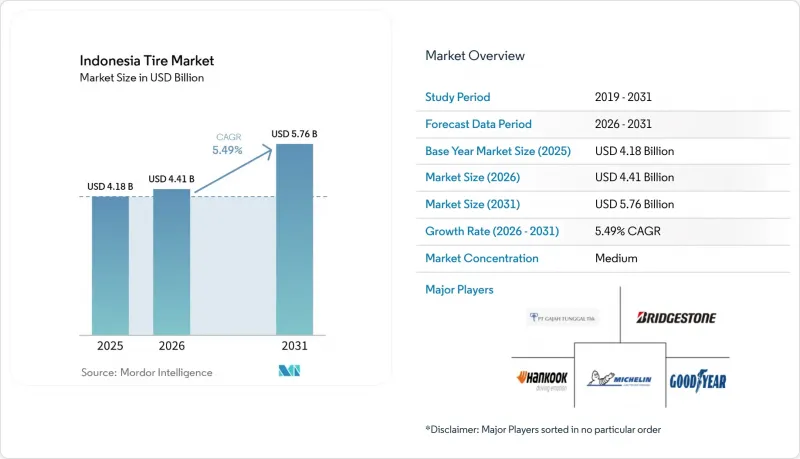
Mordor Intelligence에 의하면, 인도네시아의 타이어 시장 규모는 2025년에 41억 8,000만 달러로 평가되었고 2026년에는 44억 1,000만 달러로 추정되고 있어 2031년까지 57억 6,000만 달러에 이를 것으로 예측됩니다.
2026년부터 2031년까지의 연평균 성장률(CAGR)은 5.49%가 될 것으로 전망됩니다.
본 보고서는 계절별(여름용, 겨울용 등), 타이어 구조별(레이디얼 타이어, 바이애스 타이어 등), 차종별(이륜차, 승용차 등), 용도(온로드 및 오프로드), 최종 사용자(OEM 및 애프터마켓),림 크기(15인치 미만, 15-20인치, 기타), 구동 방식(내연기관 차량, 기타)별로 분류되어 있습니다. 시장 전망은 금액(달러) 및 수량(단위)으로 제시되어 있습니다.
인도네시아 타이어 시장 동향 및 인사이트
팬데믹 이후 이륜차 보유 대수의 급증
2025년 12월, 통근자들이 대중교통에 대한 의존도를 줄이려 함에 따라 오토바이 판매 대수는 현저한 회복세를 보였습니다. 인도네시아에서는 2025년 12월 오토바이 판매 대수가 전년 동월 대비 14.5% 증가한 46만 1,925대에 달했습니다. 이는 시장에서 5개월 연속 성장을 기록한 것입니다. 특히 도시 간 이동에 고배기량 모델을 이용하는 활동적인 라이더들 사이에서는 트레드 마모가 가속화되어, 그 결과 타이어 교체 주기가 약 12-18개월로 늘어났습니다. 또한, 디지털 대출 플랫폼의 보급으로 라이드셰어 운전자의 자금 조달이 용이해졌으며, 이는 운행 차량 수의 확대에 기여하여 결과적으로 인도네시아 타이어 시장의 성장을 뒷받침했습니다. 지방 도시의 인프라 정비가 진행되고 도로망의 연결성이 강화됨에 따라, 프리미엄 타이어 사용이 필요한 장거리 오토바이 이동이 촉진되었습니다. 그 결과, 시장에서 승용차의 보급률이 높아지는 상황에서도 이륜차용 종합적인 제품 라인업을 갖춘 제조업체는 안정적인 판매 대수를 유지하고 있습니다.
정부 주도의 도로 인프라 정비 붐이 레이디얼 타이어 수요를 촉진
연간 공공 지출은 고속도로 및 항만 접근 도로 재건에 집중되고 있습니다. 이러한 인프라 확충으로 인해 더 무거운 트럭의 운행과 지속적인 고속 주행이 가능해졌으며, 이는 레이디얼 타이어 기술에 큰 이점을 가져다주고 있습니다. 자바섬 및 수마트라섬의 운송 회랑 완공은 화물 운송을 활성화시켜, 인도네시아 타이어 시장 수요 대부분을 차지하는 상용 타이어 부문에서 교체 주기를 단축시키고 있습니다. 건설 단계에서는 차량 보유 기업이 대량의 타이어를 소비하지만, 그 후에는 유지보수 관련 구매로 전환되며, 이는 장기적으로 레이디얼 타이어의 지속적인 채택을 뒷받침하고 있습니다. 칼리만탄과 술라웨시 지역의 인프라 프로젝트에서도 유사한 추세가 나타나고 있으며, 외곽 섬 지역의 물류 현대화를 위한 노력이 탄력을 받고 있습니다. 고무 원료 조달 능력을 통합한 현지 제조업체들은 SNI 품질 기준을 준수함으로써 초기 계약을 수주할 유리한 위치에 있으며, 이를 통해 시장 내 경쟁 우위를 강화하고 있습니다.
대형 트럭 부문에서의 리트레드 보급
장거리 운송 사업자들은 전문적인 리트레드(재생)를 통해 케이싱의 수명을 최대 60%까지 연장하고 있습니다. 이 공정의 비용은 신품 타이어 가격의 약 3분의 1 수준입니다. 인도네시아 타이어 시장에서는 고속도로 노면 상태의 개선으로 인해 여러 번의 리트레드 주기가 가능해졌으며, 그 결과 고급 교체용 타이어에 대한 수요가 감소하고 있습니다. SNI 규정을 준수하는 체계적인 리트레드 업체들은 리트레드 관행을 정당화하며 대규모 차량 운영 사업자들을 성공적으로 유치하고 있습니다. 이러한 동향에 대응하여 프리미엄 타이어 브랜드들은 고객 유지 및 충성도를 강화하기 위해 케이싱 환매 프로그램을 시행하고 보증 기간 연장을 제공합니다. 또한, 리트레드 서비스를 통합하는 신규 시장 진출기업들은 비용을 중시하는 고객의 요구에 부응하기 위해 서비스 포트폴리오를 확대하고 있으며, 이로 인해 시장 내 경쟁이 심화되고 있습니다.
부문 분석
2025년, 인도네시아 타이어 시장에서 올시즌 타이어는 시장 점유율 47.33%를 차지하며 시장을 휩쓸었습니다. 이러한 추세는 계절마다 타이어를 교체할 필요가 없는 인도네시아의 열대 기후와 일치합니다. 이 올시즌 타이어는 내열성과 몬순 시즌에 최적의 트랙션을 실현하도록 특별히 설계되어 일년내내 신뢰할 수 있는 성능을 보장합니다. 한편, 서머 타이어는 급속한 성장을 보이며 연평균 성장률(CAGR) 7.13%로 성장을 지속하고, 있습니다. 이러한 성장은 잘 정비된 도로에서 날카로운 핸들링을 중시하는 도시 지역 운전자들에 의해 주로 주도되고 있습니다. 타이어 제조업체들은 현재 실리카가 풍부하게 함유된 컴파운드와 비대칭 트레드 패턴을 중시하며, 그립력과 내구성의 균형을 맞추고 있습니다. 반면, 주로 외국인 거주자의 차량을 위해 수입되는 윈터 타이어는 틈새 시장으로 분류되며, 인도네시아 타이어 시장에서 창출하는 수익은 극히 미미합니다.
앞으로도 온화한 날씨가 지속될 것으로 예상에 따라, 노면 온도가 높은 상황에서도 올시즌용 컴파운드의 안정성을 높이기 위한 연구 개발이 지속적으로 진행되고 있습니다. 여름용 타이어의 성장은 고급 승용차 판매 증가 및 모터스포츠 이벤트 증가와 밀접한 관련이 있으며, 이 두 가지 요인은 모두 반응성이 뛰어난 핸들링에 대한 소비자 수요를 높이고 있습니다. 각 공급업체들은 UTQG 등급 제시, 젖은 노면 제동 테스트 실시, 특히 몬순 시즌의 수막 현상 저항성 강조 등을 통해 타사와의 차별화를 꾀하고 있습니다. 소매업체들은 림 크기가 커지는 추세를 활용하여, 여름용 타이어를 알로이 휠 업그레이드 상품 옆에 전략적으로 진열하고 있습니다. 겨울용 타이어가 시장을 휩쓸고 있는 것은 아니지만, 그 기술적 진보는 특히 젖은 노면 그립 성능의 향상 측면에서 열대 지역용 타이어 제품군에도 혜택을 주고 있습니다.
2025년, 인도네시아 타이어 시장에서는 레이디얼 구조가 압도적인 91.46%의 점유율을 차지하고 있으며, 다양한 지형에서 뛰어난 트레드 수명과 연비 효율을 발휘하고 있다는 점이 그 배경에 있습니다. 바이애스 플라이 구조는 저속 주행이 주를 이루는 농업용 차량이나 구형 오프로드 차량에서 여전히 널리 사용되고 있지만, 시장 점유율을 빼앗기는 추세가 강해지고 있습니다. 한편, 에어리스(공기 없는) 타이어는 외딴 지역에서의 업무를 위해 펑크 방지 솔루션을 시범 도입하고 있는 물류 기업 수요에 힘입어 연평균 성장률(CAGR) 7.58%라는 견조한 성장이 예상됩니다. 주요 제조업체들은 인도네시아의 생산 능력을 활용하여 첨단 스틸 벨트 기술을 현지화하는 동시에 수입 비용 절감을 도모하고 있습니다.
에어리스 타이어의 생산 능력을 확대하기 위해서는 혁신적인 엘라스토머 설계와 전용 성형 기계가 필요하며, 그 결과 세계적인 선도 기업들과의 전략적 제휴가 진행되고 있습니다. 초기 용도는 지게차, 광산용 유틸리티 차량, 배송 차량에 집중되어 있으며, 이들 모두 업무의 중단 없는 운영을 최우선으로 하고 있습니다. 레이디얼 기술은 나노 복합 벨트와 저회전 저항 실리카 블렌드의 통합을 통해 발전하고 있으며, OEM의 배기가스 규제 목표에 부합하고 있습니다. 이처럼 인도네시아 타이어 시장은 레이디얼 설계의 우위와 더 높은 이익률 및 기술적 측면에서 브랜드 입지를 강화할 것으로 기대되는 신흥 틈새 시장의 매력을 동시에 확보해야 하는 기로에 서 있습니다.
2025년, 이륜차가 인도네시아 타이어 시장의 36.21%를 차지하고 있어, 도시 내 및 도시 간 이동에서 오토바이가 수행하는 중요한 역할이 부각되고 있습니다. 한편, 소득 증가, 이용하기 쉬운 금융 지원, 국내 차량 조립에 대한 우대 조치의 뒷받침을 받아 승용차 수요는 연평균 성장률(CAGR) 6.11%로 급증하고 있습니다. 전자상거래 물류가 확대됨에 따라 소형 상용차도 성장을 거듭하고 있습니다. 동시에 대형 트럭은 농장 및 광업공급망에서 중요한 역할을 수행하며 인도네시아 타이어 시장 규모를 지탱하고 있습니다.
이륜차용 타이어는 계속 진화하고 있으며, 측벽 보강 및 소음 저감을 목적으로 한 트레드 블록을 갖춘 전기차(EV) 모델에 초점이 맞추어져 있습니다. 승용차에 대한 수요 증가는 런플랫 타이어나 자가 복구형 타이어와 같은 기술에 새로운 기회를 제공합니다. 이러한 기술은 도로변 지원 서비스를 즉시 이용하기 어려울 수 있는 도시 거주자들에게 특히 유용합니다. 트럭 부문공급업체들은 비용에 민감한 차량 관리자들의 요구에 부응하기 위해 리트레드용 케이싱을 도입하는 등 제품 라인업을 확대되고 있습니다. 전반적으로 이러한 업계의 변화는 수익원의 다각화를 가져올 뿐만 아니라, 광범위한 다중 부문 참여에 힘입어 인도네시아 타이어 시장의 회복력을 강화하고 있습니다.
기타 혜택:
- 엑셀 형식 시장 예측(ME) 시트
- 3개월간의 애널리스트 지원
자주 묻는 질문
목차
제1장 서론
제2장 조사 방법
제3장 개요
제4장 시장 구도
제5장 시장 규모와 성장 예측
제6장 경쟁 구도
제7장 시장 기회와 향후 전망
JHS 26.09.01According to Mordor Intelligence, the indonesian tire market size was valued at USD 4.18 billion in 2025 and is estimated at USD 4.41 billion in 2026, and is projected to reach USD 5.76 billion by 2031, registering a CAGR of 5.49% between 2026 and 2031.
This report is Segmented by Season (Summer, Winter, and More), Tire Design (Radial, Bias, and More), Vehicle Type (Two-Wheelers, Passenger Cars, and More), Application (On-Road and Off-Road), End User (OEM and Aftermarket), Rim Size (Below 15 Inches, 15-20 Inches, and More), and Propulsion (Internal-Combustion Vehicles, and More). The Market Forecasts are Provided in Terms of Value (USD) and Volume (Units).
Indonesia Tire Market Trends and Insights
Rapid Surge in Two-Wheeler Ownership Post-Pandemic
In December 2025, as commuters aimed to reduce their reliance on public transportation, motorcycle sales demonstrated a significant recovery. In Indonesia, motorcycle sales increased by 14.5% year-on-year, reaching 461,925 units in December 2025. This marked the fifth consecutive month of growth in the market. Active riders, particularly those utilizing higher displacement models for intercity travel, experienced accelerated tread wear, resulting in a replacement frequency of approximately 12 to 18 months. Additionally, digital financing platforms enhanced accessibility for ride-hailing drivers, which contributed to the expansion of the active fleet and subsequently supported the growth of the Indonesian tire market. Infrastructure improvements across secondary cities strengthened road connectivity, facilitating longer motorcycle journeys that necessitate the use of premium tires. Consequently, manufacturers with comprehensive two-wheeler portfolios have been able to maintain stable sales volumes, despite the increasing penetration of passenger cars in the market.
Government Road-Infrastructure Boom Unlocking Radial-Tire Demand
Annual public spending is concentrated on rebuilding highways and port access roads. These infrastructure improvements enable the operation of heavier trucks and sustained speeds, which provide significant advantages to radial technology. The completion of transportation corridors in Java and Sumatra has enhanced freight movement, resulting in shorter replacement cycles for commercial tires, a segment that constitutes a substantial portion of the demand in the Indonesian tire market. During the construction phase, fleets consume considerable volumes of tires, subsequently transitioning to maintenance-related purchases that support the continued adoption of radial tires over the long term. A similar trend is observed in regional infrastructure projects in Kalimantan and Sulawesi, as modernization efforts in logistics across the outer islands gain momentum. Local manufacturers with integrated rubber sourcing capabilities are well-positioned to secure initial contracts by complying with SNI quality standards, thereby strengthening their competitive advantage in the market.
Retread Proliferation Across Heavy-Truck Segment
Long-haul operators are increasing casing life by up to 60% through professional retreading, a process that costs approximately one-third of the price of a new tire. In the Indonesian tire market, advancements in highway surfaces are enabling multiple retread cycles, which in turn are reducing the demand for premium replacement tires. Organized retreaders, who comply with SNI regulations, are legitimizing the retreading practice and successfully attracting large fleet operators. In response to this trend, premium tire brands are implementing casing buyback programs and offering extended warranties to strengthen customer retention and loyalty. Additionally, new market entrants integrating retreading services are expanding their service portfolios to address the needs of cost-sensitive customers, thereby increasing competition within the market.
Other drivers and restraints analyzed in the detailed report include:
- EV-Specific Tire Incentives in 2026 Green Tax Reform
- OEM Shift to >=15-Inch Rims for Low-Cost SUVs/MPVs
- Imported Budget Tires Pressuring Margins of Local Makers
For complete list of drivers and restraints, kindly check the Table Of Contents.
Segment Analysis
In 2025, all-season products dominated the Indonesian tire market, capturing 47.33% of the market share. This trend aligns with Indonesia's tropical climate, which does not necessitate seasonal tire changes. These all-season tires are specially formulated for heat resistance and optimal traction during monsoons, ensuring dependable performance throughout the year. Meanwhile, summer tires are witnessing a surge, growing at a 7.13% CAGR. This growth is largely driven by urban drivers who prioritize sharper handling on well-maintained roads. Tire manufacturers are now emphasizing silica-rich compounds and asymmetric tread patterns, balancing grip and longevity. On the other hand, winter tires, primarily imported for expatriate vehicles, occupy a niche space and generate minimal revenue in Indonesia's tire market.
Given the forecasted continuation of warm weather, there is a sustained push in research and development to enhance the stability of all-season compounds at elevated pavement temperatures. The growth of summer tires is closely tied to the rising sales of premium passenger cars and an increase in motorsport events, both of which amplify consumer demand for responsive handling. Suppliers are differentiating themselves by highlighting UTQG ratings, conducting wet-brake tests, and emphasizing aquaplaning resistance, particularly during the monsoon. Retailers are strategically placing summer tires next to alloy-wheel upgrades, capitalizing on the trend of larger rim sizes. While winter tires may not dominate the market, their technological advancements are benefiting tropical tire lines, particularly in enhancing wet-grip features.
In 2025, radial construction dominated the Indonesian tire market, capturing a substantial 91.46% share, supported by its superior tread life and fuel efficiency across various terrains. While bias ply designs remain prevalent in low-speed agriculture and older off-road vehicles, they are increasingly facing cannibalization. Meanwhile, airless non-pneumatic formats are set to grow at a robust 7.58% CAGR, driven by logistics firms testing puncture-proof solutions for their remote operations. Major manufacturers are capitalizing on Indonesia's production capabilities, localizing advanced steel belt technology, and simultaneously reducing import costs.
Expanding airless tire capacity necessitates innovative elastomer designs and specialized molding machinery, leading to strategic partnerships with global pioneers. Initial applications are centered on forklifts, mining utility vehicles, and delivery fleets, all prioritizing uninterrupted operations. Radial technology is advancing with the integration of nanocomposite belts and low rolling resistance silica blends, aligning with OEM emissions objectives. Thus, the Indonesian tire market finds itself at a crossroads, balancing the dominance of radial designs with the allure of emerging niches that promise higher margins and a stronger technological brand presence.
In 2025, two-wheelers accounted for 36.21% of Indonesia's tire market, highlighting the significant role of motorcycles in both urban and intercity travel. Meanwhile, driven by rising incomes, accessible financing, and incentives for domestic vehicle assembly, the demand for passenger cars is surging at a 6.11% CAGR. As e-commerce logistics expand, light commercial vehicles are experiencing growth. At the same time, heavy trucks play a crucial role in the plantation and mining supply chains, supporting the size of Indonesia's tire market.
Motorcycle tires are evolving, focusing on electric vehicle (EV) models that feature reinforced sidewalls and tread blocks designed for reduced noise. The increasing demand for passenger cars creates opportunities for technologies such as run-flat and self-sealing tires. These are particularly beneficial for city dwellers, where roadside assistance might not be readily available. Suppliers in the truck segment are expanding their offerings to include retread-compatible casings, catering to budget-conscious fleet managers. Collectively, these industry shifts not only diversify revenue streams but also strengthen the resilience of Indonesia's tire market, supported by its broad multi-segment engagement.
Complete Report Scope:
- By Season
- Summer
- Winter
- All-Season
- By Tire Design
- Radial
- Bias
- Non-pneumatic/Airless
- By Vehicle Type
- Two-Wheelers
- Passenger Cars
- Light Commercial Vehicles
- Heavy Commercial Trucks and Buses
- Off-the-Road and Specialty (OTR, Agriculture, Mining, Racing)
- By Application
- On-Road
- Off-Road (Construction, Mining, Agriculture)
- By End User
- OEM
- Aftermarket (Replacement and Retread)
- By Rim Size
- Below 15 inches
- 15 - 20 inches
- Above 20 inches
- By Propulsion
- Internal-Combustion Vehicles
- Battery-Electric Vehicles
- Hybrid and Fuel-Cell Vehicles
List of Companies Covered in this Report:
- PT Gajah Tunggal Tbk
- Bridgestone Tire Indonesia
- Hankook Indonesia
- PT Multistrada Arah Sarana Tbk
- Michelin Indonesia
- Goodyear Indonesia
- PT Suryaraya Rubberindo Industries
- Yokohama Indonesia
- Continental Tire Indonesia
- Pirelli - PT Evoluzione Tire
- Sumitomo Rubber Indonesia
- Giti Tire Indonesia
- Apollo Tyres Limited
- Maxxis (Cheng Shin Rubber Industry Co.)
- Trelleborg Wheel Systems
- Balkrishna Industries Limited (BKT Tires)
- Sumitomo Rubber Industries (Dunlop)
- PT Elangperdana Tyre Industry
- Double Coin Tire Group Co., Ltd
Additional Benefits:
- The market estimate (ME) sheet in Excel format
- 3 months of analyst support
TABLE OF CONTENTS
1 Introduction
- 1.1 Study Assumptions and Market Definition
- 1.2 Scope of the Study
2 Research Methodology
3 Executive Summary
4 Market Landscape
- 4.1 Market Overview
- 4.2 Market Drivers
- 4.2.1 Rapid Surge in Two-Wheeler Ownership Post-Pandemic
- 4.2.2 Government Road-Infrastructure Boom Unlocking Radial-Tire Demand
- 4.2.3 EV-Specific Tire Incentives in 2026 Green Tax Reform
- 4.2.4 OEM Shift to >=15-Inch Rims for Low-Cost SUVs/MPVs
- 4.2.5 Fleet Digitalization Boosting Predictive-Maintenance Tire Purchases
- 4.2.6 Micro-Warehouse E-Commerce Model Driving LCV Tire Volumes Outside Java
- 4.3 Market Restraints
- 4.3.1 Retread Proliferation Across Heavy-Truck Segment
- 4.3.2 Imported Budget Tires Pressuring Margins of Local Makers
- 4.3.3 Natural-Rubber Price Volatility Tied to El Nino Patterns
- 4.3.4 Skilled-Labor Gap for Advanced Radial Production
- 4.4 Value/Supply-Chain Analysis
- 4.5 Regulatory Landscape
- 4.6 Technological Outlook
- 4.7 Porter's Five Forces
- 4.7.1 Threat of New Entrants
- 4.7.2 Bargaining Power of Suppliers
- 4.7.3 Bargaining Power of Buyers
- 4.7.4 Threat of Substitutes
- 4.7.5 Competitive Rivalry
5 Market Size and Growth Forecasts (Value (USD) and Volume (Units))
- 5.1 By Season
- 5.1.1 Summer
- 5.1.2 Winter
- 5.1.3 All-Season
- 5.2 By Tire Design
- 5.2.1 Radial
- 5.2.2 Bias
- 5.2.3 Non-pneumatic/Airless
- 5.3 By Vehicle Type
- 5.3.1 Two-Wheelers
- 5.3.2 Passenger Cars
- 5.3.3 Light Commercial Vehicles
- 5.3.4 Heavy Commercial Trucks and Buses
- 5.3.5 Off-the-Road and Specialty (OTR, Agriculture, Mining, Racing)
- 5.4 By Application
- 5.4.1 On-Road
- 5.4.2 Off-Road (Construction, Mining, Agriculture)
- 5.5 By End User
- 5.5.1 OEM
- 5.5.2 Aftermarket (Replacement and Retread)
- 5.6 By Rim Size
- 5.6.1 Below 15 inches
- 5.6.2 15 - 20 inches
- 5.6.3 Above 20 inches
- 5.7 By Propulsion
- 5.7.1 Internal-Combustion Vehicles
- 5.7.2 Battery-Electric Vehicles
- 5.7.3 Hybrid and Fuel-Cell Vehicles
6 Competitive Landscape
- 6.1 Market Concentration
- 6.2 Strategic Moves
- 6.3 Market Share Analysis
- 6.4 Company Profiles (Includes Global Level Overview, Market Level Overview, Core Segments, Financials as Available, Strategic Information, Market Rank/Share for Key Companies, Products and Services, SWOT Analysis, and Recent Developments)
- 6.4.1 PT Gajah Tunggal Tbk
- 6.4.2 Bridgestone Tire Indonesia
- 6.4.3 Hankook Indonesia
- 6.4.4 PT Multistrada Arah Sarana Tbk
- 6.4.5 Michelin Indonesia
- 6.4.6 Goodyear Indonesia
- 6.4.7 PT Suryaraya Rubberindo Industries
- 6.4.8 Yokohama Indonesia
- 6.4.9 Continental Tire Indonesia
- 6.4.10 Pirelli - PT Evoluzione Tire
- 6.4.11 Sumitomo Rubber Indonesia
- 6.4.12 Giti Tire Indonesia
- 6.4.13 Apollo Tyres Limited
- 6.4.14 Maxxis (Cheng Shin Rubber Industry Co.)
- 6.4.15 Trelleborg Wheel Systems
- 6.4.16 Balkrishna Industries Limited (BKT Tires)
- 6.4.17 Sumitomo Rubber Industries (Dunlop)
- 6.4.18 PT Elangperdana Tyre Industry
- 6.4.19 Double Coin Tire Group Co., Ltd
7 Market Opportunities and Future Outlook
- 7.1 White-space and Unmet-Need Assessment