
|
시장보고서
상품코드
2117455
자동차용 전동 연료 펌프 시장 : 점유율 분석, 업계 동향과 통계, 성장 예측(2026-2031년)Automotive Electric Fuel Pumps - Market Share Analysis, Industry Trends & Statistics, Growth Forecasts (2026 - 2031) |
||||||
 Mordor Intelligence
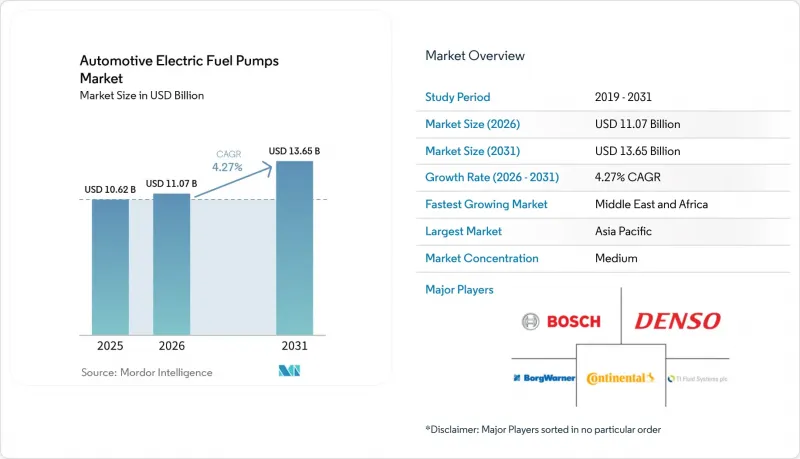
Mordor Intelligence에 의하면, 자동차용 전동 연료 펌프 시장 규모는 2025년 106억 2,000만 달러, 2026년 110억 7,000만 달러에서 2031년에는 136억 5,000만 달러로 확대된다고 예측되고 있어 2026년부터 2031년까지 연평균 성장률(CAGR)은 4.27%를 나타낼 전망입니다.
본 보고서는 제품 유형(브러시 장착 DC식 전동 연료 펌프 등), 기술(터빈식 펌프 등), 차종(승용차 및 상용차), 연료 유형(가솔린, 디젤 등), 유통 채널(OEM 및 애프터마켓), 그리고 지역별로 분류되어 있습니다. 시장 전망은 금액(달러) 기준으로 제시되어 있습니다.
전 세계 자동차용 전동 연료 펌프 시장 동향 및 인사이트
내연기관(ICE) 파워트레인에 대한 전 세계 배기가스 규제의 강화
유로 7 내구성 기준에 따르면 펌프는 20만 km 또는 10년 동안 고장 없이 작동해야 하지만, 기존의 브러시 모터로는 이 사양을 충족하기 어렵습니다. 북미의 기준과 캘리포니아주의 하이브리드차 도입 정책 또한 가솔린 하이브리드차의 생산을 지속함으로써 추가적인 추진력을 제공하고 있으며, 그로 인해 고사양 펌프는 규제 준수 전략에서 여전히 필수적인 요소로 남아 있습니다. 이러한 중복되는 정책으로 인해 기술적 최소 기준이 상향 조정되면서, 내장형 압력 센서나 내식성 합금 등의 기능이 요구되고 있습니다. 규제와 연계된 보증 기간의 장기화 또한 각 OEM 업체들에게 조기 고장 감지가 가능한 예측 유지보수 기능의 도입을 촉구하고 있습니다. 전반적으로 이러한 규제 강화로 인해 기술 선도 기업에 유리한 수년 단위의 교체 및 업그레이드 주기가 정착되고 있습니다.
가솔린 직접 분사 시스템의 급속한 보급
현재 가솔린 직접 분사(GDI)는 신규 가솔린 엔진 프로그램의 주류가 되었으며, 모든 GDI 엔진에는 전자 제어식 고압 연료 펌프가 필요합니다. 자동차 제조업체들은 CAN 네트워크를 통해 압력 데이터를 기록하고, Euro 7에서 의무화된 차량 내 연료 모니터링 규정을 준수하는 센서 탑재 모듈을 표준화하고 있습니다. 공급업체들은 이러한 규제 추진을 수익성이 낮은 기존 유닛을 지키기 위한 수단이 아니라, 프리미엄 펌프를 업셀링할 기회로 보고 있습니다. 전자 장치의 추가로 부품 명세서(BOM)의 가치가 높아져, 내연기관(ICE) 차량 보유 대수가 감소하더라도 수익을 뒷받침하고 있습니다. GDI가 프리미엄 차량에서 합리적인 가격대의 부문으로 확산됨에 따라, 생산량 증가로 인해 정밀한 유량 제어를 유지하는 브러쉬리스 설계에 대한 안정적인 수요가 발생하고 있습니다. 그 결과, 시장 전체의 평균 판매 가격을 끌어올리는 구조적인 호재가 되고 있습니다.
배터리 전기자동차(BEV)의 보급으로 인해 대상 내연기관 차량 대수가 감소
2026년 1분기, 배터리식 전기차(BEV)는 유럽 판매에 큰 영향을 미쳐 내연기관(ICE)용 펌프의 설치 수요를 감소시켰습니다. 중국에서는 BEV가 이미 교체 주기에서 완전히 벗어나 있지만, 북미 EV 시장의 둔화는 관세 영향에 따른 일시적인 현상입니다. 프리미엄 부문에서는 전동화가 급속히 진행되고 있어 브러쉬리스 DC(BLDC) 모듈 수요가 감소하고 있습니다.
부문 분석
2025년 매출액 중 브러쉬리스 DC 펌프가 53.47%를 차지하고 있으며, 이는 OEM 각사가 그 긴 수명과 저소음성을 높이 평가하고 있음을 반영합니다. 엔지니어들은 하이브리드 차량 재시동 시 전자 정류가 스파크 간섭 없이 급격한 압력 상승을 지원한다는 점을 높이 평가했습니다. 설계의 모듈성 덕분에 동일한 브러쉬리스 코어를 새들 탱크, 슬림형 셀 및 탱크 내 모듈에 재사용할 수 있어 플랫폼 비용을 절감할 수 있습니다. 공급업체들은 이러한 모듈성을 활용하여 검증 주기를 단축하고, 비용 효율을 중시하는 차종 라인에서도 수주를 확보하고 있습니다. 애프터마켓 설치 업체들도 브러시의 조기 마모로 인한 재수리를 줄일 수 있기 때문에 브러쉬리스로 업그레이드하는 것을 선호합니다.
브러시 장착 펌프는 기존 프로그램에서는 여전히 일반적이지만, 예산이 중요한 부문에 속하는 경우가 늘어나면서 신차 시장에서의 점유율을 점차 내주고 있습니다. 비용에 민감한 시장에서는 내구성보다 저렴한 가격이 우선시되어 여전히 수요가 있지만, 수명이 짧기 때문에 법정 보증 기간이 긴 지역으로 수출되는 모델의 경우 보증과 관련된 우려가 발생합니다. 일부 자동차 제조업체는 내구성에 관한 법규제가 완화된 시장을 겨냥한 차종에 한해 브러시 장착 유닛의 채택을 지정하고 있습니다. 잔여 수요가 가격에 집중되어 있어 부품 제조업체들은 이익률 압박에 직면해 있으며, 기술적 차별화를 꾀할 여지는 거의 없습니다. 장기적으로는 연평균 성장률(CAGR) 4.34%로 확대되는 브러쉬리스 펌프가 브러시형 펌프의 기존 도입 대수를 잠식함에 따라, 공급업체들은 브러시형 펌프 생산에 대한 투자를 축소할 수밖에 없게 되었습니다.
2025년에는 터빈 펌프가 61.21%의 점유율을 차지했습니다. 이는 주로 그 유량이 오늘날의 정밀한 분사 전략에 충분한 부드러움을 갖추고 있기 때문입니다. OEM 각사는 모델 주기 도중에 연료 시스템 전체를 재검증하는 경우가 드물기 때문에 일단 터빈 설계가 검증되면 후속 모델에서도 그 아키텍처가 유지되는 경향이 있습니다. 컴팩트한 패키징과 낮은 맥동성 덕분에 터빈 펌프는 유로 7에서 의무화된 압력 센서와의 통합이 용이합니다. 부품 공급업체들은 터빈 펌프에 레벨 센서 및 증기 관리 밸브를 통합하여 플러그 앤 플레이 방식의 모듈을 제공합니다. 이러한 번들화로 인해 전환 비용이 증가하여 기존 제조업체들의 입지가 더욱 공고해지고 있습니다.
슬라이딩 베인 펌프는 소수이지만, 그 견고성 덕분에 트럭 및 비도로용 차량에서 점유율을 확대하고 있으며, 기술 구성 중 가장 높은 연평균 성장률(CAGR) 4.46%로 성장을 지속하고, 있습니다. 연료 품질의 편동에 대한 내성은 여과 기준이 제각각인 경우가 많은 신흥 시장에서 매력적인 요소로 작용하고 있습니다. 각 제조업체는 소음을 줄이기 위해 베인의 형상을 개선하고 있으며, 과거 승용차에 채택되는 것을 방해했던 NVH(소음·진동·거칠기)의 격차를 좁히고 있습니다. 더 높은 흡입 압력을 요구하는 하이브리드 파워트레인의 경우, 복잡한 형상의 연료 탱크에서도 연료를 흡입할 수 있는 베인 유닛이 기본 사양으로 채택되는 경향이 있습니다. 대형차 부문에 대한 규제가 강화됨에 따라, 각 공급업체들은 터빈에 비해 도입 규모는 작지만 베인의 채택이 지속적으로 확대될 것으로 예상하고 있습니다.
지역별 분석
2025년, 아시아태평양은 전 세계 매출의 38.26%를 차지하며, 이 지역이 세계 최대의 자동차 생산 거점인 동시에 연료 시스템 모듈의 주요 수출지라는 위상을 반영하고 있습니다. 각 지역 정부는 부품 공장에 대한 투자를 적극적으로 유치하고 있으며, 자동차 제조업체의 리드 타임을 단축하는 밀집된 공급업체 클러스터를 형성하고 있습니다. 현지 생산 업체들은 규모의 경제를 활용하여 국내 및 수출용 프로그램에 공급하고 있지만, 품질의 편차가 위조품의 위험을 초래하고 있습니다. 이에 대응하여 각 OEM 업체들은 펌프 컨트롤러에 추적 가능한 일련번호와 암호화된 소프트웨어를 탑재하도록 의무화하고 있습니다. 이러한 관리 조치는 해당 지역의 중요성을 더욱 높이는 한편, 공급망 전반에 걸쳐 기술 기준을 점진적으로 높이고 있습니다.
유럽에서는 배기가스 규제가 강화됨에 따라 신규 내연기관(ICE) 탑재 대수는 감소하고 있지만, 유로 7의 센서 및 내구성에 관한 요건으로 인해 펌프 유닛의 가치는 높아지고 있습니다. 독일의 수소 인프라에 대한 자금 지원과 BMW의 eFuel 공장은 대체 연료에 대한 지속적인 실험을 보장할 것입니다. 한편, 엄격한 부품 승인 제도 덕분에 위조 펌프는 여전히 드물며, 프리미엄 애프터마켓 수요가 유지되고 있습니다.
중동 및 아프리카은 일상적인 이동 수단으로 여전히 내연기관에 의존하고 있는 노후화된 차량 군에 힘입어, 2031년까지 연평균 성장률(CAGR) 4.39%라는 가장 높은 성장률을 기록하고 있습니다. 배터리식 전기차의 보급률이 낮기 때문에 펌프 교체는 ‘선택적 업그레이드’가 아닌 ‘필수적인 조치’로 남아 있습니다. 가혹한 운행 환경으로 인해 차량 소유자는 가장 저렴한 선택지보다 견고한 설계를 선택하는 경향이 있으며, 이는 평균 판매 가격을 끌어올리고 있습니다. 부품 판매업체들은 고객의 안전과 브랜드 평판을 지키기 위해 위조품의 위험성에 대해 경고하는 인식 제고 캠페인을 확대되고 있습니다. 이러한 노력과 인프라 투자가 맞물리면서, 지역 전체에서 고사양 펌프에 대한 수용도가 점차 높아지고 있습니다.
기타 혜택:
- 엑셀 형식 시장 예측(ME) 시트
- 3개월간의 애널리스트 지원
자주 묻는 질문
목차
제1장 서론
제2장 조사 방법
제3장 개요
제4장 시장 구도
제5장 시장 규모와 성장 예측
제6장 경쟁 구도
제7장 시장 기회와 향후 전망
JHS 26.09.01According to Mordor Intelligence, the automotive electric fuel pumps market size is projected to expand from USD 10.62 billion in 2025 and USD 11.07 billion in 2026 to USD 13.65 billion by 2031, registering a CAGR of 4.27% between 2026 and 2031.
This report is Segmented by Product Type (Brushed DC Electric Fuel Pumps and More), Technology (Turbine Style Pumps and More), Vehicle Type (Passenger Cars and Commercial Vehicles), Fuel Type (Gasoline, Diesel, and More), Distribution Channel (OEM and Aftermarket), and Geography. The Market Forecasts are Provided in Terms of Value (USD).
Global Automotive Electric Fuel Pumps Market Trends and Insights
Stricter Global Emission Regulations For ICE Powertrains
Euro 7 durability rules require pumps to operate fault-free for 200,000 km or ten years, a specification that legacy brushed motors rarely meet. North American standards and California's hybrid pathway add further impetus by keeping gasoline hybrids in production, so high-spec pumps stay integral to adherence strategies. These overlapping policies raise the minimum technical baseline and pull in features such as integrated pressure sensors and corrosion-resistant alloys. Longer warranties tied to the rules also push OEMs to demand predictive maintenance capabilities for early fault detection. Collectively, the stepped-up legislation locks in a multi-year replacement and upgrade cycle that favors technology leaders.
Rapid Growth of Gasoline Direct-Injection Systems
Gasoline direct-injection (GDI) now dominates new gasoline-engine programs, and every GDI engine requires a high-pressure, electronically controlled feed pump. Automakers are standardizing on sensor-equipped modules that log pressure data over CAN networks and comply with on-board fuel-monitoring rules mandated under Euro 7. Suppliers view this regulatory push as a chance to upsell premium pumps rather than defend low-margin legacy units. Added electronics increase bill-of-materials value, which cushions revenue even while the ICE parc contracts. As GDI spreads from premium vehicles into affordable segments, volume leverage is generating steady demand for brushless designs that maintain tight flow control. The net effect is a structural tailwind that lifts average selling prices across the market.
Proliferation of Battery-Electric Vehicles Reducing Addressable ICE PARC
In Q1 2026, battery electric vehicles (BEVs) significantly impacted European sales, reducing the need for internal combustion engine (ICE) pump installations. In China, BEVs have exited the replacement cycle permanently, while North America's EV market slowdown, driven by tariffs, is temporary. Premium segments are electrifying rapidly, leading to decreased demand for brushless DC (BLDC) modules.
Other drivers and restraints analyzed in the detailed report include:
- Rising Demand For Fuel-Efficient Passenger Vehicles
- OEM Shift Toward Brushless DC Pumps For Durability & NVH
- Counterfeit Aftermarket Pumps Undermining OEM Volumes
For complete list of drivers and restraints, kindly check the Table Of Contents.
Segment Analysis
Brushless DC pumps accounted for 53.47% of 2025 revenue, reflecting OEM confidence in their long life and low noise. Engineers appreciate that electronic commutation supports rapid pressure ramp-up during hybrid restarts without spark interference. Design modularity lets the same brushless core serve saddle tanks, low-profile cells, and in-tank modules, trimming platform costs. Suppliers exploit the modularity to shorten validation cycles, winning business even on value-oriented vehicle lines. Aftermarket installers also favor brushless upgrades because they reduce comebacks linked to premature brush wear.
Brushed pumps remain common in legacy programs but increasingly occupy the budget tier while conceding new-model share. Cost sensitivity keeps them viable in markets where affordability trumps durability; however, their shorter life invites warranty tension for export models shipped to regions with longer statutory coverage. Some automakers specify brushed units only for variants aimed at markets with lenient durability laws. As residual demand focuses on price, component makers face margin pressure and little room for technical differentiation. Over time, brushless growth at a 4.34% CAGR erodes the brushed installed base and nudges suppliers to scale down investment in brushed production.
Turbine pumps held 61.21% share in 2025, primarily because their flow is smooth enough for today's precise injection strategies. OEMs rarely revalidate entire fuel systems mid-cycle, so once a turbine design proves itself, follow-on models tend to retain the architecture. Tight packaging and low pulsation make turbines easy to integrate with pressure sensors mandated under Euro 7. Component suppliers bundle turbines with integrated level senders and vapor-management valves to create plug-and-play modules. That bundling increases switching costs and cements incumbent positions.
Sliding-vane pumps, although a minority, are gaining ground on trucks and off-highway vehicles because of their robustness, posting the fastest 4.46% CAGR within the technology mix. Their tolerance for fuel quality variations appeals in developing markets where filtration standards can be inconsistent. Manufacturers refine vane geometries to lower noise, narrowing an NVH gap that once disqualified them from passenger cars. Hybrid powertrains seeking higher inlet suction often default to vane units that can draw fuel from complex tank shapes. As regulations tighten for heavy-duty segments, suppliers expect vane adoption to keep expanding, albeit off a smaller base than turbines.
Complete Report Scope:
- By Product Type
- Brushed DC Electric Fuel Pumps
- Brushless DC Electric Fuel Pumps
- By Technology
- Turbine Style Pumps
- Sliding Vane Pumps
- Roller Cell Pumps
- By Vehicle Type
- Passenger Cars
- Hatchback
- Sedan
- Sports Car and Coupe
- SUV and Crossover
- Commercial Vehicles
- Light Commercial Vehicles (LCV)
- Medium & Heavy Commercial Vehicles (MCV & HCV)
- Passenger Cars
- By Fuel Type
- Gasoline
- Diesel
- CNG & LPG
- Hydrogen
- By Distribution Channel
- OEM
- Aftermarket
- By Region
- North America
- United States
- Canada
- Rest of North America
- South America
- Brazil
- Argentina
- Rest of South America
- Europe
- United Kingdom
- Germany
- Spain
- Italy
- France
- Russia
- Rest of Europe
- Asia Pacific
- India
- China
- Japan
- South Korea
- Rest of Asia Pacific
- Middle East and Africa
- United Arab Emirates
- Saudi Arabia
- Turkey
- Egypt
- South Africa
- Rest of Middle East and Africa
- North America
Geography Analysis
Asia Pacific accounted for 38.26% of global revenue in 2025, reflecting its status as both the largest vehicle-production hub and a key exporter of fuel-system modules. Regional governments actively court investment in component plants, creating dense supplier clusters that shorten automakers' lead times. Local producers leverage economies of scale to supply domestic and export programs, but quality variability poses a risk of counterfeiting. OEMs respond by requiring traceable serial numbers and encrypted software in pump controllers. These controls reinforce the region's importance while gradually raising technical standards across supply chains.
Europe's tightening emission landscape shrinks new-ICE installations, yet Euro 7's sensor and durability mandates elevate pump unit value. Germany's hydrogen infrastructure funding and BMW's eFuel factory will ensure continued experimentation in alternative fuels. Meanwhile, counterfeit pumps remain scarce thanks to stringent parts-approval regimes, sustaining premium aftermarket demand.
The Middle East and Africa record the fastest 4.39% CAGR through 2031, propelled by an aging fleet that still relies on internal-combustion engines for everyday mobility. Low battery-electric penetration means replacement pumps remain a necessity, not a discretionary upgrade. Harsh operating conditions encourage fleets to choose robust designs over the cheapest option, lifting average selling price. Parts distributors expand education campaigns warning against counterfeit risks to protect customer safety and brand reputation. These efforts, coupled with infrastructure investments, gradually increase acceptance of higher-spec pumps across the region.
- Robert Bosch GmbH
- Denso Corporation
- Continental AG
- Aisin Seiki Co., Ltd.
- Johnson Electric Holdings Ltd.
- Magna International Inc.
- Hitachi Astemo Ltd.
- BorgWarner (Aptiv/Delphi Technologies)
- TI Fluid Systems Plc
- Valeo SA
- MAHLE GmbH
- Stanadyne LLC
- Carter Fuel Systems LLC
- Airtex (Trico Group)
- Pricol Limited
- Weifu High-Technology Group Co.
- ZF Friedrichshafen AG
- AC Delco
- Pierburg (Rheinmetall AG)
- Keihin Corp.
Additional Benefits:
- The market estimate (ME) sheet in Excel format
- 3 months of analyst support
TABLE OF CONTENTS
1 Introduction
- 1.1 Study Assumptions & Market Definition
- 1.2 Scope of the Study
2 Research Methodology
3 Executive Summary
4 Market Landscape
- 4.1 Market Overview
- 4.2 Market Drivers
- 4.2.1 Stricter Global Emission Regulations For ICE Powertrains
- 4.2.2 Rapid Growth Of Gasoline Direct-Injection Systems
- 4.2.3 Rising Demand For Fuel-Efficient Passenger Vehicles
- 4.2.4 OEM Shift Toward Brushless DC Pumps For Durability & NVH
- 4.2.5 Integration Of AI-Enabled Predictive Maintenance In Pumps
- 4.2.6 Emerging Low-Carbon E-Fuels Accelerating Retrofit Demand
- 4.3 Market Restraints
- 4.3.1 Proliferation Of Battery-Electric Vehicles Reducing Addressable ICE PARC
- 4.3.2 Counterfeit Aftermarket Pumps Undermining OEM Volumes
- 4.3.3 Raw-Material Price Volatility (Copper, Rare-Earth Magnets)
- 4.3.4 High Upfront Cost Of Smart Sensor-Integrated Pump Modules
- 4.4 Value / Supply-Chain Analysis
- 4.5 Regulatory Landscape
- 4.6 Technological Outlook
- 4.7 Porter's Five Forces
- 4.7.1 Supplier Power
- 4.7.2 Buyer Power
- 4.7.3 Threat of Substitutes
- 4.7.4 Threat of New Entrants
- 4.7.5 Competitive Rivalry
5 Market Size & Growth Forecasts
- 5.1 By Product Type
- 5.1.1 Brushed DC Electric Fuel Pumps
- 5.1.2 Brushless DC Electric Fuel Pumps
- 5.2 By Technology
- 5.2.1 Turbine Style Pumps
- 5.2.2 Sliding Vane Pumps
- 5.2.3 Roller Cell Pumps
- 5.3 By Vehicle Type
- 5.3.1 Passenger Cars
- 5.3.1.1 Hatchback
- 5.3.1.2 Sedan
- 5.3.1.3 Sports Car and Coupe
- 5.3.1.4 SUV and Crossover
- 5.3.2 Commercial Vehicles
- 5.3.2.1 Light Commercial Vehicles (LCV)
- 5.3.2.2 Medium & Heavy Commercial Vehicles (MCV & HCV)
- 5.3.1 Passenger Cars
- 5.4 By Fuel Type
- 5.4.1 Gasoline
- 5.4.2 Diesel
- 5.4.3 CNG & LPG
- 5.4.4 Hydrogen
- 5.5 By Distribution Channel
- 5.5.1 OEM
- 5.5.2 Aftermarket
- 5.6 By Region
- 5.6.1 North America
- 5.6.1.1 United States
- 5.6.1.2 Canada
- 5.6.1.3 Rest of North America
- 5.6.2 South America
- 5.6.2.1 Brazil
- 5.6.2.2 Argentina
- 5.6.2.3 Rest of South America
- 5.6.3 Europe
- 5.6.3.1 United Kingdom
- 5.6.3.2 Germany
- 5.6.3.3 Spain
- 5.6.3.4 Italy
- 5.6.3.5 France
- 5.6.3.6 Russia
- 5.6.3.7 Rest of Europe
- 5.6.4 Asia Pacific
- 5.6.4.1 India
- 5.6.4.2 China
- 5.6.4.3 Japan
- 5.6.4.4 South Korea
- 5.6.4.5 Rest of Asia Pacific
- 5.6.5 Middle East and Africa
- 5.6.5.1 United Arab Emirates
- 5.6.5.2 Saudi Arabia
- 5.6.5.3 Turkey
- 5.6.5.4 Egypt
- 5.6.5.5 South Africa
- 5.6.5.6 Rest of Middle East and Africa
- 5.6.1 North America
6 Competitive Landscape
- 6.1 Market Concentration
- 6.2 Strategic Moves
- 6.3 Market Share Analysis
- 6.4 Company Profiles (Includes Global level Overview, Market level overview, Core Segments, Financials as available, Strategic Information, Market Rank/Share for key companies, Products & Services, and Recent Developments)
- 6.4.1 Robert Bosch GmbH
- 6.4.2 Denso Corporation
- 6.4.3 Continental AG
- 6.4.4 Aisin Seiki Co., Ltd.
- 6.4.5 Johnson Electric Holdings Ltd.
- 6.4.6 Magna International Inc.
- 6.4.7 Hitachi Astemo Ltd.
- 6.4.8 BorgWarner (Aptiv/Delphi Technologies)
- 6.4.9 TI Fluid Systems Plc
- 6.4.10 Valeo SA
- 6.4.11 MAHLE GmbH
- 6.4.12 Stanadyne LLC
- 6.4.13 Carter Fuel Systems LLC
- 6.4.14 Airtex (Trico Group)
- 6.4.15 Pricol Limited
- 6.4.16 Weifu High-Technology Group Co.
- 6.4.17 ZF Friedrichshafen AG
- 6.4.18 AC Delco
- 6.4.19 Pierburg (Rheinmetall AG)
- 6.4.20 Keihin Corp.
7 Market Opportunities & Future Outlook
- 7.1 White-space & Unmet-Need Assessment