

|
시장보고서
상품코드
2117460
자동차 연료 분사 펌프 시장 : 점유율 분석, 업계 동향과 통계, 성장 예측(2026-2031년)Automotive Fuel Injection Pump - Market Share Analysis, Industry Trends & Statistics, Growth Forecasts (2026 - 2031) |
||||||
 Mordor Intelligence
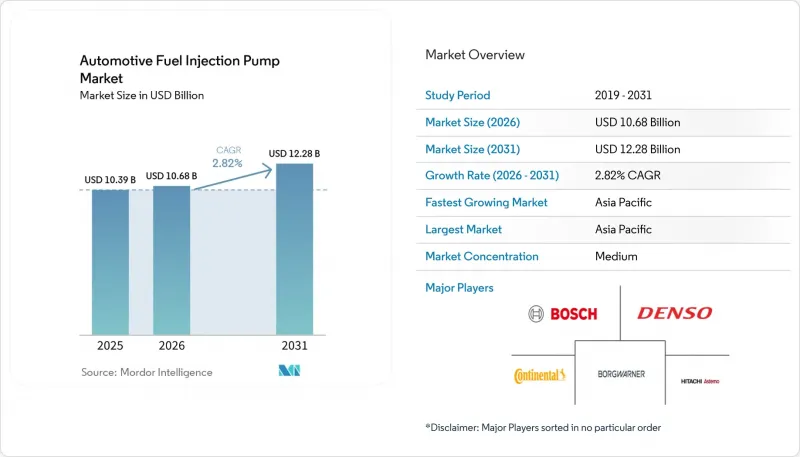
Mordor Intelligence에 의하면, 자동차 연료 분사 펌프 시장 규모는 2025년 103억 9,000만 달러, 2026년 106억 8,000만 달러에서 2031년까지 122억 8,000만 달러로 확대된다고 예측되고 있어 2026년부터 2031년까지 연평균 성장률(CAGR)은 2.82%를 나타낼 전망입니다.
본 보고서는 펌프의 유형(커먼레일식 연료 분사 펌프, 로터리식 연료 분사 펌프 등), 압력 유형(저압, 고압),용도(직분사 시스템, 멀티포인트 연료 분사 시스템), 연료 유형(가솔린, 디젤 등), 차종, 유통 채널 및 지역별로 분류되어 있습니다. 시장 전망은 금액(미 달러) 및 수량(대)으로 제시되어 있습니다.
전 세계 자동차 연료 분사 펌프 시장 동향 및 인사이트
전 세계 배기가스 규제의 강화
유로 7은 2025년에 법제화되었으며, 고도나 온도대에 관계없이 일관된 레일 압력을 요구하는 실주행 배기가스 검사가 추가되었습니다. 2026년에 전면 시행될 중국 VI-B도 이와 유사한 엄격함을 반영하고 있으며, 내연기관 차량에 대해 30,000km를 초과하는 내구성 증명을 의무화하고 있습니다. 2027년에 도입될 예정인 인도의 ‘Bharat Stage VII’ 프레임워크는 암모니아 슬립 및 차량 내 모니터링에 관한 조항을 준수해야 합니다. 이 세 지역의 규제가 합쳐지면서, 공급업체들은 첨단 소재를 채택하고 더욱 엄격한 가공 공차를 준수해야만 하는 상황에 직면해 있습니다. 인증 감사에서는 실험실 시제품보다 실제 주행 데이터가 점점 더 중요시되고 있으며, 하드웨어와 자가 진단 기능을 결합한 공급업체가 높이 평가받고 있습니다.
아시아 내 GDI 승용차 생산 증가
중국은 2030년까지 기업 평균 연비 상한선을 3.3 L/100 km로 설정하는 목표를 내걸고 있으며, 각 성의 규제 당국도 플렉스 연료 대응을 장려하고 있어 GDI 보급률이 상승하고 있습니다. 인도의 승용차 제조업체들도 마찬가지로 BS-VII 기준을 충족하기 위해 GDI로의 전환을 추진하고 있습니다. 현지 1차 공급업체들은 생산 능력을 확대하고 에탄올 대응 씰을 도입하는 한편, 다국적 공급업체들은 비용과 규제 준수의 균형을 맞추기 위해 모듈식 설계를 중시하고 있습니다. 이러한 동향으로 인해 플랫폼의 균질화가 가속화되어 중형 모델 전반에 걸쳐 규모의 경제가 실현되고 있습니다.
전기차 보급 가속화
현재 유럽의 일부 회원국에서는 순수 배터리식 전기차의 판매 대수가 디젤차를 웃돌고 있으며, 북미의 주요 OEM 기업들은 향후 설비 투자의 상당 부분을 전동화 플랫폼에 할당하고 있습니다. 이러한 전환으로 인해 내연기관의 추가 개발 예산은 억제되고 있으며, 경차 부문에서의 펌프 생산 대수는 감소하고 있습니다. 각 공급업체는 기존 자산을 분리·매각하거나, 수소 대응 프로그램에 주력하거나, 노후화된 차량의 운행을 유지하는 애프터마켓 제품 라인에 집중함으로써 리스크 헤지를 도모하고 있습니다.
부문 분석
커먼 레일식 연료 분사 펌프는 자동차 연료 분사 펌프 시장 점유율의 57.33%를 차지하고 있습니다. 이 펌프의 ‘디커플링 압력’ 설계 덕분에 엔지니어들은 여러 분사 이벤트를 미세 조정할 수 있는데, 이는 로터리식이나 실린더 내식에서는 실현하기 어려운 기능입니다. OEM의 캘리브레이션 팀은 점점 더 엄격해지는 배기가스 규제와 하이브리드 사이클에 대응할 때 이러한 유연성을 높이 평가했습니다. 또한, 이 아키텍처는 모듈식 소프트웨어 업데이트에 적합하여 내연 기관 전략이 진화하더라도 하드웨어를 지속적으로 활용할 수 있게 합니다. 따라서 각 공급업체는 커먼 레일 하드웨어에 고급 분석 기능을 결합함으로써 이 플랫폼에 대한 락인 효과를 강화하고 있습니다.
이 하위 부문은 해당 기간 동안 3.91%라는 가장 높은 연평균 성장률(CAGR)을 나타낼 전망입니다. 지속적인 소재 개선, 더 고성능의 솔레노이드, 그리고 더 엄격한 가공 공차가 이러한 성장 예측의 기반이 되고 있습니다. 신규 진출기업들은 경쟁 설계안을 처음부터 구축하기보다는 기준이 되는 특허를 라이선싱하는 경향을 보이며, 이로 인해 직접적인 경쟁이 완화되고 이익률이 유지되고 있습니다. 또한, 합성 디젤 혼합 연료로 전환하는 차량 함대의 경우에도 내구성 감사에서 인증을 획득하는 데 커먼레일 펌프가 더 용이한 것으로 밝혀졌습니다. 이러한 요인들이 결합되어, 이 기술은 향후 내연 기관 프로그램에서 기본 선택지로서의 입지를 공고히 하고 있습니다.
2025년, 고압 펌프는 자동차 연료 분사 펌프 시장 점유율의 66.11%를 차지했습니다. 연료를 미세하게 분무할 수 있는 능력 덕분에, 입자 수를 제어하는 데 있어 필수적인 존재가 되었습니다. 자동차 제조업체들은 이 고압 펌프를 폐쇄 루프 센서와 통합함으로써, 레일이 고도, 온도 및 부하의 급격한 변화에 즉각 대응할 수 있도록 하고 있습니다. 각 개발 파트너사는 부피를 늘리지 않으면서 수명을 연장하는 씰링 재료의 화학 조성 및 샤프트 코팅 기술에 주력하고 있습니다. 규제가 확대됨에 따라 고압 방식은 승용차 및 상용차 플랫폼을 불문하고 청정 연소의 대명사가 되고 있습니다.
또한, 이 부문은 3.81%라는 가장 높은 연평균 성장률(CAGR)을 달성할 것으로 예측됩니다. 성장의 핵심은 직접 분사 가솔린 및 저탄소 디젤 대체 연료로의 전환이며, 이들 모두 더 높은 분사 에너지를 필요로 합니다. 펌프 제조업체와 철강 공급업체 간의 공동 연구 개발 프로젝트는 압력 안정성을 유지하면서 코어 중량을 줄이는 것을 목표로 하고 있으며, 이러한 조합을 통해 차량에 탑재할 수 있는 범위가 확대됩니다. 하이브리드 차량도 수요를 더욱 부추기고 있습니다. 빈번한 재시동 시 고압 시스템이 제공하는 즉각적인 압력 준비 태세가 유리하게 작용하기 때문입니다. 그 결과, 투자 계획은 이 압력 등급에 크게 치우친 상태가 지속되고 있습니다.
지역별 분석
아시아태평양은 2025년 자동차 연료 분사 펌프 시장 매출의 46.25%를 차지하며, 연평균 성장률(CAGR) 3.22%로 그 선두를 더욱 확대할 것으로 전망됩니다. 중국의 ‘VI-B’ 규제 시행에 따라 내연기관(ICE)에는 30,000km 이상의 내구성과 낮은 입자 수가 의무화되었으며, 이에 따라 현지 OEM 업체들은 국내 및 합작 기업공급업체에 고압 커먼 레일 관련 계약을 발주하도록 촉진되고 있습니다. 인도의 ‘바랏 스테이지 VII’ 로드맵에서는 유사한 기준치와 실시간암모니아 슬립 모니터링이 확인되었습니다. 일본 하이브리드차 시장의 우위는 정밀 저유량 가솔린 펌프 수주를 안정화시켜, 당분간 해당 지역이 전기차(EV)에 의한 시장 잠식의 영향을 완화하고 있습니다.
유럽에서는 유로 7 도입과 배터리식 전기차 보급 가속화라는 이중의 압박에 직면해 있습니다. 승용차 디젤차 판매 대수는 감소 추세를 보이고 있지만, 고급차 제조업체들은 여전히 레인지 익스텐더식 하이브리드차 및 고성능 가솔린차용 고압 연료 시스템에 의존하고 있습니다. 독일, 프랑스, 체코 공화국에 위치한 공급업체 공장에서는 내연기관용 및 전동 구동용 하위 어셈블리를 모두 생산할 수 있도록 생산 라인을 재조정하여 설비 가동률을 안정화하고 있습니다. 유럽 그린딜(Green Deal)의 틀 내에서 자금을 지원받은 수소 버스 시제차는 연료 충전 전문 업체에게 새로운 틈새 시장을 창출하고 있으며, 건조 연료에 대응할 수 있는 밀봉재의 적용이 요구되고 있습니다.
북미에서는 주 차원의 제로 배출 규제와 대형 픽업 트럭 및 SUV에 대한 시장의 지지가 균형을 이루고 있습니다. 연안 주들이 제로 테일파이프 차량의 판매 목표를 강화하고 있는 상황에서도, 풀사이즈 하이브리드 트럭과 에탄올 플렉스 모델이 주유소 수요를 지탱하고 있습니다. 멕시코의 지역 Tier 2 공급업체들은 애프터마켓 수출로 사업을 다각화함으로써 OEM 발주 감소를 상쇄하고 있습니다. 또한, 미국은 장거리 화물 운송 분야에서 재생 가능 디젤의 실증 무대로도 기능하고 있어, 고압 디젤 펌프 시장에는 향후 몇 년간 성장 여지가 있습니다.
기타 혜택:
- 엑셀 형식 시장 예측(ME) 시트
- 3개월간의 애널리스트 지원
자주 묻는 질문
목차
제1장 서론
제2장 조사 방법
제3장 개요
제4장 시장 구도
제5장 시장 규모와 성장 예측
제6장 경쟁 구도
제7장 시장 기회와 향후 전망
JHS 26.09.01According to Mordor Intelligence, the automotive fuel injection pump market size is projected to expand from USD 10.39 billion in 2025 and USD 10.68 billion in 2026 to USD 12.28 billion by 2031, registering a CAGR of 2.82% between 2026 and 2031.
This report is Segmented by Pump Type (Common Rail Fuel Injection Pump, Rotary Fuel Injection Pump, and More), Pressure Type (Low Pressure, High Pressure), Application (Direct Injection System, Multi-Point Fuel Injection System), Fuel Type (Gasoline, Diesel, and More), Vehicle Type, Distribution Channel, and Geography. Market Forecasts are Provided in Terms of Value (USD) and Volume (Units).
Global Automotive Fuel Injection Pump Market Trends and Insights
Stringent Global Emission Regulations
Euro 7 became law in 2025 and adds real-driving-emissions checks that demand consistent rail pressure across altitude and temperature bands. China VI-B, fully enforced in 2026, mirrors those stringencies and requires durability proof beyond 30,000km for ICE vehicles. India's Bharat Stage VII framework, due in 2027, will align with ammonia-slip and onboard monitoring clauses. Together, the three regions force suppliers to adopt advanced materials and tighter machining tolerances. Certification audits increasingly emphasize real-world data rather than laboratory prototypes, rewarding vendors that couple hardware with self-diagnostics.
Rising GDI Passenger-Car Production in Asia
China aims for a corporate-average fuel-consumption ceiling of 3.3 L/100 km by 2030, and provincial regulators encourage flex-fuel compatibility, pushing GDI penetration upward. Indian passenger-car makers likewise pivot toward GDI to meet BS-VII. Local tier-ones ramp capacity and introduce ethanol-compatible seals, while multinational suppliers underscore modular designs to balance cost and compliance. The trend accelerates platform homogenization, enabling scale economics across mid-range models.
Accelerating EV Penetration
Pure battery-electric models now out-sell diesel cars in several European member states, and large North American OEMs allocate the bulk of future capex to electrified platforms. The shift curbs incremental combustion-engine development budgets and compresses pump volumes in light-duty segments. Suppliers hedge by spinning off legacy assets, courting hydrogen-ready programs, or doubling down on aftermarket lines that keep aging fleets running.
Other drivers and restraints analyzed in the detailed report include:
- Demand for Downsized Turbo-Turbo Engines
- Hybrid-Vehicle Electrified Pumps Demand
- High Cost and Complexity of HP Pumps
For complete list of drivers and restraints, kindly check the Table Of Contents.
Segment Analysis
Common-rail pumps captured 57.33% of the automotive fuel injection pump market share. Their decoupled-pressure design lets engineers tune multiple injection events in ways rotary and in-cylinder formats struggle to match. OEM calibration teams value that flexibility when navigating ever-tighter emissions files and hybrid cycles. The architecture also lends itself to modular software updates that keep hardware viable as combustion strategies evolve. Suppliers therefore bundle common-rail hardware with advanced analytics, reinforcing a lock-in effect around this platform.
The same sub-segment is forecast to post the fastest CAGR of 3.91% over the period. Continuous material upgrades, smarter solenoids, and tighter machining tolerances underpin that growth projection. New entrants tend to license baseline patents rather than build competing designs from scratch, reducing direct rivalry and sustaining margins. Fleets migrating to synthetic diesel blends also find common-rail pumps easier to certify under durability audits. Taken together, these factors cement the technology as the default choice for future internal-combustion programs.
High-pressure pumps commanded 66.11% of the automotive fuel injection pump market share in 2025. Their ability to atomize fuel finely makes them indispensable for controlling particulate numbers. Automakers integrate them with closed-loop sensors so the rail adjusts instantly to altitude, temperature, and load transients. Development partners focus on seal chemistry and shaft coatings that extend life without adding bulk. As regulations spread, the high-pressure format has become synonymous with clean combustion across passenger and commercial platforms.
This category is also expected to deliver the quickest 3.81% CAGR. Growth hinges on the move toward direct-injection gasoline and low-carbon diesel substitutes, both of which demand higher spray energy. Collaborative R&D projects between pump makers and steel suppliers aim to reduce core weight while holding pressure stability, a combination that broadens vehicle fitment. Hybrid vehicles further reinforce demand because frequent restarts benefit from the immediate pressure readiness that high-bar systems provide. Consequently, investment pipelines remain heavily skewed toward this pressure class.
Complete Report Scope:
- By Pump Type
- Common Rail Fuel Injection Pump
- Rotary Fuel Injection Pump
- In-Cylinder Pump
- Outside-Cylinder Pump
- By Pressure Type
- Low Pressure
- High Pressure
- By Application
- Direct Injection System
- Multi-Point Fuel Injection System
- By Fuel Type
- Gasoline
- Diesel
- Alternative Fuels
- By Vehicle Type
- Passenger Vehicles
- Light Commercial Vehicles
- Medium and Heavy Commercial Vehicles
- By Distribution Channel
- OEM
- Aftermarket
- By Geography
- North America
- United States
- Canada
- Rest of North America
- South America
- Brazil
- Argentina
- Rest of South America
- Europe
- United Kingdom
- Germany
- Spain
- Italy
- France
- Russia
- Rest of Europe
- Asia-Pacific
- India
- China
- Japan
- South Korea
- Rest of Asia-Pacific
- Middle East and Africa
- United Arab Emirates
- Saudi Arabia
- Turkey
- Egypt
- South Africa
- Rest of Middle-East and Africa
- North America
Geography Analysis
Asia-Pacific claimed 46.25% of 2025 revenue for the automotive fuel injection pump market and is projected to extend that lead at a 3.22% CAGR. China's VI-B enforcement obliges over 30,000km durability and low particulate counts for ICEs, spurring local OEMs to award high-pressure common-rail contracts to domestic and joint-venture suppliers. India's Bharat Stage VII roadmap confirms similar thresholds and real-time ammonia-slip monitoring. Japanese hybrid dominance sustains steady order books for precision low-flow gasoline pumps, buffering the region from near-term EV cannibalization.
Europe navigates the twin pressures of the introduction of Euro 7 and accelerated battery-electric adoption. While passenger-car diesel volumes contract, premium makers still rely on high-bar fuel systems for range-extended hybrids and performance gasoline models. Supplier plants in Germany, France, and the Czech Republic recalibrate lines to juggle combustion and e-drive sub-assemblies, keeping capacity utilization stable. Hydrogen bus prototypes funded under the European Green Deal create a new niche for pump specialists, requiring the adaptation of sealing materials to dry fuels.
North America balances state-level zero-emission mandates with market loyalty to large pickups and SUVs. Full-size hybrid trucks and ethanol-flex models preserve pump demand even as coastal states push stricter sales targets for zero-tail-pipe vehicles. Regional tier-twos in Mexico diversify toward aftermarket exports, offsetting lower OEM call-offs. The United States also acts as a testbed for renewable diesel in long-haul freight, giving high-pressure diesel pumps a multi-year runway.
- Robert Bosch GmbH
- Denso Corporation
- Continental AG
- Hitachi Astemo Ltd.
- Aisin Corporation
- Stanadyne LLC
- Cummins Inc.
- Woodward Inc.
- Weifu Group
- BorgWarner Inc. (Phinia Inc.)
- Magna International Inc.
- Mikuni Corporation
- SHW AG
- Marelli Holdings
Additional Benefits:
- The market estimate (ME) sheet in Excel format
- 3 months of analyst support
TABLE OF CONTENTS
1 Introduction
- 1.1 Study Assumptions & Market Definition
- 1.2 Scope of the Study
2 Research Methodology
3 Executive Summary
4 Market Landscape
- 4.1 Market Overview
- 4.2 Market Drivers
- 4.2.1 Stringent Global Emission Regulations
- 4.2.2 Rising GDI Passenger-Car Production in Asia
- 4.2.3 Demand for Downsized Turbo-Turbo Engines
- 4.2.4 Hybrid-Vehicle Electrified Pumps Demand
- 4.2.5 Hydrogen-Ready High-Pressure Pump R&D
- 4.2.6 AI-Enabled Fleet Predictive Maintenance
- 4.3 Market Restraints
- 4.3.1 Accelerating EV Penetration
- 4.3.2 High Cost and Complexity of HP Pumps
- 4.3.3 Precision-Component Supply-Chain Risks
- 4.3.4 Shortage of Skilled Pump Technicians
- 4.4 Value / Supply-Chain Analysis
- 4.5 Technological Outlook
- 4.6 Regulatory Landscape
- 4.7 Porter's Five Forces
- 4.7.1 Threat of New Entrants
- 4.7.2 Bargaining Power of Buyers
- 4.7.3 Bargaining Power of Suppliers
- 4.7.4 Threat of Substitutes
- 4.7.5 Competitive Rivalry
5 Market Size & Growth Forecasts (Value (USD) and Volume (Units))
- 5.1 By Pump Type
- 5.1.1 Common Rail Fuel Injection Pump
- 5.1.2 Rotary Fuel Injection Pump
- 5.1.3 In-Cylinder Pump
- 5.1.4 Outside-Cylinder Pump
- 5.2 By Pressure Type
- 5.2.1 Low Pressure
- 5.2.2 High Pressure
- 5.3 By Application
- 5.3.1 Direct Injection System
- 5.3.2 Multi-Point Fuel Injection System
- 5.4 By Fuel Type
- 5.4.1 Gasoline
- 5.4.2 Diesel
- 5.4.3 Alternative Fuels
- 5.5 By Vehicle Type
- 5.5.1 Passenger Vehicles
- 5.5.2 Light Commercial Vehicles
- 5.5.3 Medium and Heavy Commercial Vehicles
- 5.6 By Distribution Channel
- 5.6.1 OEM
- 5.6.2 Aftermarket
- 5.7 By Geography
- 5.7.1 North America
- 5.7.1.1 United States
- 5.7.1.2 Canada
- 5.7.1.3 Rest of North America
- 5.7.2 South America
- 5.7.2.1 Brazil
- 5.7.2.2 Argentina
- 5.7.2.3 Rest of South America
- 5.7.3 Europe
- 5.7.3.1 United Kingdom
- 5.7.3.2 Germany
- 5.7.3.3 Spain
- 5.7.3.4 Italy
- 5.7.3.5 France
- 5.7.3.6 Russia
- 5.7.3.7 Rest of Europe
- 5.7.4 Asia-Pacific
- 5.7.4.1 India
- 5.7.4.2 China
- 5.7.4.3 Japan
- 5.7.4.4 South Korea
- 5.7.4.5 Rest of Asia-Pacific
- 5.7.5 Middle East and Africa
- 5.7.5.1 United Arab Emirates
- 5.7.5.2 Saudi Arabia
- 5.7.5.3 Turkey
- 5.7.5.4 Egypt
- 5.7.5.5 South Africa
- 5.7.5.6 Rest of Middle-East and Africa
- 5.7.1 North America
6 Competitive Landscape
- 6.1 Market Concentration
- 6.2 Strategic Moves
- 6.3 Market Share Analysis
- 6.4 Company Profiles (Includes Global Level Overview, Market Level Overview, Core Segments, Financials as Available, Strategic Information, Market Rank/Share for Key Companies, Products and Services, SWOT Analysis, and Recent Developments)
- 6.4.1 Robert Bosch GmbH
- 6.4.2 Denso Corporation
- 6.4.3 Continental AG
- 6.4.4 Hitachi Astemo Ltd.
- 6.4.5 Aisin Corporation
- 6.4.6 Stanadyne LLC
- 6.4.7 Cummins Inc.
- 6.4.8 Woodward Inc.
- 6.4.9 Weifu Group
- 6.4.10 BorgWarner Inc. (Phinia Inc.)
- 6.4.11 Magna International Inc.
- 6.4.12 Mikuni Corporation
- 6.4.13 SHW AG
- 6.4.14 Marelli Holdings
7 Market Opportunities & Future Outlook
- 7.1 White-space & Unmet-Need Assessment


