

|
시장보고서
상품코드
2117462
자동 디밍 미러 시장 : 점유율 분석, 업계 동향과 통계, 성장 예측(2026-2031년)Auto Dimming Mirror - Market Share Analysis, Industry Trends & Statistics, Growth Forecasts (2026 - 2031) |
||||||
 Mordor Intelligence
Mordor Intelligence에 의하면, 자동 디밍 미러 시장 규모는 2025년에 20억 9,000만 달러로 평가되었고 2026년 21억 9,000만 달러에서 2031년까지 27억 8,000만 달러에 이를 것으로 예측되며, 2026년부터 2031년까지 CAGR 4.89%로 성장할 전망입니다.
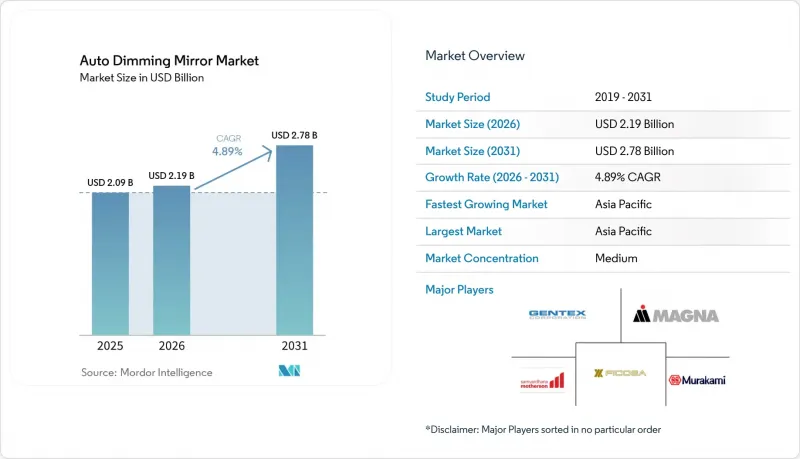
본 보고서는 제품 유형(일렉트로크로믹 미러, 어댑티브 미러 등), 기능(커넥티드 자동 디밍 미러 및 비커넥티드 자동 디밍 미러), 기술(자동 디밍 및 수동 디밍), 용도, 차종, 구동 방식, 유통 채널 및 지역별로 분류되어 있습니다. 시장 전망은 금액(달러) 및 수량(대)의 관점에서 제시되어 있습니다.
세계 자동 디밍 미러 시장 동향 및 인사이트
중형 부문 차량에서의 OEM 탑재 경쟁
자동 디밍 미러는 기존에 일반 미러가 사용되던 차종, 특히 중형 승용차에 도입되고 있습니다. 중국, 인도 및 기타 아시아태평양의 생산 거점은 자동차 생산 대수와 사양의 충실화에 따라 여전히 중요한 위치를 차지하고 있습니다. 자동차 제조업체가 이 기능을 공장 옵션으로 제공할 경우, 자동 디밍 미러 시장은 혜택을 받게 되지만, 공급업체는 현지 검증, 비용, 납기, 품질에 관한 요건을 충족해야 합니다. 공장 장착형 시스템은 공급업체 선정 기준을 변화시키고 있습니다. 자동차 제조업체들은 미러 어셈블리가 차량의 전기 아키텍처, 배선, 소프트웨어, 안전 요구사항 및 서비스 계획에 부합할 것을 요구하고 있습니다. 이로 인해 생산 주기 전반을 지원하고 설계 변경을 관리할 수 있는 공급업체가 유리해집니다. 그러나 비용 중심의 프로그램에서는 일부 등급에서 수동식 미러가 유지될 가능성이 있어, 합리적인 가격은 여전히 시장 성장의 핵심 요소로 남을 것입니다.
아시아태평양(APAC)의 자동차 생산 증가와 전기차 붐
전기차 제조업체들은 공기역학적 저항이 에너지 소비, 주행 거리 및 차량 효율성에 영향을 미치기 때문에 외장 부품을 면밀히 평가했습니다. 사이드 미러의 형태와 배치는 컴팩트한 디자인과 카메라 기반 대안에 대한 관심을 촉진하고 있습니다. 이로 인해 장거리 주행이 가능한 전기차 및 관련 플랫폼에서 외부 미러 아키텍처를 재검토해야 할 기술적 근거가 강화되고 있습니다. 미러 제조업체들은 새로운 소재, 센서, 발열체, 소프트웨어 및 카메라 통합이 필요할 수 있지만, 모든 전기차가 카메라 전용 시스템을 채택하거나 기존의 외부 미러를 제거하는 것은 아닙니다. 고급 미러 어셈블리가 자동 디밍 기능을 유지하는 분야에서는 자동 디밍 미러 시장이 혜택을 볼 것이지만, 카메라·모니터 시스템이 외장 일렉트로크로믹 모듈을 대체하게 될 경우, 해당 시장은 압박에 직면하게 될 것입니다.
기존 미러에 비해 높은 부품 원가
자동 디밍 미러는 일렉트로크로믹 유리, 센서, 전자 기기 및 차종별 통합이 필요하기 때문에 기존 미러보다 비용이 더 많이 듭니다. 자동차 제조업체들은 부품 예산이 여전히 빠듯한 보급형 차량의 경우 이 비용을 흡수하기 어렵다고 느끼고 있습니다. 그 결과, 해당 차량의 가격에 부합하지 않을 경우 이 기능을 상위 트림으로만 제한할 가능성이 있습니다. 또한 비용 측면의 압박으로 인해 공급업체는 첨단 시스템보다 검증된 설계를 우선시할 수밖에 없을 수도 있습니다. 이러한 요인들로 인해, 특히 가격에 민감한 자동차 시장에서 이 기술의 광범위한 보급이 지연될 가능성이 있습니다.
부문 분석
2025년에는 일렉트로크로믹 미러가 68.98%의 점유율을 차지했으나, 어댑티브 미러는 2031년까지 연평균 성장률(CAGR) 5.95%를 나타낼 것으로 예측됩니다. 일렉트로크로믹 제품은 일반적인 야간 주행 시 반사로 인한 눈부심을 줄이는 검증된 수단을 제공하기 때문에 여전히 중심적인 위치를 차지하고 있습니다. 공장 출고 시 차량 프로그램에 확고하게 자리 잡은 사용 실적이 지속적인 수요를 뒷받침하고 있으며, 자동차 제조업체에게는 친숙한 부품 선택지가 되고 있습니다. 각 제조업체는 이러한 제품에 대한 검증 요건을 충분히 이해하고 있으며, 기존 미러 설계 및 차량 제어 시스템에 통합할 수 있습니다. 이러한 높은 숙련도가 승용차, 일부 상용차 용도 및 광범위한 가격대의 차량에서 이 제품들의 입지를 뒷받침하고 있습니다.
어댑티브 미러는 디밍 기능 외에도 추가적인 감지, 제어 또는 커넥티드 기능을 단일 어셈블리에 통합할 수 있다는 점에서 주목받고 있습니다. 이러한 제품은 기본적인 설계보다 변화하는 광 조건에 정밀하게 적응하며, 더 광범위한 차량 기능을 지원합니다. 또한, 보급이 확대되고 있는 카메라 통합 및 소프트웨어 기반 기능과 같은 보다 광범위한 차량 설계에도 부합합니다. 제품 개발자는 추가된 기능으로 인해 미러의 제조, 진단 또는 정비가 어려워지지 않도록 보장해야 합니다. 부품 예산이 제한된 중형 차량에 어댑티브 시스템을 탑재할 경우, 비용은 여전히 중요한 고려 사항입니다.
2025년에는 커넥티드 자동 디밍 미러가 해당 카테고리 매출의 64.48%를 차지하며, 연평균 성장률(CAGR) 5.12%를 나타낼 것으로 예측됩니다. 자동차 제조업체들이 전자 제어 방식의 차량 아키텍처 및 중앙 집중식 제어 시스템에 더 많은 기능을 통합함에 따라, 미러의 역할은 확대되고 있습니다. 커넥티비티는 설계상 필요한 경우 디스플레이 기능, 카메라 기능 및 차량 내 시스템 간의 데이터 교환을 지원할 수 있습니다. 또한 제조업체가 미러의 기본 설치 위치를 변경하지 않고도 차종 등급별로 서로 다른 미러 기능을 제공하는 데에도 도움이 됩니다. 커넥티드카의 보급에 따라, 디지털 인터페이스를 채택한 신형 승용차 프로그램에서 이러한 미러는 명확한 역할을 담당하고 있습니다. 그 활용 여부는 각 차량 플랫폼 내에 이를 뒷받침하는 전기·소프트웨어·사이버 보안 아키텍처가 갖춰져 있는지에 따라 좌우됩니다.
비연결형 미러는 전자 기기에 대한 의존도가 낮아, 보다 단순한 제품을 선호하는 고객들에게 계속해서 이용되고 있습니다. 플릿 운영사, 상업용 운영사 및 교체용 구매자는 내구성, 예측 가능한 작동, 그리고 간편한 유지보수를 더 중요하게 여기는 경향이 있습니다. 이러한 미러는 네트워크 통합이나 소프트웨어 업데이트와 같은 추가 요구 사항 없이 눈부심 저감을 실현할 수 있습니다. 따라서 커넥티드카 인프라가 충분히 구축되지 않았거나, 이용할 수 없거나, 구매자에게 불필요한 경우에 적합합니다. 공급업체는 고객마다 운영 요구 사항, 서비스 모델, 구매 우선순위가 다르기 때문에 두 제품 라인을 모두 유지할 수 있습니다.
자동 디밍 기능은 2025년에 해당 카테고리 매출의 71.95%를 차지하며, 2031년까지 연평균 성장률(CAGR) 6.79%로 성장할 것으로 전망됩니다. 이 기술은 주행 중 운전자가 미러 설정을 변경할 필요 없이 후방의 빛 변화에 대응합니다. 이러한 직접적인 이점으로 인해 야간 주행의 편의성, 시인성 및 운전자의 주의 산만 감소에 중점을 두는 차량에 적합합니다. 제조업체는 비용이 허용 범위 내이고 차량 아키텍처가 이를 지원할 수 있는 경우, 여러 트림에 걸쳐 자동 시스템을 채택할 수 있습니다. 또한, 이 기술은 이미 센서, 제어 장치, 카메라 또는 디스플레이 기능을 갖춘 전자식 미러 어셈블리와도 탁월한 호환성을 보입니다.
차량 비용이 주요 구매 요인이며, 사양을 제한해야 하는 경우, 수동식 디밍 시스템은 여전히 유용합니다. 수동식 시스템은 익숙한 기계적 해결책을 제공하며, 자동식에 비해 전자 부품, 센서 및 통합 공정이 적게 필요합니다. 따라서 가격에 민감한 지역에서 판매되는 엔트리 레벨 상용차나 저가형 승용차 모델에 유용할 수 있습니다. 그러나 주행 상황이 빈번하게 변하거나 후방에서 예기치 않게 눈부심이 발생할 경우, 수동 조작은 편의성이 떨어집니다. 자동 시스템의 통합이 용이해지고 더 널리 받아들여짐에 따라, 자동차 제조업체들은 수동식 시스템의 채택을 점차 줄여나갈 가능성이 있습니다.
지역별 분석
아시아태평양은 2025년에 이 카테고리의 매출의 40.51%를 차지하며, 2031년까지 연평균 성장률(CAGR) 5.38%로 성장할 것으로 전망됩니다. 이 지역에는 주요 자동차 생산 거점이 위치해 있으며, 야간 운전을 개선하고 승용차에 눈에 띄는 부가가치를 제공하는 기능에 대한 수요가 증가하고 있습니다. 중국과 일본은 자동차 기술, 공급업체 역량, 그리고 내수 및 수출용 프로그램에서의 전자 미러 기능 개발 측면에서 여전히 중요한 위치를 차지하고 있습니다. 인도는 제조업체들이 자동차 생산을 확대하고 경쟁력을 높이고 있는 중급 모델에 추가 기능을 도입함에 따라 성장의 새로운 길을 제시하고 있습니다. 이 지역공급업체들은 현지 인증 요건을 충족하는 동시에 비용, 신뢰성 및 엔지니어링 지원 측면에서 이미 입지를 다진 세계 기업들과 경쟁해야 합니다.
북미의 자동 디밍 미러 시장은 승용차 및 프리미엄 기능 패키지에 사용되는 고부가가치 미러에 있어 중요한 시장입니다. 이 지역의 자동차 제조업체들은 기존 차량 플랫폼에 통합할 수 있는 디스플레이 미러, 카메라 통합 및 커넥티드 기능에 계속해서 관심을 보이고 있습니다. 애프터마켓 또한 구매자가 더 큰 편의성, 후방 시야, 혹은 더욱 개성 있는 실내 공간을 추구하는 업그레이드 및 특수 제품으로의 길을 열어주고 있습니다. 멕시코는 지역 전체에 공급되는 모델의 차량 조립 거점으로서, 또한 더 광범위한 공급업체 생산 네트워크의 일부로서 중요한 역할을 수행하고 있습니다. 캐나다는 북미의 차량 생산, 유통, 서비스 활동 및 국경을 초월한 공급 관계와의 연계성을 통해 수요를 뒷받침하고 있습니다.
유럽에서는 공급업체들이 규제 변화와 디지털 외부 시야 시스템 도입 압력이라는 두 가지 과제에 직면해 있어 시장 발전 속도가 완만합니다. 2025년 독일의 FLABEG Automotive가 폐쇄되면서, 유럽 내 일렉트로크로믹 미러 제품공급 상황에 변화가 생겼습니다. 또한, 유럽의 각 제조업체들은 보다 통합된 전자 설계가 요구되는 프리미엄 차량 및 전기차(EV) 프로그램을 위해 카메라·모니터 시스템 도입도 검토하고 있습니다. 남미, 중동 및 아프리카은 여전히 시장 규모가 작지만, 차량 함대의 안전 요구 사항과 현지 자동차 생산으로 인해 제한적인 수요가 예상됩니다. 이 지역에서는 눈부심 감소와 합리적인 가격, 교체 부품의 입수 용이성, 실용적인 서비스 지원이 균형을 이룬 제품이 요구되고 있습니다.
기타 혜택:
- 엑셀 형식 시장 예측(ME) 시트
- 3개월간의 애널리스트 지원
자주 묻는 질문
목차
제1장 서론
제2장 조사 방법
제3장 개요
제4장 시장 구도
제5장 시장 규모와 성장 예측
제6장 경쟁 구도
제7장 시장 기회와 향후 전망
JHS 26.09.01According to Mordor Intelligence, the auto dimming mirror market size was valued at USD 2.09 billion in 2025 and is expected to grow from USD 2.19 billion in 2026 to reach USD 2.78 billion by 2031 at 4.89% CAGR over 2026-2031.
This report is Segmented by Product Type (Electrochromic Mirrors, Adaptive Mirrors, and More), Functionality (Connected Auto-Dimming Mirrors and Non-Connected Auto-Dimming Mirrors), Technology (Automatic Dimming and Manual Dimming), Application, Vehicle Type, Propulsion Type, Distribution Channel, and Geography. The Market Forecasts are Provided in Terms of Value (USD) and Volume (Units).
Global Auto Dimming Mirror Market Trends and Insights
OEM Fitment Race in Mid-Segment Cars
Auto-dimming mirrors are entering vehicle lines that previously used conventional mirrors, especially in mid-segment passenger vehicles. China, India, and other Asia-Pacific production centers remain important as vehicle output and feature content rise. The auto-dimming mirror market benefits when automakers offer the function as a factory option, though suppliers must meet local validation, cost, delivery, and quality requirements. Factory-installed systems are changing supplier selection. Automakers require mirror assemblies to align with vehicle electrical architecture, wiring, software, safety needs, and service plans. This favors suppliers that can support full production cycles and manage engineering changes. However, cost-sensitive programs may retain manual mirrors in some trims, keeping affordability central to market growth.
Rising Vehicle Production in APAC and EV Boom
Electric vehicle manufacturers closely evaluate exterior components because aerodynamic drag affects energy use, driving range, and vehicle efficiency. Side mirror shape and placement support interest in compact designs and camera-based alternatives. This strengthens the engineering case for rethinking exterior mirror architecture in long-range electric vehicles and related platforms. Mirror producers may need new materials, sensors, heating elements, software, and camera integration, though not every electric vehicle will adopt camera-only systems or remove conventional exterior mirrors. The auto dimming mirror market will benefit where advanced mirror assemblies retain auto-dimming capability, but it will face pressure when camera-monitor systems replace exterior electrochromic modules.
High BOM Cost vs. Traditional Mirrors
Auto-dimming mirrors cost more than traditional mirrors because they require electrochromic glass, sensors, electronics, and vehicle-specific integration. Automakers find this cost harder to absorb in entry-level vehicles, where component budgets remain tight. As a result, they may restrict the feature to higher trims when it does not fit the target vehicle price. Cost pressure can also push suppliers to favor proven designs over advanced systems. These factors can slow broader adoption, especially in price-sensitive vehicle markets.
Other drivers and restraints analyzed in the detailed report include:
- Integration with ADAS/Connected-Car Features
- Stricter Glare-Safety Regulations
- Growing Adoption of Camera-Only Mirror Replacements
For complete list of drivers and restraints, kindly check the Table Of Contents.
Segment Analysis
Electrochromic mirrors held 68.98% share in 2025, while adaptive mirrors are expected to grow at a 5.95% CAGR through 2031. Electrochromic products remain central because they provide a proven way to reduce reflected glare during routine nighttime driving. Their established use on factory-installed vehicle programs supports continued demand and gives automakers a familiar component choice. Manufacturers understand the validation requirements for these products and can integrate them with existing mirror designs and vehicle controls. This familiarity supports their position across passenger vehicles, selected commercial applications, and multiple vehicle price categories.
Adaptive mirrors are gaining attention because they can combine dimming with additional sensing, control, or connected functions in a single assembly. These products may adjust more precisely to changing light conditions than basic designs and support a wider set of vehicle features. They can also fit with broader vehicle plans for camera integration and software-based functions that are becoming more common. Product developers need to ensure that the added capability does not make the mirror difficult to manufacture, diagnose, or service. Cost remains an important consideration when adaptive systems are offered on mid-range vehicles with tighter component budgets.
Connected auto-dimming mirrors accounted for 64.48% of category revenue in 2025, and are forecasted to grow at a 5.12% CAGR. Their role has expanded as vehicle manufacturers bring more functions into electronically managed vehicle architectures and centralized control systems. Connectivity can support display features, camera functions, and data exchange within a vehicle system when the design requires it. It can also help a manufacturer offer different mirror functions across vehicle trims without changing the fundamental mirror location. The installed base of connected vehicles gives these mirrors a clear role in newer passenger vehicle programs that use digital interfaces. Their use remains tied to the availability of supporting electrical, software, and cybersecurity architecture within each vehicle platform.
Non-connected mirrors continue to serve customers who prefer a simpler product with fewer electronic dependencies. Fleets, commercial operators, and replacement buyers may place more value on durability, predictable operation, and straightforward maintenance. These mirrors can provide glare reduction without the additional requirements of network integration or software updates. This makes them suitable where connected-vehicle infrastructure is less developed, unavailable, or unnecessary for the buyer. Suppliers can maintain both product lines because their customers have different operating needs, service models, and purchasing priorities.
Automatic dimming accounted for 71.95% of category revenue in 2025 and is forecasted to grow at a 6.79% CAGR through 2031. The technology responds to changes in rearward light without requiring a driver to change the mirror setting during a journey. This direct benefit makes it suitable for vehicles that emphasize nighttime comfort, visibility, and reduced driver distraction. Manufacturers can use automatic systems across several trim levels when the cost is acceptable and the vehicle architecture supports them. The technology also has a clear fit with electronic mirror assemblies that already contain sensors, controls, cameras, or display functions.
Manual dimming systems remain relevant where vehicle cost is the main purchasing factor and feature content must be controlled. They offer a familiar mechanical solution and require fewer electronic components, sensors, and integration steps than automatic alternatives. This can make them useful on entry-level commercial vehicles and lower-priced passenger models sold in price-sensitive regions. However, manual operation provides less convenience when driving conditions change frequently, or rearward glare appears unexpectedly. Vehicle manufacturers may gradually reduce their use as automatic systems become easier to integrate and more widely accepted.
Complete Report Scope:
- By Product Type
- Electrochromic Mirrors
- Adaptive Mirrors
- Manual Dimming Mirrors
- By Functionality
- Connected Auto-Dimming Mirrors
- Non-Connected Auto-Dimming Mirrors
- By Technology
- Automatic Dimming
- Manual Dimming
- By Application
- Inside Rear-View Mirror
- Outside Rear-View Mirror
- By Vehicle Type
- Passenger Vehicles
- Light Commercial Vehicles
- Medium and Heavy Commercial Vehicles
- By Propulsion Type
- Internal Combustion Engine
- Battery Electric Vehicle (BEV)
- Hybrid Electric Vehicle (HEV)
- Plug-In Hybrid Electric Vehicle (PHEV)
- Fuel Cell Electric Vehicle (FCEV)
- By Distribution Channel
- OEM
- Aftermarket
- By Geography
- North America
- United States
- Canada
- Rest of North America
- South America
- Brazil
- Argentina
- Rest of South America
- Europe
- United Kingdom
- Germany
- Spain
- Italy
- France
- Russia
- Rest of Europe
- Asia-Pacific
- India
- China
- Japan
- South Korea
- Rest of Asia-Pacific
- Middle East and Africa
- United Arab Emirates
- Saudi Arabia
- Turkey
- Egypt
- South Africa
- Rest of Middle East and Africa
- North America
Geography Analysis
Asia-Pacific accounted for 40.51% of category revenue in 2025 and is forecasted to grow at a 5.38% CAGR through 2031. The region combines major vehicle production centers with growing demand for features that improve nighttime driving and add visible value to passenger vehicles. China and Japan remain important for vehicle technology, supplier capability, and the development of electronic mirror functions for domestic and export programs. India offers another route to growth as manufacturers expand vehicle production and introduce more features to mid-range models that are becoming more competitive. Regional suppliers must satisfy local qualification requirements and compete with established global companies on cost, reliability, and engineering support.
The auto dimming mirror market in North America is significant for higher-content mirrors used in passenger vehicles and premium feature packages. Vehicle manufacturers in the region continue to show interest in display mirrors, camera integration, and connected functions that can be incorporated into established vehicle platforms. The aftermarket also provides a route for upgrades and specialty products where buyers seek added comfort, rearward visibility, or a more distinctive vehicle interior. Mexico matters as a vehicle assembly location for models supplied across the region and as part of broader supplier production networks. Canada adds demand through its connection to North American vehicle production, distribution, service activity, and cross-border supply relationships.
Europe is developing at a slower pace because suppliers face both regulatory changes and pressure to adopt digital exterior viewing systems. The closure of FLABEG Automotive Germany in 2025 altered the European supply situation for electrochromic mirror products. European manufacturers are also considering camera-monitor systems for premium and electric vehicle programs that require a more integrated electronic design. South America and the Middle East and Africa remain smaller opportunities, but fleet safety needs and localized vehicle production can support selective demand. These regions require products that balance glare reduction with affordability, availability of replacement parts, and practical service support.
- Gentex Corporation
- Magna International Inc.
- Samvardhana Motherson Reflectec
- Ficosa International S.A.
- Murakami Corporation
- Tokai Rika Co., Ltd.
- SL Corporation
- Global Media Industry Group Co., Ltd. (GERMID)
- Hyundai Mobis Co., Ltd.
- Metagal Industria E-commercio Ltd.
- Hella GmbH & Co. KGaA
- Fuyao Glass Industry Group Co., Ltd.
- Ambilight Inc.
- Continental AG
- Robert Bosch GmbH
Additional Benefits:
- The market estimate (ME) sheet in Excel format
- 3 months of analyst support
TABLE OF CONTENTS
1 Introduction
- 1.1 Study Assumptions & Market Definition
- 1.2 Scope of the Study
2 Research Methodology
3 Executive Summary
4 Market Landscape
- 4.1 Market Overview
- 4.2 Market Drivers
- 4.2.1 OEM Fitment Race in Mid-Segment Cars
- 4.2.2 Rising Vehicle Production in APAC and EV Boom
- 4.2.3 Integration with ADAS/Connected-Car Features
- 4.2.4 Stricter Glare-Safety Regulations
- 4.2.5 Regulatory Green-Light for Digital/Camera Mirror Systems
- 4.2.6 Aerodynamic Drag-Reduction Need in Long-Range EVs
- 4.3 Market Restraints
- 4.3.1 High BOM Cost vs. Traditional Mirrors
- 4.3.2 Growing Adoption of Camera-Only Mirror Replacements
- 4.3.3 Price Sensitivity in Entry-Level Vehicles
- 4.3.4 Chronic EC-Glass Supply-Chain Bottlenecks
- 4.4 Value / Supply-Chain Analysis
- 4.5 Regulatory Landscape
- 4.6 Technological Outlook
- 4.7 Porter's Five Forces
- 4.7.1 Threat of New Entrants
- 4.7.2 Bargaining Power of Suppliers
- 4.7.3 Bargaining Power of Buyers
- 4.7.4 Threat of Substitutes
- 4.7.5 Intensity of Competitive Rivalry
5 Market Size & Growth Forecasts (Value (USD), Volume (Units))
- 5.1 By Product Type
- 5.1.1 Electrochromic Mirrors
- 5.1.2 Adaptive Mirrors
- 5.1.3 Manual Dimming Mirrors
- 5.2 By Functionality
- 5.2.1 Connected Auto-Dimming Mirrors
- 5.2.2 Non-Connected Auto-Dimming Mirrors
- 5.3 By Technology
- 5.3.1 Automatic Dimming
- 5.3.2 Manual Dimming
- 5.4 By Application
- 5.4.1 Inside Rear-View Mirror
- 5.4.2 Outside Rear-View Mirror
- 5.5 By Vehicle Type
- 5.5.1 Passenger Vehicles
- 5.5.2 Light Commercial Vehicles
- 5.5.3 Medium and Heavy Commercial Vehicles
- 5.6 By Propulsion Type
- 5.6.1 Internal Combustion Engine
- 5.6.2 Battery Electric Vehicle (BEV)
- 5.6.3 Hybrid Electric Vehicle (HEV)
- 5.6.4 Plug-In Hybrid Electric Vehicle (PHEV)
- 5.6.5 Fuel Cell Electric Vehicle (FCEV)
- 5.7 By Distribution Channel
- 5.7.1 OEM
- 5.7.2 Aftermarket
- 5.8 By Geography
- 5.8.1 North America
- 5.8.1.1 United States
- 5.8.1.2 Canada
- 5.8.1.3 Rest of North America
- 5.8.2 South America
- 5.8.2.1 Brazil
- 5.8.2.2 Argentina
- 5.8.2.3 Rest of South America
- 5.8.3 Europe
- 5.8.3.1 United Kingdom
- 5.8.3.2 Germany
- 5.8.3.3 Spain
- 5.8.3.4 Italy
- 5.8.3.5 France
- 5.8.3.6 Russia
- 5.8.3.7 Rest of Europe
- 5.8.4 Asia-Pacific
- 5.8.4.1 India
- 5.8.4.2 China
- 5.8.4.3 Japan
- 5.8.4.4 South Korea
- 5.8.4.5 Rest of Asia-Pacific
- 5.8.5 Middle East and Africa
- 5.8.5.1 United Arab Emirates
- 5.8.5.2 Saudi Arabia
- 5.8.5.3 Turkey
- 5.8.5.4 Egypt
- 5.8.5.5 South Africa
- 5.8.5.6 Rest of Middle East and Africa
- 5.8.1 North America
6 Competitive Landscape
- 6.1 Market Concentration
- 6.2 Strategic Moves
- 6.3 Market Share Analysis
- 6.4 Company Profiles (Includes Global Level Overview, Market Level Overview, Core Segments, Financials as Available, Strategic Information, Market Rank/Share for Key Companies, Products and Services, SWOT Analysis, and Recent Developments)
- 6.4.1 Gentex Corporation
- 6.4.2 Magna International Inc.
- 6.4.3 Samvardhana Motherson Reflectec
- 6.4.4 Ficosa International S.A.
- 6.4.5 Murakami Corporation
- 6.4.6 Tokai Rika Co., Ltd.
- 6.4.7 SL Corporation
- 6.4.8 Global Media Industry Group Co., Ltd. (GERMID)
- 6.4.9 Hyundai Mobis Co., Ltd.
- 6.4.10 Metagal Industria E-commercio Ltd.
- 6.4.11 Hella GmbH & Co. KGaA
- 6.4.12 Fuyao Glass Industry Group Co., Ltd.
- 6.4.13 Ambilight Inc.
- 6.4.14 Continental AG
- 6.4.15 Robert Bosch GmbH
7 Market Opportunities and Future Outlook
- 7.1 White-Space and Unmet-Need Assessment


