
|
시장보고서
상품코드
2117470
서모그래피 및 적외선 검사 : 시장 점유율 분석, 업계 동향 및 통계, 성장 예측(2025-2030년)Thermography / Infrared Testing - Market Share Analysis, Industry Trends & Statistics, Growth Forecasts (2025 - 2030) |
||||||
 Mordor Intelligence
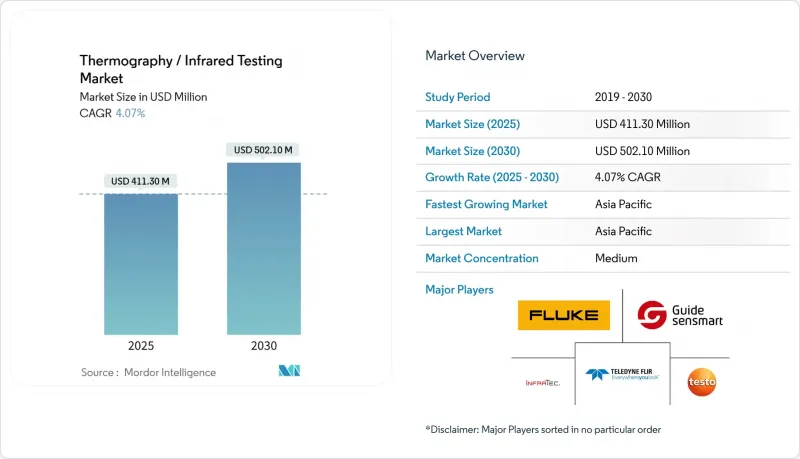
서모그래피 및 적외선 검사 시장은 2025년에 4억 1,130만 달러로 평가되었고, CAGR 4.07%를 기록해 2030년까지 5억 210만 달러에 이를 것으로 예측되며, 시장 규모와 수익성 양면에서 착실한 확대가 전망되고 있습니다.
본 보고서는 구성 요소(하드웨어 등), 기술(패시브 열화상 검사, 액티브 열화상 검사), 휴대성(휴대용/핸드헬드 등), 최종 사용자 산업(석유 및 가스,발전, 항공우주 등) 및 지역(북미, 남미, 유럽, 아시아태평양, 중동 및 아프리카)별로 분류되어 있습니다. 시장 예측은 금액(달러) 기준으로 제시되어 있습니다.
세계의 서모그래피 및 적외선 검사 시장 동향 및 인사이트
핵심 인프라 분야의 예측 유지보수 수요 급증
전력 회사, 정유시설, 화학 플랜트에서는 고장이 발생하기 전에 열화상 검사를 통해 핫스팟을 특정하는 데이터 기반 유지보수 전략으로 전환하고 있으며, 이는 사후 대응형 수리를 대체하고 있습니다. 예기치 못한 가동 중단은 산업 시설에 시간당 평균 5만 달러의 손실을 초래하지만, 열화상 검사는 설비가 가동 중인 동안 이상을 감지함으로써 사업자가 이러한 손실을 피하는 데 도움이 됩니다. 엑셀론(Exelon)이나 듀크 에너지(Duke Energy)와 같은 대형 전력 회사는 변전소 정기 순찰에 열화상 카메라를 도입하여, 재생에너지 도입률이 높아지는 가운데 송전망의 안정성을 향상시키는 실행 가능한 인사이트력을 얻고 있습니다. 현재 머신러닝 도구를 활용하여 85%의 정확도로 고장 발생 시기를 예측할 수 있게 되었으며, 유지보수 팀은 긴급 정지가 아닌 계획 정전 중에 유지보수를 수행할 수 있게 되었습니다. 클라우드 대시보드의 광범위한 도입으로 열화상 카메라를 통한 인사이트력에 대한 접근성이 더욱 확대되면서 열화상 카메라 시장의 성장세가 더욱 가속화되고 있습니다.
에너지 및 제조 업계의 산업 안전 규제 강화
규제 당국은 안전 기준에 열화상 검사를 포함시켜 자발적인 모범 사례를 법적 요건으로 전환했습니다. 유럽연합(EU)의 ‘산업 배출 지침’에서는 석유화학 플랜트에 대해 압력 용기, 용광로, 전기 개폐 장치에 대한 정기적인 열화상 조사를 실시할 것을 의무화하고 있습니다. 미국에서는 OSHA(직업안전보건청)의 지침에 따라 고위험 시설의 전원이 공급된 패널에 대해 분기별 적외선 스캔을 권장하고 있습니다. 규정 준수 의무는 보험사에도 미치고 있으며, 지속적인 열화상 모니터링 기록을 보유한 기업에 보험료 할인을 제공함으로써 안전 규정 준수와 경제적 인센티브를 연계하고 있습니다. 이와 유사한 규정을 채택하는 관할 구역이 늘어남에 따라, 교정된 이미저, 인증된 운영자 및 검사 일정 준수를 증명하는 디지털 감사 추적에 대한 수요가 급증하고 있습니다.
고해상도 또는 냉각식 이미저의 높은 도입 비용
20 mK 미만의 분해능을 가진 고급 냉각식 검출기는 10만 달러 이상에 달하기 때문에 중소기업들이 첨단 시스템을 구매하는 것을 주저하게 만들고 있습니다. 최고급 냉각식 장치와 보급형 비냉각식 카메라의 가격 차이는 종종 10배를 초과하여, 고객층이 양극화되고 있습니다. 고성능 장비에 투자하는 서비스 기업들은 투자 회수 기간이 길어지기 때문에 많은 기업이 장비 리스를 선택할 수밖에 없으며, 그 결과 계절적인 검사 성수기에는 장비 가동률이 떨어지게 됩니다. 그 결과, 항공우주용 복합재료나 석유화학 분야의 균열 진행 분석과 같은 고도화된 용도는 자금력이 있는 사업자에 한정된 채로 남아 있으며, 중기적으로는 열화상 검사 시장 전체의 성장 여지를 제한하는 요인이 되고 있습니다.
부문별 분석
2024년 매출의 73.4%를 하드웨어가 차지했으며, 이는 정밀도 지표의 기반이 되는 카메라, 광학 시스템, 센서가 자본 집약적인 특성을 가지고 있음을 반영합니다. 연평균 성장률(CAGR) 9.8%로 성장하는 분석 플랫폼은 물리적 구성 요소를 능가하는 속도로 확대되고 있으며, 이는 데이터 중심의 가치 창출로의 전환을 시사합니다. 카메라가 표준 주변 기기로 자리 잡으면서, 차별화의 초점이 실시간 패턴 인식, 멀티 센서 융합 및 고장 예측 알고리즘으로 이동함에 따라 열화상 테스트 시장의 소프트웨어 부문 규모는 확대될 것으로 예측됩니다. 각 제조업체는 현재 지속적인 수익을 확보하고 하드웨어의 상품화를 상쇄하기 위해, 기기에 평생 이용 가능한 클라우드 구독 서비스를 번들로 제공합니다. 규제 대상 산업에서는 제3자 인증이 의무화되어 있기 때문에 검사 서비스는 계속해서 호황을 누리고 있으며, 전문 컨설팅 회사에 안정적인 이익률을 보장하고 있습니다.
향후에는 개방형 API와 상호 운용성 표준을 통해 운영자가 열화상 데이터에 진동, 초음파, 전기적 지표를 중첩하여 보다 상세한 자산 상태 모델을 구축할 수 있게 될 것입니다. 원활한 통합을 구축한 공급업체는 하드웨어 이익률이 축소되더라도 타사를 압도하는 시장 점유율을 확보할 수 있을 것입니다. 반대로, 독자적인 파일 형식에 집착하는 공급업체는 기업 고객이 기기 유형을 초월한 전체 플릿 모니터링을 위한 통합 대시보드를 요구하는 상황에서 시장에서 뒤처질 위험이 있습니다.
패시브 이미징은 그 간편함과 폭넓은 적용성으로 여전히 매출의 67.8%를 차지하고 있지만, 업계가 보다 상세한 진단 정보를 요구함에 따라 액티브 기술은 연평균 성장률(CAGR) 9.2%로 급속히 확대되고 있습니다. 액티브 플래시법이나 록인법은 제어된 열 펄스를 조사함으로써 패시브 스캔으로는 감지할 수 없는 결함을 시각화하며, 복합재료의 정량적인 결함 크기 측정을 의무화하는 항공우주 안전 프로토콜을 충족합니다. 중장비 유지보수 분야에서는 기계적 진동을 통해 피로 균열이 전파되기 전에 초기 단계에서 감지할 수 있기 때문에 진동 열화상법 시장 점유율이 확대되고 있습니다.
액티브 방식의 시스템은 비용이 높고 전문 운영자가 필요하지만, 뛰어난 감도 덕분에 수익성이 높은 틈새 시장을 개척하고 있습니다. 자동차 및 항공우주 분야의 OEM 기업들은 제조 공정 중 접착부의 무결성을 인증하기 위해 인라인형 액티브 열화상 측정 스테이션을 도입하고 있습니다. AI를 활용한 분석을 통해 해석의 장벽이 낮아짐에 따라, 능동 방식은 중견 산업 분야로도 확산되어 수동 방식의 도입을 저해하지 않으면서 열화상 시장의 잠재적 규모를 확대해 나갈 것으로 전망됩니다.
지역별 분석
아시아태평양은 2024년에 전 세계 매출의 35.7%를 차지했으며, 연평균 성장률(CAGR) 6.4%로 확대되고 있습니다. 중국에서는 전자기기, 자동차, 재생에너지의 품질 검사에 열화상 검사가 도입되고 있습니다. 스마트 제조 및 탄소 중립에 관한 정부 프로그램에 따라 고에너지 장비에 대한 지속적인 열 모니터링이 의무화되어 있으며, 이것이 수요를 뒷받침하고 있습니다. 인도에서는 송전망 현대화 및 스마트 시티 추진으로 기회가 확대되고 있는 반면, 일본과 한국은 각각 반도체 제조 및 조선 검사 분야에 주력하고 있습니다.
북미에서는 석유 파이프라인, 송전선, 항공기 기단에 걸친 엄격한 자산 건전성 규제에 힘입어, 성숙 단계에 접어들었음에도 불구하고 견조한 수요가 나타나고 있습니다. 인프라 노후화로 인해 유틸리티자들은 적외선 스캔 빈도를 높여야 할 필요에 직면해 있으며, 메탄 배출료에 관한 법규제가 장거리 가스 누출 감지 장치에 대한 투자를 촉진하고 있습니다. 캐나다의 수력 발전 및 오일샌드 사업은 안정적인 수요를 창출하고 있으며, 멕시코의 자동차 산업 클러스터에서는 조립 품질 확인을 위해 열화상 검사 감사가 점점 더 많이 채택되고 있습니다.
유럽에서는 규정 준수가 핵심 요소로 대두되고 있으며, 산업 배출 규제로 인해 화학 및 석유화학 시설에서의 열화상 모니터링이 의무화되어 있습니다. 독일의 정밀 제조에 대한 철저한 추구로 인해 복합재료 접착 공정에서 능동형 열화상 카메라의 도입이 진행되고 있으며, 영국의 해상 풍력 발전소에서는 블레이드 침식 감시를 위해 견고한 이미저가 채택되고 있습니다. 프랑스의 원자력 발전소군에서는 원자로 노심 검사에 고해상도 냉각식 카메라가 필요하며, 북유럽 국가들에서는 지역 난방 네트워크로의 활용이 확대되고 있어, 이 모든 요소가 결합되어 공급업체에게 예측 가능한 수익원을 확고히 하고 있습니다.
기타 혜택 :
- 엑셀 형식 시장 예측(ME) 시트
- 3개월간의 애널리스트 지원
자주 묻는 질문
목차
제1장 서론
제2장 조사 방법
제3장 개요
제4장 시장 구도
제5장 시장 규모 및 성장 예측
제6장 경쟁 구도
제7장 시장 기회 및 향후 전망
KTH 26.09.02According to Mordor Intelligence, the thermography market reached USD 411.3 million in 2025 and is forecast to register a 4.07% CAGR, achieving USD 502.1 million by 2030, underscoring steady expansion in both market size and profitability.
This report is Segmented by Component (Hardware, and More), Technology (Passive Thermography, and Active Thermography), Portability (Portable / Handheld, and More), End-User Industry (Oil and Gas, Power Generation, Aerospace, and More), and Geography (North America, South America, Europe, Asia Pacific, and Middle East and Africa). The Market Forecasts are Provided in Terms of Value (USD).
Global Thermography / Infrared Testing Market Trends and Insights
Surging Demand for Predictive Maintenance in Critical Infrastructure
Utilities, refineries, and chemical plants are replacing reactive repairs with data-driven maintenance strategies that rely on thermal imaging to find hot spots before failures occur. Unplanned outages cost industrial sites an average of USD 50,000 per hour, and thermography helps operators avoid these losses by flagging anomalies while equipment remains online. Large utilities, such as Exelon and Duke Energy, have integrated thermal cameras into their routine substation patrols, capturing actionable insights that improve grid stability amid rising renewable energy penetration. Machine-learning tools now forecast failure timelines with 85% accuracy, letting maintenance teams schedule interventions during planned shutdowns instead of emergency stoppages. The widespread rollout of cloud dashboards is further democratizing access to thermal insights, reinforcing momentum in the thermography market.
Stricter Industrial-Safety Mandates Across Energy and Manufacturing
Regulators have incorporated thermal inspections into safety codes, transforming voluntary best practices into a legal necessity. The European Union's Industrial Emissions Directive instructs petrochemical sites to conduct periodic thermographic surveys of pressure vessels, furnaces, and electrical switchgear. In the United States, OSHA guidance now recommends quarterly infrared scans of energized panels in high-risk facilities. Compliance obligations extend to insurance carriers that offer reduced premiums to companies that document continuous thermal monitoring, thereby aligning safety compliance with financial incentives. As more jurisdictions adopt similar rules, demand surges for calibrated imagers, certified operators, and digital audit trails that prove adherence to inspection schedules.
High Capital Cost of High-Resolution or Cooled Imagers
Premium cooled detectors with sub-20 mK resolution cost above USD 100,000, deterring small enterprises from purchasing advanced systems. The price gulf between top-end cooled units and entry-level uncooled cameras often exceeds 10 times, creating a bifurcated customer base. Service firms investing in high-spec equipment face long payback cycles, pushing many to lease gear, which reduces availability during seasonal inspection peaks. Consequently, sophisticated applications in aerospace composites and petrochemical crack growth analysis remain limited to well-capitalized operators, capping the upside for the overall thermography market in the medium term.
Other drivers and restraints analyzed in the detailed report include:
- Growing Adoption of Uncooled Micro-Bolometer Cameras in Portable Devices
- Edge-AI Embedded Thermal Analytics Enabling Autonomous Inspections
- Shortage of Certified Thermographers for Specialized NDT
For complete list of drivers and restraints, kindly check the Table Of Contents.
Segment Analysis
Hardware supplied 73.4% of 2024 revenue, reflecting the capital-intensive nature of cameras, optics, and sensors that underpin accuracy metrics. At a 9.8% CAGR, analytics platforms are outpacing physical components, signaling a pivot toward data-centric value creation. The thermography market size for software is projected to expand as cameras become standardized peripherals, and differentiation shifts to real-time pattern recognition, multi-sensor fusion, and predictive failure algorithms. Manufacturers now bundle lifetime cloud subscriptions with devices to secure recurring revenue and offset the commoditization of hardware. Inspection services continue to thrive because regulated sectors require third-party certification, ensuring stable margins for specialized consultancies.
In the future, open APIs and interoperability standards will enable operators to overlay thermal data with vibration, ultrasound, and electrical metrics, generating richer asset health models. Vendors that master seamless integration stand to capture disproportionate share even if hardware profits compress. Conversely, suppliers that cling to proprietary file formats risk being sidelined as enterprise customers demand unified dashboards for fleet-wide monitoring across equipment classes.
Passive imaging still accounts for 67.8% of sales, thanks to its simplicity and broad applicability; however, active techniques are accelerating at a 9.2% CAGR as industries seek deeper diagnostic insights. Active flash and lock-in methods introduce controlled heat pulses to reveal defects that are invisible to passive scans, thereby satisfying aerospace safety protocols that mandate quantitative flaw sizing for composites. The thermography market share for vibro-thermography is increasing in heavy machinery maintenance, where mechanical excitation detects early-stage fatigue cracks before they propagate.
While active systems cost more and require specialist operators, their superior sensitivity opens premium revenue niches. OEMs in automotive and aviation incorporate in-line active thermography stations to certify bond integrity during manufacturing. As AI-powered analysis lowers interpretation barriers, active modalities are likely to permeate mid-tier industries, expanding the addressable thermography market size without cannibalizing passive deployments.
Complete Report Scope:
- By Component
- Hardware (Cameras, Sensors, Optics)
- Software and Analytics
- Services (Inspection, Training, Consulting)
- By Technology
- Passive Thermography
- Active Thermography (Flash, Lock-in, Vibro)
- By Portability
- Portable / Handheld
- Stationary / Benchtop
- Automated / Robotic
- By End-user Industry
- Oil and Gas
- Power Generation
- Aerospace
- Defense
- Automotive and Transportation
- Manufacturing and Heavy Engineering
- Construction and Infrastructure
- Chemical and Petrochemical
- Marine and Ship Building
- Electronics and Semiconductor
- Mining
- Medical Devices
- Others
- By Geography
- North America
- United States
- Canada
- Mexico
- South America
- Brazil
- Argentina
- Rest of South America
- Europe
- Germany
- United Kingdom
- France
- Italy
- Spain
- Rest of Europe
- Asia Pacific
- China
- Japan
- India
- South Korea
- South-East Asia
- Rest of Asia Pacific
- Middle East and Africa
- Middle East
- Saudi Arabia
- United Arab Emirates
- Turkey
- Rest of Middle East
- Africa
- South Africa
- Nigeria
- Rest of Africa
- Middle East
- North America
Geography Analysis
Asia-Pacific controlled 35.7% of global revenue in 2024 and is advancing at a 6.4% CAGR, with China integrating thermography into electronics, automotive, and renewable-energy quality checks. Government programs on smart manufacturing and carbon neutrality dictate continuous thermal monitoring of high-energy equipment, sustaining demand. India's push to modernize transmission grids and smart cities widens opportunities, while Japan and South Korea focus on semiconductor fabrication and shipbuilding inspections, respectively.
North America exhibits mature but resilient demand, rooted in stringent asset-integrity regulations across oil pipelines, power lines, and aerospace fleets. Aging infrastructure compels utilities to intensify infrared scanning frequencies, and methane fee legislation propels investment in long-range gas leak imagers. Canada's hydro and oil-sands operations generate steady volumes, and Mexico's automotive corridors increasingly adopt thermal audits for assembly quality.
Europe hinges on regulatory compliance-Industrial Emissions rules enforce thermal surveillance in chemical and petrochemical sites. Germany's precision-manufacturing ethos drives the adoption of active thermography for composite bonding, and the United Kingdom's offshore wind farms apply ruggedized imagers for blade erosion monitoring. France's nuclear fleet requires high-resolution cooled cameras for reactor-core inspections, and Nordic nations extend usage to district-heating networks, collectively cementing a predictable revenue stream for vendors.
- Teledyne FLIR LLC
- Fluke Corporation
- InfraTec GmbH
- Testo SE and Co. KGaA
- Guide Sensmart Tech Co. Ltd.
- Keysight Technologies Inc.
- AMETEK Land (AMETEK Inc.)
- Opgal Optronic Industries Ltd.
- DIAS Infrared GmbH
- Leonardo S.p.A.
- Seek Thermal Inc.
- HIKMICRO (Subsidiary of Hikvision)
- Infrared Cameras Inc.
- Workswell s.r.o.
- Handheld Group AB
- Advanced Energy Industries Inc.
- MoviTHERM - Advanced Thermography Solutions
- Infrared Training Center (ITC)
- Monroe Infrared Technology Inc.
- Snell Infrared
- Mobius Institute - Thermal Training
- Axis Communications AB
- ULIRVISION Technology Co. Ltd.
Additional Benefits:
- The market estimate (ME) sheet in Excel format
- 3 months of analyst support
TABLE OF CONTENTS
1 INTRODUCTION
- 1.1 Study Assumptions and Market Definition
- 1.2 Scope of the Study
2 RESEARCH METHODOLOGY
3 EXECUTIVE SUMMARY
4 MARKET LANDSCAPE
- 4.1 Market Overview
- 4.2 Market Drivers
- 4.2.1 Surging demand for predictive maintenance in critical infrastructure
- 4.2.2 Stricter industrial-safety mandates across energy and manufacturing
- 4.2.3 Growing adoption of uncooled micro-bolometer cameras in portable devices
- 4.2.4 Edge-AI embedded thermal analytics enabling autonomous inspections
- 4.2.5 Hybrid IR-ultrasound techniques boosting defect-detection accuracy
- 4.2.6 Carbon-leak monetization under methane-fee regulations
- 4.3 Market Restraints
- 4.3.1 High capital cost of high-resolution or cooled imagers
- 4.3.2 Shortage of certified thermographers for specialised NDT
- 4.3.3 Data-sovereignty concerns for cloud-based thermal analytics
- 4.3.4 Sensor grade gallium-based supply-chain volatility
- 4.4 Industry Value Chain Analysis
- 4.5 Impact of Macroeconomic Factors
- 4.6 Regulatory Landscape
- 4.7 Technological Outlook
- 4.8 Porter's Five Forces Analysis
- 4.8.1 Threat of New Entrants
- 4.8.2 Bargaining Power of Suppliers
- 4.8.3 Bargaining Power of Buyers
- 4.8.4 Threat of Substitute Products
- 4.8.5 Intensity of Competitive Rivalry
5 MARKET SIZE AND GROWTH FORECASTS (VALUE)
- 5.1 By Component
- 5.1.1 Hardware (Cameras, Sensors, Optics)
- 5.1.2 Software and Analytics
- 5.1.3 Services (Inspection, Training, Consulting)
- 5.2 By Technology
- 5.2.1 Passive Thermography
- 5.2.2 Active Thermography (Flash, Lock-in, Vibro)
- 5.3 By Portability
- 5.3.1 Portable / Handheld
- 5.3.2 Stationary / Benchtop
- 5.3.3 Automated / Robotic
- 5.4 By End-user Industry
- 5.4.1 Oil and Gas
- 5.4.2 Power Generation
- 5.4.3 Aerospace
- 5.4.4 Defense
- 5.4.5 Automotive and Transportation
- 5.4.6 Manufacturing and Heavy Engineering
- 5.4.7 Construction and Infrastructure
- 5.4.8 Chemical and Petrochemical
- 5.4.9 Marine and Ship Building
- 5.4.10 Electronics and Semiconductor
- 5.4.11 Mining
- 5.4.12 Medical Devices
- 5.4.13 Others
- 5.5 By Geography
- 5.5.1 North America
- 5.5.1.1 United States
- 5.5.1.2 Canada
- 5.5.1.3 Mexico
- 5.5.2 South America
- 5.5.2.1 Brazil
- 5.5.2.2 Argentina
- 5.5.2.3 Rest of South America
- 5.5.3 Europe
- 5.5.3.1 Germany
- 5.5.3.2 United Kingdom
- 5.5.3.3 France
- 5.5.3.4 Italy
- 5.5.3.5 Spain
- 5.5.3.6 Rest of Europe
- 5.5.4 Asia Pacific
- 5.5.4.1 China
- 5.5.4.2 Japan
- 5.5.4.3 India
- 5.5.4.4 South Korea
- 5.5.4.5 South-East Asia
- 5.5.4.6 Rest of Asia Pacific
- 5.5.5 Middle East and Africa
- 5.5.5.1 Middle East
- 5.5.5.1.1 Saudi Arabia
- 5.5.5.1.2 United Arab Emirates
- 5.5.5.1.3 Turkey
- 5.5.5.1.4 Rest of Middle East
- 5.5.5.2 Africa
- 5.5.5.2.1 South Africa
- 5.5.5.2.2 Nigeria
- 5.5.5.2.3 Rest of Africa
- 5.5.5.1 Middle East
- 5.5.1 North America
6 COMPETITIVE LANDSCAPE
- 6.1 Market Concentration
- 6.2 Strategic Moves
- 6.3 Market Share Analysis
- 6.4 Company Profiles {includes Global level Overview, Market level overview, Core Segments, Financials as available, Strategic Information, Market Rank/Share for key companies, Products and Services, and Recent Developments}
- 6.4.1 Teledyne FLIR LLC
- 6.4.2 Fluke Corporation
- 6.4.3 InfraTec GmbH
- 6.4.4 Testo SE and Co. KGaA
- 6.4.5 Guide Sensmart Tech Co. Ltd.
- 6.4.6 Keysight Technologies Inc.
- 6.4.7 AMETEK Land (AMETEK Inc.)
- 6.4.8 Opgal Optronic Industries Ltd.
- 6.4.9 DIAS Infrared GmbH
- 6.4.10 Leonardo S.p.A.
- 6.4.11 Seek Thermal Inc.
- 6.4.12 HIKMICRO (Subsidiary of Hikvision)
- 6.4.13 Infrared Cameras Inc.
- 6.4.14 Workswell s.r.o.
- 6.4.15 Handheld Group AB
- 6.4.16 Advanced Energy Industries Inc.
- 6.4.17 MoviTHERM - Advanced Thermography Solutions
- 6.4.18 Infrared Training Center (ITC)
- 6.4.19 Monroe Infrared Technology Inc.
- 6.4.20 Snell Infrared
- 6.4.21 Mobius Institute - Thermal Training
- 6.4.22 Axis Communications AB
- 6.4.23 ULIRVISION Technology Co. Ltd.
7 MARKET OPPORTUNITIES AND FUTURE OUTLOOK
- 7.1 White-space and Unmet-need Assessment