

|
시장보고서
상품코드
2117489
나이아신아마이드 : 시장 점유율 분석, 업계 동향 및 통계, 성장 예측(2026-2031년)Niacinamide - Market Share Analysis, Industry Trends & Statistics, Growth Forecasts (2026 - 2031) |
||||||
 Mordor Intelligence
나이아신아마이드 시장 규모는 2025년 11억 9,000만 달러로 평가되었습니다. 2026년에는 12억 9,000만 달러로 확대되어 2026년부터 2031년에 걸쳐 CAGR 8.85%로 성장을 지속하여, 2031년에는 19억 8,000만 달러에 이를 것으로 예측됩니다.
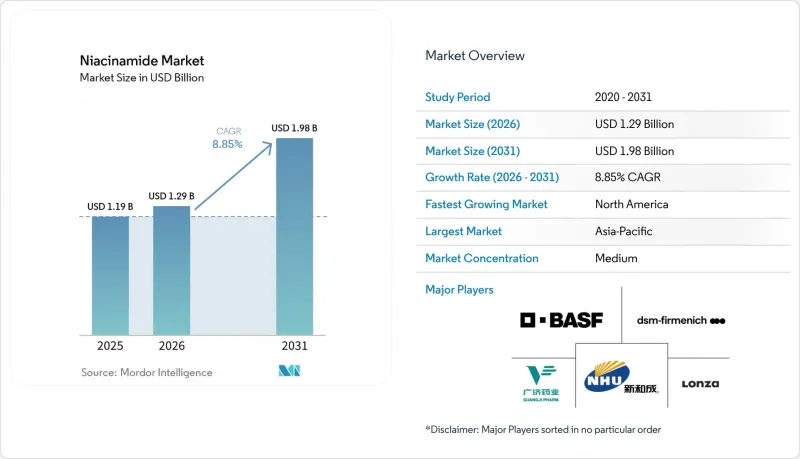
본 보고서는 형태별(분말, 과립, 액체), 등급별(의약품 등급, 사료 등급 등), 용도별(화장품 및 퍼스널케어, 의약품 등), 최종 사용자별(제약 회사, 화장품 제조업체 등), 지역별(북미, 유럽, 아시아태평양, 중동 및 아프리카, 남미)로 분류되어 있습니다. 시장 예측은 금액(달러) 기준으로 제시되어 있습니다.
세계의 나이아신아마이드 시장 동향 및 인사이트
피부과 전문의들의 지지를 받은 스킨케어 제품의 보급 확대
나이아신아마이드 시장은 이 성분이 더 이상 스킨케어에서 단순한 비타민 첨가물로 취급되지 않기 때문에 피부과 분야로부터 더 강력한 지지를 받고 있습니다. 2025년 『Dermatology and Therapy』 저널에 발표된 무작위 대조 시험에서도 유색인종 피부의 염증 후 색소 침착 예방에 대한 나이아신아마이드의 효능이 입증되었으며, 이로 인해 더 많은 소비자층에서 이 성분의 임상적 중요성이 확대되고 있습니다. 장벽 기능 지원, 색소 관리, 그리고 폭넓은 환자층에 대한 관련성이라는 이러한 요소들이 결합되어, 다른 유효 성분들이 마케팅 측면에서 큰 주목을 받고 있는 상황에서도 나이아신아마이드 시장은 제품 구성 내에서의 입지를 유지하고 있습니다. 또한, 나이아신아마이드 시장은 화장품 분야의 규제적 인지도도 높은 편이라, 이에 따라 브랜드 측의 제품 재처방 위험이 줄어들고 공급업체 선정도 더욱 용이해지고 있습니다. 브랜드들이 임상적으로 입증된 유효 성분을 중심으로 제품 라인을 구축함에 따라, 나이아신아마이드 시장은 세럼, 보습제, 자외선 차단제 및 관련 퍼스널케어 제품에서의 지속적인 채택을 통해 혜택을 보고 있습니다.
의약품 용도에서의 나이아신아마이드 사용 확대
나이아신아마이드 시장은 의약품에 가까운 용도에서의 역할에 의해서도 뒷받침되고 있습니다. 이러한 용도에서는 구매자가 규정 준수, 순도, 공급 안정성을 더욱 중요시합니다. 분석에 따르면, 기존의 결핍증 치료에 그치지 않고 NAD+ 관련 용도, 암 치료 지원 분야, 처방전이 필요한 피부과 영역으로 용도가 확대되고 있어, 나이아신아마이드 시장에서 의약품 등급 원료의 가치가 높아지고 있습니다. 이러한 동향이 중요한 이유는 특히 공급업체의 승인에 cGMP 준수 및 배치 문서가 요구되는 경우, 의약품 분야 수요가 일반용 화장품이나 사료 분야보다 더 엄격한 가격 규율을 뒷받침하는 경향이 있기 때문입니다. 그 결과, 나이아신아마이드 시장에서는 범용 제품과 규제 대상 또는 엄격한 감독이 필요한 용도를 위한 더 높은 사양공급 사이에서 더욱 뚜렷한 양극화가 나타나고 있습니다. 하류 구매자들이 제네릭 제품 조달에서 멀어짐에 따라, 추적 가능한 유통 경로와 더 높은 자격을 갖춘 제조업체에 대한 필요성이 이러한 양극화를 더욱 강화하고 있습니다. 전반적으로, 의약품 분야에서의 위상은 나이아신아마이드 시장 수요 깊이와 더 견고한 프리미엄 부문을 모두 뒷받침하고 있습니다.
일반 등급 생산자에 의한 가격 압박
나이아신아마이드 시장은 공급이 여전히 범용 등급 제품에 집중되어 있고, 생산자들이 주로 가격으로 경쟁하고 있기 때문에 압박에 직면해 있습니다. 이러한 추세는 이익률 보호가 여전히 취약하고, 수요가 침체될 경우 나이아신아마이드 시장 전체에 즉각적인 가격 압박이 재점화될 우려가 있는 사료용 등급 및 표준 화장품용 등급공급에서 가장 두드러집니다. 이것이 바로 중규모 생산자들이 중국의 초대형 공급업체나 차별화가 진행된 프리미엄 등급 제조업체들보다 더 어려운 입장에 놓여 있는 이유이기도 합니다. 이러한 압박의 뚜렷한 징후로, 2026년 2월 DSM-Firmenich가 비타민을 포함한 동물 영양 및 건강 사업을 CVC 캐피탈 파트너스에 기업 가치 22억 유로에 매각하기로 합의한 사실을 들 수 있습니다. 이는 유럽의 대기업들 사이에서 수익성이 낮은 비타민 사업에 대한 관심이 줄어들고 있음을 시사합니다. 따라서 나이아신아마이드 시장에는 명확한 상품(commodity) 부문이 존재하며, 전반적인 수요가 견조해 보일지라도 가격 회복은 여전히 불안정한 상태를 유지할 가능성이 있습니다. 이러한 압박으로 인해 조달 팀은 저부가가치 부문에서의 규모 확대, 비용 안정성 및 공급업체 집중 위험에 지속적으로 주의를 기울이고 있습니다.
부문별 분석
2025년 기준, 분말은 시장 가치의 52.76%를 차지했으며, 의약품, 영양 보조제, 식품 가공 각 분야의 확립된 제조 공정에 적합하기 때문에 나이아신아마이드 시장의 주요 형태가 되고 있습니다. 이러한 지위는 긴 유통 기한, 혼합의 용이성, 그리고 대규모로 사용되는 정제 압축 및 분무 건조 캡슐화 시스템과의 호환성에 의해 뒷받침되고 있습니다. 과립 형태는 여전히 부차적인 형태로 남아 있으며, 대량 혼합 시 분진 발생이 없는 취급이 필요한 사료 용도에서 더 중요한 역할을 하고 있습니다. 액상 형태는 현재 판매량 기준으로 규모가 작지만, 나이아신아마이드 시장이 보다 정밀한 화장품 및 주사제 용도로 전환됨에 따라 2031년까지 연평균 성장률(CAGR) 9.77%를 나타낼 것으로 예측됩니다. 이러한 성장 추세는 나이아신아마이드 시장의 가치 확대가 반드시 주류 형태에서 비롯되는 것은 아니며, 많은 경우 보다 전문적인 제형 요구를 해결하는 형태에서 비롯된다는 것을 보여줍니다.
액상 형태가 중요성을 더하고 있는 이유는 세럼이나 용액 기반 제품에서 많은 분말계 시스템이 제공할 수 있는 범위를 넘어, 일관된 용해성과 더 엄격한 농도 관리가 요구되기 때문입니다. 이는 브랜드가 더 깨끗한 처방이나 첨가제를 최소화한 설계를 추구하는 가운데 특히 중요한 의미를 지닙니다. 액상 형태를 직접 배합함으로써 제조 공정을 간소화하고, 배치 간 편차가 발생할 가능성을 줄일 수 있기 때문입니다. 『Journal of Pharmaceutical Innovation』지에 게재된 2026년 리포솜 전달에 관한 연구도, 고도의 피부과 용도에서 액상 시스템의 장기적인 매력을 뒷받침하고 있습니다. 이는 더 우수한 운반체 설계를 통해 침투성과 성분의 안정성이 향상되기 때문입니다. 입자상 원료는 우수한 제형 성능보다 취급 효율이 중시되는 상황에서는 여전히 유용할 것으로 보이지만, 나이아신아마이드 시장이 가치를 창출하고 있는 분야에서는 그 중요성이 낮아지고 있습니다. 이러한 의미에서 나이아신아마이드 시장에서는 분말이 핵심 포맷으로서의 지위를 유지하면서, 액체가 고성장 분야를 차지해 나갈 것으로 예측됩니다.
2025년에는 의약품 등급이 시장 가치의 38.13%를 차지하여 등급별 최대 점유율을 확보함과 동시에, 나이아신아마이드 시장의 판매량을 지탱하는 중요한 기반이 되었습니다. 이러한 역할은 확립된 치료 용도와 NAD+ 관련 응용에 대한 새로운 연구 관심에 의해 뒷받침되고 있으며, 이를 통해 기본적인 결핍증 치료를 넘어선 수요 유지에 기여하고 있습니다. 또한, 이 부문은 cGMP 준수 및 문서화가 실질적인 진입 장벽이 되고 있기 때문에 인증된 공급원은 범용 제품만큼 쉽게 대체될 수 없다는 점에서도 혜택을 받고 있습니다. 사료용 등급도 여전히 상당한 취급량을 차지했으나, 가격대는 최하위에 위치하여 나이아신아마이드 시장 전체의 가치 유지에 기여하는 정도는 낮았습니다. 따라서 의약품 등급은 현재 시장 규모뿐만 아니라, 나이아신아마이드 시장 내에서 보다 안정적인 가격 위치를 유지하는 데에도 중요한 역할을 하고 있습니다.
화장품 등급은 가장 빠르게 성장하고 있는 등급으로, 2031년까지 연평균 성장률(CAGR) 10.23%로 확대될 것으로 예측됩니다. 이는 프리미엄 가치의 전환이 주로 어디에서 일어나고 있는지를 보여줍니다. 이 부문의 구매자들은 단순히 수량뿐만 아니라 잔류물 관리, 순도 증명서, 원산지 표시, 감사 대응이 가능한 문서를 더욱 중요하게 여기고 있습니다. 이러한 경향이 중요한 이유는 나이아신아마이드 시장에서 단순한 벌크 원료 수요에 부응하는 것뿐만 아니라, 브랜드 차원의 차별화를 실현할 수 있는 공급업체에 대한 평가가 높아지고 있기 때문입니다. 또한, 본 분석에서는 생합성 유래 증명 및 지속가능성에 대한 실적에 대한 수요가 증가하고 있는 것으로 나타났으며, 이것이 총 공급량이 적더라도 프리미엄 화장품용 공급이 일반 원료를 능가하는 성과를 낼 수 있는 이유 중 하나입니다. 따라서 나이아신아마이드 시장은 등급에 따라 양극화가 점점 더 심화되고 있으며, 의약품용 공급이 기반을 유지하는 한편, 화장품 등급이 더 강력한 가치 상승을 주도하고 있는 것으로 보입니다.
지역별 분석
2025년, 아시아태평양은 나이아신아마이드 시장 규모의 42.15%를 차지하며, 해당 시장에서 가장 규모가 큰 지역 블록으로서의 지위를 유지했습니다. 이러한 우위는 생산 체계의 확충과 화장품, 영양 보조제, 의약품 용도에 걸친 폭넓은 하류 소비가 결합되어 발생하고 있습니다. 또한, 이 지역은 범용 용량공급부터 고품질의 프리미엄 제품에 이르기까지공급 기반을 갖추고 있어, 이를 통해 나이아신아마이드 시장의 여러 계층에 동시에 공급할 수 있게 되었습니다. 업계 관계자들은 중국이 주요 생산 거점이자 비용 경쟁력이 있는 공급의 주된 원천이라고 지적하고 있으며, 이 지역은 이러한 구조 속에서 여전히 중심적인 위치를 차지하고 있습니다. 한편, 한국과 일본은 서로 다른 역할을 담당하며, 피부과 관련 및 고급 스킨케어 분야에서 사용되는 고순도 원료에 대한 수요를 견인하고 있습니다.
이러한 조합을 통해 아시아태평양은 나이아신아마이드 시장에서 제조 규모 확대와 프리미엄 수요 형성, 이 두 가지를 모두 뒷받침하는 이중 우위를 점하고 있습니다. 북미는 가장 빠르게 성장하는 지역으로, 2031년까지 연평균 성장률(CAGR) 9.69%로 확대될 것으로 예측됩니다. 이는 임상 스킨케어, 건강기능식품 및 의약품 조제 분야의 강력한 수요 모멘텀을 반영한 것입니다. FDA의 2026년 ‘인간용 식품 프로그램’ 우선순위와 관련된 집행 활동으로 인해 문서화 및 규정 준수 품질에 대한 관심이 높아짐에 따라, 공급업체 선정에 있어 미국 규제 환경의 중요성이 점점 더 커지고 있습니다. 또한, FDA가 21 CFR 184.1535에 근거하여 나이아신아마이드를 승인한 것은 식품 관련 용도에서 이 성분의 확립된 역할을 뒷받침합니다. 나이아신아마이드 시장에서 북미는 더 엄격한 규제와 프리미엄 포지셔닝이 가치의 급속한 성장을 뒷받침하는 가장 명확한 환경 중 하나입니다.
유럽은 나이아신아마이드 시장에 안정적인 규제 프레임워크와 체계적인 보충제 및 화장품 유통 채널을 제공하기 때문에 여전히 중요한 시장입니다. EU 규정에 기반한 이 지역의 식품 강화 프레임워크와 2023년 나이아신 형태에 관한 업데이트는 이 카테고리가 성숙하고 정적인 상태에 있는 것이 아니라, 여전히 적극적으로 규제되고 있음을 보여줍니다. 또한, 독일 연방 위험평가연구소(BfR)는 보충제 내 나이아신아마이드의 일일 최대 섭취량을 160mg으로 제안하고 있으며, 이는 보충제 유통 채널 내 성분 배합 규정에 영향을 미치고 있습니다.
기타 혜택 :
- 엑셀 형식 시장 예측(ME) 시트
- 3개월간의 애널리스트 지원
자주 묻는 질문
목차
제1장 서론
제2장 조사 방법
제3장 개요
제4장 시장 구도
제5장 시장 규모 및 성장 예측
제6장 경쟁 구도
제7장 시장 기회 및 향후 전망
KTH 26.09.02According to Mordor Intelligence, the niacinamide market size is expected to grow from USD 1.19 billion in 2025 to USD 1.29 billion in 2026 and is forecast to reach USD 1.98 billion by 2031 at 8.85% CAGR over 2026-2031.
This report is Segmented by Form (Powder, Granular, Liquid), by Grade (Pharmaceutical Grade, Feed Grade, and More), by Application (Cosmetics and Personal Care, Pharmaceuticals, and More), by End User (Pharmaceutical Companies, Cosmetic Manufacturers, and More), and Geography (North America, Europe, Asia-Pacific, Middle East & Africa, South America). The Market Forecasts are Provided in Terms of Value (USD).
Global Niacinamide Market Trends and Insights
Expanding Dermatology-Backed Skincare Adoption
The Niacinamide market is benefiting from stronger dermatology support because the ingredient is no longer treated as a simple vitamin additive in skincare. A 2025 randomized trial in Dermatology and Therapy also supported niacinamide use for preventing post inflammatory hyperpigmentation in skin of color populations, which broadens the clinical relevance of the ingredient across more consumer groups. That combination of barrier support, pigment management, and broad patient relevance helps the Niacinamide market retain formulation space even as other actives receive strong marketing attention. The Niacinamide market is also supported by regulatory familiarity in cosmetics, which lowers reformulation risk for brands and makes supplier qualification more straightforward. As brands build lines around clinically recognized actives, the Niacinamide market gains from repeat use in serums, moisturizers, sunscreens, and adjacent personal care formats.
Growth in Pharmaceutically Positioned Niacinamide Use
The Niacinamide market is also being supported by its role in more pharmaceutically positioned applications, where buyers place greater weight on compliance, purity, and supply assurance. The analysis indicates growth beyond traditional deficiency treatment into NAD+-related uses, oncology support settings, and prescription dermatology, increasing the value profile of pharmaceutical-grade material within the niacinamide market. This trend matters because pharmaceutical demand typically supports stronger pricing discipline than mass cosmetic or feed channels, especially when supplier approval requires cGMP status and batch documentation. As a result, the niacinamide market is showing a clearer split between commodity output and higher-specification supply for regulated or closely supervised applications. The need for traceable distribution channels and better-qualified manufacturers further reinforces this split as downstream buyers move away from generic sourcing. Overall, pharmaceutical positioning supports both demand depth and a more defensible premium tier in the niacinamide market.
Price Pressure from Commodity-Grade Producers
The niacinamide market faces pressure as supply remains concentrated in commodity-grade output, with producers competing primarily on price. This trend is most evident in feed-grade and standard cosmetic-grade supply, where margin protection remains weaker, and any downturn in demand can quickly renew pricing pressure across the niacinamide market. This is also why mid-scale producers face a harder position than either very large Chinese suppliers or better differentiated premium-grade manufacturers. A major sign of this pressure was DSM-Firmenich's February 2026 agreement to divest its Animal Nutrition and Health business, including vitamins, to CVC Capital Partners for an enterprise value of EUR 2.2 billion, which signals less appetite among European majors for lower margin vitamin exposure. The Niacinamide market, therefore, has a clear commodity segment where price recovery can remain fragile even when broader demand looks solid. That pressure keeps procurement teams focused on scale, cost stability, and the risk of supplier concentration in lower-value segments.
Other drivers and restraints analyzed in the detailed report include:
- Food Fortification and Nutraceutical Label Expansion
- Capacity Expansion in Asia-Based Manufacturing Clusters
- Formulation Stability and pH Compatibility Constraints
For complete list of drivers and restraints, kindly check the Table Of Contents.
Segment Analysis
Powder held 52.76% of market value in 2025, which makes it the core volume format in the Niacinamide market because it fits established manufacturing routines across pharmaceuticals, nutraceuticals, and food processing. Its position is supported by long shelf life, easy blending, and compatibility with tablet compression and spray dry encapsulation systems used at scale. Granular form remained a secondary format and stayed more relevant in feed applications where dust-free handling is useful in large volume mixing. Liquid form was smaller in current volume terms, but it is forecast to grow at a 9.77% CAGR through 2031 as the Niacinamide market shifts toward more precise cosmetic and injectable uses. That growth profile shows that value expansion in the Niacinamide market is not always coming from the dominant format, but often from the one that solves more specialized formulation needs.
Liquid form is gaining importance because serum and solution-based products need consistent dissolution and tighter concentration control than many powder systems provide. This is especially relevant as brands pursue cleaner formulas and minimal excipient designs, where direct liquid incorporation can reduce processing steps and lower the chance of batch inconsistency. The 2026 liposomal delivery work in the Journal of Pharmaceutical Innovation also supports the longer-term appeal of liquid phase systems for advanced dermatological use, since better carrier design can improve permeation and ingredient stability. Granular material should remain useful where handling efficiency matters more than premium formulation performance, but it is less central to where the Niacinamide market is creating value. In that sense, the Niacinamide market is likely to keep powder as the anchor format while allowing liquid to capture the higher growth lane.
Pharmaceutical grade held 38.13% of the market value in 2025, which gave it the largest grade position and established an important volume floor for the Niacinamide market. Its role is supported by both established therapeutic use and newer research interest linked to NAD+ related applications, which helps maintain demand beyond basic deficiency treatment. This segment also benefits from the fact that cGMP compliance and documentation create practical entry barriers, so qualified supply is not as easily replaced as commodity output. Feed grade still absorbed meaningful tonnage, but it sat at the lowest end of pricing and contributed less to value protection across the Niacinamide market. That makes pharmaceutical grade important not only for current size, but also for holding a more stable pricing position inside the Niacinamide market.
Cosmetic grade is the fastest-growing grade and is projected to expand at a 10.23% CAGR through 2031, which shows where much of the premium value shift is occurring. Buyers in this segment place more weight on residual controls, purity certificates, origin claims, and audit-ready documentation than on volume alone. That preference matters because the Niacinamide market is increasingly rewarding suppliers that can serve brand-level differentiation rather than only bulk ingredient demand. The analysis also indicated stronger demand for biosynthetic origin credentials and sustainability records, which helps explain why premium cosmetic supply can outperform ordinary material, even when overall volumes are smaller. The niacinamide market, therefore, appears increasingly two-tiered by grade, with pharmaceutical supply preserving the base and cosmetic grade driving stronger value uplift.
Complete Report Scope:
- By Form
- Powder
- Granular
- Liquid
- By Grade
- Pharmaceutical Grade
- Feed Grade
- Food Grade
- Cosmetic Grade
- By Application
- Cosmetics and Personal Care
- Skincare Products
- Haircare Products
- Pharmaceuticals
- Vitamin Deficiency Treatment
- Cardiovascular Support
- Food and Beverages
- Human Nutrition
- Animal Nutrition
- Cosmetics and Personal Care
- By End User
- Pharmaceutical Companies
- Cosmetic Manufacturers
- Food and Beverage Companies
- Nutraceutical Companies
- Animal Feed Producers
- By Geography
- North America
- United States
- Canada
- Mexico
- Europe
- Germany
- United Kingdom
- France
- Italy
- Spain
- Rest of Europe
- Asia-Pacific
- China
- India
- Japan
- South Korea
- Australia
- Rest of Asia-Pacific
- Middle East and Africa
- GCC
- South Africa
- Rest of Middle East and Africa
- South America
- Brazil
- Argentina
- Rest of South America
- North America
Geography Analysis
Asia-Pacific held 42.15% of the Niacinamide market size in 2025, which kept it as the largest regional block in the Niacinamide market. Its lead comes from the combination of production depth and broad downstream consumption across cosmetics, nutrition, and pharmaceutical uses. The region also benefits from a supply base that ranges from commodity volume to more qualified premium output, which allows it to serve several tiers of the Niacinamide market at once. China remains central to this structure, as industry sources identify it as the leading production hub and a major source of cost-competitive supply. South Korea and Japan play a different role, driving demand for high-purity materials used in dermatology-linked and prestige skincare channels.
That combination gives Asia-Pacific a dual advantage in the Niacinamide market because it supports both manufacturing scale and premium demand formation. North America is the fastest-growing geography and is projected to expand at a 9.69% CAGR through 2031, which reflects strong momentum in clinical skincare, supplements, and pharmaceutical compounding demand. The U.S. regulatory environment is becoming more important in supplier selection because implementation activity tied to the FDA's 2026 Human Foods Program priorities is raising attention on documentation and compliance quality. The FDA's recognition of niacinamide under 21 CFR 184.1535 also supports its established role in food-related applications. For the Niacinamide market, North America offers one of the clearest settings where stronger regulation and premium positioning support faster value growth.
Europe remains important because it brings stable regulatory frameworks and disciplined supplement and cosmetic channels to the Niacinamide market. The region's food fortification structure under EU regulation and its 2023 update on niacin forms show that the category remains actively governed rather than mature and static. Germany's Federal Institute for Risk Assessment has also proposed a maximum of 160 mg per day for nicotinamide in food supplements, which influences formulation discipline in the supplement channel.
- Aurorium
- Bactolac Pharmaceutical, Inc.
- BASF
- dsm-firmenich AG
- Evonik Industries
- Fagron
- Foodchem International
- Hubei Guangji Pharmaceutical Co., Ltd.
- Jubilant Group
- Kyowa Hakko Bio Co., Ltd.
- Lasons India Pvt. Ltd.
- Lonza Group
- Merck
- Shandong Hongda Biotechnology Co., Ltd.
- Vanetta
- Vertellus Holdings
- Zhejiang Lanbo Biotechnology Co., Ltd.
- Zhejiang NHU
Additional Benefits:
- The market estimate (ME) sheet in Excel format
- 3 months of analyst support
TABLE OF CONTENTS
1 INTRODUCTION
- 1.1 Study Assumptions and Market Definition
- 1.2 Scope of the Study
2 RESEARCH METHODOLOGY
3 EXECUTIVE SUMMARY
4 MARKET LANDSCAPE
- 4.1 Market Overview
- 4.2 Market Drivers
- 4.2.1 Expanding Dermatology-Backed Skincare Adoption
- 4.2.2 Growth in Pharmaceutically Positioned Niacinamide Use
- 4.2.3 Food Fortification and Nutraceutical Label Expansion
- 4.2.4 Capacity Expansion in Asia-Based Manufacturing Clusters
- 4.2.5 Direct-to-Consumer Ingredient Storytelling and Clinical Claim Validation
- 4.2.6 Supply-Chain De-Risking Through Multi-Sourcing and Regional Stocking
- 4.3 Market Restraints
- 4.3.1 Price Pressure From Commodity-Grade Producers
- 4.3.2 Formulation Stability and pH Compatibility Constraints
- 4.3.3 Regulatory Fragmentation Across Cosmetic and Supplement Claims
- 4.3.4 Substitution Risk From Alternative Barrier-Repair Actives
- 4.4 Supply Chain Analysis
- 4.5 Regulatory Landscape
- 4.6 Technological Outlook
- 4.7 Porter's Five Forces Analysis
- 4.7.1 Bargaining Power of Suppliers
- 4.7.2 Bargaining Power of Buyers
- 4.7.3 Threat of New Entrants
- 4.7.4 Threat of Substitutes
- 4.7.5 Competitive Rivalry
5 MARKET SIZE AND GROWTH FORECASTS (VALUE, USD)
- 5.1 By Form
- 5.1.1 Powder
- 5.1.2 Granular
- 5.1.3 Liquid
- 5.2 By Grade
- 5.2.1 Pharmaceutical Grade
- 5.2.2 Feed Grade
- 5.2.3 Food Grade
- 5.2.4 Cosmetic Grade
- 5.3 By Application
- 5.3.1 Cosmetics and Personal Care
- 5.3.1.1 Skincare Products
- 5.3.1.2 Haircare Products
- 5.3.2 Pharmaceuticals
- 5.3.2.1 Vitamin Deficiency Treatment
- 5.3.2.2 Cardiovascular Support
- 5.3.3 Food and Beverages
- 5.3.4 Human Nutrition
- 5.3.5 Animal Nutrition
- 5.3.1 Cosmetics and Personal Care
- 5.4 By End User
- 5.4.1 Pharmaceutical Companies
- 5.4.2 Cosmetic Manufacturers
- 5.4.3 Food and Beverage Companies
- 5.4.4 Nutraceutical Companies
- 5.4.5 Animal Feed Producers
- 5.5 By Geography
- 5.5.1 North America
- 5.5.1.1 United States
- 5.5.1.2 Canada
- 5.5.1.3 Mexico
- 5.5.2 Europe
- 5.5.2.1 Germany
- 5.5.2.2 United Kingdom
- 5.5.2.3 France
- 5.5.2.4 Italy
- 5.5.2.5 Spain
- 5.5.2.6 Rest of Europe
- 5.5.3 Asia-Pacific
- 5.5.3.1 China
- 5.5.3.2 India
- 5.5.3.3 Japan
- 5.5.3.4 South Korea
- 5.5.3.5 Australia
- 5.5.3.6 Rest of Asia-Pacific
- 5.5.4 Middle East and Africa
- 5.5.4.1 GCC
- 5.5.4.2 South Africa
- 5.5.4.3 Rest of Middle East and Africa
- 5.5.5 South America
- 5.5.5.1 Brazil
- 5.5.5.2 Argentina
- 5.5.5.3 Rest of South America
- 5.5.1 North America
6 COMPETITIVE LANDSCAPE
- 6.1 Market Concentration
- 6.2 Market Share Analysis
- 6.3 Company Profiles (includes Global Level Overview, Market Level Overview, Core Segments, Financials as available, Strategic Information, Market Rank/Share, Products and Services, Recent Developments)
- 6.3.1 Aurorium
- 6.3.2 Bactolac Pharmaceutical, Inc.
- 6.3.3 BASF SE
- 6.3.4 dsm-firmenich AG
- 6.3.5 Evonik Industries AG
- 6.3.6 Fagron NV
- 6.3.7 Foodchem International Corporation
- 6.3.8 Hubei Guangji Pharmaceutical Co., Ltd.
- 6.3.9 Jubilant Life Sciences Limited
- 6.3.10 Kyowa Hakko Bio Co., Ltd.
- 6.3.11 Lasons India Pvt. Ltd.
- 6.3.12 Lonza Group AG
- 6.3.13 Merck KGaA
- 6.3.14 Shandong Hongda Biotechnology Co., Ltd.
- 6.3.15 Vanetta
- 6.3.16 Vertellus Holdings LLC
- 6.3.17 Zhejiang Lanbo Biotechnology Co., Ltd.
- 6.3.18 Zhejiang NHU Co., Ltd.
7 MARKET OPPORTUNITIES AND FUTURE OUTLOOK
- 7.1 White-Space and Unmet-Need Assessment


