|
시장보고서
상품코드
2117490
야금용 석탄 : 시장 점유율 분석, 업계 동향 및 통계, 성장 예측(2026-2031년)Metallurgical Coal - Market Share Analysis, Industry Trends & Statistics, Growth Forecasts (2026 - 2031) |
||||||
 Mordor Intelligence
야금용 석탄 시장 규모는 2025년 1,283억 7,000만 달러로 평가되었습니다. 2026년 1,324억 6,000만 달러에서 2031년까지 1,543억 7,000만 달러로 확대되며 2026년부터 2031년까지 연평균 성장률(CAGR)은 3.11%를 나타낼 전망입니다.
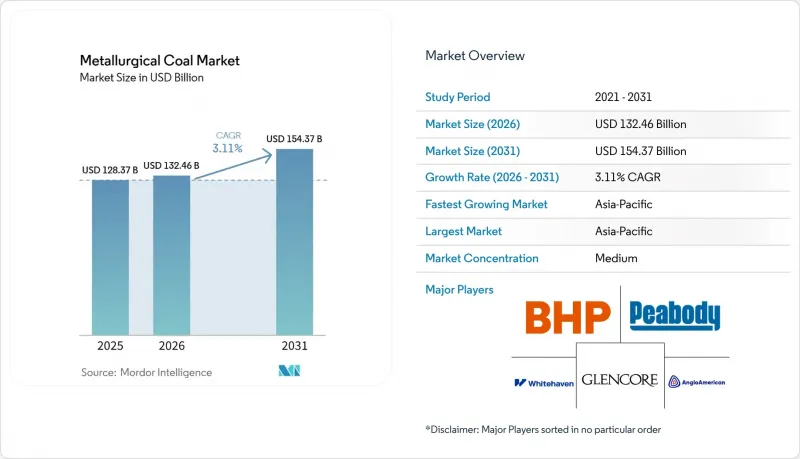
본 보고서는 제품 유형(하드 코크스용 석탄, 세미소프트 및 세미하드 코크스용 석탄 등), 채굴 방식(지하 채굴 및 노천 채굴), 용도(철강 생산, 철광석 등), 지역(아시아태평양, 북미, 유럽, 남미, 중동 및 아프리카)별로 분류되어 있습니다. 시장 예측은 금액(달러) 기준으로 제시되어 있습니다.
세계의 야금용 석탄 시장 동향 및 인사이트
철강 산업의 야금용 석탄에 대한 구조적 의존성
고로는 자산 수명이 길어, 일단 가동을 시작하면 일반적으로 수십년동안 계속 가동됩니다. 이 때문에 야금용 석탄 시장은 단기적인 시장 심리는 물론, 이미 설치된 제철 생산 능력과도 밀접하게 연관되어 있습니다. 고로·기본 산소 용광로(BF-BOF) 공정에서 철강 1톤을 생산하려면 여전히 약 0.86톤의 야금용 석탄이 필요합니다. 이는 코크스가 용광로 내 원료로서 화학적 및 구조적 역할을 수행하기 때문입니다. OECD에 따르면, 2025년부터 2027년까지 계획된 전 세계 제철 생산 능력 1억 6,500만 메트르톤 중 40% 이상이 여전히 BF-BOF 방식에 기반하고 있으며, 그 계획의 대부분은 인도와 아세안(ASEAN) 국가들이 차지하고 있습니다. 이러한 생산 능력 구성으로 인해, 성숙한 지역 간 철강 업계의 수익성이 고르지 않은 상황에서도 야금용 석탄 시장은 실제 가동 요건과 밀접하게 연계된 상태를 유지하고 있습니다. 공급 상황도 또 다른 요인으로 작용하고 있습니다. 세계철강협회(World Steel)가 지적했듯이, 코크스 제조에서 가장 가치가 높은 품위를 둘러싸고 자원 및 공급망의 제약이 발생하고 있기 때문입니다. 그 결과, 가동률이 하락하더라도 기존 고로는 생산 품질을 유지하기 위해 여전히 고품위의 원료탄을 필요로 하므로, 야금용 석탄 시장은 견조한 상태를 유지할 가능성이 있습니다.
제철 분야에서 야금용 석탄의 상업적 대체재는 제한적입니다.
야금용 석탄 시장은 고로 제강에 필요한 규모에서 석탄의 연료 기능과 환원 기능을 겸비한, 널리 상용화 가능한 대체재가 존재하지 않는다는 현실을 여전히 반영하고 있습니다. 제강 분야에서 수소 이용에 관한 OECD 조사에 따르면, 그린강 생산 공정은 자본, 수익성, 과잉 생산 능력과 같은 장벽에 직면해 있어, 석탄을 다량 사용하는 생산 공정을 필요한 속도로 대체하는 데 지연이 발생하고 있습니다. 2025년 철강 탈탄소화 전망은 새로 발표된 고로 생산 능력이 계속해서 새로 발표된 직접환원철(DRI) 생산 능력을 상회하고, 배출 강도가 대체로 횡보할 것으로 예상되므로 완만한 수준에 그칠 것으로 보입니다. 국제에너지기구(IEA) 역시 비용 압박과 고철 확보 제약으로 인해 중기적으로는 수소를 이용한 제철 도입이 제한적일 것으로 예측했습니다. 이로 인해 야금용 석탄 시장은 당분간 대체재의 영향을 받기 어려워지며, 제철소의 설비 갱신, 자금 조달, 원료 확보와 같은 보다 완만한 경제 동향에 의존하게 될 것입니다. 또한, 철강 제조업체들은 대체 원료에 대응하기 위해 기존 고로를 신속하게 재설계할 수 없기 때문에 우수한 생산자들이 장기 계약에서 계속해서 협상 우위를 유지하게 될 것입니다.
탄소 집약형 제철을 대상으로 한 탈탄소화 정책
야금용 석탄 시장은 선진국에서 석탄 의존도가 높은 제철 공정의 역할을 축소하는 것을 목적으로 한 탈탄소 규제로 인해 장기적인 제약에 직면해 있습니다. 2026년부터는 개정된 EU 배출권 거래 제도(ETS)의 벤치마크 정의가 소결광, 용선, 수소를 대상으로 하게 되어, 기존의 고로 생산보다 수소를 이용한 직접환원철·전기아크로(H2-DRI-EAF) 공정에 대한 정책 지원이 강화될 것입니다. EU의 탄소국경조정메커니즘(CBAM)은 수입 철강에 탄소 관련 비용을 부과함으로써 추가적인 압력을 가하고, EU 생산자들에게 더 깨끗한 생산 계획의 가속화를 촉구하고 있습니다. 2025년에 발표된 영국의 철강 전략도 장기적인 국내 방향성으로 전기 아크로(EAF)를 제시하고 있으며, DRI는 1차 제강 과정의 가교적 역할로 자리매김하고 있습니다. 그러나 경제협력개발기구(OECD)의 데이터에 따르면, 야금용 석탄 시장에는 여전히 상당한 과잉 생산 능력과 낮은 수익성이 나타나고 있으며, 이것이 녹색 전환을 위한 설비 투자를 지연시키고 있기 때문에 당분간은 수요의 급격한 감소에 직면하지는 않을 전망입니다. 그 결과, 시장에서는 고로용 석탄의 사용이 단기간에 중단되기보다는 시간이 지남에 따라 수요가 점진적으로 감소할 것으로 예측됩니다.
부문별 분석
하드 코크스용 석탄은 2025년에 야금용 석탄 시장의 58.24%를 차지했으며, 이는 고로 코크스 제조에서 주요 원료로서의 역할이 계속해서 유지되고 있음을 반영합니다. 이러한 위상은 낮은 황 함량, 뛰어난 성형성, 그리고 반응 후의 높은 코크스 강도에 의해 뒷받침되고 있으며, 이는 고품질 고로 운영에 있어 여전히 대체하기 어려운 특성입니다. 그 결과, 제철용 석탄 시장에서는 여전히 우수한 품위가 중시되고 있으며, 운영사들은 저렴한 석탄 블렌드를 위해 고로의 안정성을 희생할 가능성은 거의 없을 것입니다. 미분탄(PCI)은 용선 생산량을 저하시키지 않으면서 코크스 사용률을 줄이려는 철강 제조업체들 수요에 힘입어 2031년까지 연평균 성장률(CAGR) 3.87%로 확대될 것으로 예측됩니다. 특히 인도와 동남아시아에서는 제철소가 기술적 성능과 수입 비용의 균형을 맞추고 있기 때문에 세미소프트 및 세미하드 등급이 블렌드 최적화에서 여전히 중요한 역할을 하고 있습니다.
PCI용 석탄은 이 부문에서 가장 빠른 성장을 기록할 것으로 예상되며, 2031년까지 야금용 석탄 시장에서 3.87%의 성장 전망은 기존 용광로·기본 산소 용광로(BF-BOF) 시스템 내 비용 관리 수단으로서의 그 역할을 반영하고 있습니다. 최신 고로에서는 원료 혼합 시 코크스의 상당 부분을 PCI 석탄으로 대체할 수 있으며, 이를 통해 제철소는 석탄을 주원료로 하는 제철 공정을 벗어나지 않으면서도 원료 비용 효율화를 도모할 수 있습니다. 따라서 PCI 석탄의 성장은 야금용 석탄 시장을 보완하는 것이며, 이 부문은 여전히 고로 가동에 의존하고 있습니다. 공급 리스크는 하드 코크스용 석탄의 가격 기반을 지탱하고 있습니다. 호주의 보웬 분지와 애팔래치아 분지는 해상 운송용 고품질 석탄 공급에서 여전히 중심적인 역할을 하고 있지만, 두 지역 모두 정기적인 공급 차질을 겪고 있기 때문입니다. 그 결과, 제품 구성 면에서 가장 큰 부문은 여전히 품질 보증과 밀접하게 연결되어 있는 반면, 제철소가 동일한 제철 공정에서 코크스 사용률을 낮추려 함에 따라 가장 빠르게 성장하는 부문이 탄력을 받고 있습니다.
지역별 분석
아시아태평양은 2025년에 야금용 석탄 시장의 57.28%를 차지했으며, 2031년까지 연평균 성장률(CAGR) 4.21%를 기록하며 가장 빠르게 성장하는 지역 블록이 될 것으로 전망됩니다. 중국은 최대 수요 기반을 형성하고 있는데, 이는 중국의 철강 생산의 90% 이상이 여전히 고로·기본 산소 용해로(BF-BOF) 공정을 채택하고 있기 때문입니다. 이에 따라 야금용 석탄 시장은 중국의 고로 가동률과 밀접하게 연결되어 있습니다. 인도는 중요한 성장 시장이며, 철강부에 따르면 2024-25 회계연도 코크스용 석탄 수입량은 5,710만 톤에 달할 것으로 보고되었으며, 2026년까지도 제철 생산 능력 확대가 지속될 것으로 전망됩니다. 일본과 한국은 구매 패턴이 해상 운송 품질의 벤치마크 및 혼합 선호도에 계속해서 영향을 미치고 있기 때문에 이 지역의 조달 활동을 뒷받침하고 있습니다. 그 결과, 아시아태평양은 야금용 석탄 시장에서 여전히 중심적인 위치를 차지하고 있으며, 이 지역의 성숙한 철강 시스템과 확장 중인 철강 시스템 모두 석탄을 원료로 하는 제철에 계속 의존하고 있습니다.
북미 역시 수출 능력과 제철에서 석탄의 역할에 대한 국내 정책적 지원을 모두 갖추고 있어, 야금용 석탄 시장에서 여전히 중요한 위치를 차지하고 있습니다. 에너지부(DOE)가 2025년 5월에 ‘중요 자재’로 지정한 것이 이러한 입지를 뒷받침할 것으로 예상되는 한편, 연방 정부의 인허가 지원에 힘입어 2026년 초까지 앨라배마주에서 추가 매장량 개발이 이루어질 전망입니다. 캐나다 역시 브리티시컬럼비아주와 앨버타주에 보유한 고품질 제철용 석탄 매장량을 통해 계속해서 활발한 움직임을 보이고 있으며, 환경 심사의 엄격화에도 불구하고 개발에 대한 관심은 여전히 집중되고 있습니다. 대조적으로 유럽에서는 배출권 거래 제도(ETS) 개혁과 CBAM(탄소 국경 조정 조치)으로 인해 석탄을 많이 사용하는 제철 공정에 대한 압박이 높아지면서 구조적인 수요 둔화가 진행되고 있습니다. 다만, 잔존하는 고로 생산 능력이 단기적인 소비를 계속 지탱하고 있습니다.
남미, 중동 및 아프리카는 수요 규모는 작지만, 브라질과 남아프리카공화국의 통합 제철 시설이 계속해서 석탄을 원료로 필요로 하고 있기 때문에 모두 야금용 석탄 시장에서 중요한 위치를 차지하고 있습니다. 브라질에서는 고로를 보유한 일체형 제철 업체를 통해 수입 수요가 뒷받침되고 있으며, 남아프리카공화국에서는 고로를 기반으로 하는 철강 시스템에 연동되어 국내 소비가 유지되고 있습니다. 중동의 일부 지역에서는 직접환원철(DRI)을 기반으로 한 제철에 대한 투자가 증가하고 있어, 아시아태평양에 비해 석탄의 직접 수요 증가세가 억제되고 있습니다. 각 지역에서 야금용 석탄 시장의 성장은 새로운 고로·전로(BF-BOF) 설비의 증설과 연동되어 진행되지만, 전기로(EAF)나 DRI 제법이 구식 고로 설비를 대체하는 지역에서는 시장에 대한 압박이 커지고 있습니다.
기타 혜택 :
- 엑셀 형식 시장 예측(ME) 시트
- 3개월간의 애널리스트 지원
자주 묻는 질문
목차
제1장 서론
제2장 조사 방법
제3장 개요
제4장 시장 구도
제5장 시장 규모 및 성장 예측
제6장 경쟁 구도
제7장 시장 기회 및 향후 전망
KTH 26.09.02According to Mordor Intelligence, the metallurgical coal market size is projected to expand from USD 128.37 billion in 2025 and USD 132.46 billion in 2026 to USD 154.37 billion by 2031, registering a CAGR of 3.11% between 2026 to 2031.
This report is Segmented by Product Type (Hard Coking Coal, Semi-Soft and Semi-Hard Coking Coal, and More), Mining Method (Underground Mining and Surface Mining), Application (Steel Production, Iron Ore, and Others), and Geography (Asia-Pacific, North America, Europe, South America, and Middle-East and Africa). The Market Forecasts are Provided in Terms of Value (USD).
Global Metallurgical Coal Market Trends and Insights
Structural Dependency of the Steel Industry on Metallurgical Coal
Blast furnaces have long asset lives and, once commissioned, typically remain in service for decades. This keeps the metallurgical coal market linked to installed steelmaking capacity, rather than only to short-term sentiment. Producing 1 ton of steel through the Blast Furnace-Basic Oxygen Furnace (BF-BOF) route still requires nearly 0.86 tons of metallurgical coal, as coke plays both a chemical and structural role in the furnace burden. The OECD stated that more than 40% of the 165 million metric tons of global steelmaking capacity planned for 2025-2027 remains BF-BOF-based, with India and ASEAN accounting for much of that pipeline. This capacity mix keeps the metallurgical coal market tied to physical operating requirements, even when steel profitability remains uneven across mature regions. Supply conditions add another factor, as World Steel has highlighted resource and supply chain constraints around the grades most valued in coke making. As a result, the metallurgical coal market can remain firm even when capacity utilization softens, since existing blast furnaces still require high-grade input coal to maintain output quality.
Limited Commercial Substitutes for Metallurgical Coal in Steelmaking
The metallurgical coal market continues to reflect the lack of a broadly commercial substitute that can match coal's combined fuel and reduction functions at the scale required for blast furnace steelmaking. OECD research on hydrogen in steelmaking shows that green steel pathways face capital, profitability, and overcapacity barriers, which delay their ability to replace coal-intensive routes at the required pace. The steel decarbonization outlook for 2025 is expected to remain gradual, as newly announced blast furnace capacity continues to exceed newly announced Direct Reduced Iron (DRI) capacity, while emissions intensity remains largely flat. The International Energy Agency (IEA) also expects hydrogen-based steelmaking adoption to remain limited over the medium term due to cost pressures and constraints on scrap availability. This leaves the metallurgical coal market less exposed to immediate substitution and more dependent on the slower economics of steel plant turnover, financing, and feedstock readiness. It also means quality producers continue to hold negotiating leverage in long-term contracts, as steelmakers cannot rapidly redesign existing blast furnaces to accommodate alternative inputs.
Decarbonization Policies Targeting Carbon-Intensive Steelmaking
The metallurgical coal market faces a long-term restraint from decarbonization regulations that aim to reduce the role of coal-intensive steelmaking routes in developed economies. From 2026, the revised EU Emissions Trading System (ETS) benchmark definitions will cover sintered ore, hot metal, and hydrogen, strengthening policy support for H2-Direct Reduced Iron-Electric Arc Furnace (H2-DRI-EAF) pathways over traditional blast furnace production. The EU Carbon Border Adjustment Mechanism adds another layer of pressure by imposing carbon-related costs on imported steel, encouraging non-EU producers to accelerate cleaner production plans. The UK Steel Strategy, expected to be published in 2025, also points to EAF as the long-term domestic direction, with DRI positioned as a bridge for primary steelmaking. However, the metallurgical coal market does not face an immediate demand decline, as Organization for Economic Co-operation and Development (OECD) data still indicates large excess capacity and weak profitability, which delays capital spending on green transitions. As a result, the market is likely to experience a gradual demand headwind over time rather than a near-term break in blast furnace coal use.
Other drivers and restraints analyzed in the detailed report include:
- Steelmakers' Need for High-Quality, Consistent Coking Coal Supply
- Mining Automation and Productivity Enhancement
- Price Volatility and Cost Inflation Pressures on Producers
For complete list of drivers and restraints, kindly check the Table Of Contents.
Segment Analysis
Hard coking coal is projected to hold 58.24% of the metallurgical coal market in 2025, reflecting its continued role as a key feedstock for blast furnace coke making. Its position is supported by low sulfur content, strong caking properties, and higher coke strength after reaction, which remain difficult to replace in premium furnace operations. As a result, the metallurgical coal market continues to prioritize grade quality, as operators are unlikely to compromise blast furnace stability for cheaper coal blends. Pulverized Coal Injection (PCI) coal is forecast to expand at a 3.87% CAGR through 2031, supported by steelmakers seeking to reduce coke rates without lowering hot metal output. Semi-soft and semi-hard grades remain relevant in blend optimization, especially in India and Southeast Asia, where mills balance technical performance against import costs.
PCI coal is expected to record the fastest growth in this segment, and its projected 3.87% expansion in the metallurgical coal market through 2031 reflects its role as a cost-control lever within the existing Blast Furnace-Basic Oxygen Furnace (BF-BOF) system. Modern blast furnaces can use PCI coal to replace a meaningful portion of coke in the burden mix, helping mills improve raw material economics without moving away from coal-based ironmaking. This makes PCI growth complementary to the metallurgical coal market, as the segment still depends on active blast furnace operations. Supply risk supports hard coking coal's pricing position, as Australia's Bowen Basin and the Appalachian Basin remain central to seaborne quality supply, and both regions face periodic disruptions. The result is a product mix in which the largest segment remains tied to quality assurance, while the fastest-growing segment gains traction as mills seek lower coke intensity within the same process route.
Complete Report Scope:
- By Product Type
- Hard Coking Coal
- Semi-Soft and Semi-Hard Coking Coal
- Pulverized Coal Injection (PCI) Coal
- By Mining Method
- Underground Mining
- Surface Mining
- By Application
- Steel Production
- Iron Ore
- Others
- By Geography
- Asia-Pacific
- China
- India
- Japan
- South Korea
- Rest of Asia-Pacific
- North America
- United States
- Canada
- Mexico
- Europe
- Germany
- United Kingdom
- France
- Italy
- Russia
- Rest of Europe
- South America
- Brazil
- Argentina
- Rest of South America
- Middle-East and Africa
- Saudi Arabia
- South Africa
- Rest of Middle-East and Africa
- Asia-Pacific
Geography Analysis
Asia-Pacific is projected to account for 57.28% of the metallurgical coal market in 2025 and is expected to be the fastest-growing regional block, registering a CAGR of 4.21% through 2031. China provides the largest demand base, as more than 90% of its steel production still uses the Blast Furnace-Basic Oxygen Furnace (BF-BOF) route. This keeps the metallurgical coal market closely tied to blast furnace utilization in the country. India is a key growth market, with the Ministry of Steel reporting 57.1 million tons of coking coal imports in FY2024-25 and continued steel capacity expansion into 2026. Japan and South Korea support regional procurement activity, as their buying patterns continue to influence seaborne quality benchmarks and blend preferences. As a result, Asia-Pacific remains central to the metallurgical coal market, as both mature and expanding steel systems in the region continue to rely on coal-based ironmaking.
North America remains relevant in the metallurgical coal market, as it combines export capacity with domestic policy support for coal's role in steelmaking. The Department of Energy's (DOE's) May 2025 critical material designation is expected to support that position, while federal permitting support is set to cover additional reserve development in Alabama by early 2026. Canada also remains active through its premium steelmaking coal reserves in British Columbia and Alberta, which continue to attract development interest despite tighter environmental reviews. Europe, by contrast, is moving toward slower structural demand, as Emissions Trading System (ETS) reform and CBAM increase pressure on coal-intensive steelmaking routes, although residual blast furnace capacity continues to support near-term consumption.
South America and the Middle East and Africa represent smaller demand pools, but both remain relevant to the metallurgical coal market because integrated steel assets in Brazil and South Africa continue to require coal-based inputs. Brazil supports import demand through its integrated blast furnace producers, while South Africa maintains domestic usage linked to its BF-based steel system. Parts of the Middle East are investing more in Direct Reduced Iron (DRI)-based steelmaking, which limits direct coal demand growth compared with Asia-Pacific. Across regions, metallurgical coal market growth follows new BF-BOF additions, while pressure increases where EAF and DRI routes displace older blast furnace capacity.
- Alpha Metallurgical Resources, Inc.
- Anglo American plc
- BHP
- China Shenhua Energy Company Limited
- Coal India Limited
- Core Natural Resources
- Coronado Global Resources Inc.
- Glencore
- Peabody Energy, Inc.
- Raspadskaya Public Joint Stock Company
- Shanxi Coking Coal Group Co., Ltd.
- Teck Resources Limited
- Warrior Met Coal, Inc.
- Whitehaven Coal Limited
- Yancoal Australia Ltd.
Additional Benefits:
- The market estimate (ME) sheet in Excel format
- 3 months of analyst support
TABLE OF CONTENTS
1 Introduction
- 1.1 Study Assumptions and Market Definition
- 1.2 Scope of the Study
2 Research Methodology
3 Executive Summary
4 Market Landscape
- 4.1 Market Overview
- 4.2 Market Drivers
- 4.2.1 Structural Dependence of BF-BOF Steelmaking
- 4.2.2 Limited Commercial Substitutes at Scale
- 4.2.3 Steelmakers' Need for Consistent Coke Quality
- 4.2.4 Mining Automation and Digital Mine Optimization
- 4.3 Market Restraints
- 4.3.1 Decarbonization Policies and ESG Pressure
- 4.3.2 Price Volatility and Contracting Risk
- 4.3.3 Permitting Delays and Capital Intensity of New Mines
- 4.4 Value Chain Analysis
- 4.5 Porter's Five Forces Analysis
- 4.5.1 Threat of New Entrants
- 4.5.2 Bargaining Power of Suppliers
- 4.5.3 Bargaining Power of Buyers
- 4.5.4 Threat of Substitutes
- 4.5.5 Competitive Rivalry
5 Market Size and Growth Forecasts (Value)
- 5.1 By Product Type
- 5.1.1 Hard Coking Coal
- 5.1.2 Semi-Soft and Semi-Hard Coking Coal
- 5.1.3 Pulverized Coal Injection (PCI) Coal
- 5.2 By Mining Method
- 5.2.1 Underground Mining
- 5.2.2 Surface Mining
- 5.3 By Application
- 5.3.1 Steel Production
- 5.3.2 Iron Ore
- 5.3.3 Others
- 5.4 By Geography
- 5.4.1 Asia-Pacific
- 5.4.1.1 China
- 5.4.1.2 India
- 5.4.1.3 Japan
- 5.4.1.4 South Korea
- 5.4.1.5 Rest of Asia-Pacific
- 5.4.2 North America
- 5.4.2.1 United States
- 5.4.2.2 Canada
- 5.4.2.3 Mexico
- 5.4.3 Europe
- 5.4.3.1 Germany
- 5.4.3.2 United Kingdom
- 5.4.3.3 France
- 5.4.3.4 Italy
- 5.4.3.5 Russia
- 5.4.3.6 Rest of Europe
- 5.4.4 South America
- 5.4.4.1 Brazil
- 5.4.4.2 Argentina
- 5.4.4.3 Rest of South America
- 5.4.5 Middle-East and Africa
- 5.4.5.1 Saudi Arabia
- 5.4.5.2 South Africa
- 5.4.5.3 Rest of Middle-East and Africa
- 5.4.1 Asia-Pacific
6 Competitive Landscape
- 6.1 Market Concentration
- 6.2 Strategic Moves
- 6.3 Market Share (%)/Ranking Analysis
- 6.4 Company Profiles (includes Global Overview, Market Overview, Core Segments, Financials as available, Strategic Information, Products and Services, and Recent Developments)
- 6.4.1 Alpha Metallurgical Resources, Inc.
- 6.4.2 Anglo American plc
- 6.4.3 BHP
- 6.4.4 China Shenhua Energy Company Limited
- 6.4.5 Coal India Limited
- 6.4.6 Core Natural Resources
- 6.4.7 Coronado Global Resources Inc.
- 6.4.8 Glencore
- 6.4.9 Peabody Energy, Inc.
- 6.4.10 Raspadskaya Public Joint Stock Company
- 6.4.11 Shanxi Coking Coal Group Co., Ltd.
- 6.4.12 Teck Resources Limited
- 6.4.13 Warrior Met Coal, Inc.
- 6.4.14 Whitehaven Coal Limited
- 6.4.15 Yancoal Australia Ltd.
7 Market Opportunities and Future Outlook
- 7.1 White-Space and Unmet-Need Assessment