

|
시장보고서
상품코드
2117493
구조용 심재 시장 : 점유율 분석, 업계 동향과 통계, 성장 예측(2026-2031년)Structural Core Materials - Market Share Analysis, Industry Trends & Statistics, Growth Forecasts (2026 - 2031) |
||||||
 Mordor Intelligence
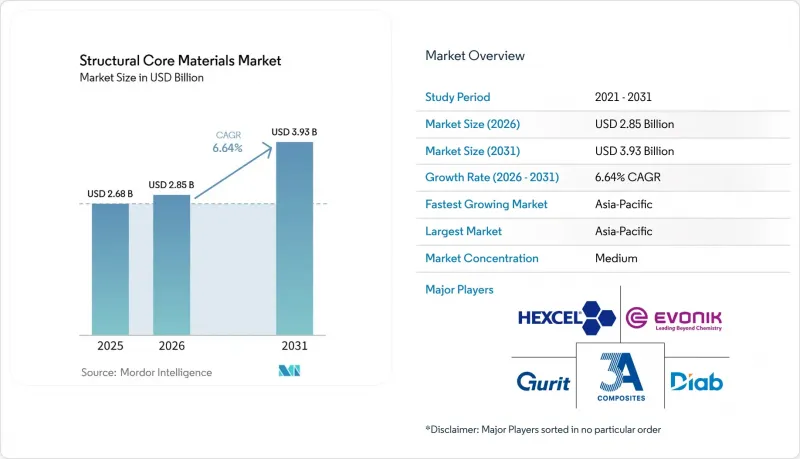
Mordor Intelligence에 의하면, 구조용 심재 시장 규모는 2025년 26억 8,000만 달러에서 2026년에는 28억 5,000만 달러로 확대되어 2031년까지 39억 3,000만 달러에 이를 것으로 예측되며, 2026년부터 2031년까지 CAGR 6.64%로 성장할 전망입니다.
본 보고서는 발포재(PET 발포재, PVC 발포재 등), 허니컴(알루미늄 허니컴, 노멕스 허니컴 등), 외피재 유형(유리섬유 강화 플라스틱(GFRP) 등), 최종 이용 산업(항공우주, 선박, 기타),및 지역(아시아태평양, 북미, 유럽, 남미, 중동 및 아프리카)별로 분류되어 있습니다. 시장 전망은 금액(달러) 기준으로 제시되어 있습니다.
전 세계 구조용 심재 시장 동향 및 인사이트
풍력 발전용 블레이드의 확대: 구조용 발포재 및 허니컴 코어에 대한 지속적인 수요
풍력 발전은 구조용 심재 시장에서 여전히 가장 큰 최종 용도 부문으로 자리 잡고 있습니다. 이는 현대 블레이드 설계에서 강성, 내피로성 및 중량 관리를 위해 샌드위치 구조가 필수적이기 때문입니다. 해상용 블레이드가 길어짐에 따라 수요가 증가하고 있으며, 설치 건수 증가가 이를 따라가지 못하는 경우에도 블레이드 1개당 필요한 심재의 양은 증가하고 있습니다. 블레이드 내 재료 선정에도 변화가 나타나고 있으며, 폴리에틸렌 테레프탈레이트(PET) 폼이 뿌리 부분에서 선호되고 있습니다. 이는 독립 기포 구조에 의한 고밀도 성능과 재활용 가능성이 기존의 천연 소재 코어 옵션보다 조달 측면에서 우선순위에 부합하기 때문입니다. 이에 따라 구조용 심재 시장은 신규 터빈 설치 대수뿐만 아니라 대형 플랫폼에 필요한 구조용 소재 증가와도 연동되는 양상을 보이고 있습니다. 그 결과, 일관성, 가공성, 지속가능성에 관한 풍력 발전용 OEM(주문자 상표 제조업체)의 요건을 충족할 수 있는 발포재 및 허니콤 소재 공급업체에게는 보다 안정적인 판매량 기반이 구축되고 있습니다.
항공우주 분야의 경량화: 복합재 샌드위치 구조 사양이 새로운 구조 기준을 확립
항공우주 분야 수요가 구조용 심재 시장을 뒷받침하고 있습니다. 이는 복합재 샌드위치 구조가 더 이상 특수한 솔루션으로 취급되지 않고, 민간 항공기 개발에 정착되고 있기 때문입니다. 에어버스 A350 XWB는 구조 질량의 54% 이상을 복합재로 구성하여, 동급 알루미늄 기체에 비해 연료 소비량을 25% 절감했습니다. 보잉 787 역시 구조 질량의 50% 가까이를 복합재료가 차지하고 있으며, 차세대 항공기 프로그램 전반에 걸쳐 이와 유사한 설계 방향성이 강화되고 있습니다. 이로 인해 객실 및 2차 구조에 사용되는 노멕스(Nomex)와 알루미늄 허니콤, 그리고 저밀도와 치수 정밀도가 필수적인 용도에 사용되는 폴리메타크릴이미드(PMI) 폼에 대한 수요가 활발하게 유지되고 있습니다. 또한, 에보닉은 기존 소재로는 경량화 및 구조적 효율 향상을 실현하기 어려운 전기 수직 이착륙기(eVTOL) 용도를 위해 ‘ROHACELL’을 포지셔닝하고 있으며, 성장 범위는 기존 기체 구조를 넘어 확대되고 있습니다.
고액의 인증 비용: 성장 속도를 희생시키며 기존 기업을 보호하는 구조적 장벽
높은 인증 비용은 신규 공급업체가 구조용 심재 시장에 진입하는 속도를 제한하고 있으며, 특히 각 소재 시스템이 장기간에 걸친 승인 주기를 거쳐야 하는 항공우주 등급에서 두드러집니다. 업계 소식통에 따르면, 소재와 플랫폼의 조합에 따라 인증에 18-36개월이 소요될 수 있다고 합니다. 또한 주요 OEM 각사는 개별 승인 데이터베이스를 유지하고 있으며, 이를 위해서는 병행된 문서 작성과 시험이 요구됩니다. 이러한 구조는 장기적인 생산 프로그램이나 확립된 고객 관계를 통해 시험 및 규정 준수 비용을 분산시킬 수 있는 기존 공급업체에 유리하게 작용합니다. 기술적으로 유망한 새로운 발포재나 허니컴 제품이라 하더라도, 인증 절차가 여전히 고비용이거나 파편화되어 있는 경우, 채택 진전은 지연될 가능성이 있습니다. 이러한 점에서 도레이의 NCAMP를 통한 성과는 중요한 의미를 지닙니다. FAA가 승인한 설계 허용치가 일반에 공개됨으로써, 새로운 열가소성 수지 솔루션에 필요한 맞춤형 시험이 줄어들기 때문입니다.
부문 분석
2025년, 폴리염화비닐(PVC) 폼은 폼 부문의 46.13%를 차지하며 폼 카테고리에서 가장 큰 소재 군이 되었습니다. 이러한 위상은 선박 선체, 풍력 발전용 블레이드 단면, 운송용 패널 등에서의 장기적인 사용을 반영한 것으로, 이러한 용도에서 기계 가공성, 비용 및 동적 응력에 대한 내성이 사양 요건을 충족하고 있습니다. 스티렌-아크릴로니트릴(SAN) 폼은 성능 면에서 PVC와 PMI의 중간에 위치하며, 선박용 금형, 모터스포츠 및 더 높은 열 성능이 요구되는 특정 운송용 부품에 사용됩니다. PMI 폼은 항공우주 및 첨단 모빌리티 용도에서 선호되는 선택지이며, 에보닉(Evonik)사의 ‘ROHACELL’ 시리즈는 오랜 기간에 걸친 인증 실적, 낮은 밀도, 그리고 오토클레이브 조건 하에서의 안정적인 거동으로 인해 지지를 받고 있습니다. 구조용 심재 시장의 폼 부문은 대량 생산되는 기존 등급과, 일단 인증되면 대체하기 어려운 소규모 프리미엄 포맷으로 나뉩니다.
폴리에틸렌 테레프탈레이트(PET) 폼은 2031년까지 연평균 성장률(CAGR) 7.23%로 확대될 것으로 예상되며, 구조용 심재 시장에서 가장 빠르게 성장하는 폼 유형이 될 것입니다. 2024년 동료 심사를 거친 연구에 따르면, 유리섬유 샌드위치 패널에 사용되는 완전 재활용 PET 폼 코어는 PVC 기반 대체재와 동등한 굽힘 특성을 보여, 대체 가능성에 대한 과학적 근거가 제시되었습니다. PET는 단일 솔루션으로 기계적 요구 사항과 순환형 조달 기준을 모두 충족합니다. ‘기타 발포재’ 부문(폴리우레탄 및 폴리스티렌 등급 포함)은 구조적 요구 사항이 낮고 비용 민감도가 더 높은 건축용 패널, 인클로저, 단열 용도로 계속해서 제한될 전망입니다. 2031년까지 PET 발포재는 구조용 심재 시장 규모에서 주요 성장 요인이 될 것으로 예상되는 반면, PVC는 계속해서 현재의 수익 기반을 형성할 것으로 보입니다.
2025년, 알루미늄 허니컴은 허니컴 부문의 47.36%를 차지하며 해당 카테고리에서 가장 큰 점유율을 기록했습니다. 이러한 위상은 항공우주 분야의 바닥 패널, 나셀 페어링, 파사드 시스템 등에서 확고한 사용 실적을 반영한 것으로, 이러한 용도에서는 내압성, 치수 안정성 및 인증 실적으로 인해 대체가 어렵습니다. 노멕스 허니컴은 항공기 내장재에서 여전히 중요한 역할을 하고 있으며, 가연성 관련 규정을 준수한다는 점이 수납 선반, 천장, 측벽 패널에서의 사용을 뒷받침하고 있습니다. 스테인리스 스틸이나 티타늄과 같은 다른 허니컴 유형은 일반적인 대체 재료로는 충족할 수 없는 구조적 요구 사항이 필요한 특수한 방위·우주 용도로 제한되어 있습니다. 구조용 심재 시장의 허니컴 부문은 확립된 인증 실적을 가진 성숙한 재료에 의해 뒷받침되고 있습니다.
열가소성 허니컴은 2031년까지 연평균 성장률(CAGR) 7.83%로 성장하고 있으며, 구조용 심재 시장에서 가장 빠르게 성장하는 허니컴 유형입니다. 이러한 성장은 재활용 가능한 내장 시스템과의 호환성은 물론, 특정 용도의 현대적인 제조 요건에 적합한 가공 공정에 의해 주도되고 있습니다. Composites United는 EconCore의 항공기 내장재용 폴리에테르이미드 허니컴 코어 기술인 ‘ThermHexWAVY’를 예로 들어 이를 강조했습니다. 이 기술은 화재, 연기 및 독성에 관한 요건을 충족하는 동시에, 물결 모양의 셀 벽 형상을 통해 면외 좌굴 저항을 향상시키도록 설계되었습니다. 열가소성 허니컴은 현재 재활용 가능성뿐만 아니라 기술적으로 신뢰성이 높은 항공우주 분야의 선택지로 자리매김하고 있습니다. 허니컴 카테고리에서 열가소성 허니컴은 구조용 심재 시장의 향후 성장에 가장 크게 기여하는 요인으로 꼽히고 있습니다.
지역별 분석
아시아태평양은 2025년에 매출의 42.83%를 차지하며, 2031년까지 연평균 성장률(CAGR) 7.12%로 성장할 것으로 전망됩니다. 중국은 이 지역의 주요 수요 축을 이루고 있으며, 중국의 풍력 터빈 블레이드 제조 거점이 대량의 발포 코어를 흡수하여 광범위한 복합재료 공급망을 뒷받침하고 있습니다. 일본은 허니컴 및 복합재료 부품 제조를 통해 항공우주 분야에 기여하고 있는 반면, 한국은 상업용 조선 용도를 통해 수요를 뒷받침하고 있습니다. 이 분야에서는 선체 및 상부 구조물 설계에 경량 샌드위치 패널이 채택되고 있습니다. 인도는 규모는 작지만 수요가 확대되고 있는 시장으로, 항공우주 제조에 대한 투자와 풍력 발전 설비 설치 확대에 따라 인증 및 준인증 코어 등급에 대한 수요가 증가하고 있습니다. 이러한 요인들로 인해 아시아태평양은 구조용 심재 시장에서 최대의 생산 및 소비 거점으로서의 위상을 확립하고 있습니다.
북미와 유럽은 구조용 심재 시장의 다음 주요 계층을 형성하고 있으며, 각각 고유한 수요 동향으로 특징지어집니다. 북미는 민간 및 방위 분야 항공우주 산업, 복합재료 가공업체 네트워크, 그리고 미국에 제조 거점을 둔 헥셀(Hexcel) 등공급업체에 의해 뒷받침되고 있습니다. 헥셀은 2025년 순매출이 19억 달러에 달했다고 보고했으며, 2026년에는 20억 달러에서 21억 달러에 이를 것으로 전망하고 있는데, 이는 항공우주 산업의 생산 대수 회복과 첨단 심재에 대한 지속적인 수요에 대한 자신감을 반영한 것입니다. 유럽에서는 소재의 지속가능성에 대한 규제 압력이 더욱 강하게 작용하고 있으며, 이로 인해 풍력 발전 및 운송 공급망에서 재생 PET 폼과 열가소성 허니컴의 채택이 가속화되고 있습니다. 에보니크(Evonik)가 2024년 9월 다름슈타트에서 ROHACELL 생산을 100% 재생 가능 전력으로 전환한 것은 이 지역의 생산자들이 탄소 공개 및 조달 요건에 맞추어 사업 운영을 조정하고 있음을 여실히 보여줍니다.
남미는 구조용 심재 시장에서 여전히 초기 단계에 있지만, 브라질은 육상 풍력 발전 개발 및 관련 블레이드 소재 수요를 통해 가장 뚜렷한 수요 기반을 보이고 있습니다. 아르헨티나 및 인근 시장은 여전히 수입 자재와 완제품 패널 시스템에 크게 의존하고 있는 선박 및 인프라 용도를 통해 비교적 소극적인 기여에 그치고 있습니다. 중동 및 아프리카에서는 인프라 투자, 건설 활동, 그리고 유틸리티 규모의 재생 에너지 프로그램의 단계적 전개와 연계된 기회가 예상됩니다. 이 지역들은 여전히 수입에 의존하고 있지만, 숙련된 인력이 제한적이고 모듈식 시공을 통해 현장 작업의 복잡성을 줄일 수 있는 지역에서는 경량 샌드위치 패널의 매력이 높아질 가능성이 있습니다. 지역별 시장 진입은 여전히 제한적이지만, 이러한 시장은 예측 기간 후반에 더 중요한 위치를 차지할 것으로 기대되는 성장 분야입니다.
기타 혜택:
- 엑셀 형식 시장 예측(ME) 시트
- 3개월간의 애널리스트 지원
자주 묻는 질문
목차
제1장 서론
제2장 조사 방법
제3장 개요
제4장 시장 구도
제5장 시장 규모와 성장 예측
제6장 경쟁 구도
제7장 시장 기회와 향후 전망
JHS 26.09.01According to Mordor Intelligence, the structural core materials market size is expected to increase from USD 2.68 billion in 2025 to USD 2.85 billion in 2026 and reach USD 3.93 billion by 2031, and is expected to grow at a CAGR of 6.64% over 2026-2031.
This report is Segmented by Foam (PET Foam, PVC Foam and More), Honeycomb (Aluminum Honeycomb, Nomex Honeycomb, and More), Outer Skin Type (Glass Fiber Reinforced Polymer (GFRP) and More), End-Use Industry (Aerospace, Marine, and More), and Geography (Asia-Pacific, North America, Europe, South America, and Middle-East and Africa). The Market Forecasts are Provided in Terms of Value (USD).
Global Structural Core Materials Market Trends and Insights
Wind Energy Blade Expansion: Sustained Volume Pull for Structural Foam and Honeycomb Cores
Wind energy remains the largest end-use segment in the structural core materials market because modern blade design depends on sandwich structures for stiffness, fatigue resistance, and weight control. Demand is rising as offshore blades grow longer, increasing the amount of core material required per blade even when installation growth is not keeping pace. Material selection within blades is also shifting, with polyethylene terephthalate (PET) foam gaining preference in root sections where closed-cell density performance and recyclability align with procurement priorities over traditional natural core options. This is keeping the structural core materials market tied not only to new turbine counts, but also to the growing structural content required in larger platforms. The result is a steadier volume base for foam and honeycomb suppliers that can meet wind Original Equipment Manufacturer (OEM) requirements on consistency, processing, and sustainability.
Aerospace Weight Reduction: Composite Sandwich Specifications Set a New Structural Baseline
Aerospace demand is supporting the structural core materials market as composite sandwich designs are now embedded in commercial aircraft development rather than treated as specialty solutions. The Airbus A350 XWB incorporated more than 54% composites by structural mass and delivered a 25% fuel consumption reduction compared to equivalent aluminum-airframe aircraft. The Boeing 787 also reached close to 50% composite content by structural mass, reinforcing the same design direction across the next generation of aircraft programs. This keeps demand active for Nomex and aluminum honeycomb in cabin and secondary structures, and for Polymethacrylimide (PMI) foam in applications where low density and dimensional precision are essential. Growth is also broadening beyond legacy airframes, as Evonik is positioning ROHACELL for electric Vertical Take-Off and Landing (eVTOL) applications where low mass and structural efficiency are difficult to achieve with conventional materials.
High Qualification and Certification Costs: A Structural Barrier Protecting Incumbents at the Expense of Pace
High certification costs restrict the pace at which new suppliers can enter the structural core materials market, particularly in aerospace grades where each material system must complete lengthy approval cycles. Industry sources indicate that qualification can take 18 to 36 months for each material and platform combination. Major OEMs also maintain separate approval databases that require parallel documentation and testing. This structure favors incumbent suppliers that can distribute testing and compliance costs across long production programs and established customer relationships. A technically promising new foam or honeycomb product may face slow adoption if the certification pathway remains expensive or fragmented. Toray's NCAMP milestone is relevant in this context because publicly available FAA-accepted design allowables reduce the custom testing required for newer thermoplastic solutions.
Other drivers and restraints analyzed in the detailed report include:
- Lightweighting Demand for Electric Vehicles and Commercial Transport: A New Volume Tier
- Shift Toward Recyclable and Thermoplastic Core Materials: Circular Economy Mandates Reshaping Procurement
- Raw Material Price Volatility: Margin Compression Across Foam and Resin Systems
For complete list of drivers and restraints, kindly check the Table Of Contents.
Segment Analysis
Polyvinyl Chloride (PVC) Foam held 46.13% of the foam segment in 2025, making it the largest material class in the foam category. This position reflects long-term use in marine hulls, wind blade sections, and transport panels, where machinability, cost, and resistance to dynamic stress support specification. Styrene Acrylonitrile (SAN) Foam sits between PVC and PMI on the performance scale and is used in marine tooling, motorsport, and selected transportation components requiring stronger thermal performance. PMI Foam is the preferred option for aerospace and advanced mobility applications, with Evonik's ROHACELL line supported by a long certification history, low density, and stable behavior under autoclave conditions. The foam segment of the structural core materials market is divided between high-volume incumbent grades and smaller premium formats that are difficult to substitute once qualified.
Polyethylene Terephthalate (PET) Foam is projected to expand at a 7.23% CAGR through 2031, making it the fastest-growing foam type in the structural core materials market. A 2024 peer-reviewed study found that fully recycled PET foam cores used in glass fiber sandwich panels delivered flexural behavior comparable to PVC-based alternatives, providing scientific support for substitution. PET addresses both mechanical requirements and circular procurement criteria in a single solution. The Other Foam category, including polyurethane and polystyrene grades, remains tied to construction panels, enclosures, and insulation applications where structural demands are lower and cost sensitivity is higher. PET Foam represents the primary growth driver for structural core materials market size through 2031, while PVC continues to define the current revenue base.
Aluminum Honeycomb represented 47.36% of the honeycomb segment in 2025, giving it the largest share in the category. Its position reflects established use in aerospace floor panels, nacelle fairings, and facade systems where crush resistance, dimensional stability, and qualification history make replacement difficult. Nomex Honeycomb remains relevant in aircraft interiors, where flammability compliance supports its role in bins, ceilings, and sidewall panels. Other Honeycomb types, including stainless steel and titanium variants, remain limited to specialized defense and space applications where structural demands exceed what more common alternatives can deliver. The honeycomb segment of the structural core materials market is anchored by mature materials with established qualification records.
Thermoplastic Honeycomb is growing at a 7.83% CAGR through 2031, making it the fastest-growing honeycomb type in the structural core materials market. Its growth is driven by compatibility with recyclable interior systems and processing routes that suit modern manufacturing requirements in certain applications. Composites United highlighted this through EconCore's ThermHexWAVY polyetherimide honeycomb core technology for aircraft interiors, designed to meet fire, smoke, and toxicity requirements while improving out-of-plane buckling resistance through a wavy cell wall geometry. Thermoplastic Honeycomb is now positioned as a technically credible aerospace option alongside its recyclability attributes. Within the honeycomb category, Thermoplastic Honeycomb is the strongest contributor to future growth in the structural core materials market.
Complete Report Scope:
- By Foam
- PET Foam
- PVC Foam
- SAN Foam
- PMI Foam
- Other Foam
- By Honeycomb
- Aluminum Honeycomb
- Nomex Honeycomb
- Thermoplastic Honeycomb
- Other Honeycomb
- By Outer Skin Type
- Glass Fiber Reinforced Polymer (GFRP)
- Carbon Fiber Reinforced Polymer (CFRP)
- NFRP
- Other Outer Skin Types
- By End-Use Industry
- Aerospace
- Wind Energy
- Marine
- Transportation
- Construction
- Other End Use Industries
- By Geography
- Asia-Pacific
- China
- India
- Japan
- South Korea
- Rest of Asia-Pacific
- North America
- United States
- Canada
- Mexico
- Europe
- Germany
- United Kingdom
- France
- Italy
- Russia
- Rest of Europe
- South America
- Brazil
- Argentina
- Rest of South America
- Middle-East and Africa
- Saudi Arabia
- South Africa
- Rest of Middle-East and Africa
- Asia-Pacific
Geography Analysis
Asia-Pacific accounted for 42.83% of revenue in 2025 and is projected to grow at a 7.12% CAGR through 2031. China is the region's primary demand anchor, as its wind turbine blade manufacturing base absorbs significant foam core volume and supports a broad composite materials supply chain. Japan contributes aerospace content through honeycomb and composite component activity, while South Korea supports demand through commercial shipbuilding applications, where lightweight sandwich panels are used in hull and superstructure design. India represents a smaller but growing source of demand as aerospace manufacturing investment and wind installations expand the need for certified and semi-certified core grades. These factors position Asia-Pacific as the largest regional production and consumption base in the structural core materials market.
North America and Europe form the next major tier of the structural core materials market, each shaped by distinct demand dynamics. North America is anchored by commercial and defense aerospace activity, a network of composite fabricators, and suppliers such as Hexcel with manufacturing operations in the United States. Hexcel reported USD 1.9 billion in 2025 net sales and guided to USD 2.0 billion to USD 2.1 billion for 2026, reflecting confidence in recovering aerospace build rates and continued demand for advanced core materials. Europe is more strongly shaped by regulatory pressure on material sustainability, which is accelerating the adoption of recycled PET foam and thermoplastic honeycomb in wind energy and transportation supply chains. Evonik's shift of ROHACELL production in Darmstadt to 100% renewable electricity in September 2024 illustrates how producers in the region are aligning operations with carbon disclosure and procurement requirements.
South America remains an early-stage part of the structural core materials market, with Brazil offering the clearest demand base through onshore wind development and related blade-material needs. Argentina and neighboring markets contribute more modestly through marine and infrastructure applications that still depend heavily on imported materials and finished panel systems. The Middle East and Africa present an opportunity tied to infrastructure investment, construction activity, and the gradual development of utility-scale renewable energy programs. These regions remain import-dependent, but lightweight sandwich panels may become more attractive where skilled labor is limited and modular construction can reduce site complexity. Regional participation remains limited, but these markets represent a growth layer expected to become more relevant later in the forecast period.
- 3A Composites GmbH (SCHWEITER TECHNOLOGIES AG)
- Armacell International S.A.
- Carbon-Core Corp.
- Changzhou Tiansheng New Materials Co., Ltd.
- Diab Group
- EconCore N.V.
- Euro-Composites S.A.
- Evonik Industries AG
- Gurit Services AG
- Hexcel Corporation
- Maricell S.r.l.
- NGM Europe S.r.l.
- Plascore, Inc.
- Polyumac USA, Inc.
- Showa Aircraft Industry Co., Ltd.
- The Gill Corporation
Additional Benefits:
- The market estimate (ME) sheet in Excel format
- 3 months of analyst support
TABLE OF CONTENTS
1 Introduction
- 1.1 Study Assumptions and Market Definition
- 1.2 Scope of the Study
2 Research Methodology
3 Executive Summary
4 Market Landscape
- 4.1 Market Overview
- 4.2 Market Drivers
- 4.2.1 Wind Energy Blade Upscaling Requires Lightweight Structural Cores
- 4.2.2 Aerospace Weight Reduction Priorities Sustain High-Spec Core Demand
- 4.2.3 Shift Toward Recyclable PET and Bio-Based Core Materials
- 4.2.4 Rising demand for lightweight composite structures
- 4.2.5 Modular Construction and Sandwich Panels Expand Structural Core Use
- 4.3 Market Restraints
- 4.3.1 High Qualification Cost in Aerospace and Wind Applications
- 4.3.2 Volatility in polymer and aluminum raw material prices
- 4.3.3 Limited recyclability of certain thermoset composite systems
- 4.4 Value Chain Analysis
- 4.5 Porter's Five Forces Analysis
- 4.5.1 Threat of New Entrants
- 4.5.2 Bargaining Power of Suppliers
- 4.5.3 Bargaining Power of Buyers
- 4.5.4 Threat of Substitutes
- 4.5.5 Competitive Rivalry
5 Market Size and Growth Forecasts (Value)
- 5.1 By Foam
- 5.1.1 PET Foam
- 5.1.2 PVC Foam
- 5.1.3 SAN Foam
- 5.1.4 PMI Foam
- 5.1.5 Other Foam
- 5.2 By Honeycomb
- 5.2.1 Aluminum Honeycomb
- 5.2.2 Nomex Honeycomb
- 5.2.3 Thermoplastic Honeycomb
- 5.2.4 Other Honeycomb
- 5.3 By Outer Skin Type
- 5.3.1 Glass Fiber Reinforced Polymer (GFRP)
- 5.3.2 Carbon Fiber Reinforced Polymer (CFRP)
- 5.3.3 NFRP
- 5.3.4 Other Outer Skin Types
- 5.4 By End-Use Industry
- 5.4.1 Aerospace
- 5.4.2 Wind Energy
- 5.4.3 Marine
- 5.4.4 Transportation
- 5.4.5 Construction
- 5.4.6 Other End Use Industries
- 5.5 By Geography
- 5.5.1 Asia-Pacific
- 5.5.1.1 China
- 5.5.1.2 India
- 5.5.1.3 Japan
- 5.5.1.4 South Korea
- 5.5.1.5 Rest of Asia-Pacific
- 5.5.2 North America
- 5.5.2.1 United States
- 5.5.2.2 Canada
- 5.5.2.3 Mexico
- 5.5.3 Europe
- 5.5.3.1 Germany
- 5.5.3.2 United Kingdom
- 5.5.3.3 France
- 5.5.3.4 Italy
- 5.5.3.5 Russia
- 5.5.3.6 Rest of Europe
- 5.5.4 South America
- 5.5.4.1 Brazil
- 5.5.4.2 Argentina
- 5.5.4.3 Rest of South America
- 5.5.5 Middle-East and Africa
- 5.5.5.1 Saudi Arabia
- 5.5.5.2 South Africa
- 5.5.5.3 Rest of Middle-East and Africa
- 5.5.1 Asia-Pacific
6 Competitive Landscape
- 6.1 Market Concentration
- 6.2 Strategic Moves
- 6.3 Market Share (%)/Ranking Analysis
- 6.4 Company Profiles (includes Global Overview, Market Overview, Core Segments, Financials as available, Strategic Information, Products and Services, and Recent Developments)
- 6.4.1 3A Composites GmbH (SCHWEITER TECHNOLOGIES AG)
- 6.4.2 Armacell International S.A.
- 6.4.3 Carbon-Core Corp.
- 6.4.4 Changzhou Tiansheng New Materials Co., Ltd.
- 6.4.5 Diab Group
- 6.4.6 EconCore N.V.
- 6.4.7 Euro-Composites S.A.
- 6.4.8 Evonik Industries AG
- 6.4.9 Gurit Services AG
- 6.4.10 Hexcel Corporation
- 6.4.11 Maricell S.r.l.
- 6.4.12 NGM Europe S.r.l.
- 6.4.13 Plascore, Inc.
- 6.4.14 Polyumac USA, Inc.
- 6.4.15 Showa Aircraft Industry Co., Ltd.
- 6.4.16 The Gill Corporation
7 Market Opportunities and Future Outlook
- 7.1 White-Space and Unmet-Need Assessment


