|
시장보고서
상품코드
2117497
디메틸 카보네이트 시장 : 점유율 분석, 업계 동향과 통계, 성장 예측(2026-2031년)Dimethyl Carbonate - Market Share Analysis, Industry Trends & Statistics, Growth Forecasts (2026 - 2031) |
||||||
 Mordor Intelligence
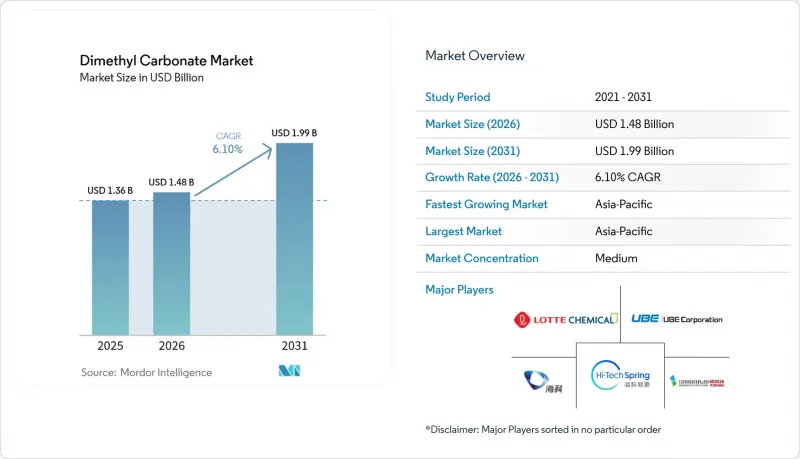
Mordor Intelligence에 의하면, 디메틸 카보네이트 시장 규모는 2025년 13억 6,000만 달러, 2026년 14억 8,000만 달러에서 2031년까지 19억 9,000만 달러로 확대된다고 예측되고 있어 2026년부터 2031년까지 CAGR 6.10%를 나타낼 전망입니다.
본 보고서는 제품 등급(산업용 디메틸 카보네이트, 의약품용 디메틸 카보네이트 등), 용도(용매, 시약 등), 최종 이용 산업(플라스틱 산업, 제약 산업 등), 지역(아시아태평양, 북미, 유럽, 남미, 중동 및 아프리카)별로 분류되어 있습니다. 시장 전망은 금액(달러) 기준으로 제시되어 있습니다.
세계 디메틸 카보네이트 시장 동향 및 인사이트
배터리 전해액용 고순도 디메틸 카보네이트 수요 증가
배터리용 디메틸 카보네이트에는 99.99% 이상의 순도가 요구되기 때문에 그 시세는 산업용 등급의 원자재 가격을 크게 상회하고 있습니다. 디메틸 카보네이트 시장에서 이러한 가격 차이는 중요한 의미를 지닙니다. 이는 매출 성장이 판매량 증가뿐만 아니라 제품 구성의 개선에 의해서도 견인되고 있기 때문입니다. EV 및 에너지 저장 용도를 위한 전 세계 배터리 수요는 2024년에 1 TWh에 달할 것으로 예상되며, 그중 EV용 배터리가 950 GWh 이상을 차지하여 2023년 대비 25% 증가했습니다. 배터리 수요는 2030년까지 3 TWh를 넘어설 것으로 예측되며, 이는 용매 조달에 대한 견고한 장기 전망을 뒷받침하고 있습니다. 유럽에서는 화학 성분의 구성이 여전히 중요한 고려 사항입니다. 이는 인산철리튬(LFP) 배터리가 NMC 배터리에 비해 단위당 디메틸 카보네이트 사용량이 적기 때문에 생산 능력 확대가 용매 수요의 비례적인 증가로 이어지지 않기 때문입니다. 따라서 디메틸 카보네이트 시장에서는 장기 배터리 공급 계약을 확보하고, 순도 요건, 물류 관리 및 오염 위험 기준을 확실하게 충족할 수 있는 공급업체가 유리한 입장에 서게 됩니다.
폴리카보네이트 합성에서의 활용 확대: 포스겐 계열 제조법의 대체
디메틸 카보네이트는 폴리카보네이트 제조 과정에서 포스겐을 사용하지 않는 공정을 뒷받침하며, 화학 물질 취급 기준이 엄격해지고 있는 분야에서 중요한 역할을 하고 있습니다. 디메틸 카보네이트 시장에서 이 용도는 배터리용도의 가치 기반 성장이 가속화되는 가운데에서도 산업용 등급 수요를 지속적으로 안정시키고 있습니다. 2025년 파일럿 시험에서는 150시간에 걸친 연속 운전에서 CO₂에서 디메틸 카보네이트(DMC),더 나아가 디페닐 카보네이트로의 공정이 입증되었으며, DMC의 종합 수율은 85.9%를 달성하여 기존 소재에 필적하는 폴리머 등급의 폴리카보네이트 품질을 얻었습니다. 중국, 한국, 일본은 여전히 최대의 폴리카보네이트 생산 거점이며, 이 용도에 대한 지역적 수요의 하한선을 견고하게 유지하고 있습니다. 동일한 업스트림 공정에서 산업용 및 고순도 제품 모두를 생산할 수 있으므로, 생산자는 하류 시장 상황의 변화에 따라 정제 방침을 유연하게 조정할 수 있습니다. 디메틸 카보네이트 시장은 이러한 듀얼 트랙 모델의 혜택을 받고 있으며, 공급업체는 성숙한 플라스틱 수요와 더 빠른 배터리 관련 성장 사이의 균형을 맞출 수 있게 되었습니다.
메탄올 및 CO₂ 원료 가격에 대한 높은 의존도
메탄올과 CO2는 디메틸 카보네이트 시장 전체에서 채택되고 있는 주요 합성 경로의 핵심 원료이며, 생산의 경제성은 공급업체가 완전히 통제할 수 없는 에너지 사이클 및 조달 상황과 밀접하게 연결되어 있습니다. 2026년 1분기에는 메탄올 비용이 35%에서 40% 상승했고, 같은 기간 동안 아시아의 디메틸 카보네이트 현물 가격은 25%에서 30% 상승했습니다. 이러한 비용 상승으로 인해 일부 원자재 구매자들은 2026년 3분기까지 보다 신중한 조달 태도로 전환했습니다. 또한, 디메틸 카보네이트 시장은 CO2 조달 위험에도 직면해 있습니다. 이는 친환경 제조 공정이 인근 산업 배기가스에 의존하고 있기 때문이며, 관련 부문의 혼란이 계획된 생산을 중단시킬 가능성이 있기 때문입니다.
부문 분석
2025년, 산업용 등급은 디메틸 카보네이트 시장의 47.22%를 차지하고 있으며, 이는 폴리카보네이트 합성 및 코팅제 생산에서 확립된 용도를 반영합니다. 포스겐이 사용되지 않는 카르보닐화 과정에서 이 등급이 차지하는 역할로 인해 수요는 안정적이며, 많은 하류 사용자들이 대량이고 신뢰할 수 있는 기본 공급량을 필요로 하기 때문입니다. 시장은 규모 면에서 계속해서 이 등급에 의존하고 있으며, 특히 플라스틱 가공 및 엔지니어링 소재 생산이 여전히 확고히 자리 잡고 있는 아시아에서 이러한 경향이 두드러집니다. 배터리용 등급은 2031년까지 연평균 성장률(CAGR) 7.91%를 나타낼 것으로 예측되며, 본 조사에서 가장 빠르게 성장하는 제품 등급이 될 것입니다. 이러한 성장은 전기자동차의 보급 확대와 에너지 저장 시스템의 도입 증가에 의해 주도되고 있으며, 이 두 가지 모두 전해액용 용매 수요를 증가시키고 있습니다.
의약품 등급은 생산량이 여전히 적지만, 순도가 99.995%를 초과해야 하고 규정 준수 요건이 더 엄격하기 때문에 가장 높은 판매 가격을 유지하고 있습니다. 이로 인해 공급이 규제되는 이 시장은 신뢰할 수 있는 생산자가 적고, 이익률 보호가 더욱 견고한 전문적인 틈새 시장이 되었습니다. 연료 첨가제 등급은 일부 관할 구역에서 메틸-터샤리-부틸-에테르(MTBE) 규제의 혜택을 받고 있어 제품 포트폴리오 내 위치를 지탱하고 있지만, 주요 수요 견인 요인은 아닙니다. 따라서 디메틸 카보네이트 시장은 명확한 가치 풀별로 구분됩니다. 산업용 등급이 판매량의 대부분을 차지하고, 배터리용 등급이 성장을 주도하며, 의약품용 등급이 높은 가격 책정을 뒷받침하고 있습니다. 동일한 업스트림 공정에서의 화학 반응을 통해 여러 등급을 공급할 수 있는 반면, 다운스트림 공정에서의 정제를 통해 최종 가격 결정력이 결정되기 때문에 이러한 구분은 생산자의 전략에 있어 매우 중요합니다.
지역별 분석
아시아태평양은 2025년에 디메틸 카보네이트 시장 점유율의 59.37%를 차지하며, 2031년까지 연평균 성장률(CAGR) 6.92%를 나타낼 것으로 예측되어 가장 크고 가장 빠르게 성장하는 지역 시장이 될 것입니다. 이 지역의 위상은 대규모 화학제품 생산, 강력한 배터리 제조, 그리고 플라스틱에 대한 막대한 하류 수요를 모두 갖춘 중국에 의해 주도되고 있습니다. 2025년, 중국의 디메틸 카보네이트 생산 능력은 연간 4억 550만 톤을 초과할 것이며, 그 중 52%는 주강 삼각주 지역의 배터리 등급 소비가 차지할 것으로 보입니다. 또한, 중국 동부는 하류 폴리카보네이트 고객의 72%를 차지하고 있어 지역 수요를 뒷받침하고 물류 비용 절감에도 기여하고 있습니다. 2024년, 중국의 신에너지차(NEV) 판매 대수는 1,000만 대를 돌파하여 전해액 용매에 대한 견고한 구조적 수요가 지속되고 있습니다. 일본과 한국은 고품질 공급을 통해 기여하고 있으며, UBE 주식회사는 기상 아질산염 공정을 활용하여 고급 배터리용도에 대응하고 있습니다.
북미에서는 수입 의존에서 국내 생산으로의 전환이 진행되고 있습니다. 이전에는 디메틸 카보네이트(DMC)와 에틸메틸카보네이트가 미국으로 전량 수입되었기 때문에 배터리 공급망은 외부 조달 위험에 노출되어 있었습니다. UBE는 루이지애나주 시설에 7억 달러를 투자하여 연간 10만 톤의 DMC 생산을 목표로 하고 있으며, 2027년도 1분기에 가동을 시작할 예정입니다. 일본국제협력은행(JBIC)은 UBE사의 미국 자회사를 통해 이 프로젝트에 대한 대출 지원을 확정함으로써, 국내 배터리용 용매 공급의 전략적 중요성을 뒷받침하고 있습니다.
유럽은 대량의 배터리용 전해액보다는 의약품, 도료, 특수 화학제품에 있어 여전히 중요한 수요 거점으로 남아 있습니다. 유럽의 디메틸 카보네이트 시장은 화학물질의 등록, 평가, 허가 및 제한에 관한 규정(REACH)의 준수에 의해 형성되어 있으며, 해당 지역에 공급하는 공급업체에 대한 등록 및 추적성 요건이 강화되고 있습니다. 2025년에는 인산철리튬(LFP) 배터리가 유럽 전기차(EV)용 배터리 수요의 10%를 초과할 것으로 예상되며, 니켈·망간·코발트(NMC)를 주성분으로 하는 화학 조성에 비해 kW시당 디메틸 카보네이트 사용량이 감소했습니다. 남미, 중동 및 아프리카는 여전히 초기 단계 시장이지만, 브라질, 아르헨티나, 사우디아라비아에서는 석유화학 및 특수 화학 분야로의 투자 활동을 통해 잠재적인 성장이 예상됩니다.
기타 혜택:
- 엑셀 형식 시장 예측(ME) 시트
- 3개월간의 애널리스트 지원
자주 묻는 질문
목차
제1장 서론
제2장 조사 방법
제3장 개요
제4장 시장 구도
제5장 시장 규모와 성장 예측
제6장 경쟁 구도
제7장 시장 기회와 향후 전망
JHS 26.09.01According to Mordor Intelligence, the dimethyl carbonate market size is projected to expand from USD 1.36 billion in 2025 and USD 1.48 billion in 2026 to USD 1.99 billion by 2031, and is expected to register a CAGR of 6.10% between 2026 to 2031.
This report is Segmented by Product Grade (Industrial Grade Dimethyl Carbonate, Pharmaceutical Grade Dimethyl Carbonate and More), Application (Solvents, Reagents, and More), End-Use Industry (Plastics Industry, Pharmaceutical Industry, and More), and Geography (Asia-Pacific, North America, Europe, South America, and Middle-East and Africa). The Market Forecasts are Provided in Terms of Value (USD).
Global Dimethyl Carbonate Market Trends and Insights
Rising Demand for High-Purity Dimethyl Carbonate in Battery Electrolytes
Battery-grade dimethyl carbonate requires purity of 99.99% or above, which keeps its realized pricing well above industrial-grade material. In the dimethyl carbonate market, this premium is significant because revenue growth is being driven by product mix improvement, not only by higher volumes. Global battery demand for EV and storage applications reached 1 TWh in 2024, with EV batteries accounting for more than 950 GWh, up 25% from 2023. Battery demand is projected to exceed 3 TWh by 2030, supporting a firm long-term outlook for solvent procurement. In Europe, chemistry mix remains an important consideration because Lithium Iron Phosphate (LFP) batteries use less dimethyl carbonate per unit than NMC cells, meaning rising capacity does not translate into a proportional increase in solvent demand. The dimethyl carbonate market therefore favors suppliers that secure long-term battery contracts and can consistently meet purity requirements, logistics control, and contamination risk standards.
Expanding Use in Polycarbonate Synthesis Replacing Phosgene-Based Routes
Dimethyl carbonate supports a non-phosgene route to polycarbonate production, making it relevant where chemical handling standards are tightening. In the dimethyl carbonate market, this application keeps industrial-grade demand stable even as battery applications grow faster in value terms. A 2025 pilot study validated a continuous CO2-to-dimethyl carbonate (DMC)-to-diphenyl carbonate process over a 150-hour run, achieving an 85.9% overall DMC yield and polymer-grade polycarbonate quality comparable to conventional material. China, South Korea, and Japan remain the largest polycarbonate production base, maintaining a strong regional demand floor for this application. The same upstream process can support both industrial and high-purity output, giving producers flexibility to adjust purification focus as downstream conditions change. The dimethyl carbonate market benefits from this dual-track model as it allows suppliers to balance mature plastics demand with faster battery-related growth.
High Dependence on Methanol and CO2 Feedstock Prices
Methanol and CO2 are the primary feedstocks in the main synthesis routes used across the dimethyl carbonate market, making production economics closely tied to energy cycles and procurement conditions that suppliers cannot fully control. Methanol costs rose 35% to 40% in the first quarter of 2026, and dimethyl carbonate spot prices in Asia increased by 25% to 30% during the same period. This cost increase pushed some commodity buyers toward a more cautious procurement stance through the third quarter of 2026. The dimethyl carbonate market also faces CO2 sourcing risk, as green production routes rely on nearby industrial flue gas streams, and disruptions in adjacent sectors can interrupt planned output.
Other drivers and restraints analyzed in the detailed report include:
- Shift Toward Safer, Low-Toxicity Solvents Across Industries
- Growth in pharmaceutical manufacturing and green Active Pharmaceutical Ingredient (API) synthesis
- Handling and Purification Challenges for High-Purity Grades
For complete list of drivers and restraints, kindly check the Table Of Contents.
Segment Analysis
Industrial grade held 47.22% of the dimethyl carbonate market in 2025, reflecting its established use in polycarbonate synthesis and coatings production. Its role in phosgene-free carbonylation keeps demand steady, as many downstream users require large, reliable base volumes. The market continues to depend on this grade for scale, particularly in Asia where plastics processing and engineering materials production remain well established. Battery grade is projected to grow at a 7.91% CAGR through 2031, making it the fastest-growing product grade in the study. This growth is driven by the expansion of electric vehicles and rising energy storage deployment, both of which are increasing demand for electrolyte solvents.
Pharmaceutical grade remains smaller in volume but commands the highest selling price, as purity must exceed 99.995% and compliance requirements are more stringent. This makes regulated supply a specialized niche with fewer credible producers and stronger margin protection. Fuel additive grade benefits from restrictions on methyl tert-butyl ether (MTBE) in several jurisdictions, which supports its place in the product portfolio, although it is not the primary demand driver. The dimethyl carbonate market is therefore divided across distinct value pools: industrial grade carries the bulk of volume, battery grade drives growth, and pharmaceutical grade supports premium pricing. This division is central to producer strategy, as the same upstream chemistry can supply multiple grades, while downstream purification determines final pricing power.
Complete Report Scope:
- By Product Grade
- Industrial Grade Dimethyl Carbonate
- Pharmaceutical Grade Dimethyl Carbonate
- Battery Grade Dimethyl Carbonate
- Fuel Additive Grade Dimethyl Carbonate
- By Application
- Polycarbonate Synthesis
- Battery Electrolyte
- Solvents
- Reagents
- Fuel Additives
- Other Applications
- By End-Use Industry
- Plastics Industry
- Paints and Coatings Industry
- Pharmaceutical Industry
- Battery Industry
- Agrochemicals Industry
- Adhesives and Sealants Industry
- Electronics Industry
- By Geography
- Asia-Pacific
- China
- India
- Japan
- South Korea
- Rest of Asia-Pacific
- North America
- United States
- Canada
- Mexico
- Europe
- Germany
- United Kingdom
- France
- Italy
- Russia
- Rest of Europe
- South America
- Brazil
- Argentina
- Rest of South America
- Middle-East and Africa
- Saudi Arabia
- South Africa
- Rest of Middle-East and Africa
- Asia-Pacific
Geography Analysis
Asia-Pacific held 59.37% of the dimethyl carbonate market share in 2025 and is expected to grow at a CAGR of 6.92% through 2031, making it both the largest and fastest-growing regional market. The region's position is driven by China, which combines large-scale chemical production, strong battery manufacturing, and significant downstream demand for plastics. China's dimethyl carbonate capacity exceeded 405.5 million tons per year in 2025, with the Pearl River Delta accounting for 52% of the country's battery-grade consumption. Eastern China accounted for 72% of downstream polycarbonate customers, supporting local demand and reducing logistics costs. China's new energy vehicle sales surpassed 10 million units in 2024, sustaining strong structural demand for electrolyte solvents. Japan and South Korea contribute through premium-quality supply, with UBE Corporation utilizing its gas-phase nitrite process to serve higher-end battery applications.
North America has been shifting away from reliance on imports toward domestic production. Previously, dimethyl carbonate (DMC) and ethyl methyl carbonate were fully imported into the United States, exposing battery supply chains to external sourcing risks. UBE Corporation has committed USD 700 million to a Louisiana facility targeting 100,000 tons per year of DMC, with operations scheduled for the first quarter of fiscal year 2027. The Japan Bank for International Cooperation (JBIC) confirmed financing support for this project through UBE's U.S. subsidiary, reinforcing the strategic importance of domestic battery solvent supply.
Europe remains a significant demand center for pharmaceuticals, coatings, and specialty chemicals, rather than for large volumes of battery electrolytes. The dimethyl carbonate market in Europe is shaped by Registration, Evaluation, Authorisation and Restriction of Chemicals (REACH) compliance, which increases registration and traceability requirements for suppliers serving the region. Lithium iron phosphate (LFP) batteries exceeded 10% of European electric vehicle (EV) battery demand in 2025, reducing dimethyl carbonate intensity per kilowatt-hour compared with nickel manganese cobalt (NMC)-heavy chemistries. South America and the Middle East and Africa remain early-stage markets, though Brazil, Argentina, and Saudi Arabia show potential through petrochemical and specialty chemical investment activity.
- Dongying Hi-tech Spring Chemical Industry Co., Ltd.
- Hebei New Chaoyang Chemical Stock Co., Ltd.
- Kishida Chemical Co. Ltd.
- Kowa Company, Ltd.
- Liaoning Oxiranchem, Inc.
- Lotte Chemical Corporation
- Merck KGaA
- Shandong Haike Chemical Group Co., Ltd.
- Shanghai Jinshan Jingwei Chemical Co., Ltd.
- Shinghwa Advanced Material Group Co.,Ltd.
- Tokyo Chemical Industry Co., Ltd.
- UBE Corporation
- Zhejiang Yuanli Chemical Co., Ltd.
Additional Benefits:
- The market estimate (ME) sheet in Excel format
- 3 months of analyst support
TABLE OF CONTENTS
1 Introduction
- 1.1 Study Assumptions and Market Definition
- 1.2 Scope of the Study
2 Research Methodology
3 Executive Summary
4 Market Landscape
- 4.1 Market Overview
- 4.2 Market Drivers
- 4.2.1 Rising Demand for High-Purity Battery Electrolyte Solvents
- 4.2.2 Expanding Use in Polycarbonate Synthesis
- 4.2.3 Shift Toward Safer, Low-Toxicity Reagents and Solvents
- 4.2.4 Growth in Pharmaceutical and Specialty Chemical Formulations
- 4.2.5 Expansion of Lithium-Ion Battery Manufacturing Capacity
- 4.3 Market Restraints
- 4.3.1 High Dependence on Feedstock and Process Economics
- 4.3.2 Handling and Purification Constraints for Battery Grade Material
- 4.3.3 Competition From Alternative Carbonate Solvents and Substitutes
- 4.4 Value Chain Analysis
- 4.5 Regulatory Landscape
- 4.6 Porter's Five Forces Analysis
- 4.6.1 Bargaining Power of Suppliers
- 4.6.2 Bargaining Power of Buyers
- 4.6.3 Threat of New Entrants
- 4.6.4 Threat of Substitutes
- 4.6.5 Intensity of Competitive Rivalry
5 Market Size and Growth Forecasts (Value)
- 5.1 By Product Grade
- 5.1.1 Industrial Grade Dimethyl Carbonate
- 5.1.2 Pharmaceutical Grade Dimethyl Carbonate
- 5.1.3 Battery Grade Dimethyl Carbonate
- 5.1.4 Fuel Additive Grade Dimethyl Carbonate
- 5.2 By Application
- 5.2.1 Polycarbonate Synthesis
- 5.2.2 Battery Electrolyte
- 5.2.3 Solvents
- 5.2.4 Reagents
- 5.2.5 Fuel Additives
- 5.2.6 Other Applications
- 5.3 By End-Use Industry
- 5.3.1 Plastics Industry
- 5.3.2 Paints and Coatings Industry
- 5.3.3 Pharmaceutical Industry
- 5.3.4 Battery Industry
- 5.3.5 Agrochemicals Industry
- 5.3.6 Adhesives and Sealants Industry
- 5.3.7 Electronics Industry
- 5.4 By Geography
- 5.4.1 Asia-Pacific
- 5.4.1.1 China
- 5.4.1.2 India
- 5.4.1.3 Japan
- 5.4.1.4 South Korea
- 5.4.1.5 Rest of Asia-Pacific
- 5.4.2 North America
- 5.4.2.1 United States
- 5.4.2.2 Canada
- 5.4.2.3 Mexico
- 5.4.3 Europe
- 5.4.3.1 Germany
- 5.4.3.2 United Kingdom
- 5.4.3.3 France
- 5.4.3.4 Italy
- 5.4.3.5 Russia
- 5.4.3.6 Rest of Europe
- 5.4.4 South America
- 5.4.4.1 Brazil
- 5.4.4.2 Argentina
- 5.4.4.3 Rest of South America
- 5.4.5 Middle-East and Africa
- 5.4.5.1 Saudi Arabia
- 5.4.5.2 South Africa
- 5.4.5.3 Rest of Middle-East and Africa
- 5.4.1 Asia-Pacific
6 COMPETITIVE LANDSCAPE
- 6.1 Market Concentration
- 6.2 Strategic Moves
- 6.3 Market Share (%)/Ranking Analysis
- 6.4 Company Profiles (includes Global Overview, Market Overview, Core Segments, Financials as available, Strategic Information, Products and Services, and Recent Developments)
- 6.4.1 Dongying Hi-tech Spring Chemical Industry Co., Ltd.
- 6.4.2 Hebei New Chaoyang Chemical Stock Co., Ltd.
- 6.4.3 Kishida Chemical Co. Ltd.
- 6.4.4 Kowa Company, Ltd.
- 6.4.5 Liaoning Oxiranchem, Inc.
- 6.4.6 Lotte Chemical Corporation
- 6.4.7 Merck KGaA
- 6.4.8 Shandong Haike Chemical Group Co., Ltd.
- 6.4.9 Shanghai Jinshan Jingwei Chemical Co., Ltd.
- 6.4.10 Shinghwa Advanced Material Group Co.,Ltd.
- 6.4.11 Tokyo Chemical Industry Co., Ltd.
- 6.4.12 UBE Corporation
- 6.4.13 Zhejiang Yuanli Chemical Co., Ltd.
7 MARKET OPPORTUNITIES AND FUTURE OUTLOOK
- 7.1 White-Space and Unmet-Need Assessment