

|
시장보고서
상품코드
2117503
다공질 유리 시장 : 점유율 분석, 업계 동향과 통계, 성장 예측(2026-2031년)Cellular Glass - Market Share Analysis, Industry Trends & Statistics, Growth Forecasts (2026 - 2031) |
||||||
 Mordor Intelligence
Mordor Intelligence에 의하면, 다공질 유리 시장 규모는 2025년에 20억 7,000만 달러, 2026년에 21억 4,000만 달러가 되고, 2031년까지 28억 4,000만 달러에 이를 것으로 예측되며, 2026년부터 2031년까지 CAGR 5.82%로 성장할 전망입니다.
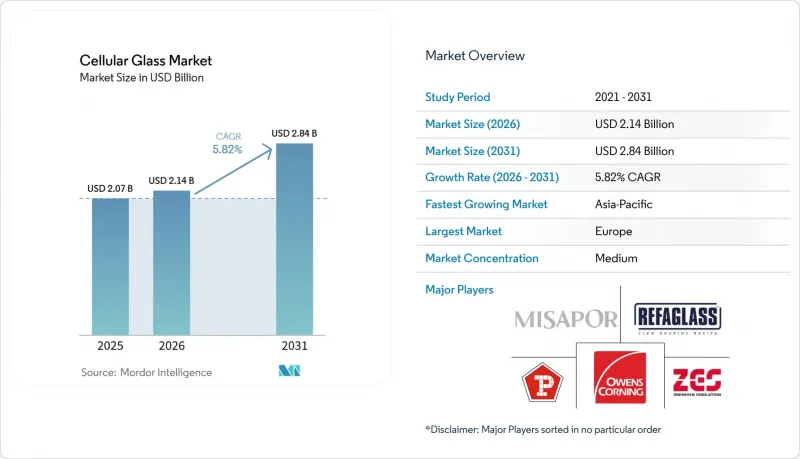
본 보고서는 제품 유형(블록, 쉘, 다공질 유리 자갈), 용도(산업용 단열재, 건축 및 건설, 기타), 지역(아시아태평양, 북미, 유럽, 남미, 중동 및 아프리카)별로 분류되어 있습니다. 시장 전망은 금액(달러) 기준으로 제시되어 있습니다.
세계 다공질 유리 시장 동향 및 인사이트
내화 단열재에 대한 수요 증가
내화 성능은 규제가 엄격한 건설 환경에서 다공질 유리 시장이 계속해서 사양상의 지지를 얻고 있는 주된 이유입니다. 다공질 유리는 EN 13501-1에 따라 A1 불연재로 분류되며, 추가적인 화학 처리나 난연 처리를 거치지 않아도 엄격한 내화 요건을 충족할 수 있는 몇 안 되는 단열재 중 하나로 꼽힙니다. 미국, 유럽 및 기타 주요 건축 시장의 프로젝트 팀은 초기 설계 검토 단계에서 파사드 및 조립 부재의 내화 성능에 더욱 주의를 기울이고 있습니다. 프로젝트의 화재 방지 전략에 불연성 솔루션이 요구될 경우, 많은 폴리머계 대체재는 더 이상 동등한 조건에서 요건을 충족할 수 없기 때문에 대체재의 위험은 줄어듭니다. 이러한 추세는 초기 단열 비용의 절감보다 건축 기준 준수 및 장기적인 리스크 관리가 더 중요시되는 상업용 건물, 산업 플랜트 및 고밀도 도시 지역 프로젝트에서 다공질 유리 시장을 뒷받침하고 있습니다.
친환경 건축 및 넷 제로 건설 프로젝트에서의 채택 확대
그린 빌딩의 틀은 인증 중심의 상업 프로젝트에서 자재 선정의 중요성이 그 어느 때보다 높아지고 있기 때문에 다공질 유리 시장에 안정적인 수요원을 제공합니다. 다공질 유리는 일반적으로 폐유리 컷렛을 원료로 제조되며, 완제품에 포함된 석유화학제품, 발포제, 휘발성 유기 화합물을 배제하고 있어 이러한 프로젝트에 적합합니다. GLAVEL사는 다공질 유리 골재에 대한 제3자 기관의 환경 인증 문서와 ‘Declare’ 라벨을 획득함으로써 이러한 입지를 강화했습니다. 이를 통해 건축가는 사양 수립 단계에서 수명 주기 및 재료의 건강 영향에 관한 보다 명확한 정보를 얻을 수 있게 되었습니다. 공인 건축가는 시공업체가 시공 입찰을 비교하기 이전에 고급 상업 프로젝트의 단열재 선정에 종종 영향을 미칩니다. 그 결과, 투명한 자재 정보, 재생 소재 함유율 및 실내 환경 품질이 조달 가치로서 중시되는 프로젝트에서 다공질 유리 시장은 성장세를 보이고 있습니다.
기존 단열재에 비해 높은 초기 비용
높은 초기 비용은 다공질 유리 시장의 주요 상업적 제약 요인으로 남아 있습니다. 제조 공정은 에너지 집약적인 유리 용융과 엄격하게 관리되는 발포 주기에 의존하기 때문에 많은 프로젝트 비교에서 미네랄 울, 발포 폴리스티렌, 폴리이소시아누레이트보다 납품 비용이 더 높습니다. 이는 구매자가 일반적으로 전체 수명 주기의 경제성이 아닌 단위 면적당 초기 설치 비용으로 자재를 비교하는 주택 및 소규모 상업 건축 분야에서 특히 두드러집니다. 남미, 동남아시아 및 동유럽의 일부 지역에서는 가격에 대한 민감도가 매우 높으며, 현지 생산 능력도 제한적입니다. 그 결과, 이들 지역의 다공질 유리 시장은 산업 시설 및 고부가가치 상업 프로젝트에 집중되어 있으며, 이러한 분야의 구매자들은 내습성, 내화성 및 긴 수명에 대해 더 높은 대가를 기꺼이 지불합니다.
부문 분석
2025년, 블록 및 쉘은 다공질 유리 시장의 58.72% 점유율을 차지하고 있으며, 이는 성형 제품이 다공질 유리 시장에서 중심적인 역할을 하고 있음을 반영합니다. 이 시장의 위상은 평지붕 시스템, 지하 부분의 방수, 배관, 탱크 및 설비용 산업용 단열재에서 비롯된 것으로, 이러한 용도에서는 미리 성형된 형태 덕분에 현장에서의 절단 작업이 줄어들고 보다 체계적인 시공이 가능해집니다. 이러한 이점은 특히 극저온 프로젝트에서 중요합니다. 저장 탱크나 이송 시스템의 경우, 상온과 영하 사용 조건 사이에서 반복되는 열 사이클 하에서도 치수 안정성이 요구되기 때문입니다. 또한, 블록 및 쉘은 내화 성능, 내습성 및 긴 수명을 우선시하는 사양에서도 확고한 입지를 구축하고 있습니다.
다공질 유리 자갈은 2031년까지 연평균 성장률(CAGR) 6.73%를 나타낼 것으로 예측되며, 이는 다공질 유리 시장에서 가장 빠르게 성장하는 제품 형태가 될 것입니다. 이러한 성장을 주도하는 것은 슬래브 하부 단열, 도로 성토, 동상 대책 및 토목 공사이며, 이러한 분야에서는 흩어진 형태의 골재가 배수성, 단열성, 경량 성토 기능을 단일 층에서 모두 갖추고 있습니다. 이로 인해 기존에는 단열 제품을 조달하지 않았던 토목·인프라 분야의 구매자들에게도 다공질 유리 시장에 진입할 수 있는 길이 열렸습니다. GLAVEL사의 환경 제품 선언(EPD)에 따르면, 재생에너지를 사용하여 100% 폐유리 재활용 소재로 제조된 이 회사의 다공질 유리 자갈은 기존의 발포 보드 조립품에 비해 내재 탄소량이 55% 낮은 것으로 나타났습니다. 또한, Foamit Group은 2025년 말 포르사(Forsa) 시설을 확장하여 소립자 다공질 유리의 생산 능력을 연간 10만 입방미터 이상으로 늘렸습니다.
지역별 분석
2025년, 유럽은 다공질 유리 시장 점유율의 36.92%를 차지하며 1위 자리를 유지했습니다. 이는 엄격한 에너지 규제, 확립된 제조거점, 그리고 신뢰할 수 있는 단열 및 방습 성능을 갖춘 자재를 선호하는 리모델링 사이클에 힘입은 결과입니다. 독일, 프랑스, 영국은 여전히 주요 수요 거점으로 자리 잡고 있습니다. 특히 독일은 재정 지원과 고성능 건축 기준 덕분에 기초 및 평지붕 단열재 분야에서 지속적인 프리미엄 부문이 형성되고 있다는 점에서 두드러집니다. 2026년 12월까지 각국의 리모델링 계획을 수립하도록 의무화하는 ‘건축물 에너지 성능 지침(EPBD)’의 요건은 기존 건축물의 더 큰 부분을 자발적 수요가 아닌 규제된 수요 풀로 전환시킴으로써 지역 시장을 더욱 강화하고 있습니다. 오웬스 코닝(Owens Corning)사가 2025년 6월에 발표한 체코 크라스테레츠에 위치한 FOAMGLAS 공장에 대한 투자 계획은 2026년 2분기 가동 개시를 목표로 생산 능력을 50% 증강하는 것을 목표로 하고 있으며, 다공질 유리 시장에서 유럽의 지속적인 수요를 전망하며 공급업체들이 어떻게 체제를 정비하고 있는지를 반영하고 있습니다.
아시아태평양은 2031년까지 연평균 성장률(CAGR) 6.52%를 나타낼 것으로 예측되며, 다공질 유리 시장에서 가장 빠르게 성장하는 지역 시장이 될 전망입니다. 중국, 인도, 한국, 그리고 일본이 LNG 수입 인프라 확충, 산업용 단열재 수요, 그리고 상업 건축 활동의 조합을 통해 이러한 성장을 주도하고 있습니다. 중국과 인도는 중요한 시장이며, 재기화 터미널의 증설로 인해 극저온 저장 탱크 단열재, 이송 배관 단열재 및 관련 저온 장비에 대한 수요가 직접적으로 증가하고 있습니다. 일본과 한국은 수소 인프라 계획 및 조선과 관련된 LNG 사업을 통해 추가적인 수요를 창출하며, 일반적인 상업 건축을 넘어선 산업용 기반을 확대되고 있습니다.
남미, 중동 및 아프리카는 다공질 유리에게 여전히 소규모 지역 시장에 그치고 있습니다. 이 지역들 수요는 단순한 일상적인 건축 활동이 아니라, 석유화학, LPG, LNG 및 대규모 인프라 투자에 좌우되고 있습니다. 남미에서는 브라질과 아르헨티나가 수요를 주도하고 있지만, 가격 민감도와 현지 생산의 한계로 인해 이 지역은 여전히 수입에 의존하고 있으며, 이미 고가인 자재의 운송 비용을 더욱 상승시키고 있습니다. 중동 및 아프리카에서는 사우디아라비아가 주목할 만한 시장이며, ‘비전 2030’ 프로젝트와 에너지 효율이 높은 건축 요건이 장기적인 성능이 입증된 내구성 있는 단열재에 대한 수요를 견인하고 있습니다. 아랍에미리트(UAE) 역시 LNG 및 석유화학 산업의 확장을 통해 지역 수요를 뒷받침하고 있으며, 산업용 단열재는 더 광범위한 보급을 위한 주요 관문으로서의 역할을 계속하고 있습니다.
기타 혜택:
- 엑셀 형식 시장 예측(ME) 시트
- 3개월간의 애널리스트 지원
자주 묻는 질문
목차
제1장 서론
제2장 조사 방법
제3장 개요
제4장 시장 구도
제5장 시장 규모와 성장 예측
제6장 경쟁 구도
제7장 시장 기회와 향후 전망
JHS 26.09.01According to Mordor Intelligence, the cellular glass market size is projected to be USD 2.07 billion in 2025, USD 2.14 billion in 2026, and reach USD 2.84 billion by 2031, and is expected to grow at a CAGR of 5.82% from 2026 to 2031.
This report is Segmented by Product Type (Blocks and Shells and Foam Glass Gravels), Application (Industrial Insulation, Building and Construction, and More), and Geography (Asia-Pacific, North America, Europe, South America, and Middle-East and Africa). The Market Forecasts are Provided in Terms of Value (USD).
Global Cellular Glass Market Trends and Insights
Rising Demand for Fire-Resistant Insulation Materials
Fire performance is a key reason the cellular glass market continues to gain specification support in regulated construction environments. Cellular glass is classified as A1 non-combustible under EN 13501-1, placing it among a narrow group of insulation materials that can meet strict fire requirements without additional chemical treatment or fire-retardant systems. Project teams in the United States, Europe, and other major building markets are giving greater attention to facade and assembly fire performance during early design review. Once a project fire strategy requires a non-combustible solution, substitution risk decreases because many polymer-based alternatives no longer qualify on equal terms. This pattern is supporting the cellular glass market in commercial buildings, industrial plants, and dense urban projects where code compliance and long-term risk management carry more weight than lower upfront insulation costs.
Increasing Adoption in Green Building and Net-Zero Construction Projects
Green building frameworks are providing the cellular glass market with a steady source of demand, as material selection now carries greater weight in certification-led commercial projects. Cellular glass suits these projects because it is commonly produced from waste glass cullet and avoids petrochemicals, blowing agents, and volatile organic compounds in the finished material profile. GLAVEL strengthened this position with third-party-verified environmental documentation for foamed glass aggregate and a Declare label, giving architects clearer lifecycle and material health information during specification. Certifying architects often influence insulation choices in premium commercial projects before contractors compare installed bids. As a result, the cellular glass market is gaining traction in projects where transparent material documentation, recycled content, and indoor environmental quality carry procurement value.
Higher Initial Cost Compared to Conventional Insulation Alternatives
High upfront cost remains a key commercial restraint on the cellular glass market. The manufacturing process relies on energy-intensive glass melting and tightly controlled foaming cycles, which keep delivered costs above those of mineral wool, expanded polystyrene, and polyisocyanurate in many project comparisons. This is most relevant in residential and light commercial construction, where buyers typically compare materials on initial installed cost per unit area rather than total service-life economics. Price sensitivity is high in South America, Southeast Asia, and parts of Eastern Europe, where local production capacity is also limited. As a result, the cellular glass market in these regions remains concentrated in industrial plants and high-value commercial projects, where buyers are more willing to pay for moisture resistance, fire safety, and long service life.
Other drivers and restraints analyzed in the detailed report include:
- Growing Preference for Sustainable and Energy-Efficient Building Solutions
- Increasing Retrofit and Renovation Activities in Mature-Market Building Stock
- Fragility and Risk of Mechanical Damage During Transportation and Installation
For complete list of drivers and restraints, kindly check the Table Of Contents.
Segment Analysis
Blocks and Shells held 58.72% of the cellular glass market share in 2025, reflecting the central role of formed products in the cellular glass market. Their market position stems from flat-roof systems, below-grade waterproofing, and industrial insulation for pipes, tanks, and equipment, where pre-shaped geometry reduces field cutting and allows for more controlled installation. This advantage is particularly relevant in cryogenic projects, as storage tanks and transfer systems require dimensional stability under repeated thermal cycling between ambient and sub-zero service conditions. Blocks and Shells are also well established in specifications that prioritize fire performance, moisture resistance, and long service life.
Foam Glass Gravels are projected to grow at a 6.73% CAGR through 2031, making this the fastest-growing product form in the cellular glass market. Growth is driven by sub-slab insulation, road embankments, frost-heave mitigation, and civil works, where the loose aggregate format combines drainage, insulation, and lightweight fill in a single layer. This opens the cellular glass market to civil engineering and infrastructure buyers that historically did not source traditional insulation products. GLAVEL's Environmental Product Declaration stated that its foam glass gravel, produced from 100% post-consumer recycled glass using renewable energy, carried 55% lower embodied carbon than conventional foam board assemblies. Foamit Group also expanded its facility in Forssa in late 2025, increasing small-grain cellular glass production capacity to above 100,000 cubic meters annually.
Complete Report Scope:
- By Product Type
- Blocks and Shells
- Foam Glass Gravels
- By Application
- Building and Construction
- Industrial Insulation
- Chemical and Petrochemical
- Oil & Gas
- Energy & Power
- Other Applications
- By Geography
- Asia-Pacific
- China
- India
- Japan
- South Korea
- Rest of Asia-Pacific
- North America
- United States
- Canada
- Mexico
- Europe
- Germany
- United Kingdom
- France
- Italy
- Russia
- Rest of Europe
- South America
- Brazil
- Argentina
- Rest of South America
- Middle-East and Africa
- Saudi Arabia
- South Africa
- Rest of Middle-East and Africa
- Asia-Pacific
Geography Analysis
Europe held 36.92% of the cellular glass market share in 2025, maintaining its leading position. This is supported by strict energy codes, a well-established manufacturing base, and a renovation cycle that favors materials with reliable thermal and moisture performance. Germany, France, and the United Kingdom remain the main demand centers. Germany stands out in particular, as financing support and high-performance building standards have created a durable premium segment for foundation and flat-roof insulation. The Energy Performance of Buildings Directive (EPBD) requirement for national renovation plans by December 2026 further strengthens the regional market by converting a larger portion of the existing building stock into a regulated demand pool rather than a discretionary one. Owens Corning's June 2025 investment announcement for its FOAMGLAS plant in Klasterec, Czech Republic, which targets a 50% increase in production capacity with commissioning in Q2 2026, reflects how suppliers are positioning for continued European demand in the cellular glass market.
Asia-Pacific is projected to grow at a CAGR of 6.52% through 2031, making it the fastest-growing regional market for cellular glass. China, India, South Korea, and Japan are driving this growth through a combination of LNG import infrastructure expansion, industrial insulation requirements, and commercial construction activity. China and India are significant markets, as regasification terminal additions are directly increasing demand for cryogenic storage tank insulation, transfer piping insulation, and related low-temperature equipment. Japan and South Korea add further demand through hydrogen infrastructure plans and shipbuilding-linked LNG activity, broadening the industrial use base beyond standard commercial construction.
South America, the Middle East, and Africa remain smaller regional markets for cellular glass. Demand in these regions is tied to petrochemical, LPG, LNG, and major infrastructure investment rather than routine building activity alone. Brazil and Argentina lead South American demand, though price sensitivity and limited local production keep the region dependent on imports, which increase the landed cost of an already premium material. In the Middle East and Africa, Saudi Arabia is a notable market as Vision 2030 projects and energy-efficient construction requirements are driving demand for durable thermal materials with proven long-term performance. The UAE also supports regional demand through LNG and petrochemical expansion, with industrial insulation remaining the primary entry point for broader adoption.
- Anhui Huichang New Material Co., Ltd.
- Earthstone International LLC
- GEOCELL Schaumglas GmbH
- Glapor Werk Mitterteich GmbH
- GLAVEL, Inc.
- Jahan Ayeg Pars Company
- Liaver GmbH and Co. KG
- MISAPOR
- Owens Corning
- POLYDROS,S.A.
- REFAGLASS s.r.o.
- Steinbach Schaumglas GmbH and Co. KG
- STES-Vladimir
- Uusioaines Oy
- Zhejiang Dehe Insulation Technology Co., Ltd.
- ZHEJIANG ZHENSHEN INSULATION TECHNOLOGY CORP.LTD.
Additional Benefits:
- The market estimate (ME) sheet in Excel format
- 3 months of analyst support
TABLE OF CONTENTS
1 Introduction
- 1.1 Study Assumptions and Market Definition
- 1.2 Scope of the Study
2 Research Methodology
3 Executive Summary
4 Market Landscape
- 4.1 Market Overview
- 4.2 Market Drivers
- 4.2.1 Rising Demand for Fire-Resistant and High-Performance Thermal Insulation
- 4.2.2 Increasing Adoption in Cryogenic and Low-Temperature Applications
- 4.2.3 Growing Preference for Sustainable and Recyclable Insulation Materials
- 4.2.4 Increasing Retrofit and Renovation Activities Across Industrial and Commercial Buildings
- 4.2.5 Rising Demand for Moisture-Resistant Insulation in High-Humidity Environments
- 4.3 Market Restraints
- 4.3.1 Higher Initial Cost Compared to Conventional Insulation Materials
- 4.3.2 Limited Awareness and Adoption Among Small and Medium-Sized Contractors
- 4.3.3 Fragility and Risk of Damage During Transportation and Installation
- 4.4 Value Chain Analysis
- 4.5 Porter's Five Forces Analysis
- 4.5.1 Threat of New Entrants
- 4.5.2 Bargaining Power of Suppliers
- 4.5.3 Bargaining Power of Buyers
- 4.5.4 Threat of Substitutes
- 4.5.5 Competitive Rivalry
5 Market Size and Growth Forecasts (Value)
- 5.1 By Product Type
- 5.1.1 Blocks and Shells
- 5.1.2 Foam Glass Gravels
- 5.2 By Application
- 5.2.1 Building and Construction
- 5.2.2 Industrial Insulation
- 5.2.3 Chemical and Petrochemical
- 5.2.4 Oil & Gas
- 5.2.5 Energy & Power
- 5.2.6 Other Applications
- 5.3 By Geography
- 5.3.1 Asia-Pacific
- 5.3.1.1 China
- 5.3.1.2 India
- 5.3.1.3 Japan
- 5.3.1.4 South Korea
- 5.3.1.5 Rest of Asia-Pacific
- 5.3.2 North America
- 5.3.2.1 United States
- 5.3.2.2 Canada
- 5.3.2.3 Mexico
- 5.3.3 Europe
- 5.3.3.1 Germany
- 5.3.3.2 United Kingdom
- 5.3.3.3 France
- 5.3.3.4 Italy
- 5.3.3.5 Russia
- 5.3.3.6 Rest of Europe
- 5.3.4 South America
- 5.3.4.1 Brazil
- 5.3.4.2 Argentina
- 5.3.4.3 Rest of South America
- 5.3.5 Middle-East and Africa
- 5.3.5.1 Saudi Arabia
- 5.3.5.2 South Africa
- 5.3.5.3 Rest of Middle-East and Africa
- 5.3.1 Asia-Pacific
6 Competitive Landscape
- 6.1 Market Concentration
- 6.2 Strategic Moves
- 6.3 Market Share (%)/Ranking Analysis
- 6.4 Company Profiles (includes Global Overview, Market Overview, Core Segments, Financials as available, Strategic Information, Products and Services, and Recent Developments)
- 6.4.1 Anhui Huichang New Material Co., Ltd.
- 6.4.2 Earthstone International LLC
- 6.4.3 GEOCELL Schaumglas GmbH
- 6.4.4 Glapor Werk Mitterteich GmbH
- 6.4.5 GLAVEL, Inc.
- 6.4.6 Jahan Ayeg Pars Company
- 6.4.7 Liaver GmbH and Co. KG
- 6.4.8 MISAPOR
- 6.4.9 Owens Corning
- 6.4.10 POLYDROS,S.A.
- 6.4.11 REFAGLASS s.r.o.
- 6.4.12 Steinbach Schaumglas GmbH and Co. KG
- 6.4.13 STES-Vladimir
- 6.4.14 Uusioaines Oy
- 6.4.15 Zhejiang Dehe Insulation Technology Co., Ltd.
- 6.4.16 ZHEJIANG ZHENSHEN INSULATION TECHNOLOGY CORP.LTD.
7 Market Opportunities and Future Outlook
- 7.1 White-Space and Unmet-Need Assessment


