

|
시장보고서
상품코드
2117514
법의학 유전체학 : 시장 점유율 분석, 업계 동향 및 통계, 성장 예측(2026-2031년)Forensic Genomics - Market Share Analysis, Industry Trends & Statistics, Growth Forecasts (2026 - 2031) |
||||||
 Mordor Intelligence
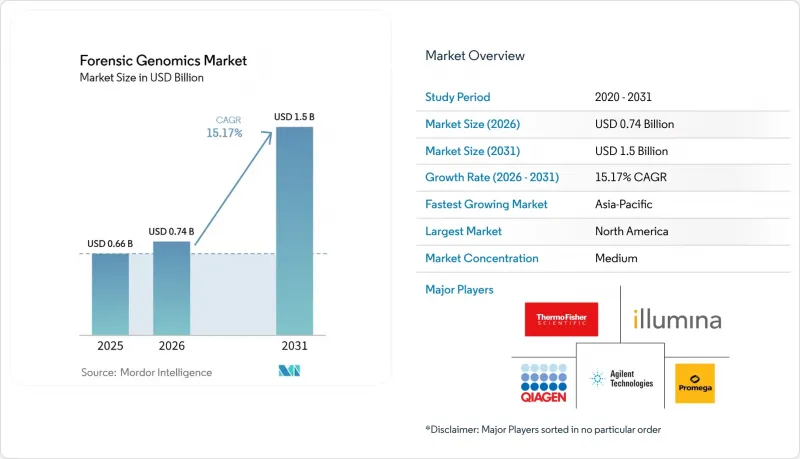
법의학 유전체학 시장은 2025년 6억 6,000만 달러로 평가되었습니다. 2026년에는 7억 4,000만 달러로 확대되어 2031년까지 15억 달러에 이를 것으로 예상되고 2026년부터 2031년에 걸쳐 CAGR 15.17%로 성장할 전망입니다.
본 보고서는 제품 유형(장비, 키트 및 소모품, 소프트웨어 및 서비스), 기법(차세대 시퀀싱, 모세관 전기영동 등), 치료 분야(친자 확인 및 가족 관계 검사, 신원 확인 등), 지역(북미, 유럽, 아시아태평양, 중동 및 아프리카, 남미)별로 분류되어 있습니다. 시장 전망은 금액(달러) 기준으로 제시됩니다.
세계의 법의학 유전체학 시장 동향 및 인사이트력
복잡한 법의학적 DNA 분석을 위한 차세대 시퀀싱(NGS)의 발전
2025년에는 차세대 시퀀싱이 주도적인 위치를 차지하여, 법의학 유전체학 시장 매출의 절반 이상이 이 기법에 의존하게 되었습니다. 이는 기존 법의학적 DNA 분석의 대부분이 모세관 전기영동으로 수행되던 상황과 비교하여 뚜렷한 변화를 보여줍니다. 2025년 발표된 동료 검토 연구에 따르면, 26개의 상염색체 STR 유전자좌를 시퀀싱함으로써 기존 CE-STR 분석에 비해 무작위 일치 확률이 700배 이상 감소하고, 인접 영역의 변이로 인해 식별 정확도가 더욱 향상되는 것으로 나타났습니다. 실제 수사 및 신원 확인 작업에서 혼합 시료, 템플릿 양이 적은 시료, 열화된 유해가 여전히 흔히 발생하기 때문에 이러한 성능은 법의학 유전체학 시장에서 중요합니다. QIAGEN사의 ‘ForenSeq Kintelligence HT 키트’도 이러한 변화를 반영하고 있습니다. 이 키트는 친족 관계 판정 및 열화된 유해 분석을 위해 1만 230개의 SNP 마커를 핵심으로 구성되어 있으며, 각 벤더사가 단순한 일상적인 워크플로우뿐만 아니라 가장 어려운 사례에도 대응할 수 있는 제품을 설계하고 있음을 보여줍니다. 따라서 법의학 유전체학 시장은 더욱 강력한 식별 능력, 더 폭넓은 검체 대응성, 그리고 더욱 충실한 증거 산출을 겸비한 플랫폼으로 전환되고 있습니다. 다만, 이러한 전환이 완전히 확대되기 위해서는 검사 기관이 보다 전문적인 생물정보학 지원을 필요로 하는 현실이 있습니다.
전국 DNA 데이터베이스 및 친족 관계 대조 프로그램의 확대
법의학 유전체학 시장은 각국의 DNA 데이터베이스가 지속적으로 확대되는 것과 밀접한 관련이 있습니다. 프로파일이 하나 추가될 때마다 법 집행 기관이나 공공 자금 지원 기관에게 데이터베이스 참여의 가치가 더욱 명확해지기 때문입니다. 2025년 후반 FBI 통계에 따르면, NDIS에는 2,480만 건 이상의 범죄자 DNA 프로파일이 저장되어 있으며, 75만 8,449건 이상의 수사를 지원해 왔습니다. 이로 인해 키트, 장비 및 실험실 처리 능력에 대한 지속적인 지출 필요성은 여전히 확고합니다. 미국에서는 ‘CODIS 접근 현대화법’이 통과되면, 요건을 충족하는 민간 법의학 연구소가 적격 DNA 프로파일을 NDIS에 직접 업로드할 수 있게 됩니다. 이것이 실현되면 공공 부문 연구소에 국한되지 않고 상업 기반이 확대될 것입니다. 더 많은 국가가 증거의 보관 관리, 검증 및 업로드 품질에 관한 운영 규정을 강화함에 따라 법의학 유전체학 시장 규모는 확대되고 있으며, 기존 공급업체들은 자사 시스템이 공식 기준을 충족할 수 있는 체제를 갖추고 있다는 점에서 우위를 점하고 있습니다.
시퀀서 및 참조 워크플로우의 높은 자본 비용과 검증 비용
법의학 유전체학 시장은 장비와 규정 준수 두 가지 측면에서 여전히 높은 자본 요건이 요구되기 때문에 여전히 큰 진입 장벽에 직면해 있습니다. Rapid DNA 시스템만 해도 장비 가격이 25만 달러에 육박하며, 차세대 시퀀싱으로 전환하는 연구소는 실제 사건 수사에서 새로운 워크플로우를 사용할 수 있게 되기 전에 지원용 소프트웨어, 데이터 스토리지 및 검증 작업 비용도 감당해야 합니다. 따라서 비용 부담은 장비 구입에 그치지 않고, 교육, 문서화, 데이터 처리, 나아가 새로운 워크플로우 인증에 소요되는 동안 연구소가 잃게 되는 시간까지 미칩니다. 이러한 상황에서도 법의학 유전체학 시장은 성장을 이어갈 수 있겠지만, 예산이 제한된 연구소나 새로운 체제를 처음부터 구축하고 있는 단계에 있는 연구소에서는 도입 진도에 편차가 계속 발생할 것입니다.
부문별 분석
2025년 법의학 유전체학 시장 규모 중 장비가 47.92%를 차지했습니다. 이는 모세관 전기영동 플랫폼이 수행하는 핵심적인 역할과 일상적인 검사 업무에서 시퀀싱 시스템 도입 대수 증가를 반영한 것입니다. 인증된 워크플로우에서는 증거 해석 및 보고 단계로 넘어가기 전에 검증된 하드웨어가 필수적이기 때문에 이 부문은 계속해서 기반이 될 것입니다. 또한, 이미 도입된 장비의 기반은 갱신 주기를 장기화시키고 있으며, 이로 인해 법의학 유전체학 시장에는 소모품, 서비스 계약, 워크플로우 업그레이드에 대한 꾸준한 지속적인 수요가 수반되는 견고한 장비 계층이 형성되고 있습니다. 법의학 유전체학 업계에서 이러한 추세는 자사 제품이 이미 실험실의 표준 작업 절차에 정착된 유서 깊은 벤더들에게 힘을 실어주고 있습니다.
소프트웨어 및 서비스는 2031년까지 연평균 성장률(CAGR) 17.14%로 가장 빠른 성장을 기록할 것으로 예측되며, 이는 워크플로우가 더욱 데이터 집약적으로 변함에 따라 법의학 유전체학 시장에서 가치 창출이 분석 및 해석으로 이동하고 있음을 나타냅니다. 이러한 변화는 확률적 유전형 분석, 클라우드 기반 실험실 정보 시스템, 그리고 단순한 시료 추출뿐만 아니라 분석상의 병목 현상을 해결하는 전문적인 계보 및 친족 관계 분석 도구와 밀접한 관련이 있습니다. 따라서 법의학 유전체학 시장에서 경쟁 우위는 하드웨어 독점에서 혼합 샘플 분석, 해석 로직의 문서화, 그리고 안전하고 감사 가능한 워크플로우 지원 능력으로 이동하고 있습니다.
지역별 분석
2025년, 북미는 법의학 유전체학 시장 점유율의 42.57%를 차지하며 지역별 1위를 유지했습니다. 이 지역의 강점은 가장 광범위한 검사실 네트워크, 최대 규모의 국가 DNA 데이터베이스, 그리고 사건 처리 확대와 기술 갱신 주기를 지속적으로 뒷받침하는 안정적인 공공 자금원에 있습니다. 제안된 ‘CODIS 접근 현대화법’이 통과되면, 자격을 갖춘 민간 검사실이 요건을 충족하는 프로파일을 NDIS에 직접 업로드할 수 있게 되어, 기존의 공공 검사실 이외 수요도 확대됨에 따라 상업적 기반이 더욱 넓어질 가능성이 있습니다.
유럽은 독일, 영국, 프랑스 등 여러 국가의 엄격한 인증 기준과 성숙한 운영 문화에 힘입어 법의학 유전체학 시장에서 여전히 2위 지역 블록으로 자리 잡고 있습니다. 이 지역의 검사 기관은 검증 품질, 기술 시험 및 확립된 DNA 대조 시스템 간의 상호 운용성을 중시하는 체계 하에서 운영되고 있습니다. 이로 인해 수요는 저비용이지만 검증되지 않은 대체품이 아닌, 규격을 준수하는 키트와 감사 가능한 소프트웨어에 집중되고 있습니다. 개인정보 보호 관련 규제 또한 법의학 유전체학 시장의 제품 설계에 영향을 미치고 있습니다. 이는 공급업체가 기밀성이 높은 유전 데이터에 대한 접근 제어, 안전한 취급 및 적법한 이용을 지원하는 워크플로우가 필요하기 때문입니다. 그 결과, 유럽은 여전히 고수익 지역이며, 조달 결정은 장비의 순수한 성능뿐만 아니라 규제 준수 여부에도 크게 좌우되는 경향이 있습니다.
아시아태평양은 가장 빠르게 성장하는 지역이며, 이 지역의 법의학 유전체학 시장은 2031년까지 연평균 성장률(CAGR) 18.21%로 확대될 것으로 예측됩니다. 중국은 이러한 성장 속도의 주요 원동력입니다. 2024년 이후 시행된 일련의 국가 법의학 DNA 기준에 따라 실험실 건설, 검사 사양 및 NGS(차세대 염기서열 분석) 기반 DNA 검사를 위한 공식 조달 절차가 확립되었기 때문입니다. 일본에서는 DNA 프로파일링에 관한 지침이 개정되고 국가 데이터베이스 등록 요건이 갱신됨에 따라 수요 구조에 또 다른 차원이 더해졌습니다. 한국과 호주는 계속해서 확고한 지역 수요를 제공하고 있는 반면, 신흥 동남아시아 시장은 향후 확장을 위한 초기 단계의 기회를 제시하고 있습니다. 2026년에 중국의 통합형 ‘1시간 법과학 DNA 검출 시스템’이 인증된 것도, 특히 현장에서 활용 가능한 형태로 국내 혁신이 지역 법의학 유전체학 시장에서 더욱 적극적인 원동력이 되고 있음을 시사합니다.
기타 혜택 :
- 엑셀 형식 시장 예측(ME) 시트
- 3개월간의 애널리스트 지원
자주 묻는 질문
목차
제1장 서론
제2장 조사 방법
제3장 개요
제4장 시장 구도
제5장 시장 규모 및 성장 예측
제6장 경쟁 구도
제7장 시장 기회 및 향후 전망
KTH 26.09.02According to Mordor Intelligence, the forensic genomics market is expected to increase from USD 0.66 billion in 2025 to USD 0.74 billion in 2026 and reach USD 1.50 billion by 2031, growing at a CAGR of 15.17% over 2026-2031.
This report is Segmented by Product Type (Instruments, Kits and Consumables, Software and Services), Method (Next-Generation Sequencing, Capillary Electrophoresis, and More), Therapeutic Area (Paternity and Familial Testing, Human Identification, and More), and Geography (North America, Europe, Asia-Pacific, Middle East and Africa, South America). The Market Forecasts are Provided in Terms of Value (USD).
Global Forensic Genomics Market Trends and Insights
Advancements in Next-Generation Sequencing (NGS) for Complex Forensic DNA Analysis
Next-generation sequencing moved into a lead position in 2025, with more than half of the forensic genomics market tied to this method by revenue. This marks a clear change from the older pattern where capillary electrophoresis defined most routine forensic DNA work. A 2025 peer-reviewed study showed that sequencing 26 autosomal STR loci reduced random match probability by more than 700 times compared with conventional CE-STR analysis, and flanking region variation improved discrimination further.That performance matters in the forensic genomics market because mixed samples, low template samples, and degraded remains remain common in actual investigations and identification work. QIAGEN's ForenSeq Kintelligence HT Kit reflects the same shift, because it is built around 10,230 SNP markers for kinship work and degraded skeletal remains, which shows that vendors are designing products for the hardest cases rather than only for routine workflows. The forensic genomics market is therefore moving toward platforms that combine stronger discrimination, broader sample compatibility, and richer evidentiary output, even though laboratories still need more dedicated bioinformatics support before this transition can scale fully.
Expansion of National DNA Databases and Kinship Matching Programs
The forensic genomics market is closely linked to the continuing expansion of national DNA databases, because each additional profile makes the value of database participation more visible to law enforcement agencies and public funders. FBI statistics for late 2025 showed that NDIS stored more than 24.8 million offender DNA profiles and had aided more than 758,449 investigations, which keeps the case for continued spending on kits, instruments, and lab processing capacity firmly in place. In the United States, the CODIS Access Modernization Act would allow eligible private forensic laboratories to upload qualifying DNA profiles directly to NDIS, which would broaden the commercial base beyond public sector labs if adopted. As more countries tighten operating rules around chain of custody, validation, and upload quality, the forensic genomics market gains volume, while established suppliers gain an advantage because their systems are better positioned to meet formal standards.
High Capital and Validation Cost of Sequencers and Reference Workflows
The forensic genomics market still faces a meaningful access barrier because capital requirements remain high for both equipment and compliance. Rapid DNA systems alone carry an instrument price near USD 250,000, and laboratories that shift into next-generation sequencing must also fund supporting software, data storage, and validation work before they can use new workflows in casework. The cost burden therefore reaches beyond instrument purchase and extends into training, documentation, data handling, and the time laboratories lose while new workflows are being qualified. The forensic genomics market can continue to grow under those conditions, but adoption will remain uneven where laboratories have limited budgets or where new capacity is still being built from the ground up.
Other drivers and restraints analyzed in the detailed report include:
- Growth in Rapid DNA and Portable Sequencing Adoption in Field Workflows
- Increasing Adoption of Forensic DNA Phenotyping and Investigative Genetic Genealogy
- Cross-Border Data Governance and Privacy Constraints on DNA Data Sharing
For complete list of drivers and restraints, kindly check the Table Of Contents.
Segment Analysis
Instruments accounted for 47.92% of the forensic genomics market size in 2025, which reflects the central role of capillary electrophoresis platforms and the growing installed base of sequencing systems in routine laboratory operations. This segment remains foundational because every accredited workflow depends on validated hardware before evidence can move into interpretation or reporting. The installed base also creates long replacement cycles, which gives the forensic genomics market a durable equipment layer with steady recurring demand for consumables, service contracts, and workflow upgrades. In the forensic genomics industry, that pattern supports established vendors whose products are already embedded in laboratory standard operating procedures.
Software and services are projected to record the fastest growth at a 17.14% CAGR through 2031, which shows that value creation in the forensic genomics market is moving toward analysis and interpretation as workflows become more data-intensive. This shift is tied to probabilistic genotyping, cloud-capable laboratory information systems, and specialist genealogy or kinship tools that address analytical bottlenecks rather than sample extraction alone. The forensic genomics market is therefore seeing competitive strength shift from hardware exclusivity toward the ability to explain mixtures, document interpretation logic, and support secure, auditable workflows.
Complete Report Scope:
- By Product Type
- Instruments
- Kits and Consumables
- Software and Services
- By Method
- Next-Generation Sequencing
- Capillary Electrophoresis
- Polymerase Chain Reaction
- Other Methods
- By Therapeutic Area
- Paternity and Familial Testing
- Human Identification
- Criminal Investigation & Cold Case Resolution
- Other Applications
- By Geography
- North America
- United States
- Canada
- Mexico
- Europe
- Germany
- United Kingdom
- France
- Italy
- Spain
- Rest of Europe
- Asia-Pacific
- China
- Japan
- India
- Australia
- South Korea
- Rest of Asia-Pacific
- Middle East and Africa
- GCC
- South Africa
- Rest of Middle East and Africa
- South America
- Brazil
- Argentina
- Rest of South America
- North America
Geography Analysis
North America held 42.57% of the forensic genomics market share in 2025, which kept it in the leading regional position. The region's advantage comes from the deepest laboratory network, the largest national DNA database, and stable public funding channels that continue to support casework expansion and technology refresh cycles. The proposed CODIS Access Modernization Act could widen the commercial base further by allowing eligible private laboratories to upload qualifying profiles directly to NDIS, which would expand demand beyond traditional public laboratories if enacted.
Europe remains the second-largest regional block in the forensic genomics market, supported by strong accreditation discipline and a mature operational culture in countries such as Germany, the United Kingdom, and France. The region's laboratories operate within a framework that places heavy weight on validation quality, proficiency testing, and interoperability across established DNA comparison systems. This keeps demand focused on standards-compliant kits and auditable software rather than on low-cost, lightly validated alternatives. Privacy rules also influence product design in the forensic genomics market, because vendors need workflows that support controlled access, secure handling, and defensible use of sensitive genetic data. As a result, Europe remains a high-quality revenue region where procurement is often driven by regulatory fit as much as by raw instrument performance.
Asia-Pacific is the fastest-growing region, with the forensic genomics market for the region projected to grow at an 18.21% CAGR through 2031. China is a major force behind that pace because a series of national forensic DNA standards that became effective from 2024 onward created a formal procurement path for laboratory construction, examination specifications, and NGS-based DNA examination. Japan's revised DNA profiling guidance adds another layer of demand discipline by updating requirements for national database submissions. South Korea and Australia continue to provide established regional demand, while emerging Southeast Asian markets represent earlier-stage opportunities for future rollout. The recognition of China's integrated one-hour forensic DNA detection system in 2026 also suggests that domestic innovation is becoming a more active force in the regional forensic genomics market, especially in field-deployable formats.
- Agilent Technologies
- Bio-Rad Laboratories
- Bode Technology Group, Inc.
- Eurofins
- Gene by Gene, Ltd.
- Hamilton Company
- Illumina
- InnoGenomics Technologies, LLC
- LGC Group
- MGI Tech Co., Ltd.
- Neogen
- NicheVision Forensics, LLC
- Othram, Inc.
- Parabon NanoLabs, Inc.
- Promega
- QIAGEN
- Sorenson Forensics, LLC
- Thermo Fisher Scientific
- Tri Tech Forensics, Inc.
- Verogen, Inc.
Additional Benefits:
- The market estimate (ME) sheet in Excel format
- 3 months of analyst support
TABLE OF CONTENTS
1 Introduction
- 1.1 Study Assumptions and Market Definition
- 1.2 Scope of the Study
2 Research Methodology
3 Executive Summary
4 Market Landscape
- 4.1 Market Overview
- 4.2 Market Drivers
- 4.2.1 Advancements in Next-Generation Sequencing (NGS) for Complex Forensic DNA Analysis
- 4.2.2 Expansion of National DNA Databases and Kinship Matching Programs
- 4.2.3 Faster Interpretation from AI-Enabled Forensic Bioinformatics
- 4.2.4 Growth in Rapid DNA and Portable Sequencing Adoption in Field Workflows
- 4.2.5 Privacy-by-Design Forensic Workflows Increasing Demand for Privacy-Preserving Analytics
- 4.2.6 Increasing Adoption of Forensic DNA Phenotyping and Investigative Genetic Genealogy
- 4.3 Market Restraints
- 4.3.1 High Capital and Validation Cost of Sequencers and Reference Workflows
- 4.3.2 Limited Availability of Certified Forensic Geneticists and Bioinformaticians
- 4.3.3 Sample Degradation, Contamination Risk, and Chain-of-Custody Sensitivity
- 4.3.4 Cross-Border Data Governance and Privacy Constraints on DNA Data Sharing
- 4.4 Supply Chain Analysis
- 4.5 Regulatory Landscape
- 4.6 Technological Outlook
- 4.7 Porter's Five Forces Analysis
- 4.7.1 Threat of New Entrants
- 4.7.2 Bargaining Power of Suppliers
- 4.7.3 Bargaining Power of Buyers
- 4.7.4 Threat of Substitutes
- 4.7.5 Competitive Rivalry
5 Market Size & Growth Forecasts (Value, USD)
- 5.1 By Product Type
- 5.1.1 Instruments
- 5.1.2 Kits and Consumables
- 5.1.3 Software and Services
- 5.2 By Method
- 5.2.1 Next-Generation Sequencing
- 5.2.2 Capillary Electrophoresis
- 5.2.3 Polymerase Chain Reaction
- 5.2.4 Other Methods
- 5.3 By Therapeutic Area
- 5.3.1 Paternity and Familial Testing
- 5.3.2 Human Identification
- 5.3.3 Criminal Investigation & Cold Case Resolution
- 5.3.4 Other Applications
- 5.4 By Geography
- 5.4.1 North America
- 5.4.1.1 United States
- 5.4.1.2 Canada
- 5.4.1.3 Mexico
- 5.4.2 Europe
- 5.4.2.1 Germany
- 5.4.2.2 United Kingdom
- 5.4.2.3 France
- 5.4.2.4 Italy
- 5.4.2.5 Spain
- 5.4.2.6 Rest of Europe
- 5.4.3 Asia-Pacific
- 5.4.3.1 China
- 5.4.3.2 Japan
- 5.4.3.3 India
- 5.4.3.4 Australia
- 5.4.3.5 South Korea
- 5.4.3.6 Rest of Asia-Pacific
- 5.4.4 Middle East and Africa
- 5.4.4.1 GCC
- 5.4.4.2 South Africa
- 5.4.4.3 Rest of Middle East and Africa
- 5.4.5 South America
- 5.4.5.1 Brazil
- 5.4.5.2 Argentina
- 5.4.5.3 Rest of South America
- 5.4.1 North America
6 Competitive Landscape
- 6.1 Market Concentration
- 6.2 Market Share Analysis
- 6.3 Company Profiles (includes Global level Overview, Market level overview, Core Segments, Financials as available, Strategic Information, Market Rank/Share for key companies, Products & Services, Recent Developments)
- 6.3.1 Agilent Technologies, Inc.
- 6.3.2 Bio-Rad Laboratories, Inc.
- 6.3.3 Bode Technology Group, Inc.
- 6.3.4 Eurofins Scientific SE
- 6.3.5 Gene by Gene, Ltd.
- 6.3.6 Hamilton Company
- 6.3.7 Illumina, Inc.
- 6.3.8 InnoGenomics Technologies, LLC
- 6.3.9 LGC Limited
- 6.3.10 MGI Tech Co., Ltd.
- 6.3.11 Neogen Corporation
- 6.3.12 NicheVision Forensics, LLC
- 6.3.13 Othram, Inc.
- 6.3.14 Parabon NanoLabs, Inc.
- 6.3.15 Promega Corporation
- 6.3.16 QIAGEN N.V.
- 6.3.17 Sorenson Forensics, LLC
- 6.3.18 Thermo Fisher Scientific Inc.
- 6.3.19 Tri Tech Forensics, Inc.
- 6.3.20 Verogen, Inc.
7 Market Opportunities & Future Outlook
- 7.1 White-space & Unmet-need Assessment


