|
시장보고서
상품코드
2117516
데스모이드 종양 시장 : 점유율 분석, 업계 동향과 통계, 성장 예측(2026-2031년)Desmoid Tumors - Market Share Analysis, Industry Trends & Statistics, Growth Forecasts (2026 - 2031) |
||||||
 Mordor Intelligence
Mordor Intelligence에 의하면, 데스모이드 종양 시장은 2025년에 30억 2,000만 달러, 2026년에 32억 달러가 되고, 2031년까지 45억 1,000만 달러에 이를 것으로 예측되며, 2026년부터 2031년까지 CAGR 7.13%로 성장할 전망입니다.
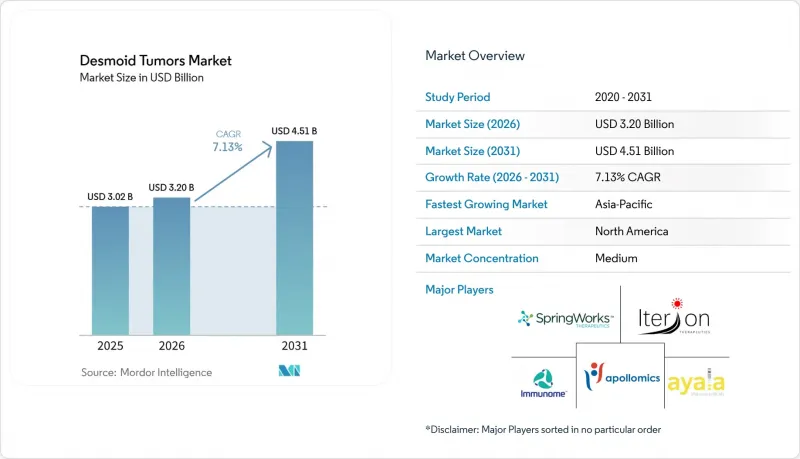
본 보고서는 치료법별(표적 치료, 방사선 치료, 화학 요법 등), 종양의 유형 및 발생 부위별(복벽 데스모이드 종양, 복강 내 데스모이드 종양 등), 최종 사용자별(병원, 전문 클리닉 등), 지역별(북미, 유럽,아시아태평양, 중동 및 아프리카, 남미)로 분류되어 있습니다. 시장 전망은 금액(달러) 기준으로 제시되어 있습니다.
전 세계 데스모이드 종양 시장 동향 및 인사이트
희귀 연조직 종양 진단 건수 증가
진단의 특이도가 향상됨에 따라, 데스모이드 종양 시장에서 환자가 광의의 섬유성 병변이라는 분류에 그치지 않고, 정식 치료 과정에 포함되는 사례가 증가하고 있습니다. 데스모이드 종양 워킹 그룹은 진단 확정 및 치료 방침 결정을 목적으로 생검 검체에 대한 CTNNB1 돌연변이 분석을 정기적으로 실시할 것을 권장하고 있으며, 이 기준은 북미 및 유럽의 주요 암 센터로 확산되고 있습니다. 연조직 종양 클리닉에서 차세대 염기서열 분석 패널의 활용 확대는 실제 발생률에 변화가 없는 경우에도, 과거에는 비특이적 섬유종증으로 분류되었던 사례를 임상의가 식별하는 데 도움이 되고 있습니다. 데스모이드 종양 시장의 경우, 이는 환자 수가 본래 제한적인 희귀질환 분야에서도 진단 대상이 되는 환자층이 확대될 수 있음을 의미합니다.
표적 치료의 임상 파이프라인 확대
2026년 데스모이드 종양 시장에서는 그 어느 때보다 활발한 분자 표적 치료 파이프라인이 형성되고 있습니다. 여기에는 승인된 경구용 감마 세크레타제 억제제 1종, 3상 임상시험 단계에 있는 또 다른 경구용 약물 1종, 그리고 서로 다른 Wnt 및 B-카테닌 표적 접근법을 사용하는 여러 초기 단계 프로그램이 포함됩니다. Immunome사의 보고에 따르면, 3상 RINGSIDE 임상시험에서 varegacestat는 위약군의 9%에 비해 56%의 객관적 반응률을 보였으며, 종양 부피의 중앙값은 83% 감소했습니다. 이러한 결과를 바탕으로 2026년 4월 신약 승인 신청(NDA)이 제출되었으며, 2026년 7월 FDA에 의해 접수 결정이 내려졌습니다. 이러한 결과는 2026년 ASCO 연례 총회에서도 발표되어, 2027년 승인 결정에 앞서 처방 의사들의 인지도를 높이는 계기가 되었습니다. 이 분야에 진출하는 제품이 늘어남에 따라, 데스모이드 종양 시장은 의료진의 관심 증가, 사례 발견의 향상, 그리고 전문 육종 네트워크를 넘어선 광범위한 치료에 대한 논의 활성화로 인해 혜택을 볼 것으로 예측됩니다.
고액의 치료비와 보험 급여 관련 과제
데스모이드 종양 시장에서 고가의 희귀질환 치료제 가격은 특히 희귀질환에 대한 충실한 보험 환급 제도를 갖춘 소수의 국가를 제외하고는 여전히 환자의 접근을 직접적으로 제한하는 요인으로 작용하고 있습니다. 미국에서는 2025년에 시행된 메디케어 파트 D 개혁에 따라 연간 본인 부담 약값 상한선이 2,000달러로 설정되고, 급여 공백이 철폐됨에 따라 고액 치료를 받는 대상 환자의 접근성이 개선되었습니다. 브라질, 걸프 지역 국가들의 의료 제도, 인도 등 많은 성장 시장에서는 이와 같은 지원 체계가 여전히 불충분하거나 아예 존재하지 않아, 그 결과 재정적 여유가 있는 전문 의료 기관과 기타 환자들 사이에 접근성 격차가 발생하고 있습니다. 또한, 전문 약국을 통한 사전 승인은 행정 업무 증가, 수 주에 걸친 심사 기간, 그리고 많은 일반 종양학 진료소가 대응하기를 원치 않는 이의 제기 등을 수반하기 때문에 치료의 보급을 지연시키고 있습니다. 이로 인해 처방전은 소수의 전문센터에 집중된 채로 남아 있으며, 데스모이드 종양 시장이 기존의 의뢰 네트워크를 넘어 확장되는 속도가 제한되고 있습니다.
부문 분석
2025년 데스모이드 종양 시장 규모에서 표적 치료는 41.23%의 점유율을 차지하며, 이 분야에서 승인된 전신 치료 옵션이 없었던 오랜 세월 끝에 주요 치료 범주로 자리 잡았습니다. 니로가세스타트는 여전히 시장의 주축이며, DeFi 3상 임상시험의 4년간 추적 조사 결과, 객관적 반응률은 1년 차 34.3%에서 4년간의 지속 치료 후 45.7%로 상승했으며, 장기간 치료를 완료한 환자에서 종양 크기의 최대 감소율 중앙값은 75.8%였습니다. 또한, 이는 특정 환자에게는 경과 관찰이 여전히 중요함에도 불구하고, 표적 치료가 데스모이드 종양 치료 분야의 대부분에서 표준 치료법으로 자리 잡아가고 있는 이유 중 하나이기도 합니다.
화학요법은 가장 빠르게 성장하는 치료 분야가 될 것으로 예상되며, 이 부문의 데스모이드 종양 시장은 2031년까지 연평균 성장률(CAGR) 8.84%로 확대될 것으로 전망됩니다. 이는 기존의 치료 패턴으로의 회귀를 의미하는 것은 아니지만, 메토트렉세이트와 빈블라스틴의 병용과 같은 메트로노믹 요법이 소아 환자, 의료 자원이 제한된 환경, 그리고 환자가 신약에 대한 접근을 기다리는 기간 동안 여전히 진정한 요구를 충족시키고 있음을 보여줍니다. 방사선 치료, 냉동 절제술, 고주파 절제술 및 색전술은 여전히 광범위한 치료 수단의 일부이며, 이는 데스모이드 종양 시장이 단일 치료 경로 모델이 아닌 다양한 치료 구조를 지속적으로 반영하고 있음을 의미합니다.
지역별 분석
2025년, 북미는 데스모이드 종양 시장의 46.22%를 차지하고 있으며, 미국에서는 이미 전신 요법이 승인되고 전문 약국에 의한 지원 체계도 정비되어 있어, 이 지역은 계속해서 주요 상업 거점으로 자리 잡고 있습니다. 또한, 2026년에는 미국에서 1만 명에서 1만 1,000명의 환자가 적극적인 치료 관리를 받게 될 전망이며, 이 지역은 치료 대상 환자 수가 가장 많고, 희귀암 치료제에 대한 보험 환급 환경도 가장 잘 확립되어 있습니다. 캐나다에서는 여전히 상용화가 더디게 진행되고 있으며, 멕시코에서는 미국에 필적할 만한 희귀질환 보험 환급 제도가 마련되어 있지 않아 경제적 제약에 직면해 있습니다.
2025년, 유럽은 데스모이드 종양 시장에서 여전히 2위 지역 블록이며, 최근 가장 중요한 사건으로는 2025년 8월 유럽 집행위원회가 ‘오구시베오’를 해당 지역에서 최초이자 유일한 승인 치료제로 승인한 것을 꼽을 수 있습니다. 독일은 육종 전문 의료 인프라가 잘 갖춰져 있고, DeFi 개발 프로그램에 참여하는 임상 리더십의 비중도 크기 때문에 조기 보급이 예상됩니다. EU의 HTA(의료기술평가) 프레임워크에 기반한 공동 평가 접근 방식은 각국에서 가격 책정 협의가 시작되는 대로, 회원국 전체에서 희귀암 치료제의 평가를 효율화하는 데 기여할 가능성이 있습니다. 한편, 영국은 MHRA(의약품 및 의료제품 규제청) 및 NICE(국립의료기술평가기구)의 심사를 거치는 독자적인 절차를 밟기 때문에 EU의 승인 경로에 비해 본격적인 상업화까지 소요되는 시간이 더 길어집니다.
아시아태평양은 가장 빠르게 성장하는 지역이 될 것으로 예측되며, 데스모이드 종양 시장은 2031년까지 연평균 성장률(CAGR) 9.44%로 확대될 것으로 전망됩니다. 일본이 두드러지는 이유는 국립암센터가 2025년에 니로가세스타트를 ‘의료적 필요성이 높은 미승인 의약품’으로 등재했기 때문이며, 이는 다른 많은 지역 시장에 비해 규제 경로가 명확함을 시사합니다. 중국에서는 학술적 지식의 축적과 새로운 임상시험 활동(2026년 4월 시작 예정인 ES014 2상 임상시험 등)을 통해 존재감을 높이고 있습니다. 호주, 한국, 인도 역시 종양학 인프라, 희귀질환에 대한 인식, 보험 지원의 개선에 따라 그 중요성이 높아지고 있지만, 해당 지역 시장 침투율은 여전히 북미나 서유럽보다 낮은 수준에서 시작되고 있습니다. 남미, 중동 및 아프리카는 여전히 장기적인 기회를 제공하고 있으며, 걸프 국가들은 병원 투자를 바탕으로, 브라질과 아르헨티나는 공공 의료 제도 및 학술 종양학 센터를 통해 비록 제한적이긴 하지만 기반을 다지고 있습니다.
기타 혜택:
- 엑셀 형식 시장 예측(ME) 시트
- 3개월간의 애널리스트 지원
자주 묻는 질문
목차
제1장 서론
제2장 조사 방법
제3장 개요
제4장 시장 구도
제5장 시장 규모와 성장 예측
제6장 경쟁 구도
제7장 시장 기회와 향후 전망
JHS 26.09.01According to Mordor Intelligence, the desmoid tumors market is projected to be USD 3.02 billion in 2025, USD 3.20 billion in 2026, and reach USD 4.51 billion by 2031, growing at a CAGR of 7.13% from 2026 to 2031.
This report is Segmented by Treatment Type (Targeted Therapy, Radiation Therapy, Chemotherapy, and More), Tumor Type and Location (Abdominal Wall Desmoid Tumors, Intra-Abdominal Desmoid Tumors, and More), End-User (Hospitals, Specialty Clinics, and More), and Geography (North America, Europe, Asia-Pacific, Middle East and Africa, South America). The Market Forecasts are Provided in Terms of Value (USD).
Global Desmoid Tumors Market Trends and Insights
Rising Diagnosis of Rare Soft Tissue Tumors
Improved diagnostic specificity is bringing more patients into formal treatment pathways in the desmoid tumors market, instead of leaving them grouped under broad fibrous lesion labels. The Desmoid Tumour Working Group recommends routine CTNNB1 mutational analysis on biopsy samples to confirm the diagnosis and guide management, and this standard is spreading across major cancer centers in North America and Europe. Wider use of next-generation sequencing panels in soft tissue tumor clinics is also helping clinicians identify cases that were once labeled as nonspecific fibromatoses, even when the true incidence does not change. For the desmoid tumors market, this means the diagnosed pool can expand even in a rare disease setting where patient numbers remain naturally constrained.
Expanding Clinical Pipeline for Targeted Therapies
The desmoid tumors market in 2026 has its most active targeted therapy pipeline so far, with one approved oral gamma secretase inhibitor, a second late-stage oral agent, and several earlier programs using different Wnt and B-catenin approaches. Immunome reported that varegacestat delivered a 56% objective response rate versus 9% for placebo in the Phase 3 RINGSIDE trial, along with a median tumor volume reduction of 83%, which supported the NDA submission in April 2026 and FDA acceptance in July 2026.Those results were also presented at the 2026 ASCO Annual Meeting, which raised prescriber awareness before any approval decision in 2027. As more products enter the field, the desmoid tumors market is likely to gain from higher physician attention, better case finding, and broader treatment discussion beyond specialist sarcoma networks.
High Treatment Cost and Reimbursement Friction
High orphan drug pricing remains a direct limit on patient access in the desmoid tumors market, especially outside the few countries with strong rare disease reimbursement systems. In the United States, Medicare Part D reforms that took effect in 2025 capped annual out-of-pocket drug spending at USD 2,000 and removed the coverage gap, which improved access for eligible patients using high-cost therapies. The same kind of support is still weaker or absent in many growth markets, including Brazil, Gulf healthcare systems, and India, which leaves access divided between well-funded specialist settings and everyone else. Prior authorization through specialty pharmacy channels also slows uptake because it adds paperwork, multi-week review periods, and appeals that many general oncology practices do not want to manage. This keeps prescribing concentrated in a small set of expert centers and limits how fast the desmoid tumors market can widen beyond established referral networks.
Other drivers and restraints analyzed in the detailed report include:
- Broader Use of Oral, Non-Surgical Treatment Pathways
- Genetic Profiling and Mutation-Guided Therapy Selection
- Active Surveillance Reducing Immediate Drug Demand
For complete list of drivers and restraints, kindly check the Table Of Contents.
Segment Analysis
Targeted therapy held 41.23% share of the desmoid tumors market size in 2025, which made it the leading treatment category after years in which the field had no approved systemic option. Nirogacestat remains the commercial anchor, and 4-year follow-up from the DeFi Phase 3 trial showed the objective response rate rising from 34.3% at year 1 to 45.7% after 4 years of continuous treatment, with a median best tumor size reduction of 75.8% among long-term completers. It also helps explain why targeted therapy is becoming the reference standard across much of the desmoid tumors industry, even though watchful waiting still remains important for selected patients.
Chemotherapy is expected to be the fastest-growing treatment category, with the desmoid tumors market for this segment expected to expand at an 8.84% CAGR through 2031. This does not suggest a return to older practice patterns, but it does show that metronomic regimens such as methotrexate plus vinblastine still meet a real need in pediatric cases, lower-resource settings, and periods when patients are waiting for access to newer drugs. Radiation therapy, cryoablation, radiofrequency ablation, and embolization remain part of the broader toolkit, which means the desmoid tumors market continues to reflect a mixed treatment structure rather than a single-pathway model.
Complete Report Scope:
- By Treatment Type
- Targeted Therapy
- Radiation Therapy
- Chemotherapy
- Other Treatment Types
- By Tumor Type and Location
- Abdominal Wall Desmoid Tumors
- Intra-Abdominal Desmoid Tumors
- Extra-Abdominal Desmoid Tumors
- Head and Neck Desmoid Tumors
- Thoracic and Chest Wall Desmoid Tumors
- By End-User
- Hospitals
- Specialty Clinics
- Ambulatory Surgical Centers
- Other End-Users
- By Geography
- North America
- United States
- Canada
- Mexico
- Europe
- Germany
- United Kingdom
- France
- Italy
- Spain
- Rest of Europe
- Asia-Pacific
- China
- Japan
- India
- Australia
- South Korea
- Rest of Asia-Pacific
- Middle East and Africa
- GCC
- South Africa
- Rest of Middle East and Africa
- South America
- Brazil
- Argentina
- Rest of South America
- North America
Geography Analysis
North America held 46.22% of the desmoid tumors market in 2025, and the region remains the main commercial center because the United States already has an approved systemic therapy and a functioning specialty pharmacy support structure. The U.S. also had 10,000 to 11,000 patients under active management in 2026, which gives the region the largest treated patient pool and the most established payer environment for orphan oncology products. Canada still has a slower commercial path while Mexico faces affordability limits because it lacks an orphan reimbursement structure comparable to the United States.
Europe remained the second-largest regional block in the desmoid tumors market in 2025, and the most important recent event was the European Commission approval of Ogsiveo in August 2025 as the first and only approved therapy in the region. Germany looks well placed for early uptake because of its specialist sarcoma infrastructure and the weight of clinical leadership involved in the DeFi development program. The joint assessment approach under the EU HTA framework could help streamline evaluation for orphan oncology products across member states once national pricing discussions begin. The UK remains on a separate track through MHRA and NICE review, which extends the time needed for full commercial rollout compared with the EU approval path.
Asia-Pacific is projected to be the fastest-growing regional area, with the desmoid tumors market expected to rise at a 9.44% CAGR through 2031. Japan stands out because its National Cancer Center listed nirogacestat in 2025 as an unapproved drug with high medical necessity, which points to a clearer regulatory path than many other regional markets. China is building relevance through growing academic experience and new investigational activity, including the April 2026 launch of the ES014 Phase 2 study. Australia, South Korea, and India are also becoming more relevant as oncology infrastructure, rare disease awareness, and insurance support improve, but the region still starts from lower penetration than North America or Western Europe. South America and the Middle East and Africa remain longer-term opportunities, with the Gulf states supported by hospital investment and Brazil and Argentina providing a narrower base through public systems and academic oncology centers.
- Amgen
- Apollomics Inc.
- AstraZeneca
- Ayala Pharmaceuticals, Inc.
- Bayer
- Bristol-Myers Squibb
- Eisai
- Eli Lilly and Company
- Immunome, Inc.
- Ipsen
- Iterion Therapeutics, Inc.
- Johnson & Johnson
- Merck
- Novartis
- Parabilis Medicines
- Pfizer
- PRISM BioLab Co., Ltd.
- Roche
- SpringWorks Therapeutics, Inc.
- Takeda Pharmaceuticals
Additional Benefits:
- The market estimate (ME) sheet in Excel format
- 3 months of analyst support
TABLE OF CONTENTS
1 Introduction
- 1.1 Study Assumptions and Market Definition
- 1.2 Scope of the Study
2 Research Methodology
3 Executive Summary
4 Market Landscape
- 4.1 Market Overview
- 4.2 Market Drivers
- 4.2.1 Rising Diagnosis of Rare Soft Tissue Tumors
- 4.2.2 Expanding Clinical Pipeline for Targeted Therapies
- 4.2.3 Broader Use of Oral, Non-Surgical Treatment Pathways
- 4.2.4 Genetic Profiling and Mutation-Guided Therapy Selection
- 4.2.5 Rare Disease Registries Improving Case Identification and Referral
- 4.2.6 Expanded Payer Acceptance for Orphan-Drug Innovation
- 4.3 Market Restraints
- 4.3.1 Limited Number of Approved Therapies
- 4.3.2 High Treatment Cost and Reimbursement Friction
- 4.3.3 Active Surveillance Reducing Immediate Drug Demand
- 4.3.4 Clinical Heterogeneity and Small Patient Pool
- 4.4 Supply/Value Chain Analysis
- 4.5 Regulatory Landscape
- 4.6 Technological Outlook
- 4.7 Porter's Five Forces Analysis
- 4.7.1 Threat of New Entrants
- 4.7.2 Bargaining Power of Suppliers
- 4.7.3 Bargaining Power of Buyers
- 4.7.4 Threat of Substitutes
- 4.7.5 Competitive Rivalry
5 Market Size & Growth Forecasts (Value, USD)
- 5.1 By Treatment Type
- 5.1.1 Targeted Therapy
- 5.1.2 Radiation Therapy
- 5.1.3 Chemotherapy
- 5.1.4 Other Treatment Types
- 5.2 By Tumor Type and Location
- 5.2.1 Abdominal Wall Desmoid Tumors
- 5.2.2 Intra-Abdominal Desmoid Tumors
- 5.2.3 Extra-Abdominal Desmoid Tumors
- 5.2.4 Head and Neck Desmoid Tumors
- 5.2.5 Thoracic and Chest Wall Desmoid Tumors
- 5.3 By End-User
- 5.3.1 Hospitals
- 5.3.2 Specialty Clinics
- 5.3.3 Ambulatory Surgical Centers
- 5.3.4 Other End-Users
- 5.4 By Geography
- 5.4.1 North America
- 5.4.1.1 United States
- 5.4.1.2 Canada
- 5.4.1.3 Mexico
- 5.4.2 Europe
- 5.4.2.1 Germany
- 5.4.2.2 United Kingdom
- 5.4.2.3 France
- 5.4.2.4 Italy
- 5.4.2.5 Spain
- 5.4.2.6 Rest of Europe
- 5.4.3 Asia-Pacific
- 5.4.3.1 China
- 5.4.3.2 Japan
- 5.4.3.3 India
- 5.4.3.4 Australia
- 5.4.3.5 South Korea
- 5.4.3.6 Rest of Asia-Pacific
- 5.4.4 Middle East and Africa
- 5.4.4.1 GCC
- 5.4.4.2 South Africa
- 5.4.4.3 Rest of Middle East and Africa
- 5.4.5 South America
- 5.4.5.1 Brazil
- 5.4.5.2 Argentina
- 5.4.5.3 Rest of South America
- 5.4.1 North America
6 Competitive Landscape
- 6.1 Market Concentration
- 6.2 Market Share Analysis
- 6.3 Company Profiles (includes Global level Overview, Market level overview, Core Segments, Financials as available, Strategic Information, Market Rank/Share for key companies, Products & Services, Recent Developments)
- 6.3.1 Amgen Inc.
- 6.3.2 Apollomics Inc.
- 6.3.3 AstraZeneca PLC
- 6.3.4 Ayala Pharmaceuticals, Inc.
- 6.3.5 Bayer AG
- 6.3.6 Bristol-Myers Squibb Company
- 6.3.7 Eisai Co., Ltd.
- 6.3.8 Eli Lilly and Company
- 6.3.9 Immunome, Inc.
- 6.3.10 Ipsen S.A.
- 6.3.11 Iterion Therapeutics, Inc.
- 6.3.12 Johnson and Johnson
- 6.3.13 Merck KGaA
- 6.3.14 Novartis AG
- 6.3.15 Parabilis Medicines
- 6.3.16 Pfizer Inc.
- 6.3.17 PRISM BioLab Co., Ltd.
- 6.3.18 Roche Holding AG
- 6.3.19 SpringWorks Therapeutics, Inc.
- 6.3.20 Takeda Pharmaceutical Company Limited
7 Market Opportunities & Future Outlook
- 7.1 White-space & Unmet-need Assessment