

|
시장보고서
상품코드
2117523
컨텐츠 배포 시장 : 점유율 분석, 업계 동향과 통계, 성장 예측(2026-2031년)Content Distribution - Market Share Analysis, Industry Trends & Statistics, Growth Forecasts (2026 - 2031) |
||||||
 Mordor Intelligence
Mordor Intelligence에 의하면, 컨텐츠 배포 시장 규모는 2025년에 1,132억 5,000만 달러, 2026년에 1,223억 8,000만 달러가 되고, 2031년까지 1,694억 1,000만 달러에 이를 것으로 예측되며, 2026년부터 2031년까지 CAGR 6.72%로 성장할 전망입니다.
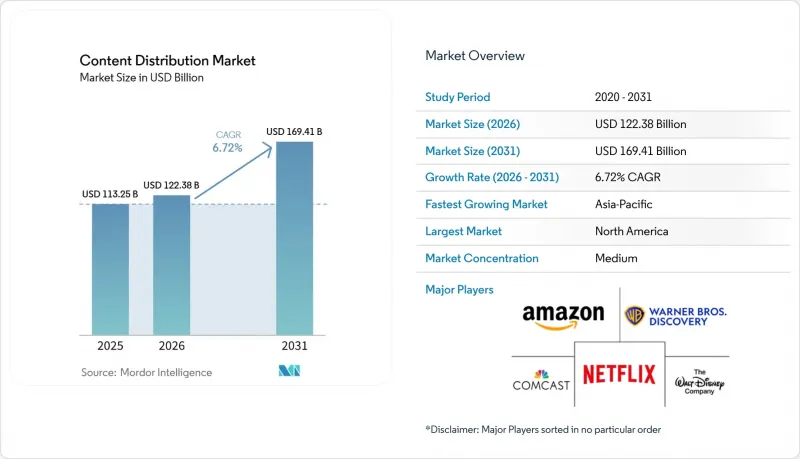
본 보고서는 컨텐츠 유형(동영상 컨텐츠, 오디오 컨텐츠, 텍스트 및 이미지 컨텐츠 등), 배포 채널(스트리밍 플랫폼, 통신 사업자, 소셜 미디어 및 디지털 플랫폼 등), 라이선싱 형태(독점 라이선스, 비독점 라이선스, 파트너십 라이선스, 수익 분배형 라이선스 등), 그리고 지역별로 분류되어 있습니다. 시장 전망은 금액(달러) 기준으로 제시되어 있습니다.
세계 컨텐츠 배포 시장 동향 및 인사이트
OTT 및 CTV에서의 컨텐츠 수익화 확대
광고 수익형 스트리밍 및 커넥티드 TV는 컨텐츠 배포 시장 내 투자 우선순위를 변화시키고 있습니다. 이는 배포 사업자가 컨텐츠를 평가할 때 표면적인 도달 범위뿐만 아니라 시청자로부터의 수익성(오디언스 일드)을 동등하게 중시하게 되었기 때문입니다. 2026년 4월 The CW Network와 Roku가 체결한 제휴는 이러한 변화를 명확히 보여줍니다. CW의 엔터테인먼트 프로그램을 다음 날 스트리밍으로 시청할 수 있게 됨에 따라, The Roku Channel을 통해 해당 네트워크의 도달 범위는 미국 광대역 가구의 절반 이상으로 확대될 것입니다. Amagi는 2026년 FAST(광고 포함 스트리밍) 시청률이 21% 상승했다고 보고했는데, 이는 반복적으로 광고 슬롯을 송출할 수 있는 카탈로그 동영상 및 정시 스트리밍 환경에서의 수익화 강화를 뒷받침합니다. 이러한 변화로 인해 프리미엄 라이브 컨텐츠, 라이브러리 자산, 그리고 폭넓은 카탈로그에 대한 접근 가치가 높아지고 있습니다. 왜냐하면 동일한 타이틀이 구독, AVOD, FAST 각 창구에서 수익을 창출할 수 있게 되었기 때문입니다. 따라서 컨텐츠 배포 시장에서는 광고 슬롯 규모, 플랫폼 도달 범위, 시청자 데이터를 단일 상업 플랫폼에 통합할 수 있는 사업자가 높이 평가받고 있습니다.
다중 플랫폼에서의 권리 패키지화 가속화
영화, TV, 디지털 스트리밍 채널에 걸친 권리 패키징으로 인해 컨텐츠 배포 시장의 기존 순차적 윈도우 모델이 점차 단축되고 있습니다. 넷플릭스가 2026년 1월 소니 픽처스 엔터테인먼트와 체결한 전 세계적인 ‘Pay-1’ 계약은 전 세계적인 도달 범위를 가진 배급사가 극장 개봉 작품에 대한 프리미엄 및 다년간의 접근권을 확보하고, 시장을 가로질러 개봉 시기에 대한 관리권을 확대할 수 있음을 보여주었습니다. 권리가 스트리밍, 방송, 광고 포함 채널을 동시에 아우르면서, 배급사는 지역, 포맷, 시기 조건 측면에서 더 큰 중복에 직면하고 있습니다. Vubiquity가 2025년 9월에 발표한 ‘Catalog Intelligence’ 업데이트는 권리 데이터, 자산 가용성 및 타이틀 메타데이터를 단일 인터페이스에서 연동함으로써 이러한 요구에 부응하고, 스튜디오와 컨텐츠 소유자가 배포 준비 상태를 더 신속하게 확인할 수 있도록 했습니다. 권리 승인을 신속하게 처리할 수 있는 사업자는 상업적 공개 기간을 확대하고 카탈로그 자산을 더 효율적으로 수익화할 수 있으므로, 컨텐츠 배포 시장은 이러한 변화로부터 혜택을 받고 있습니다.
구독 피로와 플랫폼의 세분화
구독자 피로감으로 인해 컨텐츠 배포 시장의 가격 결정력이 약화되고 있습니다. 이는 각 가구가 현재 유료 및 광고 포함 시청 옵션에 대한 폭넓은 선택지에 직면해 있기 때문입니다. 2025년 12월 넷플릭스가 워너 브라더스 디스커버리를 인수하기로 합의한 것은 단일 서비스가 장기적으로 시청자를 유지하기 위해 더욱 노력하는 가운데 규모, 라이브러리의 풍부함, 그리고 프리미엄 지적 재산권이 점점 더 중요해지고 있음을 보여줍니다. 2026년 1월 넷플릭스와 소니 픽처스 엔터테인먼트 간의 합의 역시 이러한 압력을 반영하고 있으며, 여전히 독점적인 영화 스트리밍 기간(윈도우)이 시청자 유지율 향상과 플랫폼 위상 강화를 위해 활용되고 있습니다. 2026년 6월 폭스(Fox)의 로쿠(Roku) 인수 합의 역시, 스트리밍 사업자들이 수익 확보를 위해 단순한 가입자 수 증가뿐만 아니라 플랫폼의 도달 범위와 시청자 데이터에 대한 의존도를 높이고 있음을 보여줍니다. 이러한 추세에 따라 컨텐츠 스트리밍 시장은 좁은 범위의 단독 서비스가 아닌, 번들형 요금제, 광고 포함 요금제, 그리고 보다 광범위한 플랫폼 생태계로 앞으로도 발전해 나갈 것입니다.
부문 분석
2025년, 동영상 컨텐츠는 컨텐츠 스트리밍 시장 점유율의 65.54%를 차지하며, 수익화, 권리 협상 및 프리미엄 재고 계획의 중심축으로 자리매김했습니다. 라이브 이벤트, 프리미엄 시리즈, 그리고 폭넓은 카탈로그 라이브러리는 높은 재사용 가치를 지니며, 구독 및 광고 지원 스트리밍의 각 창구를 통해 수익화할 수 있기 때문에 동영상은 많은 스트리밍 사업자에게 여전히 가장 매력적인 포맷입니다. Amagi에 따르면, 2026년에는 FAST(Free Ad-Supported Streaming) 시청 건수가 21% 증가하여, 일정 기반 스트리밍 환경에서 카탈로그 동영상의 수익화 전망이 개선되었습니다. 이로 인해 오리지널 제작 비용이 높은 수준을 유지하고 있는 상황에서 플랫폼이 기존 자산으로부터 보다 안정적인 수익을 필요로 하는 가운데, 오래된 라이브러리도 상업적으로 계속해서 의미를 갖게 될 것입니다.
오디오는 출퇴근이나 운동, 기타 배경 활동 중에 감상할 수 있다는 점에서 동영상과 달리 컨텐츠 배포 시장에서 독자적인 기회를 제공합니다. Luminate의 보고서에 따르면, 2026년 상반기 전 세계 온디맨드 오디오 스트리밍은 9.8% 증가했으며, 미국을 제외한 지역의 온디맨드 음악 스트리밍은 11.8% 증가했습니다. 이러한 성장률을 통해 컨텐츠 배포 업계의 오디오 분야에는 음악, 팟캐스트, 내레이션 형식 등을 통해 추가적인 수익 창출의 여지가 남아 있음을 시사합니다. 또한, 텍스트 및 이미지 형식도 뉴스 배포, 스포츠 데이터, 전자책 배포 분야에서 지속적인 가치를 유지하고 있으며, 이러한 분야에서는 프리미엄 동영상의 입찰 주기에 비해 라이선싱 구조가 일반적으로 안정적입니다.
지역별 분석
2025년, 북미는 전 세계 컨텐츠 배포 시장의 38.61%를 차지하며 가장 큰 수익 기반을 가진 지역이 되었습니다. 이 지역은 대형 스튜디오의 소유, 높은 스트리밍 보급률, 그리고 가장 잘 갖춰진 커넥티드 TV 광고 생태계를 모두 갖추고 있어 여전히 중심적인 지위를 유지하고 있습니다. 2025년 12월, 넷플릭스가 기업 가치 827억 달러에 워너 브라더스 디스커버리를 인수하기로 합의한 것은 규모, 프리미엄 IP, 그리고 직접 배포가 점점 더 소수의 기업로 집중되고 있음을 보여줍니다. 또한, 미국은 클라우드 네이티브 방송 전송의 주요 시험장으로 계속 자리 잡고 있으며, 2025년 로이터와 AWS가 수상 경력에 빛나는 TAMS 기반 파이프라인을 시연한 것이 그 좋은 예입니다. 캐나다와 멕시코는 이 지역의 전체적인 그림에 깊이를 더하고 있습니다. 언어 요건, 현지 컨텐츠에 대한 수요, 그리고 광대역 환경의 개선이 컨텐츠 배포 시장 전체에 대한 투자를 지속적으로 뒷받침하고 있기 때문입니다.
아시아태평양은 2031년까지 연평균 성장률(CAGR) 8.12%를 나타낼 것으로 예측되며, 컨텐츠 배포 시장에서 가장 빠르게 확장되는 지역 부문이 될 것입니다. 이러한 성장은 인도의 DTC(Direct-to-Consumer) 스트리밍 확대, 중국의 국내 플랫폼에 대한 투자, 그리고 한국의 수출 주도형 컨텐츠 공급 체제에 의해 뒷받침되고 있습니다. 인도 정보방송부에 따르면, 2025년 공동 조사에서 동영상 불법 복제로 인한 당해 연도 수익 손실이 12억 달러, 즉 합법 동영상 부문의 10%에 달할 것으로 추정되어, 라이선스에 기반한 수익화가 아직 미흡한 상황에서도 수요가 증가하고 있음을 보여주었습니다. 아시아 영상 산업 협회(AVIA)는 불법 복제가 현지 언어 프로그램의 제작 자금원이 되는 수익을 약화시키기 때문에 컨텐츠 보호가 이제 플랫폼의 경제 구조에서 핵심을 이루고 있다고 밝혔습니다. 또한, 한국의 웹툰 및 드라마 수출도 지역 내 권리 체계를 확대하고 있으며, 이는 컨텐츠 배포 시장 전체에서 독점 계약과 수익 분배 모델 모두를 뒷받침하고 있습니다.
유럽의 컨텐츠 배포 시장은 더욱 성숙한 양상을 띠고 있으며, 기존 유료 TV로부터의 압박은 광고 수익형 스트리밍 및 세계 플랫폼에 대한 라이선싱을 통해 일부 상쇄되고 있습니다. VAUNET은 2026년 5월, 2025년에 독일에서 불법 TV 생중계가 총 24억 유로(26억 달러)의 경제적 손실을 초래했다고 보고했습니다. 여기에는 미디어 플레이어의 직접 손실 15억 유로(16억 3,000만 달러)가 포함되어 있으며, 이는 불법 복제가 여전히 라이선스 유통의 경제성을 왜곡하고 있는 실태를 보여줍니다. 남미에서는 브라질과 아르헨티나에서 ‘모바일 퍼스트’형 스트리밍이 보급되면서 시장이 확대되고 있지만, 불법 복제 문제로 인해 이 지역 일부에서는 여전히 충분한 수익을 확보하지 못하고 있습니다. 중동 및 아프리카는 여전히 초기 단계 시장이지만, 사우디아라비아의 미디어 규제 완화, 아랍에미리트의 선진적인 디지털 인프라, 그리고 나이지리아의 크리에이터 경제 확대로 인해 컨텐츠 배포 시장 전망 기회가 점차 확대되고 있습니다.
기타 혜택:
- 엑셀 형식 시장 예측(ME) 시트
- 3개월간의 애널리스트 지원
자주 묻는 질문
목차
제1장 서론
제2장 조사 방법
제3장 개요
제4장 시장 구도
제5장 시장 규모와 성장 예측
제6장 경쟁 구도
제7장 시장 기회와 향후 전망
JHS 26.09.01According to Mordor Intelligence, the content distribution market size is projected to be USD 113.25 billion in 2025, USD 122.38 billion in 2026, and reach USD 169.41 billion by 2031, growing at a CAGR of 6.72% from 2026 to 2031.
This report is Segmented by Content Type (Video Content, Audio Content, Text and Image Content, and More), Distribution Channel (Streaming Platforms, Telecom Operators, Social Media and Digital Platforms, and More), Licensing (Exclusive Licensing, Non-Exclusive Licensing, Partnership Licensing, Revenue-Sharing Licensing, and More), and Geography. The Market Forecasts are Provided in Terms of Value (USD).
Global Content Distribution Market Trends and Insights
Rising OTT and CTV Content Monetization
Ad-supported streaming and connected TV are changing investment priorities in the content distribution market because distributors now evaluate content by audience yield as much as by headline reach. The April 2026 partnership between The CW Network and Roku clearly showed this shift, as next-day streaming access to CW entertainment programming will extend the network's reach to more than half of U.S. broadband households through The Roku Channel. Amagi reported in 2026 that FAST viewing rose 21%, which supports stronger monetization for catalog video and scheduled streaming environments that can carry repeatable ad inventory. This shift is increasing the value of premium live content, library assets, and broad catalog access, as the same title can now earn across subscription, AVOD, and FAST windows. The content distribution market is, therefore, rewarding operators that can connect inventory scale, platform reach, and audience data into a single commercial stack.
Accelerating Multi-Platform Rights Packaging
Rights packaging across film, television, and digital outlets is shortening the older sequential windowing model in the content distribution market. Netflix's January 2026 global Pay-1 agreement with Sony Pictures Entertainment demonstrated how distributors with worldwide reach can secure premium, multi-year access to theatrical titles and expand control over release timing across markets. As rights move across streaming, broadcast, and ad-supported channels simultaneously, distributors face greater overlap in territorial, format, and timing conditions. Vubiquity's September 2025 Catalog Intelligence update addressed this need by linking rights data, asset availability, and title metadata in a single interface, enabling studios and content owners to validate distribution readiness more quickly. The content distribution market benefits from this shift because operators that clear rights more quickly can expand commercial windows and monetize catalog assets more efficiently.
Subscription Fatigue and Platform Fragmentation
Subscriber fatigue is reducing pricing power in the content distribution market because households now face a wide set of paid and ad-supported viewing options. Netflix's December 2025 agreement to acquire Warner Bros. Discovery showed how scale, library depth, and premium intellectual property are becoming more important as standalone services work harder to retain viewers over longer periods. The January 2026 Netflix and Sony Pictures Entertainment agreement reflected the same pressure, as exclusive film windows are still being used to improve retention and support stronger platform positioning. Fox's June 2026 agreement to acquire Roku also showed that distributors are increasingly relying on platform reach and audience data, rather than subscription growth alone, to protect monetization. This restraint is likely to keep pushing the content distribution market toward bundles, ad-supported tiers, and broader platform ecosystems rather than narrow, standalone offers.
Other drivers and restraints analyzed in the detailed report include:
- Cloud-Native Distribution Workflow Adoption
- AI-Assisted Localization and Versioning
- Rights Clearance Complexity Across Territories
For complete list of drivers and restraints, kindly check the Table Of Contents.
Segment Analysis
Video held 65.54% of the content distribution market share in 2025, which kept it at the center of monetization, rights negotiation, and premium inventory planning. Video remains the most attractive format for many distributors because live events, premium series, and broad catalog libraries can be monetized across subscription and ad-supported windows with strong reuse value. Amagi said FAST viewing rose 21% in 2026, improving the monetization outlook for catalog video across scheduled streaming environments. This keeps older libraries commercially relevant at a time when original production costs remain high, and platforms need steadier returns from existing assets.
Audio presents a different opportunity in the content distribution market because listening fits commuting, exercise, and other background moments that video does not. Luminate reported that global on-demand audio streams grew 9.8% in the first half of 2026, while ex-U.S. on-demand audio song streams increased 11.8%. That pace suggests the audio layer of the content distribution industry still has room for broader monetization through music, podcasts, and spoken-word formats. Text-and-image formats also retain durable value in news syndication, sports data, and e-book delivery, where licensing structures are usually more stable than premium video bidding cycles.
Complete Report Scope:
- By Content Type
- Video Content
- Audio Content
- Text and Image Content
- Other Content Types
- By Distribution Channel
- Streaming Platforms
- Broadcaster and Cable Networks
- Telecom Operators
- Social Media and Digital Platforms
- Other Distribution Channels
- By Licensing
- Exclusive Licensing
- Non-Exclusive Licensing
- Partnership Licensing
- Revenue-Sharing Licensing
- Other Licensings
- By Geography
- North America
- United States
- Canada
- Mexico
- South America
- Brazil
- Argentina
- Chile
- Rest of South America
- Europe
- Germany
- United Kingdom
- France
- Italy
- Spain
- Rest of Europe
- Asia-Pacific
- China
- Japan
- India
- South Korea
- Australia
- Rest of Asia-Pacific
- Middle East
- Saudi Arabia
- United Arab Emirates
- Qatar
- Rest of Middle East
- Africa
- South Africa
- Egypt
- Nigeria
- Rest of Africa
- North America
Geography Analysis
North America accounted for 38.61% of the global content distribution market in 2025, making it the region with the largest revenue base. The region remains central because it combines major studio ownership, high streaming penetration, and the deepest connected TV advertising ecosystem. Netflix's December 2025 agreement to acquire Warner Bros. Discovery at an enterprise value of USD 82.7 billion showed how scale, premium IP, and direct distribution are being drawn into fewer hands. The United States also remains a major testing ground for cloud-native broadcast delivery, as Reuters and AWS demonstrated with their award-winning TAMS-based pipeline in 2025. Canada and Mexico add depth to the regional picture, as language requirements, local content needs, and improvements in broadband continue to support investment across the content distribution market.
Asia-Pacific is projected to grow at an 8.12% CAGR through 2031, making it the fastest-expanding regional segment in the content distribution market. Growth is being supported by India's expansion of direct-to-consumer streaming, China's domestic platform investment, and South Korea's export-led content pipeline. India's Ministry of Information and Broadcasting said a 2025 joint study estimated current-year revenue losses of USD 1.2 billion from video piracy, or 10% of the legal video sector, which showed that demand is rising even where licensed monetization still leaks. The Asia Video Industry Association said content protection is now central to platform economics because piracy weakens the revenue needed to fund local-language programming. South Korea's webtoon and drama exports are also widening the regional rights universe, which supports both exclusive and revenue-sharing structures across the content distribution market.
Europe presents a more mature profile in the content distribution market, with legacy pay-TV pressure partly offset by ad-supported streaming and licensing to global platforms. VAUNET reported in May 2026 that illegal live TV streaming caused total economic losses of EUR 2.4 billion (USD 2.6 billion) in Germany in 2025, including direct media company losses of EUR 1.5 billion (USD 1.63 billion), which shows how piracy still distorts licensed distribution economics. South America is expanding through mobile-first streaming adoption in Brazil and Argentina, although piracy still limits full revenue capture across parts of the region. Middle East and Africa remain earlier-stage markets, yet media liberalization in Saudi Arabia, advanced digital infrastructure in the United Arab Emirates, and a larger creator economy in Nigeria are widening future opportunities in the content distribution market.
- Amazon.com, Inc.
- The Walt Disney Company
- Netflix, Inc.
- Warner Bros. Discovery, Inc.
- Comcast Corporation
- Paramount Global
- Roku, Inc.
- Apple Inc.
- Alphabet Inc.
- Akamai Technologies, Inc.
- Kaltura, Inc.
- Brightcove Inc.
- Vimeo, Inc.
- Bitmovin Inc.
- Muvi LLC
- Amagi Media Labs Pvt. Ltd.
Additional Benefits:
- The market estimate (ME) sheet in Excel format
- 3 months of analyst support
TABLE OF CONTENTS
1 INTRODUCTION
- 1.1 Study Assumptions and Market Definition
- 1.2 Scope of The Study
2 RESEARCH METHODOLOGY
3 EXECUTIVE SUMMARY
4 MARKET LANDSCAPE
- 4.1 Market Overview
- 4.2 Market Drivers
- 4.2.1 Rising OTT and CTV Content Monetization
- 4.2.2 Accelerating Multi-Platform Rights Packaging
- 4.2.3 Cloud-Native Distribution Workflow Adoption
- 4.2.4 AI-Assisted Localization and Versioning
- 4.2.5 First-Party Audience Data Demand from Advertisers
- 4.2.6 Live and Near-Live Content Expansion
- 4.3 Market Restraints
- 4.3.1 Subscription Fatigue and Platform Fragmentation
- 4.3.2 Rights Clearance Complexity Across Territories
- 4.3.3 Piracy and Unauthorized Re-Distribution Leakage
- 4.3.4 Rising Content Delivery and Cloud Egress Costs
- 4.4 Industry Value Chain Analysis
- 4.5 Regulatory Landscape
- 4.6 Technological Outlook
- 4.7 Porter's Five Forces Analysis
- 4.7.1 Bargaining Power of Buyers
- 4.7.2 Bargaining Power of Suppliers
- 4.7.3 Threat of New Entrants
- 4.7.4 Threat of Substitutes
- 4.7.5 Intensity of Competitive Rivalry
- 4.8 Impact of Macroeconomic Factors on the Market
5 MARKET SIZE AND GROWTH FORECASTS (VALUE)
- 5.1 By Content Type
- 5.1.1 Video Content
- 5.1.2 Audio Content
- 5.1.3 Text and Image Content
- 5.1.4 Other Content Types
- 5.2 By Distribution Channel
- 5.2.1 Streaming Platforms
- 5.2.2 Broadcaster and Cable Networks
- 5.2.3 Telecom Operators
- 5.2.4 Social Media and Digital Platforms
- 5.2.5 Other Distribution Channels
- 5.3 By Licensing
- 5.3.1 Exclusive Licensing
- 5.3.2 Non-Exclusive Licensing
- 5.3.3 Partnership Licensing
- 5.3.4 Revenue-Sharing Licensing
- 5.3.5 Other Licensings
- 5.4 By Geography
- 5.4.1 North America
- 5.4.1.1 United States
- 5.4.1.2 Canada
- 5.4.1.3 Mexico
- 5.4.2 South America
- 5.4.2.1 Brazil
- 5.4.2.2 Argentina
- 5.4.2.3 Chile
- 5.4.2.4 Rest of South America
- 5.4.3 Europe
- 5.4.3.1 Germany
- 5.4.3.2 United Kingdom
- 5.4.3.3 France
- 5.4.3.4 Italy
- 5.4.3.5 Spain
- 5.4.3.6 Rest of Europe
- 5.4.4 Asia-Pacific
- 5.4.4.1 China
- 5.4.4.2 Japan
- 5.4.4.3 India
- 5.4.4.4 South Korea
- 5.4.4.5 Australia
- 5.4.4.6 Rest of Asia-Pacific
- 5.4.5 Middle East
- 5.4.5.1 Saudi Arabia
- 5.4.5.2 United Arab Emirates
- 5.4.5.3 Qatar
- 5.4.5.4 Rest of Middle East
- 5.4.6 Africa
- 5.4.6.1 South Africa
- 5.4.6.2 Egypt
- 5.4.6.3 Nigeria
- 5.4.6.4 Rest of Africa
- 5.4.1 North America
6 COMPETITIVE LANDSCAPE
- 6.1 Market Concentration
- 6.2 Strategic Moves
- 6.3 Vendor Positioning Analysis
- 6.4 Company Profiles (includes Global Level Overview, Market Level Overview, Core Segments, Financials as available, Strategic Information, Market Rank/Share, Products and Services, Recent Developments)
- 6.4.1 Amazon.com, Inc.
- 6.4.2 The Walt Disney Company
- 6.4.3 Netflix, Inc.
- 6.4.4 Warner Bros. Discovery, Inc.
- 6.4.5 Comcast Corporation
- 6.4.6 Paramount Global
- 6.4.7 Roku, Inc.
- 6.4.8 Apple Inc.
- 6.4.9 Alphabet Inc.
- 6.4.10 Akamai Technologies, Inc.
- 6.4.11 Kaltura, Inc.
- 6.4.12 Brightcove Inc.
- 6.4.13 Vimeo, Inc.
- 6.4.14 Bitmovin Inc.
- 6.4.15 Muvi LLC
- 6.4.16 Amagi Media Labs Pvt. Ltd.
7 MARKET OPPORTUNITIES AND FUTURE OUTLOOK
- 7.1 White-Space and Unmet-Need Assessment


