|
시장보고서
상품코드
2117531
에이전트형 AI 워크플로 오케스트레이션 플랫폼 시장 : 점유율 분석, 업계 동향과 통계, 성장 예측(2026-2031년)Agentic AI Workflow Orchestration Platform - Market Share Analysis, Industry Trends & Statistics, Growth Forecasts (2026 - 2031) |
||||||
 Mordor Intelligence
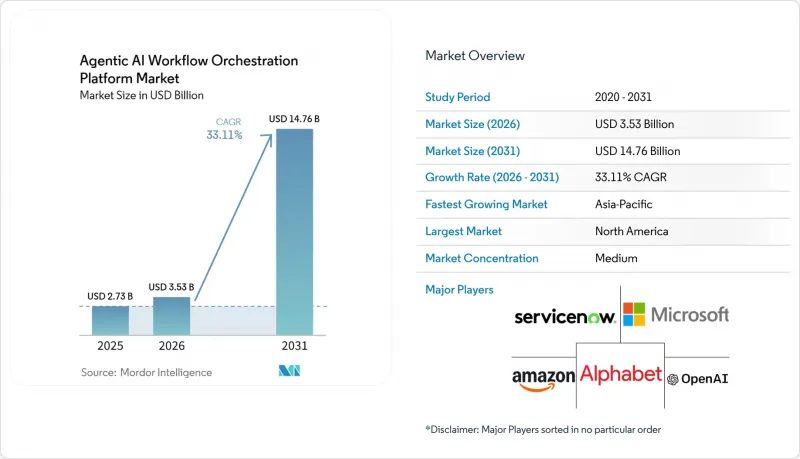
Mordor Intelligence에 의하면, 에이전트형 AI 워크플로 오케스트레이션 플랫폼 시장 규모는 2025년 27억 3,000만 달러에서 2026년에는 35억 3,000만 달러로 확대되어 2026년부터 2031년까지 CAGR 33.11%로 성장을 지속하여, 2031년에는 147억 6,000만 달러에 이를 것으로 예측됩니다.
본 보고서는 구성 요소별(가시성, 테스트 및 거버넌스 플랫폼, 에이전트 개발 및 런타임 프레임워크 등), 도입 형태별(클라우드 기반, 하이브리드, On-Premise), 기업 규모별(대기업, 중소기업),최종 사용자별(은행, 금융서비스 및 보험(BFSI), 에너지·유틸리티 등), 지역별로 분류되어 있습니다. 시장 예측은 금액(달러) 기준으로 제시되어 있습니다.
세계 에이전트형 AI 워크플로 오케스트레이션 플랫폼 시장 동향 및 인사이트
핵심 비즈니스 워크플로 전반에 걸친 다중 에이전트형 작업 자동화에 대한 기업 수요
에이전트형 AI 워크플로 오케스트레이션 플랫폼 시장의 주요 수요 신호는 단일 목적의 어시스턴트에서 엔드투엔드 비즈니스 프로세스를 완료할 수 있는 협업형 시스템으로의 전환입니다. 기업들은 더 이상 고립된 팀의 생산성 향상만을 목적으로 이러한 도구를 시범적으로 도입하는 것이 아닙니다. 도입을 수익, 비용 관리, 서비스 속도 및 프로세스 품질과 연계하고 있습니다. 이러한 변화가 중요한 이유는 가동 중인 비즈니스 시스템 전반에 걸쳐 여러 에이전트, 도구 및 승인 단계가 순차적으로 작동해야 할 때 오케스트레이션의 가치가 높아지기 때문입니다. 또한 벤더는 신뢰성, 롤백 로직, 그리고 작업이 자동화 단계와 수동 단계 사이를 어떻게 전환되는지를 명확하게 제어할 수 있도록 지원해야 하므로, 구매자의 기대도 변화하고 있습니다. 특정 모델 제공업체가 전체 스택을 정의하기를 기다리는 조직은 모든 워크플로에 적합하지 않은 좁은 런타임에 업무를 얽매이게 될 위험이 있습니다. 따라서 기업이 장기적으로 여러 모델과 비즈니스 기능을 지원할 수 있는 중립적인 조정 계층을 추구함에 따라, 에이전트형 AI 워크플로 오케스트레이션 플랫폼 시장은 탄력을 받고 있습니다.
감사 추적 및 인적 승인 게이트를 갖춘 거버넌스 지원 오케스트레이션에 대한 수요 증가
거버넌스는 에이전트형 AI 워크플로 오케스트레이션 플랫폼 시장의 주요 구매 요인으로 부상하고 있습니다. 이는 기업이 에이전트가 무엇을 수행했는지, 왜 그러한 행동을 취했는지, 그리고 어디에서 사람이 작업을 승인하거나 중지했는지에 대한 명확한 기록을 필요로 하기 때문입니다. 규제 대상 부문의 구매 담당자들은 이벤트 로그, 승인 규칙,및 제어 로직과 실행 로직의 분리를 더욱 중시하고 있습니다. 2026년에 발표된 동료 심사 연구에 따르면, 거버넌스 주도형 아키텍처는 감사 가능하고 재현 가능한 의사결정 파이프라인을 구축할 수 있으며, 수동 검토만 하는 경우보다 기업에 더 견고한 규정 준수 체계를 제공한다는 사실이 밝혀졌습니다. 이로 인해 조달 동향이 재편되고 있습니다. 거버넌스를 내장된 설계 계층으로 다루는 플랫폼이, 사후 맞춤화를 통해 제어 기능을 추가하는 도구를 점차 대체하고 있기 때문입니다. 또한 많은 조직이 현재 모든 지역 및 사업 부문에 걸쳐 일관된 내부 통제 프레임워크를 요구하고 있어, 수요는 유럽 이외의 지역으로도 확대되고 있습니다. 그 결과, 에이전트형 AI 워크플로 오케스트레이션 플랫폼 시장은 워크플로, 모델, 자율적인 액션이 추가될 때마다 거버넌스도 그에 따라 확장되어야 한다는 단순한 사실로부터 혜택을 보고 있습니다.
레거시 용도과 데이터 사일로를 아우르는 고도의 통합 복잡성
실제 비즈니스 환경에는 레거시 용도, 분산된 데이터, 문서화되지 않은 운영 로직이 넘쳐나기 때문에 레거시 시스템과의 통합은 여전히 에이전트형 AI 워크플로 오케스트레이션 플랫폼 시장에 있어 가장 큰 구조적 장벽으로 남아 있습니다. 에이전트가 공유 자동화나 실시간 컨텍스트 교환을 전제로 설계되지 않은 시스템 간에 읽기 및 쓰기 작업을 수행해야 하는 경우, 오케스트레이션은 더욱 어려워집니다. 문제는 기술적인 접근성뿐만이 아닙니다. 에이전트가 숨겨진 규칙, 서비스 트리거 또는 하류 종속성을 이해하지 못하는 경우, 많은 실패가 비즈니스 로직의 오류로 나타납니다. 그 결과, 도입 비용이 증가하고 구현 일정이 장기화되며, 성숙한 통합 팀과 견고한 내부 거버넌스를 갖춘 조직으로만 도입이 제한됩니다. 또한 미들웨어와 변환 계층의 중요성이 높아지지만, 이를 추가하면 새로운 프로젝트 작업과 유지보수 부담이 발생합니다. 에이전트형 AI 워크플로 오케스트레이션 플랫폼 시장은 성장을 이어갈 것이지만, 기업이 여전히 레거시 시스템에 크게 의존하고 있는 상황에서는 이러한 통합의 부담이 더 광범위한 확장을 계속 지연시킬 것입니다.
부문 분석
2025년, 에이전트형 AI 워크플로 오케스트레이션 시장에서 에이전트 오케스트레이션 플랫폼은 42.31%를 차지했습니다. 이는 비즈니스 의도를 에이전트, 도구, 엔터프라이즈 시스템에 걸친 일련의 액션으로 변환하는 핵심 계층으로서의 역할을 반영합니다. 이 부문이 주도적인 위치를 차지하는 이유는 연결된 모든 액션, 승인 단계 및 워크플로 규칙이 시간이 지남에 따라 플랫폼에 대한 의존도를 높이는 경향이 있기 때문입니다. 실제로 기업이 더 중요한 업무를 오케스트레이션 계층을 통해 처리하게 되면, 해당 제어 지점에 커넥터, 정책,워크플로 로직이 축적되기 때문에 타사 제품으로의 전환이 어려워집니다. Salesforce는 2026년에 ‘Agent Network’를 정식 출시함으로써 이러한 방향으로 나아가고 있으며, 이는 주요 소프트웨어 벤더들이 오케스트레이션을 기업 환경 외부에 두기보다는 보다 광범위한 기업 환경 내에 위치시키고자 한다는 점을 시사합니다. 이러한 추세는 에이전트형 AI 워크플로 오케스트레이션 플랫폼 업계를 뒷받침하는 요인입니다. 기존 플랫폼은 이미 고객의 신뢰, ID 관리, 그리고 일상적인 워크플로에 대한 직접적인 접근 권한을 확보하고 있기 때문입니다.
가시성, 테스트, 거버넌스 플랫폼은 2031년까지 연평균 성장률(CAGR) 36.84%를 나타낼 것으로 예측되며, 에이전트형 AI 워크플로 오케스트레이션 플랫폼 시장에서 가장 빠르게 성장하는 분야가 될 것입니다. 그 이유는 간단명료합니다. 부서를 넘나들며 배포가 확대됨에 따라, 다수의 에이전트 군에 의한 리플레이, 추적성, 정책 적용 및 장애 분석에 대한 수요가 높아지고 있기 때문입니다. 에이전트형 AI 워크플로 오케스트레이션 플랫폼 업계의 이 분야는 핵심 시장보다 더 빠르게 확대되고 있습니다. 이는 기업들이 파일럿 단계에서 운영 환경으로의 전환을 추진하고 있어, 모니터링을 더 이상 선택 사항으로만 취급할 수 없게 되었기 때문입니다. 에이전트 개발 및 런타임 프레임워크는 실험 비용을 절감하고 팀이 새로운 에이전트 흐름을 신속하게 프로토타이핑할 수 있도록 지원하기 때문에 여전히 중요합니다. 또한, 특히 사내에 고도의 AI 엔지니어링 역량이 부족하여 오케스트레이션을 가동 중인 시스템에 통합하는 데 지원이 필요한 조직의 경우, 전문 서비스 및 관리형 서비스도 계속해서 중요한 역할을 하고 있습니다.
2025년, 에이전트형 AI 워크플로 오케스트레이션 플랫폼 시장 규모 중 클라우드 기반 도입이 74.18%의 점유율을 차지하고 있으며, 초기 및 현재 배포에서 클라우드가 명백한 기본값이 되고 있습니다. 이 모델이 보급된 이유는 기업이 기존 클라우드 파트너십을 활용하여 신속하게 도입을 시작할 수 있고, 매니지드 런타임에 의존함으로써 사내 설정 작업을 줄일 수 있기 때문입니다. 또한, 최첨단 모델에 대한 손쉬운 접근, 소프트웨어 업데이트 가속화, 초기 도입 시 운영 복잡성 감소를 원하는 조직에도 적합합니다. 많은 구매자가 여전히 인프라에 대한 세부적인 제어보다 도입 속도를 우선시하고 있기 때문에 에이전트형 AI 워크플로 오케스트레이션 플랫폼 시장에서 클라우드 부문은 계속해서 견조한 모습을 보이고 있습니다. 이러한 이점은 데이터의 위치가 주요 설계 제약 사항이 아닌 경우나, 기업 팀이 이미 하이퍼스케일러 환경에서 주요 워크로드를 실행하고 있는 경우에 특히 두드러집니다.
하이브리드 배포는 2031년까지 연평균 성장률(CAGR) 35.49%로 확대될 것으로 예상되며, 이로 인해 에이전트형 AI 워크플로 오케스트레이션 플랫폼 시장에서 가장 빠르게 성장하는 배포 형태가 되고 있습니다. 규제 대상 산업이 이러한 변화를 주도하고 있습니다. 이러한 산업에서는 필요에 따라 고급 클라우드 모델을 활용하면서도 오케스트레이션 런타임과 기밀 데이터를 사내 인프라에 가까운 곳에 유지하고자 하기 때문입니다. UiPath는 2026년 6월, 에이전트형 AI 도입을 위한 On-Premise 중심의 ‘Automation Suite’ 접근 방식을 통해 이러한 수요에 대응했습니다. 기업들이 여러 비즈니스 환경에 걸친 거버넌스, 데이터 관리, 모델 접근성 사이에서 실용적인 균형을 모색함에 따라 하이브리드 아키텍처의 중요성은 점점 더 커지고 있습니다. 국방, 국가 안보 및 기타 엄격하게 관리되는 환경에서는 완전한 On-Premise 도입이 여전히 중요하지만, 가장 강력한 성장세를 보이고 있는 것은 내부 관리와 선택적 클라우드 연결을 결합한 설계로의 전환입니다.
지역별 분석
북미는 2025년 에이전트형 AI 워크플로 오케스트레이션 플랫폼 시장 점유율의 36.73%를 차지하며 선두 자리를 유지했습니다. 이 지역은 주요 플랫폼 공급업체가 집중되어 있고, 하이퍼스케일러에 의한 강력한 유통망, 그리고 생성형 AI 시범 프로젝트를 보다 광범위한 본가동 프로그램으로 전환하고 있는 기업 기반이 큰 강점으로 작용하고 있습니다. 또한, 북미에서는 구매자들이 오케스트레이션을 고객의 업무, 사내 서비스 흐름 및 IT 환경과 직접 연동하는 데 적극적인 태도를 보이고 있어, 에이전트형 AI 워크플로 오케스트레이션 플랫폼 시장이 더욱 빠르게 성숙하고 있습니다. 도입이 진행됨에 따라 대규모 기업 환경 전반에 걸쳐 더욱 강력한 ID 관리, 보다 견고한 워크플로, 그리고 내장형 거버넌스에 대한 수요가 증가하고 있습니다.
유럽은 규정 준수 아키텍처가 구매 결정의 핵심 요소로 부상하고 있어, 에이전트 기반 AI 워크플로 오케스트레이션 플랫폼에 있어 여전히 중요한 시장으로 남아 있습니다. 기업들이 에이전트 기반 운영을 확대하기 전에 로깅, 인적 감독 및 워크플로의 설명 책임에 더 중점을 두게 됨에 따라, 거버넌스에 중점을 둔 조달 활동이 강화되고 있습니다. 이러한 환경에서는 맞춤형 애드온이 아닌, 플랫폼 내에서 명확한 정책 제어와 강력한 감사 기능을 입증할 수 있는 벤더가 유리합니다. IBM은 ‘Think 2026’에서 다양한 소스에 기인한 모든 에이전트에 걸쳐 정책을 적용하는 다중 에이전트 시대의 제어 평면인 ‘watsonx Orchestrate’를 발표하며 이러한 입지를 강화했습니다.
에이전트형 AI 워크플로 오케스트레이션 플랫폼 시장에서 아시아태평양은 2031년까지 38.41%라는 가장 높은 연평균 성장률(CAGR)을 나타낼 전망입니다. 기업의 현대화 프로그램, 정부 주도의 AI 역량 구축, 그리고 해당 지역의 복잡한 운영 환경 전반에 걸친 오케스트레이션 도입을 위한 강력한 추진력이 이러한 성장을 뒷받침하고 있습니다. 일본에서는 데이터 관리에 대한 수요가 높아지고 있어, On-Premise 환경과 호환되는 오케스트레이션을 지원할 수 있는 아키텍처에 대한 수요가 계속해서 중요시되고 있습니다. 세존 테크놀로지는 2026년 6월, 전사적인 안전한 AI 에이전트 관리를 실현하기 위해 자사의 HULFT Square iPaaS 환경 내에 ‘Agent Orchestration’을 도입한다고 발표하며 이러한 지역적 동향을 반영했습니다. 남미, 중동 및 아프리카는 에이전트형 AI 워크플로 오케스트레이션 플랫폼 시장에서 여전히 초기 단계에 있는 지역이지만, 디지털 전환(DX) 프로그램과 각국이 주도하는 AI 이니셔티브를 통해 보다 명확한 장기적 기회 기반이 구축되고 있습니다.
기타 혜택:
- 엑셀 형식 시장 예측(ME) 시트
- 3개월간의 애널리스트 지원
자주 묻는 질문
목차
제1장 서론
제2장 조사 방법
제3장 개요
제4장 시장 구도
제5장 시장 규모와 성장 예측
제6장 경쟁 구도
제7장 시장 기회와 향후 전망
JHS 26.09.01According to Mordor Intelligence, the agentic AI workflow orchestration platform market size is expected to grow from USD 2.73 billion in 2025 to USD 3.53 billion in 2026 and is forecast to reach USD 14.76 billion by 2031 at 33.11% CAGR over 2026-2031.
This report is Segmented by Component (Observability, Testing and Governance Platforms, Agent Development and Runtime Frameworks, and More), Deployment (Cloud-Based, Hybrid, and On-Premises), Enterprise Size (Large Enterprises, and Small and Medium Enterprises), End User (BFSI, Energy and Utilities, and More), and Geography. The Market Forecasts are Provided in Terms of Value (USD).
Global Agentic AI Workflow Orchestration Platform Market Trends and Insights
Enterprise Demand for Multi-Agent Task Automation Across Core Business Workflows
The main demand signal in the agentic AI workflow orchestration platform market is the shift from single-purpose assistants to coordinated systems capable of completing end-to-end business processes. Enterprises are no longer testing these tools solely for productivity gains in isolated teams; they are linking deployments to revenue, cost control, service speed, and process quality. This shift matters because orchestration becomes more valuable when several agents, tools, and approval steps must work in sequence across live business systems. It also changes buyer expectations, since vendors must support reliability, rollback logic, and clear control over how tasks move between automated and human stages. Organizations that wait for one preferred model provider to define the whole stack risk locking their operations into a narrow runtime that does not fit every workflow. The agentic AI workflow orchestration platform market is therefore gaining traction as enterprises look for a neutral coordination layer that can support multiple models and business functions over time.
Rising Need for Governance-Ready Orchestration With Audit Trails and Human Approval Gates
Governance has become a core buying factor in the agentic AI workflow orchestration platform market because enterprises need clear records of what agents did, why they acted, and where a person approved or stopped a task. Buyers in regulated sectors are placing greater weight on event logging, approval rules, and the separation of control logic from execution logic. A 2026 peer-reviewed study found that governance-driven architectures can create auditable, reproducible decision pipelines, giving enterprises a stronger compliance position than manual review alone. This is reshaping procurement because platforms that treat governance as a built-in design layer are displacing tools that add controls later through custom work. It also widens demand beyond Europe, since many organizations now want a consistent internal control framework across all regions and business lines. As a result, the agentic AI workflow orchestration platform market is benefiting from the simple fact that governance needs to scale upward with every added workflow, model, and autonomous action.
High Integration Complexity Across Legacy Applications and Data Silos
Legacy integration remains the largest structural brake on the agentic AI workflow orchestration platform market, as real business environments are full of legacy applications, scattered data, and undocumented operating logic. Orchestration becomes harder when agents must read and write across systems that were never designed for shared automation or real-time context exchange. The problem is not only technical access; many failures appear as business logic mistakes when an agent does not understand hidden rules, service triggers, or downstream dependencies. That raises deployment costs, stretches implementation timelines, and narrows adoption to organizations with mature integration teams and strong internal governance. It also makes middleware and translation layers more important, even though those additions create new project work and new maintenance points. The agentic AI workflow orchestration platform market will keep growing, but this integration burden will continue to delay broader rollout, where enterprises still depend heavily on legacy estates.
Other drivers and restraints analyzed in the detailed report include:
- Growing Integration of Agentic Orchestration Into Existing SaaS and Cloud Ecosystems
- Expansion of Model Context Protocol and Tool-Calling Standards Accelerating Interoperability
- Immature Observability, Testing, and Debugging for Multi-Agent Workflows
For complete list of drivers and restraints, kindly check the Table Of Contents.
Segment Analysis
Agent orchestration platforms accounted for 42.31% of the agentic AI workflow orchestration market in 2025, reflecting their role as the central layer that turns business intent into sequenced actions across agents, tools, and enterprise systems. This segment leads because every connected action, approval step, and workflow rule tends to deepen platform dependence over time. In practice, once enterprises route more critical work through the orchestration layer, switching becomes more difficult because connectors, policies, and workflow logic accumulate at that control point. Salesforce moved in this direction by making Agent Network generally available in 2026, signaling that large software vendors want orchestration to sit within broader enterprise environments rather than outside them. That pattern supports the agentic AI workflow orchestration platform industry because incumbent platforms already hold customer trust, identity controls, and direct access to day-to-day workflows.
Observability, testing, and governance platforms are projected to grow at a 36.84% CAGR through 2031, making them the fastest-rising component of the agentic AI workflow orchestration platform market. The reason is straightforward: fleets of agents create a greater need for replay, traceability, policy enforcement, and failure analysis as deployments scale across departments. This part of the agentic AI workflow orchestration platform industry is expanding faster than the core market because enterprises are moving from pilots into production and can no longer treat monitoring as optional. Agent development and runtime frameworks remain important because they lower the cost of experimentation and help teams prototype new agent flows quickly. Professional and managed services also remain relevant, especially for organizations that lack deep in-house AI engineering capacity and need help integrating orchestration into live systems.
Cloud-based deployments held a 74.18% share of the agentic AI workflow orchestration platform market size in 2025, making cloud the clear default for early and current rollout. This model gained ground because enterprises could get started faster within existing cloud relationships and rely on managed runtimes to reduce internal setup work. It also suits organizations that want easier access to frontier models, faster software updates, and lower operational complexity during initial deployment. The cloud segment remains strong in the agentic AI workflow orchestration platform market because many buyers still prioritize implementation speed over deep infrastructure control. That advantage is especially evident when data residency is not the primary design constraint and when enterprise teams already run key workloads in hyperscaler environments.
Hybrid deployments are projected to expand at a 35.49% CAGR through 2031, which makes them the fastest-growing deployment path in the agentic AI workflow orchestration platform market. Regulated sectors are driving this shift because they want to keep orchestration runtimes and sensitive data closer to internal infrastructure while still using advanced cloud models where needed. UiPath addressed this demand in June 2026 through its on-premises-oriented Automation Suite approach for agentic AI deployments. Hybrid architecture is becoming increasingly important as enterprises seek a practical balance between governance, data control, and model access across multiple business environments. Fully on-premises deployments still matter in defense, national security, and other tightly controlled settings, but the strongest forward momentum is shifting toward designs that combine internal control with selective cloud connectivity.
Complete Report Scope:
- By Component
- Agent Orchestration Platforms
- Agent Development and Runtime Frameworks
- Observability, Testing and Governance Platforms
- Professional and Managed Services
- By Deployment
- Cloud-Based
- Hybrid
- On-Premises
- By Enterprise Size
- Large Enterprises
- Small and Medium Enterprises
- By End User
- IT and Telecommunication
- BFSI
- Healthcare and Life Sciences
- Retail and E-Commerce
- Industrial Manufacturing
- Education and Research Institutions
- Media and Entertainment
- Government and administration
- Energy and Utilities
- Other end-user industries
- By Geography
- North America
- United States
- Canada
- Mexico
- South America
- Brazil
- Argentina
- Rest of South America
- Europe
- Germany
- United Kingdom
- France
- Russia
- Spain
- Rest of Europe
- Asia-Pacific
- China
- Japan
- India
- South Korea
- Southeast Asia
- Rest of Asia-Pacific
- Middle East and Africa
- Middle East
- Saudi Arabia
- United Arab Emirates
- Rest of Middle East
- Africa
- South Africa
- Nigeria
- Rest of Africa
- Middle East
- North America
Geography Analysis
North America held 36.73% of the agentic AI workflow orchestration platform market share in 2025, maintaining its leading position. The region benefits from the concentration of major platform vendors, strong hyperscaler distribution, and a large base of enterprises that are moving generative AI pilots into broader production programs. The agentic AI workflow orchestration platform market is also maturing faster in North America because buyers there are more willing to connect orchestration directly to customer operations, internal service flows, and IT environments. As deployments deepen, demand is shifting toward stronger identity controls, more durable workflows, and built-in governance across large enterprise estates.
Europe remained a critical market for the agentic AI workflow orchestration platform, as compliance architecture is becoming central to buying decisions. Governance-focused procurement is strengthening as enterprises place greater emphasis on logging, human oversight, and workflow accountability before they scale agent-based operations. This environment favors vendors that can demonstrate clear policy controls and strong audit capabilities within the platform rather than through custom add-ons. IBM reinforced that positioning at Think 2026 by presenting watsonx Orchestrate as a control plane for the multi-agent era with policy enforcement across agents from different sources.
Asia-Pacific is projected to record the fastest CAGR at 38.41% through 2031 in the agentic AI workflow orchestration platform market. Enterprise modernization programs are supporting growth, government-backed AI capacity-building, and a strong push to apply orchestration across the region's complex operational settings. Japan remains important because data control needs are strengthening demand for architectures that can support on-premises-compatible orchestration. Saison Technology reflected that regional direction in June 2026 when it announced Agent Orchestration within its HULFT Square iPaaS environment for secure enterprise-wide AI agent management. South America, the Middle East, and Africa are still earlier-stage regions in the agentic AI workflow orchestration platform market, but digital transformation programs and sovereign AI efforts are beginning to build a clearer long-term opportunity base.
- OpenAI, Inc.
- Microsoft Corporation
- Alphabet Inc.
- Amazon.com, Inc.
- Salesforce, Inc.
- ServiceNow, Inc.
- UiPath, Inc.
- Automation Anywhere, Inc.
- Workato, Inc.
- Pega Systems Inc.
- IBM Corporation
- Oracle Corporation
- SAP SE
- Boomi, L.P.
- LangChain, Inc.
- Anthropic PBC
- Cohere Inc.
- NVIDIA Corporation
- Celonis SE
- Palantir Technologies Inc.
Additional Benefits:
- The market estimate (ME) sheet in Excel format
- 3 months of analyst support
TABLE OF CONTENTS
1 INTRODUCTION
- 1.1 Study Assumptions and Market Definition
- 1.2 Scope of the Study
2 RESEARCH METHODOLOGY
3 EXECUTIVE SUMMARY
4 MARKET LANDSCAPE
- 4.1 Market Overview
- 4.2 Market Drivers
- 4.2.1 Enterprise Demand for Multi-Agent Task Automation Across Core Business Workflows
- 4.2.2 Rising Need for Governance-Ready Orchestration with Audit Trails and Human Approval Gates
- 4.2.3 Growing Integration of Agentic Orchestration into Existing SaaS and Cloud Ecosystems
- 4.2.4 Expansion of Model Context Protocol and Tool-Calling Standards Accelerating Interoperability
- 4.2.5 Under-Reported Driver, Proprietary Workflow Data Exhaust Improving Agent Planning Quality
- 4.2.6 Under-Reported Driver, Board-Level Pressure to Convert GenAI Proofs Into Measurable Operating Leverage
- 4.3 Market Restraints
- 4.3.1 Immature Observability, Testing, and Debugging For Multi-Agent Workflows
- 4.3.2 Unintended Write-Back Risk in Critical Business Systems
- 4.3.3 High Integration Complexity Across Legacy Applications and Data Silos
- 4.3.4 Under-Reported Restraint, Agent Sprawl Creating Security, Ownership, and Change-Management Friction
- 4.4 Impact of Macroeconomic Factors on the Market
- 4.5 Industry Value-Chain Analysis
- 4.6 Technology Outlook
- 4.7 Regulatory Landscape
- 4.8 Porter's Five Forces Analysis
- 4.8.1 Threat of New Entrants
- 4.8.2 Bargaining Power of Suppliers
- 4.8.3 Bargaining Power of Buyers
- 4.8.4 Threat of Substitutes
- 4.8.5 Intensity of Competitive Rivalry
5 MARKET SIZE AND GROWTH FORECASTS (VALUE)
- 5.1 By Component
- 5.1.1 Agent Orchestration Platforms
- 5.1.2 Agent Development and Runtime Frameworks
- 5.1.3 Observability, Testing and Governance Platforms
- 5.1.4 Professional and Managed Services
- 5.2 By Deployment
- 5.2.1 Cloud-Based
- 5.2.2 Hybrid
- 5.2.3 On-Premises
- 5.3 By Enterprise Size
- 5.3.1 Large Enterprises
- 5.3.2 Small and Medium Enterprises
- 5.4 By End User
- 5.4.1 IT and Telecommunication
- 5.4.2 BFSI
- 5.4.3 Healthcare and Life Sciences
- 5.4.4 Retail and E-Commerce
- 5.4.5 Industrial Manufacturing
- 5.4.6 Education and Research Institutions
- 5.4.7 Media and Entertainment
- 5.4.8 Government and administration
- 5.4.9 Energy and Utilities
- 5.4.10 Other end-user industries
- 5.5 By Geography
- 5.5.1 North America
- 5.5.1.1 United States
- 5.5.1.2 Canada
- 5.5.1.3 Mexico
- 5.5.2 South America
- 5.5.2.1 Brazil
- 5.5.2.2 Argentina
- 5.5.2.3 Rest of South America
- 5.5.3 Europe
- 5.5.3.1 Germany
- 5.5.3.2 United Kingdom
- 5.5.3.3 France
- 5.5.3.4 Russia
- 5.5.3.5 Spain
- 5.5.3.6 Rest of Europe
- 5.5.4 Asia-Pacific
- 5.5.4.1 China
- 5.5.4.2 Japan
- 5.5.4.3 India
- 5.5.4.4 South Korea
- 5.5.4.5 Southeast Asia
- 5.5.4.6 Rest of Asia-Pacific
- 5.5.5 Middle East and Africa
- 5.5.5.1 Middle East
- 5.5.5.1.1 Saudi Arabia
- 5.5.5.1.2 United Arab Emirates
- 5.5.5.1.3 Rest of Middle East
- 5.5.5.2 Africa
- 5.5.5.2.1 South Africa
- 5.5.5.2.2 Nigeria
- 5.5.5.2.3 Rest of Africa
- 5.5.5.1 Middle East
- 5.5.1 North America
6 COMPETITIVE LANDSCAPE
- 6.1 Market Concentration
- 6.2 Strategic Moves
- 6.3 Market Share Analysis
- 6.4 Company Profiles (includes Global Level Overview, Market Level Overview, Core Segments, Financials as available, Strategic Information, Market Rank/Share, Products and Services, Recent Developments)
- 6.4.1 OpenAI, Inc.
- 6.4.2 Microsoft Corporation
- 6.4.3 Alphabet Inc.
- 6.4.4 Amazon.com, Inc.
- 6.4.5 Salesforce, Inc.
- 6.4.6 ServiceNow, Inc.
- 6.4.7 UiPath, Inc.
- 6.4.8 Automation Anywhere, Inc.
- 6.4.9 Workato, Inc.
- 6.4.10 Pega Systems Inc.
- 6.4.11 IBM Corporation
- 6.4.12 Oracle Corporation
- 6.4.13 SAP SE
- 6.4.14 Boomi, L.P.
- 6.4.15 LangChain, Inc.
- 6.4.16 Anthropic PBC
- 6.4.17 Cohere Inc.
- 6.4.18 NVIDIA Corporation
- 6.4.19 Celonis SE
- 6.4.20 Palantir Technologies Inc.
7 MARKET OPPORTUNITIES AND FUTURE OUTLOOK
- 7.1 White-Space and Unmet-Need Assessment