

|
시장보고서
상품코드
2117534
신남알데히드 시장 : 점유율 분석, 업계 동향과 통계, 성장 예측(2026-2031년)Cinnamic Aldehyde - Market Share Analysis, Industry Trends & Statistics, Growth Forecasts (2026 - 2031) |
||||||
 Mordor Intelligence
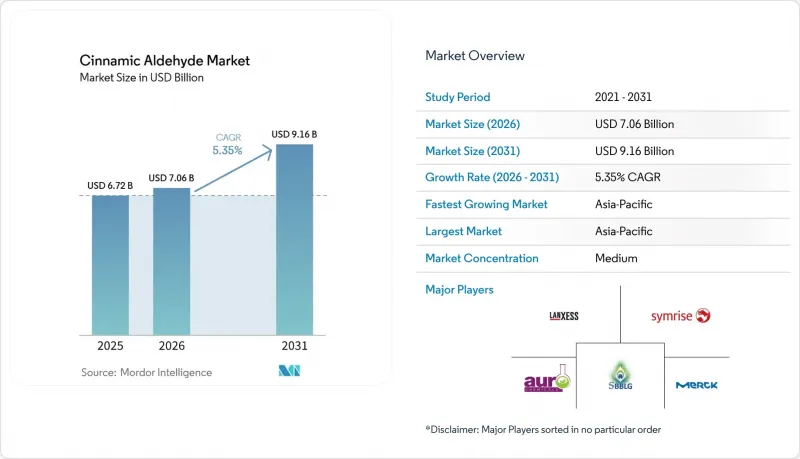
Mordor Intelligence에 의하면, 신남알데히드 시장은 2025년에 67억 2,000만 달러에 이르고, 2026년 70억 6,000만 달러에서 2031년까지 91억 6,000만 달러로 성장한다고 전망되고 있어 2026년부터 2031년까지 CAGR 5.35%를 나타낼 것으로 예측됩니다.
본 보고서는 등급(식품용(FCC), 테크니컬 등급, 기타), 원료 출처(합성, 천연, 바이오 유래, 발효 유래),용도(향미료, 향료 원료 등), 최종 용도(식품 및 음료, 퍼스널케어 및 화장품 등), 지역(아시아태평양, 북미, 유럽, 남미, 중동 및 아프리카)별로 분류되어 있습니다. 시장 전망은 금액(미 달러) 기준으로 제시되어 있습니다.
전 세계 신남알데히드 시장 동향 및 인사이트
향료 및 향기 용도에서의 신남알데히드 수요 증가
트랜스-신남알데히드는 이미 식품 분야에서 중요한 상업적 용도를 가지고 있기 때문에 향미료 및 향료 용도는 시나말데히드 시장의 주요 수요 요인으로 계속 남아 있습니다. MDPI 보고서에 따르면, 식품 용도의 연간 소비량은 180,000kg이며, 이 중 141,000kg은 계피 향신료에서 유래한 것이 아니라 의도적으로 향료로 첨가된 것입니다. 이러한 사용 패턴은 특유의 계피 풍미를 중시하는 제과, 제빵, 츄잉껌, 음료 제조업체로부터의 안정적인 주문을 뒷받침하고 있습니다. 또한, 따뜻하고 매콤한 향은 퍼스널케어 및 가정용 향기 제품에서 널리 사용되고 있기 때문에 이러한 감각적 특성이 향수 수요의 견인차 역할도 하고 있습니다. 식품과 향수 두 분야에 걸쳐 있는 이러한 특성 덕분에 신남알데히드 시장은 단일 최종 용도 범주에 의존하는 원료보다 더 폭넓은 수요 기반을 가지고 있습니다. 또한, 특정 분야의 수주가 주춤할 때에도 다른 분야가 호조를 보임으로써, 신남알데히드 시장은 수요 감소를 상쇄할 수 있습니다.
천연 및 클린 라벨 원료에 대한 소비자의 선호도 증가
추적 가능성이 확보되고, 보다 단순한 원료 시스템으로의 전환에 따라 신남알데히드 시장에서 천연 유래 및 천연 동등(네이처 아이덴티컬) 원료에 대한 관심이 높아지고 있습니다. LANXESS는 순도 97% 이상의 천연 동등 시나말데히드를 생산하고 있으며, ISO 9001:2015, ISO 14001:2015,FSSC 22000 인증은 물론, 할랄 및 코셔 기준 준수도 확보하고 있습니다. 식품, 향료 및 기관용 채널의 구매자들이 품질, 안전성 및 문서화 요건을 동시에 충족하는 공급을 점점 더 요구함에 따라, 이러한 인증들은 중요한 역할을 하고 있습니다. 또한, 천연 동등품공급은 수피 추출 시 발생하는 변동성의 영향을 직접 받지 않으면서 안정적인 관능적 특성을 제공함으로써 실질적인 과제에도 대응하고 있습니다. 천연 유래라는 포지셔닝과 생산의 일관성 사이의 이러한 균형 덕분에 공급업체는 특정 거래처에서 프리미엄 가격을 유지하기가 더 쉬워집니다. 그 결과, 신남알데히드 시장 수요는 공급의 지속성을 해치지 않으면서 클린 라벨 주장을 뒷받침하는 인증된 등급으로 이동하고 있습니다.
천연 계피 유래 원료의 가격 변동과 공급량 제한
천연 신남알데히드 공급은 계피 껍질의 입수 가능성에 의존하고 있으며, 신남알데히드 시장의 일부는 계절적인 수확 주기와 지역별 공급 변동성에 노출되어 있습니다. 껍질에서 추출하는 방식으로는 합성 경로와 같은 연중 안정적인 생산을 기대할 수 없습니다. 인증된 천연 원료에 의존하는 생산자는 껍질의 입수 가능성이 낮아지거나, 경쟁 구매자가 업스트림 수확물의 더 많은 부분을 흡수할 경우 이익률이 압박을 받게 됩니다. 이러한 압박은 식물 유래 여부가 중요하고 대체하기 어려운 프리미엄 향료나 특정 식품 용도에서 더욱 강하게 나타납니다. 또한 이러한 공급 변동으로 인해 구매자는 장기 계약 기간 동안 안정적인 원자재 비용을 확보하기 어려워집니다. 그 결과, 원자재 상황이 핍박하면 신남알데히드 시장에서 천연 등급과 합성 등급 간의 비용 격차가 확대됩니다.
부문 분석
2025년, 식품 등급(FCC)은 시나말데히드 시장 규모의 38.52%를 차지하며, 금액 기준으로 가장 큰 등급 부문이 되었습니다. 이러한 주도적 지위는 일관된 풍미 제공이 여전히 중요시되는 과자, 제과, 츄잉껌, 음료 용도에서 확립된 사용 실적을 반영합니다. 또한, 이 등급은 대규모 식품 제조 프로그램에서 지속적인 구매량과 표준화된 사양이 중시되는 구매 패턴으로부터도 혜택을 받고 있습니다. 식품 및 음료 분야의 방대한 수요 기반 덕분에, 다른 등급이 부상하더라도 이 부문은 계속해서 우위를 유지하고 있습니다. 향수 및 화장품 등급은 프리미엄 향수 및 퍼스널케어 용도에서 여전히 중요한 위치를 차지하고 있으며, 이러한 분야에서는 단순히 수량뿐만 아니라 향프로파일 일관성과 배합 특성이 더욱 중시되고 있습니다.
의약품 등급(USP/EP)은 2031년까지 연평균 성장률(CAGR) 6.18%를 나타낼 것으로 예측되며, 시나말데히드 시장에서 가장 빠르게 성장하는 등급 부문이 될 전망입니다. 이러한 성장은 API 합성, 영양 보충제 시스템, 그리고 대사, 항균, 종양학 분야에서 시나말데히드 유도체에 대한 연구를 지속하고 있는 연구 프로그램에서의 광범위한 활용과 관련이 있습니다. 랑세스(Lanxess)는 신남알데히드 업계의 이 분야에서 요구되는 품질 기준을 충족하며, 이 회사의 천연과 동등한 제품은 규정 준수를 뒷받침하는 식품 안전 및 품질 인증을 획득했습니다. 테크니컬 등급은 의약품 수준의 순도보다 비용 경쟁력이 더 중요시되는 산업용 및 가정용 분야에서 여전히 중요한 위치를 차지하고 있습니다. 그러나 신남알데히드 시장은 고급 부문에서 더욱 엄격한 품질 관리와 더 철저한 문서화로 전환되고 있습니다.
2025년 시점에서 합성 신남알데히드는 신남알데히드 시장 규모의 63.22%를 차지하며, 주요 용도 전반에 걸쳐 명백히 주요 공급원이 되고 있습니다. 이러한 주도적 지위는 신뢰할 수 있는 순도, 농업 주기에 대한 낮은 의존도, 그리고 대규모 식품 및 향료 프로그램에 적합한 비용 구조에서 기인합니다. 또한, 이 제조 경로를 통해 공급업체는 연중 내내 납품이 가능해지며, 이는 연속 생산 일정을 운영하는 구매자에게 매우 중요합니다. 이러한 안정성의 가치는 천연 원료공급 상황이 불확실해질 때 더욱 높아집니다. 천연 신남알데히드는 식물 유래라는 점이 더 높은 판매 가격을 뒷받침하는 프리미엄 향료 용도나 특정 식품 용도에서 여전히 확고한 입지를 유지하고 있습니다.
바이오 및 발효 유래 시나말데히드는 2031년까지 연평균 성장률(CAGR) 7.02%를 나타낼 것으로 예측되며, 시나말데히드 시장에서 가장 빠르게 성장하는 공급원 부문이 될 전망입니다. 발효 방식이 중요시되는 이유는 공급 탄력성을 강화하면서도 특정 규제 환경 하에서 천연 유래라는 위치를 뒷받침할 수 있다는 점에 있습니다. 이에 따라 틈새 시장의 실험적 제조 경로에 그치지 않는 보다 명확한 장기적 역할이 기대되고 있습니다. 그 결과, 시나말데히드 업계는 나무 껍질 유래 천연 등급에 현재 적용되고 있는 프리미엄 가격 구조를 재편할 가능성이 있기 때문에 바이오 유래 공급 상황을 면밀히 주시하고 있습니다.
지역별 분석
2025년 기준, 아시아태평양은 신남알데히드 시장 규모의 41.86%를 차지했으며, 2031년까지 연평균 성장률(CAGR)은 6.08%를 기록했습니다. 이에 따라 이 지역은 신남알데히드 시장에서 가장 크고 가장 빠르게 성장하는 지역으로서의 입지를 확고히 하고 있습니다. 이 지역은 대규모 소비 거점과 견고한 생산 기반을 모두 갖추고 있어 내수 수요와 수출 활동을 뒷받침하고 있습니다. 중국은 여전히 지역 내 공급 및 가공의 중심적인 역할을 수행하고 있는 반면, 인도, 일본, 한국은 식품 제조, 퍼스널케어, 의약품 생산 분야 수요를 주도하고 있습니다. 이러한 지역적 구성 덕분에 아시아태평양은 시장의 일반 상품 부문과 프리미엄 부문 모두에서 규모 면에서 두각을 나타내고 있습니다.
북미는 제과, 제빵 제품, 가정용품, 퍼스널케어 분야의 활발한 움직임에 힘입어 식품 등급 및 향료 등급 원료의 주요 소비 거점으로 자리매김하고 있습니다. 이 지역은 일상 소비재의 여러 카테고리에 걸친 광범위하고 안정적인 수요의 혜택을 받고 있습니다. 유럽은 프리미엄 향료, 향수 및 규제 대상인 퍼스널케어 용도 분야에서 여전히 중요한 위치를 차지하고 있습니다. 그러나 유럽 시장은 현재 더욱 엄격해진 규정 준수 부담에 직면해 있습니다. 이는 유럽연합 집행위원회 규정(EU) 2023/1545에 따라 2026년 7월 31일 이후, 잔류형 제품의 경우 0.001% 이상, 씻어내는 제품의 경우 0.01% 이상의 시나말데히드 표시가 의무화되기 때문입니다. 이러한 요건으로 인해, 특히 프리미엄 화장품 및 향수 분야의 고객에게 제품을 공급하는 공급업체를 중심으로 제형 재검토 및 문서 작성 업무가 증가하고 있습니다.
남미는 여전히 소규모 시장이지만, 브라질과 아르헨티나의 식품 및 음료 용도가 시나말데히드 시장의 꾸준한 확장을 뒷받침하고 있습니다. 이 지역에서는 가공식품에 대한 수요와 퍼스널케어 제품 및 가정용품 제조에 시나말데히드가 사용되는 것이 호재로 작용하고 있습니다. 중동 및 아프리카 역시 식품 향료, 퍼스널케어, 향기 용도로 사용되는 합성 등급 원료의 수입 시장으로 성장하고 있습니다. 중동의 일부 지역에서는 할랄 인증 준수가 여전히 중요한 구매 요인으로 작용하고 있으며, LANXESS는 인증된 제품 프로파일을 통해 이러한 요구 사항을 직접 충족하고 있습니다. 두 지역 모두에서 수요 증가는 최첨단 연구라기보다는 포장 식품 및 일상적인 퍼스널케어 제품의 소비 증가에 의해 주도되고 있습니다.
기타 혜택:
- 엑셀 형식 시장 예측(ME) 시트
- 3개월간의 애널리스트 지원
자주 묻는 질문
목차
제1장 서론
제2장 조사 방법
제3장 개요
제4장 시장 구도
제5장 시장 규모와 성장 예측
제6장 경쟁 구도
제7장 시장 기회와 향후 전망
JHS 26.09.01According to Mordor Intelligence, the cinnamic aldehyde market reached USD 6.72 billion in 2025, and is expected to grow from USD 7.06 billion in 2026 to USD 9.16 billion by 2031, and is expected to grow at a CAGR of 5.35% from 2026 to 2031.
This report is Segmented by Grade (Food (FCC), Technical Grade, and More), Source (Synthetic, Natural, Bio-Based and Fermentation-Derived), Application (Flavoring Agent, Fragrance Ingredient, and More), End-Use (Food & Beverage, Personal Care & Cosmetics, and More), and Geography (Asia-Pacific, North America, Europe, South America, Middle East and Africa). The Market Forecasts are Provided in Terms of Value (USD).
Global Cinnamic Aldehyde Market Trends and Insights
Rising Demand for Cinnamic Aldehyde in Flavor and Fragrance Applications
Flavor and fragrance applications remain the primary demand driver for the cinnamic aldehyde market, as trans-cinnamaldehyde already has meaningful commercial use in food systems. MDPI reported annual consumption of 180,000 kg in food applications, including 141,000 kg deliberately added as a flavoring agent rather than derived from cinnamon spice. This usage pattern supports steady orders from confectionery, bakery, chewing gum, and beverage manufacturers that rely on a recognizable cinnamon profile. The same sensory profile also drives fragrance demand, as warm and spicy notes remain widely used in personal care and household scent systems. This overlap between food and fragrance channels gives the cinnamic aldehyde market a broader demand base than ingredients that depend on a single end-use category. It also helps the cinnamic aldehyde market offset slower ordering in one channel when another remains active.
Growing Consumer Preference for Natural and Clean-Label Ingredients
The shift toward traceable and simpler ingredient systems is increasing interest in both natural and nature-identical materials in the cinnamic aldehyde market. LANXESS produces nature-identical cinnamic aldehyde with a minimum purity of 97% and supports it with ISO 9001:2015, ISO 14001:2015, and FSSC 22000 certifications, along with halal and kosher compliance. These certifications matter as buyers in food, fragrance, and institutional channels increasingly seek supply that meets quality, safety, and documentation requirements simultaneously. Nature-identical supply also addresses a practical issue by offering stable sensory performance without direct exposure to variability in bark extraction. This balance between natural positioning and production consistency helps suppliers defend premium pricing in selected accounts. As a result, demand in the cinnamic aldehyde market is shifting toward verified grades that support clean-label claims without compromising supply continuity.
Price Volatility and Limited Availability of Natural Cinnamon-Derived Feedstocks
Natural cinnamaldehyde supply depends on cinnamon bark availability, exposing part of the cinnamic aldehyde market to seasonal harvesting cycles and uneven regional supply. Bark extraction does not provide the same year-round production stability as synthetic routes. Producers that rely on certified natural raw materials face tighter margins when bark availability declines or competing buyers absorb more of the upstream crop. This pressure is stronger in premium fragrances and selected food applications, where botanical origin matters and substitution is less immediate. These supply swings also make it harder for buyers to secure stable input costs over longer contract periods. As a result, the cinnamic aldehyde market shows a wider cost gap between natural and synthetic grades when raw material conditions tighten.
Other drivers and restraints analyzed in the detailed report include:
- Increasing Adoption in Oral Care, Personal Care, and Cosmetic Formulations
- Expanding Use of Multifunctional Antimicrobial and Preservative Ingredients
- Stringent Regulatory Requirements for Product Safety and Allergen Labeling
For complete list of drivers and restraints, kindly check the Table Of Contents.
Segment Analysis
Food Grade (FCC) held a market share of 38.52% of the cinnamic aldehyde market size in 2025, making it the largest grade segment by value. Its leadership reflects its well-established use in confectionery, bakery, chewing gum, and beverage applications, where consistent flavor delivery remains critical. This grade also benefits from purchasing patterns that favor repeat volumes and standardized specifications across large food manufacturing programs. The scale of the food and beverage demand base keeps this segment ahead, even as other grades gain traction. Perfumery and cosmetic grade remains important in premium fragrance and personal care applications, where odor profile consistency and formulation behavior carry more weight than volume alone.
Pharmaceutical Grade (USP/EP) is projected to register a 6.18% CAGR through 2031, making it the fastest-growing grade segment in the cinnamic aldehyde market. This growth is tied to broader use in API synthesis, nutraceutical systems, and research programs that continue to explore cinnamaldehyde derivatives in metabolic, antimicrobial, and oncology contexts. LANXESS illustrates the quality standards required in this part of the cinnamic aldehyde industry, as its nature-identical offering carries food safety and quality certifications that support regulated procurement. Technical grade remains relevant in industrial and household applications, where cost competitiveness matters more than pharmaceutical purity. Even so, the cinnamic aldehyde market is moving toward tighter quality control and stronger documentation at the premium end.
Synthetic cinnamaldehyde accounted for 63.22% of the cinnamic aldehyde market size in 2025, making it the clear volume anchor across major applications. Its leadership stems from dependable purity, lower exposure to agricultural cycles, and a cost structure suited to large-scale food and fragrance programs. This production route also enables suppliers to offer year-round delivery, which is critical for buyers operating continuous manufacturing schedules. The value of this stability increases further when natural feedstock conditions become uncertain. Natural cinnamaldehyde continues to hold a position in premium fragrance applications and selected food uses, where botanical origin can support a higher selling price.
Bio-based and fermentation-derived cinnamaldehyde is projected to grow at a CAGR of 7.02% through 2031, making it the fastest-growing source segment in the cinnamic aldehyde market. Fermentation is important because it can strengthen supply resilience while supporting natural positioning in certain regulatory settings. This gives it a clearer long-term role beyond a niche experimental route. As a result, the cinnamic aldehyde industry is closely monitoring bio-based supply, as it could reshape the premium currently associated with bark-derived natural grades.
Complete Report Scope:
- By Grade
- Food Grade (FCC)
- Technical Grade
- Pharmaceutical Grade (USP/EP)
- Perfumery & Cosmetic Grade
- By Source
- Synthetic
- Natural
- Bio-Based and Fermentation-Derived
- By Application
- Flavoring Agent
- Fragrance Ingredient
- Antimicrobial & Preservative
- Pharmaceutical Intermediate
- Chemical Intermediate
- Other Applications
- End-use Industry
- Food & Beverage
- Personal Care & Cosmetics
- Household Care
- Oral Care
- Pharmaceuticals & Healthcare
- Industrial
- By Geography
- Asia-Pacific
- China
- India
- Japan
- South Korea
- Rest of Asia-Pacific
- North America
- United States
- Canada
- Mexico
- Europe
- Germany
- United Kingdom
- France
- Italy
- Russia
- Rest of Europe
- South America
- Brazil
- Argentina
- Rest of South America
- Middle-East and Africa
- Saudi Arabia
- South Africa
- Rest of Middle-East and Africa
- Asia-Pacific
Geography Analysis
Asia Pacific accounted for 41.86% of the cinnamic aldehyde market size in 2025 and registered a CAGR of 6.08% through 2031. This positions the region as both the largest and fastest-growing geography in the cinnamic aldehyde market. The region combines large consumption centers with a strong production base, supporting domestic use and export activity. China remains central to regional supply and processing, while India, Japan, and South Korea drive demand from food manufacturing, personal care, and pharmaceutical production. This regional mix gives Asia Pacific scale across both the commodity and premium segments of the market.
North America remains a major consumption center for food-grade and fragrance-grade material, supported by strong activity in confectionery, baked goods, household products, and personal care. The region benefits from broad and stable demand across several everyday consumer categories. Europe remains important for premium fragrance, perfumery, and regulated personal care applications. However, the European market now faces a tighter compliance burden, as Commission Regulation (EU) 2023/1545 requires the declaration of cinnamaldehyde above 0.001% in leave-on products and 0.01% in rinse-off products from July 31, 2026. This requirement is increasing reformulation and documentation work, especially for suppliers serving premium cosmetic and fragrance accounts.
South America remains a smaller market, but food and beverage applications in Brazil and Argentina are supporting steady expansion in the cinnamic aldehyde market. The region benefits from demand for processed foods and the use of cinnamic aldehyde in personal care and household product manufacturing. The Middle East and Africa are also growing import markets for synthetic-grade material used in food flavoring, personal care, and scent applications. Halal compliance remains a notable buying factor in parts of the Middle East, and LANXESS directly addresses this requirement through its certified product profile. Across both regions, demand growth is driven less by frontier research and more by rising consumption of packaged foods and routine personal care products.
- LANXESS
- Privi Speciality Chemicals Limited
- Aadhunik Industries
- Advanced Biotech
- AUROCHEMICALS
- Axxence Aromatic GmbH
- Hindustan Mint & Agro Products Pvt. Ltd.
- Kao Corporation
- Merck KGaA
- Robertet Group
- SBBLG
- Shandong Yaroma Perfumery Co., Ltd.
- Symrise
Additional Benefits:
- The market estimate (ME) sheet in Excel format
- 3 months of analyst support
TABLE OF CONTENTS
1 Introduction
- 1.1 Study Assumptions and Market Definition
- 1.2 Scope of the Study
2 Research Methodology
3 Executive Summary
4 Market Landscape
- 4.1 Market Overview
- 4.2 Market Drivers
- 4.2.1 Rising Demand for Cinnamic Aldehyde in Flavor and Fragrance Applications
- 4.2.2 Growing Consumer Preference for Natural and Clean-Label Ingredients
- 4.2.3 Increasing Adoption in Oral Care, Personal Care, and Cosmetic Formulations
- 4.2.4 Expanding Use of Multifunctional Antimicrobial and Preservative Ingredients
- 4.2.5 Rising Demand from Pharmaceutical and Specialty Chemical Industries
- 4.3 Market Restraints
- 4.3.1 Price Volatility and Limited Availability of Natural Cinnamon-Derived Feedstocks
- 4.3.2 Stringent Regulatory Requirements for Product Safety and Allergen Labeling
- 4.3.3 Availability of Alternative Synthetic and Natural Aroma Compounds
- 4.4 Value Chain Analysis
- 4.5 Porter's Five Forces Analysis
- 4.5.1 Threat of New Entrants
- 4.5.2 Bargaining Power of Suppliers
- 4.5.3 Bargaining Power of Buyers
- 4.5.4 Threat of Substitutes
- 4.5.5 Competitive Rivalry
5 Market Size and Growth Forecasts (Value)
- 5.1 By Grade
- 5.1.1 Food Grade (FCC)
- 5.1.2 Technical Grade
- 5.1.3 Pharmaceutical Grade (USP/EP)
- 5.1.4 Perfumery & Cosmetic Grade
- 5.2 By Source
- 5.2.1 Synthetic
- 5.2.2 Natural
- 5.2.3 Bio-Based and Fermentation-Derived
- 5.3 By Application
- 5.3.1 Flavoring Agent
- 5.3.2 Fragrance Ingredient
- 5.3.3 Antimicrobial & Preservative
- 5.3.4 Pharmaceutical Intermediate
- 5.3.5 Chemical Intermediate
- 5.3.6 Other Applications
- 5.4 End-use Industry
- 5.4.1 Food & Beverage
- 5.4.2 Personal Care & Cosmetics
- 5.4.3 Household Care
- 5.4.4 Oral Care
- 5.4.5 Pharmaceuticals & Healthcare
- 5.4.6 Industrial
- 5.5 By Geography
- 5.5.1 Asia-Pacific
- 5.5.1.1 China
- 5.5.1.2 India
- 5.5.1.3 Japan
- 5.5.1.4 South Korea
- 5.5.1.5 Rest of Asia-Pacific
- 5.5.2 North America
- 5.5.2.1 United States
- 5.5.2.2 Canada
- 5.5.2.3 Mexico
- 5.5.3 Europe
- 5.5.3.1 Germany
- 5.5.3.2 United Kingdom
- 5.5.3.3 France
- 5.5.3.4 Italy
- 5.5.3.5 Russia
- 5.5.3.6 Rest of Europe
- 5.5.4 South America
- 5.5.4.1 Brazil
- 5.5.4.2 Argentina
- 5.5.4.3 Rest of South America
- 5.5.5 Middle-East and Africa
- 5.5.5.1 Saudi Arabia
- 5.5.5.2 South Africa
- 5.5.5.3 Rest of Middle-East and Africa
- 5.5.1 Asia-Pacific
6 Competitive Landscape
- 6.1 Market Concentration
- 6.2 Strategic Moves
- 6.3 Market Share (%)/Ranking Analysis
- 6.4 Company Profiles (includes Global Overview, Market Overview, Core Segments, Financials as available, Strategic Information, Products and Services, and Recent Developments)
- 6.4.1 LANXESS
- 6.4.2 Privi Speciality Chemicals Limited
- 6.4.3 Aadhunik Industries
- 6.4.4 Advanced Biotech
- 6.4.5 AUROCHEMICALS
- 6.4.6 Axxence Aromatic GmbH
- 6.4.7 Hindustan Mint & Agro Products Pvt. Ltd.
- 6.4.8 Kao Corporation
- 6.4.9 Merck KGaA
- 6.4.10 Robertet Group
- 6.4.11 SBBLG
- 6.4.12 Shandong Yaroma Perfumery Co., Ltd.
- 6.4.13 Symrise
7 Market Opportunities and Future Outlook
- 7.1 White-Space and Unmet-Need Assessment


