

|
시장보고서
상품코드
2117557
푸시 알림 소프트웨어 시장 : 점유율 분석, 업계 동향과 통계, 성장 예측(2026-2031년)Push Notification Software - Market Share Analysis, Industry Trends & Statistics, Growth Forecasts (2026 - 2031) |
||||||
 Mordor Intelligence
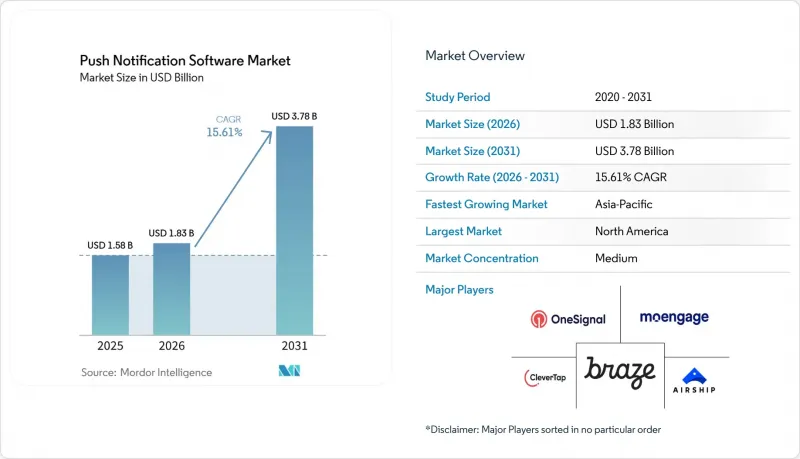
Mordor Intelligence에 의하면, 푸시 알림 소프트웨어 시장 규모는 2025년 15억 8,000만 달러, 2026년 18억 3,000만 달러에서 2031년까지 37억 8,000만 달러로 확대된다고 예측되고 있어 2026년부터 2031년까지 연평균 성장률(CAGR)은 15.61%를 나타낼 전망입니다.
본 보고서는 도입 형태(클라우드 기반 및 On-Premise형), 기업 규모(대기업 및 중소기업), 알림 채널(모바일 푸시 알림, 웹 푸시 알림 등), 최종 사용자 산업(소매 및 전자상거래, 은행 및 금융 서비스·보험 등), 그리고 지역별로 분류되어 있습니다. 시장 전망은 금액(달러) 기준으로 제시되어 있습니다.
세계 푸시 알림 소프트웨어 시장 동향 및 인사이트
모바일 및 웹에서 실시간 고객 참여에 대한 수요 증가
푸시 알림 소프트웨어 시장은 모바일 애플리케이션 및 웹사이트 전반에 걸쳐 즉각적이고 관련성 높은 고객 커뮤니케이션에 대한 수요가 증가함에 따라 혜택을 보고 있습니다. 각 브랜드는 장바구니 포기, 재고 상황, 가격 변경, 계정 활동 및 기타 시간적 제약이 있는 행동에 대해 이벤트 트리거형 메시지를 점점 더 많이 활용하고 있습니다. 이러한 트리거를 활용하는 소매업체들은 예정된 캠페인 배포에만 의존하는 기업들보다 주문 회복률이 더 높다고 보고하고 있습니다. 인도와 동남아시아 국가들에서는 실시간 참여 도구를 활용할 수 있는 ‘모바일 우선’ 사용자층이 여전히 광범위하게 존재하지만, 가입자 수가 많다고 해서 효과적인 커뮤니케이션이 보장되는 것은 아닙니다. 유료 채널을 통한 고객 재유치에는 막대한 비용이 소요될 수 있으므로, 기업들은 기존 사용자 유지에 더욱 주력하고 있습니다. 푸시 알림 소프트웨어 시장의 성숙한 사용자들은 알림 발송을 보다 광범위한 고객 유지 프로그램에 통합하고 있으며, 이로 인해 고객 데이터 및 워크플로우 시스템과 연동된 플랫폼은 일단 도입되면 대체하기 어려워지고 있습니다.
퍼스트 파티 데이터와 허가 기반 메시징의 성장
제3자 추적 수단의 감소로 인해 푸시 알림 구독은 퍼스트 파티 고객 정보를 확보하기 위한 더욱 중요한 정보원이 되고 있습니다. 푸시 토큰은 옵트인된 기기 연동형 커뮤니케이션 경로를 제공하며, 브라우저 재로딩이나 용도 업데이트 후에도 사용 가능한 상태를 유지합니다. 이 기능을 통해 브랜드는 파편화된 광고 타겟층에 전적으로 의존하지 않고도, 이미 파악된 사용자와 직접적으로 소통할 수 있게 됩니다. OneSignal은 2026년 7월, OneSignal AI 및 Model Context Protocol Server를 오픈 베타 버전으로 출시하여, AI 어시스턴트가 행동 데이터를 활용하여 타겟 오디언스를 구축하고 캠페인 업무를 수행할 수 있도록 했습니다. 유럽 데이터 보호 위원회는 개인 데이터 처리가 수반되는 경우, 적용되는 개인정보 보호 프레임워크에 따른 동의는 자유 의지에 의한 것이어야 하며, 구체적이고 충분한 정보에 기반한 명확한 것이어야 한다고 밝혔습니다. 따라서 동의 관리, 구독자 기록, 옵트아웃 제어 기능을 갖춘 제공업체는 기업의 구매 결정에서 우위를 점할 수 있습니다.
알림 피로와 사용자의 옵트아웃 압력
푸시 알림 소프트웨어 시장에서 알림 피로는 여전히 제약 요인으로 작용하고 있습니다. 시기가 부적절한 메시지나 반복되는 메시지는 사용자가 알림을 비활성화하게 만드는 원인이 되기 때문입니다. 기기 수준에서의 수신 거부는 브랜드 측에서 새로운 앱 설치나 사용자의 권한 갱신이 필요한 경우가 많아 되돌리기가 어려울 수 있습니다. 소매, 미디어 및 기타 대량 발송을 하는 사업자는 메시지가 고객의 행동이나 선호도에 맞추어 최적화되지 않은 경우 더 큰 위험에 직면합니다. Batch사의 2025년 벤치마크 조사에서는 12억 명의 방문자를 대상으로 8,000억 건의 메시지를 분석하여, 플랫폼 및 산업 카테고리별로 상이한 동의 현황이 밝혀졌습니다. 기업이 관련성 및 발송 빈도 관리에 투자하지 않으면, 구독자 목록 증가가 반드시 플랫폼의 장기적인 수익으로 이어지는 것은 아닙니다. 예측 기반의 발송 억제 도구를 활용함으로써, 제공업체는 수신 거부 위험이 높은 사용자를 식별하고, 관계가 단절되기 전에 연락 빈도를 줄일 수 있습니다.
부문 분석
2025년, 푸시 알림 소프트웨어 시장 점유율의 72.63%를 클라우드 기반 도입이 차지했습니다. 이 부문은 자동 소프트웨어 업데이트, 유연한 용량, 그리고 초기 도입 비용을 절감하는 가격 책정 모델의 혜택을 받고 있습니다. 또한, 클라우드 전송은 브라우저 알림 및 보다 광범위한 디지털 참여 프로그램에 필수적인 웹 기반 애플리케이션 프로그래밍 인터페이스(API)도 지원합니다. 중소규모 구매자는 제한된 기술 지원으로 시작하여 가입자 수 증가에 맞추어 이용 범위를 확대할 수 있기 때문에 클라우드 도구를 선호하는 경향이 있습니다. Braze는 2026년 4월 릴리스에서 다국어 번역 지원과 워크스페이스 단위의 메시지 전송 속도 제한을 추가함으로써, 클라우드 플랫폼이 고객 계정 전체에 새로운 기능을 제공할 수 있음을 보여주었습니다. SOC 2 Type II 및 ISO 27001과 같은 보안 인증은 클라우드 제공업체에게 중요한 기업 요구 사항이 되어, 소규모 벤더의 진입 장벽을 높이고 있습니다.
On-Premise 도입은 2031년까지 연평균 성장률(CAGR) 15.96%를 나타낼 것으로 예측되며, 가장 빠르게 성장하는 도입 방식이 될 전망입니다. 금융 기관, 정부 계약업체, 의료 기관에서는 데이터 저장 위치나 처리 환경에 대한 보다 엄격한 관리가 요구되는 경우가 많습니다. 의료 및 생명과학 분야의 연평균 성장률(CAGR) 18.37%는 미국의 HIPAA 요건을 지원하는 프라이빗 클라우드 및 On-Premise 환경에 대한 수요와 부분적으로 관련이 있습니다. Braze는 유럽 고객의 데이터 상주 요건을 충족하기 위해 2026년 4월 ‘BrazeAI Decisioning Studio’의 Google Cloud 기반 유럽 호스팅을 추가했습니다. 이러한 움직임은 클라우드 기반 제공과 고객의 강력한 관리 기능을 결합한 호스팅형 프라이빗 환경의 역할이 확대되고 있음을 보여줍니다. 핵심 기능을 저해하지 않으면서 유연한 도입을 제공할 수 있는 공급업체는 클라우드 우선 기업과 규제 대상 조직 모두에 서비스를 제공할 수 있습니다.
2025년, 푸시 알림 소프트웨어 시장 점유율의 64.38%를 대기업이 차지했습니다. 이러한 조직은 대개 여러 사업 부문에 걸쳐 운영되며, 알림 도구를 CRM 시스템, 고객 데이터 플랫폼, 분석 제품, 데이터 웨어하우스와 연동하고 있습니다. 이러한 통합은 공급업체 변경이 확립된 고객 여정이나 보고 프로세스를 혼란스럽게 할 가능성이 있으므로, 운영상의 전환 비용을 초래할 수 있습니다. 또한, 대규모 구매 기업은 동의 관리, 감사 기록, 역할 기반 접근 제어, 전용 인프라 및 서비스 수준 계약(SLA)도 요구하고 있습니다. 의료 시스템, 소매 체인, 은행 및 금융 서비스·보험 기관은 전달의 신뢰성과 데이터의 안전한 처리를 특히 중요하게 생각합니다. Salesforce, Oracle, SAP 및 주요 고객 데이터 플랫폼과 같은 시스템에 대한 인증된 연동 기능을 갖추지 않은 공급업체는 기업의 조달 요구를 충족하는 데 어려움을 겪을 수 있습니다.
중소기업(SME) 부문은 2031년까지 연평균 성장률(CAGR) 16.78%를 나타낼 것으로 예측됩니다. 셀프 서비스 온보딩, 프리미엄 플랜, 사용량 기반 요금제를 통해 중소기업의 도입 비용과 복잡성이 완화되고 있습니다. OneSignal사는 자사 플랫폼이 전 세계 100만 개 이상의 기업에 도입되어 있으며, 푸시 알림, 이메일,SMS, RCS, 인앱 메시징, Live Activities에 이르는 메시징을 지원한다고 밝혔습니다. 이 회사가 2026년 7월에 출시한 AI 기능은 소규모 팀이 수작업을 최소화하면서 부문 생성, 캠페인 컨텐츠 작성, 고객 여정 구축 및 커뮤니케이션 일정 설정을 수행할 수 있도록 설계되었습니다. Pushwoosh, PushEngage, WebEngage와 같은 제공업체들은 사용량에 따른 요금제를 채택하고 있어, 소규모 고객은 구독자 수 증가에 맞추어 지출을 조정할 수 있습니다. AI를 활용한 자동화를 통해 대기업의 참여 유도 프로그램과 소규모 팀이 활용할 수 있는 자원 간의 격차를 더욱 좁힐 수 있게 됩니다.
지역별 분석
2025년, 북미는 전 세계 푸시 알림 소프트웨어 시장 점유율의 36.61%를 차지했습니다. 이 지역에서는 소매, 은행/금융서비스/보험, 미디어, 디지털 커머스 기업들 사이에서 SaaS(Software-as-a-Service) 도입이 성숙 단계에 접어들었습니다. 기업 도입의 경우, Salesforce, HubSpot, 고객 데이터 플랫폼(CDP)과의 긴밀한 연동이 이루어지는 경우가 많으며, 알림 시스템은 확립된 고객 참여 운영의 일환으로 자리 잡고 있습니다. 이러한 연동을 통해 전환 비용이 증가하여 벤더와의 장기적인 관계를 유지하기가 더 쉬워집니다. 유럽은 두 번째로 큰 지역 시장을 차지하고 있으며, 독일, 영국, 프랑스가 주요 기업 고객의 거점입니다. 유럽 고객은 개인정보 보호 규정 준수가 플랫폼 선정에 영향을 미치기 때문에 동의 관리, 데이터 소재지, 감사 인프라를 더욱 중요하게 여깁니다. 따라서 유럽의 데이터 보호 프레임워크에 따라 거버넌스 기능은 해당 지역에 서비스를 제공하는 공급업체에게 중요한 경쟁적 차별화 요소가 되고 있습니다.
아시아태평양은 2031년까지 연평균 성장률(CAGR) 19.24%를 나타낼 것으로 예측됩니다. 인도, 중국, 동남아시아의 ‘모바일 퍼스트’ 상거래는 핀테크, 퀵 커머스, 에듀테크, 디지털 헬스 분야 수요를 뒷받침하고 있습니다. MoEngage, WebEngage, Netcore Cloud와 같은 지역 제공업체들은 인도 내 고객 참여 프로그램에서의 경험을 바탕으로 국내 시장을 넘어 사업을 확장하고 있습니다. 2026년 7월 Aurora Mobile이 Pobo Financial을 대상으로 실시한 JPush 도입 사례는 중국의 금융 커뮤니케이션 분야에서 고가용성 전달 시스템이 필요함을 보여주었습니다. 일본과 한국에서는 스마트폰 보급률이 높아 게임, 소매, 미디어, 소비자용 용도 기업들 수요가 시장 성장에 기여하고 있습니다.
남미는 푸시 알림 소프트웨어 시장의 신흥 지역이며, 브라질과 멕시코에서는 핀테크와 전자상거래의 성장이 도입을 뒷받침하고 있습니다. 모바일 우선의 인터넷 이용으로 인해 비용 대비 효과가 높은 고객 유지 프로그램을 추구하는 기업들에게 직접적인 고객 참여가 특히 중요해지고 있습니다. 브라질의 대규모 디지털 커머스 환경은 라이프사이클 자동화 및 행동 기반 커뮤니케이션에 대한 투자를 촉진하고 있습니다. 중동 및 아프리카은 여전히 도입 초기 단계에 있지만, 사우디아라비아와 아랍에미리트(UAE)의 금융 서비스 디지털화로 인해 은행, 핀테크 제공업체, 전자상거래 기업 사이에서 수요가 발생하고 있습니다. 나이지리아와 남아프리카공화국은 모바일 인프라 개선과 전자상거래 활동 활성화로 인해 대상 사용자층이 확대되면서 아프리카 내 중요한 시장으로 부상하고 있습니다. 이 지역에서 디지털 인프라가 구축됨에 따라, 현지 언어 및 지역별 결제 시스템과의 연동을 지원할 수 있는 제공업체는 더 유리한 입지를 확보할 가능성이 있습니다.
기타 혜택:
- 엑셀 형식 시장 예측(ME) 시트
- 3개월간의 애널리스트 지원
자주 묻는 질문
목차
제1장 서론
제2장 조사 방법
제3장 개요
제4장 시장 구도
제5장 시장 규모와 성장 예측
제6장 경쟁 구도
제7장 시장 기회와 향후 전망
JHS 26.09.01According to Mordor Intelligence, the push notification software market size is projected to expand from USD 1.58 billion in 2025 and USD 1.83 billion in 2026 to USD 3.78 billion by 2031, registering a CAGR of 15.61% between 2026 to 2031.
This report is Segmented by Deployment Mode (Cloud-Based, and On-Premises), Enterprise Size (Large Enterprises, and Small and Medium Enterprises), Notification Channel (Mobile Push Notifications, Web Push Notifications, and More), End-User Industry (Retail and E-Commerce, Banking, Financial Services, and Insurance, and More), and Geography. The Market Forecasts are Provided in Terms of Value (USD).
Global Push Notification Software Market Trends and Insights
Rising Need For Real-Time Mobile and Web Customer Engagement
The push notification software market benefits from the growing need for immediate and relevant customer communication across mobile applications and websites. Brands increasingly use event-triggered messages for abandoned carts, inventory availability, price changes, account activity, and other time-sensitive actions. Retailers that use these triggers have reported stronger order recovery than businesses that depend only on scheduled campaign broadcasts. India and Southeast Asian countries continue to offer a wide mobile-first audience for real-time engagement tools, although subscriber scale alone does not guarantee effective communication. Businesses are focusing more closely on retaining existing users because customer reacquisition through paid channels can be expensive. Mature users of the push notification software market have embedded notification delivery into broader retention programs, which makes these platforms more difficult to replace once they are linked to customer data and workflow systems.
Growth of First-Party Data and Permission-Based Messaging
The reduction in third-party tracking options has made push subscriptions a more important source of first-party customer information. A push token can provide an opted-in, device-linked communication route that remains available when browsers refresh or applications update. This capability gives brands a direct way to engage known users without relying entirely on fragmented advertising audiences. OneSignal released OneSignal AI and its Model Context Protocol Server in open beta during July 2026, allowing AI assistants to use behavioral data for audience creation and campaign work. The European Data Protection Board stated that consent under the applicable privacy framework must be freely given, specific, informed, and unambiguous when personal data processing is involved. Providers with consent management, subscriber records, and opt-out controls can therefore have an advantage in enterprise purchasing decisions.
Notification Fatigue and User Opt-Out Pressure
Notification fatigue remains a constraint on the push notification software market because poorly timed or repetitive messages can lead users to disable communications. Device-level opt-outs can be difficult to reverse because brands often need a new application install or renewed permission from the user. Retail, media, and other high-volume senders face greater risk when messages are not tailored to customer behavior and preferences. Batch's 2025 benchmark reviewed 800 billion messages across 1.2 billion visitors and found different permission outcomes across platforms and industry categories. A growing subscriber list does not necessarily translate into long-term platform revenue if businesses do not invest in relevance and frequency management. Predictive suppression tools can help providers identify users with elevated opt-out risk and reduce contact volume before the relationship is lost.
Other drivers and restraints analyzed in the detailed report include:
- Expansion of Lifecycle Automation in SaaS and Commerce Workflows
- Omnichannel Retention Strategies Replacing Single-Channel Campaigns
- Tightening Consent, Privacy, and Device-Level Permission Controls
For complete list of drivers and restraints, kindly check the Table Of Contents.
Segment Analysis
Cloud-based deployment held 72.63% of the push notification software market share in 2025. The segment benefits from automatic software updates, flexible capacity, and pricing models that reduce up-front implementation costs. Cloud delivery also supports the web-based application programming interfaces that are necessary for browser notifications and broader digital engagement programs. Small and mid-sized buyers often favor cloud tools because they can begin with limited technical support and expand usage as their subscriber base grows. Braze added multilingual translation support and workspace-level messaging rate limits in its April 2026 release, showing how cloud platforms can deliver new capabilities across customer accounts. Security certifications such as SOC 2 Type II and ISO 27001 have become important enterprise requirements for cloud providers, raising the entry barrier for smaller vendors.
On-premises deployment is expected to record a 15.96% CAGR through 2031, making it the fastest-growing deployment approach. Financial institutions, government contractors, and healthcare organizations often require stronger control over data location and processing environments. The healthcare and life sciences segment's 18.37% CAGR is linked in part to demand for private cloud or on-premises environments that support HIPAA requirements in the United States. Braze added European hosting on Google Cloud for BrazeAI Decisioning Studio during April 2026 to address data-residency requirements among European clients. This development illustrates the growing role of hosted private environments that combine cloud delivery with stronger customer controls. Providers that offer flexible deployment without reducing core functionality can serve both cloud-first companies and regulated organizations.
Large enterprises accounted for 64.38% of the push notification software market share in 2025. These organizations often operate across several business units and connect notification tools with CRM systems, customer data platforms, analytics products, and data warehouses. Such integrations can create operational switching costs because replacing a provider may disrupt established customer journeys and reporting processes. Large buyers also require consent management, audit records, role-based access controls, dedicated infrastructure, and service-level agreements. Healthcare systems, retail chains, and banking, financial services, and insurance institutions place particular importance on delivery reliability and secure handling of data. Providers without certified integrations for systems such as Salesforce, Oracle, SAP, and major customer data platforms may struggle to meet enterprise procurement needs.
The SME segment is projected to grow at a 16.78% CAGR through 2031. Self-service onboarding, freemium plans, and consumption-based pricing have lowered the cost and complexity of adoption for smaller businesses. OneSignal stated that its platform had been adopted by more than 1 million businesses globally and supported messaging across push, email, SMS, RCS, in-app messaging, and Live Activities. The company's July 2026 AI release was designed to help lean teams create segments, write campaign content, build journeys, and schedule communications with less manual work. Providers such as Pushwoosh, PushEngage, and WebEngage use usage-based pricing that allows smaller customers to align spending with subscriber growth. AI-supported automation can further narrow the gap between large-company engagement programs and the resources available to smaller teams.
Complete Report Scope:
- By Deployment Model
- Cloud-Based
- On-Premises
- By Enterprise Size
- Large Enterprises
- Small and Medium Enterprises
- By Notification Channel
- Mobile Push Notifications
- Web Push Notifications
- Desktop Push Notifications
- By End User Industry
- Retail and E-Commerce
- Banking, Financial Services, and insurance (BFSI)
- IT and Telecommunication
- Media and Entertainment
- Travel and Hospitality
- Healthcare and Life Sciences
- Education
- Other End User Industries
- By Geography
- North America
- United States
- Canada
- Mexico
- South America
- Brazil
- Argentina
- Rest of South America
- Europe
- Germany
- United Kingdom
- France
- Italy
- Spain
- Russia
- Rest of Europe
- Asia-Pacific
- China
- Japan
- india
- South Korea
- Australia
- Rest of Asia-Pacific
- Middle East and Africa
- Middle East
- Turkey
- Saudi Arabia
- United Arab Emirates
- Rest of Middle East
- Africa
- South Africa
- Nigeria
- Rest of Africa
- Middle East
- North America
Geography Analysis
North America held 36.61% of the global push notification software market share in 2025. The region has mature software-as-a-service adoption among retail, banking, financial services, insurance, media, and digital commerce companies. Enterprise deployments often connect deeply with Salesforce, HubSpot, and customer data platforms, making notification systems part of established customer engagement operations. These integrations can increase switching costs and support longer vendor relationships. Europe represented the second-largest regional market, with Germany, the United Kingdom, and France serving as significant enterprise buyer locations. European customers place greater emphasis on consent management, data residency, and audit infrastructure because privacy compliance affects platform selection. The European data protection framework has therefore made governance features an important competitive differentiator for providers serving the region.
Asia-Pacific is expected to grow at a 19.24% CAGR through 2031. Mobile-first commerce in India, China, and Southeast Asia supports demand from fintech, quick commerce, education technology, and digital health applications. Regional providers such as MoEngage, WebEngage, and Netcore Cloud have used their experience in Indian customer engagement programs to expand outside their domestic markets. Aurora Mobile's JPush deployment with Pobo Financial in July 2026 demonstrated the need for high-availability delivery systems for financial communications in China. Japan and South Korea contribute enterprise demand from gaming, retail, media, and consumer application companies with high smartphone penetration.
South America is an emerging area for the push notification software market, with Brazil and Mexico supporting adoption through fintech and e-commerce growth. Mobile-first internet use makes direct customer engagement especially relevant for businesses seeking cost-effective retention programs. Brazil's large digital commerce environment is encouraging investment in lifecycle automation and behavior-based communications. The Middle East and Africa remains at an earlier stage of adoption, although financial services digitization in Saudi Arabia and the United Arab Emirates is creating demand among banks, fintech providers, and e-commerce businesses. Nigeria and South Africa are important African markets because improving mobile infrastructure and digital commerce activity are expanding the addressable user base. Providers that support local languages and regional payment integrations may be better positioned as digital infrastructure develops across these regions.
- OneSignal, Inc.
- Airship Group, Inc.
- Braze, Inc.
- CleverTap
- MoEngage, Inc.
- Iterable, Inc.
- Salesforce, Inc.
- Adobe Inc.
- Oracle Corporation
- Attentive Mobile, Inc.
- PushEngage
- Firebase, LLC
- WebEngage
- Customer.io, Inc.
- Insider.
- HubSpot, Inc.
- Netcore Cloud Pvt. Ltd.
- VWO Engage
- Pushwoosh Inc.
- Sendinblue SAS
- Catapush
Additional Benefits:
- The market estimate (ME) sheet in Excel format
- 3 months of analyst support
TABLE OF CONTENTS
1 INTRODUCTION
- 1.1 Study Assumptions and Market Definition
- 1.2 Scope of the Study
2 RESEARCH METHODOLOGY
3 EXECUTIVE SUMMARY
4 MARKET LANDSCAPE
- 4.1 Market Overview
- 4.2 Market Drivers
- 4.2.1 Rising Need for Real-Time Mobile and Web Customer Engagement
- 4.2.2 Growth of First-Party Data and Permission-Based Messaging
- 4.2.3 Expansion of Lifecycle Automation in SaaS and Commerce Workflows
- 4.2.4 Omnichannel Retention Strategies Replacing Single-Channel Campaigns
- 4.2.5 AI-Assisted Send-Time and Message Personalization
- 4.2.6 Rising Adoption in Mid-Market and Self-Service SMB Segments
- 4.3 Market Restraints
- 4.3.1 Notification Fatigue and User Opt-Out Pressure
- 4.3.2 Tightening Consent, Privacy, and Device-Level Permission Controls
- 4.3.3 Cross-Platform Integration Complexity Across Apps, Web, and CRM Stacks
- 4.3.4 Commoditization and Low Switching Costs in Core Push Functionality
- 4.4 Industry Value-Chain Analysis
- 4.5 Impact of Macroeconomic Factors on the Market
- 4.6 Regulatory Landscape
- 4.7 Technological Outlook
- 4.8 Pricing Analysis
- 4.9 Porter's Five Forces Analysis
- 4.9.1 Bargaining Power of Buyers
- 4.9.2 Bargaining Power of Suppliers
- 4.9.3 Threat of New Entrants
- 4.9.4 Threat of Substitutes
- 4.9.5 Intensity of Competitive Rivalry
5 MARKET SIZE AND GROWTH FORECASTS (VALUE)
- 5.1 By Deployment Model
- 5.1.1 Cloud-Based
- 5.1.2 On-Premises
- 5.2 By Enterprise Size
- 5.2.1 Large Enterprises
- 5.2.2 Small and Medium Enterprises
- 5.3 By Notification Channel
- 5.3.1 Mobile Push Notifications
- 5.3.2 Web Push Notifications
- 5.3.3 Desktop Push Notifications
- 5.4 By End User Industry
- 5.4.1 Retail and E-Commerce
- 5.4.2 Banking, Financial Services, and insurance (BFSI)
- 5.4.3 IT and Telecommunication
- 5.4.4 Media and Entertainment
- 5.4.5 Travel and Hospitality
- 5.4.6 Healthcare and Life Sciences
- 5.4.7 Education
- 5.4.8 Other End User Industries
- 5.5 By Geography
- 5.5.1 North America
- 5.5.1.1 United States
- 5.5.1.2 Canada
- 5.5.1.3 Mexico
- 5.5.2 South America
- 5.5.2.1 Brazil
- 5.5.2.2 Argentina
- 5.5.2.3 Rest of South America
- 5.5.3 Europe
- 5.5.3.1 Germany
- 5.5.3.2 United Kingdom
- 5.5.3.3 France
- 5.5.3.4 Italy
- 5.5.3.5 Spain
- 5.5.3.6 Russia
- 5.5.3.7 Rest of Europe
- 5.5.4 Asia-Pacific
- 5.5.4.1 China
- 5.5.4.2 Japan
- 5.5.4.3 india
- 5.5.4.4 South Korea
- 5.5.4.5 Australia
- 5.5.4.6 Rest of Asia-Pacific
- 5.5.5 Middle East and Africa
- 5.5.5.1 Middle East
- 5.5.5.1.1 Turkey
- 5.5.5.1.2 Saudi Arabia
- 5.5.5.1.3 United Arab Emirates
- 5.5.5.1.4 Rest of Middle East
- 5.5.5.2 Africa
- 5.5.5.2.1 South Africa
- 5.5.5.2.2 Nigeria
- 5.5.5.2.3 Rest of Africa
- 5.5.5.1 Middle East
- 5.5.1 North America
6 COMPETITIVE LANDSCAPE
- 6.1 Market Concentration
- 6.2 Strategic Moves
- 6.3 Market Share Analysis
- 6.4 Company Profiles (includes Global Level Overview, Market Level Overview, Core Segments, Financials as available, Strategic Information, Market Rank/Share, Products and Services, Recent Developments)
- 6.4.1 OneSignal, Inc.
- 6.4.2 Airship Group, Inc.
- 6.4.3 Braze, Inc.
- 6.4.4 CleverTap
- 6.4.5 MoEngage, Inc.
- 6.4.6 Iterable, Inc.
- 6.4.7 Salesforce, Inc.
- 6.4.8 Adobe Inc.
- 6.4.9 Oracle Corporation
- 6.4.10 Attentive Mobile, Inc.
- 6.4.11 PushEngage
- 6.4.12 Firebase, LLC
- 6.4.13 WebEngage
- 6.4.14 Customer.io, Inc.
- 6.4.15 Insider.
- 6.4.16 HubSpot, Inc.
- 6.4.17 Netcore Cloud Pvt. Ltd.
- 6.4.18 VWO Engage
- 6.4.19 Pushwoosh Inc.
- 6.4.20 Sendinblue SAS
- 6.4.21 Catapush
7 MARKET OPPORTUNITIES AND FUTURE OUTLOOK
- 7.1 White-Space and Unmet-Need Assessment


