

|
시장보고서
상품코드
2117558
제휴 마케팅 소프트웨어 시장 : 점유율 분석, 업계 동향과 통계, 성장 예측(2026-2031년)Affiliate Marketing Software Market - Market Share Analysis, Industry Trends & Statistics, Growth Forecasts (2026 - 2031) |
||||||
 Mordor Intelligence
Mordor Intelligence에 의하면, 제휴 마케팅 소프트웨어 시장 규모는 2025년 20억 6,000만 달러에서 2026년에는 23억 7,000만 달러로 확대되어 2026년부터 2031년까지 CAGR 15.44%로 성장을 지속하여, 2031년에는 48억 7,000만 달러에 이를 것으로 예측됩니다.
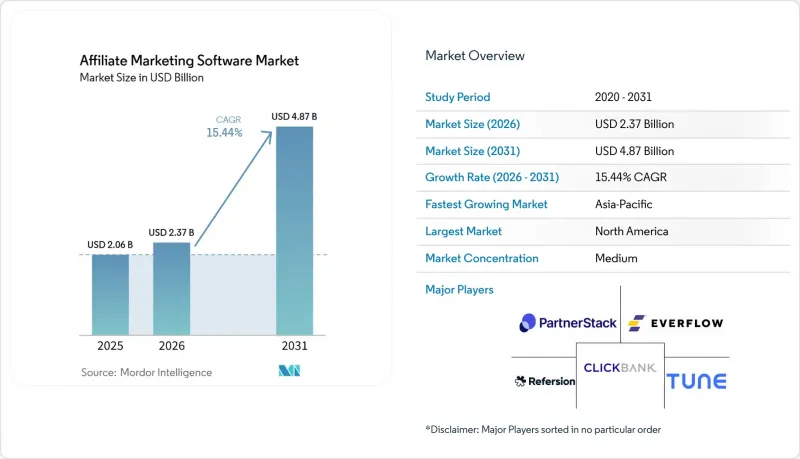
본 보고서는 도입 형태(클라우드, On-Premise, 하이브리드), 기업 규모(대기업, 중소기업), 용도(제휴 프로그램 관리, 성과 추적 및 어트리뷰션 분석 등), 최종 사용자 산업(정보기술·통신 등), 그리고 지역별로 분류되어 있습니다. 시장 예측은 금액(달러) 기준으로 제시되어 있습니다.
세계 제휴 마케팅 소프트웨어 시장 동향 및 인사이트
크리에이터 및 인플루언서 커머스의 채택 확대
제휴 마케팅 소프트웨어 시장에서 크리에이터 주도형 커머스는 소규모 캠페인 형식에서 많은 브랜드에게 지속적인 고객 확보 채널로 전환되고 있습니다. 2026년 4월에 보고된 IAB 데이터에 따르면, 크리에이터 대상 광고비는 2025년에 370억 달러에 달할 것으로 예상되며, 2026년에는 440억 달러에 이를 것으로 전망됩니다. 이러한 움직임으로 인해 제휴 프로그램이 대응해야 할 파트너의 수와 유형가 증가하고 있습니다. 기업은 크리에이터, 할인 퍼블리셔, 앰배서더, 추천 파트너 등을 각각 서로 다른 보상 체계 하에서 추적해야 하는 상황에 자주 직면합니다. 따라서 제휴 마케팅 소프트웨어 시장에서는 플랫폼이 동일한 프로그램 내에서 고정 보상과 성과 보상을 모두 관리할 수 있다는 점이 큰 장점이 됩니다. impact.com은 2026년 6월 iPX 행사에서 크리에이터용 스토어프론트 기능과 자율형 리크루팅 도구를 발표하며, 발견, 온보딩, 측정을 연계한 플랫폼으로 통합하려는 노력을 보여주었습니다.
AI를 활용한 부정 행위 감지 및 어트리뷰션 정확도에 대한 수요
제휴 마케팅 소프트웨어 시장의 대규모 제휴 프로그램에서는 커미션 산정을 왜곡할 가능성이 있는 무효 트래픽, 클릭 스팸, 어트리뷰션 하이재킹을 방지하기 위한 견고한 관리 체제가 요구되고 있습니다. 이러한 수요로 인해 부정 행위 감지 및 어트리뷰션의 투명성은 엔터프라이즈용 플랫폼 선정에 있어 더욱 중요해지고 있습니다. 제휴 마케팅 소프트웨어 시장에서는 커미션이 승인되기 전에 파트너의 행동을 평가하고, 의심스러운 활동을 식별하는 도구가 제공되기 시작했습니다. 에버플로우(Everflow)는 2026년 6월 18일, ‘AI Shield’ 제품의 일반 제공을 시작하며, 규칙 기반의 임계값을 대체하는 것으로 행동 분석을 포지셔닝했습니다. Partnerize사의 보고서에 따르면, 해당사의 ‘2026년 제로 클릭 커머스 지수’에서 퍼블리셔가 AI를 통한 발견을 통해 창출한 측정 가능한 구매에 대한 영향력은 기존의 라스트 클릭 기록을 통한 것보다 3.84배 더 큰 것으로 나타났습니다. 이러한 동향에 따라 단순히 최종 클릭에 공로를 돌리는 것이 아니라, 더 긴 고객 여정 전반에 걸쳐 영향력을 검증할 수 있는 플랫폼의 가치가 높아지고 있습니다.
제휴 사기 및 무효 트래픽 유출
관리자가 트래픽의 품질이나 커미션 산정 근거를 설명할 수 없는 경우, 부정 행위는 제휴 마케팅 소프트웨어 시장에 대한 신뢰를 훼손할 우려가 있습니다. 부정확한 데이터는 지급 분쟁이나 의사 결정 지연으로 이어질 수 있으므로, 이는 운영상의 문제가 됩니다. 또한, 재무 부서가 프로그램의 관리 체제가 적절한지 의문을 제기할 경우, 플랫폼 확장을 지연시키는 요인이 될 수도 있습니다. 따라서 제휴 마케팅 소프트웨어 시장에서는 일회성 부정 조사 대신 지속적인 모니터링을 제공해야 합니다. 쿠키 스태핑, 클릭 스팸, 어트리뷰션 하이재킹과 같은 부정 행위에 대해서는 감지 모델의 지속적인 업데이트가 요구됩니다. Everflow의 2026년 제품 출시는 프로그램 수준과 네트워크 수준 모두에서 의심스러운 행동을 식별하려는 보다 광범위한 노력을 반영하고 있습니다.
부문 분석
2025년, 제휴 마케팅 소프트웨어 시장에서 클라우드 도입 비율은 70.14%를 차지하며, 2031년까지 연평균 성장률(CAGR) 17.89%를 나타낼 것으로 예측됩니다. 클라우드는 공유된 온라인 환경을 통해 보고서 제공, 파트너 접근 및 프로그램 관리를 가능하게 합니다. 현대적인 제휴 프로그램에서는 보고서 주기 종료 시점이 아닌 캠페인 기간 중에 전환 데이터의 업데이트가 필요한 경우가 많아지고 있습니다. 클라우드 시스템이라면 별도로 로컬에 설치할 필요 없이 프로그램 팀이나 승인된 파트너에게 이러한 업데이트 정보를 제공할 수 있습니다. 또한, 실시간 부정 행위 스코어링이나 동적 어트리뷰션 재계산 등 대량의 데이터에 의존하는 기능에도 적합합니다.
도입 형태 선택은 단순한 편의성뿐만 아니라 운영상의 필요를 반영한 것입니다. 클라우드 제공업체는 각 고객에게 대규모 소프트웨어 업그레이드를 강요하지 않고도 전체 고객 기반에 기능을 추가할 수 있습니다. 이를 통해 브랜드는 여러 지역 및 파트너 그룹에 걸쳐 일관된 프로세스를 유지할 수 있습니다. 데이터 저장 위치에 관한 규제나 사내 정책으로 인해 완전한 클라우드 전환이 제한되는 경우, 하이브리드 모델은 여전히 유효합니다. On-Premise 시스템 또한 구식 기술 환경을 단계적으로 폐지하고 있는 기업들에게는 여전히 중요한 역할을 수행하고 있습니다. impact.com은 2026년 6월, iPX에서 ‘Integrations Hub’를 확장하며 클라우드 플랫폼이 연동 도구 및 데이터 서비스에 대한 접근성을 어떻게 확대하고 있는지 보여주었습니다.
2025년 제휴 마케팅 소프트웨어 시장에서 대기업이 72.89%를 차지했습니다. 이러한 조직은 대개 확립된 파트너 네트워크, 전문 팀, 그리고 보고 및 지급 관리에 관한 공식적인 요건을 갖추고 있습니다. 이러한 프로그램에서는 여러 브랜드, 시장 및 커미션 체계가 동시에 관여할 수 있습니다. 이로 인해 사기 방지 대책, 규정 준수 기능 및 다양한 어트리뷰션 기법을 포함하는 종합 플랫폼 시스템에 대한 수요가 발생하고 있습니다. 대기업의 지출은 복잡한 파트너 업무를 지원하도록 설계된 플랫폼의 높은 가격을 반영하기도 합니다.
중소기업(SME)은 2031년까지 연평균 성장률(CAGR) 18.22%로 가장 큰 성장을 기록할 것으로 예측됩니다. 이러한 성장 기회는 엔터프라이즈급 도입을 필요로 하지 않으면서도 실용적인 파트너 관리를 실현하는 도입 장벽이 낮은 제품에 의해 주도될 것입니다. 소규모 기업은 이러한 도구를 활용하여, 이전에는 스프레드시트나 개별 용도를 통해 관리되던 추천 및 제휴 활동을 체계화할 수 있습니다. 따라서 제휴 마케팅 소프트웨어 업계는 당초 대형 브랜드에 집중하던 것에서 그 범위를 더욱 넓혀가고 있습니다. 2026년 5월, PartnerStack과 AppDirect의 통합을 통해 PartnerStack의 파트너 기능이 기술 제공업체, 자문사 및 구독자에게 서비스를 제공하는 구독형 마켓플레이스와 연동되었습니다. 이러한 연동을 통해 소규모 소프트웨어 기업은 기존 상업 생태계를 통해 파트너 네트워크에 접근할 수 있게 되었습니다.
지역별 분석
2025년, 북미는 제휴 마케팅 소프트웨어 시장의 36.21%를 차지했습니다. 이 지역은 성숙한 엔터프라이즈용 제휴 생태계와 플랫폼 공급업체의 집중이라는 이점을 누리고 있습니다. 미국의 프로그램은 개별적인 포인트 솔루션에서 파트너 발굴, 측정, 운영 관리를 포괄하는 보다 광범위한 플랫폼으로 전환되고 있습니다. impact.com의 보고서에 따르면, 월마트와 레노버는 프로그램을 통해 연간 총 상품 가치(GMV) 합계가 1,100억 달러 이상을 창출하는 고객사 중 하나로 꼽힙니다. 캐나다와 멕시코는 더 광범위한 디지털 상거래의 발전에 발맞추고 있는 여전히 소규모의 지역 시장입니다.
유럽은 지역 시장 중 두 번째로 큰 규모를 자랑합니다. 이 지역의 동의 및 개인정보 보호 관련 요건으로 인해 추적 기법이 제한될 가능성이 있어, 규정 준수 기능이 내장된 플랫폼에 대한 수요가 증가하고 있습니다. 독일, 영국, 프랑스는 디지털 커머스 활동이 선진적이며 견고한 데이터 거버넌스 체계를 갖추고 있어 중요한 시장으로 자리매김하고 있습니다. 제휴 마케팅 소프트웨어 시장에서는 개인정보 보호에 대한 기대를 저해하지 않으면서 프로그램 요건을 충족하는 추적 솔루션을 지원해야 합니다.
아시아태평양은 2031년까지 17.04%라는 지역별 최고 연평균 성장률(CAGR)을 나타낼 전망입니다. 중국에서는 폐쇄형 용도 생태계 전반에 걸친 측정이 필요한 소셜 커머스 및 라이브 스트리밍 쇼핑 환경이 조성되어 있습니다. 인도에서는 디지털 광고와 제휴 마케팅 활동이 확대되고 있으며, 동남아시아에서는 크리에이터 주도형 커머스의 보급이 진전되고 있습니다. 남미에서는 전자상거래와 디지털 결제의 보급이 성장 동력이 되고 있습니다. 한편, 중동의 프로그램은 걸프협력회의(GCC) 회원국 시장에 집중되어 있습니다. 아프리카에서는 소프트웨어 도입이 아직 초기 단계이지만, 남아프리카공화국과 나이지리아에서는 금융 서비스 및 모바일 커머스 분야에서 도입 초기 단계의 체계화가 진행되고 있습니다.
기타 혜택:
- 엑셀 형식 시장 예측(ME) 시트
- 3개월간의 애널리스트 지원
자주 묻는 질문
목차
제1장 서론
제2장 조사 방법
제3장 개요
제4장 시장 구도
제5장 시장 규모와 성장 예측
제6장 경쟁 구도
제7장 시장 기회와 향후 전망
JHS 26.09.01According to Mordor Intelligence, the affiliate marketing software market size is expected to grow from USD 2.06 billion in 2025 to USD 2.37 billion in 2026 and is forecast to reach USD 4.87 billion by 2031 at 15.44% CAGR over 2026-2031.
This report is Segmented by Deployment Mode (Cloud, On-Premises, and Hybrid), Enterprise Size (Large Enterprises, and Small and Medium Enterprises), Application (Affiliate Program Management, Performance Tracking and Attribution Analytics, and More), End-User Industry (Information Technology and Telecommunication, and More), and Geography. The Market Forecasts are Provided in Terms of Value (USD).
Global Affiliate Marketing Software Market Trends and Insights
Rising Creator and Influencer Commerce Adoption
Creator-led commerce is moving from a small-campaign format to a regular customer-acquisition channel for many brands in the Affiliate marketing software market. Creator advertising spend reached USD 37 billion in 2025 and is expected to reach USD 44 billion in 2026, according to IAB data reported in April 2026. This activity expands the number and type of partners that an affiliate program must support. Companies often need to track creators, discount publishers, ambassadors, and referral partners under different payout structures. The Affiliate marketing software market, therefore, benefits when platforms can manage both fixed fees and outcome-based commissions within the same program. impact.com introduced creator storefront capabilities and an autonomous recruitment tool at its June 2026 iPX event, showing the effort to bring discovery, onboarding, and measurement into a connected platform.
AI-Enabled Fraud Detection and Attribution Accuracy Demand
Large affiliate programs in the Affiliate marketing software market need robust controls to prevent invalid traffic, click spamming, and attribution hijacking, which can distort commissions. This need has made fraud detection and transparency in attribution more important in enterprise platform selection. The Affiliate marketing software market is responding with tools that evaluate partner behavior and identify suspicious activity before commissions are approved. Everflow made its AI Shield product generally available on June 18, 2026, positioning behavioral analysis as an alternative to rules-based thresholds. Partnerize reported that its 2026 Zero-Click Commerce Index found that publishers generated 3.84 times more measurable purchase influence through AI-mediated discovery than through conventional last-click records. These developments place greater value on platforms that can test influence across a longer customer journey instead of simply assigning credit to the final click.
Affiliate Fraud and Invalid Traffic Leakage
Fraud can erode confidence in the Affiliate marketing software market when managers cannot explain the quality of traffic or the basis for commissions. The issue is operational because inaccurate data can lead to disputed payouts and delayed decisions. It can also slow platform expansion when finance teams question whether program controls are adequate. The Affiliate marketing software market must therefore provide ongoing monitoring instead of a one-time fraud review. Fraud methods such as cookie stuffing, click spamming, and attribution hijacking continue to require updates to detection models. Everflow's 2026 product release reflects the wider push to identify suspicious behavior at both the program and network levels.
Other drivers and restraints analyzed in the detailed report include:
- Shift Toward Performance-Based Marketing Spend
- First-Party Data Activation After Cookie Deprecation
- Privacy Compliance Complexity Across Jurisdictions
For complete list of drivers and restraints, kindly check the Table Of Contents.
Segment Analysis
Cloud deployment accounted for 70.14% of the Affiliate marketing software market in 2025 and is projected to grow at a 17.89% CAGR through 2031. It supports the delivery of reporting, partner access, and program controls through a shared online environment. Modern affiliate programs often need updated conversion data during a campaign rather than at the end of a reporting cycle. Cloud systems can make those updates available to program teams and approved partners without separate local installations. They are also suited to features that depend on large data volumes, including real-time fraud scoring and dynamic attribution recalculation.
The deployment preference reflects operating needs rather than convenience alone. Cloud providers can add functionality across their customer base without requiring each customer to undergo a major software upgrade. This helps brands maintain consistent processes across multiple regions and partner groups. Hybrid models remain relevant where data residency rules or internal policies limit a full cloud move. On-premises systems also retain a role for companies with older technology environments that are being retired gradually. impact.com expanded its Integrations Hub at iPX in June 2026, illustrating how cloud platforms are extending access to connected tools and data services.
Large enterprises accounted for 72.89% of the Affiliate marketing software market in 2025. These organizations often have established partner networks, specialized teams, and formal requirements for reporting and payment administration. Their programs can involve multiple brands, markets, and commission structures simultaneously. This creates demand for full-platform systems that include fraud controls, compliance features, and multiple attribution methods. Large enterprise spending also reflects the higher pricing of platforms designed to support complex partner operations.
SMEs are projected to record the highest growth at an 18.22% CAGR through 2031. The opportunity comes from lower-barrier products that offer practical partner management without the need for an enterprise-scale implementation. Smaller companies can use these tools to formalize referral and affiliate activity that may previously have been managed through spreadsheets or separate applications. The Affiliate marketing software industry is therefore expanding beyond its early focus on large brands. In May 2026, PartnerStack's integration with AppDirect connected its partner capabilities to a subscription marketplace serving technology providers, advisors, and subscribers. This kind of connection can help smaller software businesses reach partner networks through existing commercial ecosystems.
Complete Report Scope:
- By Deployment Mode
- Cloud
- On-Premises
- Hybrid
- By Enterprise Size
- Large Enterprises
- Small and Medium Enterprises
- By Application
- Affiliate Program Management
- Partner Relationship Management
- Influencer and Creator Partnership Management
- Performance Tracking and Attribution Analytics
- By End-User Industry
- Retail and E-Commerce
- Media and Entertainment
- Travel and Hospitality
- Banking, Financial Services, and Insurance (BFSI)
- Information Technology and Telecommunication
- Other End-User Industries
- By Geography
- North America
- United States
- Canada
- Mexico
- South America
- Brazil
- Argentina
- Rest of South America
- Europe
- Germany
- United Kingdom
- France
- Italy
- Spain
- Russia
- Rest of Europe
- Asia-Pacific
- China
- Japan
- India
- South Korea
- Australia and New Zealand
- Rest of Asia-Pacific
- Middle East
- Saudi Arabia
- United Arab Emirates
- Turkey
- Rest of Middle East
- Africa
- South Africa
- Nigeria
- Rest of Africa
- North America
Geography Analysis
North America accounted for 36.21% of the Affiliate marketing software market in 2025. The region benefits from a mature enterprise affiliate ecosystem and a concentration of platform vendors. United States programs have moved from separate point solutions toward broader platforms that cover partner discovery, measurement, and operational controls. impact.com reported that Walmart and Lenovo were among clients with programs generating more than USD 110 billion in combined annual gross merchandise value. Canada and Mexico remain smaller regional markets that follow wider digital commerce development.
Europe is the second-largest regional market. Its consent and privacy requirements can restrict tracking methods and raise demand for platforms with embedded compliance functions. Germany, the United Kingdom, and France are important markets due to their advanced digital commerce activity and robust data governance frameworks. The Affiliate marketing software market must support tracking solutions that meet program requirements without compromising privacy expectations.
Asia-Pacific is projected to record the highest regional CAGR of 17.04% through 2031. China has a social commerce and live-stream shopping environment that needs measurement across closed application ecosystems. India is expanding its digital advertising and affiliate activity, while Southeast Asia is seeing greater adoption of creator-led commerce. South America benefits from e-commerce and digital payment adoption, while Middle East programs are concentrated in Gulf Cooperation Council markets. Africa is still early in software adoption, though South Africa and Nigeria are seeing initial formalization in financial services and mobile commerce.
- impact.com, Inc.
- Awin Global Limited
- CJ Affiliate, Inc.
- Rakuten Marketing LLC
- Partnerize Limited
- PartnerStack Inc.
- Everflow Technologies, Inc.
- Affise Group Limited
- Post Affiliate Pro, s.r.o.
- Tune, Inc.
- scaleo, s.r.o.
- Tapfiliate B.V.
- Refersion, Inc.
- LeadDyno, LLC
- ClickBank, LLC
- Admitad GmbH
- Cellxpert, Inc.
- HasOffers, Inc.
- Osiaffiliate, Inc.
- Tradedoubler AB
Additional Benefits:
- The market estimate (ME) sheet in Excel format
- 3 months of analyst support
TABLE OF CONTENTS
1 INTRODUCTION
- 1.1 Study Assumptions and Market Definition
- 1.2 Scope of the Study
2 RESEARCH METHODOLOGY
3 EXECUTIVE SUMMARY
4 MARKET LANDSCAPE
- 4.1 Market Overview
- 4.2 Market Drivers
- 4.2.1 Rising Creator and Influencer Commerce Adoption
- 4.2.2 AI-Enabled Fraud Detection and Attribution Accuracy Demand
- 4.2.3 Shift Toward Performance-Based Marketing Spend
- 4.2.4 First-Party Data Activation After Cookie Deprecation
- 4.2.5 Micro-Partner and Niche Publisher Monetization Growth
- 4.2.6 Cross-Border Partner Program Orchestration Needs
- 4.3 Market Restraints
- 4.3.1 Affiliate Fraud and Invalid Traffic Leakage
- 4.3.2 Privacy Compliance Complexity Across Jurisdictions
- 4.3.3 Martech Stack Integration Friction
- 4.3.4 Long Sales Cycles for Enterprise Platform Replacement
- 4.4 Industry Value Chain Analysis
- 4.5 Regulatory Landscape
- 4.6 Technological Outlook
- 4.7 Impact of Macroeconomic Factors on the Market
- 4.8 Porter's Five Forces Analysis
- 4.8.1 Threat of New Entrants
- 4.8.2 Bargaining Power of Suppliers
- 4.8.3 Bargaining Power of Buyers
- 4.8.4 Threat of Substitutes
- 4.8.5 Intensity of Competitive Rivalry
5 MARKET SIZE AND GROWTH FORECASTS (VALUE)
- 5.1 By Deployment Mode
- 5.1.1 Cloud
- 5.1.2 On-Premises
- 5.1.3 Hybrid
- 5.2 By Enterprise Size
- 5.2.1 Large Enterprises
- 5.2.2 Small and Medium Enterprises
- 5.3 By Application
- 5.3.1 Affiliate Program Management
- 5.3.2 Partner Relationship Management
- 5.3.3 Influencer and Creator Partnership Management
- 5.3.4 Performance Tracking and Attribution Analytics
- 5.4 By End-User Industry
- 5.4.1 Retail and E-Commerce
- 5.4.2 Media and Entertainment
- 5.4.3 Travel and Hospitality
- 5.4.4 Banking, Financial Services, and Insurance (BFSI)
- 5.4.5 Information Technology and Telecommunication
- 5.4.6 Other End-User Industries
- 5.5 By Geography
- 5.5.1 North America
- 5.5.1.1 United States
- 5.5.1.2 Canada
- 5.5.1.3 Mexico
- 5.5.2 South America
- 5.5.2.1 Brazil
- 5.5.2.2 Argentina
- 5.5.2.3 Rest of South America
- 5.5.3 Europe
- 5.5.3.1 Germany
- 5.5.3.2 United Kingdom
- 5.5.3.3 France
- 5.5.3.4 Italy
- 5.5.3.5 Spain
- 5.5.3.6 Russia
- 5.5.3.7 Rest of Europe
- 5.5.4 Asia-Pacific
- 5.5.4.1 China
- 5.5.4.2 Japan
- 5.5.4.3 India
- 5.5.4.4 South Korea
- 5.5.4.5 Australia and New Zealand
- 5.5.4.6 Rest of Asia-Pacific
- 5.5.5 Middle East
- 5.5.5.1 Saudi Arabia
- 5.5.5.2 United Arab Emirates
- 5.5.5.3 Turkey
- 5.5.5.4 Rest of Middle East
- 5.5.6 Africa
- 5.5.6.1 South Africa
- 5.5.6.2 Nigeria
- 5.5.6.3 Rest of Africa
- 5.5.1 North America
6 COMPETITIVE LANDSCAPE
- 6.1 Market Concentration
- 6.2 Strategic Moves
- 6.3 Market Share Analysis
- 6.4 Company Profiles (includes Global Level Overview, Market Level Overview, Core Segments, Financials as available, Strategic Information, Market Rank/Share, Products and Services, Recent Developments)
- 6.4.1 impact.com, Inc.
- 6.4.2 Awin Global Limited
- 6.4.3 CJ Affiliate, Inc.
- 6.4.4 Rakuten Marketing LLC
- 6.4.5 Partnerize Limited
- 6.4.6 PartnerStack Inc.
- 6.4.7 Everflow Technologies, Inc.
- 6.4.8 Affise Group Limited
- 6.4.9 Post Affiliate Pro, s.r.o.
- 6.4.10 Tune, Inc.
- 6.4.11 scaleo, s.r.o.
- 6.4.12 Tapfiliate B.V.
- 6.4.13 Refersion, Inc.
- 6.4.14 LeadDyno, LLC
- 6.4.15 ClickBank, LLC
- 6.4.16 Admitad GmbH
- 6.4.17 Cellxpert, Inc.
- 6.4.18 HasOffers, Inc.
- 6.4.19 Osiaffiliate, Inc.
- 6.4.20 Tradedoubler AB
7 MARKET OPPORTUNITIES AND FUTURE OUTLOOK
- 7.1 White-Space and Unmet-Need Assessment


