
|
시장보고서
상품코드
2117587
예측 영업 인텔리전스 소프트웨어 : 시장 점유율 분석, 업계 동향 및 통계, 성장 예측(2026-2031년)Predictive Sales Intelligence Software - Market Share Analysis, Industry Trends & Statistics, Growth Forecasts (2026 - 2031) |
||||||
 Mordor Intelligence
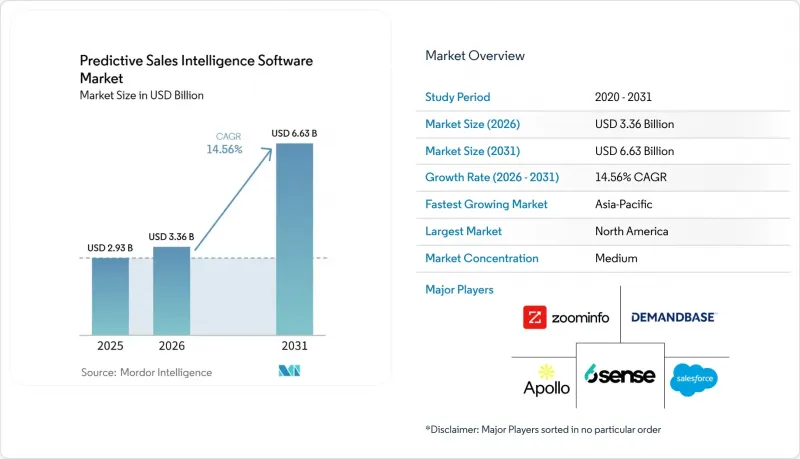
Mordor Intelligence에 의하면, 예측 영업 인텔리전스 소프트웨어 시장 규모는 2025년 29억 3,000만 달러로 평가되었습니다. 2026년 33억 6,000만 달러에서 2031년까지 66억 3,000만 달러로 확대되고 2026년부터 2031년까지 연평균 복합 성장률(CAGR)은 14.56%를 나타낼 전망입니다.
본 보고서는 구성 요소(소프트웨어 및 서비스), 도입 형태(클라우드 및 On-Premise), 조직 규모(중소기업 및 대기업), 용도(리드 생성 및 잠재 고객 발굴, 예측 리드 스코어링 등), 최종 사용자 산업(IT 및 통신 등), 그리고 지역별로 분류되어 있습니다. 시장 전망은 금액(달러) 기준으로 제시되어 있습니다.
세계의 예측 영업 인텔리전스 소프트웨어 시장 동향 및 인사이트
AI 네이티브 구매자 신호 스코어링이 전환 경제학을 혁신
2026년에는 B2B 영업 담당자의 77%가 AI가 잠재 고객의 구매 가능성을 90%의 정확도로 예측할 수 있다면 AI에 의존할 것이라고 응답했으며, 이는 2025년의 37%에서 증가한 수치입니다. 이러한 변화는 영업 팀이 단순한 호기심에서 모델 기반의 우선순위 설정에 대한 실질적인 의존으로 얼마나 빠르게 전환하고 있는지를 보여줍니다. 6sense의 보고서에 따르면, 2025년 2분기부터 2026년 1분기에 걸쳐 6QA를 통해 우선순위가 지정된 계정의 거래 가치는 우선순위가 지정되지 않은 계정에 비해 29% 높았으며, 성사 규모도 33% 더 컸다고 합니다. 가장 뛰어난 성과는 단순한 활동 신호가 아닌, 성사(Closed Won) 및 수주 실패(Closed Lost) 결과에 기반하여 모델이 학습된 분야에서 나타나고 있습니다. CRM 이력이 부족하거나 편중된 구매 담당자의 경우, 시스템이 현재 수요 상황보다 과거의 계약 체결 패턴을 반영하게 되므로 여전히 점수가 낮게 나오는 경향이 있습니다. 이에 대응하여 각 벤더사는 학습 주기를 가속화하고 있으며, 이를 통해 예측 영업 인텔리전스 소프트웨어 시장에서 최신 구매 신호와 영업 활동 간의 격차를 줄일 수 있게 되었습니다.
RevOps의 표준화가 가져오는 새로운 데이터 거버넌스 요구
수익 운영(RevOps)의 통합으로 인해 예측 영업 인텔리전스 소프트웨어의 역할은 리드의 적격성 평가에서 예측, 영업 구역 계획, 계약 갱신 모니터링으로 확대되고 있습니다. Salesforce가 22개국 영업 담당자 4,050명을 대상으로 실시한 2026년 설문조사에 따르면, 독일 영업 리더의 44%가 사일로화된 시스템이 AI 도입의 걸림돌이 되고 있다고 응답했습니다. 또한, 같은 조사에서 72%는 AI의 광범위한 활용에 앞서 데이터 정제 및 표준화를 우선시하고 있다고 답했습니다. 이러한 추세는 기업이 이미 통합된 운영 모델을 기반으로 고객 데이터를 관리하고 있는 경우, 예측 영업 인텔리전스 소프트웨어 시장에서 수익성이 높아진다는 것을 의미합니다. 따라서 RevOps 체제가 잘 갖춰진 시장일수록 벤더 입장에서는 제한적인 잠재 고객 발굴 용도에 그치지 않고, 플랫폼 전체 도입을 위한 더 큰 기회가 생깁니다.
데이터 개인정보 보호 규제가 연락처 데이터 공급망을 압박
유럽 데이터 보호 위원회(EDPB)는 2026년 7월, 생성형 AI 맥락에서 개인 데이터의 대규모 웹 스크래이핑에 대한 법적 근거 요건을 강화하는 지침을 발표했습니다. 전문가의 연락처 정보와 프로파일링 신호는 데이터 보강 및 스코어링의 핵심 입력 요소이므로, 이러한 규정은 예측 영업 인텔리전스 소프트웨어 시장에 직접적인 영향을 미칩니다. 다국적 기업의 구매자들이 더 광범위한 사업 전개 지역 전체에 걸쳐 유사한 관리 조치를 적용하고 있기 때문에 규정 준수 부담은 유럽 내에만 국한되지 않습니다. 소규모 벤더는 규정 준수에 대한 투자를 대규모 고객 기반에 분산시킬 수 없기 때문에 법적 대응이나 워크플로우 재설계에 드는 비용이 높아집니다. 이로 인해 제품 로드맵의 진행이 지연되어, 예측 영업 인텔리전스 소프트웨어 시장에서 규모가 큰 기존 기업들이 더욱 우위를 점할 가능성이 높아집니다. 이러한 압박은 아웃리치 투명성, 동의 처리, 감사 대응이 단순한 선택적 기능이 아닌 구매 요건으로 자리 잡고 있는 분야에서 특히 두드러집니다.
부문별 분석
2025년에는 소프트웨어가 62.43%의 점유율을 차지하며, 이에 따라 예측 영업 인텔리전스 소프트웨어 시장은 서비스 주도형 실행이 아닌 플랫폼 주도형 제공 형태로 자리 잡았습니다. 이러한 우위는 구매자가 단일 운영 계층 내에서 인텐트 대시보드, 예측 스코어링 엔진,워크플로우 자동화, 그리고 CRM에 통합된 알림 기능을 우선시하고 있음을 반영합니다. 소프트웨어 측도 SaaS의 경제성 혜택을 누리고 있어, 사용자 수가 증가해도 추가 제공 비용은 낮게 유지되며, 기능 업데이트도 기존의 엔터프라이즈 릴리스 주기보다 신속하게 이루어집니다. 반면, 예측 영업 인텔리전스 소프트웨어 업계에서는 복잡한 도입 과정에서 모델 조정 및 데이터 거버넌스에 여전히 전문가의 참여가 필요하기 때문에 인적 지원의 역할이 축소되지는 않을 것입니다.
서비스 시장은 2031년까지 연평균 성장률(CAGR) 16.82%로 확대될 것으로 예측되며, 소프트웨어 시장이 여전히 규모 면에서 우위를 점하고 있음에도 불구하고 가장 빠르게 성장하는 구성 요소가 되고 있습니다. 이는 엔터프라이즈 환경에서 워크플로우 설계, CRM 데이터 정비, 모델 튜닝 및 도입 감독에 대한 수요가 증가하고 있음을 반영합니다. 서비스에 대한 수요는 조직이 예측, 영업 지역 계획 및 계정 우선순위 설정 모두에 인텔리전스를 동시에 통합하고자 할 때 특히 강화되는 경향이 있습니다. 2026년 3월 Apollo.io가 Pocus를 인수한 것도 기업의 신호정보가 통합된 플랫폼 경험에 더욱 긴밀하게 통합되고 있다는 시장의 방향성을 시사합니다. 이러한 변화가 진행됨에 따라, 예측 영업 인텔리전스 소프트웨어 시장에서는 패키지 소프트웨어의 기능과 과거에는 개별 전문 서비스 프로젝트에 포함되었던 요소들 간의 경계가 모호해질 가능성이 있습니다.
클라우드는 2025년 예측 영업 인텔리전스 소프트웨어 시장 점유율의 63.81%를 차지했으며, 2031년까지 연평균 성장률(CAGR) 15.39%로 가장 빠른 성장을 기록할 것으로 예측됩니다. API 주도형 통합으로 인해 맞춤형 구현 작업의 필요성이 줄어들면서 그 입지는 더욱 공고해지고 있습니다. 이는 현재 영업팀이 소프트웨어를 구매하는 방식과 부합하며, 대부분의 상업 환경에서 인프라 소유권보다 구현 속도가 더 중요하게 여겨지기 때문입니다. 온프레미는 금융 서비스, 방위 관련 고객, 그리고 거주 요건이나 내부 보안 규정이 여전히 엄격한 계약업체 생태계 등 규제가 엄격한 환경에서 여전히 중요한 역할을 하고 있습니다. 그러나 예측 영업 인텔리전스 소프트웨어 시장은 공유된 신호 계층과 연계된 데이터 흐름이 고립된 환경보다 클라우드 환경에서 더 효과적으로 작동하는 상황에 따라 점점 더 형성되고 있습니다.
현재 더 큰 격차가 발생하고 있는 것은 클라우드 네이티브 플랫폼과 단순히 클라우드로 이전된 기존 시스템 사이입니다. 클라우드 네이티브 벤더는 더 많은 신호 유형을 통합하고, 모델 재훈련을 신속하게 수행하며, 운영상의 마찰을 최소화하면서 실시간 스코어링을 위한 연산 리소스를 확장할 수 있습니다. Apollo.io가 2026년에 Claude 및 ChatGPT를 통해 MCP 기반 액세스를 배포한 사례는 클라우드 우선 설계가 최종 사용자에게 워크플로우의 직접적인 시작을 얼마나 용이하게 하는지 보여주었습니다. 또한, 규정 준수 요건의 측면에서도 거버넌스가 확립된 클라우드 환경에서는 문서화, 로그 기록, 감사 관리를 유지하기 쉬우므로 On-Premise 배포의 정당성을 입증하기가 어려워지고 있습니다. 따라서 예측 영업 인텔리전스 소프트웨어 시장에서 클라우드는 여전히 가장 크고 가장 빠르게 성장하는 배포 계층으로 남아 있습니다.
지역별 분석
2025년, 북미는 예측 영업 인텔리전스 소프트웨어 시장 점유율의 34.56%를 차지하며 계속해서 가장 규모가 큰 지역 기여자로서의 위상을 유지했습니다. 미국은 기업용 소프트웨어에 대한 막대한 투자, 성숙한 CRM 도입, 그리고 GTM 도구의 높은 활용도가 결합되어 여전히 수요의 중심지입니다. 미국 인구조사국의 보고서에 따르면, 2026년 5월 기업의 AI 활용률은 19.8%에 달했으며, 이는 전반적인 디지털 도입 환경에서 광범위한 기준이 되었습니다. 캐나다에서는 SaaS 및 금융 서비스 구매자들 수요가 증가하고 있는 반면, 멕시코에서는 다국적 기업들이 표준화된 수익 관리 스택을 현지 사업으로 확대함에 따라 시장이 성장하고 있습니다. 예측 영업 인텔리전스 소프트웨어 시장 전체에서 이러한 지역적 우위는 가격 경쟁보다는 인프라의 성숙도에 의해 여전히 뒷받침되고 있습니다.
유럽은 규정 준수 부담이 증가하고 있음에도 불구하고, 구매의 정교성이 높기 때문에 여전히 중요한 수요 중심지입니다. 독일과 영국은 특히 기업 팀이 더 강력한 예측 체계와 우수한 데이터 거버넌스를 요구하는 분야에서 상업적 수요의 기반이 되고 있습니다. 웹 스크레이핑 및 관련 개인정보 보호 의무에 대한 유럽 데이터 보호 위원회(EDPB)의 지침은 이 지역에 서비스를 제공하는 벤더들의 제품 아키텍처 선택을 재편하고 있습니다. 즉, 유럽의 예측 영업 인텔리전스 소프트웨어 시장에서는 감사 가능성, 동의 관리, 그리고 투명성이 높은 AI를 활용한 아웃리치를 지원할 수 있는 플랫폼이 높이 평가될 것입니다.
아시아태평양은 2031년까지 연평균 성장률(CAGR) 19.42%를 나타낼 것으로 예상되며, 예측 영업 인텔리전스 소프트웨어 시장에서 가장 빠르게 성장하는 지역이 될 것입니다. 중국은 기업의 급속한 디지털화의 혜택을 받고 있는 반면, 인도는 SaaS 도입 확대와 리드 관리의 효율성을 당연하게 여기는 대규모 아웃소싱 기반에 힘입어 성장하고 있습니다. 일본과 한국은 선진적인 기업 IT 환경과 대기업 내 본격적인 AI 도입 노력을 통해 성장을 주도하고 있습니다. 남미, 중동 및 아프리카 시장 점유율은 여전히 작지만, 클라우드 기반의 보급형 제품이 도입 장벽을 낮추면서 브라질, 아르헨티나, 사우디아라비아, 아랍에미리트, 이스라엘, 남아프리카공화국에서는 도입이 진행되고 있습니다.
기타 혜택 :
- 엑셀 형식 시장 예측(ME) 시트
- 3개월간의 애널리스트 지원
자주 묻는 질문
목차
제1장 서론
제2장 조사 방법
제3장 주요 요약
제4장 시장 구도
제5장 시장 규모 및 성장 예측
제6장 경쟁 구도
제7장 시장 기회 및 향후 전망
KTH 26.09.04According to Mordor Intelligence, the predictive sales intelligence software market size is projected to expand from USD 2.93 billion in 2025 and USD 3.36 billion in 2026 to USD 6.63 billion by 2031, registering a CAGR of 14.56% between 2026 to 2031.
This report is Segmented by Component (Software, and Services), Deployment Mode (Cloud, and On-Premises), Organization Size (Small and Medium Enterprises, and Large Enterprises), Application (Lead Generation and Prospecting, Predictive Lead Scoring, and More), End-User Industry (IT and Telecommunication, and More), and Geography. The Market Forecasts are Provided in Terms of Value (USD).
Global Predictive Sales Intelligence Software Market Trends and Insights
AI-Native Buyer Signal Scoring Reshapes Conversion Economics
In 2026, 77% of B2B sales professionals said they would rely on AI if it could predict a prospect's likelihood to buy with 90% accuracy, up from 37% in 2025. That shift shows how quickly buying teams are moving from curiosity to practical dependence on model-led prioritization. 6sense reported that opportunities on prioritized 6QA accounts posted 29% higher opportunity values and 33% larger deal sizes than non-prioritized accounts between Q2 2025 and Q1 2026. The strongest results are appearing where models are trained on closed-won and closed-lost outcomes instead of simple activity signals. Buyers with sparse or biased CRM histories still face weaker scoring because the system reflects old win patterns more than present demand conditions. Vendors are responding by moving toward faster learning cycles so the predictive sales intelligence software market can shorten the gap between fresh buying signals and sales action.
RevOps Standardization Creates a New Data Governance Imperative
Revenue operations consolidation is broadening the role of predictive sales intelligence software from lead qualification into forecasting, territory planning, and renewal monitoring. Salesforce's 2026 study of 4,050 sales professionals across 22 countries found that 44% of German sales leaders said siloed systems hinder AI initiatives. The same study found that 72% prioritize data cleansing and standardization before wider AI use. That pattern means the return from the predictive sales intelligence software market rises when firms already manage customer data under a unified operating model. Markets with stronger RevOps discipline, therefore, give vendors a wider opening for full platform adoption instead of limited prospecting use.
Data Privacy Regulation Compresses the Contact Data Supply Chain
The EDPB published guidance in July 2026 that tightened expectations around lawful grounds for large-scale web scraping of personal data in generative AI contexts. Those rules affect the predictive sales intelligence software market directly because professional contact details and profiling signals are core inputs for enrichment and scoring. The compliance burden is not staying inside Europe because multinational buyers are applying similar controls across broader operating footprints. Smaller vendors face higher legal engineering and workflow redesign costs when they cannot spread compliance investment across a large customer base. This slows product roadmaps and raises the likelihood that scaled incumbents gain further ground in the predictive sales intelligence software market. The pressure is most visible where outreach transparency, consent handling, and audit readiness are becoming purchase requirements rather than optional features.
Other drivers and restraints analyzed in the detailed report include:
- Cloud Self-Serve Models Unlock the Mid-Market Growth Layer
- Intent Data Fusion Widens the Signal Quality Gap Between Vendors
- Signal Decay Erodes Predictive Model Accuracy Over Time
For complete list of drivers and restraints, kindly check the Table Of Contents.
Segment Analysis
Software held 62.43% share in 2025, which kept the predictive sales intelligence software market anchored in platform-led delivery rather than service-led execution. That lead reflects how buyers are prioritizing intent dashboards, predictive scoring engines, workflow automation, and CRM-embedded alerting within one operating layer. The software side also benefits from SaaS economics, where additional users carry lower incremental delivery costs and feature updates move faster than traditional enterprise release cycles. At the same time, the predictive sales intelligence software industry is not reducing the role of human support because model calibration and data governance still require specialist input during complex rollouts.
Services are projected to advance at a 16.82% CAGR through 2031, which makes them the fastest-growing component even though software remains larger. This reflects a growing need for workflow design, CRM cleanup, model tuning, and deployment oversight in enterprise environments. The service requirement tends to be strongest where organizations want to embed intelligence across forecasting, territory planning, and account prioritization at the same time. Apollo.io's acquisition of Pocus in March 2026 also pointed to a market direction where enterprise signal intelligence is being folded more tightly into a unified platform experience. As that shift continues, the predictive sales intelligence software market is likely to see a blur between packaged software capability and what once sat inside separate professional services projects.
Cloud held 63.81% predictive sales intelligence software market share in 2025 and is also projected to record the fastest growth at a 15.39% CAGR through 2031. That position continues to strengthen as API-led integrations reduce the need for custom deployment work. The model aligns with how revenue teams now buy software, as activation speed matters more than infrastructure ownership in most commercial settings. On-premises remains relevant in regulated environments such as financial services, defense-linked accounts, and contractor ecosystems where residency or internal security rules remain strict. Even so, the predictive sales intelligence software market is increasingly shaped by environments where shared signal layers and linked data flows work better in cloud settings than in isolated installations.
The deeper divide now sits between cloud-native platforms and older systems that were merely moved into the cloud. Cloud-native vendors can ingest more signal types, retrain models faster, and scale compute for live scoring with less operational friction. Apollo.io's 2026 rollout of MCP-based access through Claude and ChatGPT showed how a cloud-first design makes direct workflow activation easier for end users. Compliance requirements are also making on-premises deployments harder to defend because documentation, logging, and audit controls are easier to maintain in governed cloud environments. For that reason, cloud remains both the largest and the fastest-moving delivery layer in the predictive sales intelligence software market.
Complete Report Scope:
- By Component
- Software
- Services
- By Deployment Mode
- Cloud
- On-Premises
- By Organization Size
- Small and Medium Enterprises
- Large Enterprises
- By Application
- Lead Generation and Prospecting
- Predictive Lead Scoring
- Sales Forecasting
- Data Management and Enrichment
- Sales Performance Analytics and Reporting
- Other Applications
- By End-User Industry
- Banking, Financial Services, and Insurance (BFSI)
- IT and Telecommunication
- Healthcare and Life Sciences
- Retail and E-commerce
- Manufacturing
- Media and Entertainment
- Government and Public Sector
- Other End-User Industries
- By Geography
- North America
- United States
- Canada
- Mexico
- South America
- Brazil
- Argentina
- Rest of South America
- Europe
- Germany
- United Kingdom
- France
- Russia
- Rest of Europe
- Asia-Pacific
- China
- Japan
- India
- South Korea
- Australia
- Rest of Asia-Pacific
- Middle East and Africa
- Middle East
- Turkey
- Israel
- Saudi Arabia
- United Arab Emirates
- Rest of Middle East
- Africa
- South Africa
- Rest of Africa
- Middle East
- North America
Geography Analysis
North America held 34.56% of the predictive sales intelligence software market share in 2025, which kept it as the largest regional contributor. The United States remains the center of demand because it combines dense enterprise software spending with mature CRM adoption and high GTM tool usage. The U.S. Census Bureau reported that business AI use reached 19.8% in May 2026, which provided a broad baseline for the wider digital adoption environment. Canada is adding demand from SaaS and financial services buyers, while Mexico is advancing as multinational firms extend standardized revenue stacks into local operations. Across the predictive sales intelligence software market, this regional lead still rests on infrastructure maturity more than on price competition.
Europe remains an important demand center because buying sophistication is high even as compliance burdens rise. Germany and the United Kingdom continue to anchor commercial demand, particularly where enterprise teams want stronger forecasting discipline and better data governance. EDPB guidance on web scraping and related privacy obligations is reshaping product architecture choices for vendors serving the region. That means the predictive sales intelligence software market in Europe rewards platforms that can support auditability, consent discipline, and transparent AI-enabled outreach.
Asia-Pacific is projected to expand at a 19.42% CAGR through 2031, which makes it the fastest-growing region in the predictive sales intelligence software market. China is benefiting from fast enterprise digitalization, while India is supported by stronger SaaS adoption and a large outsourcing base that naturally values lead management efficiency. Japan and South Korea add growth through advanced enterprise IT environments and formal AI adoption efforts inside larger corporations. South America, the Middle East, and Africa still account for smaller shares, but adoption is building in Brazil, Argentina, Saudi Arabia, the United Arab Emirates, Israel, and South Africa as cloud-based entry tiers reduce commitment thresholds.
- ZoomInfo Technologies Inc.
- Salesforce, Inc.
- Apollo.io, Inc.
- 6sense Insights, Inc.
- Demandbase, Inc.
- LinkedIn Corporation
- Dun and Bradstreet Holdings, Inc.
- HubSpot, Inc.
- Oracle Corporation
- Cognism Ltd.
- Lusha Systems Ltd.
- SalesIntel LLC
- HG Insights LLC
- LeadGenius Inc.
- Outreach, Inc.
- SalesLoft, Inc.
- Clearbit, Inc.
- UpLead LLC
- Zoho Corporation Pvt. Ltd.
- Clari Inc.
Additional Benefits:
- The market estimate (ME) sheet in Excel format
- 3 months of analyst support
TABLE OF CONTENTS
1 INTRODUCTION
- 1.1 Study Assumptions and Market Definition
- 1.2 Scope of the Study
2 RESEARCH METHODOLOGY
3 EXECUTIVE SUMMARY
4 MARKET LANDSCAPE
- 4.1 Market Overview
- 4.2 Impact of Macroeconomic Factors on the Market
- 4.3 Market Drivers
- 4.3.1 AI-Native Buyer Signal Scoring Improves Conversion Prioritization
- 4.3.2 RevOps Standardization Drives Cross-Functional Forecast Visibility
- 4.3.3 Cloud-Based Self-Serve Adoption Expands Mid-Market Penetration
- 4.3.4 Intent Data Fusion With CRM and Marketing Automation Improves Signal Quality
- 4.3.5 Workflow Automation Reduces SDR and AE Research Time
- 4.3.6 Account-Based Selling Expansion Raises Demand for Predictive Targeting
- 4.4 Market Restraints
- 4.4.1 Data Privacy Constraints Limit Contact and Intent Data Collection
- 4.4.2 Signal Decay and Data Staleness Reduce Model Accuracy
- 4.4.3 Integration Complexity Across CRM, MAP, and CDP Stacks Delays Deployment
- 4.4.4 Budget Scrutiny Slows Enterprise-Wide Rollouts Outside Core Revenue Teams
- 4.5 Industry Value-Chain Analysis
- 4.6 Pricing Analysis
- 4.7 Technological Outlook
- 4.8 Regulatory Landscape
- 4.9 Porter's Five Forces Analysis
- 4.9.1 Bargaining Power of Buyers
- 4.9.2 Bargaining Power of Suppliers
- 4.9.3 Threat of New Entrants
- 4.9.4 Threat of Substitutes
- 4.9.5 Intensity of Competitive Rivalry
5 MARKET SIZE AND GROWTH FORECASTS (VALUE)
- 5.1 By Component
- 5.1.1 Software
- 5.1.2 Services
- 5.2 By Deployment Mode
- 5.2.1 Cloud
- 5.2.2 On-Premises
- 5.3 By Organization Size
- 5.3.1 Small and Medium Enterprises
- 5.3.2 Large Enterprises
- 5.4 By Application
- 5.4.1 Lead Generation and Prospecting
- 5.4.2 Predictive Lead Scoring
- 5.4.3 Sales Forecasting
- 5.4.4 Data Management and Enrichment
- 5.4.5 Sales Performance Analytics and Reporting
- 5.4.6 Other Applications
- 5.5 By End-User Industry
- 5.5.1 Banking, Financial Services, and Insurance (BFSI)
- 5.5.2 IT and Telecommunication
- 5.5.3 Healthcare and Life Sciences
- 5.5.4 Retail and E-commerce
- 5.5.5 Manufacturing
- 5.5.6 Media and Entertainment
- 5.5.7 Government and Public Sector
- 5.5.8 Other End-User Industries
- 5.6 By Geography
- 5.6.1 North America
- 5.6.1.1 United States
- 5.6.1.2 Canada
- 5.6.1.3 Mexico
- 5.6.2 South America
- 5.6.2.1 Brazil
- 5.6.2.2 Argentina
- 5.6.2.3 Rest of South America
- 5.6.3 Europe
- 5.6.3.1 Germany
- 5.6.3.2 United Kingdom
- 5.6.3.3 France
- 5.6.3.4 Russia
- 5.6.3.5 Rest of Europe
- 5.6.4 Asia-Pacific
- 5.6.4.1 China
- 5.6.4.2 Japan
- 5.6.4.3 India
- 5.6.4.4 South Korea
- 5.6.4.5 Australia
- 5.6.4.6 Rest of Asia-Pacific
- 5.6.5 Middle East and Africa
- 5.6.5.1 Middle East
- 5.6.5.1.1 Turkey
- 5.6.5.1.2 Israel
- 5.6.5.1.3 Saudi Arabia
- 5.6.5.1.4 United Arab Emirates
- 5.6.5.1.5 Rest of Middle East
- 5.6.5.2 Africa
- 5.6.5.2.1 South Africa
- 5.6.5.2.2 Rest of Africa
- 5.6.5.1 Middle East
- 5.6.1 North America
6 COMPETITIVE LANDSCAPE
- 6.1 Market Concentration
- 6.2 Strategic Moves
- 6.3 Market Share Analysis
- 6.4 Company Profiles (includes Global Level Overview, Market Level Overview, Core Segments, Financials as available, Strategic Information, Market Rank/Share, Products and Services, Recent Developments)
- 6.4.1 ZoomInfo Technologies Inc.
- 6.4.2 Salesforce, Inc.
- 6.4.3 Apollo.io, Inc.
- 6.4.4 6sense Insights, Inc.
- 6.4.5 Demandbase, Inc.
- 6.4.6 LinkedIn Corporation
- 6.4.7 Dun and Bradstreet Holdings, Inc.
- 6.4.8 HubSpot, Inc.
- 6.4.9 Oracle Corporation
- 6.4.10 Cognism Ltd.
- 6.4.11 Lusha Systems Ltd.
- 6.4.12 SalesIntel LLC
- 6.4.13 HG Insights LLC
- 6.4.14 LeadGenius Inc.
- 6.4.15 Outreach, Inc.
- 6.4.16 SalesLoft, Inc.
- 6.4.17 Clearbit, Inc.
- 6.4.18 UpLead LLC
- 6.4.19 Zoho Corporation Pvt. Ltd.
- 6.4.20 Clari Inc.
7 MARKET OPPORTUNITIES AND FUTURE OUTLOOK
- 7.1 White-space and Unmet-Need Assessment