

|
시장보고서
상품코드
2117597
디지털 트윈 시뮬레이션 및 시나리오 모델링 분야 생성형 AI : 시장 점유율 분석, 업계 동향 및 통계, 성장 예측(2026-2031년)Generative AI In Digital Twin Simulation and Scenario Modeling - Market Share Analysis, Industry Trends & Statistics, Growth Forecasts (2026 - 2031) |
||||||
 Mordor Intelligence
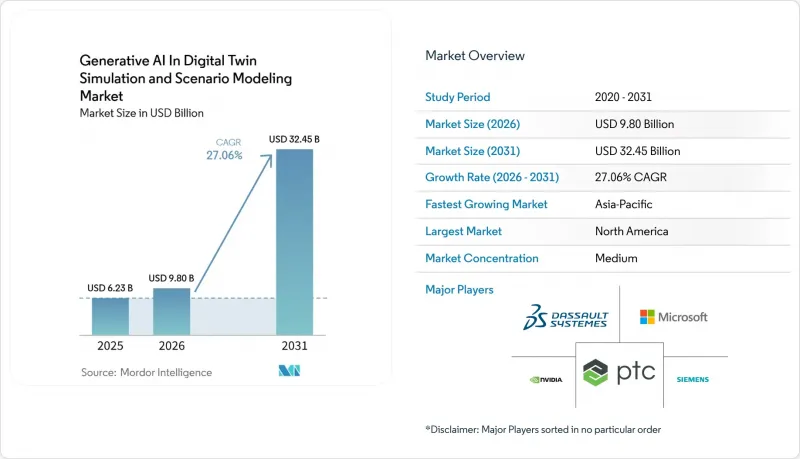
Mordor Intelligence에 의하면, 디지털 트윈 시뮬레이션 및 시나리오 모델링 분야 생성형 AI 시장 규모는 2025년 62억 3,000만 달러로 평가되었습니다. 2026년에는 98억 달러로 확대되어 2031년까지 324억 5,000만 달러에 이를 것으로 예상되고 2026-2031년에 걸쳐 CAGR 27.06%로 성장할 전망입니다.
본 보고서는 구성 요소(소프트웨어 및 서비스), 배포 방식(클라우드, On-Premise, 기타), 기업 규모(중소기업 및 대기업), 용도(예지 유지보수, 최적화, 기타), 최종 사용자(제조업, 자동차, 기타), 지역별로 분류되어 있습니다. 시장 전망은 금액(미 달러) 기준으로 제시되어 있습니다.
세계의 디지털 트윈 시뮬레이션 및 시나리오 모델링 분야 생성형 AI 시장 동향 및 인사이트
산업용 플랫폼 전반에 걸친 생성형 AI 기능의 기업 차원에서의 급속한 도입
디지털 트윈 시뮬레이션 및 시나리오 모델링 분야 생성형 AI 시장은 산업용 소프트웨어 벤더들이 기업들이 이미 대규모로 활용하고 있는 시뮬레이션 환경에 생성 모델을 추가함에 따라 급속히 확대되고 있습니다. 이러한 변화로 인해 설계안 및 운영 시나리오 검증에 소요되는 시간이 단축되어, 시뮬레이션이 전문 엔지니어뿐만 아니라 더 폭넓은 팀에게도 유용한 도구가 되고 있습니다. 지멘스(Siemens)는 2026년 1월, ‘Digital Twin Composer’가 펩시코(PepsiCo)에서 초기 도입 단계에서 설계 검증률을 거의 100%로 높이고, 처리량을 20% 향상시키며, 설비 투자를 10-15% 절감하는 데 기여했다고 발표했습니다. 이러한 변화로 인해 자체적으로 보유한 운영 데이터의 가치가 높아지고 있습니다. 이는 AI가 생성하는 시나리오의 품질이 모델의 학습 및 업데이트에 사용되는 데이터의 깊이와 관련성에 좌우되기 때문입니다. 그 결과, 디지털 트윈 시뮬레이션 및 시나리오 모델링 분야 생성형 AI 시장에서는 물리적 모델, 산업 데이터, 고성능 컴퓨팅을 단일 솔루션으로 통합할 수 있는 벤더들이 주목받고 있습니다.
확장 가능한 시나리오 기반 의사결정 및 리스크 시뮬레이션 도구에 대한 수요 증가
디지털 트윈 시뮬레이션 및 시나리오 모델링 분야 생성형 AI 시장은 정적 시뮬레이션 도구만으로는 대응하기 어려울 정도로 빈번하게 발생하는 공급망 혼란, 유지보수 위험, 에너지 비용 변동, 생산상의 상충 관계를 평가해야 할 필요성에서도 혜택을 받고 있습니다. 기업들은 현재 단순히 현 상황을 반영하는 데 그치지 않고, 타당한 운영 시나리오를 생성하여 이를 사업 목표와 비교·검토할 수 있는 디지털 트윈을 요구하고 있습니다. 에어버스(Airbus)는 2025년 4월, 자사의 디지털 트윈 환경이 5만 명 이상의 엔지니어에 의해 활용되었으며, 항공기의 전체 수명 주기에 걸쳐 마모 예측, 유지보수 일정 최적화, 예기치 못한 가동 중단 시간 감소에 기여하고 있다고 발표했습니다. 또한, 다쏘시스템과 에어버스는 2025년 4월, 향후 민간 및 군용 항공기·헬리콥터 프로그램을 위해 2만 명 이상의 사용자를 대상으로 3DEXPERIENCE 플랫폼을 전개하기 위해 전략적 파트너십을 확대했습니다. 이를 통해 디지털 트윈 시뮬레이션 및 시나리오 모델링 시장에서 생성형 AI의 역할이 엔지니어링 팀에 그치지 않고, 보다 광범위한 계획, 리스크 관리, 운영상의 의사결정 기능으로 확대되고 있습니다.
높은 모델 검증 비용과 기술적 정확도의 장벽
디지털 트윈 시뮬레이션 및 시나리오 모델링 분야 생성형 AI 시장은 AI가 생성한 모델이 광범위한 조건 하에서 물리적 현실을 반영하고 있음을 입증해야 한다는 점에서 여전히 큰 장벽에 직면해 있습니다. 고품질 검증을 위해서는 센서 데이터, 물리적 검증, 반복 테스트, 실제 운영 동작과의 대조가 필요하며, 모델 생성 속도가 빨라지더라도 비용과 시간은 여전히 높은 수준을 유지하고 있습니다. 『Journal of Intelligent Manufacturing』지에 게재된 2025년 동료 심사 연구에 따르면, 생성형 AI로 인해 디지털 트윈의 설계 주기가 가속화되더라도 검증은 여전히 기업 전반에 걸친 보급의 주요 병목 현상임이 밝혀졌습니다. 이로 인해 어려운 상충 관계가 발생하고 있습니다. 검증을 생략하는 기업은 운영상 및 법적 책임상의 위험에 직면하는 반면, 철저한 검증을 수행하는 기업은 대규모 도입 시 투자 대비 효과(ROI)를 정당화하기 어려워질 수 있습니다. 따라서 디지털 트윈 시뮬레이션 및 시나리오 모델링 분야 생성형 AI 시장에서는 검증 프로세스를 보다 고도화하여 자동화하고, 보다 확고한 근거를 바탕으로 규제 대상 이용 사례를 지원할 수 있는 벤더가 우위를 점하고 있습니다.
부문별 분석
2025년, 디지털 트윈 시뮬레이션 및 시나리오 모델링 분야 생성형 AI 시장 점유율 중 소프트웨어가 65.43%를 차지했습니다. 이는 기업 도입 과정에서 시뮬레이션 엔진, AI 오케스트레이션 계층, 라이프사이클 데이터 관리 도구가 중심적인 역할을 하고 있음을 반영한 것입니다. 고객은 일반적으로 핵심 플랫폼에서 도입을 시작한 후, 부가가치가 더 높은 시나리오 라이브러리, 모델 관리, 워크플로우 통합으로 확대해 나가기 때문에 소프트웨어는 계속해서 수익의 주축이 되고 있습니다. 더 많은 자산, 생산 라인, 설계 이력이 동일한 환경으로 이전됨에 따라 기반 플랫폼은 교체하기 어려워지고, 시간이 지남에 따라 그 유용성이 높아집니다. 이러한 추세로 인해 가치 구성은 변화하고 있음에도 불구하고, 소프트웨어는 디지털 트윈 시뮬레이션 및 시나리오 모델링 분야 생성형 AI 시장 전체에서 주도적인 위치를 계속 유지하고 있습니다.
서비스는 2031년까지 연평균 성장률(CAGR) 27.62%를 나타낼 것으로 예측되며, 이는 구매자들이 미세 조정, 지속적인 모델 운영, 시스템 수준의 통합에 대한 지원을 얼마나 빠르게 요구하고 있는지를 보여줍니다. 경쟁 우위가 일회성 도입 작업에서 운영 환경에서의 지속적인 모델 개선으로 전환되고 있기 때문에 이러한 변화는 중요합니다. PTC는 2026년 6월, PLM, ERP, CRM, IoT, EAM, FSM 시스템을 통합하고 AI를 활용한 통합 자산 기록으로 연결하는 클라우드 네이티브 자산 인텔리전스 솔루션 ‘PTC Orbit’을 발표함으로써 이러한 방향성을 더욱 강화했습니다. 이러한 제품 출시는 디지털 트윈 시뮬레이션 및 시나리오 모델링 분야 생성형 AI가 지속적인 서비스 수익의 여지를 확대하고 있는 이유를 보여줍니다. 이는 고객이 초기 도입 시점뿐만 아니라 도입 후에도 지원을 필요로 하기 때문입니다.
2025년에는 클라우드가 62.45%의 점유율을 차지했으며, 이는 기업들이 확장 가능한 GPU에 대한 접근성, 초기 비용 절감, AI 모델 실행 환경과의 손쉬운 연동을 선호하는 경향을 반영합니다. 클라우드 모델은 생성형 시뮬레이션에 매우 적합합니다. 팀이 대량의 시나리오를 일괄 처리하거나, 설계안을 비교하거나, 여러 작동 조건을 병렬로 테스트할 때 이용량이 갑작스럽게 집중되는 경우가 많기 때문입니다. 또한 조직이 자체적인 고성능 시뮬레이션 인프라를 구축하고 유지 관리해야 할 필요성도 줄어듭니다. 이러한 비용 및 접근성 측면의 이점으로 인해 산업 전반에 걸쳐 도입이 확대되는 가운데, 클라우드는 디지털 트윈 시뮬레이션 및 시나리오 모델링 분야에서 생성형 AI의 핵심적인 역할을 계속하고 있습니다.
하이브리드는 2026년부터 2031년에 걸쳐 연평균 성장률(CAGR) 27.92%를 기록하며 가장 빠르게 성장하고 있는 도입 형태입니다. 이는 많은 사용자가 물리적 자산 근처에서 실시간 추론을 필요로 하면서도, 대규모 모델 훈련이나 렌더링에 대해서는 여전히 클라우드에 의존하고 있기 때문입니다. 지멘스와 엔비디아는 2026년 1월, GPU 가속화와 산업 환경 전반에 걸친 시뮬레이션 및 추론을 결합한 ‘산업용 AI 운영 체제’를 구축하기 위해 파트너십을 확대했습니다. 이 모델은 기업이 지연 시간 제약, 데이터 상주 규정 또는 현장 수준의 제어 요구 사항에 직면했을 때 특히 효과적입니다. 따라서 디지털 트윈 시뮬레이션 및 시나리오 모델링 분야 생성형 AI 시장에서는 클라우드가 여전히 가장 큰 도입 형태로 남아 있을 것으로 예상되는 반면, 보다 복잡한 산업 운영에서는 하이브리드 아키텍처가 선호될 전망입니다.
지역별 분석
2025년, 북미는 디지털 트윈 시뮬레이션 및 시나리오 모델링 분야 생성형 AI 시장에서 36.78%를 차지하며 지역별 최대 점유율을 기록했습니다. 이 지역은 기업 소프트웨어 도입이 활발하고, GPU 및 클라우드 인프라에 대한 접근성이 뛰어나며, 산업용 소프트웨어 벤더와 대기업 사용자 간의 긴밀한 협력과 같은 이점을 누리고 있습니다. 미국은 지멘스(Siemens), 엔비디아(NVIDIA), PTC 및 기타 플랫폼 생태계를 둘러싼 활발한 개발 활동에 힘입어 여전히 이 분야의 중심적인 위치를 유지하고 있습니다. 지멘스와 엔비디아는 2026년 1월, 펩시코 등 고객사가 이미 ‘산업용 AI 운영 체제(Industrial AI Operating System)’의 방향성과 연계된 통합 기능을 활용하고 있다고 발표했습니다. 이는 생산 관련 이용 사례가 얼마나 신속하게 실제 도입으로 전환되고 있는지를 반영합니다.
아시아태평양은 2031년까지 연평균 성장률(CAGR) 28.34%로 확대될 것으로 예측되며, 디지털 트윈 시뮬레이션 및 시나리오 모델링 분야 생성형 AI 시장에서 가장 빠르게 성장하는 지역 부문이 될 것입니다. 중국, 일본, 한국, 인도가 이 성장 축의 핵심을 형성하고 있으며, 각국은 제조, 엔지니어링 인재, 기술 서비스 분야에서 서로 다른 강점을 가지고 있습니다. 중국은 주요 제조업 부문 전반에 걸쳐 산업의 디지털화를 추진하고 있는 반면, 일본은 첨단 시뮬레이션과 자동화를 활용하여 인력 부족을 보완하고 수출 경쟁력을 유지하고 있습니다. 한국은 공정 품질이나 시나리오 테스트가 극히 중요시되는 반도체 및 조선 분야에서 강력한 활용 사례를 제공합니다. 인도는 IT 서비스 생태계가 전 세계 고객을 대상으로 한 관리형 시뮬레이션 제공을 뒷받침할 수 있기 때문에 디지털 트윈 시뮬레이션 및 시나리오 모델링 분야 생성형 AI 핵심 서비스 거점으로 부상하고 있습니다.
유럽은 2025년에도 큰 점유율을 차지했으며, 독일, 프랑스, 영국, 이탈리아, 스페인이 주도했습니다. 이들 국가에서는 정밀 제조 및 공정 산업이 첨단 시뮬레이션 환경에 대한 수요를 지속적으로 뒷받침하고 있습니다. 또한 이 지역에서는 GDPR(EU 개인정보보호규정)(일반 데이터 보호 규정) 및 EU AI법에 대한 준수 요건을 통해 도입 형태가 결정되고 있어, 다른 시장에 비해 하이브리드 클라우드와 소버린 클라우드 모델이 더욱 중요시되고 있습니다. 2025년 11월, 슈나이더 일렉트릭(Schneider Electric), AVEVA, ETAP이 ‘Alliance for OpenUSD’에 가입했습니다. 이는 유럽 산업용 소프트웨어 기반 전반에 걸친 상호 운용성 표준을 명확히 추진하겠다는 의지를 보여주는 것입니다. 남미에서는 도입이 아직 초기 단계에 있지만, 브라질에서는 석유 및 가스 및 농업 기계 제조 분야를 통해 가장 뚜렷한 수요 추이를 볼 수 있습니다. 중동 및 아프리카로의 보급률은 여전히 낮은 수준이지만, 사우디아라비아,아랍에미리트, 튀르키예, 남아프리카공화국, 이집트에서는 인프라, 에너지, 산업 현대화 프로그램을 통해 장기적인 수요가 조성되고 있으며, 기반 규모는 작지만 디지털 트윈 시뮬레이션 및 시나리오 모델링 분야에서 생성형 AI의 중요성은 이 지역들에서도 여전히 유지되고 있습니다.
기타 혜택
- 엑셀 형식 시장 예측(ME) 시트
- 3개월간의 애널리스트 지원
자주 묻는 질문
목차
제1장 서론
제2장 조사 방법
제3장 개요
제4장 시장 구도
제5장 시장 규모 및 성장 예측
제6장 경쟁 구도
제7장 시장 기회 및 향후 전망
KTH 26.09.02According to Mordor Intelligence, the generative AI in digital twin simulation and scenario modeling market size is expected to increase from USD 6.23 billion in 2025 to USD 9.80 billion in 2026 and reach USD 32.45 billion by 2031, growing at a CAGR of 27.06% over 2026-2031.
This report is Segmented by Component (Software, and Services), Deployment Mode (Cloud, On-Premises, and More), Enterprise Size (Large Enterprises, and Small and Medium Enterprises), Application (Predictive Maintenance, Optimization, and More), End User (Manufacturing, Automotive, and More), and Geography. The Market Forecasts are Provided in Terms of Value (USD).
Global Generative AI In Digital Twin Simulation and Scenario Modeling Market Trends and Insights
Rapid Enterprise Adoption of Generative AI Capabilities Across Industrial Platforms
The generative AI in digital twin simulation and scenario modeling market is moving faster because industrial software vendors are adding generative models to simulation environments that enterprises already use at scale. This change reduces the time needed to test design options and operating scenarios, making simulation useful to a wider group of teams beyond specialist engineers. Siemens stated in January 2026 that Digital Twin Composer helped PepsiCo reach near-100% design validation, improve throughput by 20%, and reduce capital expenditure by 10-15% in early deployments. That shift makes proprietary operating data more valuable because the quality of AI-generated scenarios depends on the depth and relevance of the data that trains and updates the models. As a result, the generative AI in digital twin simulation and scenario modeling market is rewarding vendors that can combine physics models, industrial data, and high-performance computing into a single offering.
Rising Demand for Scalable, Scenario-Based Decision-Making and Risk Simulation Tools
The generative AI in digital twin simulation and scenario modeling market is also benefiting from the need to evaluate supply chain disruptions, maintenance risks, energy cost swings, and production tradeoffs far more often than static simulation tools can support. Companies now want digital twins that do not just reflect current conditions, but also generate plausible operating paths and compare them against business objectives. Airbus stated in April 2025 that its digital twin environment is used by more than 50,000 engineers to predict wear, optimize maintenance schedules, and reduce unplanned downtime across the aircraft lifecycle. Dassault Systemes and Airbus also extended their strategic partnership in April 2025 to deploy the 3DEXPERIENCE platform across more than 20,000 users for future civil and military aircraft and helicopter programs. This is widening the role of the generative AI in digital twin simulation and scenario modeling market beyond engineering teams and into broader planning, risk, and operational decision functions.
High Model Validation Costs and Technical Accuracy Barriers
The generative AI in digital twin simulation and scenario modeling market still faces a major barrier in proving that AI-generated models reflect physical reality across a wide range of conditions. High-quality validation requires sensor data, physics checks, repeated testing, and review against real operating behavior, which keeps cost and time high even when model generation becomes faster. A 2025 peer-reviewed study in the Journal of Intelligent Manufacturing found that validation remained the main bottleneck to broader enterprise adoption even when generative AI accelerated digital twin design cycles. This creates a difficult trade-off: firms that skip validation face operational and liability risks, while firms that perform full checks can struggle to justify the return on investment at scale. Because of that, the generative AI in digital twin simulation and scenario modeling market favors vendors that can automate more of the checking process and support regulated use cases with stronger evidence.
Other drivers and restraints analyzed in the detailed report include:
- Cloud-Native Digital Transformation and Platform-as-a-Service Deployment Models
- Need for Accelerated Product Development and Compressed Time-to-Market
- Fragmented Data Architecture and Cross-System Integration Gaps
For complete list of drivers and restraints, kindly check the Table Of Contents.
Segment Analysis
Software held 65.43% of the generative AI in digital twin simulation and scenario modeling market share in 2025, which reflected the central role of simulation engines, AI orchestration layers, and lifecycle data management tools in enterprise deployments. Software remains the revenue anchor because customers usually start with the core platform before expanding into higher-value scenario libraries, model management, and workflow integration. As more assets, production lines, and design histories move into the same environment, the underlying platform becomes harder to replace and more useful over time. This dynamic keeps software in a leading position across the generative AI in digital twin simulation and scenario modeling market, even as the mix of value is changing.
Services are projected to grow at a 27.62% CAGR through 2031, which shows how quickly buyers are asking for help with fine-tuning, ongoing model operations, and system-level integration. The shift is important because competitive advantage is moving away from one-time deployment work toward continuous model improvement in live operating settings. PTC reinforced that direction in June 2026 with PTC Orbit, a cloud-native asset intelligence solution that connected PLM, ERP, CRM, IoT, EAM, and FSM systems into a unified AI-powered asset record. That kind of release shows why the generative AI in digital twin simulation and scenario modeling market is creating more room for recurring service revenue, because customers need support after deployment, not just during initial installation.
Cloud accounted for a 62.45% share in 2025, reflecting enterprise preference for scalable GPU access, lower upfront costs, and easier links to AI model-serving environments. The cloud model fits well with generative simulation because usage often occurs in bursts when teams run large batches of scenarios, compare design alternatives, or test multiple operating conditions in parallel. It also reduces the need for organizations to build and maintain their own high-end simulation infrastructure. That cost and access advantage keeps cloud at the center of the generative AI in digital twin simulation and scenario modeling market as adoption widens across industries.
Hybrid is the fastest-growing deployment mode, with a 27.92% CAGR for 2026-2031, because many users need real-time inference near physical assets while still relying on the cloud for large-scale model training and rendering. Siemens and NVIDIA expanded their partnership in January 2026 to build an Industrial AI Operating System that combined GPU acceleration with simulation and inference across industrial environments. This model is especially relevant when firms face latency constraints, data residency rules, or site-level control requirements. For that reason, the generative AI in digital twin simulation and scenario modeling market is likely to keep cloud as the largest mode while hybrid becomes the preferred architecture for more complex industrial operations.
Complete Report Scope:
- By Component
- Software
- Services
- By Deployment Mode
- Cloud
- On-Premises
- Hybrid
- By Enterprise Size
- Small and Medium Enterprises
- Large Enterprises
- By Application
- Predictive Maintenance
- Design and Simulation
- Scenario/"What-If" Modeling
- Optimization
- By End User
- Manufacturing
- Automotive
- Aerospace and Defense
- Energy and Utilities
- Healthcare and Life Sciences
- Telecommunications and IT
- Smart Cities and Infrastructure
- Retail and E-Commerce
- Other End Users
- By Geography
- North America
- United States
- Canada
- Mexico
- South America
- Brazil
- Argentina
- Rest of South America
- Europe
- Germany
- United Kingdom
- France
- Italy
- Spain
- Russia
- Rest of Europe
- Asia-Pacific
- China
- Japan
- India
- South Korea
- Australia
- Rest of Asia-Pacific
- Middle East
- Saudi Arabia
- United Arab Emirates
- Turkey
- Rest of Middle East
- Africa
- South Africa
- Egypt
- Rest of Africa
- North America
Geography Analysis
North America held 36.78% of the generative AI in digital twin simulation and scenario modeling in 2025, making it the largest regional contributor. The region benefits from strong enterprise software adoption, deep access to GPU and cloud infrastructure, and close ties between industrial software vendors and large corporate users. The United States remains the center of this position, supported by active development work around Siemens, NVIDIA, PTC, and other platform ecosystems. Siemens and NVIDIA stated in January 2026 that customers such as PepsiCo were already using combined capabilities tied to the Industrial AI Operating System direction, which reflects how quickly production-linked use cases are moving into real deployments.
Asia-Pacific is projected to expand at a 28.34% CAGR through 2031, which makes it the fastest-growing regional segment in the generative AI in digital twin simulation and scenario modeling market. China, Japan, South Korea, and India form the core of this growth corridor, each with different strengths in manufacturing, engineering talent, or technology services. China is pushing industrial digitalization across major manufacturing sectors, while Japan is using advanced simulation and automation to offset labor constraints and protect export competitiveness. South Korea brings strong use cases in semiconductors and shipbuilding, where process quality and scenario testing carry high value. India is emerging as an important services-layer base for the generative AI in digital twin simulation and scenario modeling market, because its IT services ecosystem can support managed simulation delivery for global clients.
Europe held a significant share in 2025, led by Germany, France, the United Kingdom, Italy, and Spain, where precision manufacturing and process industries continue to support demand for advanced simulation environments. The region is also shaping deployment choices through GDPR and EU AI Act compliance needs, which makes hybrid and sovereign cloud models more relevant than in some other markets. Schneider Electric, AVEVA, and ETAP joined the Alliance for OpenUSD in November 2025, which signaled a clear push toward interoperability standards across the European industrial software base. South America remains earlier in adoption, with Brazil showing the clearest demand path through oil and gas and agricultural equipment manufacturing. The Middle East and Africa are still less penetrated, but Saudi Arabia, the UAE, Turkey, South Africa, and Egypt are building longer-term demand through infrastructure, energy, and industrial modernization programs, which keeps the generative AI in digital twin simulation and scenario modeling market relevant in these regions even from a smaller base.
- Siemens AG
- NVIDIA Corporation
- Microsoft Corporation
- PTC Inc.
- Dassault Systemes SE
- ANSYS, Inc.
- IBM Corporation
- SAP SE
- Autodesk, Inc.
- Amazon Web Services, Inc.
- Rockwell Automation, Inc.
- Schneider Electric SE
- Bentley Systems, Incorporated
- Hexagon AB
- General Electric Company
- Oracle Corporation
- Honeywell International Inc.
- Emerson Electric Co.
- Altair Engineering Inc.
- AVEVA Group Limited
Additional Benefits:
- The market estimate (ME) sheet in Excel format
- 3 months of analyst support
TABLE OF CONTENTS
1 INTRODUCTION
- 1.1 Study Assumptions and Market Definition
- 1.2 Scope of the Study
2 RESEARCH METHODOLOGY
3 EXECUTIVE SUMMARY
4 MARKET LANDSCAPE
- 4.1 Market Overview
- 4.2 Market Drivers
- 4.2.1 Rapid Enterprise Adoption of AI-Enhanced Simulation Workflows
- 4.2.2 Rising Demand for Scenario Testing Across Complex Systems
- 4.2.3 Cloud-Native Digital Twin Platforms Lowering Deployment Friction
- 4.2.4 Need for Faster Product, Process, and Asset Decision Cycles
- 4.2.5 Twin Data Exhaust from IoT, PLM, and Operational Systems
- 4.2.6 Growth in Autonomous Operations and Closed-Loop Optimization
- 4.3 Market Restraints
- 4.3.1 High Model Validation Burden for Safety-Critical Use Cases
- 4.3.2 Fragmented Data Architecture and Poor Interoperability
- 4.3.3 Rising Compute Cost for High-Fidelity Generative Simulation
- 4.3.4 Governance Gaps Around Traceability, IP, and AI Accountability
- 4.4 Value Chain Analysis
- 4.5 Regulatory Landscape
- 4.6 Technological Outlook
- 4.7 Porter's Five Forces Analysis
- 4.7.1 Bargaining Power of Suppliers
- 4.7.2 Bargaining Power of Buyers
- 4.7.3 Threat of New Entrants
- 4.7.4 Threat of Substitutes
- 4.7.5 Industry Rivalry
5 MARKET SIZE AND GROWTH FORECASTS (VALUE)
- 5.1 By Component
- 5.1.1 Software
- 5.1.2 Services
- 5.2 By Deployment Mode
- 5.2.1 Cloud
- 5.2.2 On-Premises
- 5.2.3 Hybrid
- 5.3 By Enterprise Size
- 5.3.1 Small and Medium Enterprises
- 5.3.2 Large Enterprises
- 5.4 By Application
- 5.4.1 Predictive Maintenance
- 5.4.2 Design and Simulation
- 5.4.3 Scenario/"What-If" Modeling
- 5.4.4 Optimization
- 5.5 By End User
- 5.5.1 Manufacturing
- 5.5.2 Automotive
- 5.5.3 Aerospace and Defense
- 5.5.4 Energy and Utilities
- 5.5.5 Healthcare and Life Sciences
- 5.5.6 Telecommunications and IT
- 5.5.7 Smart Cities and Infrastructure
- 5.5.8 Retail and E-Commerce
- 5.5.9 Other End Users
- 5.6 By Geography
- 5.6.1 North America
- 5.6.1.1 United States
- 5.6.1.2 Canada
- 5.6.1.3 Mexico
- 5.6.2 South America
- 5.6.2.1 Brazil
- 5.6.2.2 Argentina
- 5.6.2.3 Rest of South America
- 5.6.3 Europe
- 5.6.3.1 Germany
- 5.6.3.2 United Kingdom
- 5.6.3.3 France
- 5.6.3.4 Italy
- 5.6.3.5 Spain
- 5.6.3.6 Russia
- 5.6.3.7 Rest of Europe
- 5.6.4 Asia-Pacific
- 5.6.4.1 China
- 5.6.4.2 Japan
- 5.6.4.3 India
- 5.6.4.4 South Korea
- 5.6.4.5 Australia
- 5.6.4.6 Rest of Asia-Pacific
- 5.6.5 Middle East
- 5.6.5.1 Saudi Arabia
- 5.6.5.2 United Arab Emirates
- 5.6.5.3 Turkey
- 5.6.5.4 Rest of Middle East
- 5.6.6 Africa
- 5.6.6.1 South Africa
- 5.6.6.2 Egypt
- 5.6.6.3 Rest of Africa
- 5.6.1 North America
6 COMPETITIVE LANDSCAPE
- 6.1 Market Concentration
- 6.2 Strategic Initiatives and Partnerships
- 6.3 Market Share Analysis
- 6.4 Company Profiles (includes Global Level Overview, Market Level Overview, Core Segments, Financials as available, Strategic Information, Market Rank/Share, Products and Services, Recent Developments)
- 6.4.1 Siemens AG
- 6.4.2 NVIDIA Corporation
- 6.4.3 Microsoft Corporation
- 6.4.4 PTC Inc.
- 6.4.5 Dassault Systemes SE
- 6.4.6 ANSYS, Inc.
- 6.4.7 IBM Corporation
- 6.4.8 SAP SE
- 6.4.9 Autodesk, Inc.
- 6.4.10 Amazon Web Services, Inc.
- 6.4.11 Rockwell Automation, Inc.
- 6.4.12 Schneider Electric SE
- 6.4.13 Bentley Systems, Incorporated
- 6.4.14 Hexagon AB
- 6.4.15 General Electric Company
- 6.4.16 Oracle Corporation
- 6.4.17 Honeywell International Inc.
- 6.4.18 Emerson Electric Co.
- 6.4.19 Altair Engineering Inc.
- 6.4.20 AVEVA Group Limited
7 MARKET OPPORTUNITIES AND FUTURE OUTLOOK
- 7.1 White-Space and Unmet-Need Assessment


