

|
시장보고서
상품코드
2117602
SOP 비료 시장 : 점유율 분석, 업계 동향과 통계, 성장 예측(2026-2031년)SOP Fertilizer - Market Share Analysis, Industry Trends & Statistics, Growth Forecasts (2026 - 2031) |
||||||
 Mordor Intelligence
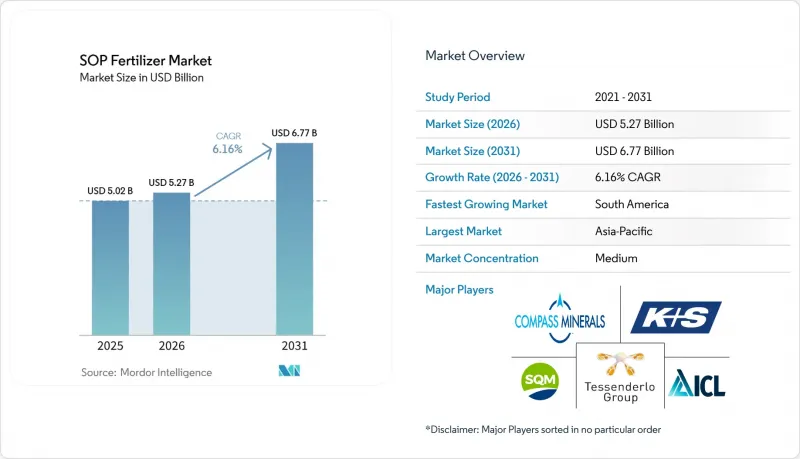
Mordor Intelligence에 의하면, SOP 시장 규모는 2025년에 50억 2,000만 달러로 평가되었고 2026년 52억 7,000만 달러에서 2031년까지 67억 7,000만 달러로 확대되어 2026년부터 2031년까지의 예측 기간에서 CAGR 6.16%로 성장할 전망입니다.
본 보고서는 유형별(표준 SOP, 과립형 SOP, 수용성 SOP 등), 시용 방법별(토양 시용, 엽면 살포, 비료 관개),작물 유형별(밭작물, 원예작물, 잔디 및 관상용 식물), 지역별(북미, 유럽, 아시아태평양 등)로 분류되어 있습니다. 시장 예측은 금액(달러) 및 수량(미터톤)으로 제시되어 있습니다.
세계 SOP 비료 시장 동향 및 인사이트
고부가가치 작물에서 염화물이 포함되지 않은 칼륨 비료에 대한 수요 증가
과일, 채소, 견과류, 담배의 염화물 민감성은 SOP 시장에 있어 강력한 농업학적 근거가 되고 있습니다. 이러한 작물 체계에서 염화물을 함유한 칼륨 비료를 시비하면 당 생성, 과실의 경도, 착색 및 수확 후 품질이 저하될 가능성이 있으므로, 작물의 영양 관리 선택은 직접적인 상업적 판단이 됩니다. 오리건 주립대학교의 『Agronomy』 저널에 게재된 2025년 연구에 따르면, 오리건주 컬럼비아 분지에서 K2SO4(황산칼륨)은 KCl(염화칼륨)과 동등한 감자 총 수확량을 가져오는 한편, 염화물 축적에 따른 괴경의 비중 저하를 피할 수 있는 것으로 밝혀졌습니다. 이 결과는 고급 식품 공급망의 구매자들이 단순히 생수확량뿐만 아니라 포장 후 품질에 대해서도 대가를 지불하는 것이 일반적이라는 점에서 중요합니다. 그 결과, SOP 시장은 판매 가치가 외관이나 저장 품질의 유지에 좌우되는 작물 체계와 여전히 밀접하게 연결되어 있습니다.
보호 재배의 확대와 원예 중심의 비료 및 관개
보호 재배는 온실, 차광 하우스, 폴리하우스 시스템 전반에 걸쳐 시장의 기술적 수요 기반을 강화하고 있습니다. 이러한 시스템에서는 정밀한 영양소 관리와 깨끗한 용액이 요구되며, 이에 따라 염화물을 포함하지 않는 고용해성 작물용 영양 제품의 가치가 높아지고 있습니다. 특히 순환식 시비 시스템은 염화물 축적에 민감하며, 과도한 염화물은 반복되는 관개 주기를 통해 영양소 균형을 깨뜨릴 우려가 있습니다. 그 결과, 수경 재배나 배지 재배에서는 SOP가 많은 경우 프리미엄 선택지라기보다는 기술적 요건으로 기능하고 있습니다. 이러한 추세는 수출용 베리류, 토마토, 피망 및 화훼 재배 프로그램에서도 두드러지며, 이 분야에서는 투입 자재의 일관성이 작물의 품질과 시장 수용을 뒷받침하고 있습니다. 보호 재배가 확대됨에 따라 황산칼륨 시장 수요는 관개 설비 및 폐쇄형 영양분 시스템과 호환되는 고순도 제품으로 이동하고 있습니다.
염화칼륨(MOP)에 비해 생산 비용이 높다는 점이 광범위한 채택을 제한하고 있습니다.
SOP 시장의 주요 상업적 제약은 염화칼륨(MOP)에 비해 비용이 높다는 점입니다. 이러한 가격 차이는 과일, 채소 및 기타 품질에 민감한 작물의 경우 감당할 수 있지만, 곡물, 유지종자 및 기타 광역 재배 시스템에서는 감당하기가 더 어렵습니다. 이 분야의 많은 생산자들은 단위 영양소당 비용을 기준으로 비료를 구매합니다. 이는 해당 작물의 경제성 측면에서 염화물 배제가 직접적인 이익으로 이어지지 않기 때문입니다. 설령 SOP에 농업적 이점이 있다 하더라도, 해당 작물이 판매 시 높은 가치를 창출하지 못한다면 가격 차이가 도입을 저해할 가능성이 있습니다. 이로 인해 광대한 농지에서 재배되는 범용 작물 재배에 있어 SOP 시장 침투에는 구조적인 상한선이 발생하며, 수요는 품질이나 시장성을 통해 가격 차이를 상쇄할 수 있는 재배 체계에 계속 집중되고 있습니다.
부문 분석
2025년, 과립형 황산칼륨(SOP)은 황산칼륨 시장 점유율의 48.5%를 차지하며, 금액 기준으로 가장 큰 제품 유형이 되었습니다. 이러한 지배적인 지위는 과수, 포도, 채소 작물의 토양 비료 시비 프로그램에서 오랫동안 확립된 역할을 반영한 것이며, 생산자들은 취급의 용이성과 밭에서의 안정적인 시비를 중요하게 생각합니다. 표준 SOP는 중요한 2위 위치를 유지하고 있는 반면, 기타 제품 유형은 규모가 더 작고 전문성이 높은 재배 프로그램에 활용되고 있습니다.
수용성 SOP는 2026년부터 2031년까지 연평균 성장률(CAGR) 7.8%로 확대될 것으로 예측되며, 황산칼륨 시장에서 가장 빠르게 성장하는 제품 유형이 될 전망입니다. 수용성 등급은 밭 살포형 제품에 비해 비료 관개, 온실 재배, 수경 재배 시스템에 더 적합하기 때문에 SOP 시장의 가치 구성에 변화를 가져오고 있습니다. 또한, 수용성 SOP는 보다 정밀한 영양분 공급을 가능하게 하는데, 이는 과일의 완성도와 균일성이 판매 가격에 직결되는 고급 원예 분야에서 중요합니다. 신뢰할 수 있는 순도, 낮은 염화물 함량, 우수한 용해 성능을 제공하는 제조업체는 이러한 추세로부터 혜택을 볼 유리한 위치에 있습니다. 장기적으로는 과립형 제품이 가장 큰 도입 기반을 유지할 것으로 예상되지만, 시장 가치의 더 큰 비중이 수용성 제형으로 이동할 가능성이 높습니다.
지역별 분석
2025년, 아시아태평양은 시장 가치의 38.5%를 차지하며 지역별 최대 부문이 되었습니다. 중국은 광범위한 보호 재배 기반, 과일 및 채소 소비 증가, 특수 작물용 자재의 적극적인 활용으로 여전히 최대의 국내 시장을 유지하고 있습니다. 인도에서는 원예에 중점을 두는 각 주에서 점적 관개가 확대되며 수용성 등급 수요를 견인함으로써 그 입지를 강화하고 있습니다. 베트남, 인도네시아, 필리핀도 수출용 채소, 커피,열대 과일 생산 프로그램에서 작물의 품질과 규격 적합성이 더욱 중요시되면서 수요 증가에 기여하고 있습니다. 해당 지역의 광대한 특수 작물 재배 면적과 고품질 영양 관리 프로그램에 대한 관심 증가로 인해, 아시아태평양은 시장의 중심적인 위치를 계속 차지하고 있습니다.
남미는 2026년부터 2031년까지 연평균 성장률(CAGR) 6.4%로 확대될 것으로 예측되며, 시장에서 가장 빠르게 성장하는 지역 부문이 될 전망입니다. 브라질에서는 생산자들이 염화물이 없는 영양 관리의 혜택을 받는 프리미엄 원예 작물로 전환하고 있어 이러한 성장을 주도하고 있습니다. 아르헨티나와 칠레에서도 유사한 추세가 관찰되며, 감귤류, 아보카도, 포도 및 관련 수출 공급망은 품질과 시장 접근 요건에 매우 민감합니다. 이 지역에서는 작물의 영양 관리 선택이 수출 경쟁력과 구매자의 수용도와 점점 더 밀접하게 연관되어 있습니다.
북미는 특산 작물, 유기농 재배 및 정밀 영양 관리 프로그램에 힘입어 시장에서 안정적인 고급 제품 시장으로서의 입지를 유지하고 있습니다. 유럽 역시 구매자들이 프리미엄 공급망에서 추적성, 생산 기준 및 저탄소 투입 자재 선택을 더욱 중시하게 됨에 따라 매력적인 시장으로 남아 있습니다. 중동에서는 제어 환경 농업과 염분이 포함된 수질 조건으로 인해 온실 시스템에서 염화물이 없는 작물 영양을 선호하게 되어 수요가 뒷받침되고 있습니다. 아프리카에서는 이집트, 남아프리카공화국, 나이지리아의 수출용 원예 작물을 통해 수요가 증가하고 있으며, 이들 국가에서는 슈퍼마켓 기준 및 해외 바이어의 요구 사항에 따라 작물 품질에 대한 기대치가 높아지고 있습니다.
기타 혜택:
- 엑셀 형식 시장 예측(ME) 시트
- 3개월간의 애널리스트 지원
자주 묻는 질문
목차
제1장 서론
제2장 본 보고서의 내용
제3장 개요 및 주요 조사 결과
제4장 주요 업계 동향
제5장 시장 규모와 성장 예측, 금액 및 수량
제6장 경쟁 구도
제7장 시장 기회와 향후 전망
JHS 26.09.01According to Mordor Intelligence, the sOP market was valued at USD 5.02 billion in 2025 and is anticipated to grow from USD 5.27 billion in 2026 to USD 6.77 billion by 2031, at a CAGR of 6.16% during the forecast period 2026-2031.
This report is Segmented by Type (Standard SOP, Granular SOP, Water-Soluble SOP, and More), by Application Mode (Soil, Foliar, and Fertigation), by Crop Type (Field Crops, Horticultural Crops, and Turf and Ornamental), and by Geography (North America, Europe, Asia-Pacific, and More). The Market Forecasts are Provided in Terms of Value (USD) and Volume (Metric Tons).
Global SOP Fertilizer Market Trends and Insights
Rising Demand for Chloride-Free Potassium Nutrition in High-Value Crops
Chloride sensitivity in fruits, vegetables, tree nuts, and tobacco provides a strong agronomic basis for the SOP market. In these crop systems, chloride-bearing potassium inputs can reduce sugar formation, fruit firmness, color development, and post-harvest quality, making crop nutrition selection a direct commercial decision. A 2025 study in Agronomy from Oregon State University found that K2SO4(Potassium sulfate) delivered total potato yields comparable to KCl (Potassium chloride) in Oregon's Columbia Basin while avoiding the tuber specific-gravity decline linked to chloride accumulation. This result is relevant because buyers in premium food supply chains typically pay for pack-out quality rather than raw yield alone. As a result, the SOP market remains closely tied to crop systems where sale value depends on maintaining visual and storage quality.
Expansion of Protected Cultivation and Horticulture-Driven Fertigation
Protected cultivation is strengthening the technical demand base for the market across greenhouse, shade-house, and polyhouse systems. These systems require precise nutrient control and clean dissolution, which increases the value of chloride-free and highly soluble crop nutrition products. Recirculating fertigation setups are particularly sensitive to chloride buildup, as excess chloride can disrupt nutrient balance across repeated irrigation cycles. As a result, SOP often functions as a technical requirement rather than a premium option in hydroponic and substrate-based farming. This trend is also evident in export-oriented berry, tomato, pepper, and floriculture programs, where input consistency supports crop quality and market acceptance. As protected cultivation expands, demand in the sulfate of potash market is shifting toward higher-purity products compatible with irrigation equipment and closed-loop nutrient systems.
Higher Production Cost Versus Muriate of Potash Limiting Broad-Acre Adoption
The primary commercial constraint on the SOP market is its higher cost compared to Muriate of Potash (MOP). This price gap is manageable for fruit, vegetable, and other quality-sensitive crops, but is more difficult to absorb in cereals, oilseeds, and other broad-acre systems. Many growers in these segments purchase fertilizers based on cost per unit of nutrient, as their crop economics do not reward chloride exclusion in the same direct way. Even where SOP offers agronomic benefits, the price premium can delay adoption if the crop does not command higher value at sale. This creates a structural ceiling on SOP market penetration in large-acreage commodity farming, with demand remaining concentrated in crop systems where quality and marketability can offset the price difference.
Other drivers and restraints analyzed in the detailed report include:
- Soil Salinity Concerns Accelerating Adoption of Low-Chloride Fertilizers
- Growth in Water-Soluble Fertilizer Adoption Across Micro-Irrigated Farms
- Price Sensitivity Among Smallholder Farmers in Emerging Markets
For complete list of drivers and restraints, kindly check the Table Of Contents.
Segment Analysis
Granular Sulfate of Potash (SOP) held 48.5% of the Sulfate of Potash market share in 2025, making it the largest product type by value. Its dominant position reflects its long-established role in soil-applied nutrition programs for tree fruits, vines, and vegetable crops, where growers value ease of handling and consistent field application. Standard SOP retained an important secondary position, while other product types served smaller and more specialized crop programs.
Water-soluble SOP is anticipated to expand at a CAGR of 7.8% between 2026 and 2031, making it the fastest-growing type in the Sulfate of Potash market. Water soluble grades are better suited to fertigation, greenhouse production, and hydroponic crop systems than field-applied products, which is shifting the value mix of the SOP market. Water-soluble SOP also supports more precise nutrient delivery, which is important in premium horticulture where fruit finish and uniformity affect realized prices. Producers offering reliable purity, low chloride content, and strong dissolution performance are better positioned to benefit from this trend. Over time, granular products are anticipated to retain the largest installed base, but a greater share of market value is likely to shift toward soluble formulations.
Complete Report Scope:
- By Type
- Standard SOP
- Granular SOP
- Water-Soluble SOP
- Other SOP Types
- By Application Mode
- Soil
- Foliar
- Fertigation
- By Crop Type
- Field Crop
- Horticultural Crop
- Turf and Ornamental
- By Geography
- North America
- Canada
- Mexico
- United States
- Rest of North America
- Europe
- France
- Germany
- Italy
- Netherlands
- Russia
- Spain
- Ukraine
- United Kingdom
- Rest of Europe
- Asia-Pacific
- Australia
- Bangladesh
- China
- India
- Indonesia
- Japan
- Pakistan
- Philippines
- Thailand
- Vietnam
- Rest of Asia-Pacific
- South America
- Argentina
- Brazil
- Rest of South America
- Middle East
- Saudi Arabia
- Turkey
- United Arab Emirates
- Rest of Middle East
- Africa
- Egypt
- Nigeria
- South Africa
- Rest of Africa
- North America
Geography Analysis
Asia-Pacific held 38.5% of the market in 2025, making it the largest regional segment by value. China remained the largest national market due to its extensive protected agriculture base, rising fruit and vegetable consumption, and strong use of specialty crop inputs. India is strengthening its position as drip irrigation expands across horticulture-focused states, driving demand for soluble grades. Vietnam, Indonesia, and the Philippines are also contributing to demand growth as export-oriented vegetable, coffee, and tropical fruit programs place greater emphasis on crop quality and compliance. The region's large specialty crop acreage and growing interest in premium nutrient programs keep Asia-Pacific at the center of the market.
South America is anticipated to expand at a 6.4% CAGR between 2026 and 2031, making it the fastest-growing regional segment in the market. Brazil is driving this growth as growers shift toward premium horticultural crops that benefit from chloride-free nutrition. Argentina and Chile are following the same trend, as citrus, avocado, grape, and related export supply chains are highly sensitive to quality and market access requirements. In this region, crop nutrition choices are increasingly linked to export readiness and buyer acceptance.
North America remains a stable, premium destination in the market, supported by specialty crops, organic production, and precision nutrient programs. Europe also remains an attractive market as buyers place greater weight on traceability, production standards, and lower-carbon input options in premium supply chains. The Middle East supports demand through controlled-environment agriculture and saline water conditions that favor chloride-free crop nutrition in greenhouse systems. Africa is adding demand through export horticulture in Egypt, South Africa, and Nigeria, where supermarket standards and overseas buyer requirements are raising crop quality expectations.
- Nutrien Ltd.
- Tessenderlo Group
- SQM S.A.
- ICL Group Ltd.
- K+S Aktiengesellschaft
- Yara International ASA
- Arab Potash Company PLC
- Intrepid Potash, Inc.
- Compass Minerals International, Inc.
- Sinofert Holdings Limited
- Coromandel International Limited
- EuroChem Group AG
- JSC Belaruskali
- Gujarat State Fertilizers and Chemicals Limited
- Sesoda Corporation
- Yunnan Yuntianhua Co., Ltd.
Additional Benefits:
- The market estimate (ME) sheet in Excel format
- 3 months of analyst support
TABLE OF CONTENTS
1 INTRODUCTION
- 1.1 Study Assumptions and Market Definition
- 1.2 Scope of the Study
- 1.3 Research Methodology
2 REPORT OFFERS
3 EXECUTIVE SUMMARY AND KEY FINDINGS
4 KEY INDUSTRY TRENDS
- 4.1 Acreage of Major Crop Types
- 4.1.1 Field Crops
- 4.1.2 Horticultural Crops
- 4.2 Average Nutrient Application Rates
- 4.3 Agricultural Land Equipped for Irrigation
- 4.4 Regulatory Framework
- 4.5 Value and Supply Chain Analysis
- 4.6 Market Drivers
- 4.6.1 Rising demand for chloride-free potassium nutrition in high-value crops
- 4.6.2 Expansion of protected cultivation and horticulture-driven fertigation
- 4.6.3 Soil salinity concerns accelerating adoption of low-chloride fertilizers
- 4.6.4 Precision nutrient management improving uptake efficiency in specialty crops
- 4.6.5 Government support for export-oriented fruit and vegetable production
- 4.6.6 Growth in water-soluble fertilizer adoption across micro-irrigated farms
- 4.7 Market Restraints
- 4.7.1 Higher production cost versus muriate of potash limiting broad-acre adoption
- 4.7.2 Limited availability of high-grade sulfate feedstock constraining supply
- 4.7.3 Price sensitivity among smallholder farmers in emerging markets
- 4.7.4 Substitution by blended fertilizers and alternative potassium sources
5 MARKET SIZE AND GROWTH FORECASTS, VALUE AND VOLUME
- 5.1 By Type
- 5.1.1 Standard SOP
- 5.1.2 Granular SOP
- 5.1.3 Water-Soluble SOP
- 5.1.4 Other SOP Types
- 5.2 By Application Mode
- 5.2.1 Soil
- 5.2.2 Foliar
- 5.2.3 Fertigation
- 5.3 By Crop Type
- 5.3.1 Field Crop
- 5.3.2 Horticultural Crop
- 5.3.3 Turf and Ornamental
- 5.4 By Geography
- 5.4.1 North America
- 5.4.1.1 Canada
- 5.4.1.2 Mexico
- 5.4.1.3 United States
- 5.4.1.4 Rest of North America
- 5.4.2 Europe
- 5.4.2.1 France
- 5.4.2.2 Germany
- 5.4.2.3 Italy
- 5.4.2.4 Netherlands
- 5.4.2.5 Russia
- 5.4.2.6 Spain
- 5.4.2.7 Ukraine
- 5.4.2.8 United Kingdom
- 5.4.2.9 Rest of Europe
- 5.4.3 Asia-Pacific
- 5.4.3.1 Australia
- 5.4.3.2 Bangladesh
- 5.4.3.3 China
- 5.4.3.4 India
- 5.4.3.5 Indonesia
- 5.4.3.6 Japan
- 5.4.3.7 Pakistan
- 5.4.3.8 Philippines
- 5.4.3.9 Thailand
- 5.4.3.10 Vietnam
- 5.4.3.11 Rest of Asia-Pacific
- 5.4.4 South America
- 5.4.4.1 Argentina
- 5.4.4.2 Brazil
- 5.4.4.3 Rest of South America
- 5.4.5 Middle East
- 5.4.5.1 Saudi Arabia
- 5.4.5.2 Turkey
- 5.4.5.3 United Arab Emirates
- 5.4.5.4 Rest of Middle East
- 5.4.6 Africa
- 5.4.6.1 Egypt
- 5.4.6.2 Nigeria
- 5.4.6.3 South Africa
- 5.4.6.4 Rest of Africa
- 5.4.1 North America
6 COMPETITIVE LANDSCAPE
- 6.1 Market Concentration
- 6.2 Strategic Moves
- 6.3 Market Share Analysis
- 6.4 Company Profiles (Includes Global Level Overview, Market Level Overview, Core Segments, Financials as Available, Strategic Information, Market Rank/Share for Key Companies, Products and Services, and Recent Developments)
- 6.4.1 Nutrien Ltd.
- 6.4.2 Tessenderlo Group
- 6.4.3 SQM S.A.
- 6.4.4 ICL Group Ltd.
- 6.4.5 K+S Aktiengesellschaft
- 6.4.6 Yara International ASA
- 6.4.7 Arab Potash Company PLC
- 6.4.8 Intrepid Potash, Inc.
- 6.4.9 Compass Minerals International, Inc.
- 6.4.10 Sinofert Holdings Limited
- 6.4.11 Coromandel International Limited
- 6.4.12 EuroChem Group AG
- 6.4.13 JSC Belaruskali
- 6.4.14 Gujarat State Fertilizers and Chemicals Limited
- 6.4.15 Sesoda Corporation
- 6.4.16 Yunnan Yuntianhua Co., Ltd.


