

|
시장보고서
상품코드
2117624
모바일 DRAM 시장 : 점유율 분석, 업계 동향과 통계, 성장 예측(2026-2031년)Mobile DRAM - Market Share Analysis, Industry Trends & Statistics, Growth Forecasts (2026 - 2031) |
||||||
 Mordor Intelligence
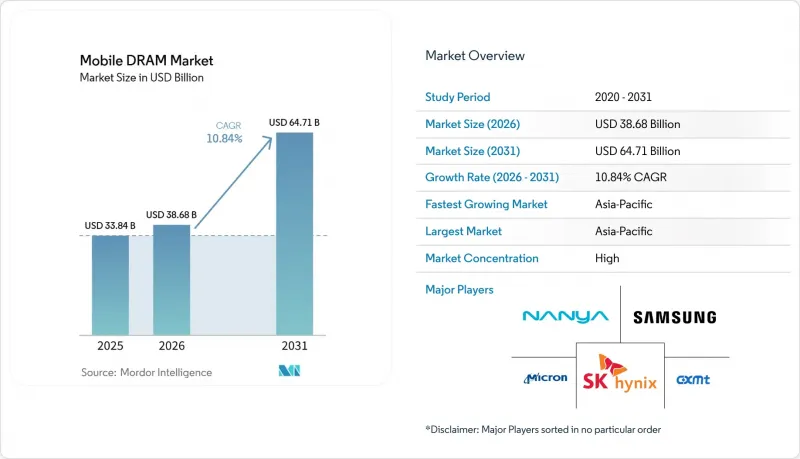
Mordor Intelligence에 의하면, 모바일 DRAM 시장 규모는 2025년에 338억 4,000만 달러가 되고, 2031년까지 647억 1,000만 달러에 이를 것으로 예측되며, 2026년부터 2031년까지 CAGR 10.84%로 성장할 전망입니다.
본 보고서는 세대별(LPDDR3, LPDDR4 및 LPDDR4X, LPDDR5 및 LPDDR5X, LPDDR6), 패키지 용량별(4GB 이하, 4GB-8GB, 8GB-16GB, 16GB 이상),패키지 구성(디스크리트 LPDDR 패키지, 패키지 온 패키지, 멀티칩 패키지 등), 지역(북미, 유럽, 아시아태평양, 기타 지역)별로 분류되어 있습니다. 시장 전망은 금액(달러) 기준으로 제시되어 있습니다.
세계 모바일 DRAM 시장 동향 및 인사이트
AI 탑재 스마트폰이 기기당 LPDDR 수요를 증가시키고 있다.
기기 내 AI가 주요 기능에서 프리미엄 스마트폰 전반에 탑재되는 제품으로 전환됨에 따라, 모바일 DRAM 시장에서는 기기당 메모리 수요가 뚜렷이 증가하고 있습니다. 2025년 플래그십 모델의 평균 메모리 용량은 12GB였으나, 생성형 AI 작업, 실시간 이미지 처리, 상시 가동되는 신경망 기능에는 더 대용량이고 고속인 로컬 메모리 풀이 필요하기 때문에 2028년까지 이러한 플랫폼은 18GB로 전환될 전망입니다. 이러한 변화가 중요한 이유는 AI 기능이 단순한 대용량뿐만 아니라 지속적인 고대역폭 액세스와 저전력 소비에 의존하기 때문입니다. 따라서 속도와 효율성을 모두 향상시키는 공급업체일수록 프리미엄 제품 수주를 확보하기 쉬운 입장에 있습니다. SK하이닉스는 2026년 3월 검증을 완료한 자사의 1c LPDDR6에 대해, 10.7 Gbps를 초과하는 속도에서 LPDDR5X 대비 데이터 처리 속도가 33% 향상되고 전력 효율이 20% 향상된다고 발표했습니다. 이는 기기 내 AI 워크로드를 위해 설계된 스마트폰 및 태블릿을 직접 타겟으로 하고 있습니다. 그 결과, 프리미엄 AI 스마트폰과 기존의 보급형 모델 사이에는 성능 및 가격 면에서 더 큰 격차가 발생하게 되며, 모바일 DRAM 시장은 과거 DRAM 세대 교체 시기보다 양극화가 더욱 심화될 것입니다.
AI 서버로의 LPDDR 확대
또한 LPDDR 아키텍처가 기존의 DDR 중심 구성보다 대역폭과 전력 효율을 우선시하는 AI 서버 및 가속기 설계에 채택됨에 따라, 모바일 DRAM 시장은 휴대전화 단말기의 범위를 넘어 확대되고 있습니다. AWS는 Arm 기반 Graviton 4 서버 칩에 LPDDR5X를 채택했으며, 마이크로소프트도 Arm 기반 Cobalt 100 프로세서에 LPDDR5X를 통합했습니다. 이는 DDR5에 비해 대역폭을 확대하면서도 전력 소비를 대폭 줄일 수 있기 때문입니다. 인텔의 ‘Crescent Island’ AI 추론 GPU는 160GB의 LPDDR5X를 채택하고 있으며, 퀄컴의 ‘AI200’ 및 ‘AI250’ 서버 가속기는 최대 768GB의 LPDDR을 지원합니다. 이는 모바일 메모리 설계에 대한 전문 지식이 이제 데이터센터용 하드웨어에 직접 활용되고 있음을 보여줍니다. 엔비디아의 ‘Vera Rubin’ 플랫폼에서 발생하는 수요만으로도 2027년에는 60억 GB의 LPDDR이 필요할 것으로 추정되며, 이는 같은 해 애플과 삼성의 스마트폰용 LPDDR 총 조달량을 약간 상회하는 규모입니다. 이는 이 새로운 수요원이 얼마나 급속도로 확대되고 있는지를 여실히 보여줍니다. 몇년전만 해도 이 수요원은 주류 모바일 계획에 존재하지 않았기 때문에 웨이퍼 할당이 부족해졌으며, 디바이스 환경과 서버 환경 모두에서 제품 인증을 획득할 수 있는 공급업체의 전략적 가치가 높아지고 있습니다.
HBM 및 DDR5 할당으로 인한 LPDDR 웨이퍼 생산 능력 압박
모바일 DRAM 시장에서 단기적으로 가장 큰 제약 요인은 HBM과 DDR5가 본래 스마트폰, 태블릿 및 관련 엣지 플랫폼을 위한 LPDDR 생산을 뒷받침해야 할 웨이퍼 생산 할당량을 빼앗고 있다는 점입니다. HBM 생산은 표준 DRAM에 비해 웨이퍼 생산 능력 측면에서 3대 1의 트레이드오프를 수반하기 때문에 명목상 LPDDR 수요 상황이 개선되고 있음에도 불구하고 HBM 생산이 확대될 때마다 LPDDR공급 여력은 더욱 핍박하게 됩니다. SK하이닉스는 2025년 말에 ‘생산·출하 동시 진행’에 가까운 재고 상황에 도달했으나, 한편 LPDDR5X의 납기 기간은 공급망 일부에서 26-39주에 달하고, 가용 여력이 얼마나 좁아지고 있는지를 여실히 보여주고 있습니다. Samsung Electronics의 평택 콤플렉스 내 신규 팹 가동 및 SK하이닉스의 확장 계획에 따른 공급 증가는 2027년까지는 구조적인 완화 효과를 가져오지 못할 것으로 예상되므로, 예측 기간의 초기 단계에서는 계속해서 할당 압박이 지속될 전망입니다. 이로 인해 가격은 강세를 보일 것이며, 출하량 확대가 지연됨에 따라 모바일 DRAM 시장은 물량 기준보다 금액 기준에서 더 빠른 성장세를 보일 것입니다.
부문 분석
2025년, LPDDR5 및 LPDDR5X는 모바일 DRAM 시장 규모의 57.8%를 차지하며, LPDDR6이 상용화되기 전부터 이 세대가 매출의 중심을 차지해 왔습니다. 이러한 위상은 플래그십 스마트폰, AI PC 및 신흥 AI 서버 설계에서 이미 이 세대가 고도의 워크로드 작동 대역폭 기준으로 취급되고 있다는 사실을 반영합니다. 2025년에도 LPDDR4X는 총 비트 출력의 42%를 차지했지만, 삼성이 신규 공급에서 철수함에 따라 수익의 중심은 레거시 제품에서 새로운 노드로 이동하고 있습니다. 또한, 2025년 8월 JEDEC 프레임워크를 통해 공통된 최소 준수 기준이 설정됨에 따라, 구세대 제품이 프리미엄 칩셋 로드맵에서 입지를 유지하기가 어려워졌습니다.
LPDDR6는 2031년까지 연평균 성장률(CAGR)이 12.9%로 가장 빠르게 성장하는 세대이며, 이러한 성장 속도는 하이엔드 디바이스 및 플랫폼 설계가 메모리 성능의 다음 변혁에 얼마나 신속하게 대응하려 하고 있는지를 반영하고 있습니다. SK하이닉스는 IEEE ISSCC 2026에서 핀당 14.4Gb/s,LPDDR5X 대비 33% 높은 대역폭과 20% 이상 뛰어난 에너지 효율을 실현한 1c LPDDR6 설계를 발표하며, 차세대 플래그십 제품 인증을 위한 초기 우위를 공고히 하고 있습니다. 삼성은 같은 컨퍼런스에서 핀당 12.8 Gb/s의 전송 속도와 21% 향상된 전력 효율을 실현한 12nm급 LPDDR6 아키텍처를 발표했으며, 이후 퀄컴에 LPDDR6X 샘플을 제공했습니다. 이는 경쟁의 문턱이 얼마나 빠르게 높아지고 있는지를 보여줍니다. LPDDR3는 현재 레거시 임베디드 기기나 산업용 이용 사례에서만 제한적인 관련성을 가지고 있을 뿐이며, 모바일 DRAM 시장은 LPDDR4X에서 LPDDR5X, 그리고 LPDDR6로의 전환 경로를 통해 점점 더 정의되고 있습니다.
지역별 분석
아시아태평양은 2025년에 모바일 DRAM 시장 점유율의 61.1%를 차지하며, 2031년까지 연평균 성장률(CAGR) 11.5%를 나타낼 것으로 예측됩니다. 이에 따라 이 지역은 공급과 수요 양면에서 중심적인 위치를 유지하게 될 것입니다. 한국은 삼성의 평택 복합 단지와 SK하이닉스의 M15X 및 계획 중인 M17 확장 계획을 통해 여전히 핵심 생산 거점으로 자리 잡고 있습니다. 한편, 중국은 CXMT의 LPDDR5X 양산 확대와 국내 인증 범위 확대를 통해 그 역할을 강화하고 있습니다. CXMT는 2026년 IPO 투자설명서에 인용된 데이터에 따르면, 2025년 4분기에 세계 DRAM 시장에서 7.7%의 점유율을 달성했으며, 이는 주요 공급업체 그룹 하위 계층에서 일어나고 있는 구조적 변화를 뒷받침하는 것입니다. 대만은 그 생태계가 첨단 모바일 설계 분야에서 전 세계 고객을 위한 ‘패키지 온 패키지(PoP)’ 및 ‘시스템 인 패키지(SiP)’ 통합 프로그램을 모두 지원하고 있기 때문에 중요한 패키징 계층을 담당하고 있습니다. 마이크론은 2026년 7월, 1조 5,000억 엔(93억 달러)을 투자하는 히로시마 공장 확장 계획의 기공식을 가졌습니다. 이 프로젝트에는 경제산업성으로부터 최대 5,000억 엔(31억 달러)의 지원이 포함되어 있으며, 이를 통해 일본은 이 지역 내 제2의 거점으로서의 역할을 강화하게 될 것입니다.
모바일 DRAM 시장에서 북미의 위상은 현재의 생산 점유율보다는 기술 로드맵과 하이퍼스케일러 수요에 의해 형성되고 있습니다. 마이크론은 2035년까지 미국의 제조 거점에 2,500억 달러 이상을 투자할 계획이며, DRAM 생산량의 40%를 국내 팹에서 생산하는 것을 목표로 하고 있지만, 모바일 관련 주요 신규 공급은 2027년 이후에 시작될 전망입니다. 유럽은 수요 주도형이며, 소프트웨어 정의 차량(SDV) 및 첨단 운전자 보조 시스템(ADAS)을 통해 LPDDR5X가 중앙 집중식 콕핏 및 컴퓨팅 플랫폼에 채택되고 있습니다. 자동차 안전 및 사이버 보안 프레임워크에 기반한 규정 준수 요건으로 인해, 유럽 수요는 가전제품 수요 주기만 고려할 때보다 더 안정적인 기반을 갖추고 있습니다.
세계 기타 지역에서는 모바일 DRAM 시장이 현지 칩 생산보다는 주로 스마트폰의 보급과 5G의 확산에 계속해서 좌우되고 있습니다. 남미, 중동 및 아프리카 및 남아시아 일부는 여전히 소비자 수요의 중심지이므로, 이들 지역의 메모리 탑재량 동향은 전 세계 휴대폰 제조업체들이 어느 정도의 가격으로 부품을 조달할 수 있는지에 크게 좌우됩니다. CXMT의 LPDDR4X 및 LPDDR5 제품은 사하라 이남 아프리카에서 확고한 입지를 구축한 브랜드를 포함하여, 해당 지역에 서비스를 제공하는 안드로이드 공급망에 이미 진입해 있습니다. 또한, 걸프 시장에서도 전기차 수입에 따라 LPDDR5X급 차량용 메모리에 의존하는 ADAS 탑재 모델이 증가함에 따라, 자동차용 메모리 수요가 확대되기 시작했습니다.
기타 혜택:
- 엑셀 형식 시장 예측(ME) 시트
- 3개월간의 애널리스트 지원
자주 묻는 질문
목차
제1장 서론
제2장 조사 방법
제3장 개요
제4장 시장 구도
제5장 시장 규모와 성장 예측
제6장 경쟁 구도
제7장 시장 기회와 향후 전망
JHS 26.09.01According to Mordor Intelligence, the mobile DRAM market size stood at USD 33.84 billion in 2025 and is forecast to reach USD 64.71 billion by 2031, growing at a CAGR of 10.84% from 2026 to 2031.
This report is Segmented by Generation (LPDDR3, LPDDR4 and LPDDR4X, LPDDR5 and LPDDR5X, and LPDDR6), Package Capacity (Up To 4 GB, 4 GB To 8 GB, 8 GB To 16 GB, and Above 16 GB), Package Configuration (Discrete LPDDR Packages, Package-On-Package, Multi-Chip Packages, and More), and Geography (North America, Europe, Asia-Pacific, and Rest of the World). The Market Forecasts are Provided in Terms of Value (USD).
Global Mobile DRAM Market Trends and Insights
AI Smartphones Increasing Per-Device LPDDR Demand
The mobile DRAM market is seeing a clear rise in per-device memory demand as on-device AI moves from headline features into shipping products across the premium smartphone tier. Flagship configurations averaged 12 GB in 2025, and those same platforms are moving toward 18 GB by 2028 as generative AI tasks, real-time image processing, and always-on neural features require a larger and faster local memory pool. This shift matters because AI features depend on sustained high-bandwidth access and low power draw, not only on raw capacity, so suppliers that improve both speed and efficiency are better placed to capture premium programs. SK hynix said its 1c LPDDR6, validated in March 2026, delivers 33% faster data processing and 20% better power efficiency than LPDDR5X at speeds above 10.7 Gbps, directly targeting smartphones and tablets built for on-device AI workloads. The result is a wider performance and pricing gap between premium AI phones and legacy entry devices, making the mobile DRAM market more polarized than during earlier DRAM generation transitions.
LPDDR Expansion Into AI Servers
The mobile DRAM market is also expanding beyond handsets as LPDDR architectures move into AI server and accelerator designs that prioritize bandwidth and power efficiency over older DDR-centric configurations. AWS adopted LPDDR5X in its Arm-based Graviton4 server chip, and Microsoft integrated LPDDR5X into its Arm-based Cobalt 100 processor because it can materially reduce power use while increasing bandwidth relative to DDR5. Intel's Crescent Island AI inference GPU uses 160 GB of LPDDR5X, and Qualcomm's AI200 and AI250 server accelerators support up to 768 GB of LPDDR, which shows that mobile memory design expertise now has a direct path into data center hardware. Demand from NVIDIA's Vera Rubin platform alone was estimated at 6 billion GB of LPDDR in 2027, slightly above the combined smartphone LPDDR procurement of Apple and Samsung that year, underscoring how quickly this new demand pool is scaling. Because this demand source did not exist in mainstream mobile planning a few years ago, it is tightening wafer allocation and raising the strategic value of suppliers that can qualify products for both device and server environments.
HBM And DDR5 Allocation Crowding Out LPDDR Wafer Capacity
The biggest near-term brake on the mobile DRAM market is that HBM and DDR5 are taking wafer space that would otherwise support LPDDR output for smartphones, tablets, and related edge platforms. HBM production carries a 3-to-1 wafer capacity trade-off compared to standard DRAM, so each incremental HBM push tightens LPDDR availability even as nominal LPDDR demand conditions improve. SK hynix reached near-produce-and-ship inventory status in late 2025, while LPDDR5X delivery times stretched to 26 to 39 weeks across parts of the supply chain, underscoring how narrow the available cushion had become. New fab additions from Samsung's Pyeongtaek complex and SK hynix's expansion pipeline are not expected to bring structural relief before 2027, so the early part of the forecast period remains exposed to allocation pressure. This keeps prices firm and delays volume realization, allowing the mobile DRAM market to grow in value faster than in physical shipments.
Other drivers and restraints analyzed in the detailed report include:
- 5G Premiumization Raising LPDDR Demand
- LPDDR4X Scarcity Forcing Refresh To Higher Generations
- Smartphone Cost Pressure Slowing Upgrade Cycle
For complete list of drivers and restraints, kindly check the Table Of Contents.
Segment Analysis
LPDDR5 and LPDDR5X held 57.8% of the mobile DRAM market size in 2025, which kept this generation at the center of revenue even before LPDDR6 reached commercial scale. Their position reflects the fact that flagship smartphones, AI PCs, and emerging AI server designs already treat this generation as the working bandwidth baseline for advanced workloads. LPDDR4X still accounted for 42% of total bit output in 2025, but Samsung's exit from new supply is shifting the revenue center of gravity away from legacy products and toward newer nodes. The August 2025 JEDEC framework also set a common compliance floor, which made it harder for older generations to stay relevant in premium chipset road maps.
LPDDR6 is the fastest-growing generation at a 12.9% CAGR through 2031, and that pace reflects how quickly high-end device and platform designs are preparing for the next shift in memory performance. SK hynix presented a 1c LPDDR6 design at IEEE ISSCC 2026 with 14.4 Gb/s per pin, 33% higher bandwidth, and more than 20% better energy efficiency than LPDDR5X, which strengthens its early position in the next wave of flagship qualifications. Samsung presented a 12nm-class LPDDR6 architecture at the same conference with 12.8 Gb/s per pin and a 21% power efficiency improvement, and it later sent LPDDR6X samples to Qualcomm, which shows how quickly the competitive bar is moving. LPDDR3 now has only limited relevance in legacy embedded and industrial use cases, so the mobile DRAM market is increasingly defined by the migration path from LPDDR4X to LPDDR5X and then to LPDDR6.
Complete Report Scope:
- By Generation
- LPDDR3
- LPDDR4 and LPDDR4X
- LPDDR5 and LPDDR5X
- LPDDR6
- By Package Capacity
- Up to 4 GB
- 4 GB to 8 GB
- 8 GB to 16 GB
- Above 16 GB
- By Package Configuration
- Discrete LPDDR Packages
- Package-on-Package
- Multi-Chip Packages (MCP)
- System-in-Package (SiP)
- By Geography
- North America
- Europe
- Asia-Pacific
- China
- Japan
- South Korea
- Taiwan
- Rest of Asia-Pacific
- Rest of the World
Geography Analysis
Asia-Pacific held 61.1% of the mobile DRAM market share in 2025 and is projected to grow at an 11.5% CAGR through 2031, which keeps the region at the center of both supply and demand. South Korea remains the core production base through Samsung's Pyeongtaek complexes and SK hynix's M15X and planned M17 expansion path, while China is building its role through CXMT's LPDDR5X ramp and wider domestic qualification. CXMT reached a 7.7% share of the global DRAM market in the fourth quarter of 2025, according to data cited in its 2026 IPO prospectus, which confirmed a structural change below the leading supplier group. Taiwan adds a critical packaging layer because its ecosystem supports both Package-on-Package and System-in-Package integration programs for global customers across advanced mobile designs. Micron broke ground on a JPY 1.5 trillion (USD 9.3 billion) Hiroshima expansion in July 2026, and the project included up to JPY 500 billion (USD 3.1 billion) in support from Japan's Ministry of Economy, Trade and Industry, which reinforces Japan's role as a secondary regional anchor.
North America's position in the mobile DRAM market is shaped more by technology road maps and hyperscaler demand than by current production share. Micron said it plans to invest more than USD 250 billion in United States manufacturing through 2035 and aims for 40% of its DRAM output to come from domestic fabs, although major new mobile-relevant supply will arrive after 2027. Europe is more demand driven, with software-defined vehicles and advanced driver assistance systems pulling LPDDR5X into centralized cockpit and compute platforms. Compliance requirements under automotive safety and cybersecurity frameworks give European demand a steadier base than consumer electronics cycles alone.
In the rest of the world, the mobile DRAM market remains tied mainly to smartphone adoption and 5G rollout rather than to local chip production. South America, the Middle East and Africa, and parts of South Asia are still consumer demand centers, so their memory content trend depends heavily on what global handset brands can source at workable price points. CXMT's LPDDR4X and LPDDR5 products have already entered Android supply chains that serve these regions, including brands with strong positions in sub-Saharan Africa. Gulf markets are also starting to add automotive memory demand as electric vehicle imports bring more ADAS-equipped models that rely on LPDDR5X-class in-vehicle memory.
- Samsung Electronics Co., Ltd.
- SK hynix Inc.
- Micron Technology, Inc.
- ChangXin Memory Technologies, Inc.
- Nanya Technology Corporation
- Integrated Silicon Solution, Inc.
- Elite Semiconductor Microelectronics Technology Inc.
- AP Memory Technology Corporation
- Etron Technology, Inc.
Additional Benefits:
- The market estimate (ME) sheet in Excel format
- 3 months of analyst support
TABLE OF CONTENTS
1 INTRODUCTION
- 1.1 Study Assumptions and Market Definition
- 1.2 Scope of the Study
2 RESEARCH METHODOLOGY
3 EXECUTIVE SUMMARY
4 MARKET LANDSCAPE
- 4.1 Market Overview
- 4.2 Market Drivers
- 4.2.1 AI Smartphones Increasing Per-Device LPDDR Content
- 4.2.2 5G Premiumization Raising LPDDR5 and LPDDR5X Adoption
- 4.2.3 LPDDR Expansion Into AI Servers and Client Modules
- 4.2.4 Software-Defined Vehicles and ADAS Raising Automotive Design-Ins
- 4.2.5 LPDDR4X Scarcity Forcing Refresh Cycles
- 4.2.6 Ultra-Thin Notebooks and AI PCs Favoring Soldered LPDDR
- 4.3 Market Restraints
- 4.3.1 High Supplier Concentration Amplifying Pricing Volatility
- 4.3.2 HBM and DDR5 Allocation Crowding Out Mobile DRAM Supply
- 4.3.3 Advanced Node Yield and Qualification Risk Delaying LPDDR6 Cost Down
- 4.3.4 Smartphone Cost Pressure Slowing Penetration in Low and Mid-Tier Devices
- 4.4 Industry Value Chain Analysis
- 4.5 Regulatory Landscape
- 4.6 Technological Outlook
- 4.7 Impact of Macroeconomic Factors on the Market
- 4.8 Porter's Five Forces Analysis
- 4.8.1 Bargaining Power of Suppliers
- 4.8.2 Bargaining Power of Buyers
- 4.8.3 Threat of New Entrants
- 4.8.4 Threat of Substitutes
- 4.8.5 Intensity of Competitive Rivalry
5 MARKET SIZE AND GROWTH FORECASTS (VALUE)
- 5.1 By Generation
- 5.1.1 LPDDR3
- 5.1.2 LPDDR4 and LPDDR4X
- 5.1.3 LPDDR5 and LPDDR5X
- 5.1.4 LPDDR6
- 5.2 By Package Capacity
- 5.2.1 Up to 4 GB
- 5.2.2 4 GB to 8 GB
- 5.2.3 8 GB to 16 GB
- 5.2.4 Above 16 GB
- 5.3 By Package Configuration
- 5.3.1 Discrete LPDDR Packages
- 5.3.2 Package-on-Package
- 5.3.3 Multi-Chip Packages (MCP)
- 5.3.4 System-in-Package (SiP)
- 5.4 By Geography
- 5.4.1 North America
- 5.4.2 Europe
- 5.4.3 Asia-Pacific
- 5.4.3.1 China
- 5.4.3.2 Japan
- 5.4.3.3 South Korea
- 5.4.3.4 Taiwan
- 5.4.3.5 Rest of Asia-Pacific
- 5.4.4 Rest of the World
6 COMPETITIVE LANDSCAPE
- 6.1 Market Concentration
- 6.2 Strategic Moves
- 6.3 Market Share Analysis
- 6.4 Company Profiles (includes Global Level Overview, Market Level Overview, Core Segments, Financials as available, Strategic Information, Market Rank/Share, Products and Services, Recent Developments)
- 6.4.1 Samsung Electronics Co., Ltd.
- 6.4.2 SK hynix Inc.
- 6.4.3 Micron Technology, Inc.
- 6.4.4 ChangXin Memory Technologies, Inc.
- 6.4.5 Nanya Technology Corporation
- 6.4.6 Integrated Silicon Solution, Inc.
- 6.4.7 Elite Semiconductor Microelectronics Technology Inc.
- 6.4.8 AP Memory Technology Corporation
- 6.4.9 Etron Technology, Inc.
7 MARKET OPPORTUNITIES AND FUTURE OUTLOOK
- 7.1 White-Space and Unmet-Need Assessment


