

|
시장보고서
상품코드
2117973
기압외상 : 시장 점유율 분석, 업계 동향 및 통계, 성장 예측(2026-2031년)Barotrauma - Market Share Analysis, Industry Trends & Statistics, Growth Forecasts (2026 - 2031) |
||||||
 Mordor Intelligence
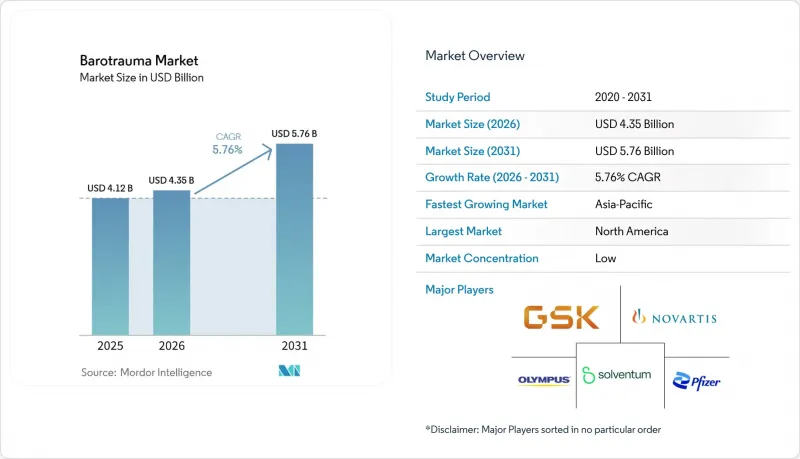
에 의하면, 기압외상 시장 규모는 2025년 41억 2,000만 달러로 평가되었습니다. 2026년에는 43억 5,000만 달러로 확대되어 2031년까지 57억 6,000만 달러에 이를 것으로 예상되고 2026-2031년에 걸쳐 CAGR 5.76%로 성장할 전망입니다.
본 보고서는 유형별(이압 손상, 부비동 기압외상, 폐 기압외상, 기타),서비스별(진단(신체 검사, 이경 검사, 청력 검사, X선 검사, CT 스캔 등), 치료(보존 요법, 약물 요법, 산소 요법, 재가압 요법, 외과 수술)), 최종 사용자(병원, 전문 클리닉, 외래수술센터(ASC), 기타),지역(북미, 유럽, 아시아태평양, 기타)별로 분류되어 있습니다. 시장 예측은 금액(달러)으로 표시되어 있습니다.
세계의 기압외상 시장 동향 및 인사이트
레크리에이션 다이빙 및 항공 분야의 노출 증가
2025년에 전 세계 항공 여객 수가 49억 7,000만 명에 달하고, 수요가 5.3% 증가하며, 전 세계 탑승률이 83.5%에 이르렀기 때문에 기압외상 시장은 꾸준히 확대되는 여행객층의 영향을 받고 있습니다. 미국에서만 2025년에 8억 9,010만 명의 여객 수를 기록했는데, 이는 일상적인 의료 현장에서 항공 관련 귀 및 부비동 증상에 대한 지속적인 노출 기반이 얼마나 커지고 있는지를 보여줍니다. 레크리에이션 다이빙 또한 중요한 요소가 되고 있습니다. CDC의 추정에 따르면, 미국에는 60만 명에서 350만 명의 활동적인 스쿠버 다이버가 있으며, 이들은 일회성 노출이 아닌 반복적인 기압 변화를 경험하고 있기 때문입니다.
이러한 노출 패턴이 중요한 이유는 귀나 부비동 관련 사례가 경미한 증상으로 시작되는 경우가 많음에도 불구하고, 공식적인 의료 경로를 통해 지속적인 약물 처방 수요, 이비인후과 내원, 경과 관찰을 위한 통원을 유발하기 때문입니다. IATA는 2026년에 승객 수 증가세가 둔화될 것으로 예측하고 있지만, 비행기를 자주 이용하는 사람들의 기반은 여전히 충분히 넓어, 1차 진료, 응급 의료, 전문 이비인후과 각 채널에서 기압외상 관련 사례가 꾸준히 발생할 것으로 보입니다.
중환자실(ICU)에서의 인공호흡 관리 및 욕창 검출 확대
기압외상 시장은 중환자 치료 분야에서도 확대되고 있습니다. 이는 인공호흡기를 착용한 환자의 폐 손상이 사례 파악에 있어 더 크고 뚜렷한 비율을 차지하게 되었기 때문입니다. 2025년 임상 리뷰에 따르면, 현대의 저분당 환기량 요법 하에서 인공호흡기를 착용한 성인의 폐기압외상 비율은 평균 10% 이하이지만, 고령화가 진행되고 수용 능력이 높은 병원 시스템에서 인공호흡기를 착용한 환자의 절대 수는 여전히 높은 수준을 유지하고 있습니다.
2025년에 실시된 4,298명의 ICU 환자를 대상으로 한 베이즈법 메타분석에 따르면, 호흡수와 구동압이 최대 흡기압 단독보다 더 중요한 상관 요인임이 밝혀졌습니다. 이에 따라 임상의들은 보다 광범위한 모니터링 논리를 채택하고 있습니다. 이러한 변화는 복잡한 폐 질환 사례가 단일 매개변수에 기반한 프로토콜에 부합하는 경우가 드물기 때문에 기압외상 시장에서 호흡 모니터링, CT 기반 치료 단계 상향 조정, 다학제 협력을 통한 중환자실(ICU) 워크플로우에 대한 수요 증가를 뒷받침하고 있습니다.
고압 산소 요법 및 전문 의료의 높은 비용
비용은 여전히 기압외상 시장에서 명백한 걸림돌이 되고 있으며, 특히 고압 산소 요법이 일반적인 보험 적용 범위 밖이거나 유일한 시설까지 장거리를 이동해야 하는 경우에 두드러집니다. 고압 산소 요법의 비용은 일반적으로 1회당 200-400달러이며, 중증 감압증의 경우 20-40회의 치료가 필요할 수 있고, 치료 내용에 따라 1건당 총 비용이 4,000-1만 6,000달러에 달하기도 합니다. 많은 민간 보험사에서는 특정 적응증에 대해 여전히 고압 산소 요법(HBOT)을 실험적 또는 연구 단계의 치료로 간주하고 있으며, 그 결과 환자에게는 막대한 본인 부담이 발생하고, 진료 의뢰 가능 여부를 예측하기 어려워지고 있습니다. 의료기관 차원에서도 설비 확충에는 막대한 비용이 소요됩니다. 예를 들어, 바라가 카운티 기념 병원은 2025년 미시간주 최초의 HBOT 시설 건설을 위해 30만 달러 규모의 건설 계약을 체결했습니다. 다인용 시스템의 경우 설비 투자 부담이 더욱 커지지만, 중증 감압증에 대해서는 여전히 재가압 요법이 표준 치료로 간주되고 있기 때문에 재정적으로 어려운 지역에서는 공급 측면과 비용 측면의 장벽을 동시에 직면하게 됩니다.
부문별 분석
귀 기압외상은 2025년 매출의 52.36%를 차지하며, 기압외상 시장에서 가장 큰 점유율을 차지했습니다. 이는 다이빙, 항공, 치료 목적의 노출 등 모든 경로에서 여전히 가장 흔한 압력 관련 손상이기 때문입니다. 이 부문은 충혈 완화제나 비강용 코르티코스테로이드로 시작하여, 증상이 지속되거나 구조적 손상이 의심되는 경우에만 클리닉에서의 시술이나 외과적 시술로 넘어가는 정평이 난 치료 경로의 혜택을 받고 있습니다. 항공 여행 및 레크리에이션 다이빙으로 인한 반복적인 노출로 인해 환자 수는 높은 수준을 유지하고 있으며, 이는 이비인후과 외래 진료 수요의 안정과 기압외상 시장에서의 확실한 처방 갱신을 뒷받침하고 있습니다.
폐 기압외상은 연평균 성장률(CAGR) 6.87%를 나타낼 것으로 예측되며, 2031년까지 기압외상 시장 규모(유형별)에서 가장 빠른 성장 속도를 보일 것으로 전망됩니다. 이러한 증가는 인공호흡기를 착용한 중환자실(ICU) 환자 수 증가뿐만 아니라, 단일 압력 임계값에 의존하지 않고 호흡 수나 구동 압력을 보다 상세하게 모니터링하게 된 것과 관련이 있습니다.
지역별 분석
북미는 2025년 매출의 41.34%를 차지하며, 지역별 기압외상 시장 규모에서 가장 큰 점유율을 기록했습니다. 미국에서는 2025년에 8억 9,010만 명의 승객 수가 기록되었으며, 이에 따라 이 지역은 전 세계 기압외상 시장에서 항공 관련 귀 및 부비동 증상에 대한 가장 큰 지속적인 노출 기반을 보유하고 있습니다. 또한, CDC(미국 질병통제예방센터)의 추정에 따르면, 미국에는 60만 명에서 350만 명에 달하는 활동적인 스쿠버 다이버가 존재하며, 이는 지역 수요에 레크리에이션 다이빙이라는 큰 층을 더해 외래 이비인후과 진료 건수의 지속적인 증가를 뒷받침하고 있습니다.
유럽은 독일, 프랑스, 영국에 확립된 전문의 네트워크와 충실한 고압 산소 치료 인프라에 힘입어, 기압외상 시장에서 여전히 2위 지역 클러스터를 유지하고 있습니다. 2025년과 2026년에는 HAUX가 니스에 유럽 최대 규모의 단일 거점형 고압 산소 챔버 시스템을 설치함에 따라 설비 용량 확대가 가속화되었으며, 이 지역의 도입 실적과 챔버를 중심으로 한 의료적 역할이 강화되었습니다.
아시아태평양은 연평균 성장률(CAGR) 7.23%를 나타낼 것으로 예측되며, 기압외상 시장에서 가장 빠르게 성장하는 지역 부문이 될 전망입니다. 중국에서는 2025년에 7억 7,610만 명의 승객 수가 기록되었으며, 동남아시아 연안 시장에서는 병원 인프라에 대한 투자와 더불어 다이빙으로 인한 노출이 증가함에 따라 외래 및 급성기 의료 수요 모두 확대되고 있습니다. 2025년에 실시된 일본의 고압산소요법(HBO) 장치에 관한 전국 조사에서는 설치된 고압산소요법 설비의 용량과 운영 준비 상황이 적극적으로 추적되고 있으며, 이는 해당 지역의 체계적인 성장 기반을 뒷받침할 뿐만 아니라, 고압산소요법에 대한 정책적 차원과 의료 제공업체 측의 관심이 지속되고 있음을 시사합니다.
기타 혜택
- 엑셀 형식 시장 예측(ME) 시트
- 3개월간의 애널리스트 지원
자주 묻는 질문
목차
제1장 서론
제2장 조사 방법
제3장 개요
제4장 시장 구도
제5장 시장 규모 및 성장 예측
제6장 경쟁 구도
제7장 시장 기회 및 향후 전망
KTH 26.09.02According to Mordor Intelligence, the barotrauma market size is expected to increase from USD 4.12 billion in 2025 to USD 4.35 billion in 2026 and reach USD 5.76 billion by 2031, growing at a CAGR of 5.76% over 2026-2031.
This report is Segmented by Type (Ear, Sinus, Pulmonary, Others), by Offering (Diagnosis [Physical Exam, Otoscopy, Audiometry, X-Ray, CT Scan, and More], Treatment [Conservative, Medications, Oxygen Therapy, Recompression, Surgery]), End User (Hospitals, Specialty Clinics, Ambulatory Surgical Centers, and More), and Geography (North America, Europe, Asia-Pacific, and More). The Market Forecasts are in Value (USD).
Global Barotrauma Market Trends and Insights
Rising Recreational Diving and Aviation Exposure Driving Barotrauma Incidence
The barotrauma market is exposed to a steadily larger traveler base as global air traffic reached 4.97 billion passengers in 2025, while demand rose 5.3% and the global load factor reached 83.5%. The United States alone recorded 890.1 million passengers in 2025, which shows how large the recurring exposure base has become for aviation-related ear and sinus presentations in routine care settings. Recreational diving adds another meaningful layer because the CDC estimated 0.6 million to 3.5 million active scuba divers in the United States, and this population experiences repeated pressure transitions rather than one-time exposure.
This exposure pattern matters because ear and sinus cases often begin as mild events, but they still create recurring medication demand, ENT consultations, and follow-up visits within the formal care pathway. Even though IATA expects traffic growth to moderate in 2026, the installed base of frequent flyers remains large enough to support steady case generation for the barotrauma market across primary care, urgent care, and specialist ENT channels.
Expanding ICU Ventilation and Pressure Injury Detection Broadening the Clinical Landscape
The barotrauma market is also expanding through critical care because pulmonary injury in mechanically ventilated patients now contributes a larger and more visible share of case identification. A 2025 clinical review stated that pulmonary barotrauma in ventilated adults now averages 10% or less under modern low-tidal-volume practice, yet the absolute number of ventilated patients remains high across aging and higher-capacity hospital systems.
A 2025 Bayesian meta-analysis across 4,298 ICU patients found that respiratory rate and driving pressure were more important correlates than peak inspiratory pressure alone, which is pushing clinicians toward broader monitoring logic. That shift supports stronger demand for respiratory monitoring, CT-based escalation, and multidisciplinary ICU workflows within the barotrauma market because complex pulmonary cases rarely fit a single-parameter protocol.
High Cost of Hyperbaric and Specialist Care Limiting Access in Constrained Markets
Cost remains a clear brake on the barotrauma market, especially where hyperbaric treatment sits outside routine coverage or depends on long travel to a single center. Hyperbaric oxygen therapy typically costs USD 200 to USD 400 per session, and severe decompression illness may require 20 to 40 sessions, which pushes total episode costs to USD 4,000 to USD 16,000 based on the treatment. Many private insurers still treat HBOT as experimental or investigational for selected indications, which leaves patients with significant out-of-pocket exposure and makes referral decisions less predictable. Capacity expansion is expensive at the provider level as well, and Baraga County Memorial Hospital awarded a USD 300,000 construction contract in 2025 for its first HBOT facility in Michigan. The capital burden rises much further for multiplace systems, while recompression remains the accepted standard for severe decompression illness, so financially constrained regions face both supply and affordability barriers at the same time.
Other drivers and restraints analyzed in the detailed report include:
- Wider Access to Hyperbaric and ENT Care Extending the Patient Catchment
- AI-Assisted Early Diagnosis and Triage Reshaping Diagnostic Workflows
- Underdiagnosis of Mild Cases in Primary Care Compressing the Addressable Market
For complete list of drivers and restraints, kindly check the Table Of Contents.
Segment Analysis
Ear barotrauma held 52.36% of 2025 revenue, the largest share within the barotrauma market share, because it remains the most common pressure-related injury across diving, aviation, and therapeutic exposure pathways. The segment benefits from a familiar care path that starts with decongestants and nasal corticosteroids and moves to office-based or surgical procedures only when symptoms persist or structural damage is suspected. Repeated exposure from air travel and recreational diving keeps case volumes high, which supports steady outpatient ENT demand and reliable refill activity within the barotrauma market.
Pulmonary barotrauma is projected to grow at 6.87% CAGR, giving it the fastest pace in the barotrauma market size by type through 2031. Its rise is tied to a larger mechanically ventilated ICU population and to more detailed monitoring of respiratory rate and driving pressure rather than reliance on a single pressure threshold.
Complete Report Scope:
- By Type
- Ear Barotrauma
- Sinus Barotrauma
- Pulmonary Barotrauma
- Others
- By Offerings
- Diagnosis
- Physical Examination
- Otoscopy
- Audiometry
- X-Ray
- CT Scan
- Others
- Treatment
- Conservative Management
- Medications
- Oxygen Therapy
- Recompression Therapy
- Surgery
- Diagnosis
- By End User
- Hospitals
- Specialty Clinics
- Ambulatory Surgical Centers
- Trauma & Emergency Centers
- Hyperbaric Treatment Centers
- By Geography
- North America
- United States
- Canada
- Mexico
- Europe
- Germany
- United Kingdom
- France
- Italy
- Spain
- Rest of Europe
- Asia-Pacific
- China
- India
- Japan
- Australia
- South Korea
- Rest of Asia-Pacific
- Middle East and Africa
- GCC
- South Africa
- Rest of Middle East and Africa
- South America
- Brazil
- Argentina
- Rest of South America
- North America
Geography Analysis
North America held 41.34% of 2025 revenue and accounted for the largest share of the barotrauma market size by geography. The United States recorded 890.1 million passengers in 2025, which gives the region the largest continuous exposure base for aviation-related ear and sinus presentations in the global barotrauma market. The CDC also estimated 0.6 million to 3.5 million active scuba divers in the United States, which adds a large recreational diving layer to regional demand and supports recurrent outpatient ENT volumes.
Europe remained the second-largest regional cluster in the barotrauma market, supported by Germany, France, and the United Kingdom through established specialist networks and deeper hyperbaric infrastructure. Capacity expansion accelerated in 2025 and 2026 as HAUX installed Europe's largest single-site pressure chamber system in Nice, reinforcing the region's installed base and its role in chamber-centered care.
Asia-Pacific is forecast to grow at 7.23% CAGR, making it the fastest regional section of the barotrauma market. China recorded 776.1 million passengers in 2025, and Southeast Asian coastal markets add rising diving exposure on top of hospital infrastructure investment, which broadens both outpatient and acute care demand. Japan's 2025 national survey of HBO devices showed active tracking of installed hyperbaric capacity and operational readiness, which supports the region's structured growth base and suggests sustained policy and provider interest in pressure medicine.
- AstraZeneca
- Atos Medical
- CellScope, Inc.
- Cipla
- Entellus Medical, Inc.
- GlaxoSmithKline
- HEINE Optotechnik
- Hillrom Holdings, Inc.
- Merck
- Novartis
- Olympus
- Pfizer
- Preceptis Medical, Inc.
- Sechrist Industries, Inc.
- Solventum Corporation
- Stryker
- Teva Pharmaceutical Industries
Additional Benefits:
- The market estimate (ME) sheet in Excel format
- 3 months of analyst support
TABLE OF CONTENTS
1 Introduction
- 1.1 Study Assumptions & Market Definition
- 1.2 Scope of the Study
2 Research Methodology
3 Executive Summary
4 Market Landscape
- 4.1 Market Overview
- 4.2 Market Drivers
- 4.2.1 Rising Recreational Diving And Aviation Exposure
- 4.2.2 Expanding ICU Ventilation And Pressure Injury Detection
- 4.2.3 Wider Access To Hyperbaric And ENT Care
- 4.2.4 AI-Assisted Early Diagnosis And Triage
- 4.2.5 Hyperbaric Facility Modernization In High-Volume Centers
- 4.2.6 Pressure-Injury Awareness Among Divers And Pilots
- 4.3 Market Restraints
- 4.3.1 High Cost Of Hyperbaric And Specialist Care
- 4.3.2 Underdiagnosis Of Mild Cases In Primary Care
- 4.3.3 Specialist And Chamber Capacity Shortages
- 4.3.4 Limited Reimbursement For Advanced Therapies
- 4.4 Value-Chain Analysis
- 4.5 Regulatory Landscape
- 4.6 Technological Outlook
- 4.7 Porter's Five Forces
- 4.7.1 Threat of New Entrants
- 4.7.2 Bargaining Power of Suppliers
- 4.7.3 Bargaining Power of Buyers
- 4.7.4 Threat of Substitutes
- 4.7.5 Industry Rivalry
5 Market Size & Growth Forecasts (Value, USD)
- 5.1 By Type
- 5.1.1 Ear Barotrauma
- 5.1.2 Sinus Barotrauma
- 5.1.3 Pulmonary Barotrauma
- 5.1.4 Others
- 5.2 By Offerings
- 5.2.1 Diagnosis
- 5.2.1.1 Physical Examination
- 5.2.1.2 Otoscopy
- 5.2.1.3 Audiometry
- 5.2.1.4 X-Ray
- 5.2.1.5 CT Scan
- 5.2.1.6 Others
- 5.2.2 Treatment
- 5.2.2.1 Conservative Management
- 5.2.2.2 Medications
- 5.2.2.3 Oxygen Therapy
- 5.2.2.4 Recompression Therapy
- 5.2.2.5 Surgery
- 5.2.1 Diagnosis
- 5.3 By End User
- 5.3.1 Hospitals
- 5.3.2 Specialty Clinics
- 5.3.3 Ambulatory Surgical Centers
- 5.3.4 Trauma & Emergency Centers
- 5.3.5 Hyperbaric Treatment Centers
- 5.4 By Geography
- 5.4.1 North America
- 5.4.1.1 United States
- 5.4.1.2 Canada
- 5.4.1.3 Mexico
- 5.4.2 Europe
- 5.4.2.1 Germany
- 5.4.2.2 United Kingdom
- 5.4.2.3 France
- 5.4.2.4 Italy
- 5.4.2.5 Spain
- 5.4.2.6 Rest of Europe
- 5.4.3 Asia-Pacific
- 5.4.3.1 China
- 5.4.3.2 India
- 5.4.3.3 Japan
- 5.4.3.4 Australia
- 5.4.3.5 South Korea
- 5.4.3.6 Rest of Asia-Pacific
- 5.4.4 Middle East and Africa
- 5.4.4.1 GCC
- 5.4.4.2 South Africa
- 5.4.4.3 Rest of Middle East and Africa
- 5.4.5 South America
- 5.4.5.1 Brazil
- 5.4.5.2 Argentina
- 5.4.5.3 Rest of South America
- 5.4.1 North America
6 Competitive Landscape
- 6.1 Market Concentration
- 6.2 Market Share Analysis
- 6.3 Company Profiles {(includes Global level Overview, Market level overview, Core Segments, Financials as available, Strategic Information, Market Rank/Share for key companies, Products & Services, and Recent Developments)}
- 6.3.1 AstraZeneca plc
- 6.3.2 Atos Medical
- 6.3.3 CellScope, Inc.
- 6.3.4 Cipla Ltd.
- 6.3.5 Entellus Medical, Inc.
- 6.3.6 GSK plc
- 6.3.7 HEINE Optotechnik GmbH & Co. KG
- 6.3.8 Hillrom Holdings, Inc.
- 6.3.9 Merck & Co., Inc.
- 6.3.10 Novartis AG
- 6.3.11 Olympus Corporation
- 6.3.12 Pfizer Inc.
- 6.3.13 Preceptis Medical, Inc.
- 6.3.14 Sechrist Industries, Inc.
- 6.3.15 Solventum Corporation
- 6.3.16 Stryker Corporation
- 6.3.17 Teva Pharmaceutical Industries Ltd.
7 Market Opportunities & Future Outlook
- 7.1 White-space & unmet-need assessment


