

|
시장보고서
상품코드
2117987
중국-유럽 간 Ro-Ro 해운 운송 시장 : 점유율 분석, 업계 동향과 통계, 성장 예측(2026-2031년)China-Europe Ro-Ro Ocean Freight Transport - Market Share Analysis, Industry Trends & Statistics, Growth Forecasts (2026 - 2031) |
||||||
 Mordor Intelligence
Mordor Intelligence에 의하면, 중국-유럽 간 Ro-Ro 해운 운송 시장 규모는 2025년에 12억 3,000만 달러로 평가되었고 2026년에는 13억 3,000만 달러에 이르고, 2031년까지 19억 3,000만 달러에 이를 것으로 예측되며, 2026-2031년까지 CAGR 7.84%로 성장할 전망입니다.
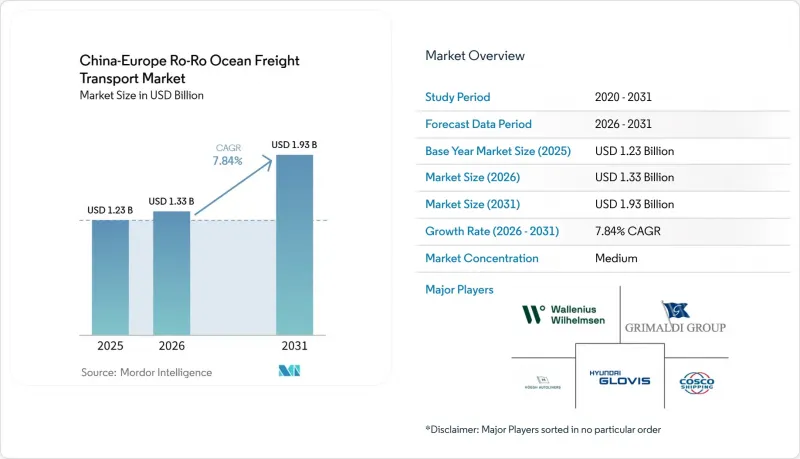
중국-유럽 간 Ro-Ro 해운 운송 시장은 중국산 자동차 수출의 급증에 힘입어 확대되고 있으며, 승용차 운송량이 여전히 차량 구성 및 항로 계획의 주도적인 역할을 하고 있습니다. 본 보고서는 화물 유형(승용차, 상용차, 오프로드 차량), 선박 크기(소형 선박, 중형 선박, 대형 선박), 최종 사용자 산업(OEM, 딜러, 기타(렌탈 회사, 차량 리스 회사, 기타)),화물 물동량/노선 클러스터(중국 수출 분석, 유럽 수출 분석)별로 분류되어 있습니다. 시장 전망은 금액(달러) 기준으로 제시되어 있습니다.
중국-유럽 간 Ro-Ro 해운 운송 시장 동향 및 인사이트
중국산 전기차 수출의 전용 Ro-Ro 선박 운송 능력으로의 전환
2025년, 중국의 전기차(EV) 수출 대수는 2배 이상인 250만 대를 넘어섰으며, 전기차 모델은 중국 자동차 총 수출량의 35% 이상을 차지하게 되었습니다. 이는 2024년의 20%에서 증가한 수치입니다. 이러한 수출량 증가로 인해 중국-유럽 간 Ro-Ro 해운 운송 시장은 계속해서 압박을 받고 있습니다. 이는 이 항로에서 여전히 고부가가치 수출품의 대부분을 전용 자동차 운반선에 의존하고 있기 때문입니다. 중국의 주요 자동차 제조업체 10곳은 2026년 해외 판매 목표를 총 700만 대 이상으로 발표했으며, 신조 선박이 취항하더라도 예약 수요는 높은 수준을 유지하고 있습니다. 또한, 각 자동차 제조업체는 자사 선단 전략을 통해 운송 능력을 직접 확보하고 있으며, BYD는 현재 연간 30만 대의 차량을 운송하는 자사 소유의 PCTC(자동차 전용선) 8척을 운항하고 있습니다. 이는 중국-유럽 간 Ro-Ro 해운 운송 시장에서 화물량이 증가하고 있을 뿐만 아니라, 표면상의 수출 수치가 시사하는 것보다 일반 시장에서 이용 가능한 운송 능력의 유연성이 저하되고 있음을 의미합니다.
중국-유럽 항로의 자동차 전용선 적재 공간 부족
중국-유럽 간 Ro-Ro 해운 운송 시장이 여전히 핍박한 이유는 선박 공급이 문제의 일부에 불과하고, 부두 접근성, 선박 회전 시간, 항해 일정이 마찬가지로 중요하기 때문입니다. 중국 자동차 제조업체들이 이용 가능한 슬롯 확보에 분주했던 결과, 중국에서 유럽으로 가는 현물 운임은 2026년 중반까지 1입방미터당 150달러에 달하고, 2025년 4분기 평균의 2배가 되었습니다. 해당 보고서는 Ro-Ro 운송 능력이 피크 시 수요를 감당하지 못해 100만 대의 자동차가 컨테이너선으로 운송되었다고 지적하고 있으며, 이는 공급 상황이 개선되면 순수한 자동차 전용선으로 다시 돌아올 가능성이 있는 잠재적 화물 규모를 보여줍니다. 홍해 우회로 인해 일부 항해에서는 10-14일의 소요 일수가 증가하여 각 선박이 연간 완료할 수 있는 항해 횟수가 감소한 반면, 중국-유럽 간 Ro-Ro 해운 운송 시장 전체의 가동률은 견조한 추세를 보이고 있습니다. 또한, EU 배출권 거래 제도(EU ETS)의 비용과 IMO 2030 준수 요건으로 인해 구형 선박의 경쟁력이 저하되어 선단 갱신을 촉진하는 한편, 유럽 항구를 운항하는 선사들에게는 운영 비용이 높은 수준을 유지하게 만들고 있습니다.
신조선 공급 증가에 따른 운임 상승 압력 완화 가능성
중국-유럽 간 Ro-Ro 해운 운송 시장은 신조선 공급을 더 이상 먼 미래의 위험 요인으로만 볼 수 없는 단계에 접어들고 있습니다. 클라크슨즈는 2026년 PCTC 선단의 성장률을 8%로 예측하는 반면, 수요 증가율은 1%에서 2%에 그칠 것으로 전망하고 있어, 수출 성장세가 둔화될 경우 운임을 계속 지탱할 여지는 좁아질 것입니다. 이 같은 사이클로 인해 이미 사상 최대의 인도 실적이 기록되었으며, 2025년에는 75척의 PCTC가 인도되었고, 2025년까지 3년 동안 133척, CEU 환산으로 약 100만 CEU에 해당하는 선박이 인도되었습니다. 2023년부터 2028년까지 인도되었거나 인도 예정인 276척의 PCTC 중 80%를 중국 조선소가 차지하고 있어, 이 항로 전체에서 공급이 집중적으로 증가하는 양상을 보이고 있습니다. 관세 및 자동차 판매 둔화로 인해 수출 수요가 위축될 경우, 중국-유럽 간 Ro-Ro 해운 운송 시장에서는 2027년 이후 가동률이 하락할 가능성이 있으며, 중소규모 또는 노후화된 선주가 가장 큰 압박에 직면하게 될 것으로 예측됩니다.
부문 분석
2025년, 중국-유럽 간 Ro-Ro 해운 운송 시장 규모의 62.04%를 승용차가 차지하고 있으며, 이는 유럽으로 수출되는 중국산 배터리 전기자동차(BEV) 및 플러그인 하이브리드 전기자동차(PHEV)의 수출 규모를 반영한 것입니다. 2025년 EU 내 중국산 전기차 판매 대수는 94만 대에 달하여 2024년 대비 50% 가까이 증가했습니다. 이에 따라 승용차 적재 능력은 선단 운영 결정에 있어 계속해서 핵심 요소로 작용했습니다. 2025년에는 중국 브랜드가 EU로의 중국산 수입 점유율에서 70%를 넘어, 2023년의 50%에서 상승했습니다. 이는 완성차 유통의 상당 부분이 현재 중국 브랜드의 성장과 밀접하게 연결되어 있음을 보여줍니다. 승용차 기반은 중국의 국내 브랜드에만 국한되지 않고, 폭스바겐(Volkswagen), BMW, 닛산(Nissan), 현대(Hyundai), 스텔란티스(Stellantis)도 해외 자동차 수출을 위해 중국 내 생산을 활용하고 있습니다.
상용차는 중국-유럽 간 Ro-Ro 해운 운송 시장에서 가장 빠르게 성장하는 화물 유형으로, 2031년까지 연평균 성장률(CAGR)이 9.53%를 나타낼 것으로 예측되지만, 그 규모는 여전히 승용차보다 작은 상태입니다. 이러한 성장은 BYD, Yutong, Higer와 같은 중국 트럭 및 버스 제조업체들의 유럽 내 유통망이 꾸준히 확충되고 있는 것과 관련이 있습니다. 오프로드 차량은 건설·농업·광업용 장비가 Ro-Ro 적재 패턴에 적합하고, 장거리 항로에서 혼합 선박의 활용을 뒷받침하고 있기 때문에 여전히 중요한 화물 밀도를 가져오고 있습니다. 2026년까지 EU의 배터리 패스포트 요건이 모든 전기차 배터리 수입에 의무화됨에 따라, 각 선사들은 중국-유럽 간 Ro-Ro 해운 운송 산업 전반에 걸친 추적성 요건을 충족하기 위해 갑판 배치 및 서류 절차를 조정하고 있습니다.
2025년에는 4,000CEU를 초과하는 대형 선박이 중국-유럽 간 Ro-Ro 해운 운송 시장 점유율의 58%를 차지하며, 장거리 차량 운송 노선에서 심해급 선박이 강력히 선호되고 있음이 부각되었습니다. 현대글로비스는 2026년 4월, 세계 최초의 10,800CEU급 PCTC ‘글로비스 리더’를 취항시켰습니다. 이는 유럽행 서비스에서 슬롯 밀도 향상과 단위 비용 절감을 위한 명확한 움직임을 보여줍니다. 또한, 이러한 선박에 채택된 LNG 듀얼 연료 추진 시스템은 배출 규제에 대응하기 위한 비용이 치솟고 있는 유럽 항구에 기항하는 운항 사업자에게 비용 면에서 이점을 제공합니다. 그리말디사가 추진 중인 암모니아 대응 9,000CEU 초과 선박 계획도 이와 같은 논리에 기반을 두고 있습니다. 이는 중국-유럽 간 Ro-Ro 해운 운송 시장에서 선박 규모와 연료의 유연성이 이제 밀접하게 연결되어 있음을 보여줍니다.
중형 선박은 가장 성장세가 두드러지는 선종으로, 2031년까지 연평균 성장률(CAGR)은 9.90%로 전망됩니다. 이는 메가 캐리어가 항상 제공할 수 있는 것은 아닌 피더 서비스나 2차 항구로의 접근에 대한 수요를 반영한 것입니다. 이러한 양극화는 중국-유럽 간 Ro-Ro 해운 운송 시장이 두 가지 궤도로 성장하고 있음을 의미하며, 초대형 선박이 간선 노선을 담당하고 중형 선박이 소규모 터미널로의 피더 운송을 담당하고 있습니다. ‘K’LINE은 2026년 6월, 자회사인 KESS를 위해 1,380CEU 규모의 LNG 듀얼 연료 PCTC 4척을 발주했는데, 이 선박들은 크기 제한이 있는 유럽의 소규모 수입차 터미널을 위해 특별히 설계된 것입니다. 2,000CEU 미만의 소형 선박에 대해서도 선령이 가장 높다는 과제에 직면해 있으며, 6,000CEU 미만의 PCTC 중 70%가 현재 15년 이상 경과했기 때문에 중국-유럽 간 Ro-Ro 해운 운송 산업 전반에서 선박 교체 주기가 활발하게 이어지고 있습니다.
기타 혜택
- 엑셀 형식 시장 예측(ME) 시트
- 3개월간의 애널리스트 지원
자주 묻는 질문
목차
제1장 서론
제2장 조사 방법
제3장 주요 요약
제4장 시장 구도
제5장 시장 규모와 성장 예측(금액, 2026-2031년)
제6장 경쟁 구도
제7장 시장 기회와 향후 전망
JHS 26.09.03According to Mordor Intelligence, the China-Europe ro-Ro ocean freight transport market size was valued at USD 1.23 billion in 2025 and is projected to reach USD 1.33 billion in 2026, and reach USD 1.93 billion by 2031, growing at a CAGR of 7.84% from 2026 to 2031.
The China-Europe Ro-Ro ocean freight transport market is expanding on the back of a sharp rise in vehicle exports from China, with passenger vehicle volumes still setting the pace for fleet use and route planning. This report is Segmented by Cargo Type (Passenger Vehicles, Commercial Vehicles, and Off-Road Vehicles), by Vessel Size (Small Vessels, Mid-Size Vessels, and Large Vessels), by End-User (OEMs, Dealers, and Others (Rental Companies, Fleet Leasing Companies, and More)), and by Flows (China Export Analysis, and Europe Export Analysis). The Market Forecasts are Provided in Terms of Value (USD).
China-Europe Ro-Ro Ocean Freight Transport Market Trends and Insights
China EV Exports Are Overflowing Available Ro-Ro Capacity
China's electric car exports doubled to more than 2.5 million units in 2025, and electric models accounted for more than 35% of all Chinese car exports, up from 20% in 2024. That volume has kept the China-Europe Ro-Ro ocean freight transport market under pressure, as the route still relies on dedicated car carriers for the bulk of high-value exports. The ten largest Chinese OEMs have announced combined overseas sales targets of more than 7 million units for 2026, keeping booking demand elevated even as new vessels arrive. OEMs are also absorbing capacity directly through captive fleet strategies, with BYD now operating 8 owned PCTCs that move 300,000 vehicles per year. This means the China-Europe Ro-Ro ocean freight transport market is not only seeing more cargo, but also less flexible open-market capacity than headline export figures suggest.
Vehicle Carrier Slot Tightness On China-Europe Lanes
The China-Europe Ro-Ro ocean freight transport market remains tight because vessel supply is only one part of the problem; berth access, turnaround time, and sailing schedules are equally important. Spot freight rates from China to Europe reached USD 150 per m3 by mid-2026, double the Q4 2025 average, as Chinese OEMs tried to secure available slots. The same report noted that 1 million vehicles were moving on container ships because Ro-Ro capacity could not absorb peak demand, indicating the extent of latent cargo that could return to pure car carriers when supply improves. Red Sea avoidance has added 10 to 14 days to some voyages, reducing the number of annual sailings each ship can complete and keeping utilization firm across the China-Europe Ro-Ro ocean freight transport market. EU ETS costs and IMO 2030 compliance requirements are also making older tonnage less competitive, supporting renewal but keeping operating costs high for operators serving European ports.
A Newbuilding Surge Threatens To Tip The Supply-Demand Balance
The China-Europe Ro-Ro ocean freight transport market is entering a phase where new vessel supply can no longer be treated as a distant risk. Clarksons projected PCTC fleet growth of 8% in 2026, against demand growth of 1% to 2%, narrowing the room for continued rate support if export momentum eases. The same cycle has already produced record deliveries, with 75 PCTCs handed over in 2025 and 133 vessels with nearly 1 million CEU delivered in the 3 years to 2025. Chinese yards account for 80% of the 276 PCTCs delivered or due between 2023 and 2028, indicating a concentrated supply build visible across the trade. If export demand softens due to tariffs or slower vehicle sales, the China-Europe Ro-Ro ocean freight transport market could see weaker utilization from 2027, with smaller and older owners facing the most pressure.
Other drivers and restraints analyzed in the detailed report include:
- Ton-Mile Demand Growth Supports Above-Average PCTC Earnings
- OEM Preference For Ro-Ro Underpins Structural Volume Stability
- Trade Policy Volatility Creates A Structural Freight Planning Overhang
For complete list of drivers and restraints, kindly check the Table Of Contents.
Segment Analysis
Passenger vehicles accounted for 62.04% of the China-Europe Ro-Ro ocean freight transport market size in 2025, reflecting the scale of Chinese battery-electric and plug-in hybrid exports to Europe. EU sales of Chinese-made EVs reached 940,000 units in 2025, up close to 50% from 2024, which kept passenger vehicle stowage at the center of fleet deployment decisions. In 2025, Chinese brands also moved above 70% share of EU imports from China, up from 50% in 2023, indicating how much of the finished vehicle flow is now tied to Chinese marque growth. The passenger base is broader than just Chinese domestic brands, as Volkswagen, BMW, Nissan, Hyundai, and Stellantis also use Chinese production for overseas vehicle exports.
Commercial vehicles are the fastest-growing cargo type in the China-Europe Ro-Ro ocean freight transport market with a 9.53% CAGR through 2031, even though the base remains smaller than that of passenger vehicles. That growth is linked to the steady build-out of European distribution by Chinese truck and bus makers such as BYD, Yutong, and Higer. Off-road vehicles still add meaningful cargo density because construction, agricultural, and mining equipment fit well with Ro-Ro loading patterns and support mixed-vessel utilization on longer routes. The EU battery passport requirement becomes mandatory for all EV battery imports by 2026, and operators are adjusting deck layouts and paperwork processes to meet traceability needs across the China-Europe Ro-Ro ocean freight transport industry.
Large vessels above 4,000 CEU accounted for 58% of the China-Europe Ro-Ro ocean freight transport market share in 2025, underscoring the strong preference for deep-sea scale on long-haul vehicle routes. Hyundai Glovis deployed the Glovis Leader in April 2026 as the world's first 10,800 CEU PCTC, which marked a clear move toward higher slot density and lower unit costs on Europe-bound services. Dual-fuel LNG propulsion on these vessels also improves the cost profile for operators calling at European ports where emissions compliance is becoming more expensive. Grimaldi's ammonia-ready 9,000+ CEU vessel program follows the same logic. It shows that scale and fuel flexibility are now closely linked in the China-Europe Ro-Ro ocean freight transport market.
Mid-size vessels are the fastest-growing class, with a 9.90% CAGR through 2031, reflecting the need for feeder work and secondary port access that mega-carriers cannot always provide. This split means the China-Europe Ro-Ro ocean freight transport market is growing on 2 tracks, with very large ships handling trunk routes and mid-size vessels feeding smaller terminals. "K" LINE ordered four 1,380 CEU LNG dual-fuel PCTCs in June 2026 for its KESS subsidiary, and those ships were specifically designed for smaller European imported-car terminals with size restrictions. Smaller ships below 2,000 CEU also face the oldest fleet profile, with 70% of sub-6,000 CEU PCTCs now over 15 years old, keeping the replacement cycle active across the China-Europe Ro-Ro ocean freight transport industry.
Complete Report Scope:
- By Cargo Type
- Passenger Vehicles (incl. 2 and 3-wheeler vehicles)
- Commercial Vehicles
- Off-road Vehicles
- By Vessel-size
- Small-size Vessels (Less than 2,000 CEU)
- Mid-size Vessels (2,000 - 4,000 CEU)
- Large vessels (More than 4,000 CEU)
- By End-user Industry
- OEMs
- Dealers
- Others (Rental Companies, Fleet leasing companies, Government & Defense Fleets, etc.)
- By Flows/Route Clusters
- China Export Analysis
- United Kingdom
- Germany
- Netherlands
- Belgium
- Spain
- Italy
- Rest of Europe
- Europe Export Analysis
- United Kingdom
- Germany
- Netherlands
- Belgium
- Spain
- Italy
- Rest of Europe
- China Export Analysis
List of Companies Covered in this Report:
- Wallenius Wilhelmsen
- Hoegh Autoliners
- Grimaldi Group
- COSCO SHIPPING Specialized Carriers
- Hyundai Glovis
- EUKOR Car Carriers
- Nippon Yusen Kabushiki Kaisha (NYK)
- Kawasaki Kisen Kaisha ("K" Line)
- Mitsui O.S.K. Lines (MOL)
- DFDS A/S (Europe-focused Ro-Ro operator)
- Sallaum Lines
- China Merchants Shenzhen RoRo Shipping Co., Ltd.
- SAIC Anji Logistics
- BYD Shipping
- China Merchants Energy Shipping (CMES)
- HMM Co., Ltd.
- Eastern Pacific Shipping
- Ray Car Carriers
- Neptune Lines
- Siem Car Carriers
- NMT International Shipping B.V.
- Chery International Logistics
Additional Benefits:
- The market estimate (ME) sheet in Excel format
- 3 months of analyst support
TABLE OF CONTENTS
1 Introduction
- 1.1 Study Assumptions and Market Definition
- 1.2 Scope of the Study
2 Research Methodology
3 Executive Summary
4 Market Landscape
- 4.1 Market Overview and Importance of Ro-Ro Ocean Freight Transport Market
- 4.2 Market Drivers
- 4.2.1 China EV Export Diversion Into Dedicated Ro-Ro Capacity
- 4.2.2 Vehicle Carrier Slot Tightness on China-Europe Lanes
- 4.2.3 Longer Tonne-Mile Demand From East Asia to Europe
- 4.2.4 OEM Preference For Damage-Minimizing Ro-Ro Versus Container Substitution
- 4.2.5 Fleet Renewal Toward Larger, Fuel-Efficient PCTCs
- 4.2.6 European Port And Hinterland Automotive Connectivity
- 4.3 Market Restraints
- 4.3.1 Newbuilding Wave Could Ease Rate Tension
- 4.3.2 Port Congestion And Berth Constraints At Core European Gateways
- 4.3.3 Trade Policy And Tariff Volatility Around Chinese Vehicle Exports
- 4.3.4 Limited Ro-Ro Infrastructure At Secondary European Discharge Ports
- 4.4 Regulatory Framework
- 4.5 Value Chain and Distribution Channel Architecture Analysis
- 4.6 Technology Innovations Outlook
- 4.7 Porter's Five Forces Analysis
- 4.7.1 Threat of New Entrants
- 4.7.2 Bargaining Power of Suppliers
- 4.7.3 Bargaining Power of Buyers
- 4.7.4 Threat of Substitutes
- 4.7.5 Rivalry Among Competitors
- 4.8 Port and Terminal Infrastructure Analysis
- 4.9 Sustainability and ESG Analysis
- 4.10 Evolution of China-Europe Ro-Ro Ocean Freight Transport
- 4.11 Impact of Geo-Political Events on Supply Chain Shifts
5 Market Size and Growth Forecasts (Value, 2026-2031)
- 5.1 By Cargo Type
- 5.1.1 Passenger Vehicles (incl. 2 and 3-wheeler vehicles)
- 5.1.2 Commercial Vehicles
- 5.1.3 Off-road Vehicles
- 5.2 By Vessel-size
- 5.2.1 Small-size Vessels (Less than 2,000 CEU)
- 5.2.2 Mid-size Vessels (2,000 - 4,000 CEU)
- 5.2.3 Large vessels (More than 4,000 CEU)
- 5.3 By End-user Industry
- 5.3.1 OEMs
- 5.3.2 Dealers
- 5.3.3 Others (Rental Companies, Fleet leasing companies, Government & Defense Fleets, etc.)
- 5.4 By Flows/Route Clusters
- 5.4.1 China Export Analysis
- 5.4.1.1 United Kingdom
- 5.4.1.2 Germany
- 5.4.1.3 Netherlands
- 5.4.1.4 Belgium
- 5.4.1.5 Spain
- 5.4.1.6 Italy
- 5.4.1.7 Rest of Europe
- 5.4.2 Europe Export Analysis
- 5.4.2.1 United Kingdom
- 5.4.2.2 Germany
- 5.4.2.3 Netherlands
- 5.4.2.4 Belgium
- 5.4.2.5 Spain
- 5.4.2.6 Italy
- 5.4.2.7 Rest of Europe
- 5.4.1 China Export Analysis
6 Competitive Landscape
- 6.1 Market Concentration
- 6.2 Key Strategic Moves
- 6.3 Market Share Analysis
- 6.4 Company Profiles (includes Global level Overview, Market level overview, Core Segments, Financials as available, Strategic Information, Market Rank/Share for key companies, Products & Services, and Recent Developments)
- 6.4.1 Wallenius Wilhelmsen
- 6.4.2 Hoegh Autoliners
- 6.4.3 Grimaldi Group
- 6.4.4 COSCO SHIPPING Specialized Carriers
- 6.4.5 Hyundai Glovis
- 6.4.6 EUKOR Car Carriers
- 6.4.7 Nippon Yusen Kabushiki Kaisha (NYK)
- 6.4.8 Kawasaki Kisen Kaisha ("K" Line)
- 6.4.9 Mitsui O.S.K. Lines (MOL)
- 6.4.10 DFDS A/S (Europe-focused Ro-Ro operator)
- 6.4.11 Sallaum Lines
- 6.4.12 China Merchants Shenzhen RoRo Shipping Co., Ltd.
- 6.4.13 SAIC Anji Logistics
- 6.4.14 BYD Shipping
- 6.4.15 China Merchants Energy Shipping (CMES)
- 6.4.16 HMM Co., Ltd.
- 6.4.17 Eastern Pacific Shipping
- 6.4.18 Ray Car Carriers
- 6.4.19 Neptune Lines
- 6.4.20 Siem Car Carriers
- 6.4.21 NMT International Shipping B.V.
- 6.4.22 Chery International Logistics
7 Market Opportunities and Future Outlook
- 7.1 White-space and Unmet-Need Assessment


