
|
시장보고서
상품코드
2118012
조직 스캐폴드 : 시장 점유율 분석, 업계 동향 및 통계, 성장 예측(2026-2031년)Tissue Scaffolds - Market Share Analysis, Industry Trends & Statistics, Growth Forecasts (2026 - 2031) |
||||||
 Mordor Intelligence
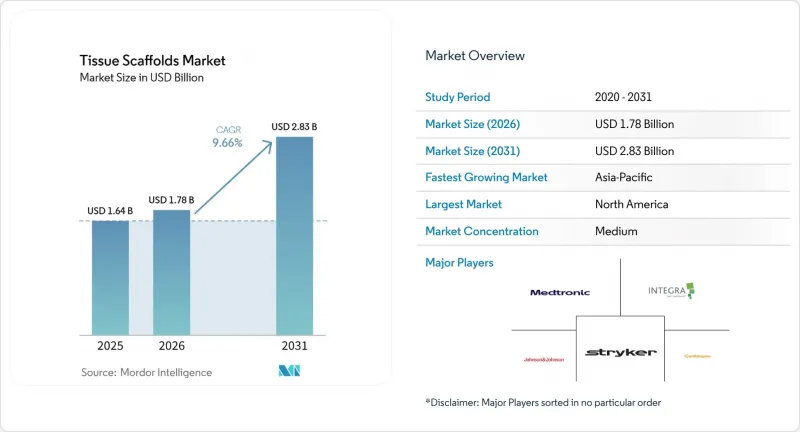
Mordor Intelligence에 의하면, 조직 스캐폴드 시장 규모는 2025년에 16억 4,000만 달러로 평가되었습니다. 2026년 17억 8,000만 달러에서 2031년까지 28억 3,000만 달러에 이를 것으로 예상되며, 예측 기간(2026-2031년) CAGR은 9.66%를 나타낼 전망입니다.
본 보고서는 재료 유형(천연 스캐폴드 등), 제조 기술(일렉트로스피닝 등), 조직 유형(골용 스캐폴드 등), 용도(정형외과, 심혈관, 기타),최종 사용자(병원 및 진료소, 기타), 지역(북미, 유럽, 아시아태평양, 중동 및 아프리카, 남미)별로 분류되어 있습니다. 시장 예측은 금액(달러) 기준으로 제시되어 있습니다.
세계의 조직 스캐폴드 시장 동향 및 인사이트
3D 바이오 프린팅 및 첨단 제조 기술의 도입
3D 바이오 프린팅은 단순한 연구 도구에 그치지 않고, 이식형 스캐폴드의 상업적 제조 수단이 되어가고 있습니다. 2025년 과학 리뷰에서는 바이오 잉크의 품질, 표준화된 제조 프로토콜 및 확장 가능한 세포 증식이 보다 광범위한 임상 적용에 있어 주요 장벽으로 지목되었습니다. 이러한 과제로 인해 재현 가능한 공정을 검증할 수 있는 재료 공급업체 및 수탁 제조업체에 대한 수요가 발생하고 있습니다. 환자 맞춤형 3D 프린팅 PEEK 임플란트에 관한 임상 프레임워크에 따르면, 병원 기반 공정인 경우 두개악안면 재건에 관한 EU MDR 제5조(5)의 요건을 충족하는 것으로 나타났습니다. 또한 이 프레임워크는 디지털 설계 및 제조를 통해 엔드투엔드 공정을 1주일 미만으로 완료할 수 있음을 시사합니다. 따라서 조직 스캐폴드 시장은 복잡한 형상, 임상 문서 및 관리된 생산을 통합적으로 관리할 수 있는 제조 파트너로 이동할 가능성이 있습니다.
만성 조직 결손 및 외상으로 인한 부담 증가
조직 스캐폴드 시장은 구조적 복원이 필요한 결손의 수와 중증도와 밀접한 관련이 있습니다. 2025년 상처 관리 종합 보고서에 따르면, 미국에서는 1,050만 명의 메디케어 수급자가 만성 상처로 고통받고 있으며, 메디케어의 연간 지출액은 225억 달러에 달할 전망입니다. 전 세계 성형외과 관련 질환의 신규 사례 수는 2022년 9억 3,017만 건에서 2050년까지 13억 5,000만 건으로 증가할 것으로 예측됩니다. 유방 절제술 후 재건, 종양 절제 및 방사선 치료에 따른 조직 손상의 경우, 기존의 이식편이 적합하지 않을 때 스캐폴드를 이용한 복원이 필요할 수 있습니다. 부피적인 근육 손실에 대한 생체 재료를 이용한 접근법은 폭발로 인한 외상, 압박 손상, 개방 골절을 치료하는 데에도 사용됩니다. 노화에 따라 상처 치유 능력이 저하되므로 치료 기간이 장기화될 가능성이 있습니다.
높은 GMP 검증 및 무균 보증 비용
GMP 준수는 조직 스캐폴드 시장의 소규모 진출기업들에게 극복하기 어려운 장벽이 되고 있습니다. 생체 스캐폴드는 임상 성능에 필요한 매트릭스의 특성을 손상시키지 않으면서 무균성 및 안전성에 대한 검증을 수행해야 합니다. 탈세포화 과정에서는 중요한 생물학적 활성 성분을 유지하면서 잔류 세포 물질을 제거해야 합니다. 로트나 생산 규모에 관계없이 이러한 검증을 반복하려면 막대한 자본과 전문적인 품질 관리 시스템이 필요합니다. 통합형 의료 기술 기업은 소규모 스캐폴드 제조업체보다 광범위한 검증 인프라를 유지할 수 있습니다. 이러한 차이는 인수 합병 활동을 촉진하고, 규모를 더욱 중요한 경쟁 우위로 만들 가능성이 있습니다.
부문별 분석
2025년에는 천연 스캐폴드가 44.43%의 시장 점유율을 차지했습니다. 콜라겐 및 히알루론산 제품은 생체 적합성 프로파일이 확립되어 있어, 상처 치료, 정형외과, 치과 재건 등 각 분야에서 널리 사용되고 있습니다. 이러한 제품에 대한 높은 임상적 친숙도는 외과의사가 알려진 취급 특성을 중시하는 시술에서 지속적인 사용을 뒷받침하고 있습니다. 또한 천연 제품은 여러 적응증에 걸쳐 충분히 이해된 소재를 필요로 하는 의료 제공업체에게 실용적인 선택지를 제공합니다. 이러한 소재에 대한 수요는 특정 전문 분야가 아닌 광범위한 시술 건수와 연동되어 추이를 보이고 있습니다.
탈세포화 세포외 기질(dECM) 스캐폴드는 2031년까지 연평균 성장률(CAGR) 14.60%를 나타낼 것으로 예측됩니다. 그 매력은 합성 재료로는 재현하기 어려운 타고난 조직 구조, 성장 인자의 농도 구배, 그리고 세포 접착 특성을 유지하고 있다는 점에 있습니다. 현재 심장, 피부, 신경 분야에서 dECM 접근법의 유효성을 평가하는 임상 연구가 활발히 진행되고 있습니다. 합성 스캐폴드는 특히 골 결손 부위의 충진이나 하중을 지탱하는 보강에서 비용 및 기계적 제어 측면에서 경쟁력을 발휘하고 있습니다. 복합 스캐폴드는 생물학적 요건과 기계적 요건의 균형이 요구되는 상황에서 여러 재료의 특성을 결합한 것입니다. 임상 조달 팀이 재현성을 더욱 중시하게 됨에 따라, 조직 스캐폴드 업계에서는 로트 간 균일성을 확보할 수 있는 제조업체가 점점 더 높이 평가받고 있습니다.
3D 프린팅은 2025년 조직 스캐폴드 시장 규모의 39.52%를 차지했으며, 2031년까지 연평균 성장률(CAGR) 11.26%를 나타낼 것으로 예측됩니다. 이 기술을 통해 혈관 신생을 촉진하는 다공성 뼈 스캐폴드나 정교한 형상이 요구되는 환자 맞춤형 임플란트를 제조할 수 있습니다. 이러한 폭넓은 용도가 이 기술이 제조 방식 중 최대 점유율과 최고 성장률을 모두 차지하고 있는 이유를 설명해 줍니다. 조직 스캐폴드 시장은 대학 연구 프로그램과 규제 대상 생산을 연결하는 제조 모델의 혜택을 받고 있습니다. 2026년 6월 Made Scientific사가 NOVAKnee 프로그램에 선정된 사례는 복잡한 구조물을 GMP 파이프라인에 통합하는 데 있어 전문 제조 파트너가 수행하는 역할을 여실히 보여줍니다. 향후 보급을 위해서는 검증된 소재, 워크플로우 관리, 그리고 임상 사용을 뒷받침하는 증거가 필수적입니다.
일렉트로스피닝은 천연 세포외 기질 섬유와 유사한 나노섬유 구조가 필요한 신경, 혈관 및 상처 치유 용도에서 여전히 중요합니다. 이 기술은 복잡한 환자별 형상보다는 표면 구조나 제어된 다공성이 더 중요한 프로그램에 적합합니다. 동결건조는 하이드로겔이나 약물을 봉입한 스캐폴드와 같은 보다 제한된 용도로 사용됩니다. 자기조립도 열적 또는 화학적 반응 특성이 제품 설계의 일부인 경우에는 유용합니다. 조직 스캐폴드 시장에서 응용 분야의 요구 사항이 다양하기 때문에 이러한 기법이 사라질 가능성은 낮을 것입니다. 그 위상은 3D 프린팅보다 전문적이지만, 보다 단순한 제조 방식으로 임상 요건을 충족할 수 있는 분야에서는 여전히 그 가치를 유지하고 있습니다.
지역별 분석
2025년, 북미는 41.72%의 점유율을 차지했습니다. 미국은 높은 의료비 지출, 재생의학 임상시험의 현저한 집중, 그리고 매트릭스 기반 제품을 위한 확립된 상업적 인프라를 모두 갖추고 있습니다. 이러한 특징들이 상처 치료, 정형외과, 혈관 복원 및 재건 분야 수요를 뒷받침하고 있습니다. 인테그라 생명과학(Integra LifeSciences)는 2026년 매출을 16억 6,200만 달러에서 17억 200만 달러로 전망하고 있으며, 2026년 1분기에는 조직 재건 분야에서 6.4%의 유기적 성장을 보고했습니다. 이는 환급 압력이 지속되는 상황에서도 수요가 유지되고 있음을 보여줍니다. 캐나다와 멕시코는 국경을 초월한 제품 유통 및 제조 투자 확대를 통해 시장에 참여하고 있습니다. 이 지역의 조직 스캐폴드 시장은 여전히 미국의 보험 적용 정책 변경에 민감한 상황에 놓여 있습니다.
유럽은 독일, 영국, 프랑스를 필두로 지역별 규모에서 2위를 차지하고 있습니다. EU의 MDR(의료기기 규정) 체계에 따라 규정 준수 요건이 강화되는 한편, 검증된 품질 시스템을 갖춘 제조업체에게는 경쟁 우위가 생기고 있습니다. 두개악안면 임플란트에 관한 ‘포인트 오브 케어(진료 현장에서의 검사)’ 프레임워크가 발표되어, EU MDR 제5조 제5항의 요건을 충족하는 병원 내 생산의 길이 제시되었습니다. 아시아태평양은 2031년까지 연평균 성장률(CAGR) 13.48%를 나타낼 것으로 예측되며, 이는 조직 스캐폴드 시장에서 지역별 가장 높은 성장률입니다. 정부의 제조 정책, 규제 정비, 그리고 대규모 인구 동향에 따른 수요가 이러한 성장 궤도를 뒷받침하고 있습니다. 중국의 국가의약품표준도서관(National Medical Products Standard Library)은 연골 스캐폴드의 세포생물학적 효과를 평가하기 위한 YY/T 1995-2025를 공표했으며, 이는 2026년 11월에 발효될 예정입니다.
중동 및 아프리카는 GCC 국가들이 주도하고 있으며, 이 지역에서는 헬스케어에 대한 투자와 외상 및 당뇨병과 관련된 상처 치료 수요가 시장을 확대시키고 있습니다. 2026년 3월 Humacyte사가 이스라엘에서 ‘SYMVESS’의 승인 신청을 진행한 사례는 실제 임상에서의 혈관 치료 경험이 지역 시장 진출을 얼마나 뒷받침할 수 있는지를 보여줍니다. 남아프리카를 비롯한 기타 시장은 보험 환급 및 콜드체인 물류의 제약으로 인해 생물 유래 스캐폴드의 보급이 제한적이어서 여전히 초기 단계에 머물러 있습니다. 남미에서는 브라질과 아르헨티나에 시장이 집중되어 있으며, 고령화의 진행과 민간 헬스케어의 성장이 초기 수요를 뒷받침하고 있습니다. 규제 조화가 진전된다면, 향후 제품의 접근성과 품질에 대한 기대가 높아질 가능성이 있습니다. 이 지역 전반에 걸쳐 제품의 보급은 첨단 제품을 현지 지불 체계 및 임상 인프라에 적합하게 조정하는 능력에 달려 있습니다.
기타 혜택 :
- 엑셀 형식 시장 예측(ME) 시트
- 3개월간의 애널리스트 지원
자주 묻는 질문
목차
제1장 서론
제2장 조사 방법
제3장 개요
제4장 시장 구도
제5장 시장 규모 및 성장 예측
제6장 경쟁 구도
제7장 시장 기회 및 향후 전망
KTH 26.09.02According to Mordor Intelligence, the tissue scaffolds market size was valued at USD 1.64 billion in 2025 and is estimated to grow from USD 1.78 billion in 2026 to reach USD 2.83 billion by 2031, at a CAGR of 9.66% during the forecast period (2026-2031).
This report is Segmented by Material Type (Natural Scaffolds, and More), Fabrication Technique (Electrospinning, and More), Tissue Type (Bone Scaffolds, and More), Application (Orthopedics, Cardiovascular, and More), End User (Hospitals and Clinics, and More), and Geography (North America, Europe, Asia-Pacific, Middle East and Africa, and South America). Market Forecasts are Provided in Terms of Value (USD).
Global Tissue Scaffolds Market Trends and Insights
3D Bioprinting and Advanced Fabrication Adoption
3D bioprinting is becoming a commercial fabrication option for implantable scaffolds rather than remaining only a research tool. A 2025 scientific review identified bioink quality, standardized production protocols, and scalable cell expansion as key barriers to wider clinical translation. These gaps create demand for material suppliers and contract manufacturers that can validate repeatable processes. A clinical framework for patient-specific 3D-printed PEEK implants showed that a hospital-based pathway can comply with EU MDR Article 5(5) requirements for craniomaxillofacial reconstruction. The framework also indicated that digital design and manufacturing can support end-to-end timelines of less than 1 week. The tissue scaffolds market may therefore shift toward fabrication partners that can manage complex geometries, clinical documentation, and controlled production together.
Rising Burden of Chronic Tissue Loss and Trauma
The tissue scaffolds market is tied to the number and severity of defects requiring structural repair. Chronic wounds affected 10.5 million Medicare beneficiaries in the United States and generated USD 22.5 billion in annual Medicare spending in the 2025 wound-care compendium. Global incident cases of plastic surgery-related conditions are projected to rise from 930.17 million in 2022 to 1.35 billion by 2050. Mastectomy reconstruction, tumor resection, and radiation-related tissue damage can require scaffold-supported repair when conventional grafts are unsuitable. Biomaterial approaches for volumetric muscle loss also address trauma from blast exposure, crush injuries, and open fractures. Aging may extend treatment cycles because wound healing capacity declines with age.
High GMP Validation and Sterility Assurance Costs
GMP compliance is a durable barrier for smaller participants in the tissue scaffolds market. Biological scaffolds must be validated for sterility and safety without damaging the matrix features needed for clinical performance. Decellularization must remove residual cellular material while retaining important bioactive components. Repeating this validation across lots and production scales requires significant capital and specialized quality systems. Integrated medical technology companies can maintain a broader validation infrastructure than smaller scaffold manufacturers. This difference can encourage acquisition activity and make scale a more important competitive advantage.
Other drivers and restraints analyzed in the detailed report include:
- Shift Toward Personalized Regenerative Implants
- Faster Translation of Bioactive and Smart Scaffold Platforms
- Reimbursement Uncertainty for Advanced Scaffold Procedures
For complete list of drivers and restraints, kindly check the Table Of Contents.
Segment Analysis
Natural scaffolds held 44.43% share in 2025. Collagen and hyaluronic acid products have established biocompatibility profiles and familiar use across wound care, orthopedics, and dental reconstruction. Their clinical familiarity supports continued use in procedures where surgeons value known handling properties. Natural products also provide a practical option for providers that need well-understood materials across several indications. Demand for these materials remains tied to broad procedural volumes rather than a single specialty.
Decellularized extracellular matrix scaffolds are projected to grow at a 14.60% CAGR through 2031. Their appeal comes from preserving native tissue architecture, growth factor gradients, and cell-adhesion features that are difficult to recreate with synthetic materials. Active clinical research is evaluating dECM approaches across cardiac, dermal, and neural uses. Synthetic scaffolds compete through cost and mechanical control, especially in bone gap filling and load-bearing reinforcement. Composite scaffolds combine material properties where biological and mechanical requirements must be balanced. The tissue scaffolds industry increasingly values manufacturers that can deliver lot consistency as clinical procurement teams place greater emphasis on reproducibility.
3D printing accounted for 39.52% of the tissue scaffolds market size in 2025 and is forecast to grow at an 11.26% CAGR through 2031. It can produce porous bone scaffolds that support vascularization as well as patient-matched implants that require detailed geometry. This range of uses explains why the technique holds both the largest share and the highest growth rate among fabrication methods. The tissue scaffolds market is benefiting from manufacturing models that connect university programs to regulated production. Made Scientific's June 2026 selection for the NOVAKnee program illustrates the role of specialized manufacturing partners in bringing complex constructs into GMP pipelines. Continued adoption depends on validated materials, workflow control, and evidence that supports clinical use.
Electrospinning remains important for neural, vascular, and wound-healing applications that need nanofibrous structures similar to native extracellular matrix fibers. It is suited to programs where surface architecture and controlled porosity matter more than complex patient-specific geometry. Freeze drying serves a narrower range of hydrogel and drug-loaded scaffold uses. Self-assembly is also relevant where thermal or chemical response properties are part of the product design. These methods are unlikely to disappear because application needs vary widely across the tissue scaffolds market. Their position is more specialized than 3D printing, but they retain value where a simpler fabrication approach meets clinical requirements.
Complete Report Scope:
- By Material Type
- Natural Scaffolds
- Synthetic Scaffolds
- Composite Scaffolds
- Decellularized ECM Scaffolds
- By Fabrication Technique
- Electrospinning
- 3D Printing
- Freeze Drying
- Self-Assembly
- By Tissue Type
- Bone Scaffolds
- Cartilage Scaffolds
- Skin Scaffolds
- Vascular Scaffolds
- Neural Scaffolds
- By Application
- Orthopedics
- Cardiovascular
- Dentistry
- Dermatology
- Plastic Surgery
- Wound Healing
- Other Applications
- By End User
- Hospitals and Clinics
- Ambulatory Surgical Centers
- Research and Academic Institutes
- Biotechnology and Pharmaceutical Companies
- Specialty Regenerative Medicine Centers
- By Geography
- North America
- United States
- Canada
- Mexico
- Europe
- Germany
- United Kingdom
- France
- Italy
- Spain
- Rest of Europe
- Asia-Pacific
- China
- Japan
- India
- Australia
- South Korea
- Rest of Asia-Pacific
- Middle East and Africa
- GCC
- South Africa
- Rest of Middle East and Africa
- South America
- Brazil
- Argentina
- Rest of South America
- North America
Geography Analysis
North America held 41.72% share in 2025. The United States combines high healthcare spending, a substantial concentration of regenerative medicine trials, and an established commercial infrastructure for matrix-based products. These features support demand across wound care, orthopedics, vascular repair, and reconstruction. Integra LifeSciences guided 2026 revenue of USD 1.662 billion to USD 1.702 billion and reported 6.4% organic growth in tissue reconstruction in the first quarter of 2026, indicating continued demand despite reimbursement pressure. Canada and Mexico participate through cross-border product flows and developing manufacturing investment. The tissue scaffolds market in the region remains exposed to changes in U.S. coverage policy.
Europe holds the second-largest regional position, led by Germany, the United Kingdom, and France. The EU MDR framework is increasing compliance requirements while creating an advantage for manufacturers with validated quality systems. The published point-of-care framework for craniomaxillofacial implants demonstrated a route for hospital-based production that meets EU MDR Article 5(5) requirements. Asia-Pacific is forecast to grow at a 13.48% CAGR through 2031, the fastest regional rate in the tissue scaffolds market. Government manufacturing policies, regulatory development, and large demographic demand support this trajectory. China's National Drug Standards Library published YY/T 1995-2025 for evaluating cellular biological effects of cartilage scaffolds, effective in November 2026.
The Middle East and Africa are led by GCC countries, where healthcare investment and trauma and diabetes-related wound care needs are expanding demand. Humacyte's March 2026 application for SYMVESS in Israel showed how real-world vascular experience can support entry into regional markets. South Africa and other markets remain at an earlier stage because reimbursement and cold-chain logistics limit broader use of biologic scaffolds. South America is concentrated in Brazil and Argentina, where aging populations and private healthcare growth are supporting early demand. Regulatory harmonization can improve product access and quality expectations over time. Across these regions, adoption depends on the ability to match advanced products with local payment pathways and clinical infrastructure.
- 3D Biotek LLC
- Anika Therapeutics
- Arthrex
- Baxter
- Beckton Dickinson
- Collagen Matrix, Inc.
- Cook Group
- Corning
- DSM-Firmenich AG
- Evonik Industries
- Integra LifeSciences
- Johnson & Johnson
- Medtronic
- MiMedx Group Inc.
- Organogenesis
- Smiths Group
- Stryker
- Tissue Regenix
- Zimmer Biomet
Additional Benefits:
- The market estimate (ME) sheet in Excel format
- 3 months of analyst support
TABLE OF CONTENTS
1 Introduction
- 1.1 Study Assumptions & Market Definition
- 1.2 Scope of the Study
2 Research Methodology
3 Executive Summary
4 Market Landscape
- 4.1 Market Overview
- 4.2 Market Drivers
- 4.2.1 3D Bioprinting and Advanced Fabrication Adoption
- 4.2.2 Rising Burden of Chronic Tissue Loss and Trauma
- 4.2.3 Shift Toward Personalized Regenerative Implants
- 4.2.4 Faster Translation of Bioactive and Smart Scaffold Platforms
- 4.2.5 Demand from Under-Reported Niche Indications, Oral Maxillofacial, Pediatric, and Revision Reconstruction
- 4.2.6 Regulated Outsourcing of Scaffold Manufacturing to Specialized CDMOs
- 4.3 Market Restraints
- 4.3.1 High GMP Validation and Sterility Assurance Costs
- 4.3.2 Reimbursement Uncertainty for Advanced Scaffold Procedures
- 4.3.3 Lot-to-Lot Variability and Cross-Lab Reproducibility Gaps
- 4.3.4 Limited Scalable Supply of Clinical-Grade Biomaterials
- 4.4 Value-Chain Analysis
- 4.5 Regulatory Landscape
- 4.6 Technological Outlook
- 4.7 Porter's Five Forces
- 4.7.1 Threat of New Entrants
- 4.7.2 Bargaining Power of Suppliers
- 4.7.3 Bargaining Power of Buyers
- 4.7.4 Threat of Substitutes
- 4.7.5 Competitive Rivalry
5 Market Size & Growth Forecasts (Value in USD)
- 5.1 By Material Type
- 5.1.1 Natural Scaffolds
- 5.1.2 Synthetic Scaffolds
- 5.1.3 Composite Scaffolds
- 5.1.4 Decellularized ECM Scaffolds
- 5.2 By Fabrication Technique
- 5.2.1 Electrospinning
- 5.2.2 3D Printing
- 5.2.3 Freeze Drying
- 5.2.4 Self-Assembly
- 5.3 By Tissue Type
- 5.3.1 Bone Scaffolds
- 5.3.2 Cartilage Scaffolds
- 5.3.3 Skin Scaffolds
- 5.3.4 Vascular Scaffolds
- 5.3.5 Neural Scaffolds
- 5.4 By Application
- 5.4.1 Orthopedics
- 5.4.2 Cardiovascular
- 5.4.3 Dentistry
- 5.4.4 Dermatology
- 5.4.5 Plastic Surgery
- 5.4.6 Wound Healing
- 5.4.7 Other Applications
- 5.5 By End User
- 5.5.1 Hospitals and Clinics
- 5.5.2 Ambulatory Surgical Centers
- 5.5.3 Research and Academic Institutes
- 5.5.4 Biotechnology and Pharmaceutical Companies
- 5.5.5 Specialty Regenerative Medicine Centers
- 5.6 By Geography
- 5.6.1 North America
- 5.6.1.1 United States
- 5.6.1.2 Canada
- 5.6.1.3 Mexico
- 5.6.2 Europe
- 5.6.2.1 Germany
- 5.6.2.2 United Kingdom
- 5.6.2.3 France
- 5.6.2.4 Italy
- 5.6.2.5 Spain
- 5.6.2.6 Rest of Europe
- 5.6.3 Asia-Pacific
- 5.6.3.1 China
- 5.6.3.2 Japan
- 5.6.3.3 India
- 5.6.3.4 Australia
- 5.6.3.5 South Korea
- 5.6.3.6 Rest of Asia-Pacific
- 5.6.4 Middle East and Africa
- 5.6.4.1 GCC
- 5.6.4.2 South Africa
- 5.6.4.3 Rest of Middle East and Africa
- 5.6.5 South America
- 5.6.5.1 Brazil
- 5.6.5.2 Argentina
- 5.6.5.3 Rest of South America
- 5.6.1 North America
6 Competitive Landscape
- 6.1 Market Concentration
- 6.2 Market Share Analysis
- 6.3 Company Profiles {(includes Global level Overview, Market level overview, Core Segments, Financials as available, Strategic Information, Market Rank/Share for key companies, Products & Services, and Recent Developments)}
- 6.3.1 3D Biotek LLC
- 6.3.2 Anika Therapeutics, Inc.
- 6.3.3 Arthrex, Inc.
- 6.3.4 Baxter International Inc.
- 6.3.5 Becton, Dickinson and Company
- 6.3.6 Collagen Matrix, Inc.
- 6.3.7 Cook Biotech Incorporated
- 6.3.8 Corning Incorporated
- 6.3.9 DSM-Firmenich AG
- 6.3.10 Evonik Industries AG
- 6.3.11 Integra LifeSciences Holdings Corporation
- 6.3.12 Johnson and Johnson
- 6.3.13 Medtronic plc
- 6.3.14 MiMedx Group Inc.
- 6.3.15 Organogenesis Holdings Inc.
- 6.3.16 Smith and Nephew plc
- 6.3.17 Stryker Corporation
- 6.3.18 Tissue Regenix Group plc
- 6.3.19 Zimmer Biomet Holdings, Inc.
7 Market Opportunities & Future Outlook
- 7.1 White-space & unmet-need assessment