|
시장보고서
상품코드
2118013
세포병리학 시장 : 점유율 분석, 업계 동향과 통계, 성장 예측(2026-2031년)Cellular Pathology - Market Share Analysis, Industry Trends & Statistics, Growth Forecasts (2026 - 2031) |
||||||
 Mordor Intelligence
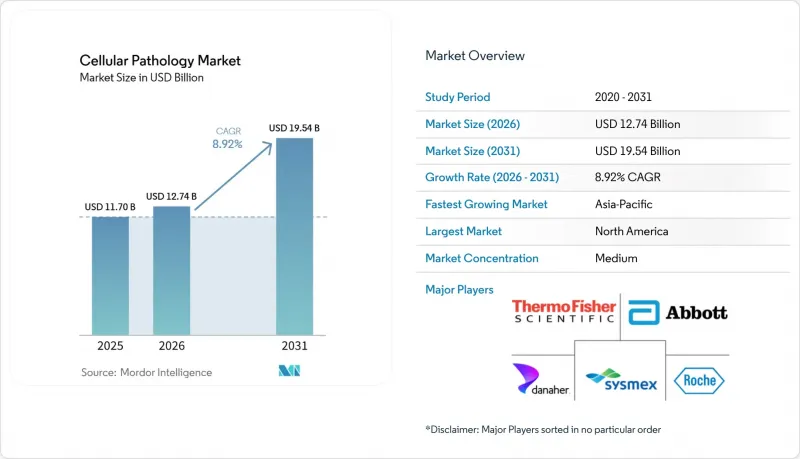
Mordor Intelligence에 의하면, 세포병리학 시장 규모는 2025년 117억 달러에서 2026년에는 127억 4,000만 달러로 확대되어 2026년부터 2031년까지 CAGR 8.92%로 성장을 지속하여, 2031년에는 195억 4,000만 달러에 이를 것으로 예측됩니다.
본 보고서는 제품 및 서비스별(장비, 소모품 등), 기술별(조직병리학, 세포병리학 등), 용도별(임상 진단 등), 적응증별(종양학, 감염증 등), 최종 사용자별(병원·의료 시스템 등), 지역별(북미 등)로 분류되어 있습니다. 시장 예측은 금액(달러) 기준으로 제시되어 있습니다.
전 세계 세포병리학 시장 동향 및 인사이트
암 및 만성 질환 진단 건수 증가
암 발병률 증가로 인해 세포병리학 시장 전체에서 조직학적 및 세포학적 검사에 대한 수요가 지속적으로 발생하고 있습니다. 국제암연구소(IARC)의 기록에 따르면, 2024년에는 2,060만 건의 신규 암 진단이 있었으며, 폐암, 여성 유방암, 대장암이 발생률이 가장 높은 범주였습니다. 연간암 발생 건수는 2050년까지 3,500만 건에 달할 것으로 예측됩니다. 조직 검사는 류마티스 관절염, 자가면역성 간염, 원발성 담관염 및 IgG4 관련 질환의 진단에도 기여하고 있습니다. 이러한 질환에 대한 선별 검사가 보급되면, 조직학 및 면역조직화학 검사실의 슬라이드 처리량이 증가할 가능성이 있습니다. 조기 발견을 도입한 국가적 예방 프로그램을 통해 병리 검사 역량은 공중보건 서비스에서 지속적인 역할을 담당하게 될 것입니다.
정밀 종양학 및 동반 진단의 도입
동반 진단은 치료 프로토콜에서 치료 시작 전에 검증된 검사를 규정하고 있으므로 지속적인 검사 수요를 창출합니다. 2026년 7월, 애질런트(Agilent)는 식도 편평상피암, 위암, 위식도 접합부암 및 식도 선암 적응증에 대해 OPDIVO(옵디보)와 병용하는 PD-L1 IHC 28-8 pharmDx에 대해 FDA 승인을 획득했습니다. 이는 해당 플랫폼에 있어 8번째 FDA 승인 적응증이 되었습니다. 또한, FoundationOne CDx도 2026년에 이토베비 및 테프메토코에 대해 FDA 승인을 획득했습니다. 이러한 승인으로 인해 조직 기반 바이오마커 평가가 암 치료 과정에서 더욱 중요한 위치를 차지하게 되었습니다. 따라서 세포병리학 시장은 단순한 검사 비용이 아닌, 치료 결정과 직결된 수요를 확보하게 될 것입니다.
막대한 초기 투자 및 총 소유 비용(TCO) 요건
디지털 워크플로우에는 스캐너, 소프트웨어 라이선스, IT 인프라, 영상 저장 및 유지보수 지원이 필요합니다. 고처리량 스캐너는 시간당 300장 이상의 슬라이드를 처리할 수 있지만, 이를 도입하려면 검사 정보 시스템의 검증, 네트워크 업그레이드 및 교정된 디스플레이도 필요합니다. 병원은 이러한 요구 사항을 단일 장비 구매가 아닌 총 소유 비용의 관점에서 평가합니다. 상환 수준이 낮기 때문에 사하라 이남 아프리카나 남미 일부 지역의 병원에게는 초기 투자가 어려울 수 있습니다. 또한, 조기에 도입한 기관은 디지털 처리량이 증가하여 사례당 비용 효율성이 개선될 때까지 전환 비용을 부담해야 합니다. 이러한 상황으로 인해 중규모 병원 네트워크에서는 기존의 현미경 검사가 유지될 가능성이 있습니다.
부문 분석
2025년에는 소모품이 부문 매출의 61.23%를 차지했습니다. 시약, 항체, 진단 키트는 임상 및 연구 워크플로우에서 반복적으로 사용됩니다. 면역조직화학 프로토콜에서는 많은 경우 특정 검증된 항체 클론이 필요합니다. 이로 인해 브랜드 소모품의 사용이 촉진되고, 검증되지 않은 제품으로의 대체는 제한됩니다. 장비 시장은 2031년까지 연평균 성장률(CAGR) 9.87%를 나타낼 것으로 예측됩니다. 세포병리학 시장 내 장비 시장 규모는 검사실이 기존 플랫폼을 디지털 호환 시스템으로 교체함에 따라 뒷받침되고 있습니다.
FDA의 승인으로 인해, 검사실에서는 1차 진단 용도로 스캐너 도입을 검토하기가 더 쉬워졌습니다. 2024년 12월부터 2026년 7월 사이에 승인된 시스템으로는 로슈(Roche)의 ‘VENTANA DP 200’ 및 ‘DP 600’, 에프레디아(Epreedia)의 ‘E1000 Dx’,인디카 랩(Indica Labs)의 ‘HALO AP Dx’, 옵트라스캔(OptraScan)의 ‘OS-Ultra’ 등이 포함됩니다. 스캐너 도입에 따라 소프트웨어 및 영상 관리 시스템 시장도 확대되고 있습니다. 서비스 계약 및 원격 보고서 제공 계약 또한 지속적인 수익원이 되고 있습니다. ISO 15189 인증 요건은 검사실 품질에 있어 소모품의 가치를 더욱 높이고 있습니다. 세포병리학 시장은 처리량 확보를 위해 계속해서 소모품에 의존하고 있지만, 장비 교체가 다음 성장 단계를 뒷받침하고 있습니다.
2025년, 조직병리학은 기술 부문 매출의 42.95%를 차지했습니다. H&E 염색 및 형태학적 검사는 조직 기반 암 진단에서 여전히 표준적인 1차 평가로 자리 잡고 있습니다. 면역조직화학은 치료에 동반 진단이 필요한 경우 여전히 중요한 역할을 수행하고 있습니다. 애지런트(Agilent)사의 PD-L1 IHC 28-8 pharmDx는 2026년 7월까지 FDA로부터 8가지 적응증에 대한 승인을 받았습니다. 디지털 병리학은 2031년까지 연평균 성장률(CAGR) 10.54%로 확대될 것으로 예측됩니다. 이에 따라 디지털 시스템은 기술 카테고리 중 가장 높은 성장률을 보이고 있습니다.
검사가 바이오마커 중심으로 전환됨에 따라 분자 병리학 및 AI를 활용한 병리학의 중요성도 커지고 있습니다. Natera사는 2026년 1분기에 종양학 검사 건수가 전년 동기 대비 54% 증가했다고 보고했습니다. ‘Signatera CDx’는 종양학 분야의 분자 잔류 병변 검사로, FDA 승인을 받은 최초의 동반 진단제가 되었습니다. 세포병리학, 유세포분석법, 그리고 인시투 하이브리다이제이션은 혈액학, 생식 의학 및 기타 특정 워크플로우에서 여전히 전문적인 역할을 담당하고 있습니다. 대안이 제한적인 분야에서는 이러한 임상적 역할이 여전히 중요합니다. 디지털 시스템은 조직 형태학의 핵심적 가치를 대체하지 않으면서, 사례 관리 및 해석에 새로운 접근 방식을 제공합니다. 이러한 기술들을 단일 진단 과정에서 병용함으로써 세포병리학 시장은 혜택을 얻게 될 것입니다.
지역별 분석
2025년, 북미는 전 세계 매출의 41.67%를 차지했습니다. 이 지역은 조직 기반 동반 진단의 광범위한 활용, 면역조직화학 및 분자병리학에 대한 확립된 보험 환급 제도, 그리고 디지털 플랫폼을 도입한 대학 병원의 존재와 같은 이점을 누리고 있습니다. 미국에서는 2024년 12월 이후 모든 슬라이드 이미징 시스템에 대해 FDA로부터 여러 건의 승인이 내려졌습니다. 퀘스트 다이아그노스틱스(Quest Diagnostics)는 2026년 7월 ‘OncoEMR Molecular Profiling Integration’을 통해 종양학 검사에 대한 접근성을 확대했습니다. 이 서비스는 1,600곳의 지역 암 진료 거점에 소속된 4,700명의 임상의들을 지원하고 있습니다. 캐나다와 멕시코는 암 의료에 대한 투자와 민간 검사 기관의 확장을 통해 규모는 작지만 성장세가 두드러진 기여를 하고 있습니다.
유럽은 세포병리학 시장에서 두 번째로 큰 지역 기여도를 차지하고 있습니다. 독일에서는 정밀 종양학에 대한 수요와 확립된 체외진단약 제조거점이 결합되어 있으며, 영국, 프랑스, 이탈리아, 스페인이 해당 지역의 검사량의 대부분을 차지하고 있습니다. 잉글랜드 국민보건서비스(NHS)의 병리학 통합 프로그램은 허브 앤 스포크(hub-and-spoke) 방식의 디지털 네트워크를 지원하고 있습니다. EU의 체외진단기기 규제는 동반진단 및 디지털 병리학 시스템의 검증 및 시판 후 의무에 영향을 미치고 있습니다. 이러한 의무는 확립된 규제 대응 역량을 갖춘 공급업체에 유리하게 작용합니다.
아시아태평양은 2031년까지 연평균 성장률(CAGR) 10.72%를 나타낼 것으로 예측됩니다. 2024년 기준, 아시아는 전 세계 암 사례의 50.7% 이상을 차지했습니다. 중국과 인도에서는 검사실 인프라와 암 검진 체계가 확충되고 있습니다. 일본의 병리 진단 지침에서는 진단 실무에서 디지털 병리 영상의 활용을 권장하고 있습니다. 한국과 호주는 여전히 선진 시장이지만, 인도에서는 검사실 구축이 2급·3급 도시로 확대되고 있습니다. 중동 및 아프리카 및 남미 시장 규모는 작지만, PathAI가 브라질의 A.C. 카마르고 암 센터와 제휴한 것은 이 지역에서 AI를 활용한 병리 진단에 대한 관심이 높아지고 있음을 보여줍니다.
기타 혜택:
- 엑셀 형식 시장 예측(ME) 시트
- 3개월간의 애널리스트 지원
자주 묻는 질문
목차
제1장 서론
제2장 조사 방법
제3장 개요
제4장 시장 구도
제5장 시장 규모와 성장 예측
제6장 경쟁 구도
제7장 시장 기회와 향후 전망
JHS 26.09.01According to Mordor Intelligence, the cellular pathology market size is expected to grow from USD 11.70 billion in 2025 to USD 12.74 billion in 2026 and is forecast to reach USD 19.54 billion by 2031 at 8.92% CAGR over 2026-2031.
This report is Segmented by Product and Service (Instruments, Consumables, and More), by Technology (Histopathology, Cytopathology, and More), by Application (Clinical Diagnostics and More), by Indication (Oncology, Infectious Diseases, and More), by End User (Hospitals and Health Systems, and More), and Geography (North America, and More). The Market Forecasts are Provided in Terms of Value (USD).
Global Cellular Pathology Market Trends and Insights
Rising Cancer and Chronic-Disease Diagnostic Workloads
Cancer incidence continues to create demand for histological and cytological examinations across the cellular pathology market. IARC recorded 20.6 million new cancer diagnoses in 2024, and lung, female breast, and colorectal cancers were the largest incidence categories. Annual cancer incidence is projected to reach 35 million cases by 2050. Tissue assessment also supports diagnosis for rheumatoid arthritis, autoimmune hepatitis, primary biliary cholangitis, and IgG4-related disease. Higher screening coverage for these conditions can add slide volumes in histology and immunohistochemistry laboratories. National prevention programs that incorporate early detection can make pathology capacity a lasting part of public-health delivery.
Precision Oncology and Companion-Diagnostic Adoption
Companion diagnostics create recurring testing needs because treatment protocols specify a validated assay before therapy begins. In July 2026, Agilent received FDA approval for PD-L1 IHC 28-8 pharmDx with OPDIVO for esophageal squamous cell carcinoma, gastric, gastroesophageal junction, and esophageal adenocarcinoma indications. This was the 8th FDA-approved indication for the platform. FoundationOne CDx also gained FDA approvals in 2026 for Itovebi and TEPMETKO. These approvals place tissue-based biomarker evaluation further into cancer treatment pathways. The cellular pathology market therefore gains demand that is linked to treatment decisions rather than discretionary laboratory spending.
High Capital and Total-Cost-of-Ownership Requirements
Digital workflows require scanners, software licenses, information technology infrastructure, image storage, and maintenance support. High-throughput scanners can process more than 300 slides per hour, but their installation also requires laboratory information system validation, network upgrades, and calibrated displays. Hospitals assess these needs as a total cost of ownership rather than as a single equipment purchase. Lower reimbursement levels can make the initial investment difficult for hospitals in Sub-Saharan Africa and parts of South America. Early adopters also carry transition costs before higher digital volumes improve cost-per-case economics. These conditions can preserve conventional microscopy in mid-sized hospital networks.
Other drivers and restraints analyzed in the detailed report include:
- Digital Pathology, AI, and Telepathology Adoption
- AI-Ready Cellular Pathology Data Generation from Routine Slides
- Pathologist and Histotechnologist Shortages
For complete list of drivers and restraints, kindly check the Table Of Contents.
Segment Analysis
Consumables held 61.23% of segment revenue in 2025. Reagents, antibodies, and diagnostic kits are used repeatedly in clinical and research workflows. Immunohistochemistry protocols often require specific validated antibody clones. This supports the use of branded consumables and limits substitution with unvalidated products. Instruments are projected to record a CAGR of 9.87% through 2031. The cellular pathology market size for instruments is supported by laboratories replacing conventional platforms with digital-ready systems.
FDA clearances have helped laboratories consider scanner purchases for primary diagnostic use. Roche's VENTANA DP 200 and DP 600, Epredia's E1000 Dx, Indica Labs' HALO AP Dx, and OptraSCAN's OS-Ultra were among systems cleared between December 2024 and July 2026. Software and image-management systems grow as scanners are deployed. Service contracts and remote reporting arrangements also add recurring revenue. ISO 15189 accreditation requirements reinforce the value placed on laboratory-quality consumables. The cellular pathology market continues to rely on consumables for volume while equipment renewal supports the next phase of growth.
Histopathology held 42.95% of the technology-segment revenue in 2025. H&E staining and morphological review remain the standard first-line assessment for tissue-based cancer diagnosis. Immunohistochemistry remains important where treatment requires a companion diagnostic. Agilent's PD-L1 IHC 28-8 pharmDx had 8 FDA-approved indications by July 2026. Digital pathology is forecast to advance at a CAGR of 10.54% through 2031. This gives digital systems the strongest growth rate among technology categories.
Molecular pathology and AI-enabled pathology are also gaining relevance as testing becomes more biomarker-focused. Natera reported 54% year-over-year growth in oncology test volumes in the first quarter of 2026. Signatera CDx became the first FDA-approved companion diagnostic for molecular residual disease testing in oncology. Cytopathology, flow cytometry, and in situ hybridization retain specialized roles in hematological, reproductive, and other targeted workflows. Their clinical role remains important where alternative approaches are limited. Digital systems add new ways to manage and interpret cases without replacing the core value of tissue morphology. The cellular pathology market benefits when these technologies are used together in a single diagnostic pathway.
Complete Report Scope:
- By Product and Service
- Instruments
- Microtomes and Cryostats
- Tissue Processors
- Automatic Stainers
- Whole-Slide Imaging Scanners
- Pathology Workstations and Displays
- Consumables
- Diagnostic Kits
- Reagents and Antibodies
- Probes and Molecular Kits
- Software and Image-Management Systems
- Services
- Instruments
- By Technology
- Histopathology
- Cytopathology
- Immunohistochemistry
- In Situ Hybridization
- Digital Pathology
- Molecular Pathology
- Flow Cytometry
- AI-Enabled Pathology
- By Application
- Clinical Diagnostics
- Genetic and Molecular Testing
- Drug Discovery and Development
- Toxicology and Safety Assessment
- Research, Education and Training
- By Indication
- Oncology
- Infectious Diseases
- Inflammatory and Autoimmune Disorders
- Gastrointestinal Diseases
- Neurological Diseases
- Gynecological Diseases
- Others
- By End User
- Hospitals and Health Systems
- Diagnostic and Reference Laboratories
- Research Laboratories and Academic Centers
- Pharmaceutical and Biotechnology Companies
- Contract Research Organizations
- Specialty Clinics and Cancer Centers
- By Geography
- North America
- United States
- Canada
- Mexico
- Europe
- Germany
- United Kingdom
- France
- Italy
- Spain
- Rest of Europe
- Asia-Pacific
- China
- Japan
- India
- Australia
- South Korea
- Rest of Asia-Pacific
- Middle East and Africa
- GCC
- South Africa
- Rest of Middle East and Africa
- South America
- Brazil
- Argentina
- Rest of South America
- North America
Geography Analysis
North America held 41.67% of global revenue in 2025. The region benefits from extensive use of tissue-based companion diagnostics, established reimbursement for immunohistochemistry and molecular pathology, and academic medical centers that are adopting digital platforms. The United States has received several FDA clearances for whole-slide imaging systems since December 2024. Quest Diagnostics expanded oncology test access through OncoEMR Molecular Profiling Integration in July 2026. The service supports 4,700 clinicians across 1,600 community cancer locations. Canada and Mexico provide smaller but growing contributions through cancer-care investment and private laboratory expansion.
Europe is the second-largest regional contributor to the cellular pathology market. Germany combines precision oncology demand with an established in vitro diagnostics manufacturing base. The United Kingdom, France, Italy, and Spain account for much of the region's testing volume. NHS England's pathology consolidation program supports hub-and-spoke digital networks. The EU In Vitro Diagnostic Regulation affects validation and post-market obligations for companion diagnostics and digital pathology systems. These obligations favor vendors with established regulatory capabilities.
Asia-Pacific is forecast to grow at a CAGR of 10.72% through 2031. Asia represented more than 50.7% of global cancer cases in 2024. China and India are expanding laboratory infrastructure and cancer screening capacity. Japan's pathology guidance supports the use of digital pathology images in diagnostic practice. South Korea and Australia remain advanced markets, while Indian laboratory development is extending into tier-2 and tier-3 cities. The markets in Middle East and Africa and South America are smaller, but PathAI's collaboration with A.C.Camargo Cancer Center in Brazil shows the growing interest in AI-enabled pathology in these regions.
- Abbott Laboratories
- Agilent Technologies
- Aiforia Technologies Plc
- Beckton Dickinson
- BioGenex
- Danaher
- Roche
- FUJIFILM
- Hamamatsu Photonics
- Hologic
- Indica Labs, LLC
- Koninklijke Philips
- NeoGenomics Laboratories
- OptraSCAN
- PathAI, Inc.
- PHC Holdings
- Proscia
- Sakura Finetek
- Sysmex
- Thermo Fisher Scientific
Additional Benefits:
- The market estimate (ME) sheet in Excel format
- 3 months of analyst support
TABLE OF CONTENTS
1 INTRODUCTION
- 1.1 Study Assumptions and Market Definition
- 1.2 Scope of the Study
2 RESEARCH METHODOLOGY
3 EXECUTIVE SUMMARY
4 MARKET LANDSCAPE
- 4.1 Market Overview
- 4.2 Market Drivers
- 4.2.1 Rising Cancer and Chronic-Disease Diagnostic Workloads
- 4.2.2 Precision Oncology and Companion-Diagnostic Adoption
- 4.2.3 Digital Pathology, AI and Telepathology Adoption
- 4.2.4 Expansion of Cancer Screening and Early-Diagnosis Programs
- 4.2.5 Molecular Readouts from Limited Tissue Samples
- 4.2.6 AI-Ready Cellular Pathology Data Generation from Routine Slides
- 4.3 Market Restraints
- 4.3.1 High Capital and Total-Cost-of-Ownership Requirements
- 4.3.2 Pathologist and Histotechnologist Shortages
- 4.3.3 Interoperability, Data-Storage and Cybersecurity Burden
- 4.3.4 Pre-Analytical Variability and Tissue Scarcity in Multiplex Testing
- 4.4 Supply Chain Analysis
- 4.5 Regulatory Landscape
- 4.6 Technological Outlook
- 4.7 Porter's Five Forces Analysis
- 4.7.1 Threat of New Entrants
- 4.7.2 Bargaining Power of Suppliers
- 4.7.3 Bargaining Power of Buyers
- 4.7.4 Threat of Substitutes
- 4.7.5 Competitive Rivalry
5 MARKET SIZE AND GROWTH FORECASTS
- 5.1 By Product and Service
- 5.1.1 Instruments
- 5.1.1.1 Microtomes and Cryostats
- 5.1.1.2 Tissue Processors
- 5.1.1.3 Automatic Stainers
- 5.1.1.4 Whole-Slide Imaging Scanners
- 5.1.1.5 Pathology Workstations and Displays
- 5.1.2 Consumables
- 5.1.2.1 Diagnostic Kits
- 5.1.2.2 Reagents and Antibodies
- 5.1.2.3 Probes and Molecular Kits
- 5.1.3 Software and Image-Management Systems
- 5.1.4 Services
- 5.1.1 Instruments
- 5.2 By Technology
- 5.2.1 Histopathology
- 5.2.2 Cytopathology
- 5.2.3 Immunohistochemistry
- 5.2.4 In Situ Hybridization
- 5.2.5 Digital Pathology
- 5.2.6 Molecular Pathology
- 5.2.7 Flow Cytometry
- 5.2.8 AI-Enabled Pathology
- 5.3 By Application
- 5.3.1 Clinical Diagnostics
- 5.3.2 Genetic and Molecular Testing
- 5.3.3 Drug Discovery and Development
- 5.3.4 Toxicology and Safety Assessment
- 5.3.5 Research, Education and Training
- 5.4 By Indication
- 5.4.1 Oncology
- 5.4.2 Infectious Diseases
- 5.4.3 Inflammatory and Autoimmune Disorders
- 5.4.4 Gastrointestinal Diseases
- 5.4.5 Neurological Diseases
- 5.4.6 Gynecological Diseases
- 5.4.7 Others
- 5.5 By End User
- 5.5.1 Hospitals and Health Systems
- 5.5.2 Diagnostic and Reference Laboratories
- 5.5.3 Research Laboratories and Academic Centers
- 5.5.4 Pharmaceutical and Biotechnology Companies
- 5.5.5 Contract Research Organizations
- 5.5.6 Specialty Clinics and Cancer Centers
- 5.6 By Geography
- 5.6.1 North America
- 5.6.1.1 United States
- 5.6.1.2 Canada
- 5.6.1.3 Mexico
- 5.6.2 Europe
- 5.6.2.1 Germany
- 5.6.2.2 United Kingdom
- 5.6.2.3 France
- 5.6.2.4 Italy
- 5.6.2.5 Spain
- 5.6.2.6 Rest of Europe
- 5.6.3 Asia-Pacific
- 5.6.3.1 China
- 5.6.3.2 Japan
- 5.6.3.3 India
- 5.6.3.4 Australia
- 5.6.3.5 South Korea
- 5.6.3.6 Rest of Asia-Pacific
- 5.6.4 Middle East and Africa
- 5.6.4.1 GCC
- 5.6.4.2 South Africa
- 5.6.4.3 Rest of Middle East and Africa
- 5.6.5 South America
- 5.6.5.1 Brazil
- 5.6.5.2 Argentina
- 5.6.5.3 Rest of South America
- 5.6.1 North America
6 COMPETITIVE LANDSCAPE
- 6.1 Market Concentration
- 6.2 Market Share Analysis
- 6.3 Company Profiles (includes Global Level Overview, Market Level Overview, Core Segments, Financials as available, Strategic Information, Market Rank/Share, Products and Services, Recent Developments)
- 6.3.1 Abbott Laboratories
- 6.3.2 Agilent Technologies, Inc.
- 6.3.3 Aiforia Technologies Plc
- 6.3.4 Becton, Dickinson and Company
- 6.3.5 BioGenex
- 6.3.6 Danaher Corporation
- 6.3.7 F. Hoffmann-La Roche Ltd.
- 6.3.8 Fujifilm Holdings Corporation
- 6.3.9 Hamamatsu Photonics K.K.
- 6.3.10 Hologic, Inc.
- 6.3.11 Indica Labs, LLC
- 6.3.12 Koninklijke Philips N.V.
- 6.3.13 NeoGenomics Laboratories, Inc.
- 6.3.14 OptraSCAN
- 6.3.15 PathAI, Inc.
- 6.3.16 PHC Holdings Corporation
- 6.3.17 Proscia Inc.
- 6.3.18 Sakura Finetek USA, Inc.
- 6.3.19 Sysmex Corporation
- 6.3.20 Thermo Fisher Scientific Inc.
7 MARKET OPPORTUNITIES AND FUTURE OUTLOOK
- 7.1 White-Space and Unmet-Need Assessment