|
시장보고서
상품코드
2118017
인사, 인재 채용 및 인력 계획 분야 생성형 AI : 시장 점유율 분석, 업계 동향 및 통계, 성장 예측(2026-2031년)Generative AI In HR Talent Acquisition and Workforce Planning - Market Share Analysis, Industry Trends & Statistics, Growth Forecasts (2026 - 2031) |
||||||
 Mordor Intelligence
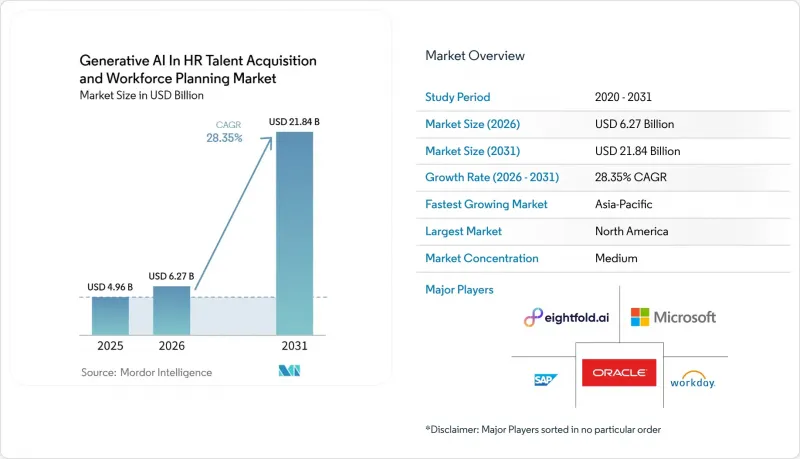
Mordor Intelligence에 의하면, 인사, 인재 채용 및 인력 계획 분야 생성형 AI 시장 규모는 2025년에 49억 6,000만 달러로 평가되었습니다. 2026년 62억 7,000만 달러에서 2031년까지 218억 4,000만 달러에 이를 것으로 예상되며, 예측 기간(2026-2031년) CAGR은 28.35%를 나타낼 전망입니다.
본 보고서는 배포 모델(클라우드, 하이브리드, 기타), 인사 기능(채용·인재 확보, 학습·개발, 성과 관리, 기타), 조직 규모(대기업, 중소기업), 최종 용도(IT 및 통신, 기타) 및 지역별로 분류되어 있습니다. 시장 예측은 금액(미 달러)으로 제시되어 있습니다.
세계의 인사, 인재 채용 및 인력 계획 분야 생성형 AI 시장 동향 및 인사이트
기업용 HR SaaS에서의 대규모 언어 모델 도입
대규모 언어 모델은 시범 운영 단계에서 HR 소프트웨어의 핵심 워크플로우로 전환되고 있습니다. 워크데이(Workday)는 2026년 3월, HR 및 재무 업무를 위한 300개 이상의 에이전트 기능을 갖춘 ‘Sana from Workday’를 출시했습니다. 버너 그룹(Burner Group)은 도입 후 40일 이내에 90%의 채택률을 달성했으며, 배포 후 400건의 ChatGPT 라이선스를 폐지했다고 보고했습니다. Oracle은 2026년 4월, Oracle Fusion Cloud HCM의 워크플로우 내에서 업무를 지원하도록 설계된 8개의 ‘Fusion Agentic Applications for HR’을 도입했습니다. 이번 출시에서는 AI 기능을 독립적인 도구로 취급하지 않고, 주요 HR 시스템에 통합하고 있습니다. 또한 조달 팀도 거버넌스 관리 및 AI 관리 관행을 더욱 중시하고 있습니다.
대량 채용 워크플로우의 자동화
대량 채용은 고용주에게 AI의 업무적 가치를 평가할 수 있는 명확한 틀을 제공합니다. 2026년 7월, Eightfold사는 자사의 ‘AI Interviewer’를 조기에 도입한 사용자의 경우 채용 주기가 42일에서 1주일 미만으로 단축되었다고 발표했습니다. 이 회사는 또한 면접까지 소요되는 시간이 최대 90% 단축되었으며, 채용 담당자의 수작업 중 80%가 자동화되었다고 보고했습니다. 조직이 결과를 면밀히 모니터링할 경우, 체계화된 선별 과정을 통해 후보자 초기 평가의 일관성을 높일 수 있습니다. SAP는 세계 사업 전반에 걸쳐 ‘SmartRecruiters for SAP SuccessFactors’를 도입하고 있으며, 2026년 9월 전 세계적인 본격 가동을 예정하고 있습니다. 인사, 인재 채용 및 인력 계획 분야 생성형 AI 시장에서 생성형 AI는 고용주가 신속한 선별과 투명한 평가 관리를 결합할 수 있다는 점에서 이점을 제공합니다.
데이터 개인정보 보호, 편향성 및 공정성에 대한 우려
편향 및 공정성에 대한 우려는 채용에 AI를 활용하는 고용주에게 법적 위험과 평판 위험을 초래합니다. 2026년 『Scientific Reports』지에 게재된 연구에 따르면, AI 채용 시스템에서는 인종, 성별, 연령에 걸친 교차적 편향이 나타날 가능성이 있는 것으로 밝혀졌습니다. 이 때문에 많은 채용 모델에서 단순한 단일 범주에 의한 심사만으로는 불충분합니다. 고용주에게는 문서화된 테스트, 감독, 그리고 모델 결과 검토 프로세스가 요구됩니다. 소규모 공급업체가 이러한 요건을 일관되게 충족하기는 어려울 수 있습니다. 또한, 이로 인해 거버넌스 역량은 인사·인재 채용·인력 계획을 위한 생성형 AI 솔루션 제공에 있어 핵심 요소가 되고 있습니다.
부문별 분석
2025년 기준, 인사, 인재 채용 및 인력 계획 분야 생성형 AI 시장 점유율의 76.48%를 클라우드가 차지했습니다. 이러한 상황은 핵심 인적 자본 관리 시스템이 수년에 걸쳐 SaaS(Software-as-a-Service) 플랫폼으로 전환되어 온 것을 반영합니다. 주요 벤더들은 클라우드 아키텍처를 활용하여 자사의 전체 HR 제품군에 AI 기능을 제공합니다. 이에 따라 클라우드 데이터 거버넌스 요건을 충족할 수 있는 조직에게 있어 클라우드 도입은 계속해서 중심적인 위치를 차지하고 있습니다.
하이브리드 도입은 2031년까지 연평균 성장률(CAGR) 29.47%를 나타낼 것으로 예측됩니다. 금융 서비스, 의료, 정부 기관 등은 급여 데이터나 후보자 데이터를 관리된 환경 내에 보관하는 경우가 있습니다. 그럼에도 불구하고, 특정 분석이나 추론 워크로드에 대해서는 클라우드 서비스를 이용할 수 있습니다. Oracle은 2026년 7월, Fusion Applications를 위한 AI 네이티브 빌더 환경을 도입했습니다. 여기에는 노코드, 로우코드, 프로우코드 옵션이 포함되어 있습니다. 레거시 시스템의 통합 요구 사항이나 엄격한 데이터 주권 관련 규정이 존재하는 상황에서는 On-Premise 시스템이 여전히 중요하게 여겨지고 있습니다. 규제 대상 기업 고객에게 서비스를 제공하는 벤더에게 있어 하이브리드 대응 능력은 그 중요성이 커지고 있습니다.
2025년 인사, 인재 채용 및 인력 계획 분야 생성형 AI 시장 규모 중 채용 및 인재 확보가 35.82%를 차지했습니다. 채용 활동에서는 채용까지 소요되는 기간, 면접 완료 현황, 내정 결과 등을 통해 측정 가능한 반복적인 워크플로가 생성됩니다. 이러한 데이터 포인트를 통해 인사 및 재무 담당자에게 이용 사례를 설명하기가 쉬워집니다. 또한, 채용 건수가 많을수록 조직은 프로세스를 개선할 기회를 반복적으로 얻을 수 있습니다.
HR 애널리틱스 및 인력 계획 시장은 2031년까지 연평균 성장률(CAGR) 30.82%로 확대될 것으로 예측됩니다. 이 기능은 정적인 보고서 작성에서 시나리오 기획, 스킬 매핑, 사내 이동 지원으로 전환되고 있습니다. 고용주는 AI를 활용하여 채용 수요가 시급해지기 전에 발생할 수 있는 기술 격차를 파악할 수 있습니다. 학습·개발, 직원 참여도, 성과 관리 분야에서도 관련 인재 데이터에 대한 수요가 증가하고 있습니다. 그 결과, 채용, 인재 개발, 인재 유지 간의 연계가 더욱 긴밀해지고 있습니다. 이러한 기능을 단일 경험으로 통합하는 벤더는 대기업 구매자에게 더 우수한 서비스를 제공할 수 있는 입장에 있다고 볼 수 있습니다.
지역별 분석
2025년, 북미는 인사, 인재 채용 및 인력 계획 분야 생성형 AI 시장 점유율의 40.27%를 차지했습니다. 이 지역에는 기업용 인사 소프트웨어 공급업체와 클라우드 기반 HCM(인적 자본 관리) 사용자가 집중되어 있습니다. 이 지역 내 수요의 대부분은 미국이 주도하고 있지만, 캐나다와 멕시코는 국경을 초월한 플랫폼 도입의 혜택을 누리고 있습니다. 워크데이는 2026년 5월, Sana Self-Service Agent를 Microsoft 365 Copilot에 통합했습니다. 이미 자리 잡은 생산성 소프트웨어 내에 HR 기능을 통합함으로써 사용자의 도입 장벽을 낮출 수 있습니다.
아시아태평양은 2031년까지 연평균 성장률(CAGR) 30.71%를 나타낼 것으로 예측됩니다. 인도, 중국, 동남아시아의 고용주들은 채용 활동 및 직원 대상 서비스의 디지털화를 추진하고 있습니다. 인도와 중국에서는 현지 언어와 노동 시장 상황에 맞춘 제품이 개발되고 있습니다. 모바일 우선(Mobile First) 후보자와의 소통은 다국어 지원 대화형 AI 및 효율적인 채용 워크플로우에 대한 수요를 뒷받침하고 있습니다.
유럽은 여전히 중요한 수요 거점이지만, 규정 준수가 수요를 좌우하는 지역입니다. EU AI법에서는 고용 분야에서의 AI 활용 대부분이 고위험으로 간주되며, 이에 따라 평가, 문서화 및 인간에 의한 감독의 필요성이 높아지고 있습니다. Leapsome사는 2026년, GDPR(EU 개인정보보호규정)을 준수하며 설명 가능한 AI 에이전트를 중시하는 AI 채용 및 인재 관리 제품군을 도입했습니다. 남미는 소규모 기반에서 발전하고 있으며, 브라질과 아르헨티나에서 활발한 수요가 나타나고 있습니다. 중동에서는 특히 사우디아라비아와 UAE에서 노동력 현지화 프로그램을 통해 잠재적인 시장이 주목받고 있습니다. 아프리카는 여전히 초기 단계에 있으며, 남아프리카공화국과 이집트가 도입을 주도하고 있습니다.
기타 혜택 :
- 엑셀 형식 시장 예측(ME) 시트
- 3개월간의 애널리스트 지원
자주 묻는 질문
목차
제1장 서론
제2장 조사 방법
제3장 개요
제4장 시장 구도
제5장 시장 규모 및 성장 예측
제6장 경쟁 구도
제7장 시장 기회 및 향후 전망
KTH 26.09.02According to Mordor Intelligence, the generative AI in HR Talent Acquisition and Workforce Planning market size was valued at USD 4.96 billion in 2025 and estimated to grow from USD 6.27 billion in 2026 to reach USD 21.84 billion by 2031, at a CAGR of 28.35% during the forecast period (2026-2031).
This report is Segmented by Deployment Model (Cloud, Hybrid, and More), HR Function (Recruitment and Talent Acquisition, Learning and Development, Performance Management, and More), Organization Size (Large Enterprises, and Small and Medium Enterprises), End-Use (IT and Telecom, and More), and Geography. The Market Forecasts are Provided in Terms of Value (USD).
Global Generative AI In HR Talent Acquisition and Workforce Planning Market Trends and Insights
Large Language Model Adoption in Enterprise HR SaaS
Large language models are moving from trials into core HR software workflows. Workday launched Sana from Workday in March 2026 with more than 300 agentic skills for HR and finance work. Berner Group reported 90% adoption within 40 days and retired 400 ChatGPT licenses after the rollout. Oracle introduced 8 Fusion Agentic Applications for HR in April 2026, designed to support actions within Oracle Fusion Cloud HCM workflows. These releases integrate AI functions into the main HR system rather than treating them as separate tools. Procurement teams are also giving more weight to governance controls and AI management practices.
Automation of High-Volume Hiring Workflows
High-volume recruiting provides employers with a clear framework for assessing the operational value of AI. In July 2026, Eightfold stated that early users of its AI Interviewer reduced hiring cycles from 42 days to under 1 week. The company also reported time-to-interview reductions of up to 90% and automation of 80% of manual recruiter tasks. Structured screening can improve consistency in early candidate evaluation when organizations closely monitor outcomes. SAP is implementing SmartRecruiters for SAP SuccessFactors across its global operations, with a worldwide go-live scheduled for September 2026. The generative AI in HR talent acquisition and workforce planning market benefits where employers can link faster screening with transparent evaluation controls.
Data Privacy, Bias, and Fairness Concerns
Bias and fairness concerns create legal and reputational risks for employers using AI in hiring. A 2026 study in Scientific Reports found that intersectional bias can manifest across race, gender, and age in AI recruitment systems. This makes simple, single-category reviews insufficient for many hiring models. Employers need documented testing, oversight, and a process for reviewing model outcomes. These requirements may be harder for smaller suppliers to meet consistently. They also make governance capability a central part of the generative AI in HR talent acquisition and workforce planning market offering.
Other drivers and restraints analyzed in the detailed report include:
- Conversational AI for Employee and Candidate Self-Service
- Skills-Based Workforce Planning and Internal Mobility
- Limited HR-Specific Training Data Quality
For complete list of drivers and restraints, kindly check the Table Of Contents.
Segment Analysis
Cloud held 76.48% of the generative AI in HR talent acquisition and workforce planning market share in 2025. The position reflects the long-running migration of core human capital systems to software-as-a-service platforms. Major suppliers use cloud architectures to deliver AI functions across their HR suites. This keeps cloud deployment central for organizations that can meet cloud data governance requirements.
Hybrid deployment is projected to grow at a 29.47% CAGR through 2031. Financial services, healthcare, and government organizations may retain payroll or candidate data in controlled environments. They can still use cloud services for selected analytics and inference workloads. Oracle introduced an AI-native builder experience for Fusion Applications in July 2026, including no-code, low-code, and pro-code options. On-premises systems remain relevant where legacy integration requirements or strict data sovereignty rules are in place. Hybrid capability is becoming important for suppliers serving regulated enterprise accounts.
Recruitment and talent acquisition accounted for 35.82% of the generative AI in HR talent acquisition and workforce planning market size in 2025. Recruiting produces recurring workflows that can be measured through time-to-fill, interview completion, and offer outcomes. These data points make the use case easier to explain to HR and finance leaders. High hiring volumes also give organizations repeated opportunities to refine their processes.
HR analytics and workforce planning are projected to expand at a 30.82% CAGR through 2031. The function is shifting from static reporting toward scenario planning, skills mapping, and internal mobility support. Employers can use AI to identify likely skills gaps before a hiring requirement becomes urgent. Learning and development, engagement, and performance management also add demand for connected people data. The result is a closer relationship between recruiting, development, and retention. Suppliers that integrate these functions into a single experience may be better positioned to serve enterprise buyers.
Complete Report Scope:
- By Deployment Model
- Cloud
- On-Premises
- Hybrid
- By HR Function
- Recruitment and Talent Acquisition
- Learning and Development
- Employee Engagement and Experience
- Performance Management
- HR Analytics and Workforce Planning
- Other HR Functions
- By Organization Size
- Large Enterprises
- Small and Medium Enterprises
- By End-Use Industry
- IT and Telecom
- BFSI
- Healthcare and Life Sciences
- Manufacturing
- Retail and E-commerce
- Other End-Use Industries
- By Geography
- North America
- United States
- Canada
- Mexico
- South America
- Brazil
- Argentina
- Rest of South America
- Europe
- Germany
- United Kingdom
- France
- Italy
- Spain
- Russia
- Rest of Europe
- Asia-Pacific
- China
- Japan
- India
- South Korea
- Australia
- Rest of Asia-Pacific
- Middle East
- Saudi Arabia
- United Arab Emirates
- Turkey
- Rest of Middle East
- Africa
- South Africa
- Egypt
- Rest of Africa
- North America
Geography Analysis
North America held 40.27% of the generative AI in HR talent acquisition and workforce planning market share in 2025. The region has a concentrated base of enterprise HR software suppliers and cloud HCM users. The United States drives most regional demand, while Canada and Mexico benefit from cross-border platform deployments. Workday brought Sana Self-Service Agent to Microsoft 365 Copilot in May 2026. Placing HR functions within established productivity software can reduce user adoption barriers.
Asia-Pacific is projected to grow at a 30.71% CAGR through 2031. Employers across India, China, and Southeast Asia are digitizing recruiting and employee services. India and China are developing products that reflect local languages and labor market conditions. Mobile-first candidate interactions support demand for multilingual conversational AI and efficient recruiting workflows.
Europe remains an important but compliance-shaped demand center. The EU AI Act treats many employment AI uses as high-risk, which increases the need for assessment, documentation, and human oversight. Leapsome introduced an AI recruiting and people management suite in 2026 that emphasizes GDPR-compliant and explainable AI agents. South America is developing from a smaller base, with Brazil and Argentina showing active demand. The Middle East has targeted potential through workforce nationalization programs, especially in Saudi Arabia and the UAE. Africa remains at an early stage, with South Africa and Egypt leading initial adoption.
- Workday, Inc.
- Oracle Corporation
- SAP SE
- Microsoft Corporation
- Eightfold AI, Inc.
- Phenom People, Inc.
- iCIMS, Inc.
- Beamery Ltd.
- Gloat, Inc.
- HireVue, Inc.
- Paradox.ai, Inc.
- Greenhouse Software, Inc.
- Lever, Inc.
- Textio, Inc.
- SeekOut Inc.
- Retain.ai Ltd.
- Lattice, Inc.
- ADP, Inc.
- IBM Corporation
- ServiceNow, Inc.
Additional Benefits:
- The market estimate (ME) sheet in Excel format
- 3 months of analyst support
TABLE OF CONTENTS
1 INTRODUCTION
- 1.1 Study Assumptions and Market Definition
- 1.2 Scope of the Study
2 RESEARCH METHODOLOGY
3 EXECUTIVE SUMMARY
4 MARKET LANDSCAPE
- 4.1 Market Overview
- 4.2 Market Drivers
- 4.2.1 Large Language Model Adoption in Enterprise HR SaaS
- 4.2.2 Automation of High-Volume Hiring Workflows
- 4.2.3 Conversational AI for Employee and Candidate Self-Service
- 4.2.4 Skills-Based Workforce Planning and Internal Mobility
- 4.2.5 Integration With Low-Code HR Tech Stacks
- 4.2.6 Hyper-Personalized Candidate and Employee Content Generation
- 4.3 Market Restraints
- 4.3.1 Data Privacy, Bias, and Fairness Concerns
- 4.3.2 Limited HR-Specific Training Data Quality
- 4.3.3 High Fine-Tuning and Governance Costs
- 4.3.4 Intellectual Property and Content Ownership Ambiguity
- 4.4 Value Chain Analysis
- 4.5 Regulatory Landscape
- 4.6 Technological Outlook
- 4.7 Porter's Five Forces Analysis
- 4.7.1 Threat of New Entrants
- 4.7.2 Bargaining Power of Suppliers
- 4.7.3 Bargaining Power of Buyers
- 4.7.4 Threat of Substitutes
- 4.7.5 Competitive Rivalry
5 MARKET SIZE AND GROWTH FORECASTS (VALUE)
- 5.1 By Deployment Model
- 5.1.1 Cloud
- 5.1.2 On-Premises
- 5.1.3 Hybrid
- 5.2 By HR Function
- 5.2.1 Recruitment and Talent Acquisition
- 5.2.2 Learning and Development
- 5.2.3 Employee Engagement and Experience
- 5.2.4 Performance Management
- 5.2.5 HR Analytics and Workforce Planning
- 5.2.6 Other HR Functions
- 5.3 By Organization Size
- 5.3.1 Large Enterprises
- 5.3.2 Small and Medium Enterprises
- 5.4 By End-Use Industry
- 5.4.1 IT and Telecom
- 5.4.2 BFSI
- 5.4.3 Healthcare and Life Sciences
- 5.4.4 Manufacturing
- 5.4.5 Retail and E-commerce
- 5.4.6 Other End-Use Industries
- 5.5 By Geography
- 5.5.1 North America
- 5.5.1.1 United States
- 5.5.1.2 Canada
- 5.5.1.3 Mexico
- 5.5.2 South America
- 5.5.2.1 Brazil
- 5.5.2.2 Argentina
- 5.5.2.3 Rest of South America
- 5.5.3 Europe
- 5.5.3.1 Germany
- 5.5.3.2 United Kingdom
- 5.5.3.3 France
- 5.5.3.4 Italy
- 5.5.3.5 Spain
- 5.5.3.6 Russia
- 5.5.3.7 Rest of Europe
- 5.5.4 Asia-Pacific
- 5.5.4.1 China
- 5.5.4.2 Japan
- 5.5.4.3 India
- 5.5.4.4 South Korea
- 5.5.4.5 Australia
- 5.5.4.6 Rest of Asia-Pacific
- 5.5.5 Middle East
- 5.5.5.1 Saudi Arabia
- 5.5.5.2 United Arab Emirates
- 5.5.5.3 Turkey
- 5.5.5.4 Rest of Middle East
- 5.5.6 Africa
- 5.5.6.1 South Africa
- 5.5.6.2 Egypt
- 5.5.6.3 Rest of Africa
- 5.5.1 North America
6 COMPETITIVE LANDSCAPE
- 6.1 Market Concentration
- 6.2 Strategic Moves
- 6.3 Market Share Analysis
- 6.4 Company Profiles (includes Global Level Overview, Market Level Overview, Core Segments, Financials as available, Strategic Information, Market Rank/Share, Products and Services, Recent Developments)
- 6.4.1 Workday, Inc.
- 6.4.2 Oracle Corporation
- 6.4.3 SAP SE
- 6.4.4 Microsoft Corporation
- 6.4.5 Eightfold AI, Inc.
- 6.4.6 Phenom People, Inc.
- 6.4.7 iCIMS, Inc.
- 6.4.8 Beamery Ltd.
- 6.4.9 Gloat, Inc.
- 6.4.10 HireVue, Inc.
- 6.4.11 Paradox.ai, Inc.
- 6.4.12 Greenhouse Software, Inc.
- 6.4.13 Lever, Inc.
- 6.4.14 Textio, Inc.
- 6.4.15 SeekOut Inc.
- 6.4.16 Retain.ai Ltd.
- 6.4.17 Lattice, Inc.
- 6.4.18 ADP, Inc.
- 6.4.19 IBM Corporation
- 6.4.20 ServiceNow, Inc.
7 MARKET OPPORTUNITIES AND FUTURE OUTLOOK
- 7.1 White-Space and Unmet-Need Assessment