
|
시장보고서
상품코드
2118031
OTT 애그리게이터 시장 : 점유율 분석, 업계 동향과 통계, 성장 예측(2026-2031년)OTT Aggregator - Market Share Analysis, Industry Trends & Statistics, Growth Forecasts (2026 - 2031) |
||||||
 Mordor Intelligence
2025년, 통합형 컨텐츠 애그리게이터는 OTT 애그리게이터 시장 규모 43.12%를 차지했습니다만, 화이트 라벨형 OTT 애그리게이션 플랫폼은 2031년까지 연평균 복합 성장률(CAGR)14.84%로 확대될 것으로 예측됩니다.
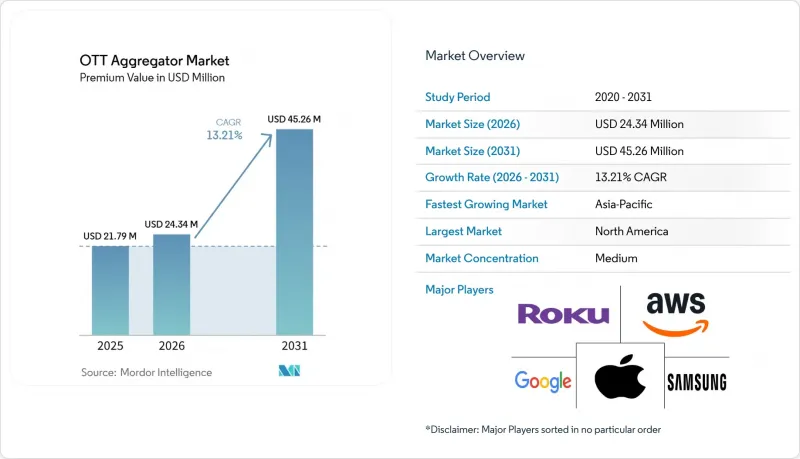
Mordor Intelligence에 따르면, 시장 규모는 2026년 2,434만 달러에서 2031년에는 4,526만 달러에 달할 것으로 예상되며, 2026년부터 2031년까지 연평균 성장률(CAGR) 13.21%를 나타낼 것으로 전망됩니다. 본 보고서는 서비스 유형(멀티 스트리밍 애그리게이터, 통합 컨텐츠 애그리게이터, 화이트 라벨 OTT 애그리게이션 플랫폼 등), 수익 모델(구독형(SVOD), 광고형(AVOD), 거래형(TVOD) 등), 기기 유형(스마트폰·태블릿,스마트 TV, 노트북·데스크톱 PC 등) 및 지역별로 분류되어 있습니다. 시장 예측은 금액(달러) 기준으로 제시되어 있습니다.
세계 OTT 애그리게이터 시장 동향 및 인사이트
구독 피로감이 애그리게이터 도입을 가속화하고 있습니다.
OTT 애그리게이터 시장은 각 가정이 개별 앱이나 결제 주기를 통해 관리해야 하는 독립형 스트리밍 서비스의 수가 꾸준히 증가하고 있는 데서 혜택을 보고 있습니다. 구독 수가 급증함에 따라 시청자들은 컨텐츠 발견 및 계정 관리의 번거로움을 줄여주는 단일 접근 지점에 점점 더 많은 관심을 보이고 있습니다. 이에 따라 어그리게이션은 단순한 편의 기능에 그치지 않고, 소비자가 원하는 컨텐츠를 유지하면서 지속적인 서비스 선택을 간소화하는 데 도움이 됩니다. 또한, 복잡성을 해소하는 플랫폼은 검색 행동, 결제 흐름, 추천 컨텐츠의 가시성에 대한 영향력을 확보할 수 있으므로 중개자 역할도 강화됩니다. 따라서 OTT(Over-The-Top) 애그리게이터 시장은 시청 선택지의 파편화가 진행될수록 통합된 접근의 매력이 높아지는 피드백 루프의 혜택을 누리고 있습니다. 이러한 역학 관계로 인해 애그리게이터는 스트리밍 유통 체인의 중심에 점점 더 가까워지고 있습니다.
일괄 청구와 앱 간 검색이 해지율을 낮춥니다.
일괄 결제는 단일 계정으로 여러 스트리밍 서비스를 확인하고, 갱신하며, 이용하는 데 필요한 번거로움을 줄여줌으로써 각 가구의 구독 관리 방식을 변화시킵니다. 앱 간 검색에는 또 다른 장점이 있습니다. 사용자는 여러 앱에서 같은 작업을 반복하는 대신, 단 한 번만 제목을 검색하면 됩니다. 이를 통해 컨텐츠를 발견할 때의 번거로움이 줄어듭니다. OTT 애그리게이터 시장에서 사용자의 불만은 참여도 저하나 해지 가속화로 이어지는 경우가 많기 때문에 이는 중요한 점입니다. 또한, 동일한 인터페이스에서 구독 내역을 항상 확인할 수 있고, 청구 주기를 넘나들며 관리하기 쉬워짐에 따라 그 이점은 더욱 커집니다. 유럽연합 집행위원회가 향후 제정할 예정인 ‘디지털 공정법(Digital Fairness Act)’에 대해 실시한 의견 수렴 과정에서 해지 절차의 투명성과 구독 조건의 명확성이 디지털 서비스 전반에 걸쳐 점점 더 중요한 정책 주제로 부상하고 있음이 드러났습니다. 이러한 기대가 더욱 공식화됨에 따라, OTT 애그리게이터 시장에서는 더 단순한 과금 시스템과 더 명확한 구독 관리 도구를 결합할 수 있는 플랫폼이 우위를 점할 가능성이 높습니다.
플랫폼 수수료를 둘러싼 분쟁이 컨텐츠 온보딩을 지연시킬 우려
OTT 애그리게이터 시장은 배포업체와 컨텐츠 서비스 간의 협력에 의존하고 있기 때문에 상업적 분쟁은 플랫폼의 성장을 직접적으로 저해할 가능성이 있습니다. 구독 수익 분배나 게재 조건을 둘러싸고 대립이 발생하면, 그 결과 컨텐츠 온보딩이 지연되거나 통합 모델이 약화되는 경우가 종종 있습니다. 시청자들은 단일 인터페이스 내에서 폭넓은 컨텐츠 카탈로그와 원활한 결제 경험을 기대하기 때문에 이는 애그리게이션의 핵심 가치를 훼손하게 됩니다. 주요 서비스가 번들에 포함되지 않은 채로 남아 있다면, 사용자는 시청의 일부를 여전히 개별적으로 관리해야 하며, 그 결과 플랫폼에 대한 충성도 저하로 이어집니다. OTT 애그리게이터 시장은 새로운 애그리게이션 계층이 급속한 확장을 도모하더라도, 프리미엄 컨텐츠 파트너와 허용 가능한 경제적 조건을 확보하지 못할 경우 특히 이 문제의 영향을 받기 쉽습니다. 시간이 지남에 따라 온보딩 지연이 반복되면, 사용자는 이미 강력한 협상력과 광범위한 서비스 네트워크를 갖춘 대규모 생태계로 이탈할 가능성이 있습니다.
부문 분석
통합형 컨텐츠 애그리게이터의 위상이 높아지고 있는 배경에는 결제, 검색, 추천 기능을 가시성이 높은 단일 인터페이스로 통합한 소비자 대상 서비스의 성숙화가 있습니다. OTT 애그리게이터 시장에서 이 모델은 백그라운드 인프라 계층이 아닌, 직접적인 프론트엔드 경험을 원하는 사용자에게 적합합니다. 또한, 계정 관리 및 컨텐츠 발견의 전 과정에 걸쳐 플랫폼 브랜드가 시청자 눈앞에 노출되므로, 소비자 인지도 향상에도 기여합니다. 멀티 스트리밍 애그리게이터도 여전히 중요한데, 신속하게 도입할 수 있을 뿐만 아니라 완전한 과금 책임을 지지 않으면서 링크, 검색, 시청 목록 기능에 중점을 두는 경우가 많기 때문입니다.
화이트 라벨 플랫폼이 탄력을 받고 있는 이유는 통신 사업자와 방송 사업자가 자사 브랜드 하에서 고객과의 관계를 유지하는 것을 선호하는 경향이 있기 때문입니다. Tata Play Binge의 화이트 라벨 서비스는 4-6개월 만에 클라이언트 브랜드의 인터페이스 내에 30개 이상의 OTT 앱을 배포함으로써 이러한 매력을 입증했습니다. 이러한 접근 방식을 통해 지역 서비스 제공업체는 독자적인 스택을 완전히 구축하지 않고도 OTT 애그리게이터 시장에 더 신속하게 진입할 수 있습니다. 기업용 동영상 관리 플랫폼은 여전히 소규모 부문이지만, 거버넌스 및 라이선싱에 기반한 접근이 방대한 컨텐츠 탐색보다 더 중요시되는 교육 및 기업 환경에서의 관리형 이용 사례를 지원합니다. 그 결과, OTT 애그리게이터 시장의 서비스 구성은 다양해지고 있으며, 소비자 대상 애그리게이션과 B2B 인프라가 동시에 확대되고 있습니다.
지역별 분석
2025년, 북미는 OTT 애그리게이터 시장의 36.19%를 차지하며 애그리게이션 서비스에 있어 최대의 지역 시장이 되었습니다. 이 지역은 잘 구축된 스트리밍 생태계, 높은 광대역 보급률, 그리고 이미 여러 디지털 구독 서비스를 관리하고 있는 소비자가 있다는 장점을 가지고 있습니다. 2025년 6월, Amazon Ads와 Roku는 Amazon 수요 측 플랫폼(DSP)을 통해 약 8,000만 가구(미국 커넥티드 TV 가구의 80% 이상)의 인증된 커넥티드 TV 가구를 통합하는 제휴를 발표했습니다. 이러한 움직임은 북미 OTT 애그리게이터 시장이 구독 기반 접근에 그치지 않고, 더 광범위한 광고 및 시청자 매칭 영역으로 확대되고 있음을 보여줍니다. 캐나다와 멕시코는 서로 다른 길을 걷고 있는데, 캐나다는 IPTV 번들형 비즈니스 모델에 가깝고, 멕시코는 가치 주도형 패키징에 중점을 두고 있습니다.
아시아태평양은 2031년까지 연평균 성장률(CAGR) 17.42%를 나타낼 것으로 예측되며, OTT 어그리게이터에게 가장 빠르게 성장하는 지역 시장이 될 전망입니다. AVIA 보고서에 따르면, 아시아태평양의 스크린 관련 수익은 2030년까지 1,960억 달러에 달할 것으로 예상되며, 그 순증분 전액은 연평균 성장률(CAGR) 7%로 확대될 것으로 예측되는 온라인 동영상에서 비롯될 것입니다. 인도는 Jio Platforms와 Bharti Airtel이 모바일 및 광대역 고객 기반을 활용하여 번들 구성의 강화와 가격 측면에서의 접근성을 대규모로 추진하고 있기 때문에 가장 치열한 경쟁의 무대가 되고 있습니다. 통신 사업자는 스트리밍 이용권과 네트워크 서비스를 단일 소비자 요금제에 결합할 수 있기 때문에 이는 OTT 애그리게이터 시장에서 강력한 구조적 우위를 가져다줍니다. 또한, 한국과 일본도 이 지역의 성장세를 뒷받침하고 있습니다. 이는 잘 구축된 현지 스트리밍 생태계가 서비스 간 횡단적인 발견 및 탐색의 가치를 높이고 있기 때문입니다.
유럽은 OTT(Over-The-Top) 애그리게이터 시장에서 여전히 중요한 위치를 차지하고 있지만, 규제가 엄격한 지역이기도 합니다. 도이치 텔레콤의 ‘MagentaTV’는 2026년 초 가입자 수 350만 명을 돌파했으며, 단일 통신사가 주도하는 인터페이스를 통해 Netflix, Disney+, Apple TV+, DAZN을 통합하고 있습니다. 도이치 텔레콤과 프로지벤사트-1은 2026년 2월, 새로운 5년간의 제휴를 통해 이 모델을 더욱 확대하여 프로지벤사트-1의 컨텐츠인Joyn, Joyn PLUS+를 MagentaTV의 카탈로그에 추가하는 한편, 주소 지정형 TV 광고(ATV) 분야의 협력을 확대했습니다. 유럽연합 집행위원회의 ‘디지털 옴니버스’ 제안은 일부 데이터 규제를 간소화하는 한편, AI 기반 프로파일링 및 서비스 간 시청자 관리와 관련된 의무를 강화함으로써 이러한 움직임에 더욱 중요한 의미를 부여했습니다. 남미, 중동 및 아프리카는 여전히 OTT 애그리게이터에게 성장 시장이지만, 낮은 구매력, 광대역 보급률의 불균형, 그리고 ‘모바일 퍼스트’나 ‘가성비 중시’ 서비스에 대한 강한 선호로 인해, 이 지역들의 비즈니스 모델은 북미나 서유럽에 비해 가격에 민감한 양상을 띠고 있습니다.
기타 혜택:
- 엑셀 형식 시장 예측(ME) 시트
- 3개월간의 애널리스트 지원
자주 묻는 질문
목차
제1장 서론
제2장 조사 방법
제3장 개요
제4장 시장 구도
제5장 시장 규모와 성장 예측
제6장 경쟁 구도
제7장 시장 기회와 향후 전망
JHS 26.09.01Unified content aggregators held 43.12% share of the OTT aggregator market size in 2025, while white-label OTT aggregation platforms are projected to expand at a 14.84% CAGR through 2031.
According to Mordor Intelligence, uSD 24.34 million in 2026 to USD 45.26 million by 2031, registering a CAGR of 13.21% between 2026 and 2031. This report is Segmented by Service Type (Multi-Streaming Aggregators, Unified Content Aggregators, White-Label OTT Aggregation Platforms, and More), Revenue Model (Subscription-Based (SVOD), Advertising-Based (AVOD), Transaction-Based (TVOD), and More), Device Type (Smartphones and Tablets, Smart TVs, Laptops and Desktops, and More), and Geography. The Market Forecasts are Provided in Terms of Value (USD).
Global OTT Aggregator Market Trends and Insights
Subscription Fatigue is Accelerating Aggregator Adoption
The OTT aggregator market is benefiting from the steady rise in the number of standalone streaming services that households must manage across separate apps and payment cycles. As subscription stacks become more crowded, viewers are increasingly interested in a single access point that reduces friction in discovery and account management. This makes aggregation more than a convenience feature, as it helps consumers keep their desired content while simplifying ongoing service choices. It also strengthens the role of the intermediary, since platforms that remove complexity can gain influence over search behavior, payment flows, and recommendation visibility. The over-the-top (OTT) aggregator market, therefore, benefits from a feedback loop in which more fragmented viewing choices increase the appeal of unified access. That dynamic is helping aggregators move closer to the center of the streaming distribution chain.
Unified Billing and Cross-App Search Reduce Churn
Unified billing changes the way households manage subscriptions by reducing the effort required to review, renew, and use multiple streaming services under a single account. Cross-app search adds another advantage; users can search for a title once instead of repeating the same task across several apps. This reduces discovery friction, which is important in the OTT aggregator market because user frustration often leads to lower engagement and faster cancellation. The benefit becomes stronger when the same interface also keeps subscription details visible and easier to manage across billing cycles. The European Commission's consultation on a forthcoming Digital Fairness Act showed that cancellation transparency and subscription clarity are becoming more important policy themes across digital services. As these expectations become more formal, the OTT aggregator market is likely to favor platforms that can combine simpler billing with clearer subscription management tools.
Platform Fee Disputes Can Delay Content Onboarding
The OTT aggregator market relies on cooperation between distributors and content services, so commercial disputes can directly slow platform growth. When subscription revenue shares or placement terms become contentious, the result is often a delay in onboarding or a weaker integration model. That weakens the core value of aggregation, because viewers expect a broad catalog and a smooth billing experience within a single interface. If a major service remains outside the bundle, users must still manage part of their viewing separately, which reduces platform stickiness. The OTT aggregator market is especially exposed to this issue when new aggregation layers try to scale quickly but cannot secure acceptable economics with premium content partners. Over time, repeated onboarding delays can push users toward larger ecosystems that already have stronger negotiating power and deeper service coverage.
Other drivers and restraints analyzed in the detailed report include:
- Smart TV Home Screens are Becoming the Default Discovery Layer
- Telco and Broadband Bundles Lower Customer Acquisition Costs
- Rights and Entitlement Fragmentation Limits Catalog Depth
For complete list of drivers and restraints, kindly check the Table Of Contents.
Segment Analysis
The larger position of unified content aggregators reflects the maturity of consumer-facing services that bring billing, search, and recommendations into one visible interface. In the OTT aggregator market, that model fits users who want a direct front-end experience rather than a background infrastructure layer. It also supports stronger consumer recognition because the platform brand stays in front of viewers throughout account management and discovery. Multi-streaming aggregators still matter because they can be deployed quickly and often focus on links, search, and watchlist functions without taking on full billing responsibility.
White-label platforms are gaining speed because telecom operators and broadcasters often prefer to keep the customer relationship under their own brand. Tata Play Binge's white-label offer showed this appeal by promoting the deployment of 30+ OTT apps within a client-branded interface in 4 to 6 months. That approach gives regional service providers a faster entry point into the OTT aggregator market without requiring them to build a full proprietary stack. Enterprise video management platforms remain a smaller segment, but they address controlled use cases in education and corporate environments where governance and licensed access matter more than mass discovery. The service mix in the OTT aggregator market is therefore broadening, with consumer aggregation and B2B infrastructure scaling at the same time.
Complete Report Scope:
- By Service Type
- Multi-Streaming Aggregators
- Unified Content Aggregators
- White-label OTT Aggregation Platforms
- Enterprise Video Management Platforms
- By Revenue Model
- Subscription-Based (SVOD)
- Advertising-Based (AVOD)
- Transaction-Based (TVOD)
- Hybrid (Subscription + Advertising)
- By Device Type
- Smartphones and Tablets
- Smart TVs
- Laptops and Desktops
- Other Device Types
- By Geography
- North America
- United States
- Canada
- Mexico
- South America
- Brazil
- Argentina
- Chile
- Rest of South America
- Europe
- Germany
- United Kingdom
- France
- Italy
- Spain
- Rest of Europe
- Asia-Pacific
- China
- Japan
- India
- South Korea
- Australia
- Rest of Asia-Pacific
- Middle East
- Saudi Arabia
- United Arab Emirates
- Qatar
- Rest of Middle East
- Africa
- South Africa
- Egypt
- Nigeria
- Rest of Africa
- North America
Geography Analysis
North America accounted for 36.19% of the OTT aggregator market in 2025, making it the largest regional base for aggregation services. The region benefits from a dense streaming ecosystem, high broadband penetration, and consumers who already manage multiple digital subscriptions. In June 2025, Amazon Ads and Roku announced a partnership that combined an estimated 80 million authenticated connected TV households, representing over 80% of all US connected TV households, via Amazon's demand-side platform. That move showed how the OTT aggregator market in North America is expanding beyond subscription access into a broader advertising and audience-matching layer. Canada and Mexico are following different paths, with Canada closer to bundled IPTV economics and Mexico more focused on value-led packaging.
Asia-Pacific is projected to expand at a 17.42% CAGR through 2031, making it the fastest-growing regional market for OTT aggregators. AVIA reported that Asia-Pacific screen revenues are expected to reach USD 196 billion by 2030, with all net growth coming from online video that is projected to expand at a 7% CAGR. India has become the clearest battleground because Jio Platforms and Bharti Airtel are using mobile and broadband relationships to push bundle depth and price access at scale. That creates a strong structural advantage in the OTT aggregator market, as telecom operators can combine streaming access with network services into a single consumer offer. South Korea and Japan also support the region's momentum because dense local streaming ecosystems increase the value of better cross-service discovery and navigation.
Europe remains a significant but regulation-heavy part of the over-the-top (OTT) aggregator market, and Deutsche Telekom's MagentaTV passed 3.5 million subscribers in early 2026, aggregating Netflix, Disney+, Apple TV+, and DAZN through a single operator-led interface. Deutsche Telekom and ProSiebenSat. 1 expanded that model further in February 2026 through a new five-year cooperation that added ProSiebenSat. 1 content, Joyn, and Joyn PLUS+ to the MagentaTV catalog and extended addressable TV advertising collaboration. The European Commission's Digital Omnibus proposal added another layer of relevance by simplifying some data rules while tightening obligations tied to AI-based profiling and cross-service audience handling. South America, the Middle East, and Africa remain growth markets for OTT aggregators, but lower purchasing power, uneven broadband coverage, and stronger preference for mobile-first or value-oriented offers make regional models more price-sensitive than those in North America and Western Europe.
- Roku, Inc.
- Amazon.com, Inc.
- Alphabet Inc.
- Apple Inc.
- Comcast Corporation
- Paramount, a Skydance Corporation
- Samsung Electronics Co., Ltd.
- LG Electronics Inc.
- Tata Play Limited
- Bharti Airtel Limited
- Jio Platforms Limited
- JustWatch GmbH
- Plex, Inc.
- Reelgood, Inc.
- Deutsche Telekom AG
- Orange S.A.
- Charter Communications, Inc.
- Verizon Communications, Inc.
- Zattoo AG
- Xperi Inc.
Additional Benefits:
- The market estimate (ME) sheet in Excel format
- 3 months of analyst support
TABLE OF CONTENTS
1 INTRODUCTION
- 1.1 Study Assumptions and Market Definition
- 1.2 Scope of the Study
2 RESEARCH METHODOLOGY
3 EXECUTIVE SUMMARY
4 MARKET LANDSCAPE
- 4.1 Market Overview
- 4.2 Impact of Macroeconomic Factors on the Market
- 4.3 Market Drivers
- 4.3.1 Subscription Fatigue Is Accelerating Aggregator Adoption
- 4.3.2 Unified Billing and Cross-App Search Reduce Churn
- 4.3.3 Smart TV Home Screens Are Becoming the Default Discovery Layer
- 4.3.4 Telco and Broadband Bundles Lower Customer Acquisition Costs
- 4.3.5 Metadata Normalization Makes Cross-Platform Recommendation Engines Viable
- 4.3.6 Ad-Supported Aggregation Expands Reach Beyond Premium Viewers
- 4.4 Market Restraints
- 4.4.1 Platform Fee Disputes Can Delay Content Onboarding
- 4.4.2 Rights and Entitlement Fragmentation Limits Catalog Depth
- 4.4.3 Privacy Constraints Restrict Cross-Service Viewing Data Monetization
- 4.4.4 Cord-Cutting Slows in Price-Sensitive Markets With Low Bundle Spend
- 4.5 Industry Value Chain Analysis
- 4.6 Regulatory Landscape
- 4.7 Technological Outlook
- 4.8 Porter's Five Forces Analysis
- 4.8.1 Threat of New Entrants
- 4.8.2 Bargaining Power of Buyers
- 4.8.3 Bargaining Power of Suppliers
- 4.8.4 Threat of Substitutes
- 4.8.5 Intensity of Competitive Rivalry
5 MARKET SIZE AND GROWTH FORECASTS (VALUE)
- 5.1 By Service Type
- 5.1.1 Multi-Streaming Aggregators
- 5.1.2 Unified Content Aggregators
- 5.1.3 White-label OTT Aggregation Platforms
- 5.1.4 Enterprise Video Management Platforms
- 5.2 By Revenue Model
- 5.2.1 Subscription-Based (SVOD)
- 5.2.2 Advertising-Based (AVOD)
- 5.2.3 Transaction-Based (TVOD)
- 5.2.4 Hybrid (Subscription + Advertising)
- 5.3 By Device Type
- 5.3.1 Smartphones and Tablets
- 5.3.2 Smart TVs
- 5.3.3 Laptops and Desktops
- 5.3.4 Other Device Types
- 5.4 By Geography
- 5.4.1 North America
- 5.4.1.1 United States
- 5.4.1.2 Canada
- 5.4.1.3 Mexico
- 5.4.2 South America
- 5.4.2.1 Brazil
- 5.4.2.2 Argentina
- 5.4.2.3 Chile
- 5.4.2.4 Rest of South America
- 5.4.3 Europe
- 5.4.3.1 Germany
- 5.4.3.2 United Kingdom
- 5.4.3.3 France
- 5.4.3.4 Italy
- 5.4.3.5 Spain
- 5.4.3.6 Rest of Europe
- 5.4.4 Asia-Pacific
- 5.4.4.1 China
- 5.4.4.2 Japan
- 5.4.4.3 India
- 5.4.4.4 South Korea
- 5.4.4.5 Australia
- 5.4.4.6 Rest of Asia-Pacific
- 5.4.5 Middle East
- 5.4.5.1 Saudi Arabia
- 5.4.5.2 United Arab Emirates
- 5.4.5.3 Qatar
- 5.4.5.4 Rest of Middle East
- 5.4.6 Africa
- 5.4.6.1 South Africa
- 5.4.6.2 Egypt
- 5.4.6.3 Nigeria
- 5.4.6.4 Rest of Africa
- 5.4.1 North America
6 COMPETITIVE LANDSCAPE
- 6.1 Market Concentration
- 6.2 Strategic Moves
- 6.3 Vendor Positioning Analysis
- 6.4 Company Profiles (includes Global Level Overview, Market Level Overview, Core Segments, Financials as available, Strategic Information, Market Rank/Share, Products and Services, Recent Developments)
- 6.4.1 Roku, Inc.
- 6.4.2 Amazon.com, Inc.
- 6.4.3 Alphabet Inc.
- 6.4.4 Apple Inc.
- 6.4.5 Comcast Corporation
- 6.4.6 Paramount, a Skydance Corporation
- 6.4.7 Samsung Electronics Co., Ltd.
- 6.4.8 LG Electronics Inc.
- 6.4.9 Tata Play Limited
- 6.4.10 Bharti Airtel Limited
- 6.4.11 Jio Platforms Limited
- 6.4.12 JustWatch GmbH
- 6.4.13 Plex, Inc.
- 6.4.14 Reelgood, Inc.
- 6.4.15 Deutsche Telekom AG
- 6.4.16 Orange S.A.
- 6.4.17 Charter Communications, Inc.
- 6.4.18 Verizon Communications, Inc.
- 6.4.19 Zattoo AG
- 6.4.20 Xperi Inc.
7 MARKET OPPORTUNITIES AND FUTURE OUTLOOK
- 7.1 White-Space and Unmet-Need Assessment


