
|
시장보고서
상품코드
2118032
AI 기반 의약품 제형 개발 : 시장 점유율 분석, 업계 동향 및 통계, 성장 예측(2026-2031년)AI-Powered Drug Formulation - Market Share Analysis, Industry Trends & Statistics, Growth Forecasts (2026 - 2031) |
||||||
 Mordor Intelligence
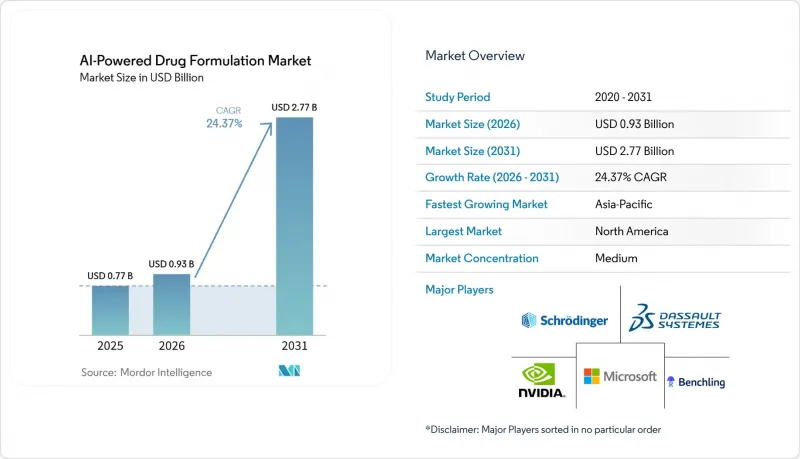
Mordor Intelligence에 의하면, AI 기반 의약품 제형 개발 시장은 2025년 7억 7,000만 달러로 평가되었습니다. 2026년 9억 3,000만 달러에서 2031년까지 27억 7,000만 달러로 확대되며 2026년부터 2031년까지 연평균 성장률(CAGR)은 24.37%를 나타낼 전망입니다.
본 보고서는 구성 요소(소프트웨어 플랫폼, 서비스), 배포 방식(클라우드 기반, On-Premise형), 기술(머신러닝 및 딥러닝 등), 용도(제형 설계 및 최적화 등), 약물 유형(저분자 의약품 등), 최종 사용자(수탁 연구 기관 등),지역(북미, 유럽 등)별로 분류되어 있습니다. 시장 예측(금액 기준, 달러).
세계의 AI 기반 의약품 제형 개발 시장 동향 및 인사이트
제제 개발 과정에서 시행착오를 줄이려는 수요 증가
개발 비용의 급등과 상용화까지의 기간 단축으로 인해, AI 기반 의약품 제형 개발 시장에서는 실험실에서의 반복 작업을 줄일 수 있는 도구에 대한 수요가 높아지고 있습니다. 이러한 압박은 개발 후기 단계에서 제제 개발 실패로 인해 신청 계획이 지연되거나, 희귀 원료가 낭비되거나, 혹은 임상시험이 이미 진행된 후에 제조 변경을 불가피하게 해야 하는 경우에 가장 강하게 느껴집니다. FDA가 품질 문제, 의약품 부족, 제조 신뢰성에 지속적으로 주력하고 있는 것은 ‘품질 기반 설계(QbD)’ 개념의 조기 도입을 뒷받침하고 있으며, 이로 인해 개발 초기 단계에서의 예측적 제형 개발의 중요성이 더욱 높아지고 있습니다. 2026년 『Nature Communications』지에 게재된 연구에 따르면, 170개의 제형에서 얻은 1,199개의 데이터 포인트를 활용하여 검증된 AI 기반 의약품 제형 제조 워크플로우를 통해 개발 시간이 60% 단축되었으며, 유효 성분(API) 사용량이 65% 감소한 것으로 나타나, 이 점을 뒷받침하고 있습니다. AI 기반 의약품 제형 개발 시장에서 구매자에게 있어 그 매력은 실용성에 있습니다. 원자재 소비량 감소와 의사결정 주기 단축은 개발 비용과 속도에 직접적인 영향을 미치기 때문입니다. 이에 따라 도입 움직임은 파일럿 단계에서 스폰서 측 및 외부 위탁 제제 환경 모두에서 일상적인 워크플로우로의 통합 단계로 점차 전환되고 있습니다.
생물학적 제제, 핵산 및 첨단 치료용 제제의 성장
AI 기반 의약품 제형 개발 시장은 저분자 의약품 프로그램보다 더 엄격한 제형 관리가 필요한 복잡한 의약품군의 급속한 확장에 힘입어 성장하고 있습니다. 2025년 하반기에도 세포 및 유전자 치료 파이프라인은 대규모로 활발하게 진행되었으며, 각 프로그램은 벡터의 안정성, 전달 시스템 및 공정 조건에 관한 매우 구체적인 결정에 의존하고 있습니다. 2026년 『Nature Reviews Materials』 지의 기사에서는 조합형 지질 나노입자 스크리닝에서 생성형 설계로의 전환이 해설되어 있으며, LiGen 모델은 검색 기반 기준선에 비해 예측 성능이 평균 30.7% 향상되었다고 보고되었습니다. Chime Biologics는 2025년 11월, 이러한 수요에 부응하기 위해 세포주 개발, 바이오프로세스, CMC 지원을 포괄하는 AI 플랫폼을 출시했습니다. 이는 엔드투엔드 바이오의약품 워크플로우 도구가 제한적인 실험의 영역을 넘어 상업적 요구로 자리 잡고 있음을 보여줍니다. 이러한 치료 분야가 확대됨에 따라, AI 기반 의약품 제형 개발 시장은 더 높은 변동성, 고부가가치 배치, 그리고 더욱 엄격한 안정성 목표에 대응할 수 있는 플랫폼으로 발전하고 있습니다.
희소하고, 고유성이 높으며, 표준화되지 않은 제형 데이터
AI 기반 의약품 제형 개발 시장의 큰 제약은 실제 제형 데이터 세트가 소규모이고 파편화되어 있다는 점입니다. 유전체학이나 영상 진단과 달리, 제형 기록에는 대개 수십에서 수백 건의 실험만 포함되어 있으며, 많은 부정적 결과는 발표되지 않은 채로 남아 있거나 단일 조직 내에 갇혀 있습니다. 2026년 『International Journal of Pharmaceutics』 저널의 연구도 유사한 결론에 도달했으며, 이러한 격차를 해소하기 위해 구조화되고 기계가 읽을 수 있는 경구 제형 데이터베이스가 소개되었습니다. 그 결과, AI 기반 의약품 제형 개발 시장의 많은 모델은 여전히 제한된 약물 분류, 공정 범위 또는 제형 유형 내에서만 최상의 성능을 발휘하고 있습니다. 보다 광범위한 데이터 표준과 공유 데이터 세트가 마련되기 전까지는 모델의 일반화 가능성이 대규모 도입에 있어 가장 명백한 제약 사항 중 하나로 남아 있을 것입니다.
부문별 분석
2025년, 소프트웨어 플랫폼은 AI 기반 의약품 제형 시장 점유율의 51.38%를 차지했으며, 2031년까지 연평균 성장률(CAGR) 24.61%로 가장 빠르게 성장하는 부문이 될 것으로 예측됩니다. 이는 구매자들이 현재 프로젝트 기반의 지원보다 재현 가능한 계산 능력을 더 중요하게 여기고 있음을 나타냅니다. AI 기반 의약품 제형 시장에서 이는 모델 실행, 데이터 처리, 워크플로우의 추적성 및 사용자 간 협업을 단일 환경에서 통합할 수 있는 공급업체에 유리하게 작용합니다. 또한, 이는 범위가 좁은 기술적 작업보다 더 광범위한 조사 개발(R&D) 및 CMC(화학·제조·품질 관리) 운영 모델에 적합한 도구가 구매 시 선호된다는 것을 시사합니다.
스폰서 및 외부 위탁 파트너가 소프트웨어 주도형 워크플로우에 익숙해짐에 따라, 모델 설정, 통합, 검증 및 프로그램별 지원을 통해 서비스 수익도 증가할 것으로 예측됩니다. 이로 인해 실무 중심의 과학 서비스가 지속적으로 성장하더라도, AI 기반 의약품 제형 개발 산업은 소프트웨어 라이선싱의 경제성과 밀접하게 연결된 상태를 유지하게 될 것입니다. 또한 이는 강력한 플랫폼 기반을 갖춘 벤더가 해당 부문의 핵심 구조를 변경하지 않고도 인접한 지원 업무로 사업을 확장할 수 있음을 의미합니다.
2025년에는 AI 기반 의약품 제형 시장 규모 중 클라우드 기반 도입이 52.72%를 차지했으며, 2031년까지 연평균 성장률(CAGR) 25.18%를 기록하며 가장 빠르게 성장하는 도입 부문이 될 것으로 예측됩니다. 많은 사용자에게 클라우드 도입은 빈번한 하드웨어 업그레이드의 필요성을 줄여주고, 프로그램 수요에 따라 용량을 확장할 수 있게 해줍니다. AI 기반 의약품 제형 개발 시장에서 이것이 중요한 이유는 신약 개발, 전임상시험, CMC 준비의 각 단계에서 프로그램 부하가 급격히 변화할 가능성이 있기 때문입니다.
중견 제약사나 생명공학 기업에게는 대기업과 동등한 사내 인프라를 유지하지 않고도 첨단 도구를 활용할 수 있다는 이점이 있습니다. 지적 재산의 기밀성, 데이터 주권, 또는 내부 통제 정책이 여전히 중요하게 여겨지는 분야에서는 On-Premise 도입도 여전히 그 역할을 하고 있습니다. 그렇지만 AI 기반 의약품 제형 개발 시장의 방향성은 여전히 클라우드 아키텍처를 지지하고 있습니다. 이는 제제 개발에서의 협업이 거점, 조직, 개발 기능의 경계를 넘어 이루어지는 경우가 점점 더 늘어나고 있기 때문입니다.
지역별 분석
2025년, 북미는 AI 기반 의약품 제형 개발 시장의 44.19% 점유율을 차지하며 지역별 최대 기여도를 기록했습니다. 이 지역은 대형 제약사의 고밀도 집적, 성숙한 스타트업 및 벤처 환경, 그리고 소프트웨어 및 바이오시뮬레이션 벤더의 강력한 기반이라는 이점을 누리고 있습니다. 미국은 스폰서 수요, 플랫폼 개발, 규제 당국과의 협력이 동일한 시장 내에서 유기적으로 연결되어 있어 여전히 이 지역의 활동 중심지 역할을 하고 있습니다. 이에 따라 북미는 AI 기반 의약품 제형 개발 시장의 최전선에 계속 위치하고 있으며, 새로운 기술 역량과 병행하여 규제 준수를 위한 도입 경로의 검증이 진행되고 있습니다.
유럽은 독일, 스위스, 영국, 프랑스의 지원을 받아 2025년에 상당한 시장 점유율을 차지했습니다. 이 지역은 강력한 제약 제조거점과 엄격한 규제 및 품질 요건을 모두 갖추고 있어, 검증된 AI 워크플로우를 위한 중요한 실증의 장이 되고 있습니다. 유럽의 구매자들은 단순한 실험 속도뿐만 아니라, 설명 가능성, 문서화, 라이프사이클 관리를 지원할 수 있는 플랫폼에 중점을 두고 있는 것으로 보입니다. 이에 따라 유럽의 AI 기반 의약품 제제 시장은 보다 신중하면서도 구조적으로 중요한 역할을 담당하고 있습니다.
아시아태평양은 중국, 인도, 한국, 일본을 견인역으로 하여 2031년까지 연평균 성장률(CAGR) 28.31%를 기록하며 가장 빠르게 성장하는 지역이 될 것으로 예측됩니다. 이 지역에서는 제약 업계의 디지털화, 아웃소싱 역량 확대, 그리고 개발 및 제조 현장에서의 AI 도구 활용 강화로 인해 성장세가 가속화되고 있습니다. 한국은 활발한 파트너십 구축으로 두각을 나타내고 있는 반면, 인도의 풍부한 CRO 기반은 서비스 차별화가 점점 더 속도와 분석 능력에 의존하는 상황에서 AI 도입을 뒷받침하고 있습니다. 중국에서는 디지털 인프라와 제약 산업의 현대화가 동일한 운영 환경 하에서 동시에 추진되고 있어 시장 규모가 확대될 것으로 전망됩니다. 그 결과, AI 기반 의약품 제형 개발 시장에서 예측 기간 동안의 지역별 성장의 상당 부분은 아시아태평양에서 발생할 것으로 보입니다.
기타 혜택 :
- 엑셀 형식 시장 예측(ME) 시트
- 3개월간의 애널리스트 지원
자주 묻는 질문
목차
제1장 서론
제2장 조사 방법
제3장 개요
제4장 시장 구도
제5장 시장 규모 및 성장 예측
제6장 경쟁 구도
제7장 시장 기회 및 향후 전망
KTH 26.09.02According to Mordor Intelligence, the AI-powered drug formulation market is projected to expand from USD 0.77 billion in 2025 and USD 0.93 billion in 2026 to USD 2.77 billion by 2031, registering a CAGR of 24.37% between 2026 and 2031.
This report is Segmented by Component (Software Platforms, Services), Deployment Mode (Cloud-Based, On-Premises), Technology (Machine Learning and Deep Learning, and More), Application (Formulation Design and Optimization, and More), Drug Type (Small Molecules, and More), End-User (Contract Research Organizations, and More), and Geography (North America, Europe, and More). Market Forecasts in Value (USD).
Global AI-Powered Drug Formulation Market Trends and Insights
Rising Need to Reduce Trial-and-Error in Formulation Development
Escalating development costs and shorter commercial timelines are pushing the AI-powered drug formulation market toward tools that can reduce repeated lab iterations. This pressure is strongest when late-stage formulation failures delay filing plans, waste scarce API, or force manufacturing changes after clinical progress has already been made. The FDA's ongoing focus on quality issues, drug shortages, and manufacturing reliability supports earlier use of quality-by-design thinking, which strengthens the case for predictive formulation work at the front end of development. A 2026 Nature Communications study reinforced that point by showing 60% lower development time and 65% lower API use in an AI-powered tableting workflow tested across 1,199 data points from 170 formulations. For buyers in the AI-powered drug formulation market, the appeal is practical because lower material consumption and faster decision cycles directly affect development cost and speed. This is why adoption is shifting from pilot activity toward routine workflow inclusion in both sponsor and outsourced formulation settings.
Growth in Biologics, Nucleic Acids, and Advanced Therapy Formulations
The AI-powered drug formulation market is also being lifted by the fast expansion of complex drug classes that require tighter formulation control than small-molecule programs. Cell and gene therapy pipelines remained active at a large scale in late 2025, and each program depends on highly specific decisions around vector stability, delivery systems, and process conditions. A 2026 Nature Reviews Materials article described the shift from combinatorial lipid nanoparticle screening toward generative design, and the LiGen model reported average predicted performance gains of 30.7% against retrieval-based baselines.Chime Biologics responded to this demand in November 2025 by launching an AI platform that spans cell line development, bioprocessing, and CMC support, which shows that end-to-end biologics workflow tools are becoming a commercial need rather than a narrow experiment. As these therapy classes grow, the AI-powered drug formulation market is being pulled toward platforms that can handle higher variability, higher value batches, and more demanding stability targets.
Sparse, Proprietary, and Non-Standardized Formulation Data
A major limit on the AI-powered drug formulation market is the small and fragmented nature of real formulation datasets. Unlike genomics or imaging, formulation records often include only tens or hundreds of experiments, and many negative results remain unpublished or locked within single organizations. A 2026 International Journal of Pharmaceutics study reached a similar conclusion and introduced a structured machine-readable oral formulation database to help address that gap. The practical result is that many models in the AI-powered drug formulation market still work best within narrow drug classes, process windows, or formulation types. Until broader data standards and shared datasets improve, model generalizability will remain one of the clearest limits on adoption at scale.
Other drivers and restraints analyzed in the detailed report include:
- Increasing Demand for Personalized and Precision Medicine Dose Design
- Pharma-CDMO Workflow Digitization and Self-Service Formulation Platforms
- Limited Validation and Explainability for Regulated Use Cases
For complete list of drivers and restraints, kindly check the Table Of Contents.
Segment Analysis
Software platforms held 51.38% of the AI-powered drug formulation market share in 2025 and are also expected to be the fastest-growing segment with 24.61% CAGR through 2031, which shows that buyers currently place more value on repeatable computational capability than on project-based support. In the AI-powered drug formulation market, this favors vendors that can combine model execution, data handling, workflow traceability, and user collaboration in one environment. It also points to a purchasing preference for tools that fit into wider R&D and CMC operating models rather than narrowly scoped technical tasks.
As sponsors and outsourced partners gain comfort with software-led workflows, service revenue is likely to follow through model setup, integration, validation, and program-specific support. This keeps the AI-powered drug formulation industry tied closely to software licensing economics even when hands-on scientific services continue to grow. It also means vendors with strong platform footprints can extend into adjacent support work without changing the core structure of the segment.
Cloud-based deployment accounted for 52.72% of the AI-powered drug formulation market size in 2025 and is also anticipated to be the fastest-growing deployment segment with a 25.18% CAGR through 2031. For many users, cloud deployment reduces the need for frequent hardware upgrades and allows capacity to scale with program demands. In the AI-powered drug formulation market, this matters because program intensity can change quickly across discovery, preclinical work, and CMC preparation.
Mid-sized pharma and biotech firms benefit because they can access advanced tools without maintaining the same level of internal infrastructure as larger enterprises. On-premises deployments still have a role where IP sensitivity, data sovereignty, or internal control policies remain high. Even so, the direction of the AI-powered drug formulation market still favors cloud architecture because collaborative formulation work increasingly crosses sites, organizations, and development functions.
Complete Report Scope:
- By Component
- Software Platforms
- Services
- By Deployment Mode
- Cloud-Based
- On-Premises
- By Technology
- Machine Learning and Deep Learning
- Predictive Modeling and Simulation
- Generative AI and Neural Networks
- Hybrid AI Approaches
- Natural Language Processing
- By Application
- Formulation Design and Optimization
- Excipient Compatibility Prediction
- Stability and Shelf-Life Prediction
- High-Throughput Screening Optimization
- Personalized and Precision Medicine Formulations
- Advanced Therapy Formulations
- By Drug Type
- Small Molecules
- Biologics
- Nucleic Acid-Based Drugs
- Cell and Gene Therapy Payloads
- Vaccines
- By End-User
- Pharmaceutical and Biotechnology Companies
- Contract Research Organizations
- Contract Development and Manufacturing Organizations
- Academic and Research Institutes
- By Geography
- North America
- United States
- Canada
- Mexico
- Europe
- Germany
- United Kingdom
- France
- Italy
- Spain
- Rest of Europe
- Asia-Pacific
- China
- Japan
- India
- Australia
- South Korea
- Rest of Asia-Pacific
- Middle East and Africa
- GCC
- South Africa
- Rest of Middle East and Africa
- South America
- Brazil
- Argentina
- Rest of South America
- North America
Geography Analysis
North America held 44.19% of the AI-powered drug formulation market share in 2025, which made it the leading regional contributor. The region benefits from a dense concentration of large pharmaceutical companies, a mature startup and venture environment, and a strong base of software and biosimulation vendors. The United States remains the center of regional activity because it combines sponsor demand, platform development, and regulatory engagement in the same market. This keeps North America at the front of the AI-powered drug formulation market, where regulated deployment pathways are being tested in parallel with new technical capabilities.
Europe held a significant share in 2025, supported by Germany, Switzerland, the United Kingdom, and France. The region combines a strong pharma manufacturing base with demanding regulatory and quality expectations, which makes it an important proving ground for validated AI workflows. European buyers appear focused on platforms that can support explainability, documentation, and lifecycle control rather than pure experimental speed alone. This gives the AI-powered drug formulation market in Europe a more measured but structurally important role.
Asia-Pacific is projected to be the fastest-growing region with a 28.31% CAGR through 2031, driven by China, India, South Korea, and Japan. The region is adding momentum through pharmaceutical digitalization, expanding outsourcing capacity, and stronger use of AI tools in development and manufacturing settings. South Korea stands out for active partnership flow, while India's large CRO base supports adoption where service differentiation depends increasingly on speed and analytical capability. China adds scale because digital infrastructure and pharmaceutical modernization are being pushed together in the same operating environment. As a result, the AI-powered drug formulation market is likely to see much of its incremental regional expansion come from Asia-Pacific over the forecast period.
- Aspen Technology, Inc.
- Atomwise, Inc.
- Benchling, Inc.
- BenevolentAI S.A.
- Certara, Inc.
- Cloud Pharmaceuticals
- Dassault Systemes
- Dotmatics Limited
- Exscientia plc
- ID Business Solutions, Inc.
- Insilico Medicine
- IBM
- Isomorphic Labs Limited
- Microsoft
- NVIDIA
- Recursion Pharmaceuticals
- Schrodinger, Inc.
- Simulations Plus
- TetraScience, Inc.
- XtalPi
Additional Benefits:
- The market estimate (ME) sheet in Excel format
- 3 months of analyst support
TABLE OF CONTENTS
1 Introduction
- 1.1 Study Assumptions and Market Definition
- 1.2 Scope of the Study
2 Research Methodology
3 Executive Summary
4 Market Landscape
- 4.1 Market Overview
- 4.2 Market Drivers
- 4.2.1 Rising Need to Reduce Trial-and-Error in Formulation Development
- 4.2.2 Growth in Biologics, Nucleic Acids, and Advanced Therapy Formulations
- 4.2.3 Increasing Demand for Personalized and Precision Medicine Dose Design
- 4.2.4 Expansion of Multi-Modal Pharma Data and Compute Infrastructure
- 4.2.5 Pharma-CDMO Workflow Digitization and Self-Service Formulation Platforms
- 4.2.6 Rising Need for Faster Excipient Screening and Stability Prediction
- 4.3 Market Restraints
- 4.3.1 Sparse, Proprietary, and Non-Standardized Formulation Data
- 4.3.2 Limited Validation and Explainability for Regulated Use Cases
- 4.3.3 Integration Friction with Legacy Lab, ELN, and QbD Workflows
- 4.3.4 High Switching Costs for Enterprise and CDMO Deployment
- 4.4 Supply/Value Chain Analysis
- 4.5 Regulatory Landscape
- 4.6 Technological Outlook
- 4.7 Porter's Five Forces Analysis
- 4.7.1 Threat of New Entrants
- 4.7.2 Bargaining Power of Suppliers
- 4.7.3 Bargaining Power of Buyers
- 4.7.4 Threat of Substitutes
- 4.7.5 Competitive Rivalry
5 Market Size & Growth Forecasts (Value, USD)
- 5.1 By Component
- 5.1.1 Software Platforms
- 5.1.2 Services
- 5.2 By Deployment Mode
- 5.2.1 Cloud-Based
- 5.2.2 On-Premises
- 5.3 By Technology
- 5.3.1 Machine Learning and Deep Learning
- 5.3.2 Predictive Modeling and Simulation
- 5.3.3 Generative AI and Neural Networks
- 5.3.4 Hybrid AI Approaches
- 5.3.5 Natural Language Processing
- 5.4 By Application
- 5.4.1 Formulation Design and Optimization
- 5.4.2 Excipient Compatibility Prediction
- 5.4.3 Stability and Shelf-Life Prediction
- 5.4.4 High-Throughput Screening Optimization
- 5.4.5 Personalized and Precision Medicine Formulations
- 5.4.6 Advanced Therapy Formulations
- 5.5 By Drug Type
- 5.5.1 Small Molecules
- 5.5.2 Biologics
- 5.5.3 Nucleic Acid-Based Drugs
- 5.5.4 Cell and Gene Therapy Payloads
- 5.5.5 Vaccines
- 5.6 By End-User
- 5.6.1 Pharmaceutical and Biotechnology Companies
- 5.6.2 Contract Research Organizations
- 5.6.3 Contract Development and Manufacturing Organizations
- 5.6.4 Academic and Research Institutes
- 5.7 By Geography
- 5.7.1 North America
- 5.7.1.1 United States
- 5.7.1.2 Canada
- 5.7.1.3 Mexico
- 5.7.2 Europe
- 5.7.2.1 Germany
- 5.7.2.2 United Kingdom
- 5.7.2.3 France
- 5.7.2.4 Italy
- 5.7.2.5 Spain
- 5.7.2.6 Rest of Europe
- 5.7.3 Asia-Pacific
- 5.7.3.1 China
- 5.7.3.2 Japan
- 5.7.3.3 India
- 5.7.3.4 Australia
- 5.7.3.5 South Korea
- 5.7.3.6 Rest of Asia-Pacific
- 5.7.4 Middle East and Africa
- 5.7.4.1 GCC
- 5.7.4.2 South Africa
- 5.7.4.3 Rest of Middle East and Africa
- 5.7.5 South America
- 5.7.5.1 Brazil
- 5.7.5.2 Argentina
- 5.7.5.3 Rest of South America
- 5.7.1 North America
6 Competitive Landscape
- 6.1 Market Concentration
- 6.2 Market Share Analysis
- 6.3 Company Profiles (includes Global level Overview, Market level overview, Core Segments, Financials as available, Strategic Information, Market Rank/Share for key companies, Products & Services, Recent Developments)
- 6.3.1 Aspen Technology, Inc.
- 6.3.2 Atomwise, Inc.
- 6.3.3 Benchling, Inc.
- 6.3.4 BenevolentAI S.A.
- 6.3.5 Certara, Inc.
- 6.3.6 Cloud Pharmaceuticals, Inc.
- 6.3.7 Dassault Systemes SE
- 6.3.8 Dotmatics Limited
- 6.3.9 Exscientia plc
- 6.3.10 ID Business Solutions, Inc.
- 6.3.11 Insilico Medicine
- 6.3.12 International Business Machines Corporation
- 6.3.13 Isomorphic Labs Limited
- 6.3.14 Microsoft Corporation
- 6.3.15 NVIDIA Corporation
- 6.3.16 Recursion Pharmaceuticals, Inc.
- 6.3.17 Schrodinger, Inc.
- 6.3.18 Simulations Plus, Inc.
- 6.3.19 TetraScience, Inc.
- 6.3.20 XtalPi Inc.
7 Market Opportunities & Future Outlook
- 7.1 White-space & Unmet-need Assessment