

|
시장보고서
상품코드
2118069
바이오연료 첨가제 시장 : 점유율 분석, 업계 동향과 통계, 성장 예측(2026-2031년)Biofuel Additives - Market Share Analysis, Industry Trends & Statistics, Growth Forecasts (2026 - 2031) |
||||||
 Mordor Intelligence
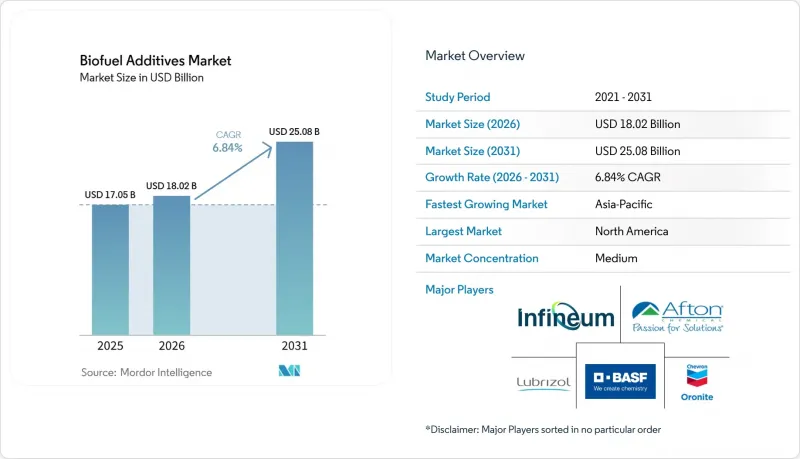
Mordor Intelligence에 의하면, 바이오연료 첨가제 시장 규모는 2025년에 170억 5,000만 달러, 2026년에 180억 2,000만 달러가 되고, 2031년까지 250억 8,000만 달러에 이를 것으로 예측되며, 2026년부터 2031년까지 CAGR 6.84%로 성장할 전망입니다.
본 보고서는 유형(산화 방지제, 부식 방지제 등), 바이오연료의 유형(바이오에탄올, 바이오디젤), 용도(디젤 연료 첨가제, 중유 첨가제 등), 최종 사용자 산업(운송, 발전 등), 지역(아시아태평양, 북미, 유럽, 남미, 중동 및 아프리카)별로 분류되어 있습니다. 시장 예측은 금액(미 달러) 기준으로 제시되어 있습니다.
전 세계 바이오연료 첨가제 시장 동향 및 인사이트
엄격한 배출 규제가 바이오연료 첨가제 채택을 가속화
바이오연료 첨가제 시장은 단순히 바이오연료 생산량뿐만 아니라 배출 규제 주기와도 밀접한 관련이 있습니다. 독일은 2026년 4월 ‘재생에너지 지침 III(RED III)’를 국내법에 임베디드하여, 2026 회계연도 이행 연도에 첨단 바이오연료의 하위 할당량을 1%에서 2%로 두 배로 늘리고, 2030년까지 3%로 끌어올리는 로드맵을 수립했습니다. 사용 후 식용유, 리그노셀룰로오스계 에탄올, 그리고 수소화 식물성 기름(HVO)의 이용 증가에 따라, 표준 지방산 메틸에스테르(FAME)용 패키지와는 다른 용도에 맞춘 항산화제 및 안정제 시스템의 필요성이 높아지고 있습니다. 이중 계상의 폐지로 인해 공급업체는 통계적 준수가 아닌 물리적 혼합을 강요받게 되며, 이는 첨가제 수요를 직접적으로 증가시킵니다. 이로 인해 바이오연료 첨가제 시장은 연료 공급망 전체의 규정 준수 품질, 저장 안정성 및 운영상의 신뢰성과 밀접하게 연결된 상태를 유지하게 됩니다.
바이오연료 혼합에서 요구되는 연료 안정성이 구조적인 첨가제 수요를 창출하고 있습니다.
바이오연료 첨가제 시장은 저장, 취급, 연소 과정에서 안정성을 유지할 수 있는 연료에 의존하고 있습니다. FAME 기반 바이오디젤은 불포화 지방산을 많이 함유하고 있어 산화되기 쉬우며, 이로 인해 침전물이나 끈적거리는 물질이 형성되어 필터나 인젝터를 막는 원인이 됩니다. ASTM D6751 및 EN 14214에서는 산화 안정성이 필수 성능 기준으로 규정되어 있으므로, 산화 방지제 첨가는 피할 수 없는 사항이 되었습니다. 또한, 에탄올 혼합 비율이 높아지면 흡습성이 증가하여 알코올 함량이 높은 연료에 대응하지 못하는 연료 시스템에서는 상분리 위험이 높아집니다. 그 결과, 특히 노후된 탱크나 파이프라인이 계속 사용되는 경우, 부식 방지제나 탈유화제는 바이오연료 첨가제 시장에서 더욱 지속적인 역할을 담당하게 되었습니다.
첨가제의 비용 민감도가 신흥 경제국에서의 보급을 제약
첨가제의 비용은 혼합이 선택 사항인 지역이나 연료 마진이 적은 지역에서 계속해서 바이오연료 첨가제 시장의 걸림돌이 되고 있습니다. 고품질 바이오디젤용 첨가제 패키지는 혼합 연료 비용의 3%-5%를 차지할 수 있어, 가격에 민감한 차량 함대의 경우 일관된 첨가 처리를 정당화하기 어렵습니다. 이러한 비용 문제는 원료나 혼합 비율이 변동하여 블렌더가 첨가량을 조정해야 할 때 더욱 심각해집니다. 많은 특수 중간체는 유럽이나 북미에서 조달되고 있어, 물류 위험과 환율 위험이 신흥 시장으로 전가되고 있습니다. 이로 인해 바이오연료 첨가제 시장은 양극화되어, 규제가 엄격한 지역에서는 고품질 배합이 주류를 이루는 반면, 기타 지역에서는 비용이 최적화된 제품이 대량으로 유통되고 있습니다.
부문 분석
2025년 시점에서 산화방지제는 바이오연료 첨가제 시장의 22.64%를 차지하며 가장 큰 첨가제 유형이 되었습니다. 이러한 위상은 산화 열화로 인해 저장 기간이 단축되고, 검(gum)이나 침전물의 위험이 높아지는 바이오디젤의 안정성 문제를 반영하고 있습니다. ASTM D6751 및 EN 14214 표준에 따라, 산화 방지제의 사용은 재량적인 지출이라기보다는 연료 품질 기준 준수와 밀접하게 연관되어 있습니다. 이 부문에는 합성 페놀계 화합물과 새로운 바이오 유래 대체재도 포함되어 있어, 공급업체는 정책 및 지속가능성 고려 사항에 따라 배합을 조정할 여지가 있습니다.
저온 유동성 개선제는 2031년까지 연평균 성장률(CAGR) 7.58%를 나타낼 것으로 예측되며, 이는 규제 대상이 한랭지 및 고지대의 운행 조건까지 확대되고 있음을 보여줍니다. 혼합 비율이 높아짐에 따라 저온에서의 운용성은 판매업체, 차량 운영 사업자 및 저장 시설에 있어 점점 더 중요해지고 있습니다. 또한, 에탄올 비율의 상승에 따라 연료와 물의 거동이 변화함에 따라 부식 방지제의 중요성도 커지고 있습니다. 한편, 침전물 억제나 파라핀계 재생 가능 디젤의 성능이 우선시되는 상황에서는 세정제, 분산제, 윤활성 향상제가 여전히 중요한 역할을 하고 있습니다. 주요 하위 부문이 대부분의 주목을 받고 있기는 하지만, 유화 방지제, 착색제, 마커, 안정제, 옥탄가 또는 세탄가 향상제에 힘입어 바이오연료 첨가제 시장 전체 수요는 광범위한 분야에 걸쳐 있습니다.
2025년에는 바이오디젤이 63.41%의 점유율을 차지하며, 바이오연료 첨가제 시장을 대규모 생산 및 사용 기반을 갖춘 연료 스트림으로 자리매김했습니다. 그 규모는 정책적 측면에서의 성숙한 대응과 도로 운송, 선박, 고정형 발전 용도에서의 광범위한 이용을 반영하고 있습니다. 산화 억제 및 저온 성능 확보에 대한 수요로 인해, 연비 효율이 변화하더라도 바이오디젤용 첨가제 수요는 안정적이며, 공급업체에게는 산화 방지제, 저온 유동성 향상제, 저장 안정성 향상제와 같은 제품에 대한 광범위하고 지속적인 수요 기반이 마련되고 있습니다.
바이오에탄올은 2031년까지 연평균 성장률(CAGR) 7.19%를 나타낼 것으로 예측되며, 시장에서 가장 빠르게 성장하는 바이오연료 유형이 될 전망입니다. 인도에서는 2026년 4월부터 전국적으로 20%의 에탄올 혼합이 도입될 예정이며, 이에 따라 저장 및 유통 시스템에서의 부식 방지 및 수분 관리의 중요성이 높아지고 있습니다. 에탄올 혼합 비율이 높은 연료가 보급됨에 따라, 염료·마커 패키지, 유화 방지제, 그리고 옥탄가 향상을 위한 배합이 각국 고유의 연료 기준에서 더욱 중요해지고 있습니다. 이는 공급업체가 단일한 세계 배합이 아닌, 맞춤형 패키지를 통해 이익률을 높일 수 있는 분야입니다.
지역별 분석
2025년, 북미는 바이오연료 첨가제 시장 점유율의 35.18%를 차지하며 지역 시장 중 1위를 유지했습니다. 이 지역은 재생 가능 연료 기준(RFS)의 철저한 시행, 대규모 재생 가능 디젤 정제 능력, 그리고 성숙한 블렌더 및 유통업체 기반의 혜택을 받고 있습니다. 이러한 구조는 연료가 규제 준수 및 저장 요건을 충족하는 데 도움이 되는 산화 방지제, 저온 유동성 향상제 및 기타 첨가제 패키지에 대한 지속적인 수요를 뒷받침하고 있습니다. 미국에서는 새로운 청정 연료에 대한 인센티브가 원료의 경제성을 형성하고, 탄소 강도에 대응하는 배합 지원의 가치를 높이고 있습니다. 북미는 상업적 규모의 기술 지원 및 프리미엄 첨가제 시스템의 조기 도입에 있어 기준 시장으로서의 역할을 수행하고 있습니다.
아시아태평양은 2031년까지 연평균 성장률(CAGR) 7.63%를 나타낼 것으로 예측되며, 바이오연료 첨가제 분야에서 가장 빠르게 성장하는 지역 시장이 될 전망입니다. 인도에서는 2026년 4월부터 에탄올 혼합 비율을 20%로 높일 방침을 발표함에 따라, 이에 따라 저장 및 유통 네트워크 전반에 걸쳐 부식 방지제, 착색제·마커 시스템, 그리고 수처리용 화학 물질에 대한 수요가 증가하고 있습니다. 중국에서는 에탄올 혼합 정책이 광범위하게 전개됨에 따라, 방대한 차량 대수에 대응하는 국가별 특화형 첨가제 패키지에 대한 수요가 증가하여 추가적인 성장 동력을 창출하고 있습니다. 일본과 한국에서는 지속가능한 항공연료(SAF) 프로그램이 확대되고 있으며, 재생 가능 제트 연료의 성장에 발맞추어 고부가가치 제품의 잠재 시장이 확대되고 있습니다. 아시아태평양의 원료 다양성으로 인해, 표준화가 진행된 시장에 비해 기술 서비스 및 현지 상황에 맞춘 배합 능력의 중요성이 더욱 높아지고 있습니다.
유럽에서는 첨단 혼합 연료에 대한 인센티브, 재생 가능 디젤의 보급, 그리고 규정 준수를 철저히 뒷받침하는 정책 체계에 힘입어 바이오연료 첨가제 시장에서 계속해서 높은 절대 판매량을 기록하고 있습니다. 독일이 2026년에 ‘재생에너지 지침 III(RED III)’를 국내법에 반영함에 따라 첨단 바이오연료 요건이 강화되었고, 2026년 규정 준수 연도부터 이중 계상이 폐지된 결과, 고품질 배합에 대한 수요가 강화되었습니다. 남미는 브라질의 성숙한 에탄올 시스템과 바이오디젤 의무화 진전에 힘입어 지속적인 성장세를 보이고 있는 반면, 중동 및 아프리카는 규모는 작지만 에너지 다각화 및 배기가스 규제 측면에서 정책적 주목을 받고 있는 시장입니다. 이 지역 전반에 걸쳐 바이오연료 첨가제 시장은 고품질 화학제품을 지원하는 성숙한 규제 체계와 저비용 처리 옵션을 우선시하는 신흥 규제 체계 사이에 뚜렷한 격차가 나타납니다.
기타 혜택:
- 엑셀 형식 시장 예측(ME) 시트
- 3개월간의 애널리스트 지원
자주 묻는 질문
목차
제1장 서론
제2장 조사 방법
제3장 개요
제4장 시장 구도
제5장 시장 규모와 성장 예측
제6장 경쟁 구도
제7장 시장 기회와 향후 전망
JHS 26.09.01According to Mordor Intelligence, the biofuel additives market size is projected to be USD 17.05 billion in 2025, USD 18.02 billion in 2026, and reach USD 25.08 billion by 2031, and is expected to grow at a CAGR of 6.84% from 2026 to 2031.
This report is Segmented by Type (Antioxidants, Corrosion Inhibitors, and More), Biofuel Type (Bioethanol and Biodiesel), Application (Diesel Fuel Additives, Heavy Fuel Oil Additives, and More), End-User Industry (Transportation, Power Generation, and More), and Geography (Asia-Pacific, North America, Europe, South America, and Middle-East and Africa). The Market Forecasts are Provided in Terms of Value (USD).
Global Biofuel Additives Market Trends and Insights
Stringent Emission Limits Accelerate Biofuel Additive Adoption
The biofuel additives market is closely tied to emissions regulation cycles, not just to headline biofuel output. Germany adopted Renewable Energy Directive III (RED III) transposition in April 2026, which doubled the advanced biofuels sub-quota from 1% to 2% for the 2026 compliance year and set a path to 3% by 2030. Higher use of used cooking oil, lignocellulosic ethanol, and Hydrotreated Vegetable Oil (HVO) raises the need for tailored antioxidant and stabilizer systems that differ from standard Fatty Acid Methyl Ester (FAME) packages. The move away from double-counting also pushes suppliers toward physical blending rather than statistical compliance, which directly increases additive demand. This keeps the biofuel additives market linked to compliance quality, storage stability, and operational reliability across the fuel chain.
Fuel Stability Needs in Biofuel Blends Create Structural Additive Demand
The biofuel additives market depends on fuels that remain stable during storage, handling, and combustion. FAME-based biodiesel oxidizes easily because it contains more unsaturated fatty acids, which can form sediments and gums that plug filters and injectors. ASTM D6751 and EN 14214 maintain oxidative stability as a required performance threshold, making antioxidant dosing difficult to avoid. Higher ethanol blend ratios also increase water absorption and the risk of phase separation in fuel systems not designed for higher alcohol content. As a result, corrosion inhibitors and demulsifiers are taking on a more permanent role in the biofuel additives market, particularly where older tanks and pipelines remain in service.
Additive Cost Sensitivity Constrains Uptake in Emerging Economies
Additive costs continue to constrain the biofuel additives market in regions where blending is voluntary or fuel margins are thin. Premium biodiesel additive packages can account for 3%-5% of blended fuel costs, making consistent treatment difficult to justify for price-sensitive fleets. This cost challenge intensifies when blenders must adjust treat rates as feedstocks and blend ratios change. Many specialty intermediates are sourced from Europe and North America, transferring logistics and currency risks to emerging markets. This creates a two-tier biofuel additives market, with premium formulations concentrated in highly regulated regions and cost-optimized packages carrying higher volumes in other regions.
Other drivers and restraints analyzed in the detailed report include:
- Renewable Diesel and Sustainable Aviation Fuel (SAF) Demand Open High-Margin Additive Segments
- Rising Engine Deposit Concerns Drive Demand for Detergent and Dispersant Chemistry
- Compatibility Challenges Across Feedstock and Fleet Diversity Slow Deployment
For complete list of drivers and restraints, kindly check the Table Of Contents.
Segment Analysis
Antioxidants accounted for 22.64% of the biofuel additives market in 2025, making them the largest additive type. This position reflects the stability challenge in biodiesel, where oxidative degradation can reduce storage life and increase the risk of gums and sediments. ASTM D6751 and EN 14214 keep antioxidant use closely tied to fuel quality compliance rather than discretionary spending. The segment also includes synthetic phenolic chemistries and newer bio-based alternatives, giving suppliers room to adjust formulations based on policy and sustainability preferences.
Cold flow improvers are forecast to grow at a 7.58% CAGR through 2031, indicating that mandates are extending into cold-weather and high-altitude operating conditions. As blend levels rise, operability at lower temperatures becomes more important for distributors, fleet operators, and storage sites. Corrosion inhibitors are also gaining ground as higher ethanol ratios alter fuel-water behavior, while detergents, dispersants, and lubricity improvers remain important where deposit control and paraffinic renewable diesel performance are priorities. Demand across the biofuel additives market remains broad, supported by demulsifiers, dyes, markers, stabilizers, and octane or cetane improvers, even as the leading sub-segments attract most of the attention.
Biodiesel held a 63.41% share in 2025, anchoring the biofuel additives market to a fuel stream with a large installed production and usage base. Its scale reflects mature policy treatment and widespread use across road transport, marine activity, and stationary power applications. The need for oxidation control and cold performance support keeps biodiesel additive demand stable even when fuel economics shift, providing suppliers with a broad, recurring base of antioxidant, cold-flow, and storage-stability products.
Bioethanol is projected to grow at a 7.19% CAGR through 2031, making it the fastest-growing biofuel type in the market. India's move to nationwide 20% ethanol blending from April 2026 is increasing the importance of corrosion control and water management in storage and distribution systems. As higher ethanol blends become more widespread, dye and marker packages, demulsifiers, and octane-oriented formulations become more relevant within country-specific fuel standards. This is an area where suppliers can improve margins through customized packages rather than a single global formula.
Complete Report Scope:
- By Type
- Antioxidants
- Corrosion Inhibitors
- Cold Flow Improvers
- Detergents and Dispersants
- Octane and Cetane Improvers
- Dyes and Markers
- Lubricity Improvers
- Demulsifiers
- Stabilizers
- Others
- By Biofuel Type
- Bioethanol
- Biodiesel
- By Application
- Diesel Fuel Additives
- Heavy Fuel Oil Additives
- Shipping Fuel Additives
- Gasoline Fuel Additives
- Aviation Fuel Additives
- Others
- By End-User Industry
- Transportation
- Power Generation
- Industrial
- Agriculture
- By Geography
- Asia-Pacific
- China
- India
- Japan
- South Korea
- Rest of Asia-Pacific
- North America
- United States
- Canada
- Mexico
- Europe
- Germany
- United Kingdom
- France
- Italy
- Russia
- Rest of Europe
- South America
- Brazil
- Argentina
- Rest of South America
- Middle-East and Africa
- Saudi Arabia
- South Africa
- Rest of Middle-East and Africa
- Asia-Pacific
Geography Analysis
North America held 35.18% of the biofuel additives market share in 2025, maintaining its lead among regional markets. The region benefits from strong enforcement of the Renewable Fuel Standard, large renewable diesel refining capacity, and a mature base of blenders and distributors. This structure supports recurring demand for antioxidants, cold-flow improvers, and other additive packages that help fuels meet compliance and storage requirements. In the United States, new clean fuel incentives are shaping feedstock economics and increasing the value of carbon-intensity-aligned formulation support. North America serves as the reference market for commercial-scale technical support and early adoption of premium additive systems.
Asia-Pacific is forecast to grow at a 7.63% CAGR through 2031, making it the fastest-growing regional market for biofuel additives. India's move to 20% ethanol blending from April 2026 is increasing demand for corrosion inhibitors, dye and marker systems, and water-handling chemistries across storage and distribution networks. China adds further momentum, as broader ethanol-blending efforts raise the need for country-specific additive packages across a large vehicle base. Japan and South Korea are expanding sustainable aviation fuel programs, widening the addressable market for higher-value products tied to the growth of renewable jet fuel. Feedstock diversity across Asia-Pacific makes technical service and localized formulation capability more important than in more standardized markets.
Europe continues to generate high absolute volumes in the biofuel additives market, supported by a policy framework that rewards advanced blending, renewable diesel uptake, and compliance discipline. Germany's transposition of the Renewable Energy Directive III (RED III) in 2026 strengthened demand for premium formulations by raising advanced biofuel requirements and ending double counting from the 2026 compliance year. South America remains anchored by Brazil's mature ethanol system and the progression of its biodiesel mandate, while the Middle East and Africa are smaller markets gaining policy attention for energy diversification and emissions control. Across these regions, the biofuel additives market shows a clear divide between mature regulatory systems that support premium chemistry and emerging systems that prioritize lower-cost treatment options.
- Afton Chemical
- Arkema
- BASF
- Biofuel Systems Group Ltd.
- Chemiphase International Ltd.
- Chevron Oronite Company LLC
- Clariant AG
- Dorf Ketal Chemicals
- Eastman Chemical Company
- Evonik Industries AG
- E-ZOIL
- Fuel Quality Services Inc.
- Infineum International Limited
- Innospec Inc.
- Lubrizol
- Nalco Champion
- NewMarket Corporation
- Solvay S.A.
- TotalEnergies Additives and Special Fuels
Additional Benefits:
- The market estimate (ME) sheet in Excel format
- 3 months of analyst support
TABLE OF CONTENTS
1 Introduction
- 1.1 Study Assumptions and Market Definition
- 1.2 Scope of the Study
2 Research Methodology
3 Executive Summary
4 Market Landscape
- 4.1 Market Overview
- 4.2 Market Drivers
- 4.2.1 Stringent Emission Limits Supporting Biofuel Blending
- 4.2.2 Fuel Stability Needs in Higher Blend Ratios
- 4.2.3 Renewable Diesel and SAF Scale-Up
- 4.2.4 Rising Engine Deposit Control Requirements
- 4.2.5 Lower-Purity Feedstock Increasing Additive Demand
- 4.2.6 Digitalized Fuel Formulation and Field Validation
- 4.3 Market Restraints
- 4.3.1 Additive Cost Sensitivity in Price-Competitive Blends
- 4.3.2 Compatibility Challenges Across Feedstock Variability
- 4.3.3 Limited Certification Pathways for New Chemistries
- 4.3.4 Slower Adoption Outside Regulated Fuel Pools
- 4.4 Value Chain Analysis
- 4.5 Porter's Five Forces Analysis
- 4.5.1 Threat of New Entrants
- 4.5.2 Bargaining Power of Suppliers
- 4.5.3 Bargaining Power of Buyers
- 4.5.4 Threat of Substitutes
- 4.5.5 Competitive Rivalry
5 Market Size and Growth Forecasts (Value)
- 5.1 By Type
- 5.1.1 Antioxidants
- 5.1.2 Corrosion Inhibitors
- 5.1.3 Cold Flow Improvers
- 5.1.4 Detergents and Dispersants
- 5.1.5 Octane and Cetane Improvers
- 5.1.6 Dyes and Markers
- 5.1.7 Lubricity Improvers
- 5.1.8 Demulsifiers
- 5.1.9 Stabilizers
- 5.1.10 Others
- 5.2 By Biofuel Type
- 5.2.1 Bioethanol
- 5.2.2 Biodiesel
- 5.3 By Application
- 5.3.1 Diesel Fuel Additives
- 5.3.2 Heavy Fuel Oil Additives
- 5.3.3 Shipping Fuel Additives
- 5.3.4 Gasoline Fuel Additives
- 5.3.5 Aviation Fuel Additives
- 5.3.6 Others
- 5.4 By End-User Industry
- 5.4.1 Transportation
- 5.4.2 Power Generation
- 5.4.3 Industrial
- 5.4.4 Agriculture
- 5.5 By Geography
- 5.5.1 Asia-Pacific
- 5.5.1.1 China
- 5.5.1.2 India
- 5.5.1.3 Japan
- 5.5.1.4 South Korea
- 5.5.1.5 Rest of Asia-Pacific
- 5.5.2 North America
- 5.5.2.1 United States
- 5.5.2.2 Canada
- 5.5.2.3 Mexico
- 5.5.3 Europe
- 5.5.3.1 Germany
- 5.5.3.2 United Kingdom
- 5.5.3.3 France
- 5.5.3.4 Italy
- 5.5.3.5 Russia
- 5.5.3.6 Rest of Europe
- 5.5.4 South America
- 5.5.4.1 Brazil
- 5.5.4.2 Argentina
- 5.5.4.3 Rest of South America
- 5.5.5 Middle-East and Africa
- 5.5.5.1 Saudi Arabia
- 5.5.5.2 South Africa
- 5.5.5.3 Rest of Middle-East and Africa
- 5.5.1 Asia-Pacific
6 Competitive Landscape
- 6.1 Market Concentration
- 6.2 Strategic Moves
- 6.3 Market Share (%)/Ranking Analysis
- 6.4 Company Profiles (includes Global Overview, Market Overview, Core Segments, Financials as available, Strategic Information, Products and Services, and Recent Developments)
- 6.4.1 Afton Chemical
- 6.4.2 Arkema
- 6.4.3 BASF
- 6.4.4 Biofuel Systems Group Ltd.
- 6.4.5 Chemiphase International Ltd.
- 6.4.6 Chevron Oronite Company LLC
- 6.4.7 Clariant AG
- 6.4.8 Dorf Ketal Chemicals
- 6.4.9 Eastman Chemical Company
- 6.4.10 Evonik Industries AG
- 6.4.11 E-ZOIL
- 6.4.12 Fuel Quality Services Inc.
- 6.4.13 Infineum International Limited
- 6.4.14 Innospec Inc.
- 6.4.15 Lubrizol
- 6.4.16 Nalco Champion
- 6.4.17 NewMarket Corporation
- 6.4.18 Solvay S.A.
- 6.4.19 TotalEnergies Additives and Special Fuels
7 Market Opportunities and Future Outlook
- 7.1 White-Space and Unmet-Need Assessment


