

|
시장보고서
상품코드
2118079
만성질환 관리용 SaMD(Software-as-a-Medical Device) 시장 : 시장 점유율 분석, 업계 동향 및 통계, 성장 예측(2026-2031년)Software As A Medical Device (SaMD) For Chronic Disease Management - Market Share Analysis, Industry Trends & Statistics, Growth Forecasts (2026 - 2031) |
||||||
 Mordor Intelligence
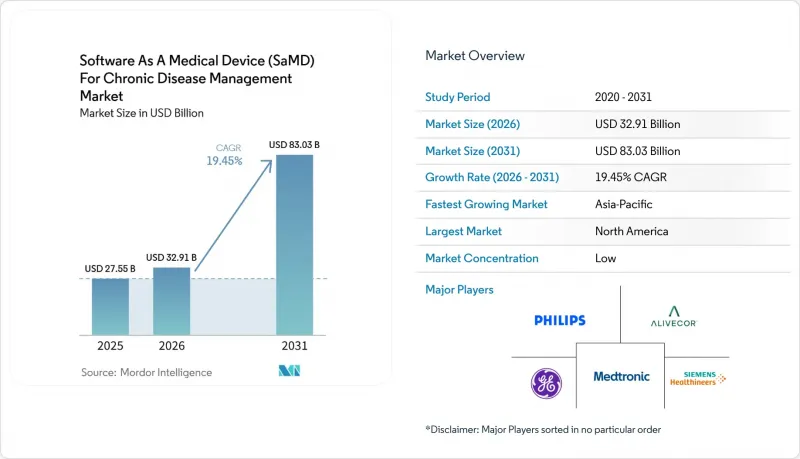
Mordor Intelligence에 의하면, 만성질환 관리용 SaMD(Software-as-a-Medical Device) 시장 규모는 2025년 275억 5,000만 달러로 평가되었고, 2026년에는 329억 1,000만 달러로 추정되고, 2026-2031년 CAGR 19.45%로 성장을 지속할 전망이며, 2031년에는 830억 3,000만 달러에 이를 것으로 예측됩니다.
본 보고서는 용도별(당뇨병 관리, 심혈관 질환 관리, 기타), 배포 방식별(클라우드 기반, 온프레미스, 하이브리드), 최종 사용자별(의료 서비스 제공업체, 지불자, 환자 및 재택 간병인, 고용주), 위험 등급별(클래스 I, 클래스 II, 클래스 III), 지역별(북미, 유럽, 기타)로 분류되어 있습니다. 시장 예측은 금액(달러) 기준으로 제시되어 있습니다.
만성질환 관리용 SaMD(Software-as-a-Medical Device) 시장 동향 및 인사이트
다중 질환 병용으로 인해 증가하는 만성질환의 부담
만성질환 관리용 SaMD(Software-as-a-Medical Device) 시장에서 만성질환은 여전히 수요의 주요 원동력으로 작용하고 있습니다. 이는 치료 과정에서 장기적인 모니터링, 반복적인 개입, 보다 철저한 환자 추적 관찰이 점점 더 요구되고 있기 때문입니다. 미국에서는 만성질환과 정신 질환이 연간 의료비의 90%를 차지하고 있으며, 4,010만 명 이상의 미국인이 당뇨병을 앓고 있습니다. 2024년에는 심혈관 질환과 뇌졸중으로 인한 사망자 수가 85만 명을 넘어섰으며, 전 세계적으로 비감염성 질환으로 인한 사망자 수는 매년 4,000만 명을 초과하고 있습니다. 환자들은 당뇨병, 심혈관 질환, 대사성 질환의 치료 과정을 동시에 거치는 경우가 많기 때문에 이러한 수요는 다양한 의료 현장에서 관련 질환을 추적하는 소프트웨어의 개발을 촉진하고 있습니다.
AI를 활용한 지속적인 위험 계층화 및 개인화
AI는 만성질환 관리용 SaMD(Software-as-a-Medical Device) 시장에서 가치 창출 방식을 변화시키고 있습니다. 이는 의료진이 정기적인 측정값에 의존하지 않고 위험을 지속적으로 모니터링할 수 있게 되기 때문입니다. 의료용 소프트웨어의 AI 및 머신러닝에 관한 FDA의 2025년 지침 수립 작업에서는 라이프사이클 관리, 승인 후 변경 관리, 보다 안전한 알고리즘 업데이트에 초점이 맞추어졌습니다. 변경 관리 계획이 잘 갖춰진 공급업체는 모델을 개선할 때마다 규제 절차를 중단하지 않고도 소프트웨어를 더 신속하게 개선할 수 있습니다. 그 결과, 시장은 알고리즘의 성능과 엄격한 거버넌스, 대규모 데이터 풀, 견고한 품질 관리 시스템, 지속적인 검증을 결합한 플랫폼으로 전환되고 있습니다.
임상 검증 및 증거 생성의 병목 현상
임상 검증은 만성질환 관리용 SaMD(Software-as-a-Medical Device) 시장에 여전히 큰 제약 요인으로 작용하고 있습니다. 이는 증거 생성이 표준 소프트웨어의 출시 주기에 비해 시간이 더 오래 걸리고 비용도 많이 들기 때문입니다. FDA의 AI 관련 SaMD에 대한 노력은 개발자가 초기 승인뿐만 아니라 안전한 변경 관리와 지속적인 검증을 지원해야 함을 보여줍니다. 심사 소요 기간은 기기의 복잡성에 따라 다르지만, 품질 시스템, 문서 관리, 소프트웨어 수명 주기 프로세스는 기업이 수익을 확대하기 전에 고정 비용으로 발생합니다. 2026년에 수립된 프레임워크에서는 디지털 의료의 적정 이행 기준(GDPM)과 보다 일관된 검증 기준이 요구되었습니다. 그러나 규제 조화가 이루어지기 전까지는 증거 요건으로 인해 자금력이 풍부한 기업이 계속해서 유리한 입장에 서게 될 것으로 보입니다.
부문 분석
2025년 기준, 당뇨병 관리는 전체 용도의 39.55%를 차지하며 만성질환 관리용 SaMD(Software-as-a-Medical Device) 시장에서 가장 큰 점유율을 기록했습니다. 이 부문은 연속 혈당 모니터링, 투여량 지원, 자동 인슐린 투여를 아우르는 성숙한 커넥티드 케어 스택의 혜택을 받았습니다. Dexcom의 'G7 15일 연속 혈당 모니터링 시스템'은 2026년 2월 3일 FDA 승인을 획득하며, 제품의 지속적인 개선이 강조되었습니다.
개발자들이 인슐린 치료를 받고 있는 광범위한 환자층을 넘어, 보다 복잡한 사용자층을 대상으로 함에 따라 당뇨병 용도는 계속해서 확대되었습니다. WellDoc은 2026년 3월, 임신 중인 당뇨병 환자와 인슐린 펌프 사용자를 위한 ‘Rx App’을 FDA에 등록하며, 이 부문에서 전문화가 더욱 진행되고 있음을 보여주었습니다. 심혈관 질환 관리는 2026-2031년 21.93%라는 가장 높은 연평균 성장률(CAGR)을 보일 것으로 예측되며, 케어 모델이 더욱 지속적이고 데이터 중심적으로 변화함에 따라 만성질환 관리용 SaMD(Software-as-a-Medical Device) 시장 규모를 확대할 것으로 전망됩니다.
2025년에는 클라우드 기반 도입이 64.22%의 점유율을 차지했으며, 배포 유형별 만성질환 관리용 SaMD(Software-as-a-Medical Device) 시장의 중심적인 위치를 계속 차지했습니다. 이 모델은 환자의 폭넓은 접근성, 대규모 데이터 저장 요구 사항, 시설별 업데이트가 필요 없는 정기적인 소프트웨어 개선을 지원합니다. 또한, 클라우드 아키텍처는 반복적인 데이터 수집과 지속적인 임상 검토를 통해 가치가 창출되는 경과 시간 모니터링에도 적합합니다.
하이브리드 모델은 구매자가 기밀성이 높은 건강 데이터를 로컬에서 관리하면서 클라우드 분석을 활용하기를 원하는 가운데, 2031년까지 연평균 성장률(CAGR) 22.67%로 확대될 것으로 예측됩니다. 병원 및 의료 시스템은 확장성을 추구하면서도 환자 데이터의 저장 및 이동에 대한 보다 강력한 관리도 필요로 합니다. 온프레미스 환경은 높은 수준의 보안이 요구되는 환경, 공공 의료 시스템, 클라우드 전환 일정이 지연되고 있는 시설에서 여전히 중요한 역할을 수행하고 있습니다. 그 결과, 도입 전략은 단순한 IT상의 선택을 넘어 임상 및 운영상의 구매 결정의 일부가 되고 있습니다.
지역별 분석
북미는 2025년 만성질환 관리용 SaMD(Software-as-a-Medical Device) 시장에서 42.25%의 점유율을 차지할 것으로 예상되며, 지역 시장 내에서 계속해서 선두를 유지할 전망입니다. 이 지역은 다른 대부분의 지역에 비해 더 견고한 보상 채널, 높은 보험 보급률, 광범위한 디지털 헬스 개발자 기반과 같은 이점을 누리고 있습니다. 2026년 7월 5일 시작될 예정인 CMS의 ACCESS 모델은 만성질환 관리에서 측정 가능한 개선이 결제의 근거가 될 수 있다는 명확한 정책적 신호를 보내줄 것으로 기대됩니다. 또한, FDA의 TEMPO 시범 프로그램도 만성질환 분야에서 기술을 활용하여 환자 치료 결과를 달성하기 위한 로드맵을 제시함으로써 추가적인 추진력을 제공합니다. 캐나다 역시 그 중요성이 커지고 있으며, 2025년 4월에는 Huma Therapeutics가 클라우드 기반 디지털 헬스 플랫폼에 대해 캐나다 보건부로부터 클래스 II 의료기기 허가를 획득했습니다.
유럽은 규제된 의료 기반과 보험 적용 대상인 디지털 치료에 대한 관심 증가에 힘입어, 사용자가 제출한 초안에서 여전히 2위 규모를 자랑하는 지역입니다. 독일은 다른 대부분의 유럽 시장보다 디지털 헬스 보험 적용을 위한 명확한 로드맵을 제시하고 있다는 점에서 두드러집니다. 이러한 프레임워크를 통해 개발자들은 만성질환 관리 부문에서 소프트웨어 상용화를 위한 보다 실질적인 진입점을 확보할 수 있습니다. 그러나 각국의 의료 제도에 따라 지급 조건과 보급률이 크게 다르기 때문에 이 지역의 발전 양상에는 여전히 편차가 나타나고 있습니다.
아시아태평양은 2031년까지 연평균 성장률(CAGR) 23.95%를 나타낼 것으로 예측되며, 가장 빠르게 확대되는 지역 시장이 될 전망입니다. 이에 따라 예측 기간 동안 만성질환 관리용 SaMD(Software-as-a-Medical Device) 시장 규모가 확대될 것으로 예측됩니다. 주요 경제권 내 만성질환 환자 수 증가, 의료비 상승, 디지털 헬스의 보급 확대가 이러한 성장을 뒷받침하고 있습니다. 중국과 인도는 특히 당뇨병, 심혈관 질환, 호흡기 질환 분야에서 가장 많은 환자층을 보유하고 있습니다. iRhythm이 2025년 5월 센코 메디컬 기기를 통해 ‘Zio ECG 기록·분석 시스템’을 일본에서 출시함에 따라, 일본은 단기적으로 중요한 상업 시장으로서의 역할을 수행하고 있습니다.
기타 혜택
- 엑셀 형식 시장 예측(ME) 시트
- 3개월간의 애널리스트 지원
자주 묻는 질문
목차
제1장 서론
제2장 조사 방법
제3장 주요 요약
제4장 시장 구도
제5장 시장 규모 및 성장 예측
제6장 경쟁 구도
제7장 시장 기회 및 향후 전망
AJY 26.09.03According to Mordor Intelligence, the software as a medical device for chronic disease management market size is expected to grow from USD 27.55 billion in 2025 to USD 32.91 billion in 2026 and is forecast to reach USD 83.03 billion by 2031 at 19.45% CAGR over 2026-2031.
This report is Segmented by Application (Diabetes Management, Cardiovascular Disease Management, and More), Deployment (Cloud-Based, On-Premise, Hybrid), End User (Healthcare Providers, Payers, Patients and Home Care Settings, Employers), Risk Class (Class I, Class II, Class III), and Geography (North America, Europe, and More). The Market Forecasts are Provided in Terms of Value (USD).
Global Software As A Medical Device (SaMD) For Chronic Disease Management Market Trends and Insights
Rising Chronic Disease Burden Amplified by Multi-Morbidity
Chronic disease remains the core demand driver for the Software as a Medical Device (SaMD) for Chronic Disease Management Market, as treatment increasingly requires long-duration monitoring, repeated intervention, and stronger patient follow-up. In the United States, chronic and mental health conditions account for 90% of annual healthcare spending, while more than 40.1 million Americans live with diabetes. Cardiovascular disease and stroke caused more than 850,000 deaths in 2024, and noncommunicable diseases cause more than 40 million deaths globally each year. This demand favors software that tracks linked conditions across care settings, as patients often move across diabetes, cardiovascular, and metabolic pathways simultaneously.
AI-Enabled Continuous Risk Stratification and Personalization
AI is changing how the Software as a Medical Device (SaMD) for Chronic Disease Management Market creates value, as care teams can monitor risk continuously instead of relying on periodic readings. The FDA's 2025 guidance work for AI and machine learning in medical software centered attention on life cycle management, post-clearance change control, and safer algorithm updates. Vendors with stronger change management plans can improve software faster without disrupting the regulatory pathway each time they refine a model. As a result, the market is moving toward platforms that combine algorithm performance with disciplined governance, larger data pools, stronger quality systems, and continuous validation.
Clinical Validation and Evidence Generation Bottlenecks
Clinical validation remains a significant restraint in the Software as a Medical Device (SaMD) for Chronic Disease Management Market, as evidence generation is slower and more expensive than standard software release cycles. The FDA's AI-related SaMD work shows that developers must support safe change management and ongoing validation, not just initial clearance. Review timelines vary by device complexity, while quality systems, documentation controls, and software life cycle processes add fixed costs before companies can scale revenue. A 2026 framework called for good digital medicine practices and more consistent validation standards; however, until harmonization improves, evidence requirements will continue to favor better-funded companies.
Other drivers and restraints analyzed in the detailed report include:
- Expansion of Value-Based Care and Outcome-Linked Reimbursement
- Remote Patient Monitoring Integration With Connected Devices
- Reimbursement Variability Across Therapies and Geographies
For complete list of drivers and restraints, kindly check the Table Of Contents.
Segment Analysis
Diabetes Management held 39.55% of the application base in 2025, giving it the largest position within the Software as a Medical Device (SaMD) for Chronic Disease Management market share. The segment benefited from a mature connected care stack covering continuous glucose monitoring, dose support, and automated insulin delivery. Dexcom's G7 15-Day Continuous Glucose Monitoring System received FDA clearance on February 3, 2026, underscoring continued product refinement.
The diabetes application continued to expand as developers targeted more complex user groups beyond the broad insulin-treated population. WellDoc registered its Rx App for Diabetes in Pregnancy and Insulin Pump Users with the FDA in March 2026, indicating deeper specialization within the segment. Cardiovascular Disease Management is projected to record the fastest CAGR of 21.93% from 2026 to 2031, increasing the Software as a Medical Device (SaMD) for Chronic Disease Management market size as care models become more continuous and data-driven.
Cloud-Based deployment accounted for a 64.22% share in 2025, keeping it at the center of the Software as a Medical Device (SaMD) for Chronic Disease Management market size by deployment. The model supports broad patient access, large data storage requirements, and regular software improvements without site-by-site updates. Cloud architecture also aligns with longitudinal monitoring, where repeated data capture and ongoing clinical review create value.
The Hybrid model is forecast to expand at a 22.67% CAGR through 2031 as buyers seek cloud analytics with local control over sensitive health data. Hospitals and health systems want scalability, but they also need stronger control over patient data storage and movement. On-Premise setups remain relevant in high-security environments, public health systems, and facilities with slower cloud migration timelines. As a result, deployment strategy is becoming part of the clinical and operational buying decision, not only an IT choice.
Complete Report Scope:
- By Application
- Diabetes Management
- Cardiovascular Disease Management
- Respiratory Disease Management
- Obesity and Metabolic Disease Management
- Other Chronic Disease Management
- By Deployment
- Cloud-Based
- On-Premise
- Hybrid
- By End User
- Healthcare Providers
- Payers
- Patients and Home Care Settings
- Employers
- By Risk Class
- Class I
- Class II
- Class III
- By Geography
- North America
- United States
- Canada
- Mexico
- Europe
- Germany
- United Kingdom
- France
- Italy
- Spain
- Rest of Europe
- Asia-Pacific
- China
- India
- Japan
- Australia
- South Korea
- Rest of Asia-Pacific
- Middle East and Africa
- GCC
- South Africa
- Rest of Middle East and Africa
- South America
- Brazil
- Argentina
- Rest of South America
- North America
Geography Analysis
North America is expected to hold 42.25% of the Software as a Medical Device (SaMD) for Chronic Disease Management market share in 2025, maintaining its lead among regional markets. The region benefits from stronger reimbursement channels, deeper insurance penetration, and a larger base of digital health developers than most other geographies. The CMS ACCESS model, scheduled to launch on July 5, 2026, is expected to create a direct policy signal that measurable improvements in chronic care can support payment. The FDA's TEMPO pilot also adds momentum by outlining a pathway for technology-enabled patient outcomes in chronic conditions. Canada is also gaining relevance, as Huma Therapeutics received a Health Canada Class II Medical Device Licence for its cloud-based digital health platform in April 2025.
Europe remains the second-largest region in the user-supplied draft, supported by a regulated healthcare base and growing interest in reimbursable digital therapeutics. Germany stands out because it offers a clearer route for digital health reimbursement than most other European markets. This framework gives developers a more practical entry point for software commercialization in chronic care. However, the region continues to progress unevenly because payment conditions and adoption rates vary widely across national healthcare systems.
Asia-Pacific is projected to grow at a CAGR of 23.95% through 2031, making it the fastest-expanding regional opportunity and increasing the Software as a Medical Device (SaMD) for Chronic Disease Management market size during the forecast period. Large chronic disease populations, rising healthcare expenditure, and increasing digital health adoption across major economies support this growth. China and India offer the largest patient pools, especially across diabetes, cardiovascular disease, and respiratory conditions. Japan serves as an important near-term commercial marker, as iRhythm launched its Zio ECG Recording and Analysis System in the country in May 2025 through Senko Medical Instrument.
- Abbott Laboratories
- Akili
- AliveCor
- Boston Scientific
- Dexcom
- GE HealthCare Technologies Inc.
- Hinge Health, Inc.
- Huma Therapeutics Limited
- Insulet
- iRhythm Technologies
- Koninklijke Philips
- Masimo
- Medtronic
- Noom, Inc.
- Omada Health
- Resmed
- Siemens Healthineers
- Tandem Diabetes Care
- Teladoc Health
- WellDoc, Inc.
Additional Benefits:
- The market estimate (ME) sheet in Excel format
- 3 months of analyst support
TABLE OF CONTENTS
1 INTRODUCTION
- 1.1 Study Assumptions and Market Definition
- 1.2 Scope of the Study
2 RESEARCH METHODOLOGY
3 EXECUTIVE SUMMARY
4 MARKET LANDSCAPE
- 4.1 Market Overview
- 4.2 Market Drivers
- 4.2.1 Rising Burden of Diabetes, Cardiovascular Disease, and COPD
- 4.2.2 Expansion of Value-Based Care and Outcome-Linked Reimbursement
- 4.2.3 AI-Enabled Continuous Risk Stratification and Personalized Interventions
- 4.2.4 Remote Patient Monitoring Integration With Connected Devices
- 4.2.5 Regulatory Clarification for AI-Enabled Medical Software
- 4.2.6 Employer and Payer Demand for Lower Total Cost of Care
- 4.3 Market Restraints
- 4.3.1 Clinical Validation and Evidence Generation Bottlenecks
- 4.3.2 Reimbursement Variability Across Therapies and Geographies
- 4.3.3 Interoperability Gaps With EHR and Device Ecosystems
- 4.3.4 Data Privacy, Cybersecurity, and AI Liability Exposure
- 4.4 Supply/Value Chain Analysis
- 4.5 Regulatory Landscape
- 4.6 Technological Outlook
- 4.7 Porter's Five Forces Analysis
- 4.7.1 Bargaining Power of Suppliers
- 4.7.2 Bargaining Power of Buyers
- 4.7.3 Threat of New Entrants
- 4.7.4 Threat of Substitutes
- 4.7.5 Intensity of Competitive Rivalry
5 MARKET SIZE AND GROWTH FORECASTS (VALUE, USD)
- 5.1 By Application
- 5.1.1 Diabetes Management
- 5.1.2 Cardiovascular Disease Management
- 5.1.3 Respiratory Disease Management
- 5.1.4 Obesity and Metabolic Disease Management
- 5.1.5 Other Chronic Disease Management
- 5.2 By Deployment
- 5.2.1 Cloud-Based
- 5.2.2 On-Premise
- 5.2.3 Hybrid
- 5.3 By End User
- 5.3.1 Healthcare Providers
- 5.3.2 Payers
- 5.3.3 Patients and Home Care Settings
- 5.3.4 Employers
- 5.4 By Risk Class
- 5.4.1 Class I
- 5.4.2 Class II
- 5.4.3 Class III
- 5.5 By Geography
- 5.5.1 North America
- 5.5.1.1 United States
- 5.5.1.2 Canada
- 5.5.1.3 Mexico
- 5.5.2 Europe
- 5.5.2.1 Germany
- 5.5.2.2 United Kingdom
- 5.5.2.3 France
- 5.5.2.4 Italy
- 5.5.2.5 Spain
- 5.5.2.6 Rest of Europe
- 5.5.3 Asia-Pacific
- 5.5.3.1 China
- 5.5.3.2 India
- 5.5.3.3 Japan
- 5.5.3.4 Australia
- 5.5.3.5 South Korea
- 5.5.3.6 Rest of Asia-Pacific
- 5.5.4 Middle East and Africa
- 5.5.4.1 GCC
- 5.5.4.2 South Africa
- 5.5.4.3 Rest of Middle East and Africa
- 5.5.5 South America
- 5.5.5.1 Brazil
- 5.5.5.2 Argentina
- 5.5.5.3 Rest of South America
- 5.5.1 North America
6 COMPETITIVE LANDSCAPE
- 6.1 Market Concentration
- 6.2 Market Share Analysis
- 6.3 Company Profiles (includes Global Level Overview, Market Level Overview, Core Segments, Financials as available, Strategic Information, Market Rank/Share, Products and Services, Recent Developments)
- 6.3.1 Abbott Laboratories
- 6.3.2 Akili, Inc.
- 6.3.3 AliveCor, Inc.
- 6.3.4 Boston Scientific Corporation
- 6.3.5 Dexcom, Inc.
- 6.3.6 GE HealthCare Technologies Inc.
- 6.3.7 Hinge Health, Inc.
- 6.3.8 Huma Therapeutics Limited
- 6.3.9 Insulet Corporation
- 6.3.10 iRhythm Technologies, Inc.
- 6.3.11 Koninklijke Philips N.V.
- 6.3.12 Masimo Corporation
- 6.3.13 Medtronic plc
- 6.3.14 Noom, Inc.
- 6.3.15 Omada Health, Inc.
- 6.3.16 ResMed Inc.
- 6.3.17 Siemens Healthineers AG
- 6.3.18 Tandem Diabetes Care, Inc.
- 6.3.19 Teladoc Health, Inc.
- 6.3.20 WellDoc, Inc.
7 MARKET OPPORTUNITIES AND FUTURE OUTLOOK
- 7.1 White-Space and Unmet-Need Assessment


