|
시장보고서
상품코드
2118089
심장 스캔 시장 : 시장 점유율 분석, 업계 동향 및 통계, 성장 예측(2026-2031년)Heart Scan - Market Share Analysis, Industry Trends & Statistics, Growth Forecasts (2026 - 2031) |
||||||
 Mordor Intelligence
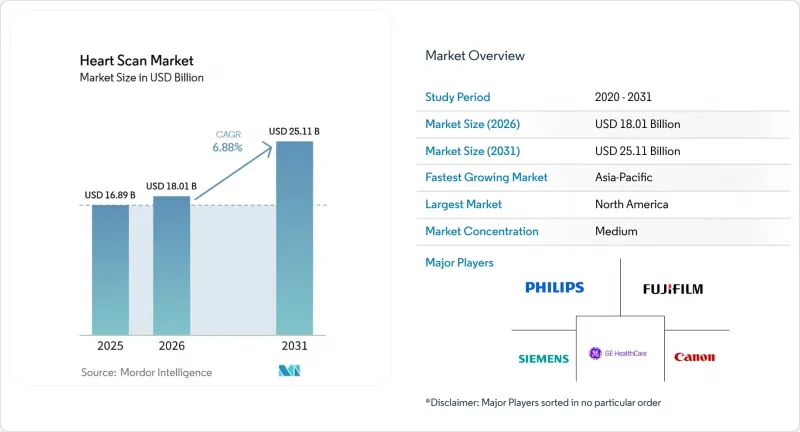
Mordor Intelligence에 의하면, 심장 스캔 시장 규모는 2025년 168억 9,000만 달러로 평가되었고, 2026년에는 180억 1,000만 달러로 추정되고, 2031년까지 251억 1,000만 달러에 이를 것으로 예상되며, 2026-2031년 CAGR 6.88%로 성장할 전망입니다.
본 보고서는 검사 방식별(심초음파 검사, 기타), 용도별(관상동맥 질환 진단, 기타), 최종 사용자별(병원 및 클리닉, 기타), 기술별(2D 영상, 기타), 지역별(북미, 유럽, 아시아태평양, 중동 및 아프리카, 남미)로 분류되어 있습니다. 시장 전망은 금액(달러) 기준으로 제시되어 있습니다.
세계의 심장 스캔 시장 동향 및 인사이트
심혈관 질환 부담 증가와 조기 비침습적 평가
인구 고령화, 고혈압, 식생활 관련 위험 요인, 대사성 질환으로 인해 2050년까지 심혈관 질환의 부담이 증가할 것으로 예측됩니다. 심혈관 질환으로 인한 사망의 75% 이상은 저·중소득 국가에서 발생하고 있으며, 이들 국가에서는 영상 진단 능력이 여전히 제한적입니다. 이러한 격차로 인해, 저비용이며 휴대 가능하고 임상 네트워크에 연결된 시스템에 대한 심장 스캔 시장 수요가 증가하고 있습니다. 또한, 단일 프리미엄 제품 라인이 아닌 다층적인 제품 포트폴리오를 보유한 공급업체가 유리한 입지를 점하고 있습니다. 조기 비침습적 평가를 통해 침습적 시술을 고려하기 전에 CCTA 및 심초음파 검사의 역할이 확대되었습니다. 장비, 인력, 보험 급여가 이를 뒷받침할 경우, 외래 진료나 현장 진료 환경에서 영상 진단에 대한 접근성을 확대할 수 있습니다.
AI를 활용한 워크플로우 자동화 및 정량적 해석
AI 도구는 심장 스캔 시장에서 영상 획득, 측정, 해석을 혁신하고 있습니다. 2025년 과학 성명에 따르면, 심장 CT 및 MRI 분야에서 AI 도입이 성공하고 있는 곳은 현재 확립된 IT 자원을 보유한 의료 기관으로 한정되어 있는 것으로 밝혀졌습니다. 이는 자동화를 통한 단기적 이점이 자원이 풍부한 의료 현장에 집중될 가능성이 높다는 것을 의미합니다. 지멘스 헬시니어스(Siemens Healthineers)는 2025년, 500개 이상의 AI 지원 측정 기능, 실시간 심장 뷰 인식, 도플러 프로브 자동 배치 기능을 갖춘 ‘ACUSON Origin’을 출시했습니다. 2025년 임상 리뷰에 따르면, AI를 활용한 포인트 오브 케어 심초음파 검사를 통해 조작자에 대한 의존도를 낮추고 영상 획득의 일관성을 향상시킬 수 있는 것으로 보고되었습니다. 따라서 심장 스캔 시장에는 장비 제조업체가 내장한 네이티브 AI와 전문 공급업체가 제공하는 벤더 간 호환 소프트웨어가 모두 포함됩니다.
높은 초기 투자 비용, 유지비, 총 소유 비용
3테슬라 심장 MRI 및 광자 계수형 CT 플랫폼을 포함한 첨단 영상 시스템은 여전히 많은 공공 의료 시스템의 구매 능력을 초과합니다. 비용은 구매비에 그치지 않고 유지보수 계약, 전문의 교육, 조영제, 방사성 의약품공급망까지 미칩니다. 이러한 비용으로 인해 의료 기관은 구매를 미루거나, 사양이 낮은 장비를 선택하거나, 예정된 교체 주기를 넘어서까지 시스템을 계속 사용하게 됩니다. 그 결과, 고소득 국가와 저소득 국가 간의 진단 능력 격차가 확대되고 있습니다. 휴대용 초음파 진단 장치는 일부 장비 비용을 절감할 수는 있지만, 훈련된 인력과 임상 네트워크의 필요성을 해소해 주지는 않습니다. 심장 스캔 시장에는 공공 부문의 조달 조건에 적합한, 전용으로 설계된 저비용 제품과 자금 조달 방식이 요구되고 있습니다.
부문 분석
2025년, 심초음파 검사는 저렴한 비용, 광범위한 이용 가능성, 실시간 영상화, 확립된 보험 환급 제도에 힘입어 심장 스캔 시장의 31.35%를 차지했습니다. 이 검사 방식에서 수행되는 검사 건수의 대부분은 경흉벽 심초음파 검사(TTE)가 차지하고 있습니다. 구조적 심장 질환에 대한 중재적 치료가 증가함에 따라 심내막 초음파 검사의 중요성이 높아지고 있습니다. 심장 CT에는 CCTA, 칼슘 스코어링, 광자 계수 CT의 응용이 포함됩니다. 핵의학을 이용한 심장 영상 진단도 관류 평가에서 여전히 중요한 역할을 하고 있습니다. 심혈관 조영술과 투시 검사는 순수한 진단 목적보다는 주로 중재적 치료에 사용되고 있습니다.
심장 자기공명영상(MRI)은 2026-2031년 연평균 성장률(CAGR) 10.48%를 나타낼 것으로 예측되며, 심장 스캔 시장에서 가장 빠르게 성장하는 모달리티가 될 전망입니다. 이 기술의 활용은 심근증의 특성 평가, 심근 생존 능력 평가, 구조적 심장 치료의 수술 계획 수립에 있어 근거에 의해 뒷받침되고 있습니다. 1.5테슬라에서 3테슬라 시스템으로의 전환에 따라 고해상도 심장 MRI에 대한 임상적 관심이 높아지고 있습니다. 2026년 2월, 이노바는 고해상도 심장 영상 촬영을 위해 GE 헬스케어의 ‘SIGNA Sprint Elite 1’ 시스템을 도입한 최초의 의료 기관이 되었습니다. 새로운 MRI 플랫폼은 주요 시장에서 MRI의 안전성 및 품질 관리 요건을 지속적으로 충족해야 합니다.
2025년, 관상동맥 질환 진단은 심장 스캔 시장 규모의 44.29%를 차지하며 가장 큰 용도 분야가 되었습니다. 이러한 위상은 2억 5,428만 명에게 영향을 미친 허혈성 심장 질환의 전 세계적인 부담을 반영합니다. CCTA는 특히 2025년 보험 환급 제도 변경 이후, 더욱 중요한 비침습적 관상동맥 평가법으로 자리매김하고 있습니다. 심부전, 구조적 심장 질환, 선천성 심장 질환, 부정맥 평가도 기타 적응증 분야로 꼽힙니다. 이러한 적응증 분야에서는 심근병증에 대한 심장 MRI나 관류 평가를 위한 핵의학 영상 등 다양한 검사법이 선택되고 있습니다. 미국 FDA의 승인 절차와 EU MDR 2017/745에 따른 유럽의 CE 마킹은 새로운 적응증 분야가 임상의에게 도입되는 방식에 계속해서 영향을 미치고 있습니다.
심장 판막증 평가 시장은 2031년까지 연평균 성장률(CAGR) 12.60%로 확대될 것으로 예측됩니다. 이러한 성장은 경카테터 대동맥판막 치환술(TAVR)과 경카테터 승모판막 치환술(TMVR)에 기인하며, 이러한 시술에서는 수술 전, 수술 중, 수술 후 영상 촬영이 필요합니다. 2026년 3월, Philips는 에드워즈 라이프 사이언시스(Edwards Lifesciences)와 공동 개발한 경카테터 승모판 에지-투-에지(edge-to-edge) 수복술을 위한 실시간 안내 시스템인 ‘EchoNavigator R5.0 with DeviceGuide’에 대해 FDA의 510(k) 승인을 획득했습니다. AI를 활용한 심전도(ECG) 선별 도구는 심초음파 검사나 심장 CT로 추가 의뢰로 이어질 가능성이 있습니다. EchoNext는 표준 12도심전도를 사용하여 구조적 심장 질환의 검출 정확도 77%를 달성한 반면, AI를 사용하지 않은 심장 전문의의 검출 정확도는 64%였습니다. 이를 통해 지금까지 제대로 구축되지 않았던 ‘스크리닝에서 영상 검사로 이어지는 흐름’이 구축될 가능성이 있습니다.
지역별 분석
2025년, 북미는 심장 스캔 시장의 38.70%를 차지했습니다. 미국은 의료 기관의 밀도가 높고, 기술을 조기에 도입하며, 적극적인 보험 급여 제도 개혁을 통해 이 지역 시장의 대부분을 차지했습니다. 2025년 CCTA(관상동맥 CT 혈관조영술) 지급액 인상과 AI를 활용한 새로운 영상 진단 도구가 해당 지역의 조달 활동을 뒷받침하고 있습니다. GE Healthcare는 2025년 3월, 1회 투여형 PET 심근 관류 조영제 ‘Flyrcado’를 출시했으며, 2025년 4월 1일부터 CMS(미국 의료보험 서비스 센터)의 패스스루 인증이 유효해졌습니다. 캐나다와 멕시코는 환급 제도와 조달 주기가 다르기 때문에 여전히 2차 지역 시장으로 남아 있습니다.
유럽은 심장 스캔 시장에서 두 번째로 큰 지역입니다. 성숙한 기술 기반과 EU MDR 2017/745의 요건이 각 모달리티별 제품 출시 순서에 영향을 미치고 있습니다. 독일, 영국, 프랑스에서는 심혈관 네트워크, 대학 병원, 전문 의료 기관을 통해 지역 수요를 뒷받침하고 있습니다. 2026년 7월 영국과 중국의 병원을 대상으로 실시된 VNE 조사에서는 가돌리늄 사용 현황이 서로 다른 지역에서 임상 파트너십이 영상 프로토콜 표준화에 어떻게 기여할 수 있는지가 밝혀졌습니다. 이탈리아와 스페인에서는 가격에 민감한 조달 경향이 관찰됩니다. 기타 유럽 국가들은 심장 영상 인프라 구축에 있어 각기 다른 단계에 있습니다.
아시아태평양은 2026-2031년 연평균 성장률(CAGR) 10.60%를 나타낼 것으로 예측되며, 가장 빠르게 성장하는 지역이 될 전망입니다. 중국의 국내 제조업체들은 공립 병원의 조달 및 첨단 진단 능력에 대한 수요 증가에 힘입어 하이엔드 영상 부문에서 입지를 확대되고 있습니다. 인도에서는 민간 종합병원에 대한 투자를 통해 심장 영상 역량을 확대하고 있지만, 심장 MRI의 경우 스캐너의 가용성 및 후처리 비용으로 인해 여전히 제약을 받고 있습니다. 일본과 한국은 혁신과 제조의 중심지이며, 양국의 규제 당국은 품질에 관해 중요한 기준을 정하고 있습니다. 중동 및 아프리카와 남미에서는 심장 센터에 대한 투자와 공공 의료 확충을 통해 규모는 작지만 성장 기회가 예상됩니다. Philips는 2026년 5월, 아시아 심혈관 영상 학회와 양해각서를 체결하고, 아시아태평양 전역의 교육 및 AI 분야 협력을 지원하기로 했습니다.
기타 혜택
- 엑셀 형식 시장 예측(ME) 시트
- 3개월간의 애널리스트 지원
목차
제1장 서론
제2장 조사 방법
제3장 주요 요약
제4장 시장 구도
제5장 시장 규모 및 성장 예측
제6장 경쟁 구도
제7장 시장 기회 및 향후 전망
AJYAccording to Mordor Intelligence, the heart scan market size is expected to increase from USD 16.89 billion in 2025 to USD 18.01 billion in 2026 and reach USD 25.11 billion by 2031, growing at a CAGR of 6.88% over 2026-2031.
This report is Segmented by Modality (Echocardiography, and More), Application (Coronary Artery Disease Diagnosis, and More), End User (Hospitals and Clinics, and More), Technology (2D Imaging, and More), and Geography (North America, Europe, Asia-Pacific, Middle East and Africa, and South America). Market Forecasts are Provided in Terms of Value (USD).
Global Heart Scan Market Trends and Insights
Rising Cardiovascular Disease Burden and Earlier Non-Invasive Assessment
Population aging, high blood pressure, dietary risks, and metabolic conditions are expected to increase the cardiovascular disease burden through 2050. More than 75% of cardiovascular disease deaths occur in low- and middle-income countries, where diagnostic imaging capacity remains limited. This gap supports demand in the heart scan market for systems that are lower cost, portable, and connected to clinical networks. It also favors suppliers with tiered portfolios rather than a single premium product line. Earlier non-invasive assessment widened the role of CCTA and echocardiography before invasive procedures are considered. Ambulatory and point-of-care settings can extend imaging access when equipment, staffing, and reimbursement support their use.
AI-Enabled Workflow Automation and Quantitative Interpretation
AI tools are changing image acquisition, measurement, and interpretation in the heart scan market. A 2025 scientific statement found that successful AI deployment in cardiac CT and MRI currently favors institutions with established information technology resources. This means that the near-term benefits of automation are likely to be concentrated in better-resourced care settings. Siemens Healthineers introduced the ACUSON Origin in 2025 with more than 500 AI-supported measurements, real-time cardiac view recognition, and automated Doppler placement. A 2025 clinical review reported that AI-enabled point-of-care echocardiography can reduce operator dependence and improve acquisition consistency. The heart scan market, therefore, includes both native AI embedded by equipment suppliers and cross-vendor software offered by specialized providers.
High Capital, Maintenance, and Total Cost of Ownership
Advanced imaging systems, including 3-Tesla cardiac MRI and photon-counting CT platforms, remain beyond the purchasing capacity of many public health systems. The cost extends beyond acquisition to service contracts, specialist training, contrast agents, and radiopharmaceutical supply chains. These expenses can lead providers to defer purchases, choose lower-specification equipment, or retain systems beyond their intended replacement cycle. The result is a widening diagnostic capability gap between high-income and lower-income settings. Portable ultrasound can lower some equipment costs, but it does not eliminate the requirements for trained personnel and clinical networks. The heart scan market needs purpose-built, lower-cost offerings and financing approaches that fit public-sector procurement conditions.
Other drivers and restraints analyzed in the detailed report include:
- Reimbursement Recognition of CCTA and Cardiac AI Analysis
- Contrast-Free and Lower-Resource Cardiac MRI Workflows
- Shortage of Cardiac Imaging Specialists and Sonographers
For complete list of drivers and restraints, kindly check the Table Of Contents.
Segment Analysis
Echocardiography held 31.35% of the heart scan market in 2025, supported by its lower cost, broad availability, real-time imaging, and established reimbursement. Transthoracic echocardiography, or TTE, accounts for most procedure volume within the modality. Intracardiac echocardiography is gaining relevance as structural heart interventions increase. Cardiac CT includes CCTA, calcium scoring, and photon-counting CT applications. Nuclear cardiac imaging also remains relevant for perfusion assessment. Cardiac angiography and fluoroscopy primarily serve interventional rather than purely diagnostic use.
Cardiac magnetic resonance imaging is projected to grow at a 10.48% CAGR from 2026 to 2031, making it the fastest-growing modality in the heart scan industry. Its use is supported by evidence in cardiomyopathy characterization, myocardial viability assessment, and planning for structural heart procedures. The shift from 1.5-Tesla to 3-Tesla systems is increasing clinical interest in higher-resolution cardiac MRI. In February 2026, Inova became the first health system to implement GE HealthCare's SIGNA Sprint Elite 1 system for high-resolution cardiac imaging. New MRI platforms must continue to meet MRI safety and quality-management requirements in major markets.
Coronary artery disease diagnosis represented 44.29% of the heart scan market size in 2025, making it the largest application. Its position reflects the large global burden of ischemic heart disease, which affected 254.28 million people. CCTA is becoming a more important non-invasive coronary assessment method, particularly after the 2025 reimbursement change. Heart failure, structural heart disease, congenital heart disease, and arrhythmia assessment represent additional applications. These applications use different modality preferences, including cardiac MRI for cardiomyopathy and nuclear imaging for perfusion assessment. U.S. FDA clearance pathways and European CE marking under EU MDR 2017/745 continue to influence how new applications reach clinicians.
Valvular heart disease evaluation is forecast to grow at a 12.60% CAGR through 2031. Growth is tied to transcatheter aortic valve replacement and transcatheter mitral valve replacement, which require imaging before, during, and after procedures. In March 2026, Philips received FDA 510(k) clearance for EchoNavigator R5.0 with DeviceGuide, a real-time guidance system for mitral transcatheter edge-to-edge repair developed with Edwards Lifesciences. AI ECG screening tools may create additional referrals for echocardiography and cardiac CT. EchoNext achieved 77% structural heart disease detection accuracy using a standard 12-lead ECG, compared with 64% for unaided cardiologists. This creates a potential screening-to-imaging pathway that was less developed previously.
Complete Report Scope:
- By Modality
- Echocardiography
- Transthoracic Echocardiography
- Transesophageal Echocardiography
- Stress Echocardiography
- Intracardiac Echocardiography
- Fetal Echocardiography
- Cardiac Computed Tomography
- Coronary CT Angiography
- Calcium Scoring CT
- Cardiac CT for Structural Heart Planning
- Photon-Counting Cardiac CT
- Cardiac Magnetic Resonance Imaging
- Closed Cardiac MRI Systems
- Open Cardiac MRI Systems
- 1.5-Tesla and 3-Tesla Cardiac MRI
- Very High-Field Cardiac MRI
- Nuclear Cardiac Imaging
- SPECT Myocardial Perfusion Imaging
- PET Myocardial Perfusion Imaging
- Hybrid Nuclear Cardiac Imaging
- Cardiac Angiography and Fluoroscopy
- Coronary Angiography
- Digital Subtraction Angiography
- Intravascular Ultrasound-Guided Imaging
- Optical Coherence Tomography-Guided Imaging
- Echocardiography
- By Application
- Coronary Artery Disease Diagnosis
- Heart Failure Assessment and Monitoring
- Structural Heart Disease Assessment
- Valvular Heart Disease Evaluation
- Congenital Heart Disease Evaluation
- Arrhythmia and Electrophysiology Assessment
- Other Applications
- By End User
- Hospitals and Clinics
- Diagnostic Imaging Centers
- Specialty Cardiac Centers
- Ambulatory Surgical Centers
- Other End Users
- By Technology
- 2D Imaging
- 3D and 4D Imaging
- Doppler and Contrast-Enhanced Imaging
- AI-Enabled Imaging Solutions
- Other Technologies
- By Geography
- North America
- United States
- Canada
- Mexico
- Europe
- Germany
- United Kingdom
- France
- Italy
- Spain
- Rest of Europe
- Asia-Pacific
- China
- Japan
- India
- Australia
- South Korea
- Rest of Asia-Pacific
- Middle East and Africa
- GCC
- South Africa
- Rest of Middle East and Africa
- South America
- Brazil
- Argentina
- Rest of South America
- North America
Geography Analysis
North America held 38.70% of the heart scan market in 2025. The United States accounted for much of the regional volume because of its institutional density, early technology adoption, and active reimbursement reform. The 2025 CCTA payment increase and new AI-supported imaging tools are supporting procurement activity in the region. GE HealthCare launched Flyrcado, a unit-dose PET myocardial perfusion imaging agent, in March 2025 with CMS pass-through status effective April 1, 2025. Canada and Mexico remain secondary regional markets with different reimbursement and procurement cycles.
Europe is the second-largest geography in the heart scan market. Its mature technology base and EU MDR 2017/745 requirements influence the order of product launches across modalities. Germany, the United Kingdom, and France support regional demand through cardiology networks, academic medical centers, and specialist care. The July 2026 VNE study across the United Kingdom and Chinese hospital centers showed how clinical partnerships can help standardize imaging protocols where gadolinium access differs. Italy and Spain have more price-sensitive procurement patterns. Other European countries remain at different stages of cardiac imaging infrastructure development.
Asia-Pacific is forecast to grow at a 10.60% CAGR from 2026 to 2031, making it the fastest-growing geographic area. Domestic Chinese manufacturers are expanding their presence in high-end imaging, supported by public hospital procurement and rising demand for advanced diagnostic capacity. India is expanding cardiac imaging capacity through private multi-specialty hospital investment, while cardiac MRI remains limited by scanner access and post-processing costs. Japan and South Korea are innovation and manufacturing centers, and their regulatory agencies set important quality expectations. The Middle East and Africa, and South America, provide smaller growth opportunities through cardiac-center investment and public healthcare expansion. Philips signed a May 2026 memorandum with the Asian Society of Cardiovascular Imaging to support education and AI collaboration across Asia-Pacific.
- Abbott Laboratories
- Agfa-Gevaert
- Bayer
- Boston Scientific
- Bracco Imaging S.p.A.
- Canon
- Circle Cardiovascular Imaging Inc.
- Esaote S.p.A.
- FUJIFILM
- GE HealthCare Technologies Inc.
- Guerbet S.A.
- Koninklijke Philips
- Medis Medical Imaging Systems
- Medtronic
- Samsung Group
- Shanghai United Imaging Healthcare Co., Ltd.
- Mindray
- Shimadzu
- Siemens Healthineers
- Terumo
Additional Benefits:
- The market estimate (ME) sheet in Excel format
- 3 months of analyst support
TABLE OF CONTENTS
1 Introduction
- 1.1 Study Assumptions & Market Definition
- 1.2 Scope of the Study
2 Research Methodology
3 Executive Summary
4 Market Landscape
- 4.1 Market Overview
- 4.2 Market Drivers
- 4.2.1 Rising Cardiovascular Disease Burden and Diagnostic Demand
- 4.2.2 Shift Toward Non-Invasive and Earlier Cardiac Assessment
- 4.2.3 AI-Enabled Workflow Automation and Quantitative Interpretation
- 4.2.4 Expansion of Ambulatory and Point-of-Care Cardiac Imaging
- 4.2.5 Reimbursement Recognition of CCTA and Cardiac AI Analysis
- 4.2.6 Contrast-Free and Lower-Resource Cardiac MRI Workflows
- 4.3 Market Restraints
- 4.3.1 High Capital, Maintenance, and Total Cost of Ownership
- 4.3.2 Shortage of Cardiac Imaging Specialists and Sonographers
- 4.3.3 Cross-Vendor Data Heterogeneity and AI Generalizability Risk
- 4.3.4 Uneven Reimbursement and Limited Rural Imaging Capacity
- 4.4 Supply-Chain Analysis
- 4.5 Regulatory Landscape
- 4.6 Technological Outlook
- 4.7 Porter's Five Forces
- 4.7.1 Threat of New Entrants
- 4.7.2 Bargaining Power of Suppliers
- 4.7.3 Bargaining Power of Buyers
- 4.7.4 Threat of Substitutes
- 4.7.5 Competitive Rivalry
5 Market Size & Growth Forecasts (Value in USD)
- 5.1 By Modality
- 5.1.1 Echocardiography
- 5.1.1.1 Transthoracic Echocardiography
- 5.1.1.2 Transesophageal Echocardiography
- 5.1.1.3 Stress Echocardiography
- 5.1.1.4 Intracardiac Echocardiography
- 5.1.1.5 Fetal Echocardiography
- 5.1.2 Cardiac Computed Tomography
- 5.1.2.1 Coronary CT Angiography
- 5.1.2.2 Calcium Scoring CT
- 5.1.2.3 Cardiac CT for Structural Heart Planning
- 5.1.2.4 Photon-Counting Cardiac CT
- 5.1.3 Cardiac Magnetic Resonance Imaging
- 5.1.3.1 Closed Cardiac MRI Systems
- 5.1.3.2 Open Cardiac MRI Systems
- 5.1.3.3 1.5-Tesla and 3-Tesla Cardiac MRI
- 5.1.3.4 Very High-Field Cardiac MRI
- 5.1.4 Nuclear Cardiac Imaging
- 5.1.4.1 SPECT Myocardial Perfusion Imaging
- 5.1.4.2 PET Myocardial Perfusion Imaging
- 5.1.4.3 Hybrid Nuclear Cardiac Imaging
- 5.1.5 Cardiac Angiography and Fluoroscopy
- 5.1.5.1 Coronary Angiography
- 5.1.5.2 Digital Subtraction Angiography
- 5.1.5.3 Intravascular Ultrasound-Guided Imaging
- 5.1.5.4 Optical Coherence Tomography-Guided Imaging
- 5.1.1 Echocardiography
- 5.2 By Application
- 5.2.1 Coronary Artery Disease Diagnosis
- 5.2.2 Heart Failure Assessment and Monitoring
- 5.2.3 Structural Heart Disease Assessment
- 5.2.4 Valvular Heart Disease Evaluation
- 5.2.5 Congenital Heart Disease Evaluation
- 5.2.6 Arrhythmia and Electrophysiology Assessment
- 5.2.7 Other Applications
- 5.3 By End User
- 5.3.1 Hospitals and Clinics
- 5.3.2 Diagnostic Imaging Centers
- 5.3.3 Specialty Cardiac Centers
- 5.3.4 Ambulatory Surgical Centers
- 5.3.5 Other End Users
- 5.4 By Technology
- 5.4.1 2D Imaging
- 5.4.2 3D and 4D Imaging
- 5.4.3 Doppler and Contrast-Enhanced Imaging
- 5.4.4 AI-Enabled Imaging Solutions
- 5.4.5 Other Technologies
- 5.5 By Geography
- 5.5.1 North America
- 5.5.1.1 United States
- 5.5.1.2 Canada
- 5.5.1.3 Mexico
- 5.5.2 Europe
- 5.5.2.1 Germany
- 5.5.2.2 United Kingdom
- 5.5.2.3 France
- 5.5.2.4 Italy
- 5.5.2.5 Spain
- 5.5.2.6 Rest of Europe
- 5.5.3 Asia-Pacific
- 5.5.3.1 China
- 5.5.3.2 Japan
- 5.5.3.3 India
- 5.5.3.4 Australia
- 5.5.3.5 South Korea
- 5.5.3.6 Rest of Asia-Pacific
- 5.5.4 Middle East and Africa
- 5.5.4.1 GCC
- 5.5.4.2 South Africa
- 5.5.4.3 Rest of Middle East and Africa
- 5.5.5 South America
- 5.5.5.1 Brazil
- 5.5.5.2 Argentina
- 5.5.5.3 Rest of South America
- 5.5.1 North America
6 Competitive Landscape
- 6.1 Market Concentration
- 6.2 Market Share Analysis
- 6.3 Company Profiles {(includes Global level Overview, Market level overview, Core Segments, Financials as available, Strategic Information, Market Rank/Share for key companies, Products & Services, and Recent Developments)}
- 6.3.1 Abbott Laboratories
- 6.3.2 Agfa-Gevaert N.V.
- 6.3.3 Bayer AG
- 6.3.4 Boston Scientific Corporation
- 6.3.5 Bracco Imaging S.p.A.
- 6.3.6 Canon Medical Systems Corporation
- 6.3.7 Circle Cardiovascular Imaging Inc.
- 6.3.8 Esaote S.p.A.
- 6.3.9 FUJIFILM Holdings Corporation
- 6.3.10 GE HealthCare Technologies Inc.
- 6.3.11 Guerbet S.A.
- 6.3.12 Koninklijke Philips N.V.
- 6.3.13 Medis Medical Imaging Systems B.V.
- 6.3.14 Medtronic plc
- 6.3.15 Samsung Medison Co., Ltd.
- 6.3.16 Shanghai United Imaging Healthcare Co., Ltd.
- 6.3.17 Shenzhen Mindray Bio-Medical Electronics Co., Ltd.
- 6.3.18 Shimadzu Corporation
- 6.3.19 Siemens Healthineers AG
- 6.3.20 Terumo Corporation
7 Market Opportunities & Future Outlook
- 7.1 White-Space and Unmet-Need Assessment