

|
시장보고서
상품코드
2118093
OTT용 AI 영상 생성 시장 : 시장 점유율 분석, 업계 동향 및 통계, 성장 예측(2026-2031년)AI Video Generation For OTT - Market Share Analysis, Industry Trends & Statistics, Growth Forecasts (2026 - 2031) |
||||||
 Mordor Intelligence
Mordor Intelligence에 의하면, OTT용 AI 영상 생성 시장 규모는 2025년 11억 3,000만 달러로 평가되었고, 2026년에는 16억 1,000만 달러로 추정되고, 2026-2031년 CAGR 26.62%로 성장을 지속할 전망이며, 2031년에는 52억 4,000만 달러에 이를 것으로 예측됩니다.
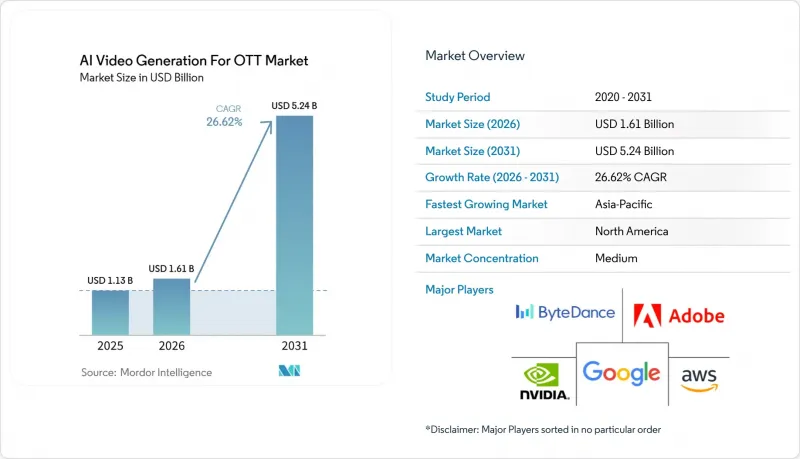
본 보고서는 생성 유형별(텍스트에서 동영상으로 생성, 이미지에서 동영상으로 생성, 기타), 최종 사용자별(스트리밍 플랫폼, 영화 스튜디오 및 제작사, 방송국 및 TV 네트워크, 기타), 지역별(북미, 남미, 유럽, 아시아태평양, 중동 및 아프리카)별로 분류되어 있습니다. 시장 예측은 금액(달러) 기준으로 제시되어 있습니다.
OTT용 AI 영상 생성 시장 동향 및 인사이트
OTT 컨텐츠의 신속한 제작 및 제작 주기 단축
OTT용 AI 영상 생성 시장은 제작 일정을 연장하지 않고도 더 많은 컨텐츠를 필요로 하는 서비스에 이점을 제공합니다. 넷플릭스는 2026년, 생성형 AI를 활용하여 기존 방식에 비해 절반의 비용으로 두 배 빠른 속도로 17분 분량의 다큐멘터리 영상을 제작할 수 있었습니다고 보고했습니다. 이 결과는 OTT용 AI 영상 생성 시장이 제작 과정 전체를 대체하는 것이 아니라, 특정 작업을 지원할 수 있음을 보여줍니다. 제작의 신속화를 통해 방송사나 스튜디오 입장에서는 컨텐츠 목록 갱신, 시즌 한정 컨텐츠, 기존 지적 재산의 확장이 더욱 현실화됩니다. 또한 스트리밍 플랫폼은 대규모 제작 예산을 투입하기 전에 틈새 형식을 시험적으로 도입하는 것도 가능해집니다. OTT용 AI 영상 생성 시장에서 이로 인해 어떤 프로젝트에 자금을 지원할지 결정하는 데 있어 제작 속도가 직접적인 요인이 됩니다.
OTT 컨텐츠의 확장성이 높은 현지화, 더빙, 버전 제작
현지화는 국제적인 스트리밍 서비스에서 여전히 큰 비용 및 일정상의 제약 요인으로 작용하고 있습니다. 한국의 ‘K-FAST’ 이니셔티브에서는 2025년부터 2026년에 걸쳐 1,200편 이상, 총 1,400시간에 달하는 컨텐츠를 영어, 스페인어, 포르투갈어로 현지화했습니다. 이 프로그램은 AI 더빙이 적용된 22개의 FAST 채널을 통해 5개월 동안 22개국에서 누적 1억 회 시청을 달성했습니다. 이러한 규모는 기존 방식의 더빙이 수익성 측면에서 어려웠던 시장에서도 AI를 활용한 더빙이 저작권자의 컨텐츠 라이브러리 수익 창출에 기여할 수 있음을 시사합니다. Deepdub은 2026년 4월, 자사의 제작 워크플로우 내에서 사용하기 위한 ‘에이전트형 더빙 어시스턴트’를 도입했습니다. 따라서 OTT용 AI 영상 생성 시장은 플랫폼 확장에 따른 언어 적응, 버전 관리, 립싱크 작업의 혜택을 누릴 수 있을 것으로 보입니다.
지적 재산권, 저작권, 연예인의 초상권에 관한 위험
법적 요건이나 동의 획득 요건으로 인해 상업용 워크플로우에서 생성된 동영상의 활용이 지연될 가능성이 있습니다. 뉴욕주는 2025년 12월에 ‘AI 투명성법’을 제정했으며, 이 법은 2026년 6월 9일에 시행되었습니다. 이 법은 상업 광고에서 합성 출연자의 공개를 의무화하고, 위반 시 최대 5,000달러의 민사 벌금을 부과합니다. 또한, 뉴욕주는 사망한 출연자의 무단 디지털 복제를 방지하기 위해 사후 퍼블리시티권에 관한 법률도 제정했습니다. 넷플릭스는 AI의 산출물이 최종 결과물, 탤런트의 초상, 개인 데이터 또는 제3자의 지적 재산권과 관련된 경우 서면 승인을 의무화하고 있습니다. 이러한 규제로 인해 OTT용 AI 영상 생성 시장에서 특히 식별 가능한 인물이나 기존 자산이 관련된 경우 심사 절차가 추가될 것입니다.
부문 분석
2025년, OTT용 AI 영상 생성 시장 중 텍스트에서 동영상으로의 생성이 41.63%를 차지한 것으로 평가되었으며, 2031년까지 연평균 성장률(CAGR) 27.48%로 성장할 것으로 전망됩니다. 이러한 위상은 이미 대본, 트리트먼트, 제작 개요를 바탕으로 작업을 수행하고 있는 크리에이티브 팀에게 텍스트 프롬프트가 친숙한 도구임을 반영합니다. 또한, 텍스트 입력이라면 이미지에서 동영상으로 생성하는 작업에서 종종 필요한 이미지 준비 과정을 생략할 수 있습니다. ByteDance는 2026년 7월, BytePlus API를 통해 Seedance 2.5의 제공을 시작하여, 한 번의 API 호출로 30초간의 연속 생성을 지원했습니다. Runway는 2025년 12월에 Gen-4.5를 출시했고, Google은 2025년 5월에 Veo 3를 발표했습니다. 두 개발 모두 동영상의 사실성을 향상시켰습니다. 이러한 모델들은 후반 작업의 품질 향상, 장면 시각화, 콘셉트 릴, 홍보 자료 제작에서 점점 더 중요한 역할을 하고 있습니다.
이미지에서 동영상으로의 생성은 기존의 정지 이미지, 콘셉트 아트, 아카이브 자료, 연속성 프레임에 애니메이션을 더한다는 점에서 다른 역할을 수행합니다. 제작 측이 승인된 시각적 소스 자료를 보유하고 있는 경우, OTT용 AI 영상 생성 시장에서 지적 재산의 확대나 합성을 통한 추가 촬영 작업을 지원할 수 있습니다. 라이온스게이트(Lionsgate)사가 자사 카탈로그를 바탕으로 숏폼 시리즈를 제작할 계획인 것은 기존 시각적 자산을 활용할 수 있는 워크플로우의 한 예를 보여줍니다. 또한, ‘오디오 투 비디오’나 ‘스타일 전이’ 도구는 광고 게재처 전반에 걸쳐 일관된 비주얼이 요구되는 캠페인에서도 유용합니다. OTT용 AI 영상 생성 시장에서는 도구가 인식 가능한 이미지, 카탈로그 자산 또는 탤런트의 초상을 사용할 경우, 보다 엄격한 권리 심사가 요구됩니다. 넷플릭스의 생성형 AI 관련 가이드라인에 따르면, 최종 결과물, 개인 데이터, 탤런트의 초상, 제3자의 지적 재산권과 관련된 자료에 대해서는 승인이 필요합니다. 이러한 심사 과정을 통해 팀이 승인된 활용을 위한 보다 간편한 방법을 모색할 경우, 텍스트에서 동영상으로 변환하는 기술 분야의 우위를 유지할 수 있습니다.
지역별 분석
2025년, 북미는 전 세계 매출의 41.56%를 차지했습니다. 이 지역의 OTT용 AI 영상 생성 시장은 주요 스트리밍 서비스, 스타트업에 대한 투자, 확립된 포스트 프로덕션 체계가 융합되어 있습니다. Runway는 2026년 2월, General Atlantic이 주도한 라운드에서 기업 가치 53억 달러를 기준으로 3억 1,500만 달러를 조달했습니다. NVIDIA, Fidelity Management and Research, AllianceBernstein,Adobe Ventures, AMD Ventures가 이번 자금 조달에 참여했습니다. 또한, 뉴욕주의 2025년 법규도 지역 스튜디오 및 방송사의 도입 방침에 영향을 미치고 있습니다. 캐나다는 시각 효과(VFX) 산업을 통해 간접적인 도입 기반을 제공하고 있으며, 멕시코는 스페인어 현지화를 지원하고 있습니다.
아시아태평양은 2031년까지 연평균 성장률(CAGR) 26.93%를 나타낼 것으로 예측됩니다. 이 지역은 기존 컨텐츠 카탈로그의 품질 향상뿐만 아니라, 대량이자 모바일 우선의 컨텐츠 제작이 특징입니다. 차이나모바일의 Migu는 2026년 7월, 여러 모델을 자동 제작 체인에 통합한 AI 단편 드라마 제작 플랫폼을 도입했습니다. 이 회사에 따르면, 이 플랫폼을 통해 총 제작 비용을 30% 이상 절감할 수 있었습니다고 합니다. 인도에서는 JioStar의 ‘JAMS’ 프로그램과 ‘Tadka’ 마이크로 드라마 역시 마찬가지로 단편 연속 영상에 초점을 맞추었습니다. 한국의 ‘K-FAST’ 프로그램은 공공 지원을 통해 현지화와 국제적인 배포 채널을 어떻게 결합할 수 있는지를 더욱 잘 보여주고 있습니다.
2025년 OTT용 AI 영상 생성 시장에서 유럽, 남미, 중동 및 아프리카는 규모는 작지만 중요한 비중을 차지했습니다. 유럽에서의 이용은 합성 미디어, 투명성, 문서화, 인적 감독에 관한 규제의 영향을 받고 있습니다. 이러한 요건은 규제 대상인 방송사나 플랫폼의 경우, 도입에 따른 업무 부담을 가중시킬 가능성이 있습니다. 남미에서는 스페인어와 포르투갈어 현지화 수요가 뒷받침되고 있으며, 브라질과 아르헨티나가 주요 상업 시장으로 부상하고 있습니다. 중동에서는 걸프협력회의(GCC) 회원국들이 미디어 기술에 대한 투자와 OTT에 대한 막대한 지출을 통해 초기 단계의 활용을 주도하고 있습니다. 아프리카의 역할은 모바일 스트리밍의 성장과 다국어 더빙 도구의 비용 하락에 좌우될 것으로 보입니다.
기타 혜택
- 엑셀 형식 시장 예측(ME) 시트
- 3개월간의 애널리스트 지원
자주 묻는 질문
목차
제1장 서론
제2장 조사 방법
제3장 주요 요약
제4장 시장 구도
제5장 시장 규모 및 성장 예측
제6장 경쟁 구도
제7장 시장 기회 및 향후 전망
AJY 26.09.03According to Mordor Intelligence, the AI video generation for OTT market size is expected to grow from USD 1.13 billion in 2025 to USD 1.61 billion in 2026 and is forecast to reach USD 5.24 billion by 2031 at 26.62% CAGR over 2026-2031.
This report is Segmented by Generation Type (Text-To-Video Generation, Image-To-Video Generation, and More), End User (Streaming Platforms, Film Studios and Production Houses, Broadcasters and Television Networks, and More), and Geography (North America, South America, Europe, Asia-Pacific, Middle East, and Africa). The Market Forecasts are Provided in Terms of Value (USD).
Global AI Video Generation For OTT Market Trends and Insights
Faster OTT Content Turnaround and Shorter Production Cycles
The AI video generation for OTT market benefits when services need more content without extending production calendars. Netflix reported in 2026 that generative AI helped produce 17 minutes of documentary footage at half the cost and twice the speed of conventional methods. This result shows how the AI video generation for OTT market can support defined tasks rather than replace a full production process. Faster creation can make catalog refreshes, seasonal content, and extensions of existing intellectual property more practical for broadcasters and studios. It also lets streaming platforms test narrower formats before committing to a larger production budget. In the AI video generation for OTT market, this makes production speed a direct factor in decisions on which projects receive funding.
Scalable Localization, Dubbing, and Versioning of OTT Content
Localization remains a major cost and timing constraint for international streaming distribution. South Korea's K-FAST initiative localized more than 1,200 titles, totaling 1,400 hours, into English, Spanish, and Portuguese during 2025 and 2026. The program reached 100 million cumulative views in 22 countries through 20 AI-dubbed FAST channels within 5 months. This scale suggests that AI-assisted dubbing can help rights holders monetize libraries in markets where conventional dubbing has been difficult to justify. Deepdub introduced an agentic dubbing co-worker in April 2026 for use within its production workflow. The AI video generation for OTT market can therefore gain from language adaptation, versioning, and lip-sync work that follows platform expansion.
Intellectual Property, Copyright, and Talent Likeness Risks
Legal and consent requirements can slow the use of generated video in commercial workflows. New York enacted the AI Transparency Law in December 2025, and the law took effect on June 9, 2026. It requires disclosure of synthetic performers in commercial advertising and provides civil penalties of up to USD 5,000 for later violations. The state also enacted a posthumous right of publicity law to address unauthorized digital replicas of deceased performers. Netflix requires written approval when AI output involves final deliverables, talent likeness, personal data, or third-party intellectual property. These controls add review steps in the AI video generation for OTT market, particularly where recognizable people or existing assets are involved.
Other drivers and restraints analyzed in the detailed report include:
- Growing Demand for AI-Generated Trailers, Promos, and Advertisements
- Automated Creation of Short-Form Content Derivatives for Social Platforms
- Inconsistent Output Quality and Enterprise-Grade Brand-Safety Concerns
For complete list of drivers and restraints, kindly check the Table Of Contents.
Segment Analysis
Text-to-video generation accounted for 41.63% of AI video generation for OTT market in 2025 and is projected to grow at a 27.48% CAGR through 2031. Its position reflects the familiarity of text prompts for creative teams that already work from scripts, treatments, and production briefs. Text input also avoids the image preparation step that image-to-video work often requires. ByteDance made Seedance 2.5 available through the BytePlus API in July 2026, supporting 30-second continuous generation in a single API call. Runway released Gen-4.5 in December 2025, while Google introduced Veo 3 in May 2025, and both developments supported improved video fidelity. These models are increasingly relevant for post-production enhancements, scene visualization, concept reels, and promotional material.
Image-to-video generation serves a different role by animating existing stills, concept art, archival material, and continuity frames. It can support intellectual-property extension and synthetic pickup work in the AI video generation for OTT market when a production has approved visual source material. Lionsgate's plan to generate short-form series from its catalog illustrates a workflow that can use existing visual assets. Audio-to-video and style-transfer tools also have relevance in campaigns that require a consistent look across advertising placements. The AI video generation for OTT industry faces greater rights review when tools use recognizable images, catalog assets, or talent likenesses. Netflix's guidance on generative AI requires approval for material involving final deliverables, personal data, talent likeness, and third-party intellectual property. That review process can preserve text-to-video leadership where teams seek less complex paths to approved use.
Complete Report Scope:
- By Generation Type
- Text-to-Video Generation
- Image-to-Video Generation
- Other Generation Types
- By End User
- Streaming Platforms
- Film Studios and Production Houses
- Broadcasters and Television Networks
- Other End Users
- By Geography
- North America
- United States
- Canada
- Mexico
- South America
- Brazil
- Argentina
- Chile
- Rest of South America
- Europe
- Germany
- United Kingdom
- France
- Italy
- Spain
- Rest of Europe
- Asia-Pacific
- China
- Japan
- India
- South Korea
- Australia
- Rest of Asia-Pacific
- Middle East
- Saudi Arabia
- United Arab Emirates
- Qatar
- Rest of Middle East
- Africa
- South Africa
- Egypt
- Nigeria
- Rest of Africa
- North America
Geography Analysis
North America held 41.56% of global revenue in 2025. The AI video generation for OTT market in the region combines large streaming services, startup investment, and established post-production capacity. Runway raised USD 315 million in February 2026 at a USD 5.3 billion valuation, with General Atlantic leading the round. NVIDIA, Fidelity Management and Research, AllianceBernstein, Adobe Ventures, and AMD Ventures participated in the financing. New York's 2025 legislation is also influencing deployment policies at regional studios and broadcasters. Canada offers a secondary adoption base through its visual-effects sector, while Mexico supports Spanish-language localization.
Asia-Pacific is projected to grow at a 26.93% CAGR through 2031. The region is defined by high-volume, mobile-first content production rather than only quality enhancement for established catalogs. China Mobile Migu introduced an AI short-drama creation platform in July 2026 that integrates several models into an automated production chain. The company said the platform reduced total production costs by more than 30%. JioStar's JAMS program and Tadka micro-drama show the same focus on short serialized video in India. South Korea's K-FAST program further shows how public support can combine localization and international channel distribution.
Europe, South America, the Middle East, and Africa represented smaller but important parts of the AI video generation for OTT market in 2025. Europe's use is influenced by rules on synthetic media, transparency, documentation, and human oversight. These requirements can increase implementation work for regulated broadcasters and platforms. South America is supported by Spanish and Portuguese localization needs, with Brazil and Argentina serving as primary commercial markets. Gulf Cooperation Council countries support earlier-stage use in the Middle East through media technology investment and high OTT spending. Africa's role will depend on mobile streaming growth and the declining cost of multilingual dubbing tools.
- Adobe Inc.
- Amazon Web Services, Inc.
- ByteDance Ltd.
- Google LLC
- NVIDIA Corporation
- OpenAI, Inc.
- Runway AI, Inc.
- Synthesia Limited
- HeyGen Inc.
- Pika Labs, Inc.
- Stability AI Ltd.
- Kaiber AI, Inc.
- Canva Pty Ltd
- Microsoft Corporation
- WPP plc
- Publicis Groupe S.A.
- Shenzhen Jianying Technology Co., Ltd.
- Flawless AI Ltd.
Additional Benefits:
- The market estimate (ME) sheet in Excel format
- 3 months of analyst support
TABLE OF CONTENTS
1 INTRODUCTION
- 1.1 Study Assumptions and Market Definition
- 1.2 Scope of The Study
2 RESEARCH METHODOLOGY
3 EXECUTIVE SUMMARY
4 MARKET LANDSCAPE
- 4.1 Market Overview
- 4.2 Market Drivers
- 4.2.1 Faster OTT Content Turnaround and Shorter Production Cycles
- 4.2.2 Scalable Localization, Dubbing, and Versioning of OTT Content
- 4.2.3 Growing Demand for AI-Generated Trailers, Promos, and Advertisements
- 4.2.4 Automated Creation of Short-Form Content Derivatives for Social Platforms
- 4.2.5 Increasing Use of Synthetic Pickups and Reshoots to Extend Existing Footage
- 4.2.6 Metadata-Aware Generation of Personalized Video Assets Across OTT Catalogs
- 4.3 Market Restraints
- 4.3.1 Intellectual Property, Copyright, and Talent Likeness Risks
- 4.3.2 Inconsistent Output Quality and Enterprise-Grade Brand-Safety Concerns
- 4.3.3 High Compute and Storage Costs for Long-Form, High-Resolution Video Generation
- 4.3.4 Limited Interoperability Between AI Video Tools and Existing OTT Production Workflows
- 4.4 Industry Value Chain Analysis
- 4.5 Regulatory Landscape
- 4.6 Technological Outlook
- 4.7 Porter's Five Forces Analysis
- 4.7.1 Bargaining Power of Buyers
- 4.7.2 Bargaining Power of Suppliers
- 4.7.3 Threat of New Entrants
- 4.7.4 Threat of Substitutes
- 4.7.5 Intensity of Competitive Rivalry
- 4.8 Impact of Macroeconomic Factors on the Market
5 MARKET SIZE AND GROWTH FORECASTS (VALUE)
- 5.1 By Generation Type
- 5.1.1 Text-to-Video Generation
- 5.1.2 Image-to-Video Generation
- 5.1.3 Other Generation Types
- 5.2 By End User
- 5.2.1 Streaming Platforms
- 5.2.2 Film Studios and Production Houses
- 5.2.3 Broadcasters and Television Networks
- 5.2.4 Other End Users
- 5.3 By Geography
- 5.3.1 North America
- 5.3.1.1 United States
- 5.3.1.2 Canada
- 5.3.1.3 Mexico
- 5.3.2 South America
- 5.3.2.1 Brazil
- 5.3.2.2 Argentina
- 5.3.2.3 Chile
- 5.3.2.4 Rest of South America
- 5.3.3 Europe
- 5.3.3.1 Germany
- 5.3.3.2 United Kingdom
- 5.3.3.3 France
- 5.3.3.4 Italy
- 5.3.3.5 Spain
- 5.3.3.6 Rest of Europe
- 5.3.4 Asia-Pacific
- 5.3.4.1 China
- 5.3.4.2 Japan
- 5.3.4.3 India
- 5.3.4.4 South Korea
- 5.3.4.5 Australia
- 5.3.4.6 Rest of Asia-Pacific
- 5.3.5 Middle East
- 5.3.5.1 Saudi Arabia
- 5.3.5.2 United Arab Emirates
- 5.3.5.3 Qatar
- 5.3.5.4 Rest of Middle East
- 5.3.6 Africa
- 5.3.6.1 South Africa
- 5.3.6.2 Egypt
- 5.3.6.3 Nigeria
- 5.3.6.4 Rest of Africa
- 5.3.1 North America
6 COMPETITIVE LANDSCAPE
- 6.1 Market Concentration
- 6.2 Strategic Moves
- 6.3 Vendor Positioning Analysis
- 6.4 Company Profiles (includes Global Level Overview, Market Level Overview, Core Segments, Financials as available, Strategic Information, Market Rank/Share, Products and Services, Recent Developments)
- 6.4.1 Adobe Inc.
- 6.4.2 Amazon Web Services, Inc.
- 6.4.3 ByteDance Ltd.
- 6.4.4 Google LLC
- 6.4.5 NVIDIA Corporation
- 6.4.6 OpenAI, Inc.
- 6.4.7 Runway AI, Inc.
- 6.4.8 Synthesia Limited
- 6.4.9 HeyGen Inc.
- 6.4.10 Pika Labs, Inc.
- 6.4.11 Stability AI Ltd.
- 6.4.12 Kaiber AI, Inc.
- 6.4.13 Canva Pty Ltd
- 6.4.14 Microsoft Corporation
- 6.4.15 WPP plc
- 6.4.16 Publicis Groupe S.A.
- 6.4.17 Shenzhen Jianying Technology Co., Ltd.
- 6.4.18 Flawless AI Ltd.
7 MARKET OPPORTUNITIES AND FUTURE OUTLOOK
- 7.1 White-Space and Unmet-Need Assessment


