
|
시장보고서
상품코드
2118114
아시아태평양의 컨테이너 디포 물류 시장 : 시장 점유율 분석, 업계 동향 및 통계, 성장 예측(2026-2031년)Asia-Pacific Container Depot Logistics - Market Share Analysis, Industry Trends & Statistics, Growth Forecasts (2026 - 2031) |
||||||
 Mordor Intelligence
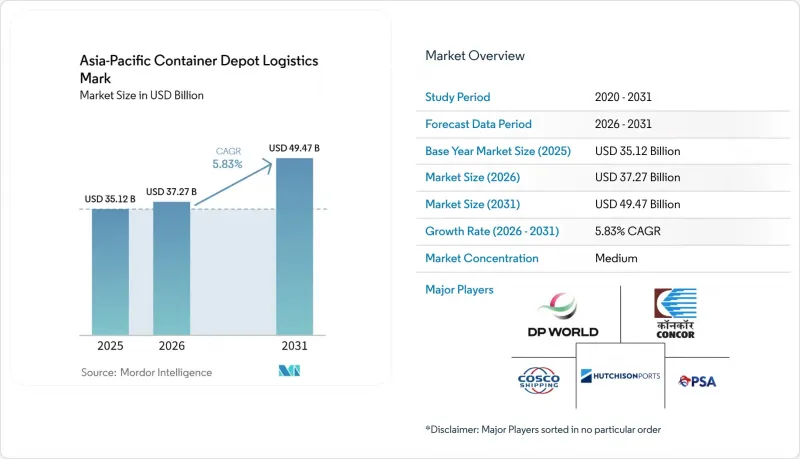
Mordor Intelligence에 의하면, 아시아태평양 컨테이너 디포 물류 시장 규모는 2025년에 351억 2,000만 달러로 평가되었고, 2026년에는 372억 7,000만 달러로 추정되고, 2031년까지 494억 7,000만 달러에 이를 것으로 예측되며, 2026-2031년 CAGR은 5.83%를 나타낼 전망입니다.
또한, 생산 활동이 베트남, 인도, 인도네시아로 확대됨에 따라 화물은 기존 수출 거점에 집중되지 않고, 보다 광범위한 내륙 및 연안 운송 경로를 통해 이동하고 있습니다. 본 보고서는 디포 유형별(내륙 컨테이너 디포, 빈 컨테이너 디포, 기타), 서비스 유형별(컨테이너 보관 서비스, 컨테이너 취급 서비스, 기타), 컨테이너 유형별(드라이 컨테이너, 냉장 컨테이너), 무역 지향별(국제/환적, 국내), 국가별(중국, 일본, 인도, 호주, 인도네시아, 싱가포르, 베트남, 태국, 기타)로 분류되어 있습니다. 시장 전망은 금액(달러) 기준으로 제시되어 있습니다.
아시아태평양의 컨테이너 디포 물류 시장 동향 및 인사이트
수출 주도형 허브에서의 컨테이너 재배치 수요 증가
아시아태평양의 컨테이너 흐름은 여전히 불균형하며, 수출이 활발한 지역에서는 빈 컨테이너에 대한 보다 신속한 접근이 계속해서 요구되고 있습니다. 2026년 초, 유럽의 디포 이용률이 90%를 초과함에 따라 해운사들은 컨테이너를 유럽에서 중국과 동남아시아로 되돌리고 있었습니다. 이러한 움직임으로 인해 베트남, 인도, 한국의 빈 컨테이너 디포에서 분류, 검사, 수리, 스테이징 작업이 증가하고 있습니다. 아시아태평양의 컨테이너 디포 물류 시장은 이러한 움직임의 혜택을 받고 있습니다. 빈 컨테이너의 재배치는 단순한 지원 업무가 아니라, 오프독 야드(off-dock yard)에 있어 직접적인 수익원이 되고 있기 때문입니다. 또한 해운사들은 컨테이너 식별이 신속하고, 야드 관리가 체계적이며, 턴어라운드 타임이 짧은 디포 파트너를 더욱 중요하게 여기고 있습니다.
내륙 드라이 포트 및 ICD 네트워크의 확대
내륙 드라이 포트와 ICD의 확충은 아시아태평양 컨테이너 디포 물류 시장에 있어 여전히 가장 뚜렷한 성장 동력 중 하나입니다. CONCOR는 인도 국내에 68개의 터미널을 보유하고 사업 거점을 190곳 이상으로 확대한 데 이어, 다르파트푸르, 캄푸르 물류 단지, 카다콜라에서 새로운 시설의 가동을 시작했습니다. 베트남은 카이멩과 탄칸 모크바이를 포함한 19개의 ICD를 계획 목록으로 승인했으며, 방글라데시는 외부 자본을 유치하기 위해 ICD 시설에 대한 외국인 소유 제한을 철폐했습니다. 중국도 2026-2030년까지의 복합운송 실행 계획을 수립하여, 대규모 물류 단지에 철도 부선을 직접 연결하고 내륙 지역으로의 철도·해상 연계 강화를 요구하고 있습니다. 통관 절차와 부가가치 업무가 내륙으로 이전됨에 따라, 게이트웨이 항구는 컨테이너 화물 터미널 및 야드 가격 책정에서 예전만큼의 주도권을 잃어가고 있습니다.
주요 회랑 인근의 디포 부지 부족과 비용 상승
주요 항만 및 산업 회랑 인근의 디포 적지는 이 지역 전체에서 여전히 제한적입니다. 태국의 동부 경제 회랑에서는 지난 2년 동안 산업용지 가격이 20-30% 상승했으며, 산업단지의 공실률은 6.2%까지 떨어졌습니다. 이와 유사한 압박은 주요 항만 회랑 주변에서도 나타나고 있으며, 사업자들에게는 하드 스탠드 용량, 트럭 접근성, 냉장 컨테이너 및 세척 설비용 공간이 요구되고 있습니다. 이로 인해 신규 시장 진출기업이 이미 기존 토지 보유 기반을 갖춘 기존 사업자의 경제성을 따라잡기 어려워지고 있습니다. 또한 일부 개발업자들은 도시권 외곽으로 진출할 수밖에 없는 상황이지만, 그곳에서는 이동 거리가 길어지고 통행료 부담이 가중되어 서비스 경쟁력이 저하될 가능성이 있습니다.
부문 분석
2025년, 아시아태평양 컨테이너 디포 물류 시장 점유율 중 내륙 컨테이너 디포가 41.13%를 차지했습니다. 이는 대규모 수출 회랑에서 주요 통관 및 철도 인터페이스로서의 역할을 반영한 것입니다. 이러한 위상은 2027년까지 철도 및 해상 복합 운송량을 연평균 15% 확대하겠다는 중국의 노력을 포함한 정책 주도형 복합 운송 투자에 의해 뒷받침되고 있습니다. 컨테이너 화물 터미널은 소량 화물의 집하 및 항만 주변의 단거리 하역을 지원하기 위해 여전히 관문 항구 근처에 중요한 거점을 유지하고 있습니다. 빈 컨테이너 보관소는 설비의 수급 불균형으로 인해 빈 컨테이너 관리가 더욱 대규모화되고 전문적인 업무로 변화함에 따라, 2031년까지 연평균 성장률(CAGR)이 8.69%로 가장 빠르게 성장하는 보관소 유형입니다.
터미널과 가까운 관리형 보관 장소가 필요한 운송업체에게 항만 내 디포는 여전히 중요하지만, 항만 구역 내 지가 급등으로 인해 항만 외(오프독) 대체 시설이 더욱 매력적인 선택지로 떠오르고 있습니다. RSA Global은 JNPA 생태계 내에 인도 최대 규모의 자동화 빈 컨테이너 시설을 258억 루피(3억 500만 달러)를 투자하여 건설할 것이라고 발표했습니다. 이 시설은 월간 5만 TEU 이상을 처리할 수 있는 능력을 갖추고 있습니다. 이 프로젝트에는 자동 창고 시스템(AS/RS), OCR 지원 게이트, 디지털 야드 관리가 포함되어 있어, 자본이 보다 고효율적인 빈 컨테이너 야드로 이동하고 있음을 보여줍니다. 수출 지향형 제조업이 확대되고 수작업에 의존하는 야드가 더욱 치열한 회전율 압박에 직면함에 따라, 베트남이나 인도네시아에서도 유사한 운영 모델이 더 빈번하게 나타날 것으로 예측됩니다.
2025년, 컨테이너 보관 서비스는 아시아태평양 컨테이너 디포 물류 시장 규모의 33.94%를 차지했으며, 최대 서비스 부문이 되었습니다. 이러한 선두 위상은 지속적인 무역 불균형, 혼잡한 거점에서의 체류 주기 장기화, 일정 유연성을 추구하는 화주들의 재고 완충 장치 활용 확대에 기인합니다. 컨테이너 유지보수 및 수리 서비스는 검사 요건의 엄격화와 전 세계 컨테이너 선단의 노후화를 배경으로, 2031년 연평균 성장률(CAGR)이 9.84%에 달하고, 가장 빠르게 성장하는 서비스 유형입니다. 컨테이너 취급 서비스는 여전히 주요 수익원이지만, 표준화가 진행됨에 따라 규모 확대와 야드 생산성 향상에 대한 압박이 커지고 있습니다.
세척 및 세탁 서비스는 일부 지역에서 여전히 물 접근성 및 배수 규정 준수가 실무상의 제약 요인으로 작용하고 있어 성장 속도가 둔화되고 있습니다. 보세 창고, 크로스 도킹, 라벨 재부착, 컨테이너 개조 등 기타 부가가치 물류 서비스는 디포 운영 사업자가 단일 부지 내에서 화물 취급을 더 많이 유지하려고 노력함에 따라 그 중요성이 커지고 있습니다. 유센 로지스틱스가 빈즈온에서 진행한 냉장 창고 확장은 보관, 온도 관리, 지원 물류 기능을 한 곳에 통합한 서비스 패키지를 고객이 점점 더 중요하게 여기고 있음을 보여줍니다. 따라서 아시아태평양의 컨테이너 디포 물류 시장은 단순한 야드 운영에서 벗어나 보다 광범위한 서비스 플랫폼으로 전환되고 있습니다.
기타 혜택
- 엑셀 형식 시장 예측(ME) 시트
- 3개월간의 애널리스트 지원
목차
제1장 서론
제2장 조사 방법
제3장 주요 요약
제4장 시장 구도
제5장 시장 규모 및 성장 예측(금액, 2026-2031년)
제6장 경쟁 구도
제7장 시장 기회 및 향후 전망
AJYAccording to Mordor Intelligence, the Asia-Pacific container depot logistics market size was valued at USD 35.12 billion in 2025 and is forecast to reach USD 37.27 billion in 2026 and USD 49.47 billion by 2031 at 5.83% CAGR over 2026-2031.
Production is also spreading to Vietnam, India, and Indonesia, so cargo is moving across a wider set of inland and coastal corridors rather than remaining concentrated in older export centers. This report is Segmented by Depot Type, (inland Container Depots, Empty Container Depots, and More), by Service Type (Storage, Handling, and More), by Container Type (Dry and Reefer), by Trade Orientation (International and Domestic), and by Country (China, Japan, India, Australia, Indonesia, Singapore, Vietnam, Thailand, and More). The Market Forecasts are Provided in Terms of Value (USD).
Asia-Pacific Container Depot Logistics Market Trends and Insights
Rising Container Repositioning Needs Across Export-Led Hubs
Container flows across the Asia-Pacific region remain uneven, and export-heavy locations continue to need faster access to empty boxes. In early 2026, carriers were moving equipment back from Europe to China and Southeast Asia after depot utilization in Europe exceeded 90%. That movement increases sorting, inspection, repair, and staging work at empty container depots in Vietnam, India, and South Korea. The Asia-Pacific container depot logistics market benefits from this, as empty repositioning has become a direct operating line for off-dock yards rather than just a support task. Shipping lines are also placing more value on depot partners that can show faster box identification, cleaner yard discipline, and shorter turnaround times.
Expansion of Inland Dry Port and ICD Networks
The build-out of inland dry ports and ICDs remains one of the clearest supports for the Asia-Pacific container depot logistics market. CONCOR expanded its logistics footprint to more than 190 locations with 68 terminals in India, while new facilities were commissioned at Dalpatpur, Kanpur Logistics Park, and Kadakola. Vietnam approved 19 ICDs in its planning list, including Cai Mep and Tan Cang-Moc Bai, and Bangladesh removed foreign ownership caps on ICD facilities to attract outside capital. China also set out a multimodal action plan for 2026-2030 that calls for direct rail siding access at large logistics parks and stronger rail-sea links into inland zones. As more customs clearance and value-added work moves inland, gateway ports lose some of their earlier hold on container freight station and yard pricing.
Scarcity And Cost Inflation Of Depot-Grade Land Near Major Corridors
Depot-grade land near major ports and industrial corridors remains limited across the region. Thailand's Eastern Economic Corridor saw industrial land prices rise by 20-30% over the past 2 years, and vacancy in industrial estates fell to 6.2%. Similar pressure is visible around primary port corridors where operators need hardstand capacity, truck access, and room for reefer or wash support. This makes it harder for new entrants to match the economics of incumbents that already hold legacy land banks. It also pushes some developers toward outer-metro sites, where longer travel distances and toll costs can erode service competitiveness.
Other drivers and restraints analyzed in the detailed report include:
- Growth in Reefer Throughput and Temperature-Controlled Cargo Handling
- Port Congestion Deflection Into Off-Dock and Inland Depots
- Manual Operations And Low Interoperability Across Depot IT Systems
For complete list of drivers and restraints, kindly check the Table Of Contents.
Segment Analysis
Inland container depots accounted for 41.13% of the Asia-Pacific container depot logistics market share in 2025, reflecting their role as the main customs and rail interface across large export corridors. Their position is supported by policy-led multimodal investment, including China's push to expand rail-sea intermodal volumes by 15% a year through 2027. Container freight stations still have an important base near gateway ports because they support less-than-container-load consolidation and short-distance port-side handling. Empty container depots are the fastest-growing depot type, with a 8.69% CAGR through 2031, as equipment imbalance is turning empty box management into a larger and more specialized activity.
Port-based depots still matter for carriers that need controlled storage close to terminals, but higher land costs inside port areas are making off-dock alternatives more attractive. RSA Global announced India's largest automated empty container facility in the JNPA ecosystem with an INR 2,580 crore (USD 305 million) investment, and capacity to handle more than 50,000 TEUs a month. The project includes an automated storage and retrieval system, OCR-enabled gates, and digital yard management, which shows how capital is moving toward higher-efficiency empty yards. Similar operating models are likely to appear more often in Vietnam and Indonesia as export-oriented manufacturing spreads and manual yards face heavier turnaround pressure.
Container storage services accounted for 33.94% of the Asia-Pacific container depot logistics market size in 2025, making them the largest service line. The lead position came from persistent trade imbalances, longer dwell cycles at busy nodes, and wider use of inventory buffers by shippers seeking greater schedule flexibility. Container maintenance and repair services are the fastest-growing service type, with a 9.84% CAGR through 2031, driven by stricter inspection requirements and an aging global container fleet. Container handling services still represent a major revenue stream, but they are becoming more standardized, putting greater pressure on scale and yard productivity.
Cleaning and washing services are growing more slowly because access to water and compliance with wastewater regulations remain practical constraints in several locations. Other value-added logistics services, including bonded warehousing, cross-docking, relabeling, and container modification, are gaining importance as depot operators try to keep more cargo activity inside a single site. Yusen Logistics' cold storage expansion in Binh Duong showed how customers increasingly value service bundles that combine storage, temperature control, and supporting logistics functions in one place. The Asia-Pacific container depot logistics industry is therefore moving toward broader service platforms rather than stand-alone yard operations.
Complete Report Scope:
- By Depot Type
- Inland Container Depots (ICDs)
- Container Freight Stations (CFS)
- Empty Container Depots (ECDs)
- Port-Based Container Depots
- By Service Type
- Container Storage Services
- Container Handling Services
- Container Maintenance and Repair (M&R) Services
- Container Cleaning & Washing Services
- Other Value-Added Logistics Services
- By Container Type
- Dry Containers
- Reefer Containers
- By Trade Orientation
- International/Transshipment Container Handling
- Domestic Container Movement
- By Country
- China
- Japan
- India
- South Korea
- Australia
- Indonesia
- Singapore
- Vietnam
- Thailand
- Rest of Asia-Pacific
List of Companies Covered in this Report:
- DP World
- PSA International
- Hutchison Ports
- China COSCO Shipping Ports Limited
- Container Corporation of India Limited
- Yusen Logistics Co., Ltd.
- Nippon Express Holdings, Inc.
- Qube Holdings Limited
- Adani Ports and Special Economic Zone Limited
- Sumitomo Warehouse Co., Ltd.
- Kamigumi Co., Ltd.
- Gulftainer Company Limited
- APM Terminals
- China Merchants Port Holdings
- International Container Terminal Services Inc. (ICTSI)
- Kintetsu World Express (KWE)
- SITC Logistics
- Gemadept Corporation
- Hind Terminals Pvt. Ltd.
- Arshiya Ltd.
- Associated Container Terminals Ltd. (ACTL)
- Flinders Port Holdings
Additional Benefits:
- The market estimate (ME) sheet in Excel format
- 3 months of analyst support
TABLE OF CONTENTS
1 Introduction
- 1.1 Study Assumptions and Market Definition
- 1.2 Scope of the Study
2 Research Methodology
3 Executive Summary
4 Market Landscape
- 4.1 Market Overview and Importance of Container Depot Logistics
- 4.2 Market Drivers
- 4.2.1 Rising Container Repositioning Needs Across Export-Led Hubs
- 4.2.2 Expansion of Inland Dry Port and ICD Networks
- 4.2.3 Growth in Reefer Throughput and Temperature-Controlled Cargo Handling
- 4.2.4 Shift Toward Digital Yard Visibility and Asset Tracking
- 4.2.5 Port Congestion Deflection Into Off-Dock and Inland Depots
- 4.2.6 Demand for Bonded, Free-Trade-Zone Linked Value-Added Services
- 4.3 Market Restraints
- 4.3.1 Scarcity and Cost Inflation of Depot-Grade Land Near Major Corridors
- 4.3.2 Manual Operations and Low Interoperability Across Depot IT Systems
- 4.3.3 Uneven Customs Digitization Slowing Cross-Border Container Release
- 4.3.4 Power Reliability and Water Constraints for Wash and Reefer Support Operations
- 4.4 Regulatory Framework
- 4.5 Value Chain and Distribution Channel Architecture Analysis
- 4.6 Technology Innovations Outlook
- 4.7 Porter's Five Forces Analysis
- 4.7.1 Threat of New Entrants
- 4.7.2 Bargaining Power of Suppliers
- 4.7.3 Bargaining Power of Buyers
- 4.7.4 Threat of Substitutes
- 4.7.5 Rivalry Among Competitors
- 4.8 Container Throughput Trends
- 4.9 Import-Export Trade Analysis
- 4.10 Port and Terminal Infrastructure Analysis
- 4.11 Sustainability and ESG Analysis
- 4.12 Evolution of Container Depot Logistics Market
- 4.13 Impact of Geo-Political Events on Supply Chain Shifts
5 Market Size and Growth Forecasts (Value, 2026-2031)
- 5.1 By Depot Type
- 5.1.1 Inland Container Depots (ICDs)
- 5.1.2 Container Freight Stations (CFS)
- 5.1.3 Empty Container Depots (ECDs)
- 5.1.4 Port-Based Container Depots
- 5.2 By Service Type
- 5.2.1 Container Storage Services
- 5.2.2 Container Handling Services
- 5.2.3 Container Maintenance and Repair (M&R) Services
- 5.2.4 Container Cleaning & Washing Services
- 5.2.5 Other Value-Added Logistics Services
- 5.3 By Container Type
- 5.3.1 Dry Containers
- 5.3.2 Reefer Containers
- 5.4 By Trade Orientation
- 5.4.1 International/Transshipment Container Handling
- 5.4.2 Domestic Container Movement
- 5.5 By Country
- 5.5.1 China
- 5.5.2 Japan
- 5.5.3 India
- 5.5.4 South Korea
- 5.5.5 Australia
- 5.5.6 Indonesia
- 5.5.7 Singapore
- 5.5.8 Vietnam
- 5.5.9 Thailand
- 5.5.10 Rest of Asia-Pacific
6 Competitive Landscape
- 6.1 Market Concentration
- 6.2 Key Strategic Moves
- 6.3 Market Share Analysis
- 6.4 Company Profiles (includes Global level Overview, Market level overview, Core Segments, Financials as available, Strategic Information, Market Rank/Share for key companies, Products & Services, and Recent Developments)
- 6.4.1 DP World
- 6.4.2 PSA International
- 6.4.3 Hutchison Ports
- 6.4.4 China COSCO Shipping Ports Limited
- 6.4.5 Container Corporation of India Limited
- 6.4.6 Yusen Logistics Co., Ltd.
- 6.4.7 Nippon Express Holdings, Inc.
- 6.4.8 Qube Holdings Limited
- 6.4.9 Adani Ports and Special Economic Zone Limited
- 6.4.10 Sumitomo Warehouse Co., Ltd.
- 6.4.11 Kamigumi Co., Ltd.
- 6.4.12 Gulftainer Company Limited
- 6.4.13 APM Terminals
- 6.4.14 China Merchants Port Holdings
- 6.4.15 International Container Terminal Services Inc. (ICTSI)
- 6.4.16 Kintetsu World Express (KWE)
- 6.4.17 SITC Logistics
- 6.4.18 Gemadept Corporation
- 6.4.19 Hind Terminals Pvt. Ltd.
- 6.4.20 Arshiya Ltd.
- 6.4.21 Associated Container Terminals Ltd. (ACTL)
- 6.4.22 Flinders Port Holdings
7 Market Opportunities and Future Outlook
- 7.1 White-space and Unmet-Need Assessment