|
시장보고서
상품코드
2118125
글리시딜 메타크릴레이트 시장 : 시장 점유율 분석, 업계 동향 및 통계, 성장 예측(2026-2031년)Glycidyl Methacrylate - Market Share Analysis, Industry Trends & Statistics, Growth Forecasts (2026 - 2031) |
||||||
 Mordor Intelligence
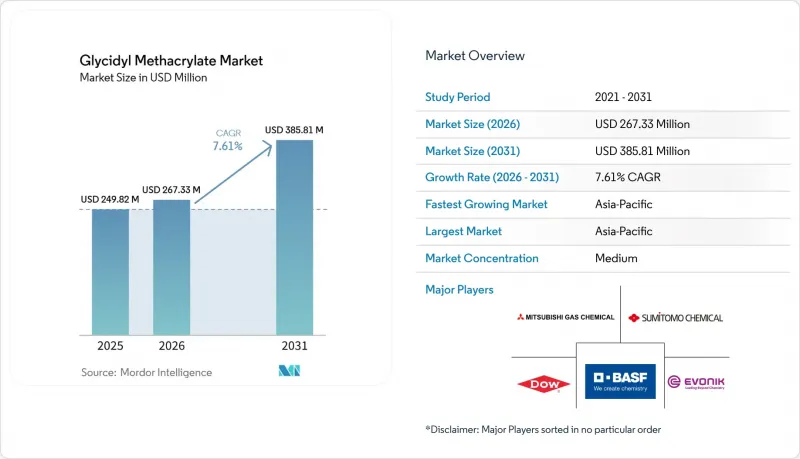
Mordor Intelligence에 의하면, 글리시딜 메타크릴레이트 시장 규모는 2025년에 2억 4,982만 달러로 평가되었고, 2026년 2억 6,733만 달러에서 2031년까지 3억 8,581만 달러에 이를 것으로 추정되며, 2026-2031년 예측 기간에서 CAGR은 7.61%를 나타낼 전망입니다.
본 보고서는 순도별(순도 97% 미만 및 순도 97% 이상), 용도별(접착제, 코팅 등), 제조 공정별(에스테르화 등), 최종 사용자 산업별(자동차, 건설 등), 지역별(아시아태평양, 북미, 유럽, 남미, 중동 및 아프리카)로 분류되어 있습니다. 시장 예측은 금액(달러) 기준으로 제시되어 있습니다.
세계의 글리시딜 메타크릴레이트 시장 동향 및 인사이트
고성능 접착 촉진제 및 기능성 모노머에 대한 수요 증가
글리시딜 메타크릴레이트는 본래 상용성이 없는 폴리머 매트릭스 사이에 공유 결합을 형성합니다. 이러한 특성으로 인해 고성능 접착제 및 코팅 제제에서 반응성 상용화제로 활용될 수 있습니다. UV 경화형 및 분체 도장 시스템에서는 이 물질의 에폭사이드 개환 반응성을 활용하여 상온 경화 조건에서 가교 밀도를 높이고 있습니다. 유럽 및 북미의 저휘발성 유기 화합물(VOC) 규제로 인해, 규제 준수와 기능적 성능을 모두 충족하는 시스템에 대한 필요성이 더욱 높아지고 있습니다. 안정적인 억제제 배합을 유지하고 있는 제조업체는 적시 생산(JIT)을 지원하고, 배합 제조업체와의 장기적인 공급 계약을 확보할 수 있습니다. 또한, 선박, 화학 처리, 인프라 유지 관리용 코팅에서도 가혹한 노출 조건 하에서 금속 표면에 대한 밀착성이 필수적인 상황에서 신뢰성 높은 성능을 발휘합니다.
고성능 코팅 및 접착제 분야에서 글리시딜 메타크릴레이트의 채택 확대
글리시딜 메타크릴레이트 시장에서 코팅은 여전히 중요한 용도 분야입니다. 이 모노머는 자동차, 산업, 건축 용도에서 접착력, 내화학성 및 내구성을 향상시키기 때문입니다. UV 경화형 및 수성 코팅 분야에서 글리시딜 메타크릴레이트에 대한 수요는 북미 및 유럽의 VOC 규제 준수 요건에 힘입어 증가하고 있습니다. GMA(글리시딜 메타크릴레이트)를 기능화한 실란트는 구조적 접착, 전기 절연 및 열 사이클 내성을 동시에 실현해야 하는 EV 배터리 모듈 조립을 위해 인증 절차가 진행 중입니다. 이러한 시스템은 -40°C에서 120°C의 온도 범위에서 작동하며, 금속 이온 함량이 극히 낮은 고순도 등급이 필요합니다. 이러한 요구 사항으로 인해 산업용 등급 공급업체로는 대응하기 어려울 수 있는 프리미엄 카테고리가 생겨나고 있습니다. 또한, 배합 설계자들은 알루미늄, 탄소섬유 강화 폴리머 및 엔지니어링 열가소성 수지의 접합부를 위한 구조용 접착제에서 GMA를 반응성 희석제로 사용하고 있습니다.
유해 화학물질로 분류됨에 따른 엄격한 취급, 보관 및 운송 요건
국제암연구소(IARC)는 2019년 GMA를 ‘인간에게 발암 가능성이 높은 물질(그룹 2A)’로 분류했습니다. 이 분류와 EU 규제로 인해 제조, 유통 및 최종 용도에 걸친 운영상의 의무가 발생하고 있습니다. 미국의 유해 물질 정보 전달 기준은 2024년에 개정되어, 업데이트된 GHS(세계 조화 시스템)의 틀을 반영한 유해성 정보 전달이 의무화되었습니다. 8시간 시간 가중 평균을 기준으로 한 유럽의 직업적 노출 한계치 0.016 ppm은 중국의 국가 기준치인 5 mg/m3와는 다릅니다. 이러한 기준을 더욱 조화시키기 위해서는 중국 시설에서 환기, 밀폐 및 취급 관리에 대한 투자가 필요합니다. 운송 인증, 20°C 이하로 온도가 관리되는 보관, 그리고 억제제 관리는 소규모 배합 업체에게 비용 증가로 이어집니다.
부문 분석
2025년, 글리시딜 메타크릴레이트 시장에서 순도 97% 이상 등급이 시장 가치의 79.21%를 차지한 것으로 평가되었으며, 2031년까지 연평균 성장률(CAGR) 8.03%로 성장할 것으로 전망됩니다. 이러한 위상은 주요 용도 전반에 걸쳐 폴리머의 품질 요건이 엄격해지고 있음을 반영합니다. 코팅 및 접착제 배합 제조업체들은 UV 경화형 시스템에서 일관된 경화 거동을 확보하고 황변을 줄이기 위해 이 등급을 사용하고 있습니다. 전자 및 헬스케어 분야의 용도에서는 금속 이온 함량이 극히 낮아야 하므로, 순도가 낮은 소재는 인증 대상에서 제외될 가능성이 있습니다. 그 결과, 이전에는 더 폭넓은 사양이 허용되던 용도에서도 고순도 제품으로의 광범위한 전환이 진행되고 있습니다.
순도 97% 이상의 글리시딜 메타크릴레이트 시장 역시 확대되는 전자 및 제약 용도에 힘입어 성장하고 있습니다. 순도 97% 미만의 소재에 대한 수요는 가격 민감도가 높은 일반 산업용 코팅, 인쇄 잉크 및 표준 폴리머 개질 분야에서 여전히 중요한 위치를 차지하고 있습니다. 산동성과 장쑤성의 생산자들은 주로 이러한 산업용 등급 수요를 충족시키고 있습니다. 프리미엄 등급 공급을 목표로 하는 공급업체에게는 분별 증류, 억제제 관리 및 상세한 품질 문서가 요구됩니다. 이러한 투자에는 전자 및 자동차 업계 고객과의 인증 기간도 필요합니다. 이러한 격차로 인해 아시아태평양(APAC)이 대량 공급을 담당하는 반면, 북미 및 유럽의 전문 업체들은 인증되고 추적 가능한 소재에 대해 프리미엄 가격을 받고 있다는 지리적 경향이 강화되고 있습니다.
2025년에는 코팅이 매출의 33.72%를 차지했으며, 글리시딜 메타크릴레이트 시장에서 가장 큰 용도가 되었습니다. 자동차용 탑코트, 산업용 유지보수 코팅 및 건설용 처리제는 다양한 기판에 대한 접착력과 내후성에 의존합니다. 휘발성 유기 화합물(VOC) 배출 규제로 인해 무용제 경화가 촉진됨에 따라 UV 경화형 코팅 시스템이 급속히 발전하고 있습니다. 접착제는 자동차 경량화로 인해 구조용 접착 수요가 증가함에 따라 두 번째로 큰 용도가 되었습니다. GMA 관능기화 실란트는 단일 배합으로 구조적, 유전적, 열적 특성이 필요한 전기차(EV)용 배터리 모듈에도 사용되고 있습니다.
플라스틱 및 폴리머 개질 분야는 2031년까지 연평균 성장률(CAGR) 8.28%를 나타낼 것으로 예측되며, 이는 각 용도 중 가장 높은 성장률입니다. GMA는 전체 글리시딜 메타크릴레이트 시장에서 엔지니어링 열가소성 수지 및 바이오 폴리머의 보강재에 반응성 상용화제로 사용되고 있습니다. 2025년 연구에 따르면, GMA를 그래프트화한 폴리유산(PLA)은 개질되지 않은 천연섬유 복합재료에 비해 인장 강도가 440% 이상 향상된 것으로 밝혀졌습니다. 인쇄 잉크는 포장 및 간판 용도에서 안정적인 산업 수요를 창출하고 있습니다. 복합재료와 실란트는 항공우주용 적층 재료나 전기차(EV) 배터리 시스템과 같이 규모는 작지만 고품질이 요구되는 용도에 사용되고 있습니다. 치과용 재료, 진단약, 약물 전달 시스템은 고품질 공급업체를 대상으로 하는 정밀 폴리머 용도로 발전하고 있는 분야입니다.
지역별 분석
아시아태평양은 2025년에 글리시딜 메타크릴레이트 시장 점유율의 35.72%를 차지한 것으로 평가되었으며, 2031년까지 연평균 성장률(CAGR) 8.17%를 나타낼 것으로 전망됩니다. 중국은 산동성과 장쑤성의 제조 클러스터에 힘입어 해당 지역 공급의 대부분을 차지하고 있습니다. 자체 생산한 에피클로로히드린에 대한 접근성을 통해 현지 생산자들은 수입에 의존하는 경쟁사들에 비해 비용 면에서 우위를 확보하고 있습니다. 롄클라우드 항닝강 화학은 후방 통합을 통해 산업용 등급 공급을 뒷받침하고 있습니다. 일본과 한국은 전자기기 제조에 사용되는 고순도 소재 수요의 대부분을 차지하고 있습니다.
미쓰비시 가스 화학 및 일본 촉매를 비롯한 일본 생산자들은 웨이퍼 제조용 조달 고순도 글리시딜 메타크릴레이트의 제조 인증을 획득했습니다. 한국의 전자기기 제조업체들은 상세한 문서와 금속 이온의 추적성을 요구하고 있어 공급업체를 변경하기 어렵습니다. 인도에서는 자동차 조립 거점의 확대와 특수 화학물질에 대한 우대 조치로 인해, 이전에는 주로 중국산 수입에 의존하던 국내 소비가 증가하고 있습니다. 중국의 직업적 노출 한계치인 5 mg/m3는 여전히 유럽 기준을 상회하고 있어, 더 엄격한 기준을 충족하기 위해서는 시설의 대대적인 개조가 필요할 가능성이 있습니다. 이로 인해 규정 준수 대책을 위한 자금 조달 능력을 갖춘 대규모 시설이 유리해지며, 국내 생산자 간의 통합이 진행될 가능성이 있습니다.
북미는 2025년에 2위 규모에 달했으며, 이는 미국 내 도료, 접착제, 복합재료에 대한 수요와 더불어 다우(Dow)사의 제조 및 유통 규모에 힘입은 것입니다. 2024년에 개정된 ‘유해물질 정보 전달 기준’ 및 ‘유해물질 규제법(TSCA)’에 기반한 미국의 취급 요건은 확립된 규정 준수 체계를 갖춘 공급업체를 우대하는 것입니다. 에스트론 케미컬(Estron Chemical)은 이 지역에서 자외선/전자빔(UV/EB) 경화형 및 저휘발성 유기화합물(VOC) 함유 코팅 배합에 주력하고 있습니다. 유럽은 독일, 프랑스, 영국을 중심으로 사업을 전개하고 있으며, 이들 국가에서는 자동차용 도료 및 구조용 접착제 분야에서 고순도 소재가 표준으로 자리 잡고 있습니다. 남미, 중동 및 아프리카는 여전히 소규모 시장이지만, 건설, 자동차 조립, 석유 및 가스, 광업, 석유화학 분야 수요가 있으며, 수입 의존도가 높아 리드타임 관련 리스크가 발생하고 있습니다.
기타 특전 :
- 엑셀 형식 시장 예측(ME) 시트
- 3개월간 애널리스트 지원
자주 묻는 질문
목차
제1장 서론
제2장 조사 방법
제3장 개요
제4장 시장 구도
제5장 시장 규모 및 성장 예측
제6장 경쟁 구도
제7장 시장 기회 및 향후 전망
AJY 26.09.01According to Mordor Intelligence, the glycidyl methacrylate market size was valued at USD 249.82 million in 2025 and is estimated to grow from USD 267.33 million in 2026 to reach USD 385.81 million by 2031, at a CAGR of 7.61% during the forecast period 2026-2031.
This report is Segmented by Purity (Purity Less Than 97% and Purity Greater Than or Equal To 97%), Application (Adhesives, Coatings, and More), Manufacturing Process (Esterification and More), End-User Industry (Automotive, Construction, and More), and Geography (Asia-Pacific, North America, Europe, South America, and Middle-East and Africa). The Market Forecasts are Provided in Terms of Value (USD).
Global Glycidyl Methacrylate Market Trends and Insights
Growing Demand for High-Performance Adhesion Promoters and Functional Monomers
Glycidyl methacrylate provides covalent bonding between otherwise incompatible polymer matrices. This property supports its use as a reactive compatibilizer in high-performance adhesives and coating formulations. UV-curable and powder coating systems utilize the material's epoxide ring-opening reactivity to build crosslink density under ambient curing conditions. Low-Volatile Organic Compound (VOC) regulations in Europe and North America strengthen the case for systems that combine regulatory compliance with functional performance. Producers that maintain stable inhibitor packages can support just-in-time manufacturing and secure longer supply arrangements with formulators. Marine, chemical-processing, and infrastructure-maintenance coatings also offer dependable performance where adhesion to metal surfaces under severe exposure conditions is essential.
Increasing Adoption of Glycidyl Methacrylate in High-Performance Coatings and Adhesives
Coatings remain an important application segment for the glycidyl methacrylate market, as the monomer improves adhesion, chemical resistance, and durability in automotive, industrial, and architectural applications. Demand for glycidyl methacrylate in UV-curable and waterborne coatings is supported by VOC compliance requirements in North America and Europe. GMA-functionalized sealants are being qualified for EV battery module assembly, where structural bonding, electrical insulation, and thermal cycling resistance must be delivered together. These systems operate over a temperature range of -40°C to 120°C and require high-purity grades with very low metal-ion content. This requirement creates a premium category that industrial-grade suppliers may not be able to serve. Formulators also use GMA as a reactive diluent in structural adhesives for aluminum, carbon-fiber-reinforced polymer, and engineering thermoplastic joints.
Stringent Handling, Storage, and Transportation Requirements Due to Hazardous Chemical Classification
The International Agency for Research on Cancer classified GMA as probably carcinogenic to humans (Group 2A) in 2019. This classification, along with EU restrictions, creates operational obligations across manufacturing, distribution, and end use. The U.S. Hazard Communication Standard was revised in 2024 to require hazard communication that reflects the updated GHS framework. The European occupational exposure limit of 0.016 ppm, based on an 8-hour time-weighted average, differs from China's national value of 5 mg/m3. A move toward closer alignment would require Chinese facilities to invest in ventilation, enclosure, and handling controls. Transport certification, temperature-controlled storage below 20°C, and inhibitor management raise costs for smaller formulators.
Other drivers and restraints analyzed in the detailed report include:
- Growing Demand for Lightweight and High-Performance Materials in the Automotive Industry
- Expanding Application in Functional Polymers, Composite Materials, and Specialty Resins
- Volatility in Raw Material Prices for Methacrylate-Based Feedstocks
For complete list of drivers and restraints, kindly check the Table Of Contents.
Segment Analysis
The purity greater than or equal to 97% grade captured 79.21% of value in the glycidyl methacrylate market in 2025 and is expected to grow at an 8.03% CAGR through 2031. Its position reflects tighter polymer-quality requirements across major applications. Coating and adhesive formulators use this grade to support consistent cure behavior and reduce yellowing in UV-curable systems. Electronics and healthcare applications require very low levels of metal ions, which can exclude lower-purity materials from qualification. The result is a broad shift toward high-purity supply, even in applications that previously accepted wider specifications.
The glycidyl methacrylate market for the greater than or equal to 97% grade is also supported by expanding electronics and pharmaceutical applications. Demand for material below 97% remains relevant for general industrial coatings, printing inks, and standard polymer modification, where cost sensitivity is high. Producers in Shandong and Jiangsu primarily supply these industrial-grade requirements. Suppliers seeking the premium tier require fractional distillation, inhibitor controls, and detailed quality documentation. These investments also require qualification periods with electronics and automotive customers. This gap reinforces a geographic pattern in which APAC supplies volume while North American and European specialists receive premiums for certified, traceable material.
Coatings held 33.72% of revenue in 2025, making them the largest application in the glycidyl methacrylate market. Automotive topcoats, industrial maintenance coatings, and construction treatments rely on adhesion to different substrates and weathering resistance. UV-curable coating systems are developing rapidly as restrictions on Volatile Organic Compound (VOC) emissions encourage solvent-free curing. Adhesives were the second largest application, as vehicle lightweighting increased demand for structural bonding. GMA-functionalized sealants also serve Electric Vehicle (EV) battery modules that require structural, dielectric, and thermal properties in a single formulation.
Plastics and polymer modification are forecast to grow at an 8.28% CAGR through 2031, the highest rate among applications. GMA is used across the glycidyl methacrylate market as a reactive compatibilizer in engineering thermoplastics and biopolymer reinforcement. A 2025 study found that GMA-grafted polylactic acid (PLA) increased tensile strength by more than 440% compared with unmodified natural-fiber composites. Printing inks provide stable industrial demand from packaging and signage applications. Composites and sealants serve smaller, premium applications in aerospace laminates and EV battery systems. Dental materials, diagnostics, and drug-delivery systems form a developing group of precision polymer applications for high-grade suppliers.
Complete Report Scope:
- By Purity
- Purity less than 97%
- Purity greater than or equal to 97%
- By Application
- Adhesives
- Coatings
- Plastics and Polymer Modification
- Composites
- Printing Inks
- Sealants
- Other Applications
- By Manufacturing Process
- Esterification
- Transesterification
- By End-user Industry
- Automotive
- Construction
- Electronics
- Aerospace
- Healthcare
- Other End Uses
- By Geography
- Asia-Pacific
- China
- India
- Japan
- South Korea
- Rest of Asia-Pacific
- North America
- United States
- Canada
- Mexico
- Europe
- Germany
- United Kingdom
- France
- Italy
- Russia
- Rest of Europe
- South America
- Brazil
- Argentina
- Rest of South America
- Middle-East and Africa
- Saudi Arabia
- South Africa
- Rest of Middle-East and Africa
- Asia-Pacific
Geography Analysis
Asia-Pacific is expected to hold 35.72% of the glycidyl methacrylate market share in 2025 and is forecast to register an 8.17% CAGR through 2031. China accounts for much of the region's supply, supported by manufacturing clusters in Shandong and Jiangsu. Access to captive epichlorohydrin gives local producers a cost advantage over import-dependent competitors. Lianyungang Ningkang Chemical supports industrial-grade supply through backward integration. Japan and South Korea account for the bulk of demand for high-purity materials used in electronics fabrication.
Japanese producers, including Mitsubishi Gas Chemical and Nippon Shokubai, have qualified to produce high-purity glycidyl methacrylate for procurement in wafer fabrication. South Korean electronics customers require detailed documentation and metal-ion traceability, making supplier replacement difficult. India's expanding automotive assembly base and specialty-chemical incentive programs are increasing domestic consumption that previously relied mainly on Chinese imports. China's occupational exposure limit of 5 mg/m3 remains above the European benchmark, and stricter alignment could require significant facility upgrades. This would favor larger facilities capable of funding compliance work and could support consolidation among domestic producers.
North America was the second-largest region in 2025, supported by U.S. demand for coatings, adhesives, and composites, as well as Dow's manufacturing and distribution scale. U.S. handling requirements under the revised 2024 Hazard Communication Standard and Toxic Substances Control Act (TSCA) oversight favor suppliers with established compliance systems. Estron Chemical focuses on ultraviolet/electron beam (UV/EB)-curable and low-volatile organic compound (VOC) coating formulations in the region. Europe is centered on Germany, France, and the United Kingdom, where high-purity material is standard for automotive coatings and structural adhesives. South America, the Middle East, and Africa remain smaller markets, with demand from construction, automotive assembly, oil and gas, mining, and petrochemicals, while reliance on imports raises lead-time risk.
- BASF
- Dow
- Estron Chemical Inc.
- Evonik Industries AG
- Haihang Industry Co., Ltd.
- Hubei Soundny Biotechnology Co., Ltd.
- Hubei Xiansheng Biotechnology Co., Ltd.
- Jindun Chemical Co., Ltd.
- Kowa American Corporation
- Lianyungang Ningkang Chemical Co., Ltd
- MITSUBISHI GAS CHEMICAL COMPANY, INC.
- Nippon Shokubai Co., Ltd.
- Sumitomo Chemical Co., Ltd.
- Weicheng Advanced Material (Shandong) Co., Ltd
- Wuhan Sincere-star Chemical Co., Ltd.
- Zhonglan Industry Co., Ltd.
Additional Benefits:
- The market estimate (ME) sheet in Excel format
- 3 months of analyst support
TABLE OF CONTENTS
1 Introduction
- 1.1 Study Assumptions and Market Definition
- 1.2 Scope of the Study
2 Research Methodology
3 Executive Summary
4 Market Landscape
- 4.1 Market Overview
- 4.2 Market Drivers
- 4.2.1 Growing Demand for High-Performance Adhesion Promoters and Functional Monomers
- 4.2.2 Increasing Adoption of Glycidyl Methacrylate in High-Performance Coatings and Adhesives
- 4.2.3 Growing Demand for Lightweight and High-Performance Materials in the Automotive Industry
- 4.2.4 Expanding Application in Functional Polymers, Composite Materials, and Specialty Resins
- 4.2.5 Increasing Consumption in Durable Industrial Coatings, Inks, and Advanced Composite Systems
- 4.3 Market Restraints
- 4.3.1 Stringent Handling, Storage, and Transportation Requirements Due to Hazardous Chemical Classification
- 4.3.2 Volatility in Raw Material Prices for Methacrylate-Based Feedstocks
- 4.3.3 Stringent Environmental and Occupational Regulations Governing Reactive Monomers and Chemical Emissions
- 4.4 Value Chain Analysis
- 4.5 Porter's Five Forces Analysis
- 4.5.1 Threat of New Entrants
- 4.5.2 Bargaining Power of Suppliers
- 4.5.3 Bargaining Power of Buyers
- 4.5.4 Threat of Substitutes
- 4.5.5 Competitive Rivalry
5 Market Size and Growth Forecasts (Value)
- 5.1 By Purity
- 5.1.1 Purity less than 97%
- 5.1.2 Purity greater than or equal to 97%
- 5.2 By Application
- 5.2.1 Adhesives
- 5.2.2 Coatings
- 5.2.3 Plastics and Polymer Modification
- 5.2.4 Composites
- 5.2.5 Printing Inks
- 5.2.6 Sealants
- 5.2.7 Other Applications
- 5.3 By Manufacturing Process
- 5.3.1 Esterification
- 5.3.2 Transesterification
- 5.4 By End-user Industry
- 5.4.1 Automotive
- 5.4.2 Construction
- 5.4.3 Electronics
- 5.4.4 Aerospace
- 5.4.5 Healthcare
- 5.4.6 Other End Uses
- 5.5 By Geography
- 5.5.1 Asia-Pacific
- 5.5.1.1 China
- 5.5.1.2 India
- 5.5.1.3 Japan
- 5.5.1.4 South Korea
- 5.5.1.5 Rest of Asia-Pacific
- 5.5.2 North America
- 5.5.2.1 United States
- 5.5.2.2 Canada
- 5.5.2.3 Mexico
- 5.5.3 Europe
- 5.5.3.1 Germany
- 5.5.3.2 United Kingdom
- 5.5.3.3 France
- 5.5.3.4 Italy
- 5.5.3.5 Russia
- 5.5.3.6 Rest of Europe
- 5.5.4 South America
- 5.5.4.1 Brazil
- 5.5.4.2 Argentina
- 5.5.4.3 Rest of South America
- 5.5.5 Middle-East and Africa
- 5.5.5.1 Saudi Arabia
- 5.5.5.2 South Africa
- 5.5.5.3 Rest of Middle-East and Africa
- 5.5.1 Asia-Pacific
6 Competitive Landscape
- 6.1 Market Concentration
- 6.2 Strategic Moves
- 6.3 Market Share (%)/Ranking Analysis
- 6.4 Company Profiles (includes Global Overview, Market Overview, Core Segments, Financials as available, Strategic Information, Products and Services, and Recent Developments)
- 6.4.1 BASF
- 6.4.2 Dow
- 6.4.3 Estron Chemical Inc.
- 6.4.4 Evonik Industries AG
- 6.4.5 Haihang Industry Co., Ltd.
- 6.4.6 Hubei Soundny Biotechnology Co., Ltd.
- 6.4.7 Hubei Xiansheng Biotechnology Co., Ltd.
- 6.4.8 Jindun Chemical Co., Ltd.
- 6.4.9 Kowa American Corporation
- 6.4.10 Lianyungang Ningkang Chemical Co., Ltd
- 6.4.11 MITSUBISHI GAS CHEMICAL COMPANY, INC.
- 6.4.12 Nippon Shokubai Co., Ltd.
- 6.4.13 Sumitomo Chemical Co., Ltd.
- 6.4.14 Weicheng Advanced Material (Shandong) Co., Ltd
- 6.4.15 Wuhan Sincere-star Chemical Co., Ltd.
- 6.4.16 Zhonglan Industry Co., Ltd.
7 Market Opportunities and Future Outlook
- 7.1 White-Space and Unmet-Need Assessment