

|
시장보고서
상품코드
2118158
콜레스테롤 관리 기기 시장 : 시장 점유율 분석, 업계 동향 및 통계, 성장 예측(2026-2031년)Cholesterol Management Devices - Market Share Analysis, Industry Trends & Statistics, Growth Forecasts (2026 - 2031) |
||||||
 Mordor Intelligence
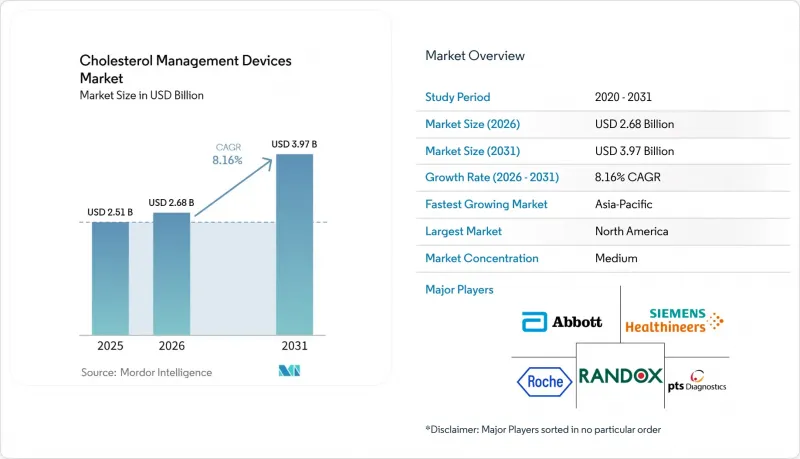
에 의하면, 콜레스테롤 관리 기기 시장은 2025년에 25억 1,000만 달러로 평가되었고, 2026년에 26억 8,000만 달러로 추정되고, 2031년까지 39억 7,000만 달러에 이를 것으로 예측되며, 2026-2031년 CAGR 8.16%로 성장할 전망입니다.
본 보고서는 기기 유형별(콜레스테롤 측정기, 지질 검사 키트 등), 기술별(디지털 기기, 아날로그 기기), 최종 사용자별(병원 및 진료소 등), 유통 채널별(병원 약국 등), 지역별(북미, 유럽, 아시아태평양 등)로 분류되어 있습니다. 시장 전망은 금액(달러) 기준으로 제시되어 있습니다.
세계의 콜레스테롤 관리 기기 시장 동향 및 인사이트
1차 진료 및 약국에서의 심혈관 위험 선별 검사 증가
콜레스테롤 관리 기기 시장의 배경이 되는 역학적 압력은 단순한 사망자 수 통계에 그치지 않고, 현재 많은 의료 현장에서 정기적인 선별 검사 방침을 형성하고 있습니다. 'Global Burden of Disease 2023' 조사에 따르면, 높은 LDL 콜레스테롤을 포함한 수정 가능한 대사성 위험 요인이 전 세계 심혈관 질환 관련 장애 조정 생명년(DALY)의 67.3%를 차지하고 있으며, 이로 인해 콜레스테롤 검사는 각국의 예방 정책에서 계속해서 중요한 위치를 차지하고 있습니다(HEALTHDATA.ORG). 2026년 ACC 및 AHA 가이드라인 또한 심혈관 위험 평가의 시작 시기를 젊은 층으로 앞당기고 있으며, 이는 동맥경화 위험이 고령이 되어 갑자기 나타나는 것이 아니라 수십 년에 걸쳐 축적된다는 견해를 반영하고 있습니다(JACC.ORG). 진료소, 지역 약국, 예방 의료 프로그램에서 선별 검사가 확대됨에 따라, 콜레스테롤 관리 기기 시장은 분석 장비, 모니터 및 정기 검사용 소모품에 대한 도입 기반 확대라는 수요의 혜택을 받고 있습니다.
외래 및 재택 환경에서의 현장 진단 지질 검사 성장
현장 지질 검사는 심혈관 내과 진료소에 그치지 않고, 1차 진료, 응급 의료, 소매 의료 현장에서도 그 중요성이 커지고 있습니다. 주요 변화는 지질 패널 결과 제공이 중앙 채혈 인프라에 대한 의존도를 낮추고 있다는 점이며, 이를 통해 환자가 내원한 당일에 신속한 의사 결정이 가능해졌습니다. 결과를 신속하게 제공함으로써 즉각적인 투약 조정, 의뢰 결정 및 후속 조치 계획이 가능해져, 일상 진료에서 이러한 시스템의 실용적 가치가 높아지고 있습니다. 이를 통해 콜레스테롤 관리 기기 시장은 속도와 편의성이 검사의 정기적 이용을 좌우하는 경우가 많은 외래 진료 워크플로우의 요구에 더욱 신속하게 대응할 수 있게 됩니다. 이와 유사한 추세는 콜레스테롤 관리 기기 시장의 가정 내 이용을 촉진하고 있으며, 특히 만성 질환 관리가 간헐적인 내원에서 진료 간격을 둔 지속적인 모니터링으로 전환되고 있는 상황에서 두드러집니다.
검사실 밖 콜레스테롤 검사에 대한 보험 환급 장벽
검사실 밖에서 이루어지는 콜레스테롤 검사에 대한 보험 환급 모델은 특히 미국에서 여전히 실무상의 장벽으로 작용하고 있습니다. 유나이티드 헬스케어는 2025년 9월 상업 보험 환급 방침의 업데이트를 발표했으며, 이는 2025년 12월 1일부터 발효되었습니다. 이에 따라 진료소, 외래 진료소 및 독립 검사 기관에서의 일상적인 임상 검사에 대한 조건이 엄격해졌습니다. 콜레스테롤 관리 기기 시장에서 이 조치는 진료소용 및 현장 진단(Point-of-Care) 제품의 보급을 지연시키고 있습니다. 중소 제조업체들은 대형 검사 서비스 제공업체가 이미 보유하고 있는 것과 같은 보험사와의 계약 협상력을 종종 갖추지 못하고 있기 때문입니다. 또한 콜레스테롤 관리 기기 시장에서 검사가 중앙 집중형 검사 기관에서 진료소, 약국, 재택 간호 경로로 전환되는 속도도 제한되고 있습니다.
부문 분석
2025년, 콜레스테롤 측정기는 기기 유형별 매출의 57.26%를 차지했는데, 이는 실제 임상 현장에서 고혈압과 이상지질혈증이 종종 함께 관리되고 있는 실태를 반영한 것입니다. 지질 검사 키트는 지질 검사 권장 범위의 확대와 소형 손가락 채혈 시스템에 대한 수요 증가에 힘입어 2031년까지 연평균 성장률(CAGR) 8.8%로 가장 빠른 성장을 기록할 것으로 예측됩니다. 지질 검사 키트는 약국, 소매 의료 및 정기적인 재택 검사 모델에서 여전히 그 유용성을 높이고 있습니다.
따라서 콜레스테롤 관리 기기 업계의 각 기업은 고객 생애 가치(LTV)를 향상시키기 위해 기기 도입과 스트립 및 시약의 지속적인 판매 간의 균형을 맞추고 있습니다. 콜레스테롤 검사는 단독 측정으로 이루어지는 것이 아니라 혈당, HbA1c 및 기타 위험 지표와 함께 의뢰되는 사례가 증가하고 있으므로, 여러 분석 항목을 다루는 심혈관 대사 워크플로우에 적합한 제품 라인은 계속해서 우위를 유지할 것으로 전망됩니다.
2025년에는 디지털 기기가 기술 분야 매출의 51.24%를 차지했으며, 디지털 하드웨어는 병원, 검사실, 재택 간호 환경에서 주요 상업 표준이 되었습니다. 이러한 위상은 사용자가 측정값을 저장하고 확인할 수 있도록 돕는 앱 연동, 클라우드 전송, 스마트폰 연동 인터페이스가 널리 이용 가능해진 것을 반영합니다. 아날로그 기기는 2031년까지 연평균 성장률(CAGR) 9.21%로 확대될 것으로 예측되며, 기술별 분류에서 콜레스테롤 관리 기기 시장 중 가장 빠르게 성장하는 분야가 될 전망입니다.
그러나 비용 효율성을 중시하는 환경이나 디지털 연결의 신뢰성이 여전히 낮은 지역에서는 아날로그 기기의 중요성이 여전히 높습니다. 많은 이용 사례에서 합리적인 가격과 사용 편의성이 여전히 중요하게 여겨지고 있기 때문에 콜레스테롤 관리 기기 시장에서 아날로그 방식의 점유율은 급격한 철수라기보다는 서서히 감소해 나갈 것으로 예측됩니다.
지역별 분석
북미는 2025년, 성숙한 의료 인프라, 높은 검사 실시 빈도, 그리고 진단 경로에 대한 폭넓은 접근성에 힘입어 콜레스테롤 관리 기기 시장 점유율의 46.51%를 차지했습니다. 2026년 ACC 및 AHA의 이상지질혈증 지침은 성인기에 Lp(a) 검사를 1회 실시할 것을 권장하고, 위험 평가에서 ApoB의 역할을 확대하고 있으므로, 미국에서 중요한 단기적 촉진요인이 될 것입니다. 캐나다와 멕시코의 점유율은 작지만, 도시 지역의 심혈관 질환 관리 프로그램이 해당 지역 전체의 진단 분야 투자 확대를 지속적으로 뒷받침하고 있습니다.
유럽은 콜레스테롤 관리 기기 시장에서 여전히 2위 지역 부문이며, 독일, 영국, 프랑스가 주요 국가 차원 수요 거점입니다. 이 지역에서는 분산형 현장 검사(point-of-care testing)보다 중앙 집중형 임상 검사가 여전히 주류를 이루고 있으며, 이것이 병원 및 외래 진료 현장에서의 제품 도입 패턴을 형성하고 있습니다. IVDR(체외진단용 의료기기 규정)과 관련된 규정 준수 요건으로 인해, 제조업체들은 특히 유럽 전역으로의 광범위한 진출을 목표로 할 경우, 증거 창출 및 제품 포트폴리오의 우선순위 설정에 더 많은 비용을 투자해야 하는 상황에 직면해 있습니다. 유럽 집행위원회가 2025년 12월에 제안한 개정안에 따라 2027년까지 해당 절차의 일부가 간소화될 가능성이 있으며, 이를 통해 차세대 커넥티드형 콜레스테롤 모니터링 시스템 시장 진입이 촉진될 것입니다.
아시아태평양은 2031년까지 연평균 성장률(CAGR) 10.43%를 나타낼 것으로 예측되며, 콜레스테롤 관리 기기 시장에서 가장 빠르게 성장하는 지역 블록이 되고 있습니다. 인도는 도시 지역의 심혈관 질환 부담 증가와 진단 능력 확대에 힘입어, 해당 지역에서 가장 빠르게 성장하는 국가 시장으로 꼽힙니다. 일본은 확립된 건강검진 체계를 통해 정기적인 지질 검사의 안정적인 기반을 제공하고 있는 반면, 기타 아시아 시장에서는 의료기관 및 소비자를 위한 검사 체계 구축이 진행되고 있습니다. 남미, 중동 및 아프리카는 콜레스테롤 관리 기기 시장에서 여전히 초기 단계의 기회에 머물러 있으며, 도시 지역 수요는 증가하고 있으나 경제적 제약과 인프라 격차로 인해 도입 속도는 여전히 완만합니다.
기타 혜택 :
- 엑셀 형식 시장 예측(ME) 시트
- 3개월간의 애널리스트 지원
자주 묻는 질문
목차
제1장 서론
제2장 조사 방법
제3장 개요
제4장 시장 구도
제5장 시장 규모 및 성장 예측
제6장 경쟁 구도
제7장 시장 기회 및 향후 전망
AJY 26.09.01According to Mordor Intelligence, the cholesterol management devices market is projected to be USD 2.51 billion in 2025, USD 2.68 billion in 2026, and reach USD 3.97 billion by 2031, growing at a CAGR of 8.16% from 2026 to 2031.
This report is Segmented by Device Type (Cholesterol Monitors, Lipid Test Kits, and More), Technology (Digital Devices, Analog Devices), End-User (Hospitals and Clinics, and More), Distribution Channel (Hospital Pharmacies, and More), and Geography (North America, Europe, Asia-Pacific, and More). The Market Forecasts are Provided in Terms of Value (USD).
Global Cholesterol Management Devices Market Trends and Insights
Rising Cardiovascular Risk Screening Across Primary Care and Pharmacies
The epidemiological pressure behind the cholesterol management devices market extends beyond headline mortality counts and now shapes routine screening policy in many care settings. The Global Burden of Disease 2023 study found that modifiable metabolic risk factors, including high LDL cholesterol, accounted for 67.3% of global cardiovascular disease related disability adjusted life years, which keeps cholesterol testing high on national prevention agendas HEALTHDATA.ORG. The 2026 ACC and AHA guideline also moves cardiovascular risk assessment earlier in life, reflecting the view that atherosclerotic risk builds over decades rather than appearing suddenly in older age JACC.ORG. As screening broadens across physician offices, community pharmacies, and preventive care programs, the cholesterol management devices market gains from a larger installed base requirement for analyzers, monitors, and recurring test supplies.
Growth of Point-of-Care Lipid Testing in Outpatient and Home Settings
Point of care lipid testing is moving beyond cardiology offices and has become more relevant in primary care, urgent care, and retail health settings. The main shift is that lipid panel delivery is becoming less dependent on central phlebotomy infrastructure, which allows more same day decision making during a patient visit. Faster result turnaround supports immediate medication adjustment, referral decisions, and follow-up planning, which improves the practical value of these systems for routine care. This makes the cholesterol management devices market more responsive to workflow needs in outpatient care, where speed and convenience often determine whether a test is used regularly. The same trend also supports home use in the cholesterol management devices market, especially where chronic disease management is moving away from episodic clinical visits toward ongoing monitoring between appointments.
Reimbursement Friction for Non-Laboratory Cholesterol Testing
The reimbursement model for non-laboratory cholesterol testing remains a practical barrier, especially in the United States. UnitedHealthcare issued a September 2025 commercial reimbursement policy update that became effective on December 1, 2025 and tightened the conditions around routine laboratory testing across office, outpatient, and independent laboratory settings. In the cholesterol management devices market, this slows adoption of office based and point of care products because smaller manufacturers often lack the payer contracting strength that large laboratory service providers already have. It also limits how quickly testing can move from centralized laboratories into clinics, pharmacies, and home centered care pathways within the cholesterol management devices market.
Other drivers and restraints analyzed in the detailed report include:
- Expansion of Digital and Connected Cholesterol Monitoring Ecosystems
- Higher Adoption of Preventive Cardiometabolic Checkups in Aging Populations
- Regulatory Validation Burden Across Multiparameter and Connected Devices
For complete list of drivers and restraints, kindly check the Table Of Contents.
Segment Analysis
Cholesterol monitors held 57.26% of device type revenue in 2025, which reflects how hypertension and dyslipidemia are often managed together in real clinical practice. Lipid test kits are expected to record the fastest growth at an 8.8% CAGR through 2031, supported by broader lipid testing recommendations and stronger demand for compact fingerstick based systems. Lipid test kits still are becoming more useful in pharmacy, retail health, and recurring home testing models.
Companies in the cholesterol management devices industry are therefore balancing capital device placement with repeat strip and reagent sales to improve lifetime customer value. Product lines that fit multi-analyte cardiometabolic workflows should remain better positioned, because cholesterol testing is increasingly ordered alongside glucose, HbA1c, and other risk markers rather than as an isolated measurement.
Digital devices accounted for 51.24% of technology revenue in 2025, which made digital hardware the main commercial standard across hospital, laboratory, and home care settings. That position reflects the wider availability of app connectivity, cloud transfer, and smartphone linked interfaces that help users store and review measurements. Analog devices are projected to expand at a 9.21% CAGR through 2031, which makes them the fastest growing part of the cholesterol management devices market within the technology split.
Even so, analog devices still matter in cost sensitive settings and in locations where digital connectivity remains less reliable. The cholesterol management devices market will likely see gradual share erosion for analog formats rather than an abrupt exit, because affordability and operational simplicity still matter in many use cases.
Complete Report Scope:
- By Device Type
- Cholesterol Monitors
- Lipid Test Kits
- Other Device Types
- By Technology
- Digital Devices
- Analog Devices
- By End-User
- Hospitals and Clinics
- Diagnostic Laboratories
- Home Healthcare Settings
- By Distribution Channel
- Hospital Pharmacies
- Retail Pharmacies
- Online Retail and E-Commerce
- By Geography
- North America
- United States
- Canada
- Mexico
- Europe
- Germany
- United Kingdom
- France
- Italy
- Spain
- Rest of Europe
- Asia-Pacific
- China
- Japan
- India
- Australia
- South Korea
- Rest of Asia-Pacific
- Middle East and Africa
- GCC
- South Africa
- Rest of Middle East and Africa
- South America
- Brazil
- Argentina
- Rest of South America
- North America
Geography Analysis
North America held 46.51% of the cholesterol management devices market share in 2025, supported by mature healthcare infrastructure, high testing intensity, and broad access to diagnostic pathways. The 2026 ACC and AHA dyslipidemia guideline is a meaningful near-term catalyst in the United States because it makes Lp(a) testing a once in adulthood recommendation and expands the role of ApoB in risk assessment. Canada and Mexico contribute a smaller share, but urban cardiovascular programs continue to support broader diagnostic investment across the region.
Europe remained the second largest regional segment in the cholesterol management devices market, with Germany, the United Kingdom, and France forming the main country level demand centers. The region still leans more heavily toward centralized laboratory medicine than decentralized point of care testing, which shapes product adoption patterns across hospitals and outpatient settings. IVDR related compliance demands are pushing manufacturers to spend more on evidence generation and portfolio prioritization, especially when they want wide European coverage. The European Commission's December 2025 amendment proposal could simplify parts of that process by 2027, which would help the entry path for next generation connected cholesterol monitoring systems.
Asia-Pacific is projected to grow at a 10.43% CAGR through 2031, which makes it the fastest growing regional block in the cholesterol management devices market. India is described as the fastest growing country market in the region, supported by rising urban cardiovascular burden and expanding diagnostic capacity. Japan provides a stable base for routine lipid testing through established health check structures, while other Asian markets continue to build institutional and consumer testing capacity. South America and the Middle East and Africa remain earlier stage opportunities in the cholesterol management devices market, where urban demand is rising but affordability limits and infrastructure gaps still moderate adoption.
- Abbott Laboratories
- Acon Laboratories
- Arkray
- Bayer
- Beckton Dickinson
- Bioptik Technology
- Cardinal Health
- Danaher
- EKF Diagnostics
- Johnson & Johnson
- Koninklijke Philips
- Medtronic
- Nova Biomedical
- PTS Diagnostics
- Quest Diagnostics
- Randox Laboratories
- Roche
- Siemens Healthineers
- Sinocare
- Thermo Fisher Scientific
Additional Benefits:
- The market estimate (ME) sheet in Excel format
- 3 months of analyst support
TABLE OF CONTENTS
1 Introduction
- 1.1 Study Assumptions and Market Definition
- 1.2 Scope of the Study
2 Research Methodology
3 Executive Summary
4 Market Landscape
- 4.1 Market Overview
- 4.2 Market Drivers
- 4.2.1 Rising Cardiovascular Risk Screening Across Primary Care and Pharmacies
- 4.2.2 Growth of Point-of-Care Lipid Testing in Outpatient and Home Settings
- 4.2.3 Expansion of Digital and Connected Cholesterol Monitoring Ecosystems
- 4.2.4 Higher Adoption of Preventive Cardiometabolic Checkups in Aging Populations
- 4.2.5 Expansion of at-Home Self-Testing Through Subscription and Employer Health Programs
- 4.2.6 Demand for Multi-Analyte Cardiometabolic Panels that Bundle Cholesterol with HbA1c and Glucose
- 4.3 Market Restraints
- 4.3.1 Reimbursement Friction for Non-Laboratory Cholesterol Testing
- 4.3.2 Regulatory Validation Burden Across Multiparameter and Connected Devices
- 4.3.3 Consumables Dependency and Pricing Pressure on Test Strips and Reagents
- 4.3.4 Clinical Preference for Centralized Laboratory Reference Testing in Higher-Acuity Settings
- 4.4 Supply/Value Chain Analysis
- 4.5 Regulatory Landscape
- 4.6 Technological Outlook
- 4.7 Porter's Five Forces Analysis
- 4.7.1 Threat of New Entrants
- 4.7.2 Bargaining Power of Suppliers
- 4.7.3 Bargaining Power of Buyers
- 4.7.4 Threat of Substitutes
- 4.7.5 Competitive Rivalry
5 Market Size & Growth Forecasts (Value, USD)
- 5.1 By Device Type
- 5.1.1 Cholesterol Monitors
- 5.1.2 Lipid Test Kits
- 5.1.3 Other Device Types
- 5.2 By Technology
- 5.2.1 Digital Devices
- 5.2.2 Analog Devices
- 5.3 By End-User
- 5.3.1 Hospitals and Clinics
- 5.3.2 Diagnostic Laboratories
- 5.3.3 Home Healthcare Settings
- 5.4 By Distribution Channel
- 5.4.1 Hospital Pharmacies
- 5.4.2 Retail Pharmacies
- 5.4.3 Online Retail and E-Commerce
- 5.5 By Geography
- 5.5.1 North America
- 5.5.1.1 United States
- 5.5.1.2 Canada
- 5.5.1.3 Mexico
- 5.5.2 Europe
- 5.5.2.1 Germany
- 5.5.2.2 United Kingdom
- 5.5.2.3 France
- 5.5.2.4 Italy
- 5.5.2.5 Spain
- 5.5.2.6 Rest of Europe
- 5.5.3 Asia-Pacific
- 5.5.3.1 China
- 5.5.3.2 Japan
- 5.5.3.3 India
- 5.5.3.4 Australia
- 5.5.3.5 South Korea
- 5.5.3.6 Rest of Asia-Pacific
- 5.5.4 Middle East and Africa
- 5.5.4.1 GCC
- 5.5.4.2 South Africa
- 5.5.4.3 Rest of Middle East and Africa
- 5.5.5 South America
- 5.5.5.1 Brazil
- 5.5.5.2 Argentina
- 5.5.5.3 Rest of South America
- 5.5.1 North America
6 Competitive Landscape
- 6.1 Market Concentration
- 6.2 Market Share Analysis
- 6.3 Company Profiles (includes Global level Overview, Market level overview, Core Segments, Financials as available, Strategic Information, Market Rank/Share for key companies, Products & Services, Recent Developments)
- 6.3.1 Abbott
- 6.3.2 ACON Laboratories
- 6.3.3 ARKRAY
- 6.3.4 Bayer
- 6.3.5 Beckman Coulter
- 6.3.6 Bioptik Technology
- 6.3.7 Cardinal Health
- 6.3.8 Danaher
- 6.3.9 EKF Diagnostics
- 6.3.10 Johnson and Johnson
- 6.3.11 Koninklijke Philips N.V.
- 6.3.12 Medtronic
- 6.3.13 Nova Biomedical
- 6.3.14 PTS Diagnostics
- 6.3.15 Quest Diagnostics
- 6.3.16 Randox Laboratories
- 6.3.17 Roche Diagnostics
- 6.3.18 Siemens Healthineers
- 6.3.19 Sinocare
- 6.3.20 Thermo Fisher Scientific, Inc.
7 Market Opportunities & Future Outlook
- 7.1 White-space & Unmet-need Assessment


