|
시장보고서
상품코드
2118190
EU AI 법 컴플라이언스 소프트웨어 시장 : 시장 점유율 분석, 업계 동향 및 통계, 성장 예측(2026-2031년)EU AI Act Compliance Software - Market Share Analysis, Industry Trends & Statistics, Growth Forecasts (2026 - 2031) |
||||||
 Mordor Intelligence
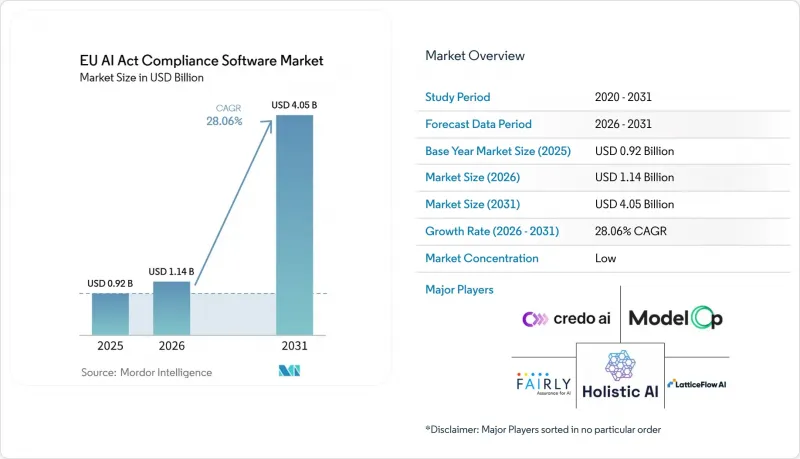
Mordor Intelligence에 의하면, EU AI 법 컴플라이언스 소프트웨어 시장 규모는 2025년에 9억 2,000만 달러로 평가되었고, 2026년 11억 4,000만 달러에서 2031년까지 40억 5,000만 달러에 이를 것으로 예측되며, 예측 기간(2026-2031년) CAGR은 28.06%를 나타낼 전망입니다.
본 보고서는 솔루션 유형별(소프트웨어 및 서비스), 규정 준수 기능별(위험 분류, AI 라이프사이클 거버넌스 및 모니터링 등), 배포 모델별(클라우드, 하이브리드, 온프레미스), 기업 규모별(대기업, 중소기업), 최종 사용자별(BFSI 등) 및 지역별로 분류되어 있습니다. 시장 전망은 금액(달러) 기준으로 제시되어 있습니다.
EU의 AI 법 컴플라이언스 소프트웨어 시장 동향 및 인사이트
단계적인 EU AI법 시행 및 단기적인 규정 준수 기한
EU AI 법 컴플라이언스 소프트웨어 시장은 단일 기한이 아닌, 여러 구매 기회를 창출하는 단계적인 컴플라이언스 일정의 혜택을 받고 있습니다. 제5조의 금지 조항은 2025년 2월 2일부터 시행되었으며, 제50조의 투명성 의무는 2026년 8월 2일부터 적용됩니다. 개정된 일정에 따르면, 부속서 III의 고위험 요건 적용 시작일은 2027년 12월 2일이며, 부속서 I의 제품에 통합된 AI에 관한 요건 적용 시작일은 2028년 8월 2일입니다. 이러한 순서에 따라 조직은 부담이 가장 큰 의무가 적용되기 전에 자산 목록 작성 및 문서화 절차를 확립하도록 권장됩니다. 금지된 AI 관행에 대해서는 최대 3,500만 유로(937만 달러) 또는 전 세계 연간 매출액의 7%에 해당하는 벌금이 부과될 수 있으므로, 조기에 관리 체계를 구축하는 것이 재무적 측면에서도 매우 중요합니다. 또한, 조직은 AI법에 대한 대응을 DORA나 의료기기 규정 등 부문별 규제와 조화시켜야 하며, 이로 인해 여러 컴플라이언스 업무를 단일 워크플로로 통합하는 소프트웨어에 대한 수요가 증가하고 있습니다.
역외 적용 및 EU 시장 접근 위험
EU AI 법 컴플라이언스 소프트웨어 시장에는 EU域 내 조직 외에도 수요가 있습니다. 이는 해당 법이 EU 역내에서 사용되는 특정 AI 시스템의 출력을 대상으로 하고 있기 때문입니다. 이러한 적용 범위는 미국, 영국, 싱가포르 및 기타 시장을 거점으로 하면서도 유럽 고객에게 서비스를 제공하는 공급업체나 도입 기업에도 영향을 미칩니다. 또한, EU 역외에 거점을 둔 고위험 시스템 제공업체도 EU 역내에 인증 대리인을 두어야 합니다. 소프트웨어를 활용함으로써 이러한 조직은 책임 할당, 기록 보관, 그리고 서로 다른 거점 간 증거 제공이 가능해집니다. 클라우드 기반 제공은 분산된 팀에게 유용합니다. 이는 각국에서 별도의 사내 플랫폼을 구축하지 않고도 사용자가 공유된 규정 준수 워크플로를 유지할 수 있기 때문입니다. 이와 같은 국경을 초월한 조정의 필요성으로 인해, EU 요건과 ISO/IEC 42001 및 NIST AI 위험 관리 프레임워크와 같은 관련 거버넌스 프레임워크를 연계하는 도구도 지지를 받고 있습니다.
미확정된 기술 기준과 변동하는 해석 지침
EU AI 법 컴플라이언스 소프트웨어 시장은 법적 의무와 적합성을 입증하는 데 필요한 기술적 인프라 사이에 격차가 존재하기 때문에 제약에 직면해 있습니다. 2026년 4월 현재, 조화 규격은 아직 관보에 공표되지 않았으며, 구매자는 일부 관리 조치에 대한 정확한 기술적 근거를 확신할 수 없는 상황입니다. AI법 평가를 위한 공식 지정 인증 기관이 존재하지 않는 점도 이러한 불확실성을 더욱 가중시키고 있습니다. 소프트웨어 공급업체는 표준 및 지침이 성숙해짐에 따라 더욱 구체화될 가능성이 있는 요건에 대응할 수 있도록 워크플로를 구축해야 합니다. 구매자는 상세한 규격이 발표된 후 플랫폼을 개정해야할 것으로 예상될 경우, 결정을 미룰 가능성이 있습니다. 업데이트된 일정에 따라 준비 기간은 연장되었지만, 조직은 당면한 투명성 확보 의무와 향후 발생할 고위험 의무 간의 균형을 맞추어야 합니다. AI 거버넌스 및 적합성 평가에 대한 전문 지식이 제한적인 점도, 특히 사내 팀이 규제적, 기술적, 그리고 업계 고유의 요구 사항을 종합적으로 해석해야 하는 경우, 도입을 더욱 지연시키고 있습니다.
부문 분석
2025년, 소프트웨어는 EU AI 법 컴플라이언스 소프트웨어 시장 점유율의 72.41%를 차지했습니다. 이 부문이 주도적인 위치를 차지한 이유는 조직이 위험 분류, 기술 문서 작성, 모니터링 및 적합성 평가를 관리하기 위한 실용적인 도구가 필요하기 때문입니다. 이러한 기능은 많은 AI 시스템에 공통적으로 존재하며, 스프레드시트나 개별적인 법적 검토만으로는 일관되게 관리하기 어렵습니다. 통합된 플랫폼을 활용하면 팀은 시스템의 목적을 문서화하고, 적용되는 의무를 파악하며, 조치를 할당하고, 증거를 보관할 수 있습니다. 따라서 광범위한 AI 자산을 보유한 기업에게 이 소프트웨어는 주요 도입 모델이 되고 있습니다. 또한 이 부문은 지침이나 내부 정책 변경에 따라 관리 조치를 업데이트해야 하는 조직에도 적합합니다.
서비스 시장은 2031년까지 연평균 성장률(CAGR) 30.74%를 나타낼 것으로 예측됩니다. 2025년에 플랫폼을 선정한 많은 조직은 현재 도입, 설정, 교육 및 감사 대응을 위한 준비 작업에 착수하고 있습니다. 이에 따라 요구 사항을 내부 절차로 구체화할 수 있는 전문가의 지원에 대한 수요가 발생하고 있습니다. Credo AI는 2025년에 파트너 프로그램을 확대하여 Databricks, Microsoft 및 거버넌스·리스크 전문 기업을 파트너로 맞이함으로써, 기업용 서비스 제공에 있어 파트너 생태계의 활용을 보여주었습니다. 소규모 기업의 경우에도 사내에 법무나 기술적 자원이 부족하기 때문에 지침이 포함된 서비스가 필요할 수 있습니다. 플랫폼과 서비스의 결합은 벤더의 수익 기회를 확대하지만, 서비스의 비중이 커지면 이익률에 압박이 가해질 가능성이 있습니다.
2025년, 위험 분류는 EU AI 법 컴플라이언스 소프트웨어 시장의 26.83% 점유율을 차지했습니다. 조직은 시스템이 금지 대상인지, 고위험인지, 투명성 요건의 대상인지, 아니면 더 낮은 수준의 의무 대상인지 판단해야 하므로, 분류는 규정 준수 프로그램의 출발점이 됩니다. 이 프로세스는 팀이 관련 책임자, 데이터 소스 및 필요한 문서를 식별하는 데에도 도움이 됩니다. 유럽 집행위원회의 고위험 분류에 관한 지침은 이러한 작업에 대한 보다 체계적인 접근 방식을 뒷받침하고 있습니다. 소프트웨어를 활용하면 반복 가능한 질문 항목을 사용하고, 결정 내용을 시스템 기록과 연동함으로써 분류의 일관성을 높일 수 있습니다. 라이프사이클 모니터링, 데이터 거버넌스 및 데이터 계보, 투명성 및 문서 관리는 초기 분류가 완료된 후 중요성이 커지는 관련 기능입니다.
적합성 평가 및 감사 관리는 2031년까지 연평균 성장률(CAGR) 29.91%를 나타낼 것으로 예측됩니다. 고위험 AI 시스템 공급자는 개정된 일정에 따라 EU 시장에 시스템을 출시하기 전에 기술 문서를 작성하고, 해당 평가를 완료하며, 시스템을 등록해야 합니다. 이 작업에는 제품, 엔지니어링, 법무, 보안, 운영 각 팀의 증빙 자료가 필요합니다. 소프트웨어를 활용하면 관리 조치, 테스트 결과, 문서, 승인을 단일 기록으로 통합함으로써 수작업에 의한 후속 조치를 줄일 수 있습니다. LatticeFlow AI는 2026년 4월, AI 거버넌스 프레임워크와 기술 평가를 연계하는 ‘AI Atlas’를 출시했습니다. 이는 검증 가능한 증거에 중점을 둔 제품 접근 방식의 한 예입니다. 조직이 시스템 식별 단계에서 감사 대응이 가능한 컴플라이언스 파일 작성 단계로 전환함에 따라, 이 기능의 가치는 더욱 높아집니다.
기타 혜택 :
- 엑셀 형식 시장 예측(ME) 시트
- 3개월간의 애널리스트 지원
자주 묻는 질문
목차
제1장 서론
제2장 조사 방법
제3장 주요 요약
제4장 시장 구도
제5장 시장 규모 및 성장 예측
제6장 경쟁 구도
제7장 시장 기회 및 향후 전망
AJY 26.09.03According to Mordor Intelligence, the EU AI act compliance software market size was valued at USD 0.92 billion in 2025 and is estimated to grow from USD 1.14 billion in 2026 to reach USD 4.05 billion by 2031, at a CAGR of 28.06% during the forecast period (2026-2031).
This report is Segmented by Solution Type (Software, and Services), Compliance Function (Risk Classification, AI Lifecycle Governance and Monitoring, and More), Deployment Model (Cloud, Hybrid, and On-Premises), Enterprise Size (Large Enterprises, and Small and Medium-Sized Enterprises), End User (BFSI, and More), and Geography. The Market Forecasts are Provided in Terms of Value (USD).
EU AI Act Compliance Software Market Trends and Insights
Phased EU AI Act Enforcement and Near-Term Compliance Deadlines
The EU AI Act Compliance Software Market benefits from a phased compliance schedule that creates several purchasing points rather than a single deadline. Prohibitions in Article 5 have been in effect since February 2, 2025, and Article 50 transparency obligations apply from August 2, 2026. The revised schedule places the Annex III high-risk requirements on December 2, 2027, and the Annex I product-embedded AI requirements on August 2, 2028. This sequence encourages organizations to establish an inventory and documentation process before their most demanding obligations apply. Penalties can reach EUR 35 million (USD 9.37 million) or 7% of worldwide annual turnover for prohibited AI practices, which raises the financial importance of early controls. Organizations also need to align AI Act work with sector rules such as DORA and the Medical Device Regulation, which support demand for software that consolidates several compliance tasks into a single workflow.
Extraterritorial Reach and EU Market-Access Exposure
The EU AI Act Compliance Software Market has demand beyond EU-based organizations, as the Act covers certain AI system outputs used within the Union. This scope affects providers and deployers that operate from the United States, the United Kingdom, Singapore, and other markets but serve European customers. Providers of high-risk systems established outside the Union also need an authorized representative in the EU. Software can help these organizations assign responsibilities, retain records, and make evidence available across different locations. Cloud delivery is useful for distributed teams because it lets users maintain shared compliance workflows without building a separate internal platform in every country. The same need for cross-border coordination supports tools that connect EU requirements with related governance frameworks, including ISO/IEC 42001 and the NIST AI Risk Management Framework.
Unsettled Technical Standards and Moving Interpretive Guidance
The EU AI Act Compliance Software Market faces constraints due to the gap between legal obligations and the technical infrastructure required to demonstrate conformity. Harmonized standards had not yet been published in the Official Journal as of April 2026, leaving buyers less certain about the exact technical basis for some controls. The lack of formally designated notified bodies for AI Act assessments adds to this uncertainty. Software providers must configure workflows for requirements that may become more specific as standards and guidance mature. Buyers may delay decisions if they expect to revise a platform after detailed standards are issued. The updated timetable adds more time for preparation, but it also leaves organizations balancing immediate transparency duties with later high-risk obligations. Limited availability of AI governance and conformity-assessment expertise further slows implementation, especially where internal teams must interpret regulatory, technical, and sector-specific requirements together.
Other drivers and restraints analyzed in the detailed report include:
- Expansion of High-Risk AI Use Cases in Regulated Industries
- Need for Continuous Evidence Across the AI Lifecycle
- Fragmented Accountability Across Providers, Deployers, and Third-Party Model Vendors
For complete list of drivers and restraints, kindly check the Table Of Contents.
Segment Analysis
Software captured 72.41% of the EU AI Act Compliance Software Market share in 2025. The segment leads because organizations need practical tools for risk classification, technical documentation, monitoring, and management of conformity assessment. These functions are repeated across many AI systems and are difficult to manage consistently through spreadsheets or isolated legal reviews. A centralized platform can help teams document the system's purpose, identify applicable obligations, assign actions, and retain evidence. This makes software the primary delivery model for enterprises with broad AI inventories. The segment also fits organizations that need to update controls as guidance and internal policies change.
Services are forecast to grow at a 30.74% CAGR through 2031. Many organizations that selected a platform in 2025 are now moving into implementation, configuration, training, and audit-readiness work. This creates demand for specialist support that can translate requirements into internal procedures. Credo AI expanded its partner program in 2025 to include Databricks, Microsoft, and governance and risk specialists, illustrating the use of partner ecosystems for enterprise delivery. Smaller firms may also need guided services because they lack in-house legal and technical capacity. The mix of platforms and services can widen vendor revenue opportunities, although a larger services role can place pressure on margins.
Risk classification held 26.83% of the EU AI Act Compliance Software Market share in 2025. Classification is the starting point for a compliance program because organizations must determine whether a system is prohibited, high-risk, subject to transparency requirements, or subject to lower-level obligations. The process also helps teams identify the relevant owner, data sources, and required documentation. The European Commission's high-risk classification guidance supports a more structured approach to this work. Software can make classification more consistent by using repeatable questions and keeping the decisions connected to the system record. Lifecycle monitoring, data governance and lineage, and transparency and documentation management are related functions that become more important after the initial classification is complete.
Conformity assessment and audit management are forecast to grow at a 29.91% CAGR through 2031. Providers of high-risk AI systems will need to prepare technical documentation, complete applicable assessments, and register systems before placing them on the EU market under the revised timeline. The task requires evidence from product, engineering, legal, security, and operational teams. Software can reduce manual follow-up by linking controls, test results, documentation, and approvals into a single record. LatticeFlow AI launched AI Atlas in April 2026 to map AI governance frameworks to technical evaluations, an example of a product approach focused on verifiable evidence. This function becomes more valuable as organizations move from identifying systems to preparing an audit-ready compliance file.
Complete Report Scope:
- By Solution Type
- Software
- Services
- By Compliance Function
- Risk Classification
- AI Lifecycle Governance and Monitoring
- Data Governance and Lineage
- Transparency and Documentation Management
- Conformity Assessment and Audit Management
- By Deployment Model
- Cloud
- Hybrid
- On-Premises
- By Enterprise Size
- Large Enterprises
- Small and Medium-Sized Enterprises
- By End User
- IT and Telecommunication
- BFSI
- Automotive and Transportation
- Healthcare and Life Sciences
- Retail and E-Commerce
- Other End Users
- By Geography
- Germany
- United Kingdom
- France
- Russia
- Spain
- Rest of Europe
List of Companies Covered in this Report:
- Holistic AI Limited
- Credo AI, Inc.
- ModelOp, Inc.
- Fairly AI Inc.
- LatticeFlow AG
- Fiddler Labs, Inc.
- ArthurAI, Inc.
- Aporia Technologies Ltd.
- Monitaur, LLC
- Trustible, Inc.
- Modulos AG
- Mindgard Ltd.
- CalypsoAI Corp.
- FairNow, Inc.
- WhyLabs, Inc.
- ComplyAI, Inc.
- Parity Responsible AI, Inc.
- Securiti.ai, Inc.
- Truera, Inc.
- Robust Intelligence, Inc.
Additional Benefits:
- The market estimate (ME) sheet in Excel format
- 3 months of analyst support
TABLE OF CONTENTS
1 INTRODUCTION
- 1.1 Study Assumptions and Market Definition
- 1.2 Scope of the Study
2 RESEARCH METHODOLOGY
3 EXECUTIVE SUMMARY
4 MARKET LANDSCAPE
- 4.1 Market Overview
- 4.2 Market Drivers
- 4.2.1 Phased EU AI Act Enforcement and Near-Term Compliance Deadlines
- 4.2.2 Extraterritorial Reach and EU Market-Access Exposure
- 4.2.3 Expansion of High-Risk AI Use Cases in Regulated Industries
- 4.2.4 Need for Continuous Evidence Across the AI Lifecycle
- 4.2.5 Convergence of EU AI Act, ISO/IEC 42001, and NIST AI RMF Controls
- 4.2.6 Procurement and Board-Level Demand for Demonstrable Responsible AI
- 4.3 Market Restraints
- 4.3.1 Unsettled Technical Standards and Moving Interpretive Guidance
- 4.3.2 Fragmented Accountability Across Providers, Deployers, and Third-Party Model Vendors
- 4.3.3 Limited Availability of AI Governance and Conformity-Assessment Expertise
- 4.3.4 Integration Friction Across Shadow AI, Legacy MLOps, and Multi-Cloud Estates
- 4.4 Impact of Macroeconomic Factors on the Market
- 4.5 Industry Value-Chain Analysis
- 4.6 Technology Outlook
- 4.7 Regulatory Landscape
- 4.8 Porter's Five Forces Analysis
- 4.8.1 Threat of New Entrants
- 4.8.2 Bargaining Power of Suppliers
- 4.8.3 Bargaining Power of Buyers
- 4.8.4 Threat of Substitutes
- 4.8.5 Intensity of Competitive Rivalry
5 MARKET SIZE AND GROWTH FORECASTS (VALUE)
- 5.1 By Solution Type
- 5.1.1 Software
- 5.1.2 Services
- 5.2 By Compliance Function
- 5.2.1 Risk Classification
- 5.2.2 AI Lifecycle Governance and Monitoring
- 5.2.3 Data Governance and Lineage
- 5.2.4 Transparency and Documentation Management
- 5.2.5 Conformity Assessment and Audit Management
- 5.3 By Deployment Model
- 5.3.1 Cloud
- 5.3.2 Hybrid
- 5.3.3 On-Premises
- 5.4 By Enterprise Size
- 5.4.1 Large Enterprises
- 5.4.2 Small and Medium-Sized Enterprises
- 5.5 By End User
- 5.5.1 IT and Telecommunication
- 5.5.2 BFSI
- 5.5.3 Automotive and Transportation
- 5.5.4 Healthcare and Life Sciences
- 5.5.5 Retail and E-Commerce
- 5.5.6 Other End Users
- 5.6 By Geography
- 5.6.1 Germany
- 5.6.2 United Kingdom
- 5.6.3 France
- 5.6.4 Russia
- 5.6.5 Spain
- 5.6.6 Rest of Europe
6 COMPETITIVE LANDSCAPE
- 6.1 Market Concentration
- 6.2 Strategic Moves
- 6.3 Market Share Analysis
- 6.4 Company Profiles (includes Global Level Overview, Market Level Overview, Core Segments, Financials as available, Strategic Information, Market Rank/Share, Products and Services, Recent Developments)
- 6.4.1 Holistic AI Limited
- 6.4.2 Credo AI, Inc.
- 6.4.3 ModelOp, Inc.
- 6.4.4 Fairly AI Inc.
- 6.4.5 LatticeFlow AG
- 6.4.6 Fiddler Labs, Inc.
- 6.4.7 ArthurAI, Inc.
- 6.4.8 Aporia Technologies Ltd.
- 6.4.9 Monitaur, LLC
- 6.4.10 Trustible, Inc.
- 6.4.11 Modulos AG
- 6.4.12 Mindgard Ltd.
- 6.4.13 CalypsoAI Corp.
- 6.4.14 FairNow, Inc.
- 6.4.15 WhyLabs, Inc.
- 6.4.16 ComplyAI, Inc.
- 6.4.17 Parity Responsible AI, Inc.
- 6.4.18 Securiti.ai, Inc.
- 6.4.19 Truera, Inc.
- 6.4.20 Robust Intelligence, Inc.
7 MARKET OPPORTUNITIES AND FUTURE OUTLOOK
- 7.1 White-Space and Unmet-Need Assessment