
|
시장보고서
상품코드
2118208
소셜미디어 관리 소프트웨어 시장 : 시장 점유율 분석, 업계 동향 및 통계, 성장 예측(2026-2031년)Social Media Management Software - Market Share Analysis, Industry Trends & Statistics, Growth Forecasts (2026 - 2031) |
||||||
 Mordor Intelligence
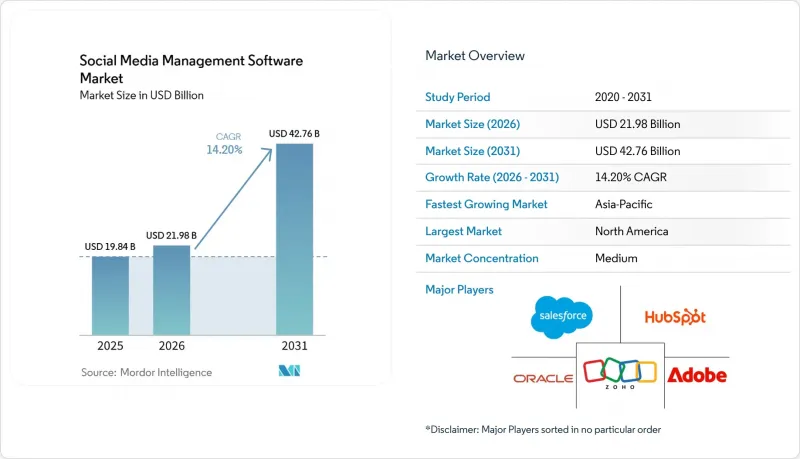
Mordor Intelligence에 의하면, 소셜미디어 관리 소프트웨어 시장 규모는 2025년에 198억 4,000만 달러로 평가되었고, 2026년 219억 8,000만 달러에서 2031년까지 427억 6,000만 달러에 이를 것으로 예측되며, 예측 기간(2026-2031년)에서 CAGR은 14.20%를 나타낼 전망입니다.
본 보고서는 구성 요소별(솔루션 및 서비스), 도입 형태별(클라우드, 온프레미스, 하이브리드), 조직 규모별(중소기업 및 대기업), 용도별(고객 참여 및 커뮤니티 관리 등), 산업 분야별(헬스케어 및 생명과학 등), 그리고 지역별로 분류되어 있습니다. 시장 예측은 금액(달러) 기준으로 제시되어 있습니다.
세계의 소셜 미디어 관리 소프트웨어 시장 동향 및 인사이트
AI를 활용한 컨텐츠 기획 및 배포 워크플로우에 대한 수요 증가
소셜 미디어 관리 소프트웨어 시장은 AI를 활용한 게시물이 더 이상 프리미엄 추가 기능으로 간주되지 않는 단계로 전환되고 있습니다. 이는 기업 구매자들이 핵심 플랫폼 내에서 기획, 초안 작성, 타이밍 설정, 최적화를 지원하는 기능을 기대하게 되었기 때문입니다. 현재 더 중요하게 여겨지는 것은 모델 그 자체뿐만 아니라 그 배후에 있는 과거 신호 데이터입니다. 왜냐하면 더 강력한 독자적인 데이터 레이어는 게시물 및 보고서 작성 전반에 걸쳐 관련성, 속도, 의사결정의 질을 향상시킬 수 있기 때문입니다. Hootsuite가 2026년 6월에 ‘Wisdom’을 출시하면서 이러한 변화가 명확해졌습니다. 이 제품은 15년 이상 축적된 독자적인 소셜 데이터와 1억 5,000만 개의 모니터링 데이터 소스를 기반으로 한 ‘소셜 퍼스트’ AI 에이전트를 도입하고 있으며, 자사가 보유한 소셜 데이터의 규모가 소셜 미디어 관리 소프트웨어 시장에서 얼마나 제품적 우위를 점하고 있는지를 보여주고 있습니다. 또한, Sprout Social의 2026년판 ‘소셜 인텔리전스 보고서’에 따르면, 마케팅 담당 임원 중 71%가 2029년까지 기업 전략 수립에 있어 소셜 데이터가 기존 시장 조사를 능가할 것으로 예상하고 있으며, AI를 활용한 퍼블리싱 워크플로가 더욱 광범위한 인텔리전스 활용 사례와 점점 더 밀접하게 연결되고 있는 이유를 여실히 보여주고 있습니다. 이러한 도구가 트렌드 감지, 컨텐츠 제작, 일정 관리, 보고서 작성을 일련의 프로세스로 처리하기 시작함에 따라, 소셜 미디어 관리 소프트웨어 시장은 과거 대규모 소셜 미디어 부서의 전유물이었던 운영 규모를 소규모 팀도 활용할 수 있게 하고 있습니다.
크로스 채널 소셜 리스닝 및 감성 분석에 대한 수요 증가
브랜드들이 소셜 미디어, 리뷰, AI 생성 응답을 고객, 경쟁사, 평판에 관한 신호의 실시간 정보원으로 활용하게 됨에 따라, 소셜 미디어 관리 소프트웨어 시장에서는 리스닝 기능에 대한 중요성이 높아지고 있습니다. 리스닝이 단순한 모니터링 기능이 아닌 비즈니스 인텔리전스 과제로 자리 잡음에 따라 채널의 폭, 데이터 처리 속도, 분류 정확도가 더욱 중요해지면서, 이러한 변화는 플랫폼 간 경쟁 양상을 바꿔가고 있습니다. Meltwater의 2026년 상반기 릴리스에서는 강화된 ‘GenAI Lens’ 보고서 기능이 추가되었습니다. 이를 통해 조직은 AI가 생성한 검색 결과에서 브랜드의 존재감을 모니터링하고 형성할 수 있게 되었으며, 리스닝의 범위가 지금까지 제품 측면에서 크게 주목받지 못했던 영역으로 확대되었습니다. 또한, Sprout Social도 2026년 5월에 자사의 ‘Trellis’ 에이전트형 AI 엔진을 ‘퍼블리싱’, ‘리스닝’, ‘스마트 인박스’, ‘보고서’ 각 기능으로 확대했습니다. 이는 파편화된 리스닝 도구나 실행 도구가 아닌, 통합된 시그널 파이프라인으로 시장이 전환되고 있음을 반영합니다. 이러한 추세가 심화됨에 따라, 소셜 미디어 관리 소프트웨어 시장에서는 소셜 인텔리전스를 단순한 부가 모듈이 아닌, 브랜드, 고객 관리, 캠페인 의사 결정의 핵심이 되는 운영 센터로 자리매김하고 있습니다.
분산된 플랫폼 API와 빈번한 소셜 네트워크 정책 변경
소셜 미디어 관리 소프트웨어 시장은 여전히 인증 규칙, 게시 권한, 속도 제한, 개정 주기가 서로 다른 여러 소셜 네트워크에 대한 액세스에 의존하고 있으며, 이는 공급업체에게 지속적인 엔지니어링 작업을 야기하고 있습니다. 구매자들이 더 광범위한 채널을 지원하기를 기대함에 따라 이러한 부담은 더욱 커지고 있습니다. 끊임없이 변화하는 네트워크 정책 전반에 걸쳐 호환성을 유지하는 것은 제품 출시를 지연시키고 운영 비용을 증가시킬 가능성이 있기 때문입니다. Hootsuite가 2026년 6월에 발표한 ‘Social OS’에는 Perch, Nest, Lumen을 아우르는 Model Context Protocol 커넥터가 포함되어 있으며, 이는 공급업체가 여러 개의 독립적인 통합 경로를 유지해야 하는 부담을 줄이려는 시도의 한 예입니다. 또한 Meltwater도 2026년 7월에 Meltwater MCP에 대한 접근성을 확대하여, 조직이 자사의 인텔리전스 도구를 기존 AI 에이전트 워크플로우에 연결할 수 있도록 했습니다. 이는 소셜 미디어 관리 소프트웨어 시장에서 데이터 접근성을 통해 탄력성을 강화하려는 유사한 노력을 시사합니다. 엔지니어링 팀이 소규모인 벤더는 이러한 상황에서 불리한 입장에 놓이게 됩니다. 정책이나 API가 변경될 때마다 로드맵 수립에 할당된 자원이 빼앗겨, 더 수세적인 제품 개발을 강요받을 가능성이 있기 때문입니다.
부문 분석
2025년에는 ‘솔루션’이 소셜 미디어 관리 소프트웨어 시장의 70.89% 점유율을 차지하며 이 부문을 주도했습니다. 이는 정기적인 소프트웨어 구독이 여전히 이 카테고리의 주요 수익원임을 보여줍니다. 한편, ‘서비스’ 부문은 2031년까지 연평균 성장률(CAGR) 17.25%를 나타낼 것으로 예측되며, 이는 독립형 소프트웨어 사용보다 공급자 주도형 지원이 더 빠르게 확대되고 있음을 시사합니다. 이러한 추세는 많은 구매자가 도구를 구매할 수는 있지만, 리스닝 프로그램 설정, AI 모델 미세 조정, 그리고 방대한 양의 소셜 신호를 비즈니스 팀의 중요한 의사 결정으로 전환하기 위해서는 여전히 외부 지원이 필요함을 시사합니다. 또한, 제품의 가치가 구매자가 인텔리전스를 대규모로 운영할 수 있는지 여부에 점점 더 의존하게 됨에 따라, 소셜 미디어 관리 소프트웨어 시장이 단순한 플랫폼 접근 단계를 넘어 진화하고 있음을 보여줍니다.
이러한 격차로 인해 셀프 서비스형 디지털 네이티브 고객과, 계약에 도입 지원, 관리형 모니터링, 전략적 검토가 포함된 종합적인 지원을 선호하는 대규모 조직 사이에서 더욱 뚜렷한 분열이 발생하고 있습니다. 소셜 미디어 관리 소프트웨어 업계에서 이것이 중요한 이유는 특히 거버넌스,문서화, 내부 조정의 요구 사항이 높은 경우, 대기업이나 규제 대상 고객은 소프트웨어 라이선스 이상의 것을 필요로 하는 경우가 많기 때문입니다. 따라서 벤더가 단순한 도구로서 곁에 존재하는 것이 아니라 구매자의 지속적인 운영 프로세스의 일부가 될 때, 서비스 중심의 제안은 더 강력한 고객 유지로 이어집니다. 또한, 이러한 추세는 저비용 자동화 도구가 발전하고 있음에도 불구하고 일부 고객층에서 프리미엄 가격 책정이 유지되는 이유를 설명하는 요인 중 하나가 됩니다. 왜냐하면 관리형 지원은 소프트웨어만으로는 완전히 해결할 수 없는 조직적 과제를 여전히 해소해 주기 때문입니다.
2025년 시점에서 클라우드는 소셜 미디어 관리 소프트웨어 시장 점유율의 61.23%를 차지했으며, 2031년까지 연평균 성장률(CAGR) 16.77%로 확대될 것으로 예측됩니다. 이에 따라 클라우드는 시장을 선도할 뿐만 아니라 가장 빠르게 성장하는 도입 모델이 되고 있습니다. 이러한 위상은 실시간 협업, 신속한 기능 업데이트, 그리고 소셜, CRM, 분석 시스템과의 지속적인 통합이 플랫폼의 핵심 고객 가치와 밀접하게 연결된 제품 구조를 반영하고 있습니다. 2026년 6월 Hootsuite가 발표한 ‘Social OS’ 아키텍처는 단일 실시간 피드를 통해 게시, 고객 관리, 옹호, 인텔리전스 각 제품을 연결하는 공유 에이전트형 클라우드 계층을 기반으로 하며, 클라우드 설계가 플랫폼 전략에 얼마나 깊이 통합되어 있는지를 보여주었습니다. 그 결과, 소셜 미디어 관리 소프트웨어 시장에서는 클라우드 도입이 단순한 제공 형태 선택지라기보다는 고급 제품 기능을 실현하기 위한 기본 선택지로 취급되고 있습니다.
하이브리드 환경이나 온프레미스 환경은 데이터 주권, 보안 제어, 혹은 현지 인프라와 관련된 규제로 인해 구매자의 클라우드 도입 선택지가 좁아지는 경우, 여전히 일정한 역할을 수행하고 있습니다. 이는 특히 공공기관, 엄격한 관리 하에 있는 조직, 그리고 감사 대상인 운영 환경에서 중요하며, 이러한 환경에서는 워크플로우의 속도와 마찬가지로 데이터의 저장 위치 및 접근 관리도 중요한 요소가 됩니다. 하지만 온프레미스 모델은 업데이트 주기가 느리고, 플랫폼 변경에 대응하기 위한 비용을 장기적으로 정당화하기 어려워지고 있어 그 기세가 점차 약해지고 있습니다. 그 결과, 소셜 미디어 관리 소프트웨어 시장은 클라우드의 속도와 거버넌스 관리를 모두 충족할 수 있는 벤더 쪽으로 기울고 있습니다. 이는 구매자들이 동일한 시스템 내에서 실시간 실행과 더욱 강력한 모니터링을 모두 점점 더 요구하고 있기 때문입니다.
지역별 분석
2025년, 북미는 소셜 미디어 관리 소프트웨어 시장의 37.16%를 차지하며 최대 지역 시장이 되었습니다. 이는 기업 예산, 플랫폼 통합, 그리고 성숙한 디지털 운영 모델이 이 지역에 집중되어 있기 때문입니다. 이 지역은 소셜 운영을 독립적인 기능으로 관리하기보다는 소셜 도구를 CRM, 커머스, 애널리틱스, 서비스 플랫폼과 연동하는 것을 주저하지 않는 대기업 고객이 밀집해 있다는 장점이 있습니다. 세일즈포스의 2026년 여름 제품 출시에서는 멀티 에이전트 오케스트레이션과 AI를 활용한 고객 참여 기능이 추가되어, 고객 시스템과 소셜 미디어 관리 소프트웨어 시장 간의 더 깊은 통합에 있어 이 지역이 주요 실증의 장으로서의 역할이 더욱 강화되었습니다. 유럽은 여전히 2위 지역 시장이며, 유럽 데이터 보호 위원회(EDPB)의 2025년 지침에 따라 각 벤더들은 지역 전체에서 동의 처리, 데이터 최소화 및 감사 대응이 가능한 워크플로우 관리를 강화해야 하는 압박을 받고 있습니다.
아시아태평양은 2031년까지 연평균 성장률(CAGR) 15.98%를 나타낼 것으로 예측되며, 국가에 따라 수요 견인 요인이 크게 다르지만 소셜 미디어 관리 소프트웨어 시장에서 가장 빠르게 확장되고 있는 지역입니다. 일부 시장에서는 기업의 AI 도입이 견인 요인으로 작용하는 반면, 다른 시장에서는 디지털 비즈니스 활동의 확대, 모바일 우선의 소비자 행동, 그리고 중소기업의 소셜 채널 이용 증가가 더 큰 영향을 미치고 있습니다. 일본에서는 AI 기반 소셜 운영 도구로의 전환이 더욱 두드러지게 진행되고 있으며, ADK 마케팅 솔루션즈는 2026년 7월, 기업의 SNS 자동화를 위한 ‘SOCIAI AI 에이전트’를 출시했습니다. 또한, 덴츠 디지털도 2025년 8월에 AI를 활용한 컨텐츠 생성 기능을 플랫폼에 추가했습니다. 이는 지역 내 가치 창출이 전 세계 소프트웨어 제공업체뿐만 아니라 현지 AI 서비스 계층을 통해서도 점점 더 이루어지고 있음을 보여줍니다. 한국, 호주, 뉴질랜드 등 보다 성숙한 시장에서는 제품 간 차별화가 줄어들고 있으며, 기본 기능의 포괄성보다는 AI의 심도나 통합의 질이 중요해지고 있습니다.
남미는 소셜 미디어 관리 소프트웨어 시장에서 여전히 신흥 기회로 남아 있으며, 브라질이 소매업 및 소비자 브랜드 전반 수요를 주도하고 있지만, 도입은 여전히 본격적인 엔터프라이즈용 플랫폼보다는 합리적인 가격의 중소기업용 도구에 치우쳐 있습니다. 따라서 현재 평균 계약 규모가 북미나 유럽 일부 지역보다 작다고는 하지만, 이 지역은 장기적인 대규모 도입의 관점에서 중요하게 여겨지고 있습니다. 중동 및 아프리카는 현재 매출 규모는 작지만, 사우디아라비아와 아랍에미리트(UAE)의 공공 부문 디지털화 프로그램이 더 강력한 언어 지원 및 아카이브 관리 기능을 갖춘 거버넌스 대응 플랫폼에 대한 수요를 견인하고 있습니다. 아프리카 전역에서는 나이지리아와 남아프리카공화국이 도입을 주도하고 있으며, 모바일 인터넷 보급률의 상승에 따라 더 광범위한 현지 운영 환경에서 저비용으로 도입하기 쉬운 소셜 미디어 관리 솔루션에 대한 수요가 계속해서 뒷받침될 것으로 예측됩니다.
기타 혜택 :
- 엑셀 형식 시장 예측(ME) 시트
- 3개월간의 애널리스트 지원
자주 묻는 질문
목차
제1장 서론
제2장 조사 방법
제3장 개요
제4장 시장 구도
제5장 시장 규모 및 성장 예측
제6장 경쟁 구도
제7장 시장 기회 및 향후 전망
AJY 26.09.01According to Mordor Intelligence, the social media management software market size was valued at USD 19.84 billion in 2025 and is estimated to grow from USD 21.98 billion in 2026 to reach USD 42.76 billion by 2031, at a CAGR of 14.20% during the forecast period (2026-2031).
This report is Segmented by Component (Solutions, and Services), Deployment Mode (Cloud, On-Premises, and Hybrid), Organization Size (Small and Medium Enterprises, and Large Enterprises), Application (Customer Engagement and Community Management, and More), Industry Vertical (Healthcare and Life Sciences, and More), and Geography. The Market Forecasts are Provided in Terms of Value (USD).
Global Social Media Management Software Market Trends and Insights
Rising Demand for AI-Assisted Content Planning and Publishing Workflows
The social media management software market is moving into a stage where AI-assisted publishing is no longer seen as a premium add-on, because enterprise buyers now expect help with planning, drafting, timing, and optimization inside the core platform. What matters more now is not only the model itself, but the historical signal base behind it, because a stronger proprietary data layer can improve relevance, speed, and decision quality across publishing and reporting. Hootsuite's June 2026 launch of Wisdom made this shift visible by introducing a social-first AI agent built on more than 15 years of proprietary social data and 150 million monitored data sources, which shows how scale in owned social data is becoming a product advantage in the social media management software market. Sprout Social's 2026 Social Intelligence Report also found that 71% of marketing directors expect social data to surpass traditional market research in shaping enterprise strategy by 2029, underscoring why AI publishing workflows are increasingly tied to broader intelligence use cases. As these tools begin handling trend detection, content creation, scheduling, and reporting within a single loop, the social media management software market is giving smaller teams access to an operating scale that used to be mostly the domain of large social media departments.
Growing Need for Cross-Channel Social Listening and Sentiment Analytics
The social media management software market is placing greater emphasis on listening functions, as brands now use social media, reviews, and AI-generated responses as real-time sources of customer, competitor, and reputation signals. That shift is changing how platforms compete, since channel breadth, data speed, and classification quality matter more when listening becomes a business intelligence task rather than a simple monitoring feature. Meltwater's 2026 mid-year release added enhanced GenAI Lens reporting, enabling organizations to monitor and shape brand presence in AI-generated search results, extending listening into an area that had previously received limited product attention. Sprout Social also expanded its Trellis agentic AI engine across Publishing, Listening, Smart Inbox, and Reporting in May 2026, reflecting the market's move toward unified signal pipelines rather than disconnected listening and execution tools. As this pattern deepens, the social media management software market is treating social intelligence less like an adjacent module and more like the operating center for brand, care, and campaign decisions.
Fragmented Platform APIs and Frequent Social Network Policy Changes
The social media management software market still relies on access to multiple social networks that operate with different authentication rules, publishing permissions, rate limits, and revision cycles, which creates ongoing engineering work for platform vendors. This burden grows as buyers expect broader channel coverage, because maintaining compatibility across a changing set of network policies can slow product delivery and raise operating costs. Hootsuite's June 2026 Social OS launch included Model Context Protocol connectors across Perch, Nest, and Lumen, demonstrating one way vendors are trying to reduce the burden of maintaining multiple, separate integration paths. Meltwater also expanded access to Meltwater MCP in July 2026, enabling organizations to connect its intelligence tools to existing AI agent workflows, which points to a similar effort to make data access more resilient in the social media management software market. Vendors with smaller engineering teams are at a disadvantage under these conditions, because each policy or API change can take resources away from roadmap development and force more defensive product work.
Other drivers and restraints analyzed in the detailed report include:
- Increasing Shift to Cloud-Native MarTech Stacks
- Expansion of Performance-Driven Social Commerce and Creator Marketing
- Data Privacy Constraints on Tracking, Targeting, And Attribution
For complete list of drivers and restraints, kindly check the Table Of Contents.
Segment Analysis
Solutions led the segment with 70.89% of the social media management software market share in 2025, indicating that recurring software subscriptions remain the core revenue driver for the category. Services, however, are projected to grow at a 17.25% CAGR through 2031, indicating faster expansion in provider-led support than in stand-alone software access. This pattern suggests that many buyers can purchase tools, but still need outside help to configure listening programs, tune AI models, and convert large volumes of social signals into decisions that matter to business teams. It also shows that the social media management software market is moving beyond basic platform access, because the value of the product increasingly depends on whether buyers can operationalize intelligence at scale.
That divide is creating a more visible split between self-serve digital-native customers and larger organizations that prefer bundled support with implementation, managed monitoring, and strategic review built into the contract. In the social media management software industry, this matters because enterprise and regulated accounts often need more than software licenses, especially when governance, documentation, and internal coordination requirements are high. Service-heavy offers can therefore support stronger retention when the vendor becomes part of the buyer's ongoing operating process rather than a tool that sits beside it. The same pattern also helps explain why premium pricing can hold in some accounts even as lower-cost automation tools improve, because managed support still solves organizational gaps that software alone does not fully address.
Cloud held 61.23% of the social media management software market share in 2025 and is projected to expand at a 16.77% CAGR through 2031, making it both the leading and fastest-growing deployment model. That position reflects a product structure in which real-time collaboration, rapid feature updates, and continuous integration with social, CRM, and analytics systems are closely tied to the platform's core customer value. Hootsuite's June 2026 Social OS architecture, built on a shared agentic cloud layer that connects publishing, care, advocacy, and intelligence products through a single real-time feed, showed how deeply cloud design is now built into platform strategy. As a result, the social media management software market is now treating cloud deployment less as a delivery preference and more as the default for advanced product capabilities.
Hybrid and on-premises environments still retain a role in which data sovereignty, security controls, or local infrastructure rules narrow cloud adoption choices for the buyer. This is particularly relevant for public entities, tightly controlled institutions, and audited operating environments where data location and access oversight matter as much as workflow speed. Even so, on-premises models are losing ground because update cycles are slower and the cost of keeping pace with platform changes is harder to justify over time. That leaves the social media management software market tilted toward vendors that can combine cloud speed with governance controls, since buyers increasingly want both real-time execution and stronger oversight in the same system.
Complete Report Scope:
- By Component
- Solutions
- Services
- By Deployment Mode
- Cloud
- On-Premises
- Hybrid
- By Organization Size
- Small and Medium Enterprises
- Large Enterprises
- By Application
- Social Publishing and Campaign Management
- Customer Engagement and Community Management
- Social Listening and Competitive Intelligence
- Brand Reputation, Compliance and Risk Management
- By Industry Vertical
- Banking, Financial Services, and Insurance (BFSI)
- Retail and E-Commerce
- Government and Public Administration
- Healthcare and Life Sciences
- IT and Telecommunication
- Media and Entertainment
- Industrial Manufacturing
- Travel and Hospitality
- Other Industry Verticals
- By Geography
- North America
- United States
- Canada
- Mexico
- South America
- Brazil
- Argentina
- Rest of South America
- Europe
- Germany
- United Kingdom
- France
- Italy
- Spain
- Russia
- Rest of Europe
- Asia-Pacific
- China
- Japan
- India
- South Korea
- Australia and New Zealand
- Rest of Asia-Pacific
- Middle East
- Saudi Arabia
- United Arab Emirates
- Turkey
- Rest of Middle East
- Africa
- South Africa
- Nigeria
- Rest of Africa
- North America
Geography Analysis
North America accounted for 37.16% of the social media management software market in 2025, making it the largest regional base, as enterprise budgets, platform integrations, and mature digital operating models are more concentrated there. The region benefits from a dense base of large corporate accounts that are willing to connect social tools with CRM, commerce, analytics, and service platforms rather than manage social operations as a separate function. Salesforce's Summer 2026 product release added multi-agent orchestration and AI-powered customer engagement capabilities, which reinforced the region's role as the main proving ground for deeper integration between customer systems and the social media management software market. Europe remained the second-largest regional market, and the European Data Protection Board's 2025 guidance is pushing vendors to strengthen consent handling, data minimization, and audit-ready workflow controls across the region.
Asia-Pacific is projected to grow at a 15.98% CAGR through 2031, making it the fastest-expanding geography in the social media management software market, even though demand drivers vary widely across countries. Some markets are driven by enterprise AI adoption, while others are being shaped more by expanding digital business activity, mobile-first consumer behavior, and rising SME use of social channels. Japan is moving more visibly toward AI-native social operating tools, and ADK Marketing Solutions launched the SOCIAI AI agent for corporate SNS automation in July 2026. Dentsu Digital also upgraded its platform in August 2025 with AI-assisted content-generation capabilities, demonstrating that regional value creation is increasingly flowing through local AI service layers as well as through global software providers. In more mature markets such as South Korea, Australia, and New Zealand, product differentiation is narrowing, which means AI depth and integration quality are becoming more important than basic feature coverage.
South America remains an emerging opportunity in the social media management software market, with Brazil driving demand across retail and consumer-facing brands, though adoption still leans toward accessible SME-tier tools rather than full enterprise platforms. This makes the region important for scaled adoption over time, even if average contract size remains below that of North America and parts of Europe today. The Middle East and Africa are smaller in current revenue terms, but public-sector digital programs in Saudi Arabia and the UAE are driving demand for governance-capable platforms with stronger language support and archival discipline. Nigeria and South Africa lead adoption across Africa, and rising mobile internet penetration is likely to support continued demand for lower-cost, easier-to-deploy social management solutions across a broader set of local operating environments.
- Adobe Inc.
- Buffer, Inc.
- Cision Ltd.
- Hootsuite Inc.
- HubSpot, Inc.
- Khoros LLC
- Later, Inc.
- Meltwater Group ASA
- NetBase Quid, Inc.
- Oracle Corporation
- Salesforce, Inc.
- Sendible Limited
- Sprinklr, Inc.
- Sprout Social, Inc.
- Talkwalker S.a r.l.
- Zoho Corporation Pvt. Ltd.
- Brandwatch Limited
- Emplifi, Inc.
- Agorapulse SAS
- SEMrush Holdings, Inc.
Additional Benefits:
- The market estimate (ME) sheet in Excel format
- 3 months of analyst support
TABLE OF CONTENTS
1 INTRODUCTION
- 1.1 Study Assumptions and Market Definition
- 1.2 Scope of the Study
2 RESEARCH METHODOLOGY
3 EXECUTIVE SUMMARY
4 MARKET LANDSCAPE
- 4.1 Market Overview
- 4.2 Market Drivers
- 4.2.1 Rising Demand for AI-Assisted Content Planning and Publishing Workflows
- 4.2.2 Growing Need for Cross-Channel Social Listening and Sentiment Analytics
- 4.2.3 Increasing Shift to Cloud-Native MarTech Stacks
- 4.2.4 Expansion of Performance-Driven Social Commerce and Creator Marketing
- 4.2.5 Rising Demand for Privacy-Safe First-Party Engagement Workflows
- 4.2.6 Growth in Governance Requirements for Regulated Social Customer Engagement
- 4.3 Market Restraints
- 4.3.1 Fragmented Platform APIs and Frequent Social Network Policy Changes
- 4.3.2 Data Privacy Constraints on Tracking, Targeting, and Attribution
- 4.3.3 Tool Overlap with Broader Marketing Suites and CRM Platforms
- 4.3.4 Limited Process Maturity in Small Businesses for Advanced Social Operations
- 4.4 Industry Value Chain Analysis
- 4.5 Impact of Macroeconomic Factors on the Market
- 4.6 Technology Outlook
- 4.7 Regulatory Landscape
- 4.8 Porter's Five Forces Analysis
- 4.8.1 Threat of New Entrants
- 4.8.2 Bargaining Power of Suppliers
- 4.8.3 Bargaining Power of Buyers
- 4.8.4 Threat of Substitutes
- 4.8.5 Competitive Rivalry
5 MARKET SIZE AND GROWTH FORECASTS (VALUE)
- 5.1 By Component
- 5.1.1 Solutions
- 5.1.2 Services
- 5.2 By Deployment Mode
- 5.2.1 Cloud
- 5.2.2 On-Premises
- 5.2.3 Hybrid
- 5.3 By Organization Size
- 5.3.1 Small and Medium Enterprises
- 5.3.2 Large Enterprises
- 5.4 By Application
- 5.4.1 Social Publishing and Campaign Management
- 5.4.2 Customer Engagement and Community Management
- 5.4.3 Social Listening and Competitive Intelligence
- 5.4.4 Brand Reputation, Compliance and Risk Management
- 5.5 By Industry Vertical
- 5.5.1 Banking, Financial Services, and Insurance (BFSI)
- 5.5.2 Retail and E-Commerce
- 5.5.3 Government and Public Administration
- 5.5.4 Healthcare and Life Sciences
- 5.5.5 IT and Telecommunication
- 5.5.6 Media and Entertainment
- 5.5.7 Industrial Manufacturing
- 5.5.8 Travel and Hospitality
- 5.5.9 Other Industry Verticals
- 5.6 By Geography
- 5.6.1 North America
- 5.6.1.1 United States
- 5.6.1.2 Canada
- 5.6.1.3 Mexico
- 5.6.2 South America
- 5.6.2.1 Brazil
- 5.6.2.2 Argentina
- 5.6.2.3 Rest of South America
- 5.6.3 Europe
- 5.6.3.1 Germany
- 5.6.3.2 United Kingdom
- 5.6.3.3 France
- 5.6.3.4 Italy
- 5.6.3.5 Spain
- 5.6.3.6 Russia
- 5.6.3.7 Rest of Europe
- 5.6.4 Asia-Pacific
- 5.6.4.1 China
- 5.6.4.2 Japan
- 5.6.4.3 India
- 5.6.4.4 South Korea
- 5.6.4.5 Australia and New Zealand
- 5.6.4.6 Rest of Asia-Pacific
- 5.6.5 Middle East
- 5.6.5.1 Saudi Arabia
- 5.6.5.2 United Arab Emirates
- 5.6.5.3 Turkey
- 5.6.5.4 Rest of Middle East
- 5.6.6 Africa
- 5.6.6.1 South Africa
- 5.6.6.2 Nigeria
- 5.6.6.3 Rest of Africa
- 5.6.1 North America
6 COMPETITIVE LANDSCAPE
- 6.1 Market Concentration
- 6.2 Strategic Moves
- 6.3 Market Share Analysis
- 6.4 Company Profiles (includes Global Level Overview, Market Level Overview, Core Segments, Financials as available, Strategic Information, Market Rank/Share, Products and Services, Recent Developments)
- 6.4.1 Adobe Inc.
- 6.4.2 Buffer, Inc.
- 6.4.3 Cision Ltd.
- 6.4.4 Hootsuite Inc.
- 6.4.5 HubSpot, Inc.
- 6.4.6 Khoros LLC
- 6.4.7 Later, Inc.
- 6.4.8 Meltwater Group ASA
- 6.4.9 NetBase Quid, Inc.
- 6.4.10 Oracle Corporation
- 6.4.11 Salesforce, Inc.
- 6.4.12 Sendible Limited
- 6.4.13 Sprinklr, Inc.
- 6.4.14 Sprout Social, Inc.
- 6.4.15 Talkwalker S.a r.l.
- 6.4.16 Zoho Corporation Pvt. Ltd.
- 6.4.17 Brandwatch Limited
- 6.4.18 Emplifi, Inc.
- 6.4.19 Agorapulse SAS
- 6.4.20 SEMrush Holdings, Inc.
7 MARKET OPPORTUNITIES AND FUTURE OUTLOOK
- 7.1 White-Space and Unmet-Need Assessment