

|
시장보고서
상품코드
2118209
헤드리스 CMS 소프트웨어 시장 : 시장 점유율 분석, 업계 동향 및 통계, 성장 예측(2026-2031년)Headless CMS Software - Market Share Analysis, Industry Trends & Statistics, Growth Forecasts (2026 - 2031) |
||||||
 Mordor Intelligence
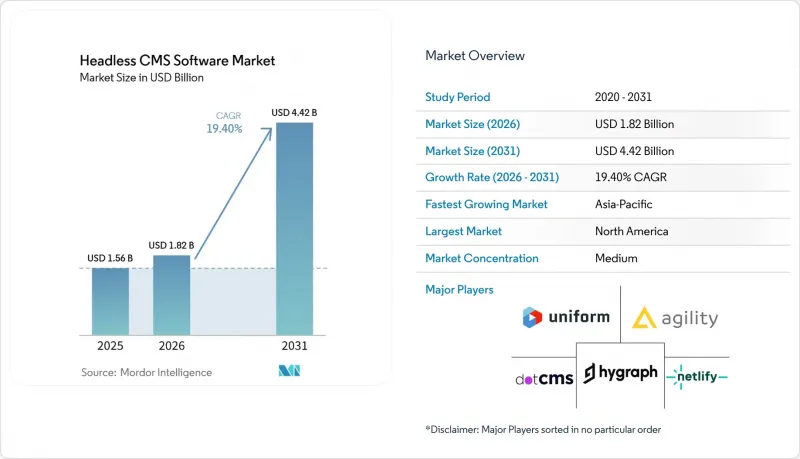
Mordor Intelligence에 의하면, 헤드리스 CMS 소프트웨어 시장 규모는 2025년 15억 6,000만 달러로 평가되었고, 2026년에는 18억 2,000만 달러로 추정되고, 2031년까지 44억 2,000만 달러에 이를 것으로 예상되며, 2026-2031년 CAGR 19.40%로 성장할 전망입니다.
본 보고서는 구성 요소별(소프트웨어 및 서비스), 도입 형태별(클라우드 기반, 온프레미스형, 하이브리드형), 조직 규모별(대기업, 중소기업), 용도별(웹사이트 및 포털 관리, 전자상거래 컨텐츠 관리 등), 최종 사용자 산업별(소매 및 전자상거래 등), 그리고 지역별로 분류되어 있습니다. 시장 전망은 금액(달러) 기준으로 제시되어 있습니다.
세계의 헤드리스 CMS 소프트웨어 시장 동향 및 인사이트
웹, 앱 및 신흥 플랫폼에 걸친 옴니채널 컨텐츠 배포
컨텐츠 운영은 현재 웹사이트를 훨씬 넘어 앱, 키오스크, 웨어러블 기기, 음성 인터페이스, 몰입형 포맷까지 확대되고 있습니다. 2025년 5월에 발표된, 1,300명의 CMS 사용자를 대상으로 한 Storyblok의 ‘State of CMS 2025’ 보고서에 따르면, 컨텐츠 배포 채널에서 가장 큰 증가가 예상되는 것은 AR, VR, 음성 제어 스피커(15%)이며, 그 다음으로 스마트 워치(14%)인 것으로 밝혀졌습니다. 해당 보고서에 따르면, 61%의 팀이 2개 이상의 CMS를 동시에 운영하고 있어, 2025년에도 멀티채널 퍼블리싱이 얼마나 파편화되어 있었는지를 보여주고 있습니다. 헤드리스 모델은 컨텐츠를 한 번 저장한 후, 각 표시 화면마다 컨텐츠 레이어를 재구축하지 않고 API를 통해 각 엔드포인트로 배포함으로써 이러한 부담을 해소합니다. 이는 헤드리스 CMS 소프트웨어 시장에서 중요한 의미를 지닙니다. 왜냐하면 웹이나 모바일의 틀을 넘어 사업을 확장하는 브랜드에게 있어, 페이지 기반 시스템은 실용적인 한계에 다다르고 있으며, 전환은 미래의 선택지라기보다는 운영상의 필요성이 되어가고 있기 때문입니다.
API 우선 및 조합형 아키텍처 도입
기업 소프트웨어 구매 동향은 모듈형 스택으로 전환되고 있으며, 헤드리스 CMS는 이러한 변화의 컨텐츠 계층에 위치하고 있습니다. MACH Alliance의 보고서에 따르면, 가맹 기업의 87%가 MACH 기술을 광범위하게 도입하고 있으며, 도입 기업의 93%가 해당 투자가 ROI 기대치를 충족하거나 초과했다고 응답했습니다. 이러한 추세는 헤드리스 CMS 소프트웨어 시장을 뒷받침하고 있습니다. API 우선 컨텐츠 플랫폼은 개별적으로 선택된 커머스, 개인화, 검색 및 데이터 도구와 자연스럽게 통합되기 때문입니다. 2026년 6월 1일, 세일즈포스가 4,800개 이상의 기업 브랜드에서 사용되고 있는 컴포저블 컨텐츠 플랫폼 ‘Contentful’의 인수를 위한 최종 합의서에 서명한 것은 중요한 신호가 되었습니다. 이 거래는 헤드리스 컨텐츠 인프라가 전문적인 아키텍처 옵션에서 기업 소프트웨어의 핵심 계층으로 전환되고 있음을 보여줍니다.
레거시 시스템 및 데이터 모델과의 통합 복잡성
레거시 CMS 환경은 오래된 데이터 구조를 기반으로 구축된 CRM, PIM, DAM, 분석 및 커머스 플랫폼과 연결되어 있는 경우가 많기 때문에 고립된 시스템인 경우는 드뭅니다. Sanity사의 2025년판 엔터프라이즈 가이드에 따르면, 모놀리식 CMS에서 완전한 헤드리스 환경으로의 표준적인 전환에는 코어 모델 구성 및 통합 연결에 보통 16-24주가 소요된다고 합니다. 따라서 많은 조직에서는 마이그레이션 기간 동안 레거시 시스템과 헤드리스 시스템을 병행하여 운영하고 있으며, 이로 인해 컨텐츠 일관성 문제, 라우팅 충돌, 버전 관리 시스템에 대한 부하가 발생하고 있습니다. 이는 헤드리스 CMS 소프트웨어 시장에 심각한 장벽이 되고 있습니다. 컨텐츠 자산이 가장 풍부한 기업일수록 레거시 스택이 복잡하게 얽혀 있는 경향이 있기 때문입니다. 그 결과, 헤드리스 아키텍처에 대한 장기적인 비즈니스 타당성이 이미 승인된 경우라도 마이그레이션 프로세스는 지연될 수밖에 없습니다.
부문 분석
2025년 헤드리스 CMS 소프트웨어 시장에서 소프트웨어가 70.45%를 차지했으며, 구독형 플랫폼의 수익이 여전히 이 카테고리의 특징을 잘 보여주고 있습니다. 이러한 우위는 핵심 컨텐츠 모델링, API 제공, 워크플로우 제어, 사용자 액세스를 정기적인 라이선스 체계에 통합한 SaaS 네이티브 벤더들에 의해 가져온 것입니다. 기업들은 일반적으로 헤드리스 CMS를 온프레미스 소프트웨어가 아닌 관리형 클라우드 플랫폼으로 구매하기 때문에 대부분의 거래에서 라이선싱이 여전히 첫 번째 상업적 계층을 차지하고 있습니다. 소프트웨어에 대한 수익 집중은 구매자가 통합, 마이그레이션, 운영 지원에 대한 지출을 확대하기 전에 먼저 플랫폼 구독부터 시작하는 경우가 많다는 현실을 반영하기도 합니다. 헤드리스 CMS 소프트웨어 시장에서 실제 제공 범위가 라이선스 자체를 훨씬 초과하는 경우에도, 이러한 추세로 인해 소프트웨어는 벤더의 포지셔닝 중심에 계속 자리 잡고 있습니다.
서비스 부문은 2031년까지 연평균 성장률(CAGR) 22.02%로 확대될 것으로 예측되며, 이 구조 내에서 가장 빠르게 성장하는 구성 요소가 될 것입니다. 이러한 성장 속도는 헤드리스 도입에 필요한 컨텐츠 모델 재설계, 레거시 시스템 마이그레이션, 프론트엔드 구축 및 멀티채널 통합의 복잡성에서 기인합니다. 많은 구매자들은 여전히 컨텐츠를 기존의 페이지 기반 워크플로우에서 분리하고, 웹, 앱, 커머스 환경 전반에 새로운 전달 계층을 구축하는 데 필요한 작업을 과소평가했습니다. 이러한 인식의 격차로 인해, 기업이 플랫폼 구매에서 본격적인 운영으로 전환할 수 있도록 지원할 수 있는 도입 파트너, 관리형 지원 및 아키텍처 전문가에 대한 지속적인 수요가 발생하고 있습니다. 시간이 지남에 따라 기본적인 API 기능의 호환성이 확보되기 쉬워짐에 따라, AI 지원 컨텐츠 모델, 거버넌스 설계 및 다지역 배포와 관련된 서비스가 단순한 기능 목록보다 구매 결정에 더 직접적인 영향을 미치게 될 것입니다.
2025년에는 클라우드 기반 도입이 67.11%의 점유율을 차지한 것으로 평가되었으며, 이는 운영상의 편의성과 유연한 확장성이 여전히 이 시장에서 가장 강력한 기본 이점임을 입증합니다. SaaS를 통한 제공은 인프라 관리 부담을 줄이고 설정 시간을 단축할 뿐만 아니라, 구매자가 기반이 되는 호스팅 환경을 유지할 필요 없이 채널 전반에 걸친 컨텐츠 배포를 지원합니다. 많은 조직에게 이는 여전히 헤드리스 도입을 위한 가장 원활한 경로이며, 사내 IT 팀의 부담을 덜어줍니다. 또한, 클라우드 도입은 대부분의 벤더가 최신 워크플로우, 개인화, 통합 기능을 패키징하는 방식과도 부합합니다. 헤드리스 CMS 소프트웨어 시장에서 이로 인해 더욱 복잡한 거버넌스 요구 사항이 기업의 로드맵을 형성하기 시작했음에도 불구하고, 클라우드는 매출 기준으로 주요 도입 모델이 되었습니다.
하이브리드 배포는 2031년까지 연평균 성장률(CAGR) 21.62%로 확대될 것으로 예상되며, 가장 빠르게 성장하는 제공 모델이 될 전망입니다. 이는 클라우드 네이티브 API의 유연성을 추구하는 한편, 데이터 저장 위치, 스토리지 소재지 또는 컨텐츠 거버넌스에 대해 보다 엄격한 관리가 필요한 기업의 요구를 반영한 것입니다. 정부 기관, 금융 서비스, 의료 분야의 조직은 이 점에서 특히 중요한 위치를 차지하고 있습니다. 일부 컨텐츠는 추가적인 관리 조치 없이는 제3자 퍼블릭 클라우드 환경으로 완전히 이전할 수 없기 때문입니다. 하이브리드 모델은 이러한 사용자에게 실용적인 중간 경로를 제공합니다. 이를 통해 배포 계층이나 통합 기능은 최신 상태를 유지하면서, 특정 컨텐츠나 시스템은 내부 관리 범위 내에 둘 수 있게 됩니다. 따라서 하이브리드 모델의 도입은 일시적인 타협안이 아니라, 규제 대상이나 보안상 중요한 컨텐츠 환경에서 의도적으로 채택되는 운영 모델로서 증가하고 있습니다.
지역별 분석
2025년, 북미는 헤드리스 CMS 소프트웨어 시장에서 36.14%의 점유율을 차지하며 매출 기준 최대 지역 기여자가 되었습니다. 이 지역은 옴니채널 컨텐츠 배포를 단순한 부가 기능이 아닌 경쟁상의 필수 요건으로 여기는 디지털 네이티브 소매업체, 미디어 플레이어, 기술 기업 및 금융 서비스 기관이 밀집해 있다는 점에서 혜택을 받았습니다. 미국은 계속해서 주요 수익원이며, 캐나다와 멕시코는 통합된 컨텐츠 모델을 선호하는 국경을 초월한 디지털 상거래 수요를 통해 시장을 뒷받침했습니다. 조기 도입은 해당 지역의 SaaS 생태계의 강점과 기업 고객의 도입 과정에서 발생할 수 있는 마찰을 완화할 수 있는 전문적인 도입 파트너의 존재도 반영하고 있습니다. 남미의 기여도는 여전히 미미하지만, 모바일 우선 상거래의 성장과 디지털화의 진전으로 인해 구조화된 컨텐츠 시스템 도입의 의의가 더욱 명확해짐에 따라 브라질과 아르헨티나는 계속해서 관심을 보이고 있습니다.
아시아태평양은 2031년까지 연평균 성장률(CAGR) 20.89%로 확대될 것으로 예측되며, 헤드리스 CMS 소프트웨어 시장에서 가장 빠르게 성장하는 지역이 될 전망입니다. 중국, 인도, 일본, 한국이 그 수요의 대부분을 주도하고 있지만, 그 이유는 국가마다 다릅니다. 중국은 대규모 전자상거래 기반과 확장 가능한 API 기반 배포가 필요한 컨텐츠 집약형 디지털 플랫폼이라는 강점을 가지고 있습니다. 인도에서는 JavaScript 및 API 우선 아키텍처에 정통한 대규모 소프트웨어 개발 커뮤니티가 존재하기 때문에 도입이 실질적으로 용이하여 시장에 활력을 불어넣고 있습니다. 호주 및 뉴질랜드도 컴포저블 아키텍처의 광범위한 채택에 따라 강력한 성장세를 보이고 있으며, 한편 한국의 선진적인 엔터프라이즈 기술 환경이 해당 지역의 지속적인 성장을 뒷받침하고 있습니다.
유럽은 헤드리스 CMS 소프트웨어 시장에서 큰 점유율을 차지하고 있지만, 조사 데이터에는 특정 지역별 비율은 명시되어 있지 않습니다. 영국, 독일, 프랑스가 수요의 핵심을 형성하고 있으며, 다국어 퍼블리싱, 접근성, 거버넌스, 그리고 레거시 컨텐츠 환경의 현대화와 같은 요구에 힘입고 있습니다. 특히 독일은 대규모 산업 조직이나 기업 조직이 감사에 대응 가능한 워크플로우와 구조화된 다지역 퍼블리싱을 필요로 하는 시장으로서 두드러집니다. 프랑스에서는 데이터 관리 및 도입 방식의 선택이 중요시되므로, 셀프 호스팅형이나 프라이빗 클라우드 기반 모델에 대한 수용도가 높아지고 있습니다. 한편, 북유럽 국가들과 베네룩스 국가들은 여전히 2차 시장으로서 발전을 이어가고 있습니다. 중동 및 아프리카은 여전히 초기 단계 시장이지만, 아랍에미리트(UAE)와 사우디아라비아에서는 디지털 정부 및 기업용 기술에 대한 투자가 확대되고 있으며, 남아프리카공화국과 나이지리아는 계속해서 이 지역의 초기 수요 기반을 뒷받침하고 있습니다.
기타 혜택 :
- 엑셀 형식 시장 예측(ME) 시트
- 3개월간의 애널리스트 지원
자주 묻는 질문
목차
제1장 서론
제2장 조사 방법
제3장 개요
제4장 시장 구도
제5장 시장 규모 및 성장 예측
제6장 경쟁 구도
제7장 시장 기회 및 향후 전망
AJY 26.09.01According to Mordor Intelligence, the headless CMS software market size is expected to increase from USD 1.56 billion in 2025 to USD 1.82 billion in 2026 and reach USD 4.42 billion by 2031, growing at a CAGR of 19.40% over 2026-2031.
This report is Segmented by Component (Software and Services), Deployment Type (Cloud-Based, On-Premises, and Hybrid), Organization Size (Large Enterprises, and Small and Medium Enterprises), Application (Website and Portal Management, E-Commerce Content Management, and More), End User Industry (Retail and E-Commerce, and More), and Geography. The Market Forecasts are Provided in Terms of Value (USD).
Global Headless CMS Software Market Trends and Insights
Omnichannel Content Delivery across Web, Apps, and Emerging Surfaces
Content operations now extend well beyond websites into apps, kiosks, wearables, voice interfaces, and immersive formats. The Storyblok State of CMS 2025 report, published in May 2025 and based on 1,300 CMS users, found that the biggest planned increases in content delivery channels were AR and VR and voice-activated speakers at 15%, followed by smartwatches at 14%. The same report said 61% of teams operated 2 or more CMSs simultaneously, showing how fragmented multichannel publishing still was in 2025. A headless model addresses this strain by storing content once and distributing it through APIs to each endpoint without rebuilding the content layer for every surface. That matters in the Headless CMS Software Market because brands expanding beyond web and mobile are reaching a practical limit with page-based systems, so migration is becoming an operating need rather than a future preference.
API-First and Composable Architecture Adoption
Enterprise software buying is moving toward modular stacks, and headless CMS sits at the content layer of that shift. The MACH Alliance reported that 87% of member enterprises had widely implemented MACH technologies, and 93% of adopters said their investment met or exceeded ROI expectations. That momentum supports the Headless CMS Software Market because API-first content platforms naturally integrate with commerce, personalization, search, and data tools selected independently. A major signal came on June 1, 2026, when Salesforce signed a definitive agreement to acquire Contentful, a composable content platform used by more than 4,800 enterprise brands. The deal showed that headless content infrastructure is moving from a specialist architecture choice into a core enterprise software layer.
Integration Complexity with Legacy Systems and Data Models
Legacy CMS environments are rarely isolated systems because they are often tied to CRM, PIM, DAM, analytics, and commerce platforms built on older data structures. Sanity's 2025 enterprise guidance said that a standard migration from a monolithic CMS to a fully headless setup typically required 16-24 weeks for core model configuration and integration wiring. Many organizations, therefore, run legacy and headless systems in parallel during migration, which creates content consistency issues, routing conflicts, and strain on version control systems. This is a serious barrier for the Headless CMS Software Market because the enterprises with the largest content estates also tend to have the most entangled legacy stacks. The result is a slower migration path, even when the long-term business case for a headless architecture has already been accepted.
Other drivers and restraints analyzed in the detailed report include:
- Generative AI-Ready Content Operations
- Faster Localization, Governance, and Multiregion Publishing
- Higher Implementation Cost and Technical Skill Requirements
For complete list of drivers and restraints, kindly check the Table Of Contents.
Segment Analysis
Software accounted for 70.45% of the Headless CMS Software Market in 2025, underscoring how subscription-based platform revenue still defines the category. This lead came from SaaS-native vendors that package core content modeling, API delivery, workflow controls, and user access within recurring license structures. Enterprises have generally bought headless CMS as a managed cloud platform rather than as installed software, so licensing remains the first commercial layer in most deals. Revenue concentration in software also reflects how buyers often start with platform subscriptions before they expand spending into integration, migration, and operational support. In the Headless CMS Software Market, this keeps software at the center of vendor positioning even when the real delivery effort extends far beyond the license itself.
Services are projected to expand at a 22.02% CAGR through 2031, making them the fastest-growing component of this structure. The pace is tied to the complexity of content model redesign, legacy migration, frontend buildout, and multichannel integration required by headless deployments. Many buyers still underestimate the work required to decouple content from older page-based workflows and to stand up new delivery layers across web, app, and commerce environments. That gap creates durable demand for implementation partners, managed support, and architecture specialists that can help enterprises move from platform purchase to full-scale operation. Over time, as baseline API capabilities become easier to match, services tied to AI-ready content models, governance design, and multilocale rollout are likely to influence buying decisions more directly than feature checklists alone.
Cloud-based deployment held a 67.11% share in 2025, confirming that operational simplicity and elastic scale remain the strongest default advantages in this market. SaaS delivery reduces infrastructure management, shortens setup time, and supports content distribution across channels without requiring buyers to maintain underlying hosting environments. For many organizations, that is still the cleanest route into headless adoption, as it reduces the burden on internal IT teams. Cloud deployment also aligns with how most vendors package their newest workflow, personalization, and integration features. In the Headless CMS Software Market, this made cloud the leading deployment model by revenue, even as more complex governance demands began to shape enterprise roadmaps.
Hybrid deployment is projected to expand at a 21.62% CAGR through 2031, making it the fastest-growing delivery model. This reflects the needs of enterprises that want cloud-native API flexibility but also need tighter control over data residency, storage location, or content governance. Organizations in government, financial services, and healthcare are especially relevant here because some content cannot be moved fully into third-party public cloud environments without additional controls. Hybrid models give these users a practical middle path, where delivery layers and integrations can remain modern while selected content or systems stay closer to internal control. That is why hybrid adoption is rising not as a temporary compromise, but as a deliberate operating model for regulated and security-sensitive content environments.
Complete Report Scope:
- By Component
- Software
- Services
- By Deployment Type
- Cloud-Based
- On-Premises
- Hybrid
- By Organization Size
- Large Enterprises
- Small and Medium Enterprises
- By Application
- Website and Portal Management
- Mobile and Application Content Management
- E-Commerce Content Management
- Digital Experience Platforms (DXP)
- API-Driven Omnichannel Content Delivery
- By End User Industry
- Retail and E-Commerce
- Media and Publishing
- Banking, Financial Services, and Insurance (BFSI)
- Healthcare and Life Sciences
- IT and Telecommunication
- Government and Public Administration
- Travel and Hospitality
- Other End User Industries
- By Geography
- North America
- United States
- Canada
- Mexico
- South America
- Brazil
- Argentina
- Rest of South America
- Europe
- Germany
- United Kingdom
- France
- Italy
- Spain
- Russia
- Rest of Europe
- Asia-Pacific
- China
- Japan
- India
- South Korea
- Australia and New Zealand
- Rest of Asia-Pacific
- Middle East
- Saudi Arabia
- United Arab Emirates
- Turkey
- Rest of Middle East
- Africa
- South Africa
- Nigeria
- Rest of Africa
- North America
Geography Analysis
North America held a 36.14% share of the Headless CMS Software Market in 2025, making it the largest regional contributor by revenue. The region benefited from a dense base of digital-native retailers, media companies, technology firms, and financial services organizations that treat omnichannel content delivery as a competitive requirement rather than a side capability. The United States remained the main revenue center, while Canada and Mexico added support through cross-border digital commerce needs that favor unified content models. Early adoption also reflected the strength of the regional SaaS ecosystem and the availability of specialist implementation partners that can reduce deployment friction for enterprise buyers. South America remained a smaller contributor, but Brazil and Argentina continued to show interest as mobile-first commerce growth and digital modernization created a clearer case for structured content systems.
Asia-Pacific is projected to expand at a 20.89% CAGR through 2031, making it the fastest-growing region in the Headless CMS Software Market. China, India, Japan, and South Korea are driving most of that demand, although the reasons differ by country. China benefits from a large e-commerce base and content-intensive digital platforms that require scalable API-driven delivery. India adds momentum through a large software development community that is comfortable with JavaScript and API-first architectures, making adoption easier to implement in practice. Australia and New Zealand also show strong movement in line with broader composable architecture adoption, while South Korea's advanced enterprise technology environment supports continued regional growth.
Europe holds a significant share of the Headless CMS Software Market, even though the input does not assign a single regional percentage. The United Kingdom, Germany, and France form the core of demand, supported by needs around multilingual publishing, accessibility, governance, and modernization of legacy content environments. Germany stands out as a market where large industrial and enterprise organizations need audit-ready workflows and structured multiregion publishing. France remains receptive to self-hosted and private-cloud models where data control and deployment choice are important, while the Nordics and Benelux continue to develop as secondary markets. The Middle East and Africa remain early-stage markets, but the UAE and Saudi Arabia are seeing greater investment in digital government and enterprise technology, while South Africa and Nigeria continue to anchor the region's early demand base.
- Contentful GmbH
- Contentstack Inc.
- Sanity AS
- Strapi SAS
- Hygraph GmbH
- Agility Inc.
- ButterCMS, LLC
- Prismic.io SAS
- DatoCMS S.r.l.
- DotCMS LLC
- Crownpeak Technology, Inc.
- Kentico Software s.r.o.
- Kontent.ai, Inc.
- Magnolia International Ltd.
- Bloomreach, Inc.
- Directus, Inc.
- Uniform Systems, Inc.
- Ghost Foundation
- Netlify, Inc.
- Liferay, Inc.
Additional Benefits:
- The market estimate (ME) sheet in Excel format
- 3 months of analyst support
TABLE OF CONTENTS
1 INTRODUCTION
- 1.1 Study Assumptions and Market Definition
- 1.2 Scope of the Study
2 RESEARCH METHODOLOGY
3 EXECUTIVE SUMMARY
4 MARKET LANDSCAPE
- 4.1 Market Overview
- 4.2 Market Drivers
- 4.2.1 Omnichannel Content Delivery Across Web, Apps, and Emerging Surfaces
- 4.2.2 API-First and Composable Architecture Adoption
- 4.2.3 Generative AI-Ready Content Operations
- 4.2.4 Faster Localization, Governance, and Multiregion Publishing
- 4.2.5 Security, Performance, and Developer Autonomy Versus Monolithic CMS
- 4.2.6 Low-Code Content Operations for Mid-Market Adoption
- 4.3 Market Restraints
- 4.3.1 Integration Complexity With Legacy Systems and Data Models
- 4.3.2 Higher Implementation Cost and Technical Skill Requirements
- 4.3.3 Governance Burden Across Distributed APIs and Workflows
- 4.3.4 Vendor Lock-In Risk From Platform-Specific Extensions and Hosting
- 4.4 Industry Value Chain Analysis
- 4.5 Impact of Macroeconomic Factors on the Market
- 4.6 Technology Outlook
- 4.7 Regulatory Landscape
- 4.8 Porter's Five Forces Analysis
- 4.8.1 Threat of New Entrants
- 4.8.2 Bargaining Power of Suppliers
- 4.8.3 Bargaining Power of Buyers
- 4.8.4 Threat of Substitutes
- 4.8.5 Competitive Rivalry
5 MARKET SIZE AND GROWTH FORECASTS (VALUE)
- 5.1 By Component
- 5.1.1 Software
- 5.1.2 Services
- 5.2 By Deployment Type
- 5.2.1 Cloud-Based
- 5.2.2 On-Premises
- 5.2.3 Hybrid
- 5.3 By Organization Size
- 5.3.1 Large Enterprises
- 5.3.2 Small and Medium Enterprises
- 5.4 By Application
- 5.4.1 Website and Portal Management
- 5.4.2 Mobile and Application Content Management
- 5.4.3 E-Commerce Content Management
- 5.4.4 Digital Experience Platforms (DXP)
- 5.4.5 API-Driven Omnichannel Content Delivery
- 5.5 By End User Industry
- 5.5.1 Retail and E-Commerce
- 5.5.2 Media and Publishing
- 5.5.3 Banking, Financial Services, and Insurance (BFSI)
- 5.5.4 Healthcare and Life Sciences
- 5.5.5 IT and Telecommunication
- 5.5.6 Government and Public Administration
- 5.5.7 Travel and Hospitality
- 5.5.8 Other End User Industries
- 5.6 By Geography
- 5.6.1 North America
- 5.6.1.1 United States
- 5.6.1.2 Canada
- 5.6.1.3 Mexico
- 5.6.2 South America
- 5.6.2.1 Brazil
- 5.6.2.2 Argentina
- 5.6.2.3 Rest of South America
- 5.6.3 Europe
- 5.6.3.1 Germany
- 5.6.3.2 United Kingdom
- 5.6.3.3 France
- 5.6.3.4 Italy
- 5.6.3.5 Spain
- 5.6.3.6 Russia
- 5.6.3.7 Rest of Europe
- 5.6.4 Asia-Pacific
- 5.6.4.1 China
- 5.6.4.2 Japan
- 5.6.4.3 India
- 5.6.4.4 South Korea
- 5.6.4.5 Australia and New Zealand
- 5.6.4.6 Rest of Asia-Pacific
- 5.6.5 Middle East
- 5.6.5.1 Saudi Arabia
- 5.6.5.2 United Arab Emirates
- 5.6.5.3 Turkey
- 5.6.5.4 Rest of Middle East
- 5.6.6 Africa
- 5.6.6.1 South Africa
- 5.6.6.2 Nigeria
- 5.6.6.3 Rest of Africa
- 5.6.1 North America
6 COMPETITIVE LANDSCAPE
- 6.1 Market Concentration
- 6.2 Strategic Moves
- 6.3 Market Share Analysis
- 6.4 Company Profiles (includes Global Level Overview, Market Level Overview, Core Segments, Financials as available, Strategic Information, Market Rank/Share, Products and Services, Recent Developments)
- 6.4.1 Contentful GmbH
- 6.4.2 Contentstack Inc.
- 6.4.3 Sanity AS
- 6.4.4 Strapi SAS
- 6.4.5 Hygraph GmbH
- 6.4.6 Agility Inc.
- 6.4.7 ButterCMS, LLC
- 6.4.8 Prismic.io SAS
- 6.4.9 DatoCMS S.r.l.
- 6.4.10 DotCMS LLC
- 6.4.11 Crownpeak Technology, Inc.
- 6.4.12 Kentico Software s.r.o.
- 6.4.13 Kontent.ai, Inc.
- 6.4.14 Magnolia International Ltd.
- 6.4.15 Bloomreach, Inc.
- 6.4.16 Directus, Inc.
- 6.4.17 Uniform Systems, Inc.
- 6.4.18 Ghost Foundation
- 6.4.19 Netlify, Inc.
- 6.4.20 Liferay, Inc.
7 MARKET OPPORTUNITIES AND FUTURE OUTLOOK
- 7.1 White-Space and Unmet-Need Assessment


