

|
시장보고서
상품코드
2118222
부틸 고무 시장 : 시장 점유율 분석, 업계 동향 및 통계, 성장 예측(2026-2031년)Butyl Rubber - Market Share Analysis, Industry Trends & Statistics, Growth Forecasts (2026 - 2031) |
||||||
 Mordor Intelligence
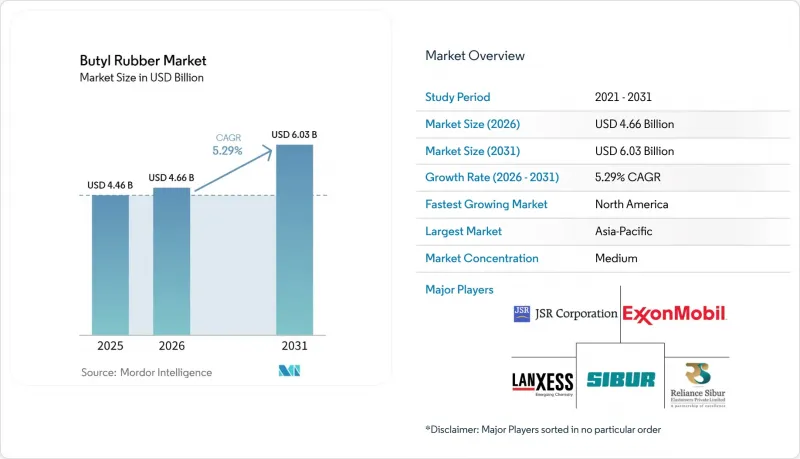
Mordor Intelligence에 의하면, 부틸 고무 시장 규모는 2025년 44억 6,000만 달러로 평가되었고, 2026년 46억 6,000만 달러에서 2031년까지 60억 3,000만 달러로 확대될 것으로 예측되며, 2026-2031년 CAGR 5.29%를 나타낼 전망입니다.
본 보고서는 유형별(일반 부틸 고무(IIR), 클로로부틸 고무(CIIR), 브로모부틸 고무(BIIR)), 용도별(타이어 제조, 의료 및 제약 등), 최종 사용자 산업별(자동차, 소비재 등), 지역별(아시아태평양, 북미, 유럽, 남미, 중동 및 아프리카)로 분류되어 있습니다. 시장 예측은 금액(달러) 기준으로 제시되어 있습니다.
세계의 부틸 고무 시장 동향 및 인사이트
전기차(EV) 보급 확대가 고성능 부틸 고무 타이어 수요를 견인
배터리식 전기차는 배터리 팩으로 인해 차량 중량이 증가하고 에어 배리어 층에 부하가 가해지기 때문에 내연기관 차량에 비해 타이어의 내층 라이너에 더 높은 성능이 요구됩니다. 또한, 순간 토크는 라이너 접합부의 마모를 가속화할 가능성이 있어, 자동차 제조업체와 타이어 공급업체에게 내구성이 뛰어난 컴파운드가 점점 더 중요해지고 있습니다. 엑슨모빌에 따르면, 고성능 할로부틸 라이너는 공기 유지 성능 향상으로 전기차용 타이어의 수명을 최대 17%까지 연장할 수 있다고 합니다. 이러한 성능 요구 사항 증가로 인해 신형 전기차용 타이어 사양에서 브로모부틸 및 클로로부틸 컴파운드의 사용이 증가하고 있습니다. 그 결과, 부틸 고무 시장에서는 프리미엄 타이어 프로그램에서 표준 IIR(아이언 내층 고무)에서 점차 전환이 진행되고 있습니다. 또한, 전기차 1대당 재료 사용량 증가에 따라 자동차 생산 대수 증가와 부틸 고무 시장 전체에서 특수 내부 라이너용 컴파운드에 대한 수요 증가가 연동되고 있습니다.
의약품용 캡 및 무균 포장 용도에서의 부틸고무 이용 확대
부틸 고무는 기체 투과성이 낮고, 멸균 내성이 뛰어나며, 바늘이 관통한 후 재밀봉이 가능하기 때문에 주사용 의약품의 스토퍼, 플런저 부품 및 바늘 실드에 사용되고 있습니다. 또한, 의약품용 밀폐재는 추출물, 용출물 및 치수 안정성에 관한 엄격한 요건을 충족해야 합니다. 인간용 의약품의 기술 요건 조화에 관한 국제 협의회(ICH)가 제시한 추출물 및 용출물에 관한 Q3E 가이드라인 초안은 2025년 8월에 승인되었으며, 엘라스토머 재질의 용기 및 밀봉 시스템과의 관련성을 포함하여 공개 의견 수렴이 시작되었습니다. 이 과정을 통해 의약품 등급 소재의 신규 공급업체에 대한 문서화 및 시험 요건이 강화될 것입니다. 적합성 평가 작업에는 6-12개월이 소요되므로, 기존 기술 기록이나 고객의 승인을 이미 보유하고 있는 제조업체가 유리한 입장에 서게 됩니다. 부틸 고무 시장은 바이오의약품, 바이오시밀러 및 프리필드 주사기의 성장에 힘입고 있지만, 신규 공급업체가 이 용도에 진입하는 것은 여전히 어려운 상황입니다.
이소부틸렌 및 석유화학 원료 가격 변동이 생산 비용에 영향을 미치고 있습니다.
이소부틸렌은 모든 등급의 부틸 고무를 제조하는 데 사용되는 주요 원료이므로, 원유 및 정제 사업의 경제 상황 변화가 생산자의 비용에 영향을 미칩니다. 일체형 생산 체계를 갖춘 제조업체는 공개 시장에서 원료를 구매하는 공급업체보다 이러한 위험을 더 효과적으로 관리할 수 있습니다. 본 조사 보고서는 투입 비용이 완제품 가격보다 급격히 상승할 경우, 가격 변동으로 인해 이익률이 압박받을 가능성이 있다고 지적하고 있습니다. 이러한 위험은 업스트림 부문의 일괄 생산 체제를 갖추지 못한 아시아, 북미, 유럽의 중규모 생산자들에게 더욱 심각합니다. 또한, 중국공급 증가로 인해 일부 공급업체가 비용 상승분을 고객에게 전가할 수 있는 능력도 약화되고 있습니다. 따라서 기존 시장이나 신흥 시장에서 타이어나 의약품에 대한 수요가 확대되고 있는 경우에도, 부틸고무 시장은 여전히 원자재 가격 변동에 민감한 상황에 놓여 있습니다.
부문 분석
2025년 시점에서 일반 부틸 고무(IIR)는 부틸고무 시장 점유율의 49.62%를 차지했으나, 브로모부틸고무(BIIR)는 2026년부터 2031년에 걸쳐 연평균 성장률(CAGR) 6.18%를 나타낼 것으로 예측됩니다. IIR이 이러한 주도적인 위치를 유지할 수 있었던 것은 타이어 내부 튜브, 진동 댐퍼, 케이블 절연체, 산업용 호스, 츄잉껌 베이스 등에서의 용도가 확립되어 있기 때문입니다. 이러한 용도에서 낮은 기체 투과성과 내화학성은 여전히 중요한 요소로 작용하고 있습니다. 일반 IIR 부틸 고무 시장 규모는 여전히 타이어 생산량과 일반 산업 수요에 크게 좌우되고 있습니다. 프리미엄 타이어 설계에서는 더 빠른 가황과 인접 컴파운드와의 높은 호환성이 요구되기 때문에 할로겐화 등급으로의 전환이 서서히 진행되고 있습니다.
브로모부틸 고무는 전기차용 타이어 사양, 프리미엄 OEM 프로그램, 그리고 천연 고무 트레드 컴파운드와의 공가황 성능 덕분에 수요가 확대되고 있습니다. 엑슨모빌의 ‘Exxpro’ 브로모부틸 이오노머 시리즈와 ARLANXEO의 ‘X_Butyl BB’ 시리즈는 승인 주기에 수년이 소요되는 성능 중심의 용도에 대응하고 있습니다. 이러한 인증 주기는 승인된 타이어 설계에서 기존 공급업체가 급격히 대체되는 것을 방지하는 역할을 합니다. CIIR은 제약용 캡 제조에서 다른 역할을 수행합니다. 이 분야에서는 자동화된 공정에서 치수 재현성과 낮은 추출물 프로파일이 요구됩니다. 할로겐화 등급 제품 라인업을 강화한 공급업체는 성장세가 빠르고 전문성이 높은 수요를 확보할 수 있습니다. 반면, 범용 IIR에만 집중하는 공급업체는 지역별 생산 능력 확대나 경쟁으로 인한 큰 압박에 직면하게 될 것입니다.
지역별 분석
2025년, 아시아태평양은 전 세계 수요의 46.37%를 차지했으며, 이 지역은 세계 1위의 위치를 점하고 있습니다. 중국이 특정 수입 할로겐화 부틸 고무에 부과하는 관세는 현지 조달을 촉진하고, 일부 해외 공급업체 시장 진입을 제한하고 있습니다. Reliance Sibur Elastomers의 잠나가르 공장은 일반 부틸 고무의 연간 생산 능력이 120킬로톤(ktpa), 할로겐화 부틸 고무의 생산 능력이 60 ktpa로, 인도의 국내 공급 체계를 강화하고 있습니다. 또한, 인도의 타이어 생산 능력 확충도 내부 라이너 소재의 소비 확대를 뒷받침하고 있습니다. 일본과 한국은 특히 중국 이외 시장에서 고품질 할로겐화 부틸 고무 수출 분야의 입지를 유지하고 있습니다. 이러한 지역 구성으로 인해 부틸 고무 시장은 타이어 수요에 따른 대량 수요, 확대되는 현지 공급, 그리고 무역 보호 조치의 중요한 역할이라는 특징을 가지고 있습니다.
북미는 2031년까지 연평균 성장률(CAGR) 6.53%를 나타낼 것으로 예측되며, 이는 지역별 부문 중 가장 높은 성장률입니다. 의약품 포장 수요와 전기차용 타이어 요구 사항이 이 지역의 부틸 고무 시장을 뒷받침하는 주요 요인이 되고 있습니다. 또한, 이 지역은 타이어 제조업체, 제약사 및 특수 소재 개발 활동이 인접해 있다는 이점도 누리고 있습니다. 엑슨모빌의 제품 포트폴리오는 전기차 용도를 포함하여 자동차 업계 고객이 요구하는 타이어 내부 라이너 사양을 충족하고 있습니다. 유럽 수요는 지역 내 공급이 비교적 제한적임에도 불구하고, 의약품 포장 및 프리미엄 타이어의 사양에 의해 뒷받침되고 있습니다. 그 결과, 유럽의 구매자들은 특수 등급 및 신뢰할 수 있는 공급 체계를 더욱 중시하고 있습니다.
남미, 중동 및 아프리카는 여전히 소규모 시장이지만, 각각 고유한 수요 상황을 보이고 있습니다. 공급되는 소재를 통해 브라질의 산업용 고무 기반 시설에 대한 지속적인 투자가 확인되고 있으며, 이는 자동차 및 건설 활동에서 발생하는 수요와 일치합니다. 브라질의 자동차 및 건설 활동은 타이어, 씰, 관련 고무 제품의 현지 소비를 뒷받침하고 있습니다. 중동에서는 통합형 석유화학 자산이 업스트림 원료 공급을 뒷받침하는 한편, 건설 투자가 방수막 및 접착용 실란트 수요를 지탱하고 있습니다. 아프리카 수요는 여전히 소규모이지만, 도시화, 인프라 투자 및 자동차 보급과 밀접한 관련이 있습니다. 이러한 지역들은 부틸 고무 시장에 추가적인 판매처를 제공하고 있지만, 그 규모는 아시아태평양, 북미, 유럽에 미치지 못하며 수요 집중도도 여전히 낮은 상태입니다.
기타 혜택 :
- 엑셀 형식 시장 예측(ME) 시트
- 3개월간의 애널리스트 지원
자주 묻는 질문
목차
제1장 서론
제2장 조사 방법
제3장 개요
제4장 시장 구도
제5장 시장 규모 및 성장 예측
제6장 경쟁 구도
제7장 시장 기회 및 향후 전망
AJY 26.09.01According to Mordor Intelligence, the butyl rubber market size is projected to expand from USD 4.46 billion in 2025 and USD 4.66 billion in 2026 to USD 6.03 billion by 2031, and is expected to register a CAGR of 5.29% between 2026 and 2031.
This report is Segmented by Type (Regular Butyl Rubber (IIR), Chlorobutyl Rubber (CIIR), and Bromobutyl Rubber (BIIR)), Application (Tire Manufacturing, Medical and Pharmaceutical, and More), End-User Industry (Automotive, Consumer Goods, and More), and Geography (Asia-Pacific, North America, Europe, South America, and Middle-East and Africa). The Market Forecasts are Provided in Terms of Value (USD).
Global Butyl Rubber Market Trends and Insights
Increasing EV Adoption Driving Demand for High-Performance Butyl Rubber Tires
Battery electric vehicles place greater demands on tire inner liners than internal-combustion vehicles because battery packs increase vehicle weight and stress the air-barrier layer. Instant torque can also increase wear at liner junctions, making durable compounds more important for vehicle manufacturers and tire suppliers. Exxon Mobil states that high-performance halobutyl inner liners can extend electric-car tire life by up to 17% through improved air retention. This performance need is increasing the use of bromobutyl and chlorobutyl compounds in new electric vehicle tire specifications. The butyl rubber market, therefore, faces a gradual shift away from standard IIR in premium tire programs. Higher material use per electric vehicle also links growth in vehicle production with greater demand for specialized inner-liner compounds across the butyl rubber market.
Rising Use of Butyl Rubber in Pharmaceutical Closures and Sterile Packaging Applications
Butyl rubber is used in stoppers, plunger components, and needle shields for injectable medicines because it offers low gas permeability, sterilization resistance, and resealing after needle penetration. Pharmaceutical closures must also meet demanding requirements for extractables, leachables, and dimensional consistency. The International Council for Harmonisation of Technical Requirements for Pharmaceuticals for Human Use (ICH) Q3E draft guideline for extractables and leachables was endorsed in August 2025 and opened for public consultation, including its relevance to elastomeric container-closure systems. This process raises the documentation and testing requirements for new suppliers of pharmaceutical-grade material. Qualification work can take 6 to 12 months, which supports the position of producers with existing technical records and customer approvals. The butyl rubber market benefits from growth in biologics, biosimilars, and prefilled syringes, although entry into this application remains difficult for new suppliers.
Volatility in Isobutylene and Petrochemical Feedstock Prices Affecting Production Costs
Isobutylene is the main feedstock used to produce all butyl rubber grades, so changes in crude oil and refining economics affect producer costs. Integrated producers can manage this exposure better than suppliers that buy feedstock on the open market. The supplied research notes that price changes can compress margins when input costs rise faster than finished-product prices. This risk is more severe for mid-scale producers in Asia, North America, and Europe that do not have integrated upstream operations. Chinese supply additions have also reduced the ability of some suppliers to pass higher costs to customers. The butyl rubber market, therefore, remains sensitive to feedstock cycles even where tire and pharmaceutical demand is growing in established and emerging regions.
Other drivers and restraints analyzed in the detailed report include:
- Growing Adoption of Halobutyl Rubber in High-Performance and Premium Tire Manufacturing
- Expansion of Tire Manufacturing Capacity Across Asia-Pacific Supporting Market Growth
- Limited Recycling Infrastructure and Challenges in Processing for Halogenated Butyl Rubber Waste
For complete list of drivers and restraints, kindly check the Table Of Contents.
Segment Analysis
Regular Butyl Rubber (IIR) held 49.62% of the butyl rubber market share in 2025, while Bromobutyl Rubber (BIIR) is forecast to grow at a 6.18% CAGR from 2026 to 2031. IIR retained this leading position because it has established uses in tire inner tubes, vibration dampers, cable insulation, industrial hoses, and chewing gum base. Its low gas permeability and chemical resistance remain important across these applications. The butyl rubber market size for regular IIR continues to depend heavily on tire volume and general industrial demand. Premium tire designs are gradually moving toward halogenated grades where faster curing and stronger compatibility with adjacent compounds are needed.
Bromobutyl Rubber is gaining from electric vehicle tire specifications, premium original-equipment programs, and its co-vulcanization performance with natural-rubber tread compounds. Exxon Mobil's Exxpro bromobutyl ionomer range and ARLANXEO's X_Butyl BB range address performance-focused applications where approval cycles can take several years. These qualification cycles help protect established suppliers from rapid replacement in approved tire designs. CIIR serves a different role in pharmaceutical closure production, where automated processes require repeatable dimensions and low extractable profiles. Suppliers that improve their mix of halogenated grades can access faster-growing and more specialized demand. Suppliers focused only on commodity IIR face greater pressure from regional capacity additions and price competition.
Complete Report Scope:
- By Type
- Regular Butyl Rubber (IIR)
- Chlorobutyl Rubber (CIIR)
- Bromobutyl Rubber (BIIR)
- By Application
- Tire Manufacturing
- Medical and Pharmaceutical
- Adhesives and Sealants
- Hoses and Belts
- Protective Clothing and Industrial Products
- Roofing and Waterproofing Membranes
- Other Applications
- By End-User Industry
- Automotive
- Pharmaceutical and Healthcare
- Construction
- Industrial Manufacturing
- Consumer Goods
- Other End-user Industry
- By Geography
- Asia-Pacific
- China
- India
- Japan
- South Korea
- Rest of Asia-Pacific
- North America
- United States
- Canada
- Mexico
- Europe
- Germany
- United Kingdom
- France
- Italy
- Russia
- Rest of Europe
- South America
- Brazil
- Argentina
- Rest of South America
- Middle-East and Africa
- Saudi Arabia
- South Africa
- Rest of Middle-East and Africa
- Asia-Pacific
Geography Analysis
Asia-Pacific held 46.37% of global demand in 2025, giving the region the leading position worldwide. China's duties on selected imported halogenated butyl rubber support local sourcing and limit access for some foreign suppliers. Reliance Sibur Elastomers' Jamnagar facility has 120 kilotons per annum (ktpa) of regular butyl capacity and 60 ktpa of halobutyl capacity, strengthening India's domestic supply position. India's tire capacity additions also support higher consumption of inner-liner materials. Japan and South Korea retain positions in premium halobutyl exports, particularly for markets outside China. This regional mix gives the butyl rubber market high-volume tire demand, growing local supply, and an important role for trade protection.
North America is forecast to grow at a 6.53% CAGR through 2031, the fastest rate among the geographic segments. Pharmaceutical packaging demand and electric vehicle tire requirements provide the principal support for the butyl rubber market in the region. The region also benefits from proximity between tire makers, pharmaceutical producers, and specialty-material development activity. Exxon Mobil's product portfolio addresses tire inner-liner requirements for automotive customers, including electric vehicle applications. European demand is supported by pharmaceutical packaging and premium tire specifications, despite a more limited regional supply. European buyers consequently place greater value on specialized grades and dependable supply arrangements.
South America and Middle-East and Africa remain smaller markets, but each has distinct demand conditions. The supplied material identifies continued investment in Brazil's industrial-rubber base, which is consistent with demand from automotive and construction activity. Brazil's automotive and construction activity supports local consumption of tires, seals, and related rubber products. In the Middle East, integrated petrochemical assets can support upstream feedstock availability, while construction investment supports waterproofing membranes and adhesive sealants. African demand remains smaller and is linked to urbanization, infrastructure investment, and vehicle adoption. These regions provide additional outlets for the butyl rubber market, although their scale remains below that of Asia-Pacific, North America, and Europe, and their demand is less concentrated.
- ARLANXEO
- China Petrochemical Corporation
- Denka Elastlution Co., Ltd.
- ENEOS Materials Corporation
- Exxon Mobil Corporation
- Formosa Synthetic Rubber (Ningbo) Corporation Limited
- JSR Corporation
- Kumho Petrochemical Co., Ltd.
- LANXESS
- Reliance Sibur Elastomers Private Limited
- SABIC
- SIBUR Holding PJSC
- Zeon Corporation
- Zhejiang Cenway Materials Co., Ltd.
Additional Benefits:
- The market estimate (ME) sheet in Excel format
- 3 months of analyst support
TABLE OF CONTENTS
1 Introduction
- 1.1 Study Assumptions and Market Definition
- 1.2 Scope of the Study
2 Research Methodology
3 Executive Summary
4 Market Landscape
- 4.1 Market Overview
- 4.2 Market Drivers
- 4.2.1 Increasing Adoption of Electric Vehicles Boosting Demand for High-Performance Butyl Rubber Tires
- 4.2.2 Rising Use of Butyl Rubber in Pharmaceutical Closures and Sterile Packaging Applications
- 4.2.3 Growing Adoption of Halobutyl Rubber in High-Performance and Premium Tire Manufacturing
- 4.2.4 Expansion of Tire Manufacturing Capacity Across Asia-Pacific Supporting Market Growth
- 4.2.5 Increasing Demand for Butyl Rubber in Adhesives, Sealants, and Construction Applications
- 4.3 Market Restraints
- 4.3.1 Volatility in Isobutylene and Petrochemical Feedstock Prices Affecting Production Costs
- 4.3.2 Limited Recycling Infrastructure and Challenges in Processing Halogenated Butyl Rubber Waste
- 4.3.3 Stringent Regulatory Approval and Lengthy Qualification Processes for Pharmaceutical-Grade Butyl Rubber
- 4.4 Value Chain Analysis
- 4.5 Porter's Five Forces Analysis
- 4.5.1 Threat of New Entrants
- 4.5.2 Bargaining Power of Suppliers
- 4.5.3 Bargaining Power of Buyers
- 4.5.4 Threat of Substitutes
- 4.5.5 Competitive Rivalry
5 Market Size and Growth Forecasts (Value)
- 5.1 By Type
- 5.1.1 Regular Butyl Rubber (IIR)
- 5.1.2 Chlorobutyl Rubber (CIIR)
- 5.1.3 Bromobutyl Rubber (BIIR)
- 5.2 By Application
- 5.2.1 Tire Manufacturing
- 5.2.2 Medical and Pharmaceutical
- 5.2.3 Adhesives and Sealants
- 5.2.4 Hoses and Belts
- 5.2.5 Protective Clothing and Industrial Products
- 5.2.6 Roofing and Waterproofing Membranes
- 5.2.7 Other Applications
- 5.3 By End-User Industry
- 5.3.1 Automotive
- 5.3.2 Pharmaceutical and Healthcare
- 5.3.3 Construction
- 5.3.4 Industrial Manufacturing
- 5.3.5 Consumer Goods
- 5.3.6 Other End-user Industry
- 5.4 By Geography
- 5.4.1 Asia-Pacific
- 5.4.1.1 China
- 5.4.1.2 India
- 5.4.1.3 Japan
- 5.4.1.4 South Korea
- 5.4.1.5 Rest of Asia-Pacific
- 5.4.2 North America
- 5.4.2.1 United States
- 5.4.2.2 Canada
- 5.4.2.3 Mexico
- 5.4.3 Europe
- 5.4.3.1 Germany
- 5.4.3.2 United Kingdom
- 5.4.3.3 France
- 5.4.3.4 Italy
- 5.4.3.5 Russia
- 5.4.3.6 Rest of Europe
- 5.4.4 South America
- 5.4.4.1 Brazil
- 5.4.4.2 Argentina
- 5.4.4.3 Rest of South America
- 5.4.5 Middle-East and Africa
- 5.4.5.1 Saudi Arabia
- 5.4.5.2 South Africa
- 5.4.5.3 Rest of Middle-East and Africa
- 5.4.1 Asia-Pacific
6 Competitive Landscape
- 6.1 Market Concentration
- 6.2 Strategic Moves
- 6.3 Market Share (%)/Ranking Analysis
- 6.4 Company Profiles (includes Global Overview, Market Overview, Core Segments, Financials as available, Strategic Information, Products and Services, and Recent Developments)
- 6.4.1 ARLANXEO
- 6.4.2 China Petrochemical Corporation
- 6.4.3 Denka Elastlution Co., Ltd.
- 6.4.4 ENEOS Materials Corporation
- 6.4.5 Exxon Mobil Corporation
- 6.4.6 Formosa Synthetic Rubber (Ningbo) Corporation Limited
- 6.4.7 JSR Corporation
- 6.4.8 Kumho Petrochemical Co., Ltd.
- 6.4.9 LANXESS
- 6.4.10 Reliance Sibur Elastomers Private Limited
- 6.4.11 SABIC
- 6.4.12 SIBUR Holding PJSC
- 6.4.13 Zeon Corporation
- 6.4.14 Zhejiang Cenway Materials Co., Ltd.
7 Market Opportunities and Future Outlook
- 7.1 White-Space and Unmet-Need Assessment


